
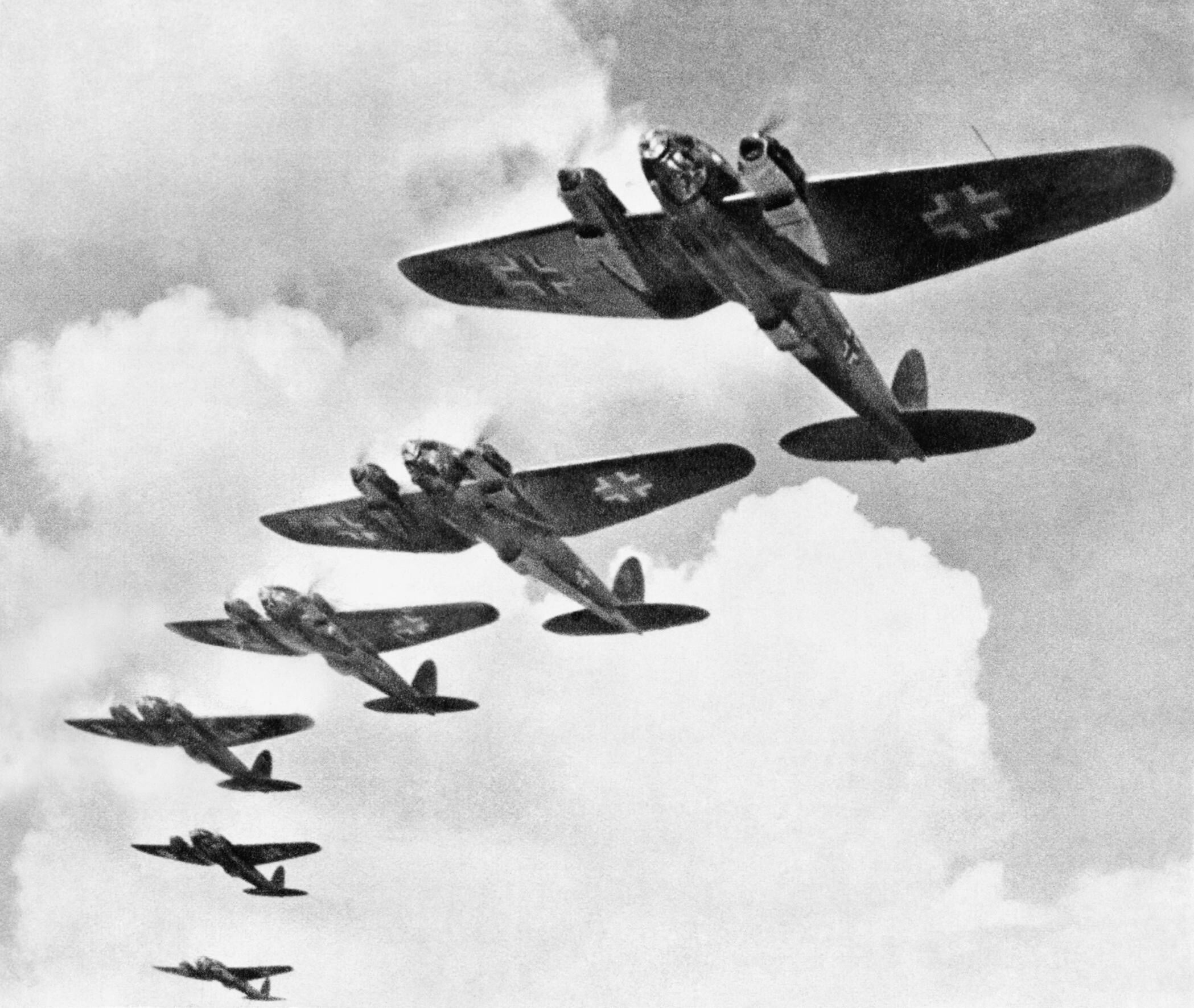
Heinkel He 111
One of the most recognisable aircraft of the Second World War — a medium bomber with a fully-glazed “greenhouse” nose that began life disguised as an airliner, formed the backbone of the Luftwaffe’s bomber arm, and was still being built under licence in Spain decades after 1945.
The Heinkel He 111: the airliner that was always a bomber
When the Heinkel He 111 was unveiled in 1935, Germany presented it to the world as a fast ten-passenger airliner for the state airline Lufthansa. It was nothing of the sort. Designed by the brothers Siegfried and Walter Günter at Ernst Heinkel’s works at Rostock-Marienehe, the aircraft was conceived from the start with a bomber in mind — a way to build combat aircraft while the Treaty of Versailles still formally barred Germany from having an air force. A handful did fly brief commercial routes; the great majority became bombers as soon as the Luftwaffe was openly rearming.
The type was blooded in the Spanish Civil War, where He 111B bombers of the German Condor Legion flew for the Nationalist side from 1937. They were fast enough that opposing fighters rarely caught them, and losses were low — a result that led German planners to a conclusion that would later prove costly: that a fast bomber needed little defensive armament. The definitive versions that followed — the He 111P and the mass-produced He 111H — adopted the aircraft’s signature feature: a smoothly rounded, fully-glazed and slightly asymmetric nose in place of the earlier stepped cockpit, giving the bombardier and pilot an almost uninterrupted forward view.
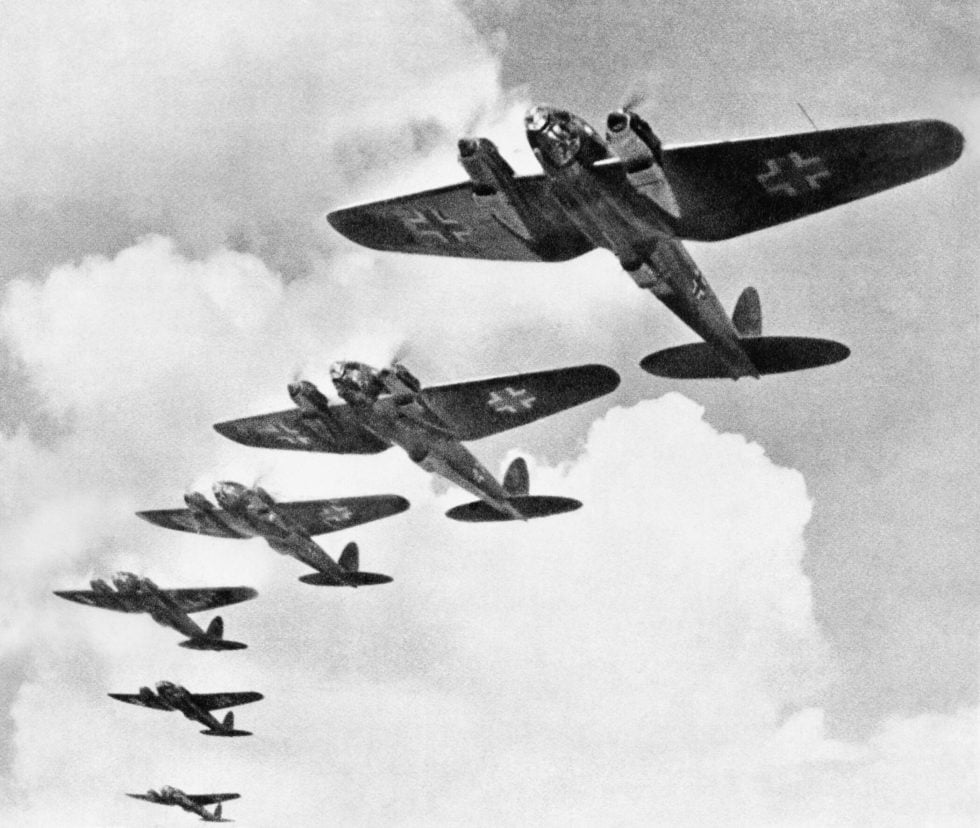
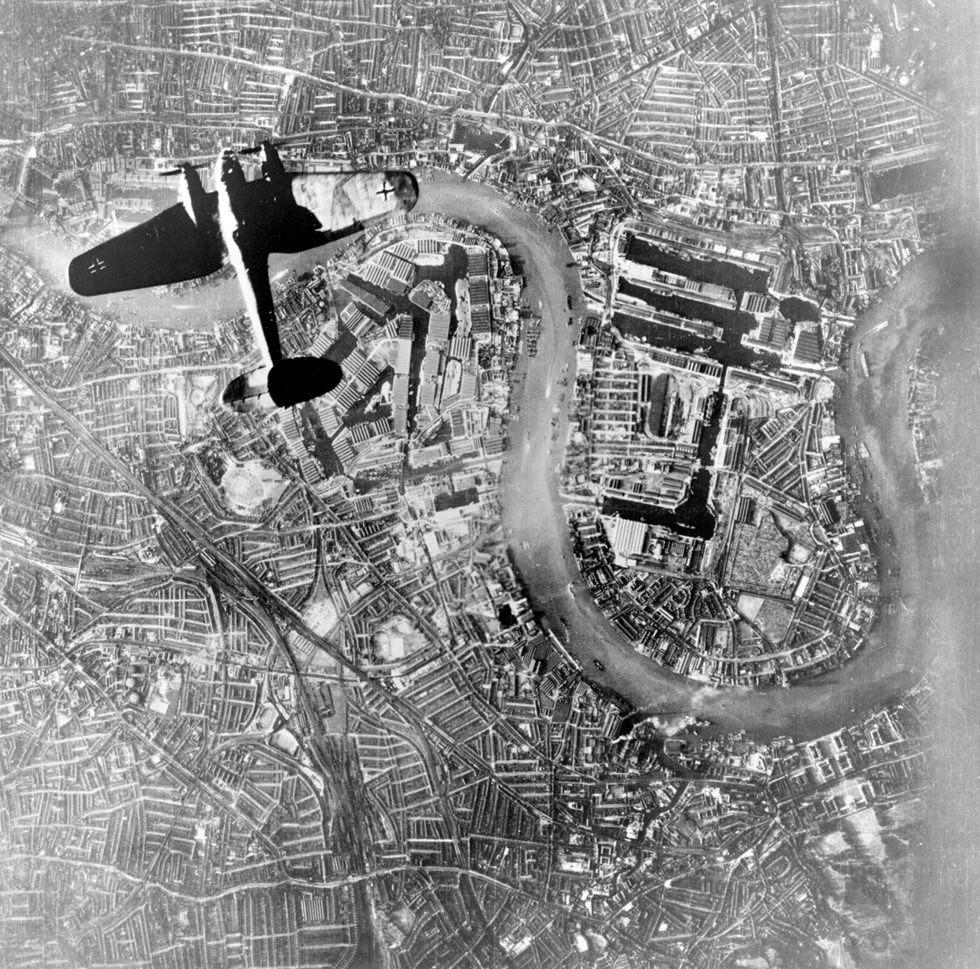
By 1939 the He 111 was the mainstay of the Luftwaffe bomber force, leading the air campaigns over Poland, France and the Low Countries. Then came the Battle of Britain and the Blitz. Against Spitfires and Hurricanes the earlier lesson was exposed as an illusion: the He 111 carried a modest bomb load of around two tonnes, cruised slower than the fighters hunting it, and defended itself with hand-aimed rifle-calibre machine guns. Daylight losses mounted until the type was pushed largely into night bombing. Yet the airframe proved endlessly adaptable — serving as a torpedo bomber against Arctic convoys, a transport during the Stalingrad airlift, a tug for heavy gliders (the twin-fuselage He 111Z), and even an airborne launch platform for V-1 flying bombs. Around 6,500 were built before production ended in 1944, and the story did not end there: Spain built the type under licence as the CASA 2.111, some flying into the 1970s and later standing in for their German ancestors on film.
01The He 111’s “greenhouse” nose: why the Heinkel bomber looked the way it did
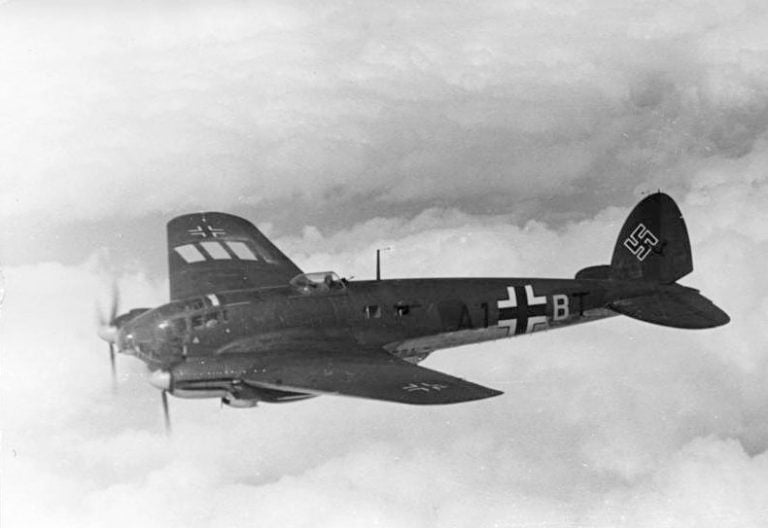
Early He 111 variants (the B and E models used in Spain) had a conventional stepped cockpit with a separate windscreen. From the He 111P of 1938–39, Heinkel replaced it with a fully-glazed, aerodynamically smooth nose that blended straight into the fuselage — the feature that makes the aircraft instantly recognisable. To give the pilot a forward view over the glazing, the design was slightly asymmetric: the pilot sat offset to port, and for take-off and landing he could raise his seat so his head projected through a sliding hatch in the roof. The bombardier lay prone in the nose, and a chin-mounted gondola beneath carried a rearward-firing gun. It was elegant, but it also concentrated the crew in a fragile glass shell — and did little to solve the aircraft’s real weakness, its light defensive armament.
What makes the He 111 special
The fully-glazed asymmetric nose
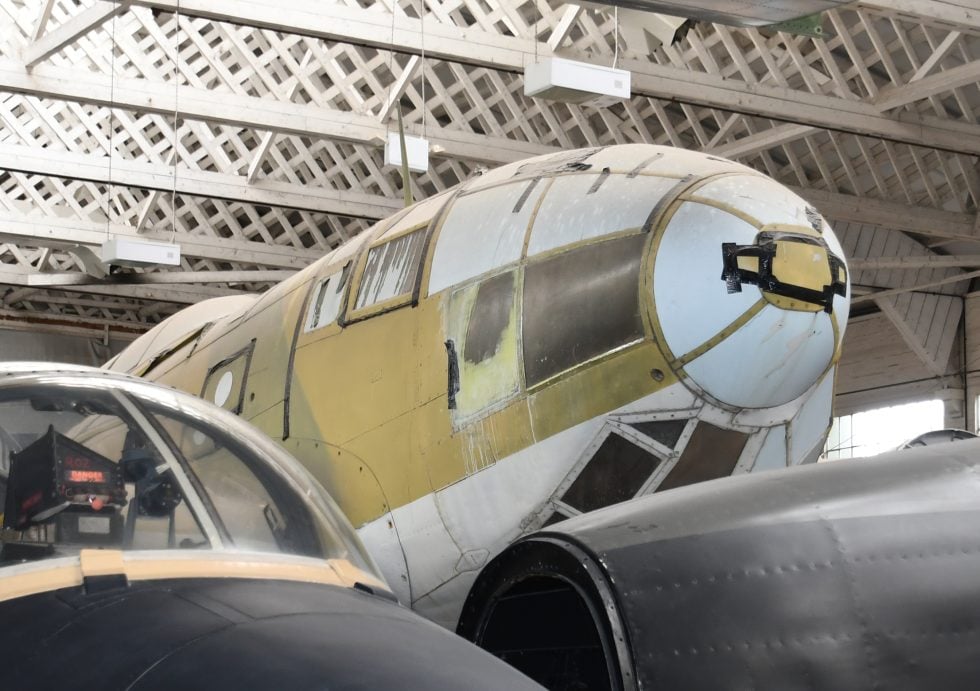
From the He 111P onward the aircraft wore a smooth, fully-glazed “greenhouse” nose with no separate windscreen step. The layout was deliberately asymmetric — the pilot sat offset to port and could raise his seat to see over the glazing on take-off and landing. The clean nose improved the airflow and gave the bombardier an exceptional view, at the cost of housing the crew in an exposed glass shell.
Twin Jumo power — and a bomber’s hard limits
The definitive He 111H was carried by two Junkers Jumo 211 inverted-V12 engines of around 1,300–1,350 hp each, for roughly 440 km/h. Bombs were stowed nose-up in internal vertical cells or on external racks, to about 2,000 kg. Speed and load were only ever moderate, and the type’s hand-aimed, rifle-calibre defensive guns left it dangerously exposed to modern fighters in daylight.
Longevity and the CASA 2.111 licence
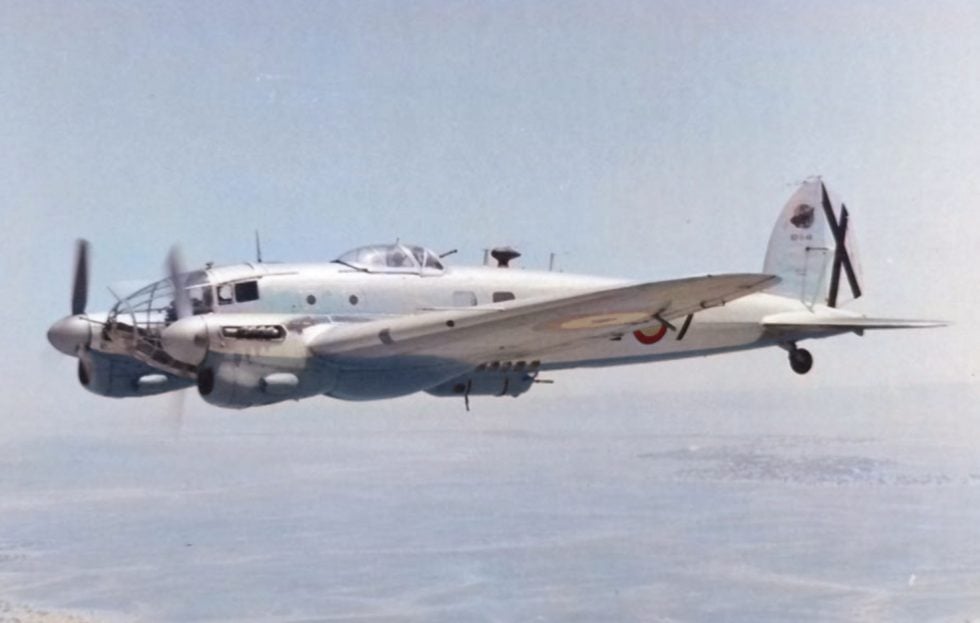
Obsolescent by 1943, the He 111 nonetheless outlived the Third Reich. Spain built it under licence as the CASA 2.111, initially with Jumo engines and later re-engined with British Rolls-Royce Merlin units. Spanish examples flew on into the early 1970s, and several later appeared on screen — most famously standing in for Luftwaffe He 111s in the 1969 film Battle of Britain.
02The He 111 in the Battle of Britain: why the Heinkel bomber was so vulnerable
The He 111’s combat record in Spain had convinced the Luftwaffe that a fast bomber needed only light defensive armament. Over Britain in 1940 that judgement failed. The Heinkel was slower than the RAF fighters intercepting it, its bomb load of roughly two tonnes was modest for a strategic campaign, and its defence rested on a handful of hand-aimed 7.92 mm MG 15 machine guns that could not hold off eight-gun Spitfires and Hurricanes. Crews welded on extra guns and up-gunned later variants with 13 mm weapons, but the fundamental problem remained. Daylight losses grew heavy enough that the He 111 — like much of the German bomber arm — was shifted to the night raids of the Blitz, where darkness, not armament, was its protection.
03The He 111’s second life: torpedoes, transports, gliders and the He 111Z Zwilling
As a front-line bomber the He 111 was fading by 1943, but the airframe was endlessly reworked. The He 111H-6 carried two torpedoes and attacked Allied shipping, including the Arctic convoys to the Soviet Union. During the encirclement at Stalingrad in the winter of 1942–43 He 111s were pressed into service as transports, suffering heavy losses. The strangest offshoot was the He 111Z “Zwilling” (“Twin”): two He 111H-6 fuselages joined by a new centre wing carrying a fifth engine, built as a tug for the enormous Me 321 Gigant glider. Twelve were made. Late in the war, He 111H-22s even air-launched V-1 flying bombs against England.
Full He 111 specifications
Figures are for the mass-produced He 111H-6; values varied across the many variants.
Baseline is the He 111 H-6 of 1941–42, the most numerous single sub-variant of the most-produced series and the standard Luftwaffe medium bomber of the middle war years. The earlier He 111P was externally near-identical but used 1,175 PS Daimler-Benz DB 601A-1 engines rather than Jumo 211s, and was slightly slower and shorter-legged; it was the mark that introduced the stepless glazed nose. The He 111Z Zwilling was a different aircraft altogether — two H-6 airframes joined by a new centre section, 35.4 m span, five engines, seven crew, around 28,600 kg maximum weight. Sub-variant figures differ by a few per cent between wartime data sheets and later reference works, and captured-aircraft test results differ again.
Dimensions & weights
- Crew
- 5 typical pilot, navigator/bomb-aimer who also manned the nose gun, radio operator/dorsal gunner, ventral gondola gunner and a flight engineer who worked the beam guns; six on some late marks
- Length
- 16.40 m (53 ft 9 in)
- Wingspan
- 22.60 m (74 ft 2 in); the He 111Z spanned 35.40 m (116 ft 2 in)
- Height
- 4.00 m (13 ft 1 in)
- Wing area
- 86.50 m² (931 sq ft); the elliptical planform of the He 111B and E was simplified to straight-tapered panels from the P series to speed production
- Empty weight
- 8,680 kg (19,140 lb)
- Loaded weight
- 12,030 kg (26,520 lb) normal operational weight
- Max takeoff weight
- 14,000 kg (30,860 lb) overload, with external bomb or torpedo racks and full fuel
- Internal fuel
- ~3,450 L (~760 imp gal / ~910 US gal) in four wing tanks. An auxiliary tank of about 835 L could be fitted in the forward bomb bay, trading roughly half the internal bomb load for reach — the usual arrangement on long over-water sorties
Performance
- Max speed
- 435 km/h (270 mph) at 6,000 m / 19,700 ft, clean. Around 360–390 km/h (225–240 mph) at sea level, and materially less with external bombs or a torpedo hung
- Cruise speed
- 370 km/h (230 mph) at 5,000 m / 16,400 ft; economical cruise nearer 300 km/h (185 mph)
- Rate of climb
- 4.0 m/s (790 ft/min) at sea level at operational weight; roughly half an hour to reach 6,000 m fully loaded
- Service ceiling
- 6,500 m (21,300 ft) at operational weight; about 8,500 m (27,900 ft) lightly loaded. Low enough that heavy flak and single-engine fighters both reached it comfortably
- Range
- ~2,300 km (~1,430 miles) with maximum fuel and a reduced bomb load; nearer ~1,200 km (~750 miles) carrying a full 2,000 kg of bombs
- Ferry range
- ~2,900 km (~1,800 miles) with the bomb-bay auxiliary tank fitted and no warload; quoted ferry figures vary by several hundred kilometres between sources
- Takeoff run
- 600 m (2,000 ft) ground roll at normal loaded weight on a firm grass field; considerably longer at overload weights, which is why assisted-takeoff rockets were fitted to some heavily laden marks
- Landing run
- 500 m (1,650 ft) ground roll. Takeoff and landing distances were not tabulated consistently in surviving manuals and depend heavily on load and surface
- Bomb load
- ~2,000 kg (~4,400 lb) normal, as eight 250 kg bombs in the internal cells. Up to ~3,600 kg (~7,900 lb) on external racks in overload, at heavy cost in speed, ceiling and range. For comparison, an Avro Lancaster carried about 6,350 kg routinely
Propulsion & systems
- Engines
- 2 × Junkers Jumo 211 Jumo 211F-2 on the H-6: inverted V-12, liquid-cooled, direct fuel injection. Earlier H marks used the 1,200 PS Jumo 211D-1; the P series used Daimler-Benz DB 601A-1 instead, and the switch to Jumo power on the H was driven mainly by the fighter programmes having first call on DB 601 output
- Power each
- 1,340 PS (1,322 hp / 986 kW) for takeoff; about 1,060 PS in continuous cruise at altitude
- Propellers
- 3-blade VDM constant-speed metal units, 3.50 m diameter
- Glazed nose
- Fully glazed asymmetric nose Introduced on the P series and carried through the H, this was the He 111's signature feature and its most-copied idea. The entire nose was glazed as one continuous transparency with no separate windscreen step in front of the pilot — the "stepless" cockpit. Aerodynamically it was clean, and the field of view for pilot, navigator and bomb-aimer working shoulder to shoulder was outstanding. In practice it was also punishing: sunlight and searchlights glared straight into the crew's eyes, curved panels distorted what the pilot saw, and rain, icing and gun-blast crazing made it worse. The fix was a compromise — a bulged panel offset to port for the pilot's forward view, with the flat optically-true aiming panel offset to starboard for the bombsight, and a seat that could be raised so the pilot's head projected through a sliding roof hatch to see over the nose for takeoff and landing in bad visibility
- Defensive armament
- Up to 7 positions Originally hand-held 7.92 mm MG 15s in nose, dorsal, ventral and beam mounts. Progressively upgraded to twin MG 81Z in the ventral gondola and beam windows and a 13 mm MG 131 in a powered dorsal turret, with a 20 mm MG FF in the nose or gondola front on some anti-shipping aircraft. All of it hand-aimed by a small crew with poor mutual support, and inadequate against eight-gun fighters
- Bombsight
- Lotfernrohr 7 (Lotfe 7) gyro-stabilised optical sight in the later H marks, with earlier aircraft carrying the Goerz and Lotfe C series; a BZA computing sight was used for shallow-dive attack. Pathfinder aircraft added radio-beam navigation equipment instead of relying on the sight alone
- First flight
- 24 February 1935 He 111 V1, flown by Gerhard Nitschke at Rostock-Marienehe. Presented publicly as a fast airliner for Lufthansa, and genuinely used as one, while being designed from the start as a bomber
- Service entry
- 1936 with the Luftwaffe; combat debut with the Condor Legion in Spain the same year
- Built
- ~6,500 German production, commonly given as ~6,500 and ranging from about 5,600 to 7,300 between sources depending on whether prototypes, conversions and rebuilds are counted; production ran to 1944. A further ~236 were built under licence in Spain by CASA as the 2.111 between 1945 and 1956
- Unit cost
- ~265,000 RM the airframe price usually quoted for a wartime He 111H, against roughly 60,000 RM for a Bf 109. Treat this as indicative only: German wartime prices were administered figures inside a command economy using forced and slave labour, they excluded much government-furnished equipment, and converting them into modern money is not a meaningful exercise
- Cost per flight hour
- ~USD 5,000–10,000 (hypothetical) No original-engined He 111 flies anywhere in the world, so there is no real operating rate to quote. The figure above is an order-of-magnitude estimate for a large piston twin warbird — fuel, insurance, crew and engine reserve — with a Merlin overhaul alone commonly reserved at six figures per engine. Worth stating plainly: every "He 111" that flew at airshows or in films such as Battle of Britain was a Spanish-built CASA 2.111, and the airworthy ones were re-engined with Rolls-Royce Merlins — so the bombers on screen attacking Britain were powered by the same engines as the Spitfires and Hurricanes chasing them
04The He 111’s cost: why no reliable price figure exists
The He 111 was a state-directed wartime product, built in the tens of thousands of man-hours by a war economy rather than sold on an open market, so a firm flyaway unit price and a credible cost-per-flight-hour simply do not exist in the public record. Any precise figure attached to it should be treated as an estimate. What is well documented is the scale: around 6,500 aircraft across a decade of production, and, remarkably, a licence-built afterlife in Spain (the CASA 2.111) that kept the design in service and in the air long after the German original had been retired.
Armament & payload
He 111 armament: eight vertical cells, five hand-held guns and a war it could not win
The He 111 was fast for a bomber in 1936 and obsolescent as a bomber by 1940. Its offensive load was small and awkwardly stowed, its defensive guns were hand-aimed rifle-calibre weapons, and the aircraft was asked to do strategic work it was never sized for. What it did carry, over nine years of continuous service, ranged from 250 kg bombs to torpedoes, guided glide bombs and V-1 flying bombs.
Defensive guns
Early aircraft carried three hand-held 7.92 mm MG 15 drum-fed machine guns — one in the nose ball mount, one in an open dorsal position, one firing aft from the ventral Bola gondola. Combat forced steady growth: twin MG 81Z mounts in the gondola and the beam windows, a 13 mm MG 131 in an enclosed and later powered dorsal position, and a 20 mm MG FF cannon in the nose or gondola front on anti-shipping aircraft. It was still not enough. The guns were aimed by hand by a crew of five who also had to fly, navigate and bomb; fields of fire overlapped badly; and the frontal aspect was barely defended. The Battle of Britain exposed this brutally. Formations of He 111s attacked by eight-gun Hurricanes and Spitfires took losses the escort could not prevent, head-on attacks proved devastating, and the answer — more guns, more armour, more weight — made an already slow aircraft slower. By 1941 daylight operations over defended airspace were being abandoned in favour of night work.
Bombs
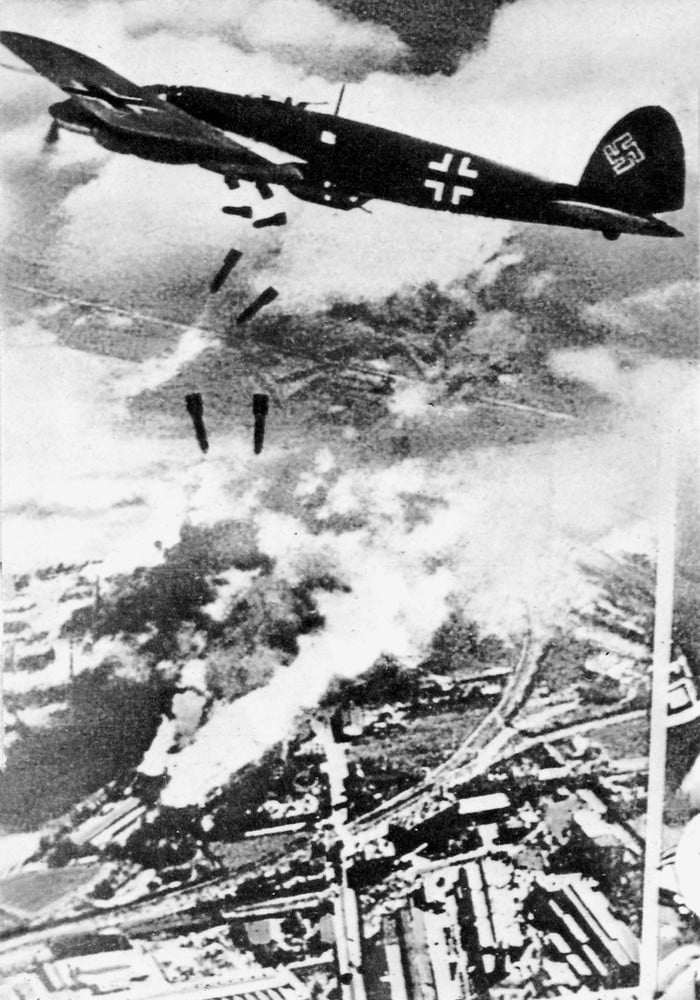
The internal bay held eight vertical cells, each taking one bomb of up to 250 kg stowed nose-up — a total of about 2,000 kg. The layout was compact and it worked, but it hard-capped the size of any single weapon: nothing larger than 250 kg would fit inside. Bigger bombs, SC 500, SC 1000 and the 1,800 kg types, had to go on external PVC racks under the fuselage, which cost speed, ceiling and range, and generally meant giving up part of the internal load or the bay fuel tank. Maximum overload was around ~3,600 kg external, rarely flown. A common Blitz fit was simply eight 250 kg bombs, or a mix of high explosive and incendiary containers. The comparison that matters: an RAF Lancaster of 1943 routinely carried three times as much, further.
Torpedoes & anti-shipping
The H-6 was built with external racks for two LT F5b torpedoes of about 765 kg each, and torpedo work became one of the type's most effective roles. Kampfgeschwader 26, operating from Norwegian and Arctic bases, flew mass low-level torpedo attacks against the Allied convoys running to Murmansk and Archangel, notably against PQ 17 and PQ 18 in 1942, in coordination with Ju 88s and long-range reconnaissance. Attacks were pressed at wave height in daylight against heavily escorted ships and were costly on both sides. He 111s also laid aerial mines in British coastal waters and estuaries, and carried out shipping strikes in the Mediterranean and Black Sea.
Missile carriage
Two strands. The He 111H-12 was fitted with FuG 203 Kehl transmitters to carry and steer the Hs 293 rocket-boosted guided glide bomb against shipping — a small effort compared with the Do 217 and He 177 units. Far more significant was the He 111H-22: a conversion carrying a single Fi 103 (V-1) flying bomb on a pylon at the wing root. From July 1944, III./KG 3 and then KG 53 launched V-1s at night from over the North Sea against London, Southampton and Manchester, climbing to release altitude, lighting the pulsejet and diving away. Roughly 1,200 air-launched V-1s are usually cited, with estimates ranging higher. Accuracy was poor, the launch flash gave the aircraft away to RAF night fighters, and losses to fighters and to accidents were severe enough that the campaign was abandoned in January 1945.
Special operations fits
The He 111 was the Luftwaffe's pathfinder aircraft. Kampfgruppe 100 flew H-3s equipped with X-Gerät, a precision radio-beam system in which the aircraft flew along a director beam and crossed a series of intersecting cross-beams that started and stopped a mechanical clock to compute the release point. On the night of 14/15 November 1940 KGr 100 used it to mark Coventry with incendiaries for the main force. A later system, Y-Gerät, used range measurement by a single beam and was flown by III./KG 26. Both were countered by British jamming within months. Other fits: agent- and supply-dropping aircraft for KG 200, transport and paratroop work, and improvised freighters — He 111s flew a large share of the airlift sorties into the Stalingrad pocket in the winter of 1942–43, and proved the most capable aircraft on that task, though the airlift failed and cost the transport force heavily.
He 111Z & glider tug
The He 111Z Zwilling ("twin") was one of the more remarkable expedients of the war: two He 111H-6 airframes joined by a new wing centre section carrying a fifth Jumo 211, with a crew of seven and the pilot in the port fuselage. It existed for one reason — to tow the enormous Me 321 Gigant glider, which otherwise needed the notoriously lethal Troika-Schlepp of three Bf 110s flying in close formation on separate ropes. About 12 were built. They towed Me 321s and Go 242s, chiefly on the Eastern Front, and studies were made of using the type as a launch aircraft for large guided weapons, which came to nothing. Ordinary He 111s also served widely as tugs for the DFS 230 and Go 242 assault gliders.
Three typical He 111 loads
- Night raid on Britain
- 8 × SC 250 internal, full fuel He 111H-3/H-4, KG 26 or KG 55, winter 1940–41. About 2,000 kg of high explosive and incendiary containers in the vertical cells, MG 15s manned, crossing the coast at 4,000–5,000 m by night after daylight operations had proved unsustainable
- Arctic torpedo strike
- 2 × LT F5b torpedoes He 111H-6 of KG 26 from northern Norway, 1942. Bomb bay given over to the auxiliary fuel tank, torpedoes on external racks, attack pressed at wave height against convoy escorts. The role in which the type was most effective and most exposed
- V-1 air launch
- 1 × Fi 103 flying bomb He 111H-22 of KG 53, 1944–45. Single V-1 on a wing-root pylon, launched at night from low level over the North Sea. Poor accuracy, a launch flash visible for miles, and loss rates that ended the campaign inside seven months
Fits were strongly mark-dependent and changed continuously. A 1937 He 111B in Spain had three drum-fed MG 15s and no self-sealing tanks; a 1943 He 111H-16 had an MG 131 dorsal turret, twin MG 81Z in the gondola and beam positions, armour, and racks for a torpedo or a 1,800 kg bomb. Any single "He 111 armament" figure belongs to a particular sub-variant and often to a particular unit's field modifications, not to the type.
Variants
He 111 variants: from Spain in 1936 to Spanish-built Merlins in 1973
Nine years of front-line production and a further decade of licence-building in Spain gave the He 111 one of the longest lives of any bomber of its generation — not because it stayed competitive, but because nothing adequate arrived to replace it.
- He 111B
- ~300 built 1936–37. Daimler-Benz DB 600 engines, conventional stepped cockpit with a separate windscreen, elliptical wing. First combat type, flown by the Condor Legion in Spain from 1937
- He 111E
- ~200 built 1938. Jumo 211A engines, bomb load raised to about 2,000 kg. Also served in Spain; several were sold on to the Spanish air force after the civil war
- He 111P
- ~400 built 1939. Introduced the fully glazed stepless nose and the straight-tapered wing, powered by 1,175 PS DB 601A-1s. The mark that flew the opening campaigns in Poland and the West; production was curtailed because fighter programmes had priority on DB 601 engines
- He 111H
- ~5,600 built 1939–44. The definitive and most-produced series, running from H-1 to H-23 in dozens of sub-variants: Jumo 211 engines throughout, growing armament, armour, radio-navigation and special-mission fits. Everything from the Blitz to the Stalingrad airlift was flown on H airframes
- He 111H-6
- ~1,775 built 1941–42. The most numerous single sub-variant and this page's baseline: 1,340 PS Jumo 211F-2s, racks for two LT F5b torpedoes, heavier defensive fit. The standard mid-war bomber and the Arctic anti-shipping aircraft
- He 111H-22
- ~100 converted 1944. V-1 carrier for KG 53, one Fi 103 on a wing-root pylon, launched at night over the North Sea. Conversion totals are hedged in every source
- He 111Z Zwilling
- ~12 built 1942–43. Two H-6 airframes joined by a new centre section with a fifth Jumo 211, seven crew, 35.4 m span. Built to tow the Me 321 Gigant glider; used mainly on the Eastern Front
- CASA 2.111
- ~236 built Spain, 1945–56, under a licence agreed before the war ended. Early aircraft used remaining Jumo 211s; when those ran out the survivors were re-engined with Rolls-Royce Merlin 500-29s, giving the type a distinctive nose profile. Served with the Ejercito del Aire as bomber and transport until 1973, and supplied nearly every "He 111" seen in post-war films and airshows
What it was used for. This is documented history and is worth stating without euphemism. He 111s of the Condor Legion took part in the bombing of Guernica on 26 April 1937, alongside Ju 52s and Italian aircraft; the Basque town was largely destroyed and civilians were killed in numbers that remain disputed, with credible estimates ranging from roughly 150 to over 1,600. In September 1939 He 111s were used in the bombing of Warsaw, including the deliberate attacks on the besieged city on 25 September that killed thousands of civilians. On 14 May 1940 aircraft of KG 54 carried out the bombing of Rotterdam, destroying the medieval city centre, killing around 850 people and leaving tens of thousands homeless. From September 1940 the He 111 was the principal bomber of the Blitz against British cities, and on the night of 14/15 November 1940 He 111s of KGr 100 marked Coventry using X-Gerät for a force of over 500 aircraft; 568 people were killed and the cathedral and much of the city centre were destroyed. He 111s were also used in the bombing of Belgrade in April 1941 and throughout the campaigns in the Soviet Union. These operations were flown deliberately and repeatedly against urban areas. They are part of what this aircraft was, and no account of the type is complete without them.
Obsolescent before the Blitz began. The He 111 was a fast bomber by 1936 standards and a liability by 1940. It cruised at speeds a Hurricane could exceed by 150 km/h, it defended itself with hand-aimed rifle-calibre guns, and it carried about 2,000 kg of bombs — roughly a third of what RAF heavy bombers would carry over the same distances two years later. Its bomb bay physically could not take a weapon larger than 250 kg. It was, in short, a medium bomber built for battlefield support and short-range interdiction, and in 1940 it was sent to conduct a strategic bombing campaign against a defended industrial country. It could not do that, and the losses of the Battle of Britain made the point in weeks rather than months. The deeper failure was that nothing replaced it. Germany began a four-engine Ural bomber programme in the early 1930s and cancelled it after the death of its main advocate, Walther Wever, in 1936. The He 177 Greif that was supposed to provide a heavy bomber was crippled for years by its coupled-engine installation and a persistent tendency to catch fire; the Bomber B programme meant to produce a fast successor collapsed entirely. So the He 111 stayed in production until 1944 and in front-line service until 1945, nine years after it entered service, flying missions it had been outclassed for since the summer of 1940. The type's longevity is usually cited as evidence of a sound design. It is at least as much evidence of an air force that never solved the problem the aircraft was standing in for.
Survivors: no original German-built He 111 is airworthy anywhere in the world. A small number survive as static museum exhibits — among them an He 111 H-20 recovered from Norway and displayed at the RAF Museum in London, and examples in Norwegian and German collections. Every "He 111" that flew at airshows or appeared in films through the 1960s, 1970s and into the 2000s — including Battle of Britain (1969) — was a Spanish-built CASA 2.111, in the flying cases powered by Rolls-Royce Merlins. Several CASA 2.111s survive in European and North American museums and one or two have flown in recent decades; the Commemorative Air Force's example was destroyed in a fatal crash in 2003, and none is understood to be flying regularly today. Airworthy and static counts drift as airframes move between restoration, display and storage.
From airliner disguise to Spanish afterlife
First flight
The He 111 V1 prototype flies on 24 February at Rostock-Marienehe, publicly presented as a fast airliner while designed for bombing.
Combat debut in Spain
He 111B bombers of the Condor Legion fly for the Nationalists in the Spanish Civil War; low losses wrongly reassure planners about defensive armament.
Invasion of Poland
The He 111 spearheads the Luftwaffe bombing campaign as the opening act of the Second World War in Europe.
Battle of Britain & the Blitz
A mainstay of the bomber force, the He 111 suffers heavy daylight losses to RAF fighters and is switched to night raids on British cities.
New roles at sea and in the air
The He 111H-6 attacks Allied shipping as a torpedo bomber, while the twin-fuselage He 111Z is built to tow the Me 321 Gigant glider.
The Stalingrad airlift
He 111s are pressed into service as transports to supply the encircled Sixth Army, taking severe losses in the winter skies.
Air-launched V-1s · production ends
He 111H-22s launch V-1 flying bombs at England; German production of the type winds down after roughly 6,500 built.
The CASA 2.111 in Spain
Spain builds the He 111 under licence, later re-engined with Rolls-Royce Merlins; examples fly on until 1973 and appear in the 1969 film Battle of Britain.
From history: twelve He 111 stories
An airliner that was really a bomber
Germany unveiled the He 111 as a Lufthansa airliner while designing it for war.
Read the full story
The false lesson of the Condor Legion
In Spain the He 111 outran enemy fighters — teaching the wrong lesson about defence.
Read the full story
The greenhouse nose
The He 111’s smoothly glazed, asymmetric nose is one of aviation’s most recognisable shapes.
Read the full story
The opening campaign
The He 111 led the Luftwaffe bombing that opened the Second World War in Europe.
Read the full story
Exposed in daylight
Over Britain the Heinkel met fighters it could neither outrun nor fight off.
Read the full story
Retreat into the dark
Unable to survive by day, the He 111 became a night bomber over British cities.
Read the full story
Torpedoes against the convoys
The He 111H-6 became a torpedo bomber, striking Allied shipping in the Arctic and Mediterranean.
Read the full story
The He 111Z Zwilling
Two He 111 fuselages were joined into one five-engined aircraft to tow a giant glider.
Read the full story
Bomber turned transport
At Stalingrad the He 111 flew supply missions into an encircled army, at heavy cost.
Read the full story
Launching the V-1
Late in the war He 111s carried V-1 flying bombs aloft and launched them at England.
Read the full story
The CASA 2.111
Spain built the He 111 under licence and flew it, Merlin-engined, into the 1970s.
Read the full story
A second career in film
Spanish-built He 111s stood in for Luftwaffe bombers in the 1969 film Battle of Britain.
Read the full story
The He 111 in pictures
The He 111 in motion
Video coming soon — a curated documentary on the Heinkel He 111 will be added to this exhibit shortly.
Where the He 111 flew and served
The record that defines the He 111
The He 111 was a workhorse, not a world-beater. Its story is one of early dominance followed by growing vulnerability — effective while it faced weak opposition or flew by night, but exposed and out-classed against modern fighters in daylight. Its true legacy is its extraordinary adaptability and its remarkable longevity.
Compare the combat record of other military aircraft. Figures as of July 2026 and, where contested, hedged.
Everything people ask about the He 111
Can I fly in a He 111?
Why does the He 111 have that glass “greenhouse” nose?
Was the He 111 a good bomber?
How many He 111 were built?
What is the CASA 2.111?
Did the He 111 fight in the Battle of Britain?
Are any He 111 still flying?
What was the He 111Z?
You can’t fly the He 111.
These, you can.
Some legends only live in museums — others are fuelled and waiting. MiGFlug has put civilians in real military jet cockpits since 2004.
 Fly the L-39 AlbatrosThe world’s most-flown jet trainer — aerobatics included
 Fly the F-104 Starfighter“The missile with a man in it”
 Fly the MiG-21The Cold War’s most-produced jet
 Fly the T-33 Shooting StarAmerica’s first jet trainer
 Fly the DH VampireA piece of early jet history
 Fly the S.211Agile Italian jet trainer
 Fly the MB-326The classic Aermacchi jet
 Fly the MiG-15The Soviet legend of the Korean War
Continue the tour
Every fact, checked
- World History Encyclopedia — Heinkel He 111Overview of the aircraft’s airliner origins, Spanish debut and wartime service.
- History of War — He 111 combat recordSpanish Civil War use and the scale of Battle of Britain losses.
- Imperial War MuseumsBlitz context and the He 111 over British cities in 1940–41.
- Royal Air Force MuseumReference for the He 111’s design, role and preserved airframes.
- Oryx — Türkiye’s He 111 bombersDetail on Turkey’s ~24 Heinkels ordered in 1937 and retired in 1945.
- Military Factory — He 111Specifications and the family of variants across the type’s career.
- The Aviation Geek ClubHe 111Z Zwilling, torpedo-bomber and V-1 air-launch history.
- The National WWII MuseumContext on the Luftwaffe bomber arm and the strategic air war.