
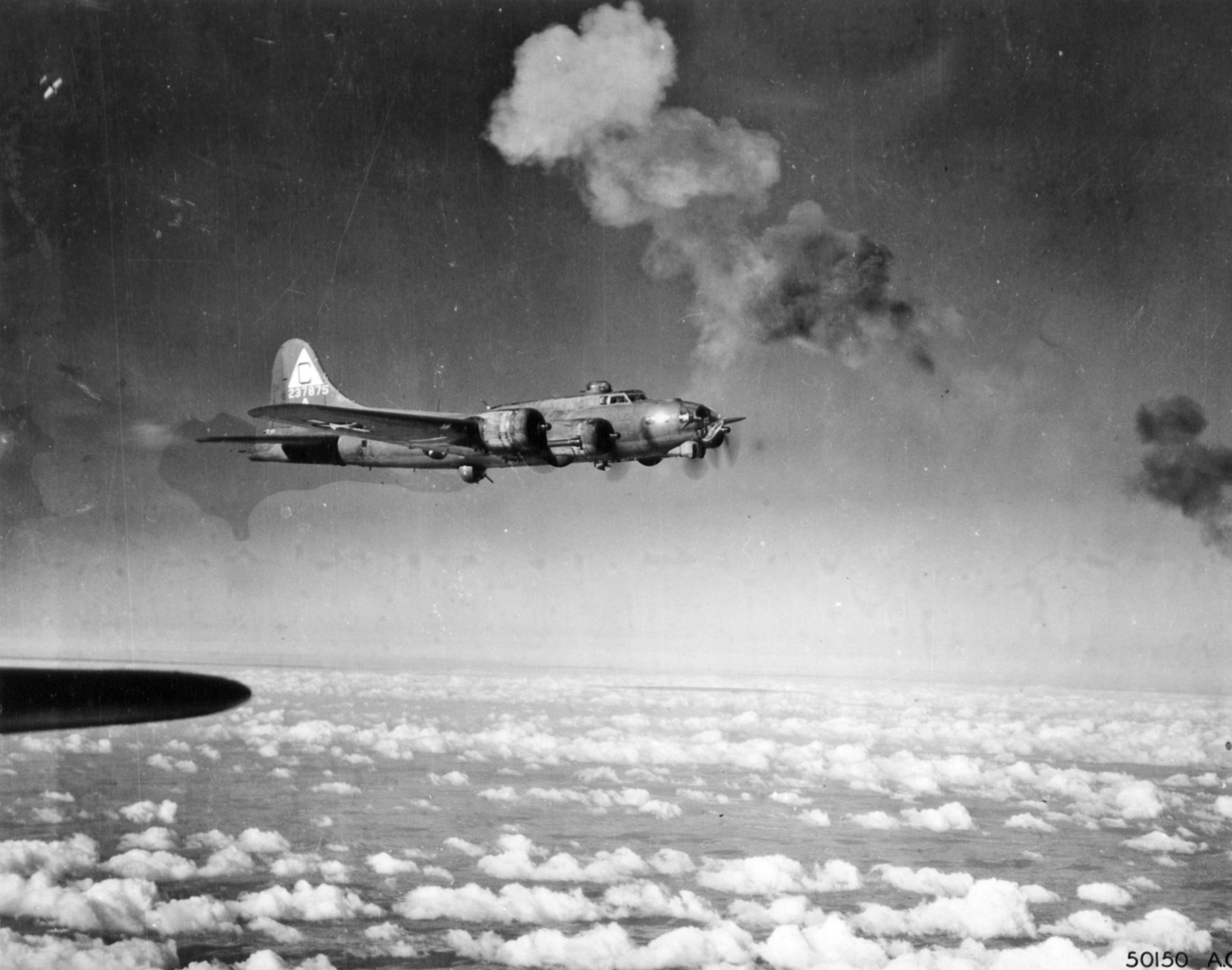
Boeing B-17
“Flying Fortress”
The four-engined heavy bomber at the heart of the American daylight bombing war over Europe — famous for its bristling guns, its high-altitude precision doctrine, and an almost mythical ability to bring its crew home in pieces.
The B-17 Flying Fortress: backbone of the daylight bombing war
In 1934 the US Army Air Corps asked American industry for a new multi-engine bomber. Where rivals offered twin-engined designs, Boeing gambled the company’s future on four engines — a bigger, longer-ranged, heavier-armed machine designated the Model 299. When it was rolled out in Seattle in 1935, a reporter looking at its many defensive machine guns called it a “flying fortress,” and the name stuck. The prototype first flew on 28 July 1935. It crashed that October after a test crew took off with the controls still locked — nearly killing the whole programme — but the Air Corps had seen enough promise to press on, and the B-17 entered service in the late 1930s.
When the United States entered the Second World War, the Fortress became the instrument of a distinctly American idea: high-altitude daylight precision bombing. While RAF Bomber Command bombed German cities by night, the US Army Air Forces — above all the Eighth Air Force flying from bases in England — set out to hit specific factories, refineries and rail yards in daylight, aiming through the closely guarded Norden bombsight. B-17s flew in tight, mutually supporting “combat box” formations so that their massed .50-calibre guns could beat off fighters, climbing to bomb from around 25,000–30,000 feet where flak was less accurate.
The doctrine’s fatal flaw was escort range. On unescorted deep raids the bombers were savaged: the Schweinfurt ball-bearing raids of 1943 — especially “Black Thursday,” 14 October, when 60 of 291 B-17s were lost in a single mission — showed that daylight bombing beyond fighter cover was unsustainable. The turning point came in early 1944, when the long-range P-51 Mustang could finally escort the bombers all the way to the target and back. Through it all the Fortress earned its enduring legend for ruggedness, staggering home with engines dead, tails shot away and control cables severed. Around 12,731 were built; the most famous, the Memphis Belle, became a symbol of the crews who flew a full tour and lived.
01The B-17 Flying Fortress and the daylight bombing gamble: Schweinfurt and the escort gap
American planners believed a tight formation of heavily armed bombers could fight its way to any target in daylight without escort — the “self-defending bomber.” Reality was harsher. Once B-17s flew beyond the range of their short-legged escorts, German fighters could attack almost at will. The two 1943 raids on the ball-bearing works at Schweinfurt exposed the flaw: the second, on 14 October 1943, cost 60 bombers shot down out of 291 dispatched, with dozens more written off — loss rates that no force could absorb for long. Unescorted deep daylight raids were effectively suspended.
The answer was not a better bomber but a better escort. Fitted with drop tanks, the P-51 Mustang could accompany the bombers to Berlin and back from early 1944, and in the “Big Week” battles of February 1944 the escorts began to break the Luftwaffe fighter force in the air. The B-17 remained the tool; the Mustang made the daylight campaign survivable.
What makes the B-17 Flying Fortress special
Four engines and legendary toughness
Boeing’s decision to build a four-engined bomber gave the B-17 the height, load and — crucially — the survivability that made its name. Crews routinely nursed Fortresses home on two or three engines, with huge holes torn in wings and fuselage, tail surfaces shot away and control cables severed. The airframe’s ability to absorb battle damage and still fly became the aircraft’s defining trait and the reason its crews trusted it.
The Norden bombsight and daylight precision
The B-17 was the airframe built around a doctrine: high-altitude daylight precision bombing. Its bombardier aimed through the secret Norden bombsight, an analogue computer that factored altitude, speed and wind to release bombs at the calculated instant. In clear conditions it was remarkably accurate for its day; in the cloud, smoke and chaos of combat, real-world accuracy was far coarser — but the whole American strategy rested on it.
Turbo-supercharged, stratospheric bomber
Four Wright R-1820 Cyclone radials, each fed by an exhaust-driven turbo-supercharger, let the B-17 cruise and bomb from around 25,000–30,000 feet, where thin air blunted flak and enemy fighters struggled to climb. Operating there meant unpressurised crews on oxygen in cabin temperatures far below freezing — frostbite was a constant hazard — but altitude was one of the Fortress’s best defences.
02The B-17 Flying Fortress’s defensive firepower: thirteen fifties and the combat box
The definitive B-17G carried thirteen 0.50-calibre M2 Browning machine guns — in the nose “chin” turret added to counter head-on attacks, in dorsal and ball turrets, at the waist, in the tail and cheek positions. The idea was collective defence: bombers flew in a stacked, overlapping combat box so that an attacking fighter faced fire from many aircraft at once. It helped, but it was never enough on its own against determined, cannon-armed German fighters attacking from head-on — which is why long-range escort mattered so much.
03The B-17 Flying Fortress’s turbo-supercharged Cyclones: bombing from the stratosphere
Each Wright R-1820-97 Cyclone produced around 1,200 horsepower, but its real trick was the General Electric exhaust-driven turbo-supercharger that maintained power in the thin air of high altitude. That let the Fortress operate far higher than most contemporaries. The cost was borne by the crew: cabins were unpressurised, temperatures could fall below −40 °C, and men worked on bottled oxygen in heated suits that frequently failed — frostbite injuries sometimes outnumbered wounds from enemy fire.
Full B-17 Flying Fortress specifications
Dimensions & weights
- Crew
- 10 typical (pilot, co-pilot, navigator, bombardier, flight engineer/top-turret gunner, radio operator, ball-turret gunner, two waist gunners, tail gunner) — B-17G
- Length
- 22.66 m (74 ft 4 in) — B-17G
- Wingspan
- 31.62 m (103 ft 9 in)
- Height
- 5.82 m (19 ft 1 in), tail down
- Wing area
- 131.9 m² (1,420 ft²)
- Empty weight
- 16,391 kg (36,135 lb)
- Loaded weight
- 24,500 kg (54,000 lb), normal mission
- Max takeoff weight
- 29,700 kg (65,500 lb), overload
- Internal fuel
- ~10,520 l (~2,780 US gal) including the outer-wing "Tokyo tanks"; earlier marks carried substantially less
Figures are for the B-17G, the definitive and most-produced mark. Earlier marks differ: the B-17B/C/D were shorter-tailed and far lighter, and the B-17E introduced the tall fin and dorsal fillet that added roughly 2 m to overall length and defined the shape most people picture.
Performance
- Max speed
- 462 km/h (287 mph) at 7,600 m (25,000 ft) — B-17G
- Cruise speed
- 293 km/h (182 mph); formation cruise on operations was slower still, often near 250 km/h (155 mph) indicated
- Rate of climb
- 4.6 m/s (900 ft/min) at sea level, clean
- Service ceiling
- 10,850 m (35,600 ft); loaded formations typically bombed from 6,400–8,500 m (21,000–28,000 ft)
- Combat radius
- ~1,300 km (~800 mi) with a moderate bomb load; deep targets such as Schweinfurt and Berlin sat at the outer edge of practical radius
- Ferry range
- ~5,470 km (~3,400 mi) ferry, no bombs, maximum internal fuel
- Takeoff run
- 1,036 m (3,400 ft) ground run at maximum weight; markedly shorter at operational weights and in cold air
- Landing run
- 610 m (2,000 ft) at typical post-mission weight, hard surface
- Bomb load
- 2,000 kg (4,400 lb) typical on long-range missions; 4,500 kg (9,900 lb) on short-range missions; ~7,800 kg (~17,600 lb) absolute overload with external racks. The distinction is routinely misreported — the huge overload figure was never what a Fortress carried to Berlin.
B-17F and B-17G performance is broadly similar; the G traded a few km/h for the chin turret and extra gunnery. Early B-17B/C/D aircraft were lighter and slightly faster but effectively defenceless by 1942 standards.
Propulsion & systems
- Engines
- 4 × Wright R-1820-97 Cyclone nine-cylinder air-cooled radials with General Electric exhaust-driven turbosuperchargers — the turbos are what gave the B-17 its high-altitude performance
- Power each
- 895 kW (1,200 hp) takeoff rating; war emergency power higher for short periods
- Propellers
- 3.53 m (11 ft 7 in) Hamilton Standard three-blade constant-speed, full-feathering
- Defensive guns
- 13 × 12.7 mm (13 × .50 in M2 Browning) on the B-17G — the heaviest defensive fit of any American bomber of the war
- Turrets
- Chin, dorsal, ventral, tail Bendix remote-sighted chin turret (new on the G, the direct answer to the head-on attacks Luftwaffe fighters had adopted against the F), Sperry powered top turret, Sperry ball turret under the belly, plus cheek, waist and tail positions
- Bombsight
- Norden M-series gyro-stabilised optical sight coupled to the autopilot. In clear air over a range it was genuinely good; in combat over Europe — flak, cloud, contrails, evasive formations — accuracy fell far short of the wartime "pickle barrel" publicity, with only a modest share of bombs falling within 300 m (1,000 ft) of the aiming point.
- Armour & protection
- Self-sealing tanks, armour plate armour behind the pilots and at key crew stations, self-sealing fuel tanks from the D onward, later flak vests and steel helmets for the crew. The airframe’s reputation for absorbing damage and still flying home was earned, but it was structural toughness, not armour, that did most of it.
- First flight
- 28 July 1935 Boeing Model 299 prototype; lost in a crash that October when the gust locks were left engaged — the accident that gave aviation the pre-flight checklist
- Service entry
- 1938 Y1B-17 service-test aircraft delivered to the 2nd Bombardment Group from early 1937
- Built
- ~12,731 (~8,680 of them B-17Gs) built by Boeing, Douglas and Lockheed-Vega under the BDV pool
- Unit cost
- ~US$238,000 period figure, commonly quoted for 1945; wartime unit cost fell sharply as production scaled, so any single number is an approximation
- Cost per flight hour
- ~US$5,000–10,000 present-day warbird operating estimate, not a historical figure. Fewer than ten B-17s are airworthy anywhere in the world; four thirsty radials, scarce parts and airframes over eighty years old make operation extraordinarily expensive, and the operating charities that fly them raise much of it from ride revenue and donations.
Earlier marks: B-17B/C/D carried a handful of hand-held guns and no powered turrets; the B-17E added the tail gun and powered dorsal and ball turrets; the B-17F refined the F-model nose and fuel system. Only the G had the chin turret from the factory.
04The B-17 Flying Fortress’s cost: what a wartime Fortress cost — and what one costs to fly today
A wartime B-17 was, by modern standards, astonishingly cheap: mass production drove the flyaway price down to roughly $204,000–$238,000 across the war years — figures often quoted from US government wartime accounting, so treat them as order-of-magnitude rather than precise. There is no meaningful “cost per flight hour” for the type in its service life; it was a wartime state product built by the thousand.
Today the relevant number is the cost of keeping one of the handful of airworthy survivors flying. Operators of warbirds such as Sally B and (formerly) the Collings Foundation fleet have cited running costs of the order of several thousand US dollars per flight hour once fuel, insurance, maintenance and overhaul are counted — which is why B-17 flights are rare charity-supported events, not a commercial ride you can simply book.
Armament & payload
Boeing B-17 Flying Fortress: guns, bombs and the doctrine they were meant to prove
The B-17 was built around an idea: that a bomber bristling with heavy machine guns, flying in tight formation at high altitude, could defend itself all the way to the target and back without escort. The B-17G carried that idea to its limit with thirteen .50-calibre Brownings. The idea was wrong, and the Eighth Air Force paid for it in men.
Defensive guns
Thirteen 12.7 mm (.50 in) M2 Browning machine guns on the B-17G — two in the chin turret, two in the top turret, two in the ball turret, two cheek guns in the nose, one in the radio room on earlier G airframes, one at each waist window and two in the tail. Ammunition was heavy and finite; gunners were trained to fire short, disciplined bursts, and the guns froze readily at the temperatures encountered above 7,600 m.
Massed formation fire looked overwhelming on paper. In practice a fighter attacking head-on closed at a combined speed that left gunners barely a couple of seconds of tracking, and the Luftwaffe learned to attack from exactly that quarter.
Turrets & positions
Sperry powered top turret behind the cockpit, worked by the flight engineer. Sperry ball turret under the belly. Bendix chin turret under the nose on the G, aimed by the bombardier through a remote sight. Tail position, upgraded on late G airframes to the roomier Cheyenne turret with a reflector sight and better field of fire. Waist windows were staggered on the G so the two gunners were not fighting each other for space.
The ball turret deserves plain description: a sphere barely large enough for a small man curled around two guns, entered in flight, with the gunner’s parachute stowed inside the aircraft rather than with him. It was cramped, freezing and difficult to leave in a hurry. Crews knew it, and it was still manned on every mission.
Bombs (typical loads)
On long-range missions into Germany a Fortress typically carried around 2,000 kg (4,400 lb) — often a stack of 500 lb general-purpose bombs — because fuel for the round trip, and the altitude needed to survive it, cost payload. Six 1,000 lb bombs or a mixed load of 500 lb GP and incendiary clusters were common fits.
The B-17 was never a heavy hauler by British standards; a Lancaster carried several times the tonnage. The Fortress traded payload for altitude, defensive armament and the daylight-precision mission it was designed around.
Bombs (maximum & special)
Short-range missions allowed roughly 4,500 kg (9,900 lb). The often-quoted maximum of about 7,800 kg (17,600 lb) required external wing racks and an overload takeoff, and was an edge case rather than an operational norm — it appears in specification tables far more often than it appeared over a target.
As the campaign shifted, incendiary loads grew. Against city-area targets and in poor weather, when radar-aimed bombing through cloud replaced visual attack, loads leaned heavily towards incendiary clusters and the practical effect was area attack, whatever the doctrine said.
Bombsight & fire control
The Norden bombsight was a genuinely sophisticated gyro-stabilised computing sight, coupled to the autopilot so that the bombardier effectively flew the aircraft on the bomb run. It was classified, guarded and heavily publicised.
The claim that it could drop a bomb into a pickle barrel from 6,000 m was marketing. Combat results over Europe were far poorer: cloud, haze, contrails, flak-disturbed formations, wind estimation errors and formation bombing on a lead ship all degraded accuracy badly, and only a minority of bombs fell within 300 m (1,000 ft) of the aiming point on a typical 1943 mission. Accuracy improved later in the war with better training, better lead crews and clearer conditions, but the gap between claim and reality never closed.
Special variants’ fits
The YB-40 was a B-17F stripped of bombs and packed with extra turrets and ammunition to fly as an escort gunship. It failed for a simple aerodynamic reason: once the real bombers dropped their bombs and lightened, the heavy YB-40 could not stay with the formation it was supposed to protect. The programme was abandoned after a short operational trial in 1943.
Project Aphrodite converted war-weary Fortresses into BQ-7 radio-controlled flying bombs loaded with several tonnes of explosive; a two-man crew took off, armed the load and bailed out over England while a mother ship flew the drone to the target. Results were poor and the missions were dangerous to the volunteer crews themselves. The effort was quietly dropped.
Representative fits
- Deep-penetration daylight raid, Eighth Air Force, 1944 (B-17G) — full 13-gun defensive fit with maximum ammunition, outer-wing Tokyo tanks filled, roughly 2,000 kg (4,400 lb) of 500 lb GP bombs and incendiary clusters, bombing on a lead ship from about 7,600 m (25,000 ft).
- Short-range tactical or interdiction sortie (B-17G) — reduced fuel, up to about 4,500 kg (9,900 lb) internal, typically 1,000 lb GP bombs against marshalling yards, bridges and coastal defences within a few hundred kilometres of base.
- Post-war PB-1W and SB-17G — armament removed or reduced. The Navy PB-1W carried an AN/APS-20 search radar in a large ventral radome for early airborne warning; the SB-17G air-sea rescue conversion carried a droppable airborne lifeboat slung under the fuselage.
Armament figures are mark-dependent and shifted even within a mark. The B-17B/C/D carried only a handful of hand-aimed guns; the E introduced the tail gun and powered turrets; the F fought most of 1943 without a chin turret and suffered accordingly against frontal attacks; the G standardised the thirteen-gun fit. Late in the war, with long-range P-51 escort available and the Luftwaffe fighter force broken, some units removed the ball turret and cheek guns to save weight — a quiet admission that the self-defending bomber had been superseded by the escort fighter.
Variants
Boeing B-17 Flying Fortress: the marks, from defenceless prototype to thirteen-gun G
- B-17B / C / D (1939–1941)
- The early production marks — roughly 39 B, 38 C and 42 D aircraft. Lightly armed with hand-held guns, no powered turrets, no self-sealing tanks until the D. RAF Fortress I operations in 1941 exposed the design’s weaknesses so plainly that the type was withdrawn from Bomber Command daylight use.
- B-17E (1941–1942)
- About 512 built. The transforming redesign: an entirely new rear fuselage with the tall fin and dorsal fillet, a tail gun position for the first time, and powered dorsal and ventral turrets. This is the aircraft that became recognisably the Flying Fortress.
- B-17F (1942–1943)
- Around 3,405 built. A frameless moulded nose, paddle-blade propellers, strengthened landing gear and the outer-wing "Tokyo tanks" that extended range. It carried the bulk of the 1943 daylight campaign — including Schweinfurt-Regensburg — without a chin turret.
- B-17G (1943–1945)
- About 8,680 built, the most-produced mark by a wide margin. The Bendix chin turret was the headline change, answering the head-on fighter attacks that had been tearing into F-model formations; staggered waist windows and the Cheyenne tail turret followed.
- YB-40 escort gunship (1943)
- Roughly two dozen B-17F conversions carrying extra turrets and ammunition instead of bombs. A clear failure: after the bombers dropped their loads the YB-40 could not keep up with the formation it was escorting. Withdrawn after a handful of missions; the chin turret it tested was its lasting legacy.
- F-9 photo-reconnaissance
- Around 46 aircraft converted from E, F and G airframes with camera installations replacing bombing equipment, flying strategic reconnaissance and bomb-damage assessment over Europe and the Mediterranean.
- PB-1W (US Navy, 1945–1955)
- Roughly 31 aircraft fitted with the AN/APS-20 radar in a ventral radome for airborne early warning and maritime search — among the first operational AEW aircraft anywhere, and a direct ancestor of the mission the Navy still flies today.
- B-17H / SB-17G air-sea rescue
- Around 130 conversions carrying a droppable airborne lifeboat under the fuselage, with search radar. Used in the Pacific and post-war to recover downed aircrew; the type stayed in this role into the early 1950s.
- Post-war firebombers and civil conversions
- Surplus Fortresses became aerial survey aircraft, cargo haulers, engine testbeds and — most durably — forestry water bombers, a handful flying tanker work in North America into the 1980s. Several of today’s surviving airframes owe their existence to that second career.
The human cost belongs in any honest account of this aircraft. Eighth Air Force bomber crews suffered some of the highest casualty rates of any Allied formation: roughly 26,000 of its airmen were killed in combat, and for much of 1943 the statistical odds of finishing a twenty-five-mission tour were worse than even. The unescorted deep raids proved the point brutally — on 17 August 1943 the Schweinfurt-Regensburg mission cost 60 bombers out of 376 dispatched, and on 14 October the second Schweinfurt raid, remembered as Black Thursday, cost another 60 of 291, with hundreds more airmen dead or captured in a single day. The Eighth suspended deep unescorted penetration after that. The doctrine of the self-defending bomber did not survive contact with the Luftwaffe; what restored the daylight campaign in 1944 was not more guns on the B-17 but the long-range escort fighter.
Of the ~12,731 built, only a small remnant survives: on the order of forty-odd complete airframes worldwide including static museum aircraft, and fewer than ten airworthy at any given moment. That flying number is not fixed — it rises when a long restoration is finished and falls when an aircraft is grounded, retired or lost. It fell on 12 November 2022, when the B-17G Texas Raiders collided with a P-63 Kingcobra during an airshow at Dallas, destroying the aircraft and killing six people across the two machines. It was one of the few airworthy Fortresses left, and its loss materially reduced an already tiny flying population.
From Model 299 to the last Fortresses
First flight
Boeing’s four-engined Model 299 flies on 28 July; a reporter dubs it the “Flying Fortress.” The prototype crashes that October with the controls locked.
Enters service
Early Y1B-17s reach the US Army Air Corps, which develops high-altitude daylight bombing doctrine around the type.
Combat debut
The RAF flies early Fortress Mk I raids — with disappointing results — and later uses the type mainly with Coastal Command. The US enters the war in December.
Eighth Air Force begins
On 17 August the Eighth Air Force flies its first heavy-bomber raid from England, opening the American daylight campaign over occupied Europe.
Schweinfurt and Black Thursday
The ball-bearing raids peak on 14 October, when 60 of 291 B-17s are lost. Unescorted deep daylight bombing proves unsustainable.
Escorts change everything
Long-range P-51 Mustangs escort the bombers to Berlin and back; “Big Week” in February begins breaking the Luftwaffe in the air.
War’s end
With Germany defeated, the strategic campaign winds down and B-17 production ends after roughly 12,731 aircraft.
Second lives and warbirds
Surplus Fortresses serve as air-sea rescue, drones, mapping and transport aircraft with several nations; a handful survive today as treasured airworthy warbirds.
From the cockpit: twelve Flying Fortress stories
The name that stuck
A Seattle reporter looking at the Model 299’s guns called it a “flying fortress.”
Read the full story
The crash that almost killed the programme
The prototype took off with its controls still locked, and crashed on 30 October 1935.
Read the full story
The self-defending bomber
American planners believed massed guns and tight formation could beat off fighters without escort.
Read the full story
The Norden secret
The Norden bombsight was so classified that bombardiers swore an oath to protect it.
Read the full story
“All American” flew home cut nearly in two
A B-17 named All American returned after a mid-air collision almost severed its tail.
Read the full story
25 missions and a ticket home
Completing a full tour of 25 (later 30) missions was a coin-flip with death.
Read the full story
The bomber that became a legend
The Memphis Belle completed 25 missions and toured America as a symbol of the crews.
Read the full story
Sixty lost in a day
On 14 October 1943 the second Schweinfurt raid cost 60 of 291 B-17s.
Read the full story
The Mustang closes the gap
Drop-tank P-51s could finally escort the bombers to Berlin and back.
Read the full story
The RAF’s Fortresses
Britain flew the B-17 too — but mostly hunting U-boats and jamming radar, not bombing cities.
Read the full story
Fortresses in strange colours
Surplus B-17s flew as rescue aircraft, drones, mapmakers — and for Israel, Brazil and Portugal.
Read the full story
The handful still flying
Of nearly 12,731 built, only a tiny number remain airworthy today.
Read the full story
The Flying Fortress in pictures
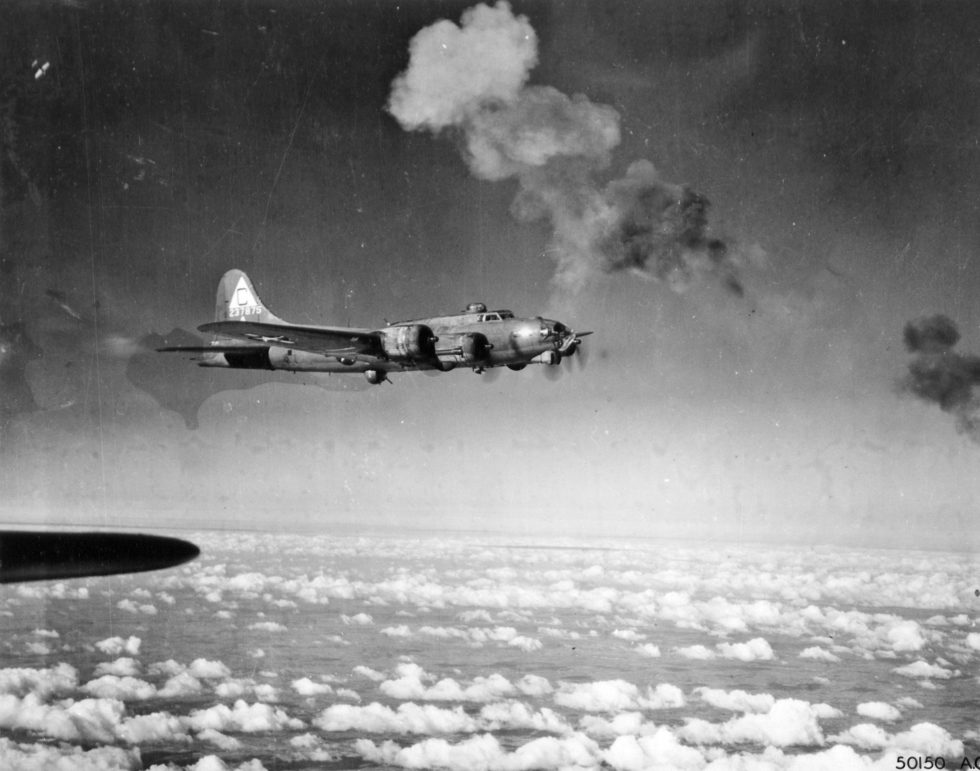
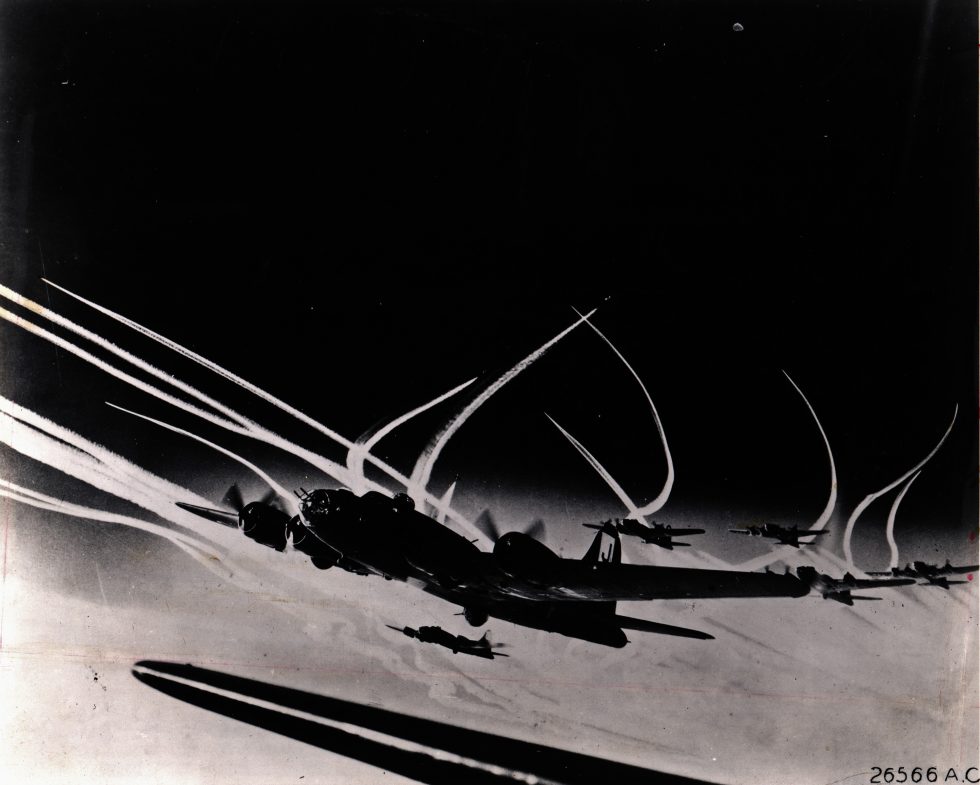
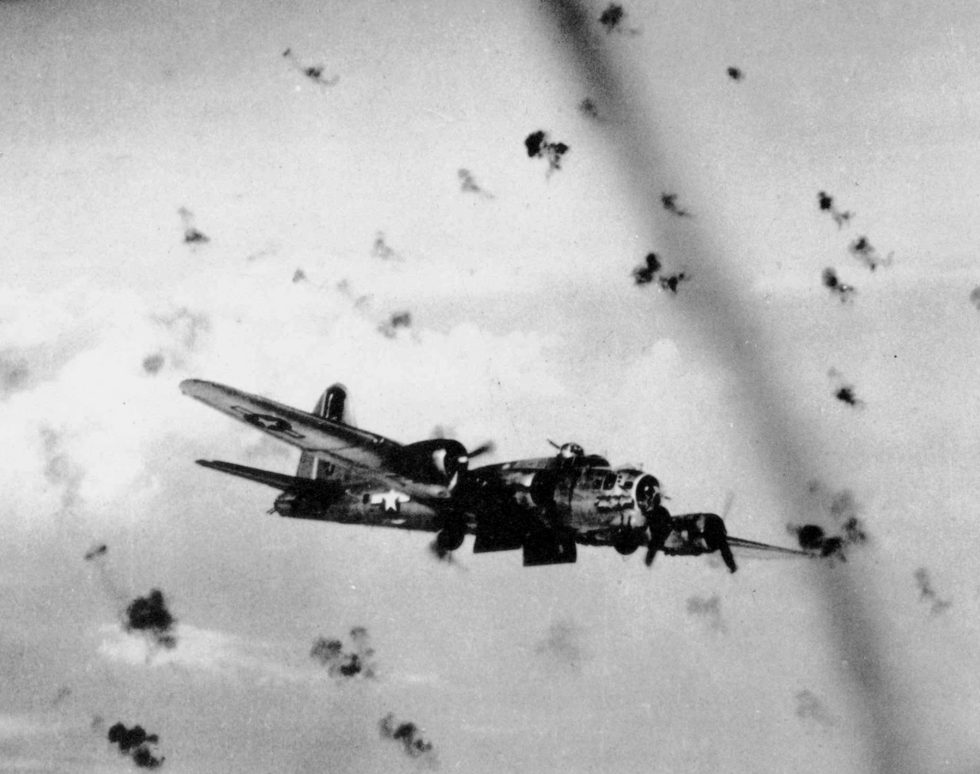
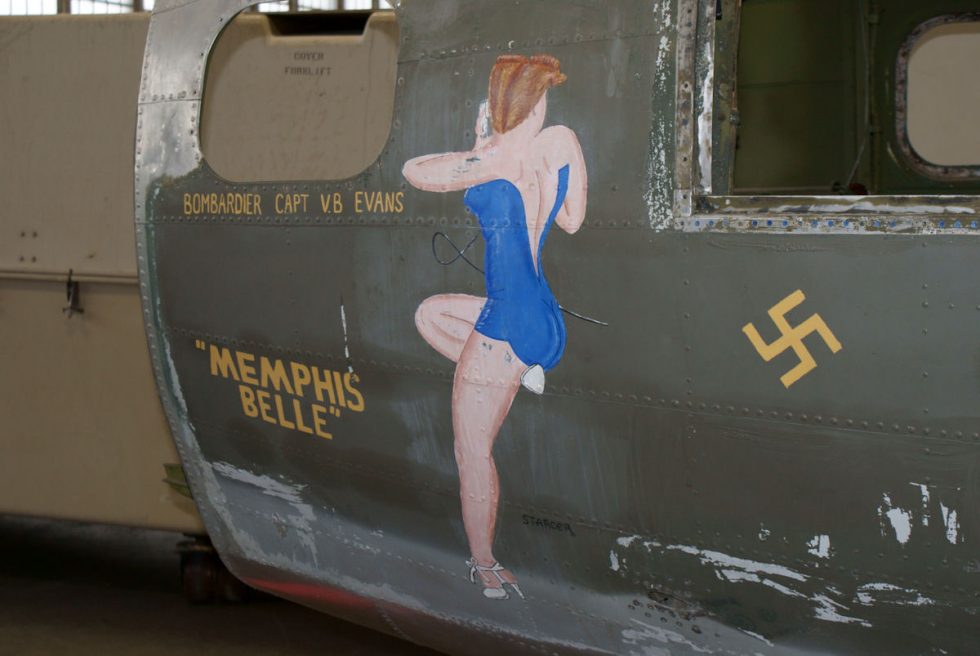
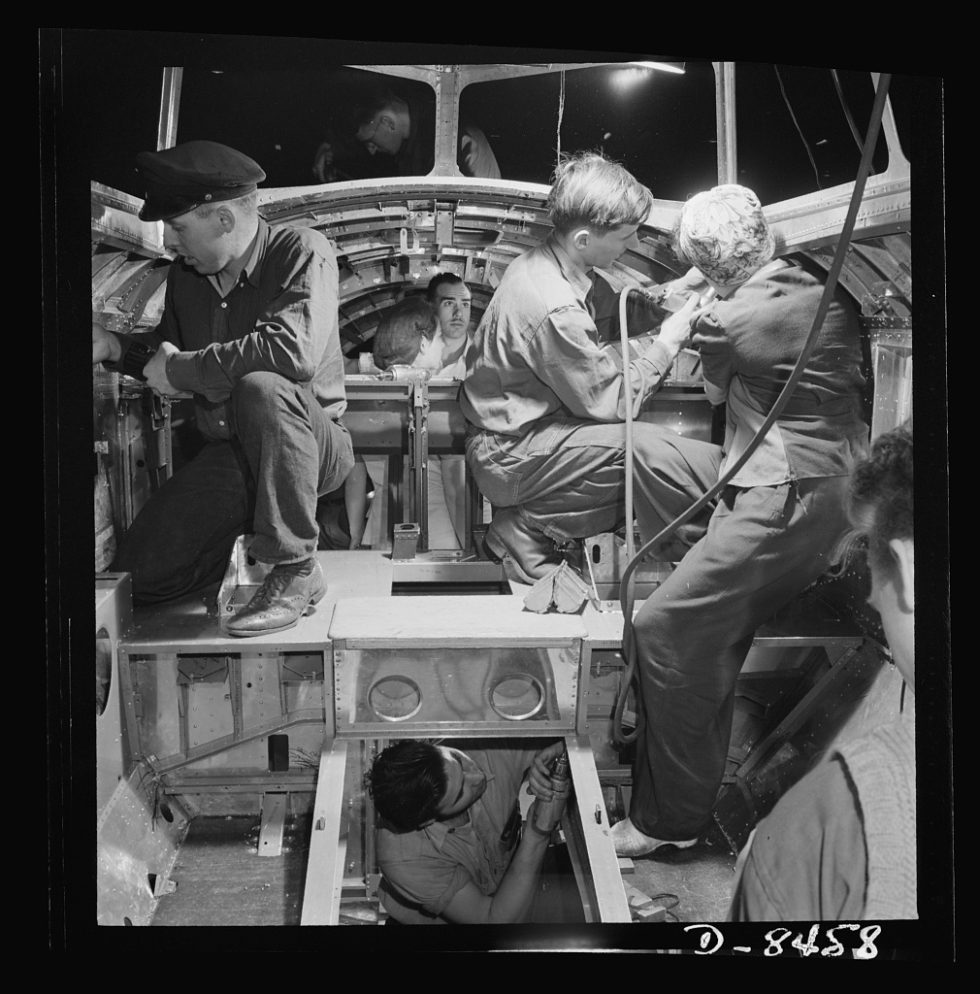
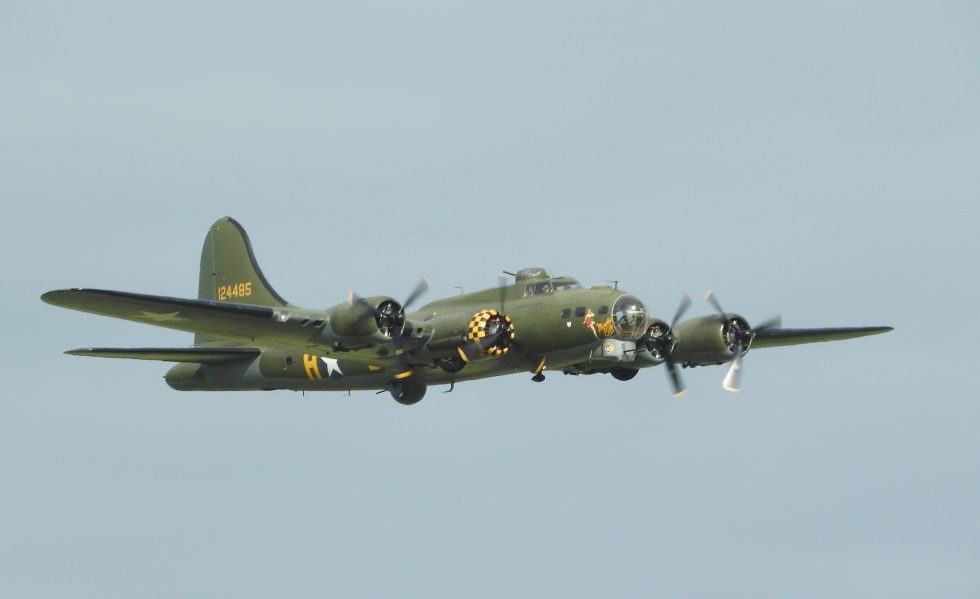
The Flying Fortress in motion
Video coming soon — we are sourcing a properly licensed, high-quality B-17 film to feature here. In the meantime, explore the photo gallery above and the operations map below to see where the Fortress flew.
Where the Flying Fortress flew
The score that defines the B-17
The Fortress is not measured in air-to-air kills but in tonnage dropped and punishment survived. It was the principal weapon of the Eighth Air Force’s daylight campaign over Europe — a campaign that cost thousands of bombers and tens of thousands of airmen, yet ultimately helped wreck German war industry and draw the Luftwaffe into a battle of attrition it could not win.
Compare the combat record of every military aircraft. Figures as of July 2026.
Everything people ask about the B-17 Flying Fortress
Can I fly in a B-17?
Why is the B-17 called the “Flying Fortress”?
How many .50-calibre guns did the B-17 carry?
Why did the B-17 suffer such heavy losses?
What was the Norden bombsight?
What was the Memphis Belle?
How many B-17s were built, and how many survive?
Was the B-17 better than the B-24 Liberator?
You can’t fly the B-17.
These, you can.
Some legends only live in museums — others are fuelled and waiting. MiGFlug has put civilians in real military jet cockpits since 2004.
 Fly the L-39 AlbatrosThe world’s most-flown jet trainer — aerobatics included
 Fly the F-104 Starfighter“The missile with a man in it”
 Fly the MiG-21The Cold War’s most-produced jet
 Fly the T-33 Shooting StarAmerica’s first jet trainer
 Fly the DH VampireA piece of early jet history
 Fly the S.211Agile Italian jet trainer
 Fly the MB-326The classic Aermacchi jet
 Fly the MiG-15The Soviet legend of the Korean War
Continue the tour
Every fact, checked
- National Museum of the US Air Force — Boeing B-17GCanonical B-17G specifications, armament and the ~12,731 total built.
- The National WWII Museum — Boeing B-17 Flying FortressDevelopment, the 1935 first flight, crew of ten and thirteen .50-cal guns.
- Imperial War Museums — B-17 vs B-24Specifications, turbo-supercharged Cyclones and the ruggedness reputation.
- National Museum of the US Air Force — Norden M-9 BombsightThe Norden bombsight and the daylight-precision doctrine.
- Imperial War Museums — How the Eighth Air Force defeated the LuftwaffeThe daylight campaign, 1943 losses and the P-51 escort turning point.
- The National WWII Museum — “Black Thursday”The second Schweinfurt raid and the catastrophic unescorted loss rates.
- National Museum of the US Air Force — Memphis BelleThe Memphis Belle and its 25 completed combat missions.
- The Aviation Geek Club — The “headless” B-17A vivid example of the Fortress’s legendary battle-damage survivability.