
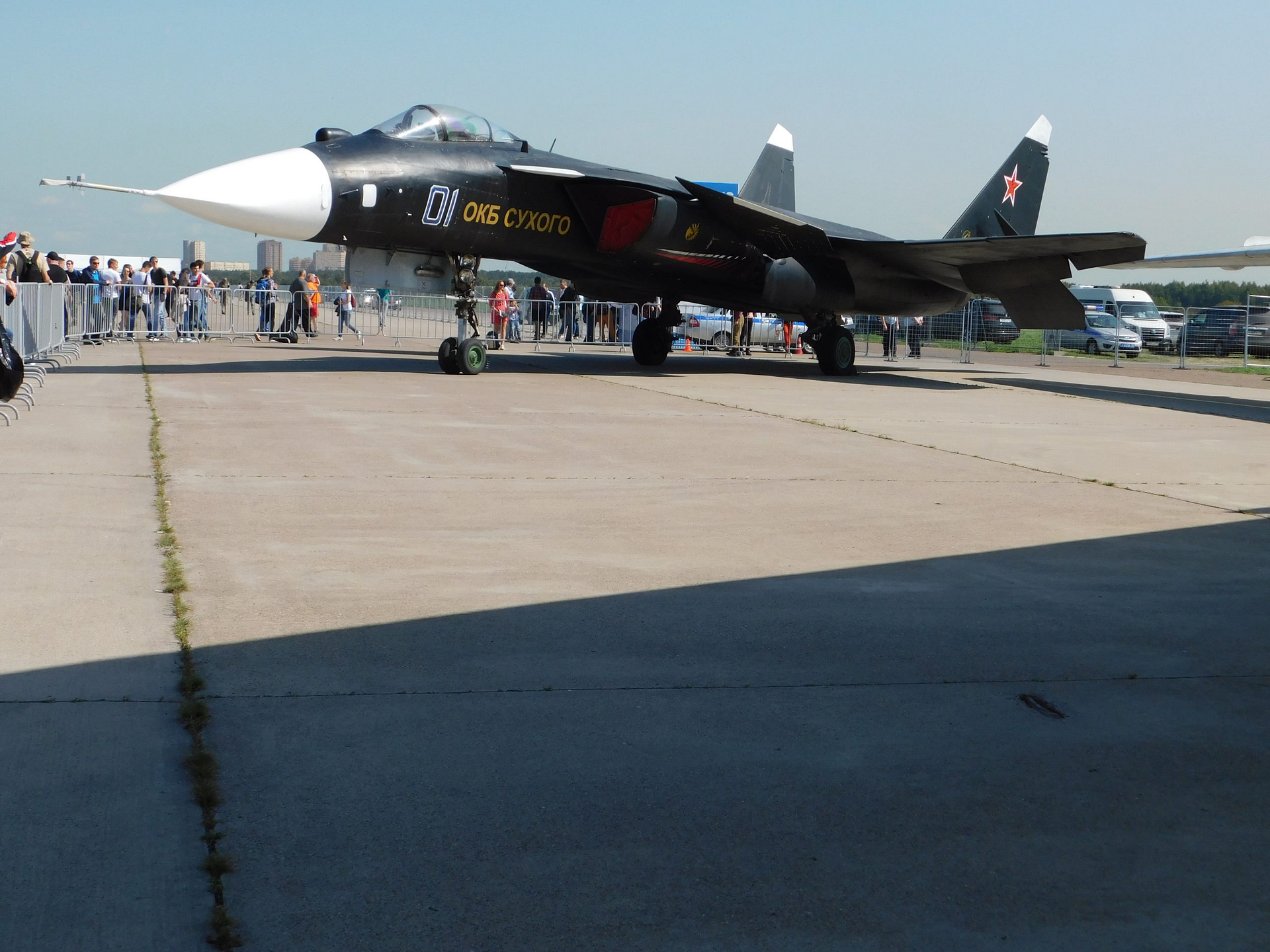
Sukhoi Su-47
“Berkut”
A single Russian technology demonstrator with dramatic forward-swept wings — built not to enter service, but to explore the aerodynamics, composites and flight-control ideas that would help shape a later generation of Sukhoi fighters.
The Sukhoi Su-47 Berkut: Russia’s forward-swept experiment
Few aircraft look as unmistakably wrong-way-round as the Sukhoi Su-47 Berkut. Its wings sweep forward rather than back, giving the jet the silhouette of an aircraft caught mid-transformation. That shape is the whole point of the machine — and the reason it existed at all. The Su-47 was never a fighter you could buy, deploy or fight with. It was a single technology demonstrator: one airframe, built by the Sukhoi design bureau to test ideas rather than to win wars.
The programme grew out of Soviet-era studies into forward-swept wings, a configuration long known to promise better low-speed handling and agility but held back by a stubborn structural problem. Work continued after the collapse of the USSR, largely as a Sukhoi initiative during a period when Russian defence budgets had all but evaporated. The aircraft first carried the internal designations S-32 and then S-37; it was publicly redesignated Su-47 around 2002. The name Berkut means “golden eagle.”
The sole Su-47 made its first flight on 25 September 1997, with Sukhoi chief test pilot Igor Votintsev at the controls. To get airborne at all it borrowed a pair of Aviadvigatel D-30F6 afterburning turbofans — the same engines that power the MiG-31 interceptor. A more advanced powerplant with thrust-vectoring was envisaged for any production derivative but was never fitted. In practice the demonstrator was flown conservatively, restricted to roughly Mach 1.6; the higher speeds sometimes quoted for it were design aspirations, not tested limits.
What the forward-swept wing offered was real: at high angles of attack it kept the airflow attached and the controls responsive, promising sharper manoeuvrability and gentler low-speed behaviour. What it demanded was equally real — a forward-swept wing wants to twist itself apart under load, a runaway effect called aeroelastic divergence. The Su-47 answered it not with brute metal but with carefully oriented carbon-fibre composite skins, tailored so the wing resists that twisting. In that sense the Berkut was as much a flying composites experiment as an aerodynamic one.
Over the following years the aircraft served as a flying laboratory. It flew at the MAKS airshow near Moscow, tested fly-by-wire control laws, and was later fitted with an internal weapons bay used for fit and integration trials — work that fed directly into Russia’s next-generation fighter effort, the PAK FA programme that became the Su-57. The Su-57 ultimately adopted a conventional swept wing, but the composites and systems experience gathered on the Berkut carried across.
Because it looks so purposeful, the Su-47 is frequently mistaken online and in popular culture for an operational warplane. It has appeared in numerous video games — most prominently the Ace Combat series — and in countless model kits. The reality is quieter and, in its way, more interesting: a one-off Russian research aircraft that never fired a shot, never entered service, and did its most important work as a testbed.
01The Su-47 Berkut’s designations: from S-32 and S-37 to Su-47
The aircraft went through several names, which is one reason it is so often muddled in online sources. Early studies used the internal designation S-32; the demonstrator that actually flew in 1997 was known as the S-37. Around 2002 Sukhoi re-badged it Su-47, a more production-sounding designation used for marketing the concept. It should not be confused with the unrelated Su-37 “Terminator,” a thrust-vectoring development of the Su-27 — a different aircraft entirely.
Whatever it was called, there was only ever one. Talk of a “fleet” of Su-47s, or of the type being fielded by the Russian Air Force, is a persistent myth. The single airframe is today kept at Zhukovsky, near Moscow, and has occasionally been rolled out for public display.
What makes the Su-47 special
The forward-swept wing
The Su-47’s defining feature is a wing that sweeps forward. Aerodynamically this keeps airflow attached toward the wing roots at high angles of attack, promising better low-speed handling, higher lift and sharper manoeuvrability than a conventional swept wing. The idea was not new — but making it work on a large, fast aircraft was the hard part.
Composite aeroelastic tailoring
A forward-swept wing tends to twist leading-edge-up under load, worsening the load in a runaway cycle called aeroelastic divergence that can tear the wing off. The Berkut’s answer was oriented carbon-fibre composite skins — laid up so the wing resists that specific twisting mode. The wings are overwhelmingly composite, making the aircraft as much a materials experiment as an aerodynamic one.
A flying laboratory, not a fighter
The Su-47 was a technology demonstrator. It carried no operational radar or weapons in service, and its borrowed D-30F6 engines were a means to an end. Its job was to test forward-swept aerodynamics, large composite structures, fly-by-wire control and — later — an internal weapons bay, feeding lessons into the Su-57 programme.
02The Su-47’s forward-swept wing: why the shape promises agility — and threatens to tear itself apart
On a conventional swept-back wing, airflow tends to drift outward toward the tips as the aircraft slows or pulls hard, so the tips stall first — and the tips carry the ailerons, so control is lost just when it is needed most. A forward-swept wing reverses that flow, moving air inward toward the roots. The tips keep flying and the controls keep biting at high angles of attack, which is why the layout promises better slow-speed handling and agility.
The price is structural. Because the wing sweeps forward, aerodynamic load twists the leading edge up, which increases the load, which twists it further — a feedback loop known as aeroelastic divergence. Build the wing from ordinary metal stiff enough to resist it and it becomes far too heavy. The solution, pioneered on the American Grumman X-29 and taken further on the Su-47, is aeroelastic tailoring: composite skins whose fibres are deliberately oriented so the wing bends and twists only in safe directions. The Berkut is, in effect, a demonstration that this can be done at fighter size.
03The Su-47 and the Su-57: what a one-off demonstrator handed to a real fighter
The Su-47 never became a production aircraft, and Russia’s fifth-generation fighter — the PAK FA, which entered service as the Su-57 — wears a conventional swept wing, not a forward-swept one. So what did the Berkut actually contribute? Chiefly experience: in building and flying very large composite structures, in fly-by-wire control of an unstable airframe, and in integrating an internal weapons bay, which the Su-47 carried in its later years as a test installation. Those are core competencies for any stealth-influenced fighter, and the Su-57 uses composites for roughly a quarter of its structure. The Berkut is best understood as one of several stepping stones — a research airframe that helped de-risk technologies, even though its signature feature was not carried forward.
Full Su-47 Berkut specifications
Airframe & Performance
- 全体人员
- 1
- 长度
- ~22.6 m
- 翼展
- ~16.7 m
- 高度
- ~6.4 m
- 空重
- Variously reported ~16,000–20,000 kg
- Max takeoff weight
- ~34,000 kg
- Demonstrated speed
- ~Mach 1.6
- Design speed (never cleared)
- ~Mach 2.1 · ~2,500 km/h
- Wing configuration
- Forward-swept, composite skins
- Canards
- Yes · all-moving foreplanes
Propulsion & Programme
- Engines
- 2 × Aviadvigatel D-30F6
- Thrust (each)
- ~152 kN with afterburner
- Intended engine
- Advanced thrust-vectoring type (never fitted)
- 武器
- None fitted · internal bay tested later
- First flight
- 25 September 1997 (as S-37)
- Test pilot
- Igor Votintsev
- Built
- 1 (technology demonstrator)
- Unit cost
- No reliable public figure
- Cost per flight hour
- No reliable public figure
04The Su-47’s operating costs: why no meaningful price exists
The Su-47 was a one-off research aircraft, never mass-produced and never sold, so there is no flyaway unit price and no credible cost-per-flight-hour figure for it in the public record. Development was funded partly by Sukhoi itself during the lean Russian defence years of the 1990s, and the airframe reused existing MiG-31 engines precisely to keep costs down. Any specific dollar figure attached to a Su-47 online is, in practice, an invention. What can be said is that as a single hand-built demonstrator packed with novel composite structures, its per-airframe cost bore no relation to a production fighter’s.
From forward-swept idea to museum piece
Soviet forward-swept studies
Soviet designers explore forward-swept wings for a future agile fighter, laying groundwork that survives the collapse of the USSR.
Sukhoi presses on
Amid collapsed defence budgets, Sukhoi continues the project largely on its own initiative, building a single demonstrator under the designations S-32 and S-37.
First flight
On 25 September the sole aircraft flies for the first time at Zhukovsky, with chief test pilot Igor Votintsev at the controls.
Public debut
The Berkut appears at the MAKS airshow near Moscow, its forward-swept wings making it one of the show’s most photographed aircraft.
Renamed Su-47
The demonstrator is publicly redesignated Su-47 “Berkut,” a more production-sounding name for the concept.
Weapons-bay testbed
Fitted with an internal weapons bay for fit and integration trials, the aircraft helps mature technologies for Russia’s PAK FA fifth-generation programme.
Lessons feed the Su-57
Composites and systems experience from the Berkut carries into the Su-57, which adopts a conventional wing but a heavily composite structure.
Rolled out at MAKS
The single airframe, long stored at Zhukovsky, is towed out for public display at the MAKS-2019 airshow. It is not in flying condition.
Twelve stories about the Berkut
A Soviet idea that outlived the Soviet Union
The forward-swept wing was studied in the USSR long before the Berkut flew in post-Soviet Russia.
Read the full story
Why the wings point the wrong way
Forward sweep keeps the airflow attached where it matters, promising control at high angles of attack.
Read the full story
The wing that wants to tear itself off
Forward-swept wings suffer aeroelastic divergence — solved on the Su-47 with tailored composites.
Read the full story
Borrowed hearts from a MiG-31
The demonstrator flew on two Aviadvigatel D-30F6 turbofans — the same engines as the MiG-31.
Read the full story
25 September 1997
Sukhoi chief test pilot Igor Votintsev took the sole Berkut into the air for the first time.
Read the full story
Three names, one aircraft
S-32, then S-37, then Su-47 — the shifting designations fuel endless online confusion.
Read the full story
A laboratory with wings
Beyond aerodynamics, the Su-47 tested fly-by-wire, composite structures and an internal weapons bay.
Read the full story
What the Su-57 kept — and dropped
The forward-swept wing did not survive; the composites and systems know-how did.
Read the full story
A Russian cousin to an American experiment
The Grumman X-29 explored the same forward-swept idea a decade earlier, at smaller scale.
Read the full story
The fighter that fights only in games
The Su-47 is a video-game and model-kit star — and constantly mistaken for an operational jet.
Read the full story
No, Russia does not fly a squadron of these
A durable myth casts the Su-47 as a fielded warplane; it never was.
Read the full story
Retired to Zhukovsky
The sole Berkut is preserved near Moscow and shown occasionally at airshows.
Read the full story
The Berkut in pictures
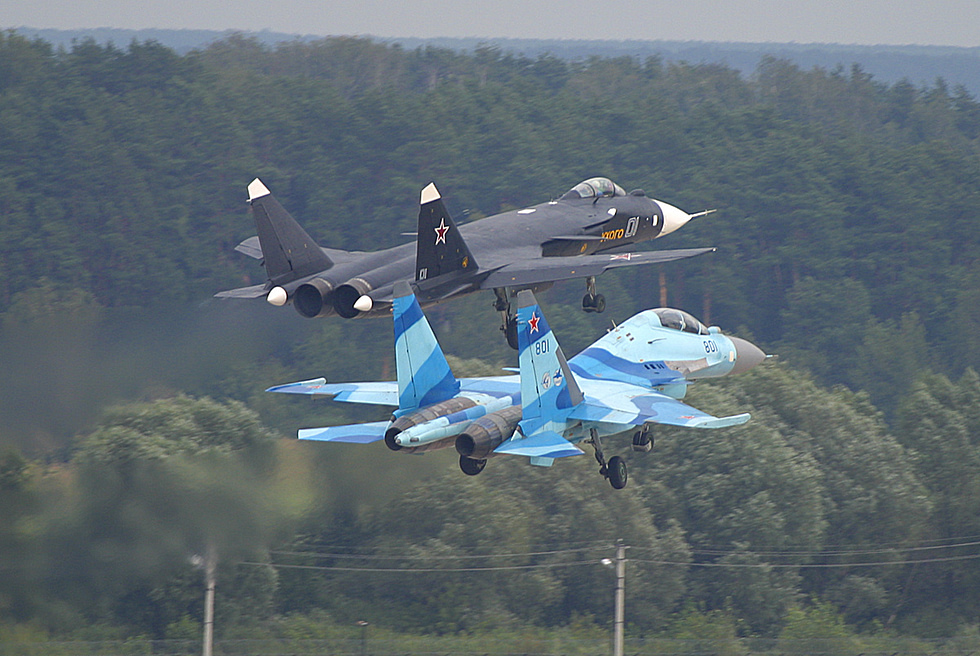
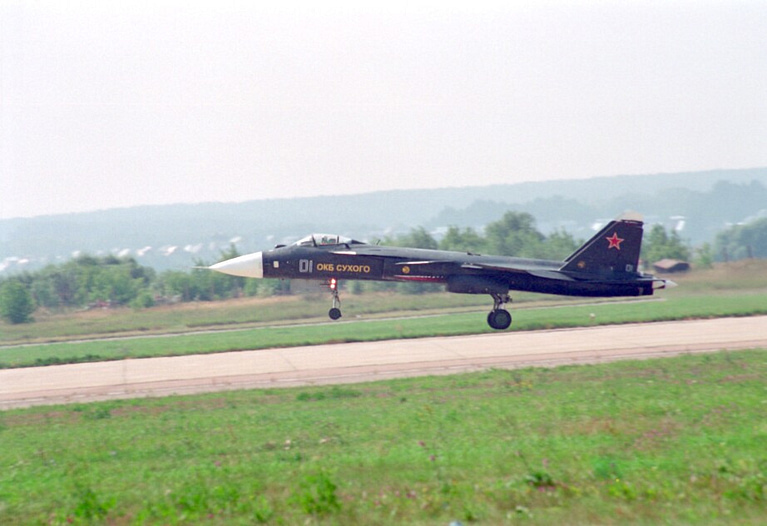
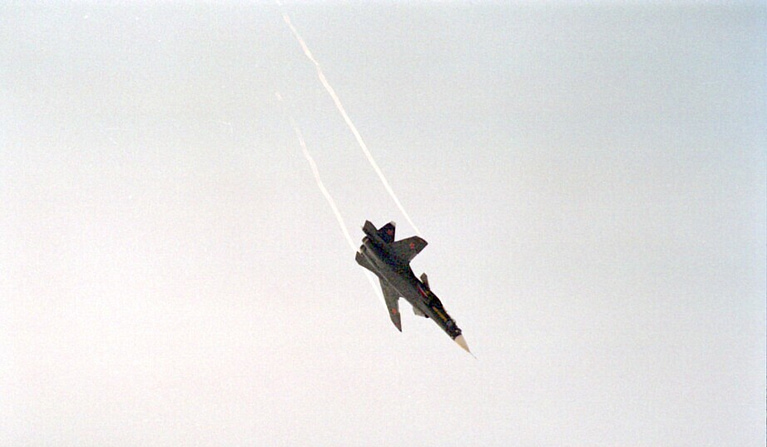
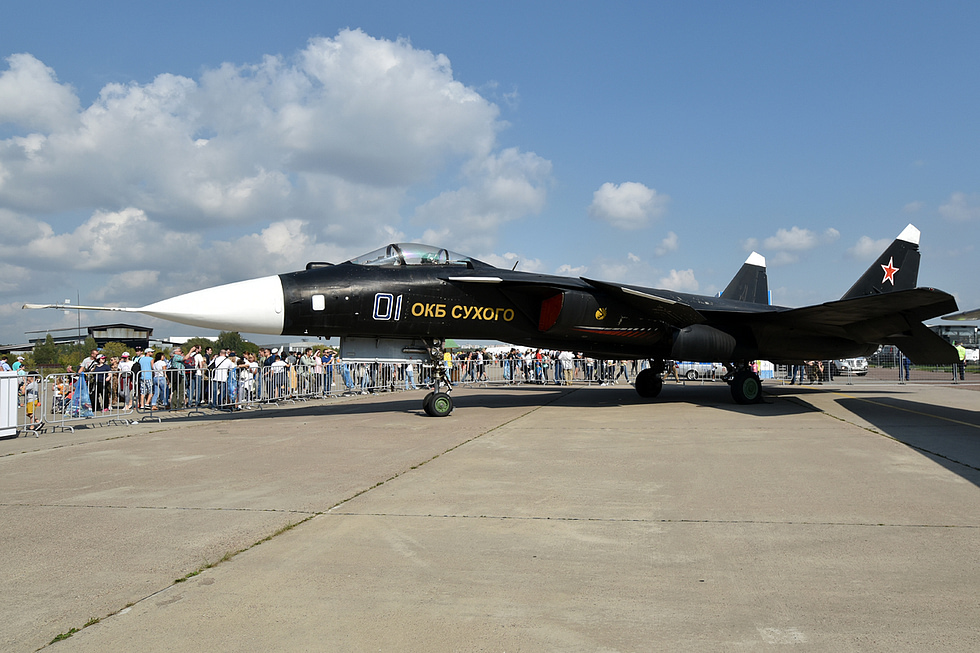
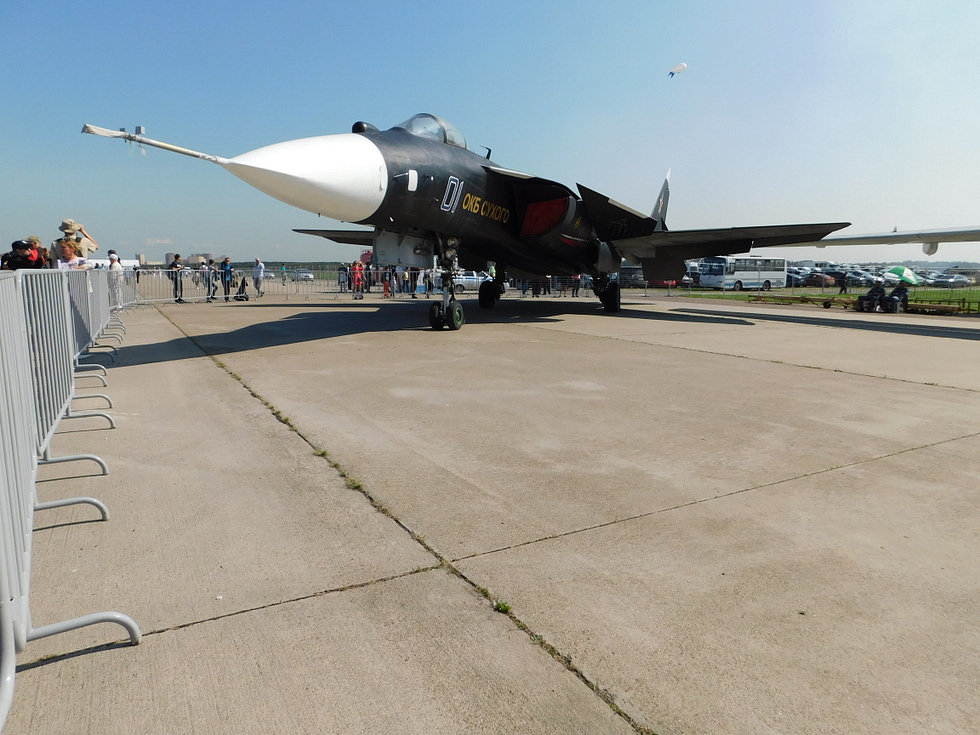
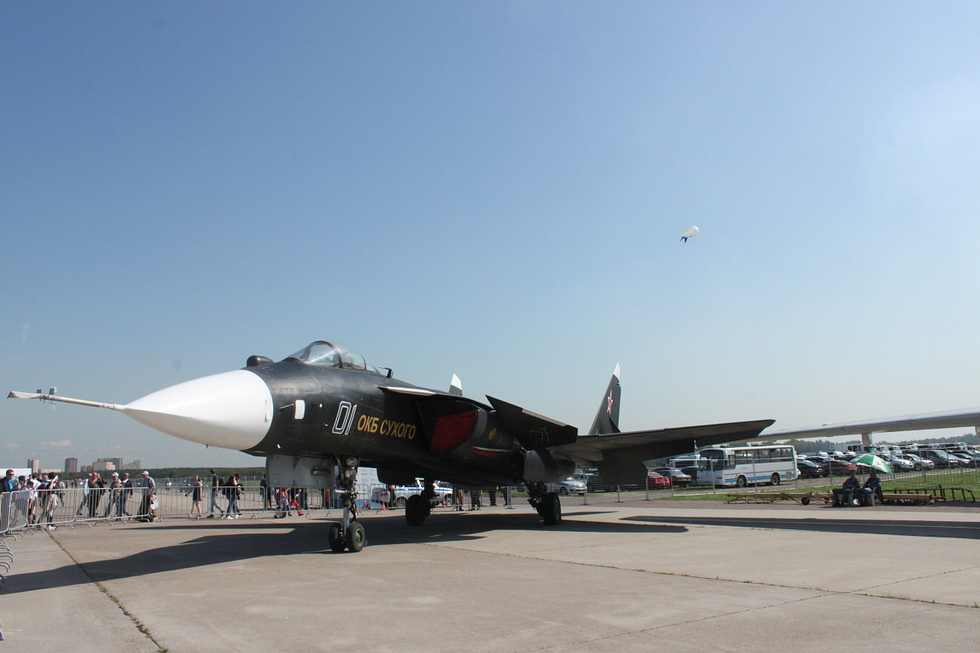
Where the Su-47 flew
An aircraft that never went to war
The Su-47 has no combat record, because it was never a combat aircraft. It flew no missions, scored no kills, and carried no weapons operationally. Its “record” is a research one: a single airframe that gathered flight data on forward-swept aerodynamics, large composite structures and fly-by-wire control over roughly two decades of testing, then retired to a museum apron. Measuring it against fighters that fought would be a category error — the Berkut was built to learn, not to win engagements.
For aircraft that did fight, see the wider combat record of every military aircraft. The Su-47’s value lies in the technologies it matured, described in the stories and Q&A above and below.
Everything people ask about the Su-47
Can I fly in a Su-47?
How many Su-47s were built?
Why does the Su-47 have forward-swept wings?
Was the Su-47 ever a real, operational fighter?
What engines did the Su-47 use?
Is the Su-47 related to the Su-57?
Where is the Su-47 now?
You can’t fly the Su-47.
These, you can.
Some legends only live in museums — others are fuelled and waiting. MiGFlug has put civilians in real military jet cockpits since 2004.
 Fly the L-39 AlbatrosThe world’s most-flown jet trainer — aerobatics included
 Fly the F-104 Starfighter“The missile with a man in it”
 Fly the MiG-21The Cold War’s most-produced jet
 驾驶T-33流星战斗机America’s first jet trainer
 Fly the DH VampireA piece of early jet history
 Fly the S.211Agile Italian jet trainer
 Fly the MB-326The classic Aermacchi jet
 Fly the MiG-15The Soviet legend of the Korean War
Continue the tour
Every fact, checked
- Airforce Technology — S-37 / Su-47Programme overview, dimensions, engines and the PAK FA connection.
- Aerospaceweb.org — S-37 BerkutDetailed technical entry on forward-swept aerodynamics and the X-29 comparison.
- GlobalSecurity.org — Su-47 specificationsFull spec table showing the range of published figures for weight and speed.
- Military Factory — Sukhoi Su-47Designation history (S-32 to Su-47), engines and demonstrator framing.
- Army Recognition — Su-47 Berkut at 25First-flight date, test pilot Igor Votintsev and the single-airframe history.
- National Security Journal — Su-47 BerkutThe internal weapons bay, the MAKS-2019 display and the Su-57 relationship.
- WarWings Daily — Su-47 technical analysisEngines, composites, aeroelastic tailoring and the Su-57 composites lineage.
- National Museum of the USAF — Grumman X-29Reference for the American forward-swept experiment the Berkut is often compared with.