
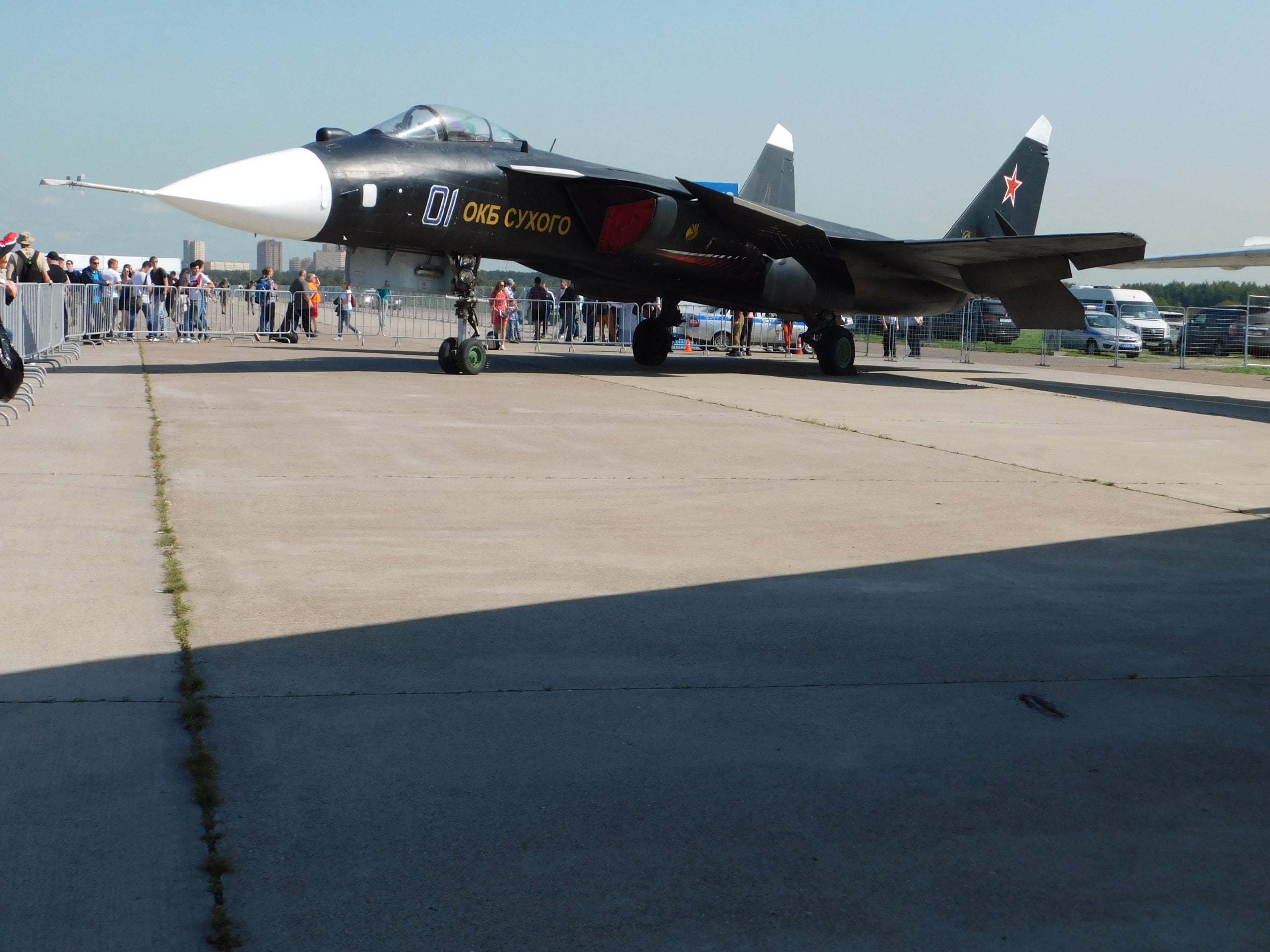
Sukhoi Su-47
“Berkut”
A single Russian technology demonstrator with dramatic forward-swept wings — built not to enter service, but to explore the aerodynamics, composites and flight-control ideas that would help shape a later generation of Sukhoi fighters.
The Sukhoi Su-47 Berkut: Russia’s forward-swept experiment
Few aircraft look as unmistakably wrong-way-round as the Sukhoi Su-47 Berkut. Its wings sweep forward rather than back, giving the jet the silhouette of an aircraft caught mid-transformation. That shape is the whole point of the machine — and the reason it existed at all. The Su-47 was never a fighter you could buy, deploy or fight with. It was a single technology demonstrator: one airframe, built by the Sukhoi design bureau to test ideas rather than to win wars.
The programme grew out of Soviet-era studies into forward-swept wings, a configuration long known to promise better low-speed handling and agility but held back by a stubborn structural problem. Work continued after the collapse of the USSR, largely as a Sukhoi initiative during a period when Russian defence budgets had all but evaporated. The aircraft first carried the internal designations S-32 and then S-37; it was publicly redesignated Su-47 around 2002. The name Berkut means “golden eagle.”
The sole Su-47 made its first flight on 25 September 1997, with Sukhoi chief test pilot Igor Votintsev at the controls. To get airborne at all it borrowed a pair of Aviadvigatel D-30F6 afterburning turbofans — the same engines that power the MiG-31 interceptor. A more advanced powerplant with thrust-vectoring was envisaged for any production derivative but was never fitted. In practice the demonstrator was flown conservatively, restricted to roughly Mach 1.6; the higher speeds sometimes quoted for it were design aspirations, not tested limits.
What the forward-swept wing offered was real: at high angles of attack it kept the airflow attached and the controls responsive, promising sharper manoeuvrability and gentler low-speed behaviour. What it demanded was equally real — a forward-swept wing wants to twist itself apart under load, a runaway effect called aeroelastic divergence. The Su-47 answered it not with brute metal but with carefully oriented carbon-fibre composite skins, tailored so the wing resists that twisting. In that sense the Berkut was as much a flying composites experiment as an aerodynamic one.
Over the following years the aircraft served as a flying laboratory. It flew at the MAKS airshow near Moscow, tested fly-by-wire control laws, and was later fitted with an internal weapons bay used for fit and integration trials — work that fed directly into Russia’s next-generation fighter effort, the PAK FA programme that became the Su-57. The Su-57 ultimately adopted a conventional swept wing, but the composites and systems experience gathered on the Berkut carried across.
Because it looks so purposeful, the Su-47 is frequently mistaken online and in popular culture for an operational warplane. It has appeared in numerous video games — most prominently the Ace Combat series — and in countless model kits. The reality is quieter and, in its way, more interesting: a one-off Russian research aircraft that never fired a shot, never entered service, and did its most important work as a testbed.
01The Su-47 Berkut’s designations: from S-32 and S-37 to Su-47
The aircraft went through several names, which is one reason it is so often muddled in online sources. Early studies used the internal designation S-32; the demonstrator that actually flew in 1997 was known as the S-37. Around 2002 Sukhoi re-badged it Su-47, a more production-sounding designation used for marketing the concept. It should not be confused with the unrelated Su-37 “Terminator,” a thrust-vectoring development of the Su-27 — a different aircraft entirely.
Whatever it was called, there was only ever one. Talk of a “fleet” of Su-47s, or of the type being fielded by the Russian Air Force, is a persistent myth. The single airframe is today kept at Zhukovsky, near Moscow, and has occasionally been rolled out for public display.
What makes the Su-47 special
The forward-swept wing
The Su-47’s defining feature is a wing that sweeps forward. Aerodynamically this keeps airflow attached toward the wing roots at high angles of attack, promising better low-speed handling, higher lift and sharper manoeuvrability than a conventional swept wing. The idea was not new — but making it work on a large, fast aircraft was the hard part.
Composite aeroelastic tailoring
A forward-swept wing tends to twist leading-edge-up under load, worsening the load in a runaway cycle called aeroelastic divergence that can tear the wing off. The Berkut’s answer was oriented carbon-fibre composite skins — laid up so the wing resists that specific twisting mode. The wings are overwhelmingly composite, making the aircraft as much a materials experiment as an aerodynamic one.
A flying laboratory, not a fighter
The Su-47 was a technology demonstrator. It carried no operational radar or weapons in service, and its borrowed D-30F6 engines were a means to an end. Its job was to test forward-swept aerodynamics, large composite structures, fly-by-wire control and — later — an internal weapons bay, feeding lessons into the Su-57 programme.
02The Su-47’s forward-swept wing: why the shape promises agility — and threatens to tear itself apart
On a conventional swept-back wing, airflow tends to drift outward toward the tips as the aircraft slows or pulls hard, so the tips stall first — and the tips carry the ailerons, so control is lost just when it is needed most. A forward-swept wing reverses that flow, moving air inward toward the roots. The tips keep flying and the controls keep biting at high angles of attack, which is why the layout promises better slow-speed handling and agility.
The price is structural. Because the wing sweeps forward, aerodynamic load twists the leading edge up, which increases the load, which twists it further — a feedback loop known as aeroelastic divergence. Build the wing from ordinary metal stiff enough to resist it and it becomes far too heavy. The solution, pioneered on the American Grumman X-29 and taken further on the Su-47, is aeroelastic tailoring: composite skins whose fibres are deliberately oriented so the wing bends and twists only in safe directions. The Berkut is, in effect, a demonstration that this can be done at fighter size.
03The Su-47 and the Su-57: what a one-off demonstrator handed to a real fighter
The Su-47 never became a production aircraft, and Russia’s fifth-generation fighter — the PAK FA, which entered service as the Su-57 — wears a conventional swept wing, not a forward-swept one. So what did the Berkut actually contribute? Chiefly experience: in building and flying very large composite structures, in fly-by-wire control of an unstable airframe, and in integrating an internal weapons bay, which the Su-47 carried in its later years as a test installation. Those are core competencies for any stealth-influenced fighter, and the Su-57 uses composites for roughly a quarter of its structure. The Berkut is best understood as one of several stepping stones — a research airframe that helped de-risk technologies, even though its signature feature was not carried forward.
Full Su-47 Berkut specifications
Baseline note: the figures below describe the single Sukhoi S-37 Berkut as flown — one airframe, carrying the white side number 01, first flown at Zhukovsky on 25 September 1997 and redesignated Su-47 in 2002. There was never a second aeroplane, never a production standard and never a service configuration, so there are no marks and no deltas in the usual sense; where the sources disagree the disagreement is noted in grey instead. Four of those disagreements are worth settling before the tables start. First, the wing: English-language references give a span of 16.7 m and a wing area of 56 m², German and some Russian tables give 15.16 m and 61.87 m², and the two pairs cannot both be right — they imply aspect ratios of 5.0 and 3.7 for the same wing. The 16.7 m and 56 m² pairing is the one most widely repeated and is used here. Second, the engines: most Russian sources say the aeroplane flew on D-30F6 turbofans lifted straight from the MiG-31, while several Western references list the D-30F11, a Perm derivative of the same engine tailored to the S-37; the airframe flew on a MiG-31 engine either way. Third, the weights: the 24,000–26,000 kg often printed as "empty weight" is almost certainly the 25,670 kg normal take-off weight misfiled, because Sukhoi never published an empty weight for this aircraft. Fourth, the speeds: 2,200 km/h and Mach 2.1 are design aspirations for a fighter that was never built, not measurements. The Su-47 was cleared to Mach 1.6 and is credited with reaching about Mach 1.65. Everything above that number in a published table is arithmetic, not flight test.
Dimensions & weights
- Crew
- 1 — in a cockpit lifted essentially whole from the Su-27 family, canopy and ejection seat included. That was a deliberate economy: the money the programme had left was spent on the wing, not on rediscovering how to seat a pilot.
- Length
- 22.6 m (74 ft 2 in) including the flight-test nose probe. Some tables give 22.2 m (72 ft 10 in), which is probably the airframe without the probe. That makes the Berkut about half a metre longer than an Su-27, and more than 50 per cent longer than the Grumman X-29.
- Wingspan
- 16.7 m (54 ft 9 in) as most commonly published. A minority of sources, including the German reference literature, give 15.16 m (49 ft 9 in). The gap is too large to be a rounding error and probably reflects one figure being taken over the wingtips and the other over the structural wing box.
- Height
- 6.4 m (21 ft 0 in) to the top of the fins; 6.36 m (20 ft 10 in) in some tables. The canted fins are Su-27 items, reused rather than redesigned.
- Wing area
- 56 m² (603 sq ft) as usually quoted; 61.87 m² (666 sq ft) in the German literature. Either way it is a very large wing — three to three and a half times the area of the X-29’s, on an aeroplane four times the weight.
- Aspect ratio
- 5.0 on the 16.7 m and 56 m² figures; 3.7 on the 15.16 m and 61.87 m² figures. Publishing both pairs as though they described the same aeroplane is the clearest evidence that nobody outside Sukhoi has the real geometry.
- Wing sweep
- About 20° forward at the quarter chord — and this figure should be treated as an estimate from photographs rather than a released number, because Sukhoi has never published the geometry. What matters is the comparison: the X-29 was swept 29.3° forward at the leading edge, so the Berkut’s wing is markedly less aggressive. Less forward sweep means a less critical divergence problem, which is one reason a much bigger wing could be built without a much bigger structural gamble.
- Wing planform
- Cranked, with a broad fixed root glove ahead of the swept-forward outer panels — the outer panels carry the flaperons and ailerons, the glove carries the main structural join. It is not the clean single-taper wing of the X-29; it is a fighter wing that happens to sweep the wrong way.
- Empty weight
- Not published — and the 24,000–26,000 kg (52,900–57,300 lb) that circulates in online tables is the normal take-off weight, repeated in the wrong column. An honest table says it does not know.
- Normal take-off weight
- 25,670 kg (56,590 lb) — the figure given consistently across Russian and Western sources, and the only weight for this aeroplane that all of them agree on.
- Maximum take-off weight
- 34,000 kg (74,960 lb). A minority of tables give 35,000 kg (77,160 lb). For scale, an Su-27 tops out near 30,000 kg, so the Berkut is a genuinely heavy aeroplane, not a scaled research article.
- Wing loading
- 458 kg/m² at normal take-off weight (94 lb/sq ft), on the 56 m² figure; 415 kg/m² (85 lb/sq ft) if the wing really is 61.87 m². Low for a heavy fighter either way, which is exactly what you would expect of an aeroplane built to explore manoeuvring lift.
- Number built
- 1 — airframe 01. A second flying article was laid out and abandoned on cost grounds; the airframe that exists is the only one that ever existed.
Performance
- Maximum speed demonstrated
- About Mach 1.65 — roughly 1,750 km/h (1,090 mph) at altitude. This is the number the aeroplane actually reached, and it is the number that matters.
- Maximum speed quoted
- 2,200 km/h at altitude (1,370 mph), Mach 2.1. This is a design figure for a notional production fighter with different engines and variable intakes. The Berkut as built never approached it and was never cleared to try.
- Speed limit imposed
- Mach 1.6 — the initial flight-test restriction, set by the structure and by the fixed-geometry intakes rather than by the engines, which in a MiG-31 are good for Mach 2.83.
- Maximum speed at sea level
- 1,400 km/h (870 mph), Mach 1.14 — also a quoted rather than a demonstrated figure.
- Rate of climb
- 233 m/s (45,900 ft/min) as published. Plausible for 304 kN of reheat under 25.7 tonnes, but it is a calculated figure, not a stopwatch one.
- Service ceiling
- 18,000 m (59,000 ft) — the standard Su-27-family number, and unsurprising given how much of the Su-27 is in this airframe.
- Range
- 3,300 km (2,050 miles, 1,780 nm) on internal fuel, as quoted. One of the claimed virtues of forward sweep is better subsonic cruise efficiency, so this figure carries an argument inside it — but no independent test data supports it.
- Combat radius
- Not published — and meaningless for an aeroplane with no combat fit, no radar and no weapons.
- Load factor
- +9 g design limit. Whether the composite wing was ever taken there in flight is not stated in any public source; the structural test article, not the flying one, is where that case was proved.
- Thrust-to-weight ratio
- 1.21 at normal take-off weight, 0.91 at maximum — computed from 2 × 152 kN against 25,670 kg and 34,000 kg. Published tables give 1.29 and 1.00, which requires either more thrust or less aeroplane than the other figures in the same tables allow.
- Angle-of-attack behaviour
- Aileron authority retained well beyond the angle at which a conventional swept wing loses it — this is the real aerodynamic dividend and the Berkut demonstrated it. The frequently repeated claim of controlled flight at 90° angle of attack is a brochure line, not a test result.
Propulsion & systems
- Engines
- 2 × Aviadvigatel (formerly Soloviev) D-30F6 afterburning turbofans — the MiG-31 interceptor engine, taken off the shelf because it was the only Russian engine in the thrust class that existed, was in production and could be had. Several Western references give the designation D-30F11, a Perm derivative adapted to the S-37 installation; the disagreement is about the suffix, not about the provenance.
- Thrust
- 93.1 kN dry (20,900 lbf) and 152 kN with reheat (34,000 lbf, 15,500 kgf) per engine — 304 kN in total, which is roughly a fifth more than a standard Su-27.
- Intended engine
- Saturn/Lyulka AL-41F — the fifth-generation engine of the Soviet I-90 requirement, in the 175–196 kN class with thrust vectoring and supersonic cruise without reheat. It was never fitted. The Berkut flew its entire career on an interim engine, and every supersonic figure quoted for it assumes an engine it never had.
- Nozzles
- Plain axisymmetric, fixed — two-dimensional and three-dimensional vectoring nozzles were planned for later phases and never installed. Thrust vectoring on Sukhoi aircraft was proved elsewhere, on the Su-37 and the Su-30MKI, not here.
- Air intakes
- Fixed-geometry side intakes with no variable ramps — the single most telling detail in the aeroplane. A fighter meant to cruise beyond Mach 2 needs variable intake geometry. The Berkut did not have it, which is proof in metal that supersonic performance was never what this airframe was for.
- Flight control system
- Digital fly-by-wire, no mechanical reversion — developed out of the Su-27M work rather than written from scratch. This is a real difference from the X-29: the American aeroplane was 35 per cent statically unstable and would have departed in under a second without its triplex computers, whereas the Berkut is a relaxed-stability fighter of conventional Russian practice that happens to have its wing on backwards.
- Layout
- Longitudinal triplane: all-moving canards, forward-swept wing, all-moving tailplanes — three lifting surfaces in tandem, which is the Berkut’s other genuine novelty. The canards unload the wing root and control the wing’s spanwise flow at high angle of attack; the small aft tailplanes, mounted on the tail booms, give pitch authority the canards alone could not. Neither the X-29 nor the Su-57 uses this arrangement.
- Wing structure
- Carbon-fibre composite skin panels over a metal substructure, laid up so that bending twists the wing leading edge down — the same aeroelastic tailoring principle the X-29 proved, applied to a wing three times the area on an aeroplane four times the weight. That scaling, not the principle, is the Berkut’s structural contribution. The panels were among the largest one-piece composite aircraft structures built in Russia at the time.
- Composite content
- About 13 per cent of airframe structural weight — modest by the standards of the F-22 that the programme was answering, and a fair measure of how far Soviet and Russian composite manufacturing had actually got by the mid-1990s as opposed to how far the papers claimed.
- Airframe commonality
- Su-27 forward fuselage, canopy, vertical fins and landing gear — a deliberate cost decision, and the reason a bankrupt design bureau could build a 25-tonne demonstrator at all. It also means that anything the Berkut proved about handling was proved with a known quantity ahead of the cockpit and a known quantity under it.
- Tail booms
- Two booms of unequal length flanking the engines — the longer one was provisioned for a rearward-facing radar, the shorter houses the braking parachute. The rearward radar was never installed.
- Radar and mission avionics
- None fitted — the nose was provisioned for a radar and carried ballast instead. No fire control, no mission computer, no weapon interface was ever installed in the aeroplane. This is not a criticism; it is the definition of a technology demonstrator, and it is the fact most often lost when the Berkut is written up as a cancelled fighter.
- Internal fuel
- Not published — Sukhoi has never released a figure, and the 3,300 km range claim therefore cannot be checked against a fuel load.
04The Su-47’s operating costs: why no meaningful price exists
The Su-47 was a one-off research aircraft, never mass-produced and never sold, so there is no flyaway unit price and no credible cost-per-flight-hour figure for it in the public record. Development was funded partly by Sukhoi itself during the lean Russian defence years of the 1990s, and the airframe reused existing MiG-31 engines precisely to keep costs down. Any specific dollar figure attached to a Su-47 online is, in practice, an invention. What can be said is that as a single hand-built demonstrator packed with novel composite structures, its per-airframe cost bore no relation to a production fighter’s.
Armament & payload
The Su-47 never carried a weapon, and the empty bay in its belly is the most important thing it ever held
The Berkut was unarmed for its entire life. No gun was fitted, no pylon was hung, no missile was ever carried or released, and no fire-control system was ever installed to command one. What it did have — and what makes it more than a flying wind-tunnel model — was a real internal weapons bay in a real fighter-sized fuselage, which is a structural and aerodynamic problem quite separate from aerodynamics of the wing. Cutting a large hole in the load-bearing belly of a supersonic aeroplane, hanging doors on it that must open at speed without wrecking the airflow into the engines or the stability of the aircraft, and finding room for the actuators and the missile ejectors, is exactly the problem Russia had never solved and had to solve before the T-50 could exist.
The six cards below therefore describe what the aeroplane actually carried, what it was provisioned for and what it was pointedly not given, rather than six columns of "none carried". The distinction matters because the Berkut is routinely written up as a fighter that was cancelled. It was not. It was a demonstrator that did its job and stopped. Every weapon named in the fourth card below comes from Sukhoi marketing material and Western intelligence summaries describing a projected production aircraft. None of it was ever fitted to airframe 01, and treating those lists as the Su-47’s armament is the single most common error made about this aeroplane.
Gun: none fitted, and the bay left empty
- No cannon was installed at any point. The Su-27 forward fuselage the Berkut inherited has a gun installation on the starboard wing root for the GSh-30-1 30 mm single-barrel gun, but on airframe 01 that volume went to test instrumentation and ballast.
- No ammunition tank, no feed, no gun gas venting and no blast panel were fitted. Photographs showing the characteristic Su-27 gun port on the starboard leading-edge extension are showing an inherited fairing, not a weapon.
- A projected production Su-47 was described as carrying one GSh-30-1 with 150 rounds, on the standard Sukhoi pattern. That description was never realised in hardware.
- Nor was there ever a gunsight, a head-up display driving a gunnery solution, or a radar to feed one. The Berkut’s cockpit was a flight-test cockpit.
The internal weapons bay, which is the real payload story
- The airframe was built with an internal weapons bay in the centre fuselage — the feature that most clearly separates the Berkut from the X-29 and marks it as a fighter demonstrator rather than an aerodynamic one.
- Published descriptions of the projected fighter give one main bay sized for four medium-range air-to-air missiles, with a second forward bay ahead of the nose gear for two short-range weapons in the production layout. Airframe 01 carried the main bay only.
- The bay work was the Berkut’s most direct contribution to the Su-57. Bay geometry, door kinematics, the acoustic and buffet environment inside an open bay at speed, and ejector launcher installation were all problems Sukhoi had to learn on a real airframe, and the Berkut was the airframe available.
- The Su-57 as built uses a different bay arrangement from the one sketched for the Su-47 — two main tandem bays plus side bays for short-range missiles — so the inheritance is method rather than geometry.
- No weapon was ever ejected from the Berkut’s bay in flight in any account that can be verified. The bay was a structural and aerodynamic testbed, not a release-trials aircraft.
External stations: provisioned, never used
- The projected production aircraft was described with up to fourteen stations — wingtip rails, six to eight underwing and four to six under the fuselage — on the usual Su-27-family pattern.
- Airframe 01 flew clean throughout its career. No pylon was fitted, no store was carried, and the wiring and stores-management plumbing that would have been needed were never installed.
- This is not an oversight. A wing whose entire reason for existing is its aeroelastic behaviour under load is the last wing on which anyone wants to hang an unrepresentative concentrated mass. Keeping it clean kept the structural data clean.
- The one external fit the aeroplane did carry was a long flight-test nose probe, which is why its length is quoted two ways.
The paper armament, listed once and labelled as paper
- Air-to-air, as projected: R-77 (AA-12 Adder) and the extended-range R-77PD for beyond visual range, R-73 (AA-11 Archer) and the developed K-74 for close combat.
- Air-to-surface, as projected: Kh-29T and Kh-29L (AS-14 Kedge), Kh-59M (AS-18 Kazoo), Kh-31P and Kh-31A (AS-17 Krypton), with KAB-500 and KAB-1500 guided bombs.
- All of it is drawn from Sukhoi’s own promotional material for a fighter derived from the Berkut and from Western reference works repeating it. None of it describes the aeroplane that flew.
- The lists are worth printing precisely because they are so widely reprinted as fact. An encyclopedia that omits them leaves the reader to find them somewhere less careful.
- The honest summary: the Su-47’s armament is a marketing document, and its payload is a set of strain gauges.
Sensors and instrumentation: what it did carry
- A flight-test noseboom with angle-of-attack and sideslip vanes, feeding the air data the fly-by-wire system needed and the test engineers wanted.
- Strain gauge and accelerometer instrumentation through the composite wing box and its metal carry-through, because the divergence and bending-torsion behaviour of that wing was the whole point of building the aeroplane.
- Tufting and flow-visualisation fits at various times to study spanwise flow and the canard-wing vortex interaction at high angle of attack.
- No radar, no infrared search and track, no radar warning receiver, no defensive aids. The tail-boom radome that catches the eye in photographs is a provision, not an installation.
- A braking parachute in the shorter tail boom, and a conventional Su-27-family landing gear beneath — both inherited, both unremarkable, both chosen so that nothing outside the experiment could go wrong.
What it was denied, and what that cost
- It never received the AL-41F engines the programme was designed around. Without them there was no supercruise, no thrust vectoring and no honest supersonic case — and the fixed intakes meant the airframe could not have used the thrust anyway.
- It never received a radar or a mission system, so nothing about the Berkut’s combat effectiveness was ever tested, modelled in flight or demonstrated. Any claim about how it would have fought is speculation.
- It never received a low-observable treatment. The forward-swept wing, the canards, the exposed compressor faces and the slab-sided intakes make it a poor radar target in the wrong sense of the phrase, and by the late 1990s that alone disqualified the configuration from being a fifth-generation fighter.
- The second flying airframe, which would have allowed a proper two-aircraft test programme in the way the X-29 had, was abandoned on cost. Everything the Berkut demonstrated, it demonstrated with a sample of one.
- The result is an aeroplane that proved subsonic and transonic handling, aileron authority at high angle of attack, and that a large forward-swept composite wing could be built and flown safely. It proved nothing about combat capability, and it was never asked to.
Three representative test configurations
- Envelope expansion, 1997–1999
- Clean airframe, noseboom, full structural instrumentation, nose ballast in place of radar. Flown out of Zhukovsky to establish flutter and loads margins and to work the fly-by-wire control laws against a wing nobody had flown at this size. The Mach 1.6 restriction dates from this phase.
- High angle-of-attack and departure resistance
- Clean airframe with flow visualisation and additional air data instrumentation, exploring the canard-wing-tailplane triplane at the angles where a conventional swept wing loses its ailerons first. This is where the forward-swept wing earns its keep and where the Berkut’s data was genuinely new to Sukhoi.
- Weapons bay trials, mid-2000s
- Modified centre fuselage carrying the internal bay and its doors, flown in support of the T-50 programme after Sukhoi won the PAK FA competition in April 2002. The aeroplane in this configuration was shown publicly at Zhukovsky, and it is the phase that connects the Berkut to a fighter that entered service.
Sourcing caveat: no complete flight log for airframe 01 has ever been published, and the phase boundaries above are reconstructed from air-show appearances, Sukhoi statements and Western reporting rather than from a released test programme. Weapon designations in the fourth card are given with NATO reporting names where they exist and describe a projected aircraft only. Where this page and the MiGFlug entry on the Grumman X-29 both discuss aeroelastic tailoring, the X-29 page carries the detailed aerodynamic and structural explanation; this one deals with what Sukhoi did differently.
Variants
The Berkut had no variants, but it had a long line of designations, and each one marks a stage in a programme that kept shrinking
There is only one airframe, so a variant list for the Su-47 is really a list of names, projects and might-have-beens. That list is worth setting out carefully, because the designation history is where most of the confusion about this aeroplane comes from. Sukhoi reused the numbers 32 and 37 more than once in the 1980s and 1990s, the aircraft acquired its Su-47 service-style designation five years after it first flew, and the naval thread that ran alongside the land-based one has been mistaken for a separate aeroplane more than once.
The wider frame is the Soviet I-90 requirement, formally approved in 1983 as the answer to the American Advanced Tactical Fighter that became the F-22. Mikoyan took the heavy end of that requirement and produced the Project 1.44. Sukhoi, working partly to order and partly on its own initiative under Mikhail Simonov and later Mikhail Pogosyan, took the forward-swept route. When the Soviet Union dissolved, state funding for both stopped. Mikoyan’s aeroplane sat unflown for most of a decade. Sukhoi’s flew, because Sukhoi paid for it out of Su-27 export earnings — which is the single most important fact about the Berkut and the reason it exists at all.
- S-22 (early to mid-1980s, design study)
- The first forward-swept-wing configuration studied at Sukhoi, a subsonic-focused layout that established the bureau’s interest and its working relationship with TsAGI on the divergence problem. Never built.
- S-32 (from 1983, supersonic development)
- The supersonic development of the S-22 and Sukhoi’s formal response to the I-90 requirement. This is the designation under which most of the design work was done and the one under which the aircraft was first reported in the West. Design was substantially complete by 1988.
- Su-27KM (late 1980s, naval proposal)
- A carrier-capable forward-swept-wing fighter proposed to the Soviet Navy on the same aerodynamic basis, trading on the low approach speeds and good low-speed handling that forward sweep genuinely offers. It went no further than paper, but it is why some accounts describe the S-32 as a naval project.
- S-37 Berkut (1996–2002, one built)
- The designation of the single flying airframe, assembled with the fuselage complete by mid-1996 and static testing finished in May 1997. First flight 25 September 1997 from Zhukovsky. Public debut at MAKS-1999. Berkut is Russian for golden eagle.
- S-37 (1980s, unrelated project — name clash)
- Sukhoi had already used S-37 for a single-engine light tactical fighter study in the 1980s, unconnected with the Berkut. The reuse of the number is a genuine trap for anyone reading Russian sources of the period.
- Su-47 (2002 onwards, redesignation)
- The aircraft was redesignated Su-47 in 2002, adopting a service-style number it had never earned in service. Some sources date this to 2001. The NATO reporting name Firkin is widely quoted but sits oddly on a one-off demonstrator that was never an operational type.
- Su-47 weapons bay testbed (mid-2000s, same airframe)
- The same aeroplane with a modified centre fuselage carrying an internal weapons bay, flown in support of the T-50 after Sukhoi won the PAK FA competition in April 2002. Not a new aircraft, but the configuration in which the Berkut did its most consequential work.
- Second flying airframe (cancelled, never completed)
- A second flyable article was planned and abandoned for lack of money. Its cancellation is why the Berkut programme could never do what the X-29 programme did with two aircraft: run parallel structural and high angle-of-attack phases, and cross-check results between airframes.
- Projected production Su-47 (never built)
- The fighter the demonstrator was meant to lead to: AL-41F engines with thrust vectoring, variable intakes, a nose radar, a rearward-facing tail radar, two internal bays and up to fourteen external stations. It was overtaken by the T-50, which chose a conventional swept wing, and by the recognition that forward sweep helps most at transonic speed and hurts at supersonic speed.
- Sukhoi Su-57 (2010 onwards, the successor)
- Not a Berkut variant, but the aeroplane the Berkut fed. The Su-57 inherited the composite structural methods, the large-panel manufacturing experience, the internal bay work and a good deal of flight control law development — and rejected the forward-swept wing entirely.
Survivor note: exactly one Su-47 was ever built and it survives. Airframe 01 remains Sukhoi property at the company’s flight-test base at Zhukovsky, south-east of Moscow, where it has spent its whole life; it has appeared periodically in the static park at the MAKS air shows held there, most visibly in 2019. It has never been transferred to a museum with regular public access, no formal preservation decision has been published, and there is no reproduction and no second airframe. Anyone who has seen a Su-47 has seen that one. Two further cautions: the D-30F6 and D-30F11 engine designations are used interchangeably in the literature for what was in both cases a MiG-31 engine, and the phrase "Su-47 prototype" should be resisted — a prototype is the first example of something intended for production, and nothing was ever intended to follow this aeroplane.
From forward-swept idea to museum piece
Soviet forward-swept studies
Soviet designers explore forward-swept wings for a future agile fighter, laying groundwork that survives the collapse of the USSR.
Sukhoi presses on
Amid collapsed defence budgets, Sukhoi continues the project largely on its own initiative, building a single demonstrator under the designations S-32 and S-37.
First flight
On 25 September the sole aircraft flies for the first time at Zhukovsky, with chief test pilot Igor Votintsev at the controls.
Public debut
The Berkut appears at the MAKS airshow near Moscow, its forward-swept wings making it one of the show’s most photographed aircraft.
Renamed Su-47
The demonstrator is publicly redesignated Su-47 “Berkut,” a more production-sounding name for the concept.
Weapons-bay testbed
Fitted with an internal weapons bay for fit and integration trials, the aircraft helps mature technologies for Russia’s PAK FA fifth-generation programme.
Lessons feed the Su-57
Composites and systems experience from the Berkut carries into the Su-57, which adopts a conventional wing but a heavily composite structure.
Rolled out at MAKS
The single airframe, long stored at Zhukovsky, is towed out for public display at the MAKS-2019 airshow. It is not in flying condition.
Twelve stories about the Berkut
A Soviet idea that outlived the Soviet Union
The forward-swept wing was studied in the USSR long before the Berkut flew in post-Soviet Russia.
Read the full story
Why the wings point the wrong way
Forward sweep keeps the airflow attached where it matters, promising control at high angles of attack.
Read the full story
The wing that wants to tear itself off
Forward-swept wings suffer aeroelastic divergence — solved on the Su-47 with tailored composites.
Read the full story
Borrowed hearts from a MiG-31
The demonstrator flew on two Aviadvigatel D-30F6 turbofans — the same engines as the MiG-31.
Read the full story
25 September 1997
Sukhoi chief test pilot Igor Votintsev took the sole Berkut into the air for the first time.
Read the full story
Three names, one aircraft
S-32, then S-37, then Su-47 — the shifting designations fuel endless online confusion.
Read the full story
A laboratory with wings
Beyond aerodynamics, the Su-47 tested fly-by-wire, composite structures and an internal weapons bay.
Read the full story
What the Su-57 kept — and dropped
The forward-swept wing did not survive; the composites and systems know-how did.
Read the full story
A Russian cousin to an American experiment
The Grumman X-29 explored the same forward-swept idea a decade earlier, at smaller scale.
Read the full story
The fighter that fights only in games
The Su-47 is a video-game and model-kit star — and constantly mistaken for an operational jet.
Read the full story
No, Russia does not fly a squadron of these
A durable myth casts the Su-47 as a fielded warplane; it never was.
Read the full story
Retired to Zhukovsky
The sole Berkut is preserved near Moscow and shown occasionally at airshows.
Read the full story
The Berkut in pictures
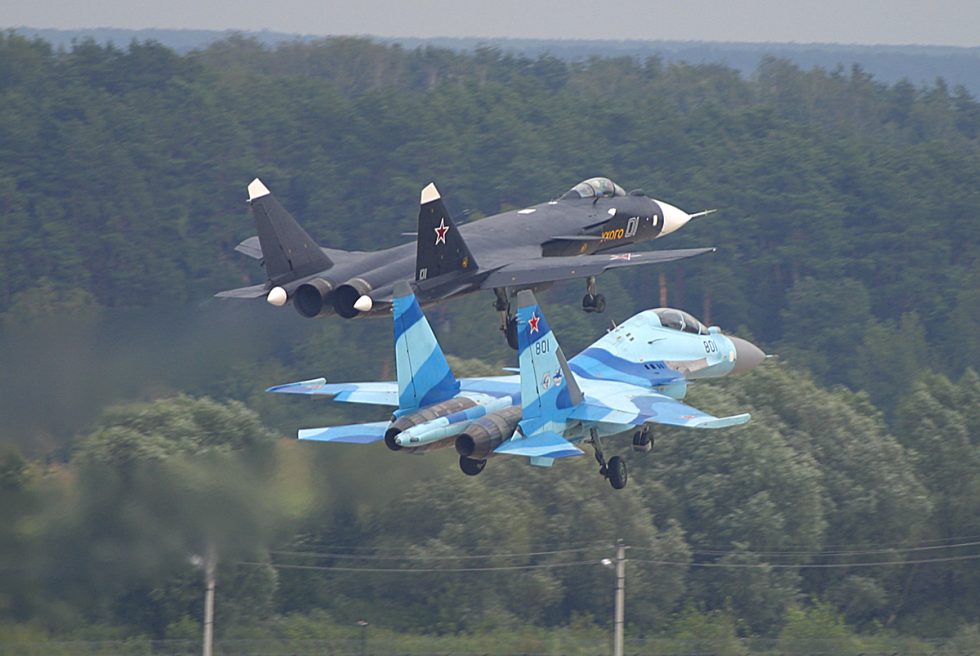
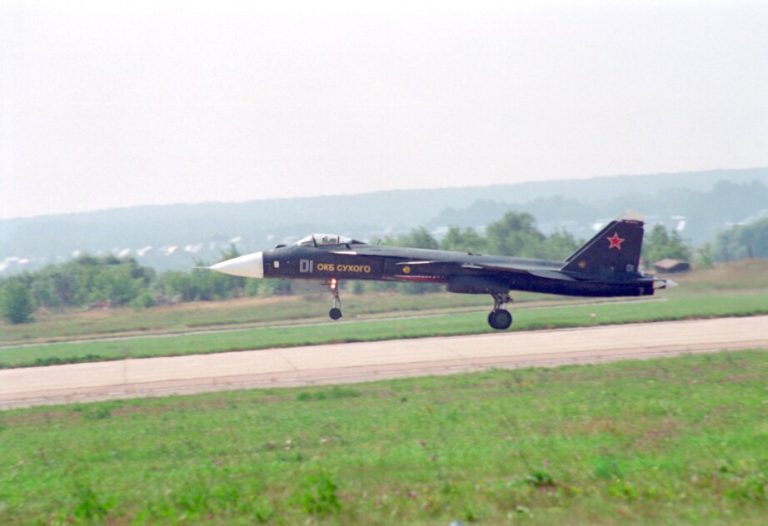
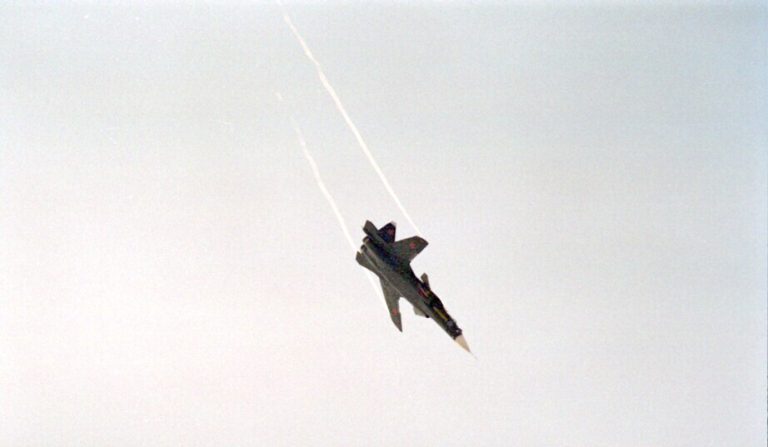
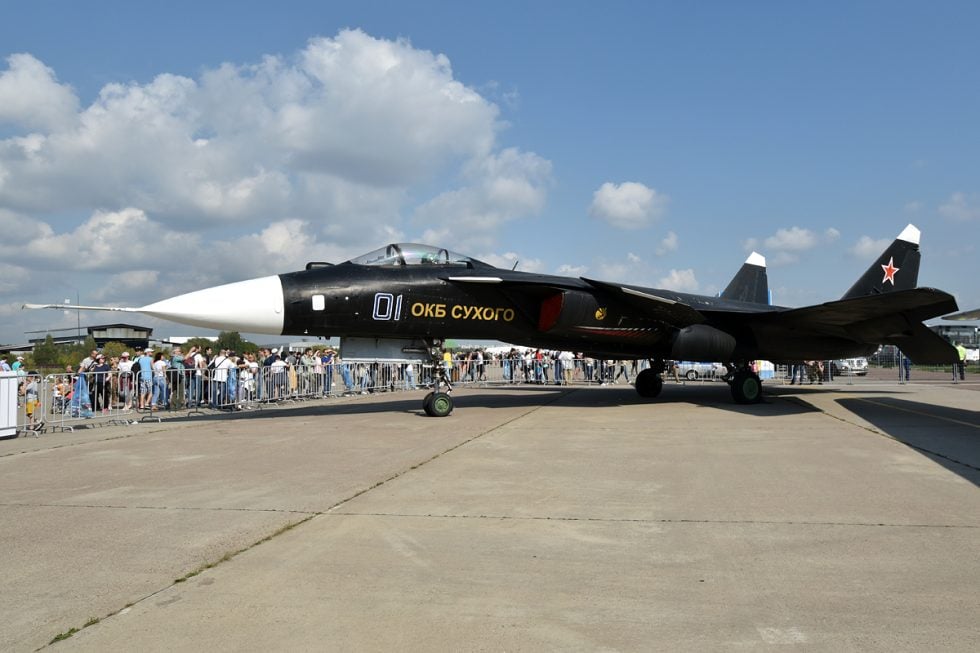
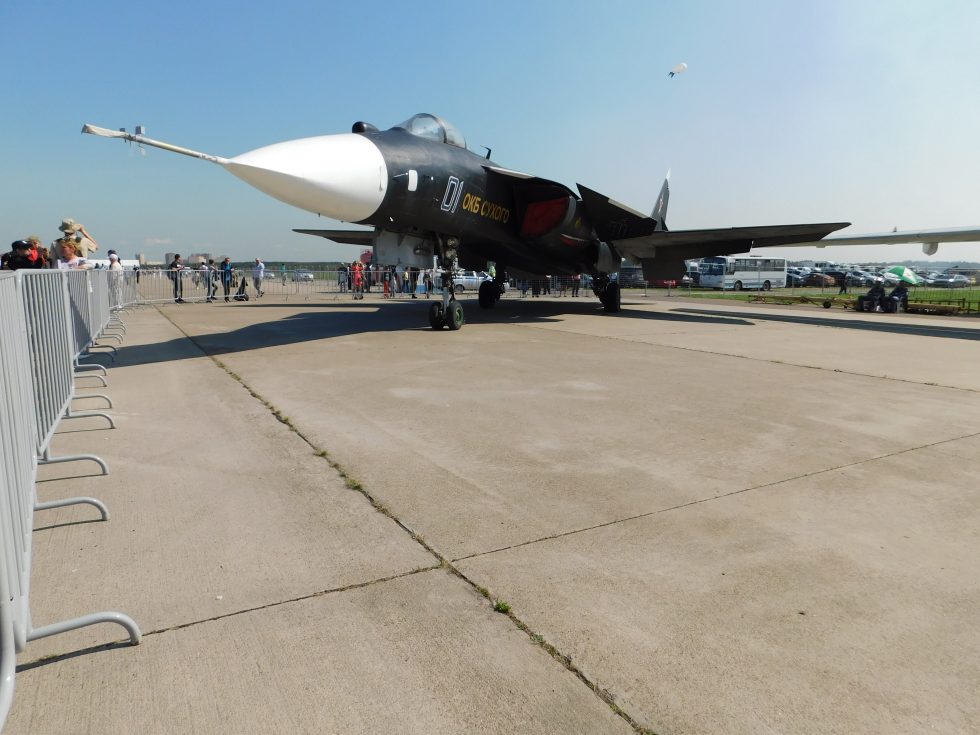
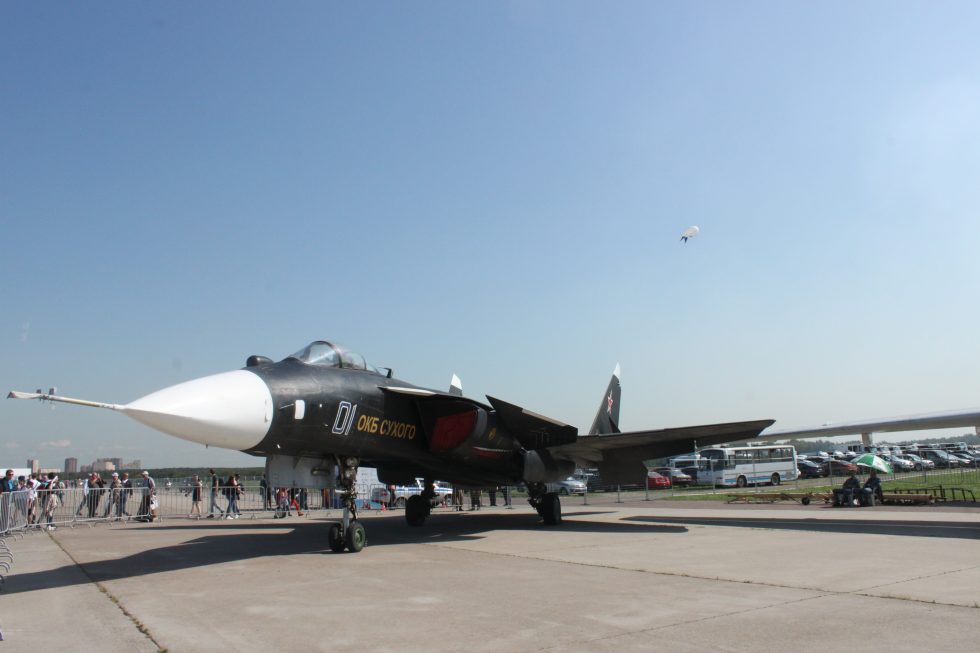
Where the Su-47 flew
An aircraft that never went to war
The Su-47 has no combat record, because it was never a combat aircraft. It flew no missions, scored no kills, and carried no weapons operationally. Its “record” is a research one: a single airframe that gathered flight data on forward-swept aerodynamics, large composite structures and fly-by-wire control over roughly two decades of testing, then retired to a museum apron. Measuring it against fighters that fought would be a category error — the Berkut was built to learn, not to win engagements.
For aircraft that did fight, see the wider combat record of every military aircraft. The Su-47’s value lies in the technologies it matured, described in the stories and Q&A above and below.
Everything people ask about the Su-47
Can I fly in a Su-47?
How many Su-47s were built?
Why does the Su-47 have forward-swept wings?
Was the Su-47 ever a real, operational fighter?
What engines did the Su-47 use?
Is the Su-47 related to the Su-57?
Where is the Su-47 now?
You can’t fly the Su-47.
These, you can.
Some legends only live in museums — others are fuelled and waiting. MiGFlug has put civilians in real military jet cockpits since 2004.
 Fly the L-39 AlbatrosThe world’s most-flown jet trainer — aerobatics included
 Fly the F-104 Starfighter“The missile with a man in it”
 Fly the MiG-21The Cold War’s most-produced jet
 Fly the T-33 Shooting StarAmerica’s first jet trainer
 Fly the DH VampireA piece of early jet history
 Fly the S.211Agile Italian jet trainer
 Fly the MB-326The classic Aermacchi jet
 Fly the MiG-15The Soviet legend of the Korean War
Continue the tour
Every fact, checked
- Airforce Technology — S-37 / Su-47Programme overview, dimensions, engines and the PAK FA connection.
- Aerospaceweb.org — S-37 BerkutDetailed technical entry on forward-swept aerodynamics and the X-29 comparison.
- GlobalSecurity.org — Su-47 specificationsFull spec table showing the range of published figures for weight and speed.
- Military Factory — Sukhoi Su-47Designation history (S-32 to Su-47), engines and demonstrator framing.
- Army Recognition — Su-47 Berkut at 25First-flight date, test pilot Igor Votintsev and the single-airframe history.
- National Security Journal — Su-47 BerkutThe internal weapons bay, the MAKS-2019 display and the Su-57 relationship.
- WarWings Daily — Su-47 technical analysisEngines, composites, aeroelastic tailoring and the Su-57 composites lineage.
- National Museum of the USAF — Grumman X-29Reference for the American forward-swept experiment the Berkut is often compared with.