

Avro Shackleton
Britain’s Cold War submarine-hunter: four screaming Griffons, a crew of ten, and up to sixteen hours over a grey Atlantic — the Lancaster’s loudest, longest-serving grandchild.
故事
The Avro Shackleton: the Lancaster’s grandchild that guarded the Atlantic for forty years
When the Royal Air Force needed a machine to hunt Soviet submarines across the freezing wastes of the North Atlantic, it did not start with a clean sheet. It reached back to the most famous bomber of the Second World War. The Avro Shackleton was drawn straight from the family tree of the Lancaster and the Lincoln — a big, four-engined, propeller-driven patrol aircraft that first flew in 1949 and, astonishingly, was still flying front-line RAF sorties in 1991.
The lineage is direct and worth stating plainly. The wartime Avro Lancaster bomber was developed into the more powerful Avro Lincoln; from the Lincoln’s wings and undercarriage, Avro’s chief designer Roy Chadwick’s team drew up a new fuselage for long over-water patrol. Early in its life the aircraft was even known as the Lincoln ASR.3 and the “GR.1” before being named after the Antarctic explorer Sir Ernest Shackleton — a family connection, as the type’s design owed something to the earlier Avro Tudor airliner. What emerged was unmistakably a Lancaster descendant: the same broad-shouldered stance, the same deep wing, the same throaty roar — only more so.
“A hundred thousand rivets flying in loose formation” — the affectionate jibe that followed the Shackleton everywhere.
That roar is the Shackleton’s signature. Where the Lancaster used Merlins, the Shackleton used four Rolls-Royce Griffon V12s, each swinging a pair of six-bladed contra-rotating propellers. The result was one of the loudest aircraft ever to serve — so loud that it earned the nickname “the Growler,” and so punishing that high-tone hearing loss became a recognised occupational hazard for its crews. Ten men flew in that noise for sortie after sortie, some lasting well over half a day, taking turns at the radar, the galley and the bunks on patrols that could exceed 3,000 kilometres out and back.
Their quarry was the Soviet submarine fleet. Through the 1950s, 60s and 70s the Shackleton was RAF Coastal Command’s eyes over the Atlantic and the North Sea, sweeping the GIUK gap between Greenland, Iceland and the United Kingdom with search radar, sonobuoys, depth charges and, if needed, homing torpedoes. But maritime patrol was only half the story. Shackletons dropped airborne lifeboats on air-sea rescue missions, hauled troops and freight, and served as the long arm of a shrinking empire — flying strike and colonial-policing sorties over Aden, bombing rebel positions in Oman’s Jebel Akhdar campaign, supporting the 1956 Suez operation and patrolling during the Indonesia–Malaysia Confrontation.
Then came its strangest chapter. When the Royal Navy’s carrier-borne early-warning Gannets were retired in 1972, the RAF needed a stopgap airborne early-warning platform — and reached, once again, for the Shackleton. Twelve MR.2s were fitted with 1940s-vintage AN/APS-20 radar sets (some of the very sets pulled from those Gannets) and pressed into service as the AEW.2. Intended to last a handful of years, they instead soldiered on until 1 July 1991, by which point the Shackleton was a genuine aviation anachronism: a piston-engined, WWII-radar-equipped machine guarding NATO’s northern flank into the age of the fast jet. South Africa, meanwhile, flew its own Shackleton MR.3s on Cape patrols from 1957 until 1984. Few aircraft have bridged so many eras — or made so much noise doing it.
It is worth pausing on just how strange the Shackleton’s longevity was. When the prototype flew in 1949, the jet age was barely beginning; the RAF’s front line still bristled with Spitfires and piston-engined Meteors were novelties. When the last Shackleton landed for the final time in 1991, the RAF was flying the Tornado, the Cold War was ending, and stealth aircraft had already flown in combat over Iraq. A single airframe design had stretched across the entire span from the propeller era to the threshold of the modern age — a bridge no other British front-line aircraft managed to build.
For all its noise and its antiquity, the Shackleton was loved. It was rugged, dependable and forgiving; it brought its crews home from sixteen-hour sorties over the worst weather the North Atlantic could offer; and it did jobs — sub-hunting, sea rescue, early warning — that mattered enormously even if they never made headlines. The men who flew it called themselves, only half-jokingly, the last of the “kipper fleet.” The aircraft that emerged from the shadow of the Lancaster ended up carving out an identity entirely its own: not a bomber, but a patient, growling guardian of the grey seas around Britain and the Cape.
Go deeper
01The Avro Shackleton’s lineage: from Lancaster to Lincoln to submarine-hunter
The Shackleton is best understood as the third generation of a single design family. The Avro Lancaster (first flight 1941) was the RAF’s great wartime heavy bomber. Avro developed it into the larger, longer-ranged Avro Lincoln, which reached squadrons at the very end of the war. When the Admiralty and Air Ministry issued a requirement for a dedicated long-range maritime reconnaissance aircraft to replace the Lend-Lease Liberators and the Lancaster ASR/GR conversions, Avro answered with a design that married a new, fatter fuselage to Lincoln-derived wings, tail and landing gear.
Roy Chadwick, the designer behind the Lancaster, led the early work; tragically he was killed in the 1947 crash of the Avro Tudor 2, before the Shackleton flew. The prototype (VW135) first took to the air on 9 March 1949. Because so much was carried over, the type entered service quickly, reaching the RAF in April 1951 as the MR.1. The bloodline shows in every line of the aircraft — and in its sound.
The choice to build a piston-engined patrol aircraft in 1949, when Britain was already pioneering the jet engine, was deliberate. Maritime patrol rewards endurance over speed: an aircraft that can loiter at low level for twelve, fourteen, sixteen hours is worth far more to a submarine-hunter than one that can dash at high speed but must turn for home in a fraction of the time. Early jets were thirsty and short-legged; a big, efficient piston aircraft with a broad wing was exactly the right tool. The Shackleton’s designers understood that the Atlantic gap could only be closed by an aircraft that could stay out there, hour after hour, in the worst of weather.
The family resemblance to the Lancaster and Lincoln is not merely cosmetic. The Shackleton shared the twin-fin tail arrangement, the mid-set wing and the same fundamental structural philosophy of its bomber ancestors. Pilots who had flown Lancasters in the war found the Shackleton’s handling broadly familiar, if heavier and even noisier. In a very real sense, the Shackleton kept the spirit of Bomber Command’s workhorse alive for four more decades, long after the last Lancaster had been retired.
02Why the Avro Shackleton was so deafening: Griffons, contra-props and crew hearing loss
Each of the Shackleton’s four Rolls-Royce Griffon engines drove two six-bladed propellers turning in opposite directions on a common axis. Contra-rotating props cancel torque and convert engine power efficiently, but they generate an intense, penetrating drone at a frequency the human ear finds especially fatiguing. Inside the un-pressurised fuselage there was little to soften it.
The consequences were real and are worth handling honestly: many Shackleton aircrew suffered high-tone deafness, and the aircraft’s reputation as “the Growler” was earned the hard way. Crews wore ear protection, but on patrols that could run past sixteen hours the cumulative exposure took its toll. The later MR.3 added some soundproofing and a few creature comforts — a proper galley, better bunks — but no Shackleton was ever a quiet place to work. Even today, ground-runs of preserved aircraft draw crowds precisely for that shattering, unmistakable noise.
The physics behind the sound is worth understanding. A conventional propeller produces most of its noise at the blade tips, where the airflow approaches the speed of sound. Stack two propellers close together, spinning in opposite directions, and the rear disc chops repeatedly through the disturbed, vortex-laden air left by the front disc. The result is a rapid succession of pressure pulses at a frequency the human ear registers as a harsh, buzzing growl rather than a smooth drone. Multiply that by four engines and eight propeller discs, and the effect is overwhelming.
Veterans’ accounts of the noise are consistent and vivid: conversation aboard was impossible without the intercom; the whole airframe vibrated; and crews stepped off after a long sortie with their ears ringing for hours. The recognition of “Shackleton ear” as an occupational injury is part of a wider, sobering story about hearing damage among mid-century aircrew, and it deserves to be told plainly rather than romanticised. The Growler’s glorious sound came at a genuine human cost.
03Hunting Soviet submarines: the Avro Shackleton’s Cold War maritime patrol mission
The Shackleton’s core job was anti-submarine warfare and maritime reconnaissance. Flying from bases such as Ballykelly in Northern Ireland, St Mawgan in Cornwall and Kinloss and Lossiemouth in Scotland, its crews swept the North Atlantic and the strategically vital GIUK gap, watching for Soviet submarines trying to break out into the open ocean.
To do it, the aircraft carried search radar (the ventral “dustbin” radome on the MR.2 and MR.3), sonobuoys to listen for submarines underwater, and a bomb bay that could hold depth charges, homing torpedoes and mines — up to around 10,000 lb of stores. Two 20 mm cannon in the nose gave it a limited strike and anti-shipping capability. Endurance was the whole point: with a very long-span wing and economical cruise, the Shackleton could stay on task for the better part of a day, far out over water where no other RAF aircraft could loiter so long. It was unglamorous, exhausting work — hours of grey sea, punctuated by the adrenaline of a contact.
The tactics were painstaking. A patrol crew might spend hours flying a search pattern, watching the radar for the tiny return of a snorkel or periscope breaking the surface. On a promising contact the aircraft would drop a pattern of sonobuoys — floating hydrophones that radioed back what they heard — and the crew would work to build a picture of the submarine’s course, speed and depth before committing to an attack with depth charges or a homing torpedo. It was a discipline much closer to detective work than to the slashing dogfights of fighter lore.
The strategic backdrop gave this drudgery its meaning. The Soviet submarine fleet grew rapidly through the Cold War, and NATO’s planners feared that in a war the Atlantic sea lanes — the lifeline carrying reinforcements and supplies from North America to Europe — would be cut by submarines slipping through the GIUK gap. The Shackleton, and later the Nimrod, existed to close that gap: to find, track and if necessary sink those submarines before they could reach the open ocean. Every quiet patrol was a small contribution to a very large deterrent.
04The Avro Shackleton AEW.2: the WWII-radar stopgap that served until 1991
In 1971 the Royal Navy retired the Fairey Gannet AEW.3, leaving Britain without airborne early warning. The planned replacement (a version of the Nimrod) was years away, so the RAF converted twelve Shackleton MR.2 airframes into airborne early-warning aircraft designated AEW.2, fitting them with the American AN/APS-20 radar — a set that dated back to the 1940s and, in several cases, was physically transferred from the retiring Gannets.
These aircraft, flown by 8 Squadron from RAF Lossiemouth and given individual names drawn from the children’s TV series “The Magic Roundabout” (Dougal, Florence, Ermintrude and others), were meant as a short-term fix. Instead they served for nearly twenty years, finally retiring on 1 July 1991 — making the Shackleton one of the longest-serving aircraft of its generation and a Cold War curiosity: a piston-engined machine, with wartime radar, holding NATO’s northern early-warning line into the era of the F-15 and Tornado.
The reason the stopgap became permanent is a familiar procurement story. The intended replacement was an airborne-early-warning version of the Nimrod — the Nimrod AEW.3 — whose mission-system development ran catastrophically over budget and behind schedule through the 1980s before being cancelled outright in 1986. Britain eventually bought the Boeing E-3 Sentry instead, which did not enter RAF service until the early 1990s. Until it did, the ancient Shackletons were quite literally all the airborne early warning the RAF had, and so they kept flying, year after year, long past any reasonable retirement date.
Flying the AEW.2 was a demanding, old-fashioned business. The radar was maintained by specialists who had learned their trade decades earlier; spares were increasingly scarce; and the aircraft themselves were tired airframes worked hard. That 8 Squadron kept them operational and effective into 1991 is a considerable testament to the ground crews and aircrew involved. When the last one landed, it marked not just the end of the Shackleton but the end of the piston-engined combat aircraft in RAF front-line service.
Design & Engineering
How the Avro Shackleton was built to stay airborne for sixteen hours
Everything about the Shackleton was subordinated to one goal: staying useful over the ocean for as long as possible. That priority explains its choices — efficient piston engines instead of thirsty early jets, a long, broad wing, a big fuel load, and a fuselage built as a workplace for a large crew rather than a tight cockpit for one pilot. Here is how the three key elements came together.
Four Griffons, eight contra-rotating props
Four Rolls-Royce Griffon 57/57A V12 engines of roughly 1,960 hp each, every one turning a pair of six-bladed de Havilland contra-rotating propellers. Splitting the power across two counter-rotating discs cancelled torque and gave efficient, high-endurance cruise — at the cost of a legendary, ear-splitting drone that damaged crews’ hearing. Later MR.3s even gained two small Viper jets to help heavyweight take-offs.
Lancaster DNA, stretched for the ocean
Lincoln-derived wings, tail and undercarriage carried a new, deep fuselage with room for a crew of ten, bunks and a galley — a workplace, not a cockpit. The long-span wing and large fuel load bought endurance measured in double-digit hours; the definitive MR.3 added a tricycle undercarriage, wingtip fuel tanks and a little soundproofing for the men inside.
Radar, sonobuoys and a bomb bay
Air-to-surface search radar in a ventral “dustbin” radome, patterns of sonobuoys to listen for submerged submarines, and a marine-markers and flares fit made it a true sub-hunter. The bomb bay took depth charges, homing torpedoes and mines up to ~10,000 lb, with two 20 mm nose cannon. The AEW.2 swapped all of it for one ancient AN/APS-20 early-warning radar.
05South Africa’s Avro Shackletons: the SAAF’s Cape patrol MR.3s, 1957–1984
The Shackleton’s only export customer was South Africa. The South African Air Force ordered eight Shackleton MR.3s, the first pair arriving in August 1957 and all in service with 35 Squadron by early 1958. From Cape Town they flew long maritime patrols around the Cape of Good Hope — a vital sea lane — for more than a quarter of a century.
Their most famous action was environmental rather than military: in 1971 SAAF Shackletons helped deal with the wrecked, blazing tanker SS Wafra by depth-charging and ultimately sinking the hulk offshore to limit an oil spill. An international arms embargo eventually starved the fleet of spares, and combined with airframe fatigue the SAAF retired its Shackletons in November 1984. Remarkably, the SAAF Museum later returned one example, “Pelican 22” (1722), to taxiable and even briefly airworthy condition — though it has since been grounded for safety and crew reasons.
South Africa’s Shackletons flew some of the longest and most demanding maritime patrols anywhere. The waters off the Cape of Good Hope are among the roughest in the world, and the sea lane around southern Africa carried a huge share of the world’s oil traffic, especially when the Suez Canal was closed. The SAAF’s handful of aircraft covered an enormous expanse of the South Atlantic and Indian Oceans, and their crews built a reputation for endurance flying that matched anything the RAF asked of its own Shackleton squadrons.
The arms embargo imposed on apartheid-era South Africa made the fleet progressively harder to keep flying. Unable to buy spares openly, the SAAF cannibalised aircraft and improvised repairs, but by 1984 the combination of fatigue life and unobtainable parts made continued service impractical. The retirement of the Shackleton left a gap in South African maritime patrol that was never fully filled. The type’s South African chapter ended, but its legend did not: the 1994 loss of “Pelican 16” in the Sahara, on a goodwill flight to Britain, became one of the most extraordinary survival stories in the aircraft’s history.
06The Avro Shackleton’s operating costs: what long-range patrol actually cost
Hard per-hour cost figures for the Shackleton are not reliably recorded in the public record, and any single number should be treated with caution — 1950s–80s RAF accounting did not publish costs the way modern programmes do. What can be said is that the Shackleton was, by the standards of its mission, relatively economical: a piston-engined aircraft burning avgas rather than a thirsty early jet, designed for long, low-and-slow endurance rather than speed.
The real “cost” of the Shackleton was measured differently — in crew fatigue, in hearing damage from the Griffons, and in the mounting maintenance burden of keeping 1940s-derived airframes and radar serviceable into the 1990s. By the end, spares and fatigue-life, not fuel, were what finally retired the type. We flag all cost figures here as estimates; treat the unit and hourly costs as “not reliably recorded.”
07Avro Shackleton survivors: which airframes still exist, and is any airworthy?
Several Shackletons survive in museums around the world, and the type has a devoted preservation following. Notable static examples include MR.3 WR977 at the Newark Air Museum, MR.3 XF708 at IWM Duxford, MR.3 WR982 at the Gatwick Aviation Museum (engines runnable), AEW.2 WL790 at the Pima Air & Space Museum in Arizona, and SAAF airframes at the South African Air Force Museum. AEW.2 WL747 lies derelict at Paphos in Cyprus.
Is any Shackleton airworthy today? Honestly: not currently. The SAAF’s “Pelican 22” has been ground-run and was once flown post-restoration, but is grounded. In the UK, the Shackleton Preservation Trust has for years been restoring MR.2 WR963 (registered G-SKTN) at Coventry toward a possible return to flight, keeping its Griffons in running order with regular engine-runs — but as of the mid-2020s no Shackleton is flying. The situation has changed before and could change again, so treat “airworthy” claims with care and check current status.
The preservation community around the Shackleton is unusually active precisely because the aircraft is so evocative. Engine-runs — where a static aircraft fires up its Griffons on the ground for an audience — have become popular events in their own right, letting new generations experience the Growler’s extraordinary sound without the aircraft ever leaving the tarmac. WR982 at Gatwick and WR963 at Coventry are among the airframes kept in running order for exactly this reason.
Whether a Shackleton will ever fly again is genuinely uncertain. Returning a large, complex, ageing four-engined aircraft to certified flight is enormously expensive and demanding, and the regulatory bar is high. Enthusiasts remain hopeful, and the WR963 project has made real progress over the years, but nothing is guaranteed. For now, the honest answer to “can I see a Shackleton fly?” is: not yet — but you can hear one roar.
08The Rolls-Royce Griffon and contra-rotating propellers: the heart of the Shackleton
The Rolls-Royce Griffon was the larger, more powerful successor to the famous Merlin that had powered the Spitfire and the Lancaster. With a capacity of around 37 litres against the Merlin’s 27, the Griffon delivered more torque at lower revs — ideal for turning large propellers efficiently at the low, economical cruise speeds a patrol aircraft needs. The Shackleton used four of them, in the Griffon 57 and 57A versions, each producing roughly 1,960 horsepower.
What made the installation distinctive was the propeller arrangement. Each Griffon drove not one propeller but two, mounted on concentric shafts and turning in opposite directions — a six-blade contra-rotating unit made by de Havilland. Contra-rotating propellers solve a real problem: a single large propeller absorbing so much power would produce enormous torque and gyroscopic effects, making the aircraft difficult to handle. Splitting the load across two counter-rotating discs cancels the torque, improves efficiency and lets the engine turn a huge amount of power into thrust without an impractically large single propeller.
The trade-off, as every Shackleton crew knew, was noise — and mechanical complexity. The contra-rotating gearboxes and propeller assemblies were sophisticated pieces of engineering that demanded careful maintenance. But they gave the Shackleton exactly the efficient, high-endurance cruise its mission demanded, and they gave it its unmistakable voice. To many enthusiasts the sound of four Griffons and eight propeller discs is the single most thrilling noise in British aviation.
09Variants of the Avro Shackleton: MR.1, MR.2, MR.3, AEW.2 and the trainers
The Shackleton evolved through several distinct marks. The MR.1 and improved MR.1A were the first maritime-reconnaissance versions, entering service from 1951 with a dorsal gun turret and the original Griffon installation; around 76 were built. The MR.2, from 1953, moved the search radar to a retractable ventral “dustbin” radome and lengthened the nose, improving both aerodynamics and sensor coverage; about 69 were built.
这 MR.3, first flown in 1955, was the most refined maritime version: it introduced a tricycle undercarriage (replacing the earlier tail-wheel layout), wingtip fuel tanks for greater range, and improved crew comfort including better soundproofing and a proper rest area. Thirty-four were built for the RAF and eight for South Africa. Later RAF MR.3s were fitted with auxiliary Viper jet engines in the outer nacelles to help with heavyweight take-offs, as their all-up weight had grown.
这 AEW.2 was the airborne-early-warning conversion: twelve MR.2 airframes rebuilt from 1971 with the AN/APS-20 radar in a large chin radome, serving until 1991. Training variants (designated T.4 and others) were also produced by converting earlier airframes to instruct navigators and radar operators. Total production across all marks is usually given as about 185 aircraft, though sources vary slightly on the exact breakdown.
10Accidents, losses and the human cost of the Avro Shackleton
Long-endurance patrol flying, often at low level over hostile seas and in poor weather, was inherently dangerous, and the Shackleton suffered its share of accidents over four decades of service. Crews faced the hazards of night and all-weather operations far from land, heavy aircraft at the limits of their performance, and the sheer fatigue of sorties that could last most of a day.
Among the SAAF fleet, one aircraft was lost with its crew in the Wemmershoek mountains in 1963. The most famous incident, however, ended happily: in 1994 the SAAF Shackleton “Pelican 16,” en route to Britain, was forced down in the Sahara after engine trouble. All nineteen people aboard survived the landing and were rescued, though the aircraft could not be recovered and remains in the desert to this day — a startling, intact relic slowly weathering in the sand.
The other, quieter cost was the hearing damage described elsewhere on this page. It is a reminder that the romance of a vintage aircraft always sits alongside the real experience of the people who operated it — the long, cold, deafening hours that made the Shackleton’s missions possible. Remembering the aircraft honestly means remembering that human cost too.
11Avro Shackleton vs Nimrod vs P-3 Orion: how the Growler compared
The Shackleton belonged to the first Cold War generation of long-range maritime patrol aircraft, and comparing it with its successors shows how quickly the field moved. Its direct RAF replacement in the anti-submarine role was the Hawker Siddeley Nimrod — a jet based on the Comet airliner — which offered far higher transit speed, a pressurised cabin, and vastly more capable sensors. The Nimrod could reach a distant patrol area much faster and work it in far greater comfort.
Across the Atlantic, the United States and many allied nations flew the Lockheed P-3 Orion, a turboprop that struck a middle path: faster and more modern than the Shackleton, but still propeller-driven for efficient low-level loiter. The P-3 became the Western world’s standard maritime patrol aircraft for decades, and its longevity in some ways mirrors the Shackleton’s own.
What the Shackleton offered that its successors could not was simply time in the air for the money, in an era when jets were still thirsty and short-legged. It was slower, louder and cruder than what came after — but it was there first, and it did the job for forty years. In the AEW role in particular, its persistence long after it should have been replaced is a story less about the aircraft’s excellence than about the difficulty and cost of replacing it — a lesson in procurement as much as in engineering.
Full Specifications
Avro Shackleton MR.3 specifications and performance
Representative figures for the Shackleton MR.3, the definitive maritime-reconnaissance variant. The Shackleton was never about outright performance — its top speed of around 480 km/h is modest, and its ceiling low — because its whole design philosophy traded speed and altitude for endurance and load-carrying at low level over the sea. Figures vary between marks and sources; treat all performance numbers as approximate, and note that a heavily-loaded aircraft on a long patrol behaved very differently from the book figures.
Dimensions & performance
| 全体人员 | ~10 |
| 长度 | 26.6 m (87 ft 4 in) |
| 翼展 | 36.5 m (120 ft) |
| Max speed | ~480 km/h (300 mph / 260 kn) |
| Typical patrol speed | ~370 km/h (200 kn), low level |
| 范围 | ~3,600 km (1,950 nmi) |
| Endurance | ~14–16 hours |
| 设备天花板 | ~6,200 m (20,200 ft) |
| Max takeoff weight | ~39,000 kg (86,000 lb) |
Powerplant, payload & cost
| Engines | 4× Rolls-Royce Griffon 57/57A V12 |
| Power | ~1,960 hp (1,460 kW) each |
| Propellers | 6-blade contra-rotating (per engine) |
| Guns | 2× 20 mm Hispano cannon (nose, MR marks) |
| Warload | ~10,000 lb: depth charges, torpedoes, mines, bombs |
| Sensors | Search radar, sonobuoys; AN/APS-20 (AEW.2) |
| Number built | ~185 (all marks; figures vary) |
| Unit cost | Not reliably recorded |
| Cost per flight hour | Not reliably recorded |
Variants at a glance
| Mark | Role & changes | 笔记 |
| MR.1 / MR.1A | First maritime-reconnaissance version; dorsal gun turret | In service 1951; ~76 built |
| MR.2 | Ventral “dustbin” search radar; lengthened nose | From 1953; ~69 built |
| MR.3 | Tricycle undercarriage, tip tanks, soundproofing | From 1955; 34 RAF + 8 SAAF |
| MR.3 (Phase 3) | Auxiliary Viper jets in outer nacelles for heavy take-off | Later RAF upgrade |
| AEW.2 | Airborne early warning; AN/APS-20 chin radar | 12 MR.2 conversions; 1972–1991 |
| T.4 / trainers | Navigator and radar-operator training conversions | Converted from earlier marks |
Production and conversion figures vary between sources; totals are usually given as roughly 185 aircraft across all marks.
12Flying the Avro Shackleton: what the aircraft was actually like to operate
The Shackleton was, by all accounts, a heavy but honest aircraft to fly — demanding physically, especially on a long sortie, but predictable and forgiving in a way that mattered enormously for an aircraft asked to operate at low level over the sea in bad weather. The early tail-wheel MR.1 and MR.2 required careful handling on the ground; the MR.3’s tricycle undercarriage made take-off and landing considerably easier.
As all-up weights climbed over the years — more fuel, more equipment, more crew comforts — the later MR.3s began to struggle on take-off, particularly from hot-and-high airfields or on a warm day. The answer was pragmatic and very much of its era: two small Armstrong Siddeley Viper turbojets were fitted into the outer engine nacelles, used only to boost the aircraft off the ground and shut down once safely airborne. A four-piston-engined aircraft with two auxiliary jets is an unusual sight, and a neat illustration of how the Shackleton was continually adapted to keep doing its job.
In the air, the aircraft cruised low and slow on patrol, often below a few thousand feet, hunting for the tell-tale radar or visual signs of a submarine. It was cold, it was loud, and it was exhausting — but it was also stable and dependable, exactly what a crew needs when they are sixteen hours into a sortie over an empty, freezing ocean far from home.
13The Avro Shackleton’s radar and sensors: how it actually found submarines
A maritime patrol aircraft is really a flying sensor platform, and the Shackleton carried a suite that evolved over its life. The heart of it was air-to-surface-vessel (ASV) search radar, which on the MR.2 and MR.3 lived in a retractable ventral radome — the distinctive “dustbin” — giving all-round coverage to detect ships and surfaced or snorkelling submarines at range.
Radar alone could not find a submerged submarine, so the Shackleton also carried sonobuoys: expendable floating sensors dropped in patterns onto the sea, each one lowering a hydrophone to listen for the sound of a submarine and radioing what it heard back to the aircraft. By reading the returns from a spread of buoys, the crew could estimate a target’s position, course and speed. Marine markers, flares and, later, magnetic and electronic detection aids rounded out the fit.
The AEW.2 conversion swept all of this away in favour of a single, very different sensor: the American AN/APS-20 radar, mounted in a large chin radome, designed to detect low-flying aircraft and surface contacts at long range and pass that early-warning picture to fighters and controllers. That a 1940s-designed radar was still doing useful front-line work into the 1990s says as much about the difficulty of replacing it as about the set itself.
14The Avro Shackleton in memory: “the Growler,” the kipper fleet and the enthusiasts
Few aircraft inspire the affection the Shackleton does among enthusiasts and veterans. Its combination of extreme age, extraordinary sound and unglamorous, vital work has given it a devoted following. Crews called themselves the “kipper fleet” — a wry nod to guarding Britain’s fishing grounds and coasts — and the camaraderie of those long, shared sorties left a lasting bond.
Today that legacy is carried by preservation groups, museums and associations who keep the surviving airframes cared for and, in a few cases, capable of running their engines. Public engine-runs have become events in their own right, drawing crowds who come specifically to experience the Growler’s sound. Documentaries, books and modelling communities keep the type’s story alive for people who never saw one fly.
The Shackleton occupies an unusual place in aviation memory: not a famous fighter or a war-winning bomber, but a patient, noisy guardian whose value lay in the missions that never made the news. That quiet importance — forty years of watching the seas so that others could sleep — is exactly why it is remembered so fondly.
15The GIUK gap: why the Avro Shackleton spent its life over the North Atlantic
To understand the Shackleton you have to understand the geography of the Cold War at sea. The “GIUK gap” — the stretches of ocean between Greenland, Iceland and the United Kingdom — was the chokepoint through which Soviet submarines based in the north had to pass to reach the open Atlantic. If NATO could watch and control that gap, it could blunt the submarine threat to the sea lanes; if it could not, convoys carrying reinforcements from North America to Europe would be desperately vulnerable.
The Shackleton was one of NATO’s principal tools for closing that gap. Flying from bases in Scotland, Northern Ireland and Cornwall, its crews patrolled these cold, grey waters continuously, building a picture of what moved through them and standing ready to prosecute any submarine contact. It was a mission with no front line and no headlines — just endless vigilance over a stretch of sea that mattered enormously to the balance of the Cold War.
This is why an aircraft optimised for endurance rather than speed made so much sense. The value was in being able to stay out over the gap, hour after hour, in any weather. The Shackleton, and after it the Nimrod, existed to make sure that the northern approaches to the Atlantic were never left unwatched.
16The Avro Shackleton’s crew of ten: who did what on a sixteen-hour patrol
Where a fighter is flown by one person, the Shackleton was operated by a crew of around ten, each with a specialised role, working together for the length of a very long sortie. There were two pilots and a flight engineer up front to manage the four Griffons and the aircraft’s systems; navigators to keep track of position over a featureless ocean far from landmarks; and radar and sensor operators to run the search equipment and interpret its returns.
On patrol the crew rotated through their duties, taking turns to rest in the aircraft’s bunks and to prepare food in its galley. This was not a luxury but a necessity: no one could stare at a radar screen or fly at low level over the sea for sixteen hours without a break, and the aircraft was designed so that the team could sustain effectiveness across a sortie that spanned most of a day and night.
That shared endurance forged the strong identity of the “kipper fleet.” The Shackleton was a genuinely collective machine — its success depended not on a single ace but on a well-drilled team working the sensors, the navigation and the aircraft in concert, deep into the fatigue of a long flight, in a cabin filled with the ceaseless growl of the engines.
17The end of an era: the Avro Shackleton as the RAF’s last piston-engined warrior
When the last AEW.2 retired on 1 July 1991, it was not just the end of the Shackleton — it was the end of the piston-engined combat aircraft in RAF front-line service. Every other piston type had long since given way to jets and turboprops; the Shackleton, through a mixture of good design, hard work and procurement delay, had outlasted them all.
The symbolism is striking. The aircraft’s design lineage ran directly back to the Lancaster of 1941; its engines were a wartime family; its AEW radar was a 1940s set. And yet it served alongside the Tornado, in the same air force that would soon operate the Eurofighter, and it kept watch through the final years of the Cold War it had spent its whole life fighting. Few machines have so completely bridged the gap between one age of aviation and the next.
Its retirement closed a chapter that had opened before the jet age began. The Shackleton had been drawn from a wartime bomber, built to hunt a Cold War enemy, and flown until that enemy’s system was collapsing. When it finally landed for the last time, it took with it the last living link between RAF front-line flying and the propeller-driven world of the Second World War.
18The Avro Shackleton’s weapons: depth charges, torpedoes, mines — and the nuclear question
As an anti-submarine and anti-shipping aircraft, the Shackleton carried its offensive load in a long internal bomb bay. The staple weapons were depth charges — explosive charges set to detonate at a chosen depth against a submerged submarine — along with homing torpedoes that could chase a submarine once its position was known, and naval mines for laying defensive or offensive barriers. Total warload was on the order of 10,000 lb. For self-defence and light strike, the maritime marks also carried two 20 mm cannon in the nose.
There is also a nuclear footnote to handle carefully. During the Cold War, Western maritime patrol aircraft operating under NATO were, in some cases, cleared to carry American-supplied nuclear depth bombs such as the Mk 101 “Lulu” — weapons intended to destroy submarines with a nuclear rather than conventional warhead. Sources indicate the Shackleton was among the aircraft associated with this capability; as with much Cold War nuclear detail, exact arrangements are not fully documented publicly, so this should be treated as reported rather than definitively established.
In practice, the overwhelming majority of the Shackleton’s work involved conventional stores and, more often still, no weapons release at all — the aircraft’s job was chiefly to find and track, deterring and reporting far more than it ever attacked. On colonial-policing sorties over Aden and Oman it also dropped conventional bombs in a light-strike role, a reminder of just how many hats this single airframe wore.
19Bases and squadrons: where the RAF flew the Avro Shackleton
Shackletons served with a number of RAF squadrons, principally within Coastal Command (and later Strike Command after the two were merged). Their home was the string of maritime-patrol airfields around the British Isles: RAF Ballykelly in Northern Ireland, RAF St Mawgan in Cornwall, and RAF Kinloss and RAF Lossiemouth in the north-east of Scotland, all positioned to reach the Atlantic and the northern approaches quickly.
Beyond the UK, Shackletons deployed to overseas bases to cover imperial and Cold War commitments — operating from Aden (RAF Khormaksar) for policing the Aden Protectorate, from bases supporting operations in Oman and around the Mediterranean, and further afield during the Indonesia–Malaysia Confrontation in the Far East. Detachments to Malta, Gibraltar and Cyprus supported maritime patrol across the Mediterranean and beyond.
The AEW.2 fleet was concentrated with 8 Squadron at RAF Lossiemouth, which flew the airborne-early-warning mission from 1972 until 1991. By the end, Lossiemouth was the last home of the last Shackletons — the place where the RAF’s piston-engined era finally came to a close.
20Why Britain needed the Avro Shackleton: the maritime gap of the late 1940s
By the end of the Second World War the RAF’s maritime patrol force was a patchwork of Lend-Lease American aircraft — Liberators and Catalinas — and modified British bombers. With the war over, the American aircraft had to be returned or scrapped, and the makeshift conversions were ageing. Yet the maritime threat did not disappear; if anything, the rapid growth of the Soviet submarine fleet made long-range ocean patrol more important than ever.
Britain therefore needed a purpose-built, long-range maritime reconnaissance aircraft of its own, and needed it quickly. Air Ministry Specification R.5/46 set out the requirement, and Avro — with its proven four-engined bomber pedigree and the Lincoln already in production — was ideally placed to answer it. By adapting existing components rather than starting from scratch, Avro could deliver a capable aircraft in a fraction of the time a clean-sheet design would have taken.
That urgency shaped the Shackleton’s whole character: a robust, conservative, endurance-focused design that leaned on wartime experience rather than chasing the new jet technology. It was exactly the right answer to the question being asked in 1946, and it is a large part of why the aircraft was ready to serve by 1951 — and why it lasted so long afterwards.
21The Avro Shackleton’s legacy: what the Growler left behind
The Shackleton’s direct legacy is the continuity of British maritime patrol. Its anti-submarine role passed to the Hawker Siddeley Nimrod, which carried the mission into the twenty-first century; when the Nimrod itself was retired, the capability eventually returned to the RAF in the form of the Boeing P-8 Poseidon. The thread of long-range ocean watch that the Shackleton wove in 1951 runs unbroken to the present day.
Its AEW legacy is more cautionary. The tortured, ultimately cancelled Nimrod AEW.3 programme — the very failure that kept the Shackletons flying so long — became a textbook case in the perils of over-ambitious defence procurement, and the RAF’s move to the proven Boeing E-3 Sentry was shaped in part by that painful experience. In that sense the ancient Shackleton AEW.2 was both a symptom and a stopgap of a procurement crisis.
But the Shackleton’s deepest legacy is cultural. It is remembered with real warmth as “the Growler,” an aircraft whose sound, longevity and unglamorous devotion to duty made it a genuine national character. It stands as a monument to the value of endurance over glamour — and to the men who flew those long, deafening, vital patrols over the grey seas, decade after decade, so that the sea lanes stayed safe.
Timeline
The Avro Shackleton’s service history, 1947–1991
From a late-1940s requirement to the last flight in 1991, the Shackleton’s timeline spans the entire arc of the early jet age — a piston-engined aircraft that outlasted almost everything designed alongside it. These are the milestones that defined its four decades of service.
Requirement and design
Air Ministry Specification R.5/46 calls for a long-range maritime patrol aircraft; Avro adapts Lincoln components under Roy Chadwick’s team.
Chadwick lost
Roy Chadwick, the Lancaster’s designer and the man behind the early Shackleton, is killed in the crash of the Avro Tudor 2.
First flight
Prototype VW135 flies on 9 March 1949, powered by four Griffon engines with contra-rotating propellers.
RAF service
The MR.1 enters Royal Air Force Coastal Command service in April 1951 for maritime reconnaissance and anti-submarine patrol.
MR.2 introduced
Improved MR.2 with a longer nose and ventral “dustbin” search radar enters service.
MR.3 & Suez
The MR.3 flies (Sept 1955) with tricycle undercarriage and tip tanks; Shackletons support the 1956 Suez operation.
SAAF & Oman
South Africa receives its first Shackleton MR.3s; RAF Shackletons fly strike sorties in the Jebel Akhdar War in Oman.
Colonial policing
Shackletons operate over Aden, and patrol during the Indonesia–Malaysia Confrontation.
AEW.2 stopgap
Twelve MR.2s converted to airborne early-warning AEW.2 with 1940s AN/APS-20 radar, flown by 8 Squadron from Lossiemouth.
Nimrod AEW cancelled
The Nimrod AEW.3 replacement is cancelled after huge cost overruns; the RAF later buys the Boeing E-3 Sentry, keeping the Shackletons flying meanwhile.
SAAF retirement
The South African Air Force retires its Shackleton fleet after 27 years of Cape patrols.
RAF retirement
The last AEW.2s retire on 1 July 1991 — ending 40 years of RAF Shackleton service.
Pelican 16
SAAF “Pelican 16” force-lands in the Sahara en route to the UK; all 19 aboard survive; the wreck remains in the desert.
Return-to-flight bid
The Shackleton Preservation Trust works to restore MR.2 WR963 (G-SKTN) at Coventry toward airworthiness, with regular Griffon engine-runs.
Stories & Eyewitnesses
Twelve things that made the Shackleton the Shackleton
The nickname“The Growler”
Pilots described the sound as a physical presence in the cabin — a growl you felt through your seat as much as heard. It is the single detail nearly everyone who encountered the aircraft remembers first, and it remains the reason preserved airframes are fired up for the public today.
The jibe“100,000 rivets in loose formation”
There was pride buried in the joke. The Shackleton looked and sounded like a relic long before it retired, yet it kept doing difficult, dangerous work reliably. Crews teased it precisely because they trusted it to bring them home.
The missionSixteen hours over grey sea
Most sorties found nothing at all — hours of monotony over featureless water. But the discipline never slackened, because the one contact that mattered might appear at any moment, and finding it was the whole point of being out there.
The lineageA Lancaster in all but name
Pilots who had flown the wartime bombers found the Shackleton broadly familiar, if heavier and louder. In a sense it carried the spirit of Bomber Command’s workhorse forward four more decades, into a Cold War its designers had barely imagined.
South AfricaThe Wafra oil-spill sinking
It is one of the more unusual missions in the aircraft’s history and the subject of a popular documentary: a maritime patrol aircraft using its anti-submarine weapons not against an enemy, but to protect a coastline from an ecological disaster.
SurvivalPelican 16 in the Sahara
The aircraft was on a goodwill flight, intended for preservation in the UK, when it came down. Too remote to recover, it remains where it landed — remarkably intact — a lonely monument to both the type and the skill of the crew who put it down safely.
The AEW crewsGuarding NATO with 1940s radar
The reason was a procurement failure: the Nimrod AEW.3 replacement was cancelled in 1986 after huge cost overruns, and the E-3 Sentry did not arrive until the early 1990s. Until then, these ancient aircraft were all the airborne early warning the RAF had.
Air-sea rescueDropping the lifeboat
The airborne lifeboat was a small marvel in itself: a self-righting powered craft, dropped by multiple parachutes, that gave downed airmen or shipwrecked sailors a real chance in seas where a life raft alone might not be enough.
Colonial policingAden, Oman and Suez
These were often low-level sorties in punishing heat over rugged terrain, far from the aircraft’s natural maritime element. They show how versatile — and how heavily worked — the Shackleton fleet was through the 1950s and 60s.
The Magic RoundaboutAircraft named Dougal and Florence
The whimsy was affectionate camouflage for a demanding role. The crews knew exactly how old and how vital their aircraft were; naming them after cartoon characters was a way of carrying that responsibility lightly.
Life aboardBunks, galley and a very long day
On a sixteen-hour sortie the crew genuinely lived aboard: cooking meals, resting in shifts, and enduring the cold, the vibration and the noise together. The camaraderie of the “kipper fleet” was forged in exactly those long, shared hours.
The last flight1 July 1991
It was the end of an era in the most literal sense: the departure of the last piston-engined combat aircraft from RAF front-line service, and the quiet closing of a line that ran directly back to the Lancaster of the Second World War.
Photo Gallery
The Avro Shackleton in pictures
From the four-Griffon nose to the cavernous bomb bay, from RAF flight-line to South African service and today’s preserved survivors — a look at the Growler across its long life. All photographs are drawn from Wikimedia Commons and credited to their authors below.
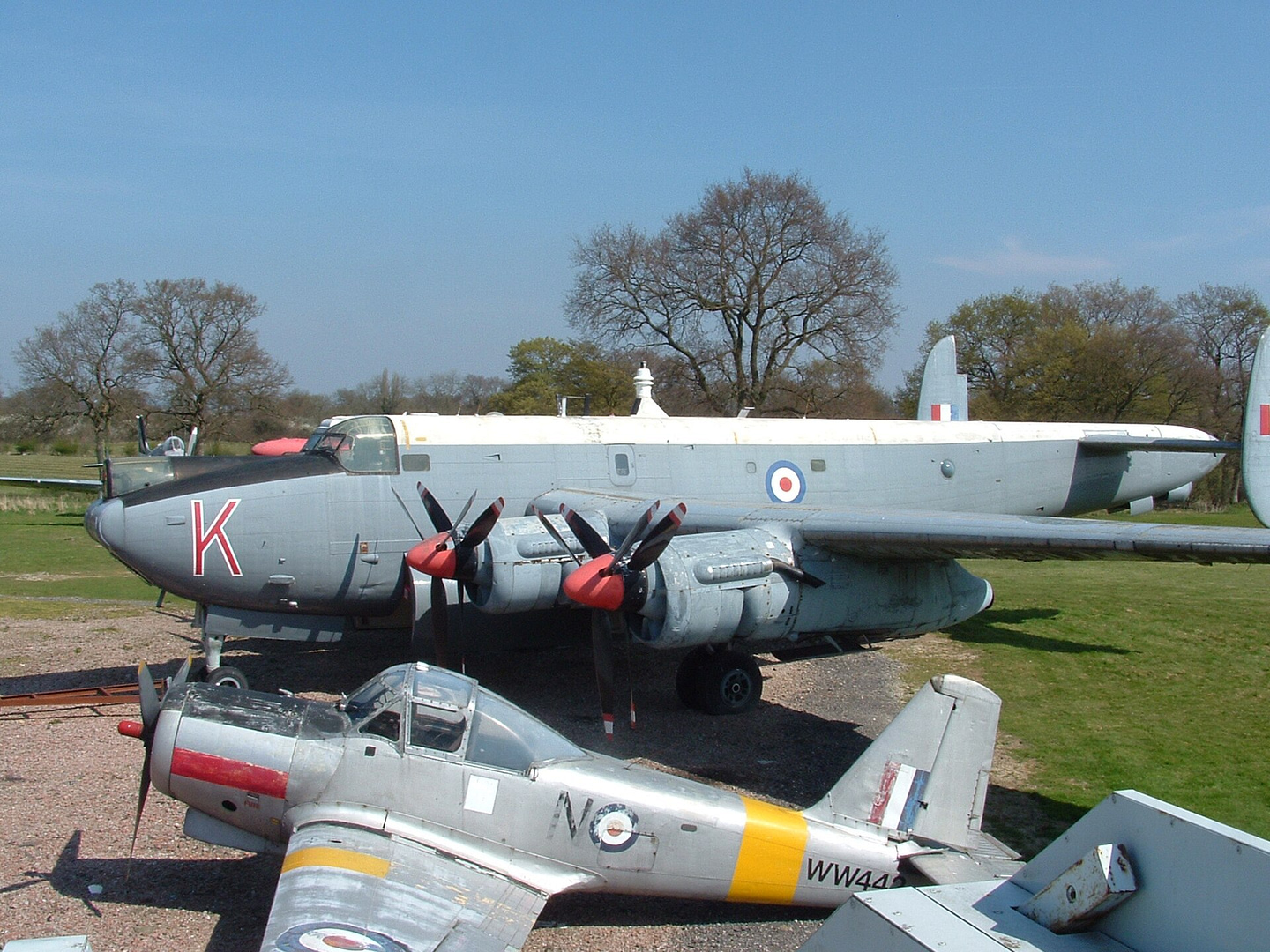
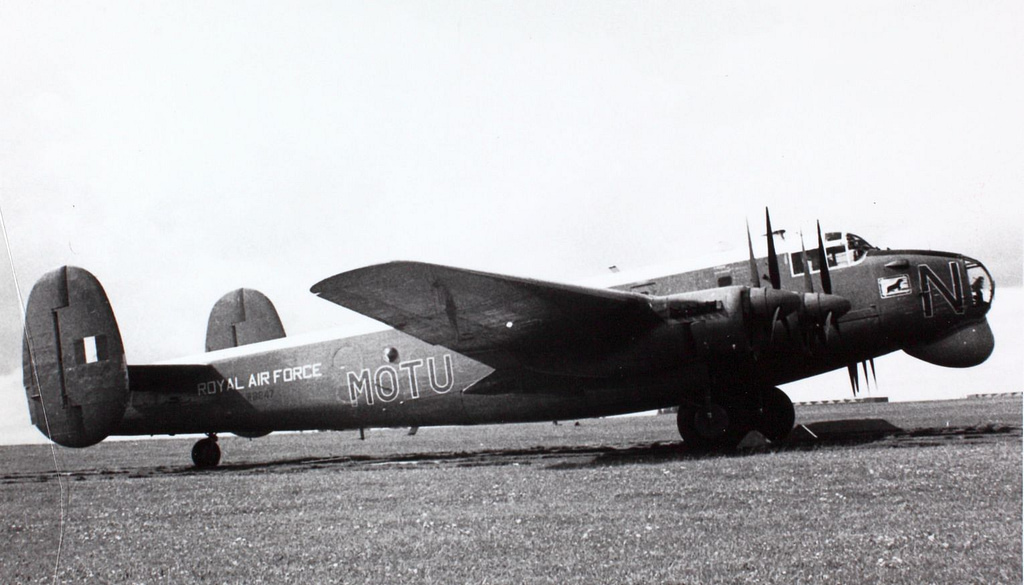
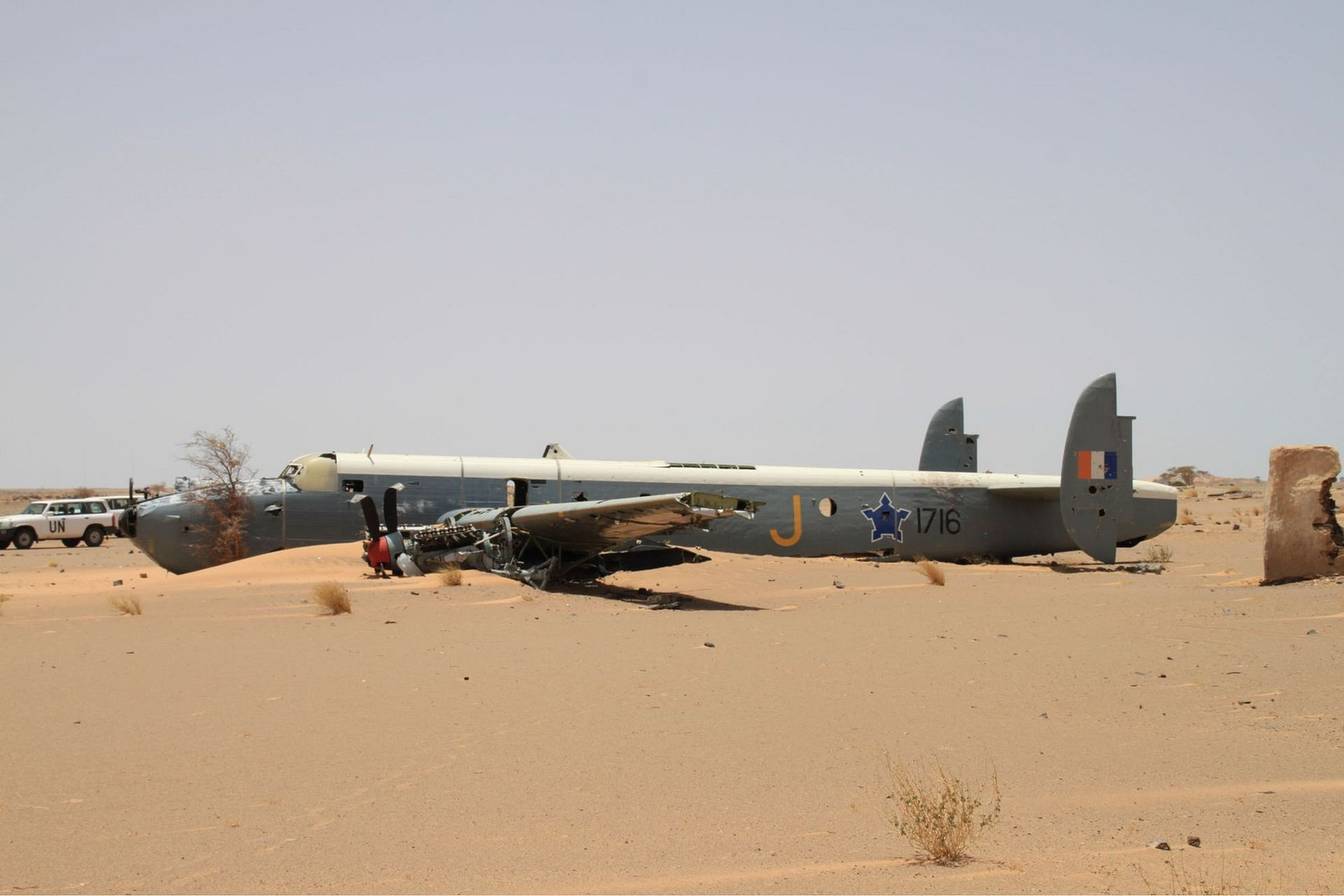
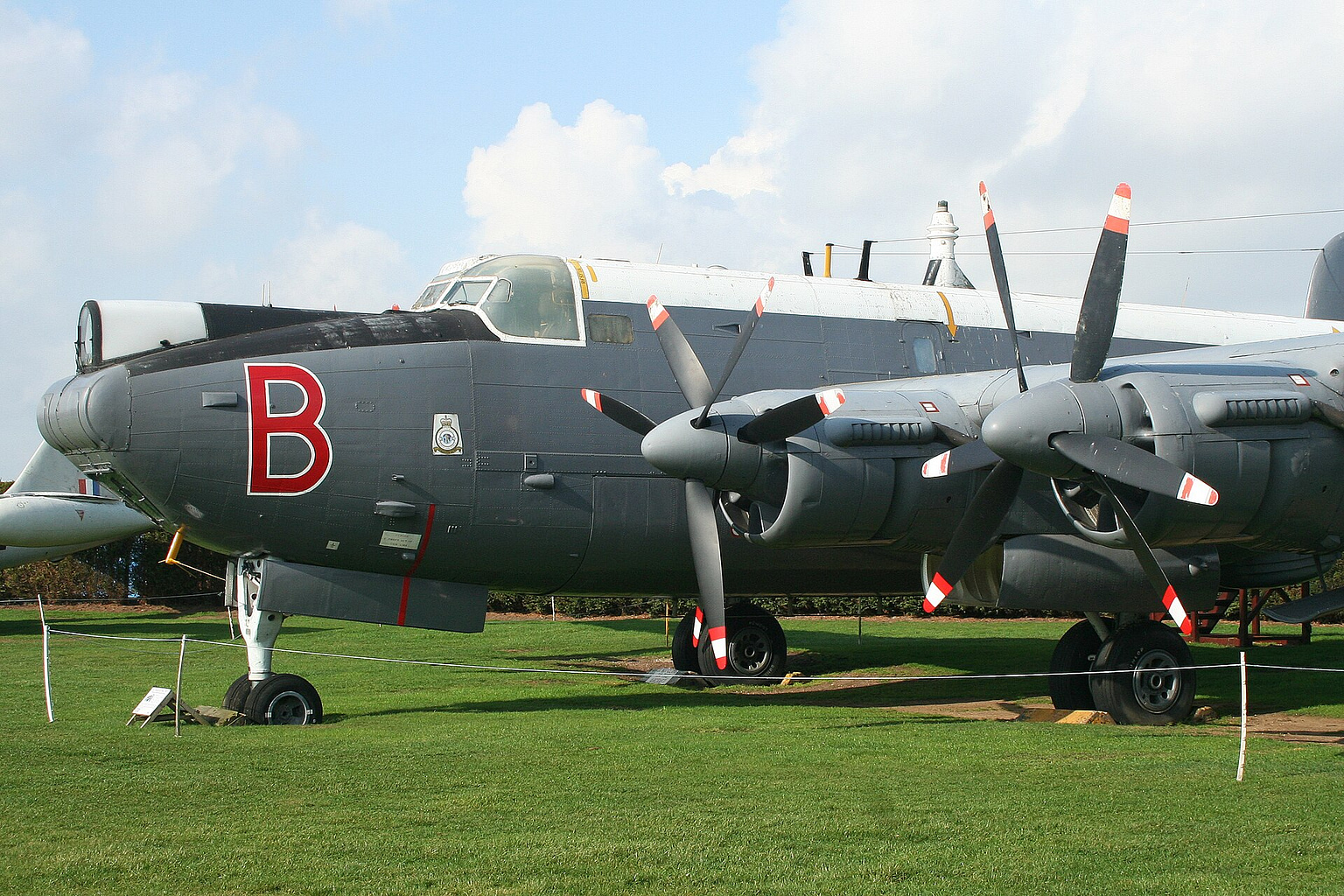
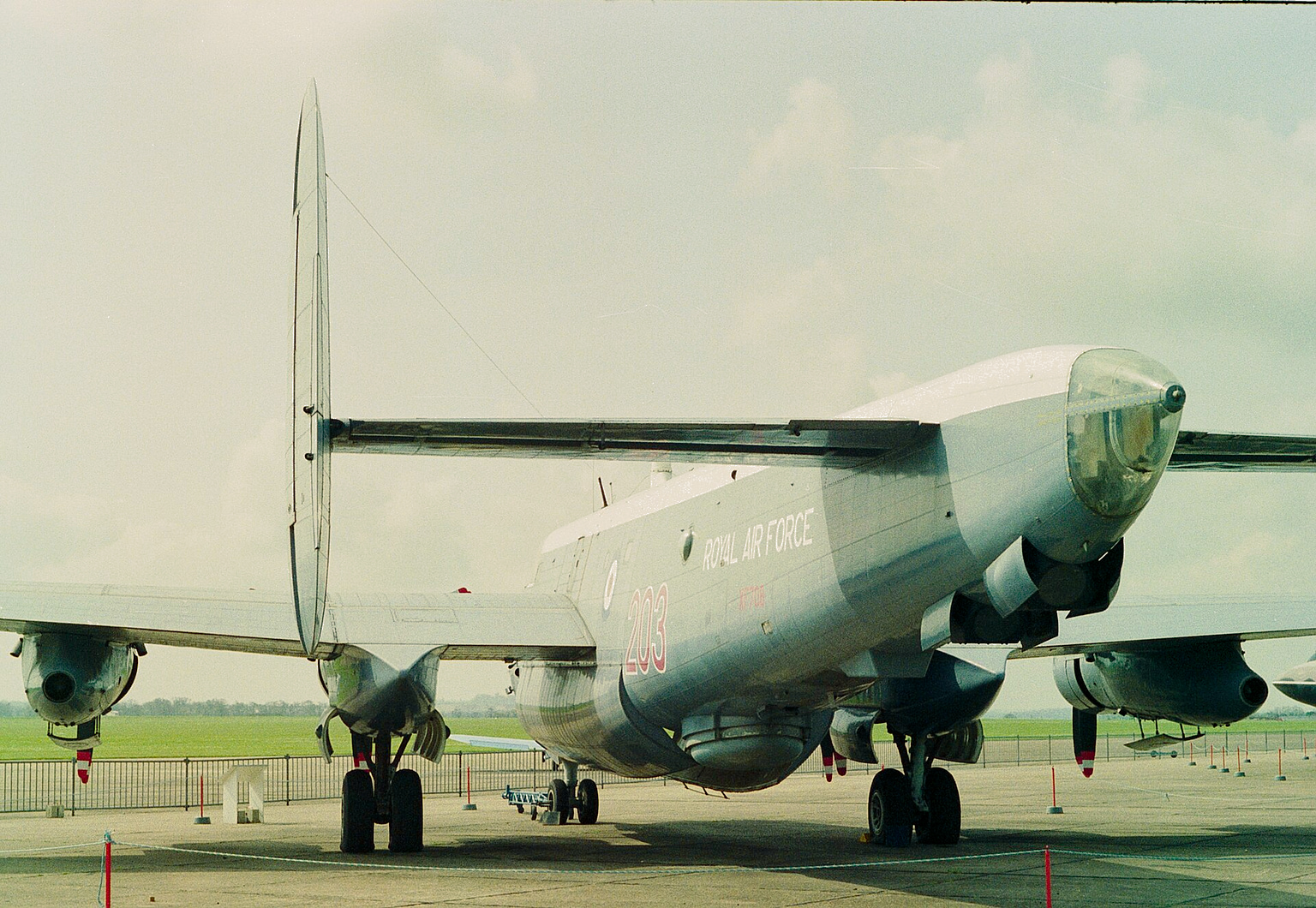
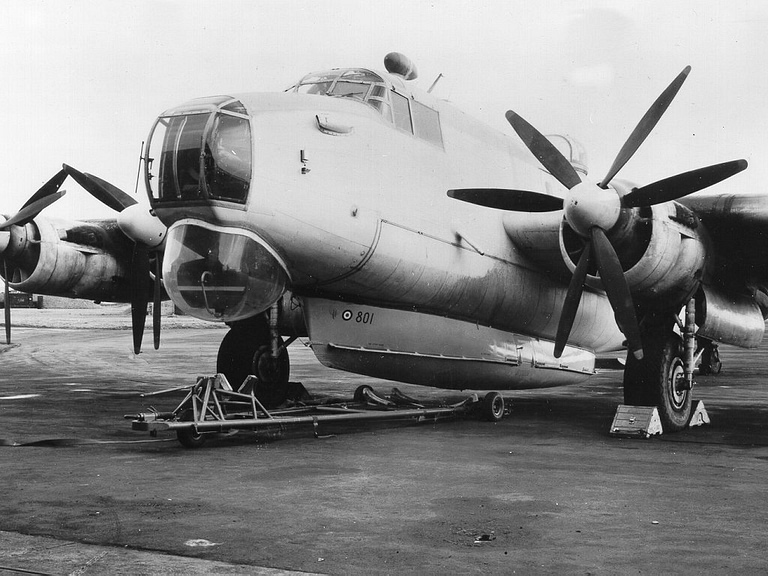
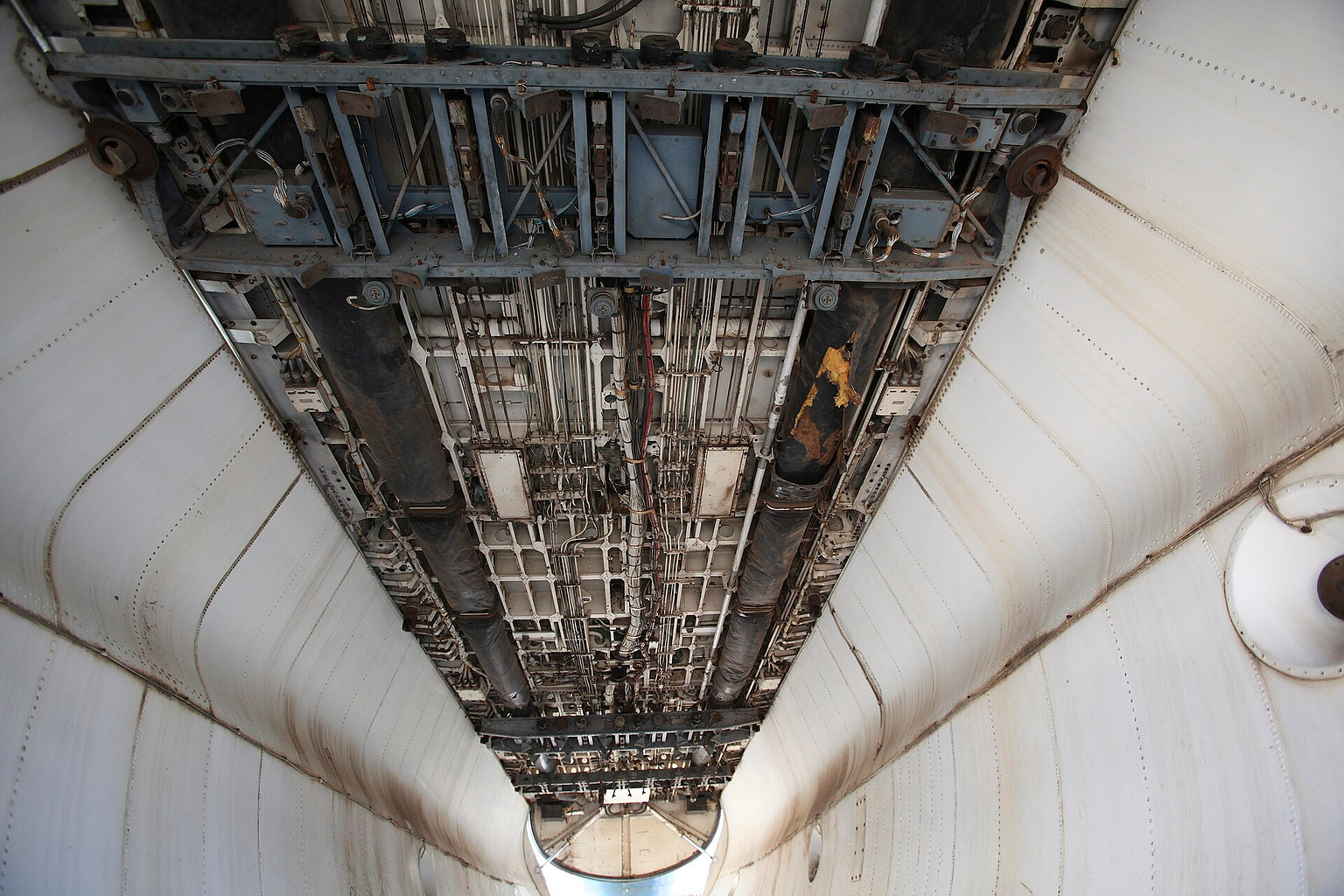
Click any photo to enlarge. All images via Wikimedia Commons; credits and licences as noted.
Watch
The Avro Shackleton on film
If you have never heard a Shackleton, no description quite does it justice — the four Griffons and their contra-rotating propellers have to be heard to be believed. This short documentary from Mark Felton Productions, an established military-history channel, tells one of the type’s most remarkable stories: how South Africa’s Shackletons were turned, briefly, into an “ecological bomber” to sink the wrecked tanker SS Wafra and contain an oil spill off the African coast.
“Avro Shackleton – Ecological Bomber” by Mark Felton Productions (~670,000 views) — the story of the SAAF Shackletons and the Wafra oil-spill sinking, from an established military-history channel.
Operations Overview
Where the Avro Shackleton flew: origin, RAF roles, export and survivors
The Shackleton was flown operationally by only two air forces — the RAF and the South African Air Force — but its patrols and deployments ranged far wider. Its natural element was the open North Atlantic, which has no borders to shade on a map; what the map below shows instead is where the aircraft was built, where the RAF took it on operations, who else flew it, and where the survivors rest today. Toggle the categories to explore each. Hover over (or tap) any highlighted country for detail.
Origin & manufacturer (blue): the United Kingdom, where all ~185 Shackletons were built by Avro. RAF service & roles (olive): home bases plus operational theatres — Suez (Egypt), Aden (Yemen), Oman, and the Indonesia–Malaysia Confrontation. Export operator (dark grey): South Africa. Surviving airframes (light grey): countries where preserved Shackletons remain.
By the Numbers
The Avro Shackleton’s service record
Figures are approximate and vary between sources. Unlike a fighter, the Shackleton saw no air-to-air combat, so no kill/loss record applies — its “combat” was the patient business of maritime patrol, anti-submarine warfare, air-sea rescue, strike and colonial policing. Its true measure is not victories but decades: forty years of unbroken vigilance over the sea.
Questions & Answers
Avro Shackleton: your questions answered
The Shackleton prompts a lot of questions — about that unforgettable noise, its Lancaster ancestry, why it served so absurdly long, and whether you could ever fly in one. Here are honest, sourced answers to the ones people ask most, starting with the big one.
Can I fly in an Avro Shackleton?
No. No Avro Shackleton is currently airworthy, and none has ever been available as a passenger ride — the surviving aircraft are museum and preservation pieces, some of them ground-run for their unforgettable engine noise but not flown. The Shackleton Preservation Trust is working to return one example (WR963) to flight in the UK, but that is not a bookable experience. MiGFlug does not offer Shackleton flights.
However, you can fly in genuine military aircraft today. MiGFlug arranges flights in jets such as the L-39 Albatros, the Hawker Hunter and even a MiG-29 to the edge of space — see the full list at migflug.com/flights-prices.
Why was the Avro Shackleton so loud?
Each of its four Rolls-Royce Griffon engines drove two six-bladed contra-rotating propellers. That layout is efficient but produces an intense, penetrating drone, and the un-pressurised fuselage did little to muffle it. The aircraft was nicknamed “the Growler,” and many crew members suffered high-tone hearing loss — a genuine and well-documented part of the type’s story.
What was the Avro Shackleton used for?
Primarily long-range maritime patrol and anti-submarine warfare — hunting Soviet submarines over the North Atlantic during the Cold War. It also flew search-and-rescue (dropping airborne lifeboats), transport, and colonial-policing and strike missions over Aden, Oman and Suez. From 1972 to 1991, twelve converted AEW.2 aircraft served in the airborne early-warning role.
How is the Avro Shackleton related to the Lancaster?
Directly. The Shackleton was developed from the Avro Lincoln, which was itself a development of the wartime Avro Lancaster bomber. It used Lincoln-derived wings, tail and undercarriage with a new fuselage — making it the last member of Avro’s great four-engined bomber family, adapted for maritime patrol.
How long did the Avro Shackleton serve, and why so long?
The RAF flew Shackletons from 1951 until 1 July 1991 — about forty years. The maritime-patrol marks were replaced by the Nimrod in the 1970s, but twelve aircraft converted to the AEW.2 early-warning role soldiered on as a “stopgap” because their intended jet replacement was repeatedly delayed. The result was one of the longest-serving aircraft of its generation.
Did other countries fly the Avro Shackleton?
Only one export operator: South Africa. The South African Air Force flew eight Shackleton MR.3s on maritime patrol around the Cape of Good Hope from 1957 until 1984. Every other Shackleton served with the Royal Air Force.
Are any Avro Shackletons still flying?
Not at present. Several survive in museums, and a few can run their engines on the ground, but as of the mid-2020s none is airworthy. The Shackleton Preservation Trust has been restoring MR.2 WR963 (registered G-SKTN) at Coventry toward a possible return to flight, keeping its Griffons in running order — but treat any “flying Shackleton” claim with caution and check the current status.
How many Avro Shackletons were built?
Approximately 185 aircraft across all marks — roughly 76 MR.1/MR.1A, about 69 MR.2, and 34 MR.3s for the RAF plus 8 MR.3s for South Africa, with 12 of the MR.2 airframes later converted into AEW.2 early-warning aircraft. Exact figures vary slightly between sources, so treat these as close approximations rather than definitive counts.
Why is it called the Shackleton?
The aircraft is named after the Antarctic explorer Sir Ernest Shackleton. Avro had a habit of naming aircraft after explorers and places (the Lancaster, Lincoln, York and Tudor among them), and the polar-explorer name suited a long-range aircraft built to endure harsh conditions far from home. Early in development it was also referred to by other designations before the Shackleton name was settled.
Where can I see an Avro Shackleton today?
Preserved Shackletons are on display at several museums. In the UK you can see MR.3 WR977 at the Newark Air Museum, MR.3 XF708 at IWM Duxford, and MR.3 WR982 at the Gatwick Aviation Museum; MR.2 WR963 is under restoration at Coventry. In the United States, AEW.2 WL790 is displayed at the Pima Air & Space Museum in Arizona, and South African examples are held at the South African Air Force Museum. Always check opening times and the current location of individual airframes before travelling.
Fly Something Real
You can’t fly the Shackleton — these, you can
The Growler is a museum piece now, and no Shackleton is currently airworthy — the closest you will get is standing beside one as its Griffons are fired up on the ground. But the thrill of flying in a real, genuine military aircraft is very much bookable. MiGFlug has arranged fighter and jet flights for civilians for two decades, in aircraft flown by former military pilots, all over the world — from gentle aerobatic sorties in a jet trainer to a supersonic climb to the very edge of space, where the sky turns black and you can see the curvature of the Earth.
Related Aircraft
If you like the Avro Shackleton, meet its neighbours in the Book of Beasts
The Shackleton sits at the meeting point of several stories in our aircraft museum — the wartime bomber it descended from, the Cold War giants it served alongside, and the maritime patrol tradition it belonged to. Follow the thread to three of its closest relatives.
The parentAvro LancasterThe wartime heavy bomber whose wings and DNA the Shackleton inherited.Cold War deltaAvro VulcanAvro’s other Cold War giant — the V-bomber that carried Britain’s deterrent.Flying boatPBY CatalinaThe legendary long-range maritime patrol flying boat that hunted where the Shackleton later did.Sources & Further Reading
Where these Avro Shackleton facts come from
This page draws on museum records, preservation groups, veteran testimony, established aviation publications and documentary sources rather than any single reference. Where figures are contested — production totals, performance numbers, the nuclear-weapons question, current airworthiness — we have flagged them as approximate or reported. For further reading, these are the sources we would point you to.