
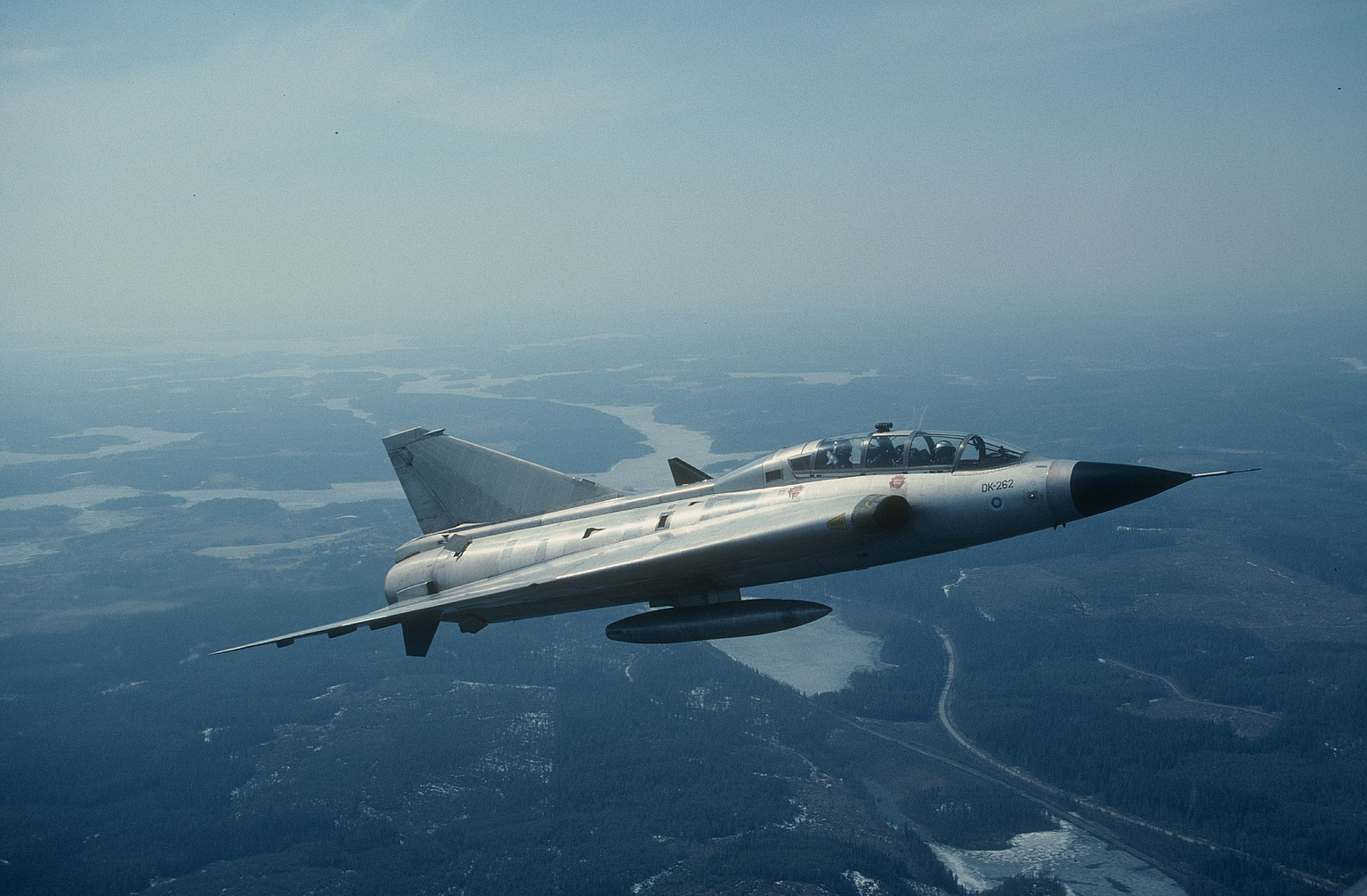
Saab 35 Draken
“The Dragon”
The double-delta gamble that made neutral Sweden the first nation in Western Europe to field a Mach 2 fighter — a road-basing interceptor that could stand on its tail decades before the Su-27 made it famous.
The dragon that guarded a neutral sky
In the late 1940s a small, neutral, non-aligned Sweden faced an outsized problem: how to stop fast, high-flying jet bombers from crossing its airspace without leaning on any alliance to do it. The Swedish Air Force wanted an interceptor that could climb like a rocket, go supersonic, and still recover to short, dispersed strips deep in the forest. Saab’s design team, led by Erik Bratt, answered with one of the most radical shapes of the jet age — the double-delta wing, a compound planform with a steeply swept inner section blended into a gentler outer delta.
Nobody had flown a wing like it, so Saab de-risked the whole programme with a half-scale flying testbed, the Saab 210 “Lilla Draken” (Little Dragon), which took to the air in January 1952 and proved the concept. The full-size prototype first flew on 25 October 1955, went supersonic in level flight within months, and reached Mach 2 in January 1960 — making the Draken the first Western European-designed aircraft to get there. It entered service with wing F13 in March 1960.
The Draken was built around Sweden’s Bas 60 (later Bas 90) dispersal doctrine: instead of concentrating jets on a handful of airfields an enemy could destroy in one strike, the air force would scatter them to camouflaged forest bases and reinforced public roads, rearmed and refuelled by small teams of conscript ground crews. The aircraft had to be tough, simple and quick to turn around — and it was. Its double-delta also gave pilots a startling party trick: pulled hard, the nose would rear up into a controlled superstall the Swedes called kort parad, “the short parry,” bleeding speed so fast a pursuer would overshoot — a cobra-style manoeuvre decades before the Su-27.
Roughly 600–650 Drakens were built over two decades, and the type was exported to Denmark, Finland and Austria. It never fired a shot in anger. Its whole career was interception, reconnaissance, quick-reaction alert and the quiet, constant work of guarding neutral skies — a job it did until Austria, the last operator, retired the type in 2005.
01The Saab 35 Draken’s double-delta wing: why Sweden built a shape nobody had flown
The double-delta fused two wings into one: an inner delta swept at roughly 80°, optimised for high speed and packed with fuel, engine and landing gear, blended into an outer delta of about 60° that preserved lift and control at lower speeds. That let a single airframe combine a very high top speed with acceptable take-off and landing behaviour — a hard trick in the mid-1950s. At high angle of attack the sharp leading edges shed energetic vortices that add lift, an effect later exploited deliberately on the F-16, F/A-18 and Rafale. Saab discovered much of it the careful way, first on the half-scale Saab 210 testbed, before committing the real aircraft.
What makes it special
The double-delta wing
The Draken’s signature is a compound delta — an ~80° inner wing for speed and volume, an ~60° outer wing for low-speed lift. One planform gave it Mach 2 performance and short-field manners at once, and its leading-edge vortex lift anticipated ideas used on fighters built decades later. Hush-Kit’s analysts even note the shape gave it an unusually small head-on radar signature for its generation.
Built to fight from the highway
Engineered for Sweden’s Bas 60/90 dispersal doctrine, the Draken was designed to scatter to forest strips and reinforced public roads and be turned around by small teams of conscript ground crews. Robust, simple systems and short-field performance meant no single enemy strike could catch the air force on the ground — neutrality with a hard edge.
The ‘short parry’ and the zoom-climb
The double-delta let the Draken pitch to very high alpha and enter a controlled superstall — kort parad — that scrubbed speed and forced a chaser to overshoot, a cobra-type move long before it was famous. Paired with a fast snap-up zoom-climb, it suited the jet’s core job: catching high, fast bombers at the edge of the stratosphere.
02The Saab 35 Draken’s engine: a licensed Rolls-Royce Avon with a Swedish afterburner
Power came from a single Volvo Flygmotor RM6C — a licence-built Rolls-Royce Avon 300 fitted with a Swedish-designed afterburner (the EBK 66/67). It delivered roughly 56 kN dry and about 78 kN in reheat, enough to push the Draken past Mach 2. Sweden’s decision to license and then locally develop the Avon — rather than import a finished engine — was part of the same self-reliant, non-aligned logic that shaped the whole aircraft.
03The Saab 35 Draken’s high-alpha handling: brilliant, and briefly dangerous
The same wing that let the Draken perform its kort parad also made low-speed handling demanding on the early marks: mishandled, the jet could enter an uncommanded superstall that required deliberate, trained recovery. Swedish pilots learned to treat the high-alpha regime as both a weapon and a hazard. It is frequently cited as the first aircraft able to perform a cobra-type manoeuvre — but contemporaneously it was flown as a carefully managed combat and recovery technique, not an airshow flourish.
Full specifications
Airframe & Performance
- 全体人员
- 1 (2 in SK 35 / TF-35 trainers)
- 长度
- ~15.35 m
- 翼展
- ~9.42 m
- 高度
- ~3.89 m
- 空重
- ~7,865 kg (J 35F)
- Max takeoff weight
- ~11,900–16,000 kg (config-dependent)
- Max speed
- Mach 2 (~2,100+ km/h) · up to Mach 2.3 cited
- 设备天花板
- ~20,000 m
- 攀升速率
- ~199 m/s
- Ferry range
- ~2,750 km with external tanks
Propulsion & Systems
- 引擎
- 1 × Volvo Flygmotor RM6C
- Basis
- Licensed Rolls-Royce Avon 300 + Swedish afterburner
- 推力
- ~56 kN dry · ~78 kN reheat
- Guns
- 30 mm ADEN (2 early marks, 1 on J 35F)
- Missiles
- Rb 24 (Sidewinder), Rb 27 / Rb 28 (Falcon)
- First flight
- 25 October 1955
- Built
- ~600–650 (Saab cites 612; others 651)
- Unit cost
- No consistent public figure
- Cost per flight hour
- No reliable public figure
04The Saab 35 Draken’s operating costs: why no reliable price exists
The Draken was a Swedish state product built for the national air force, never sold on an open dollar market, so a firm flyaway unit price and a credible cost-per-flight-hour simply do not exist in the public record. Surplus airframes later changed hands privately for figures in the low hundreds of thousands of dollars, but that reflects a decommissioned 1960s jet’s scrap-and-collector value, not what it cost Sweden to build or operate. Any precise dollar figure attached to a Draken should be read as an estimate.
From double-delta gamble to last Cold-War sentinel
Design study begins
Saab starts work on a Mach-capable interceptor to replace the Tunnan and Lansen and defend neutral Swedish airspace.
Lilla Draken flies
The half-scale Saab 210 testbed takes to the air on 21 January, validating the untested double-delta wing.
First flight
The full-size Draken prototype flies on 25 October with test pilot Bengt Olow; it exceeds Mach 1 in level flight in January 1956.
Enters service & hits Mach 2
The J 35 joins wing F13 in March; a Draken had reached Mach 2 that January — a Western European first.
Denmark buys in
The Royal Danish Air Force adopts the Saab 35XD as a strike and reconnaissance aircraft, the first export customer.
Finland joins
Finland begins operating the Draken, with some airframes assembled locally by Valmet and later cleared to carry Soviet missiles.
Austria’s last-of-line
Austria takes 24 rebuilt ex-Swedish airframes as the J 35OE — its first true supersonic interceptors.
Retirement
Sweden retires the type in 1998/1999; Finland in 2000; Austria flies the last military Drakens until 2005.
Twelve stories from the double-delta dragon
The double-delta gamble
Sweden bet its air defence on a wing shape nobody had ever flown.
Read the full story
Lilla Draken, the Little Dragon
A half-size aircraft flew first to de-risk the real one.
Read the full story
A dragon leaves the ground
Test pilot Bengt Olow lifted the prototype off on 25 October 1955.
Read the full story
Mach 2, the European first
Sweden hit twice the speed of sound before its bigger neighbours.
Read the full story
The cobra before the cobra
Draken pilots reared the nose to the vertical decades before the Su-27.
Read the full story
War from the highway
Sweden’s plan was to fight from roads, not runways.
Read the full story
The Finnish Draken’s Soviet sting
A Western fighter that flew with Russian missiles.
Read the full story
Danish dragons over the North Sea
Denmark turned the interceptor into a strike aircraft.
Read the full story
Guarding the Alps while the Balkans burned
Austria’s Drakens policed neutral skies during the Yugoslav wars.
Read the full story
The 1950s jet that photographed stealth
A Cold-War interceptor caught two F-117 Nighthawks over neutral Austria.
Read the full story
The first Western European Mach 2 fighter
A neutral nation beat the big air forces to twice the speed of sound.
Read the full story
Dragons in retirement
A handful still fly — but you cannot buy a ticket.
Read the full story
The Draken in pictures
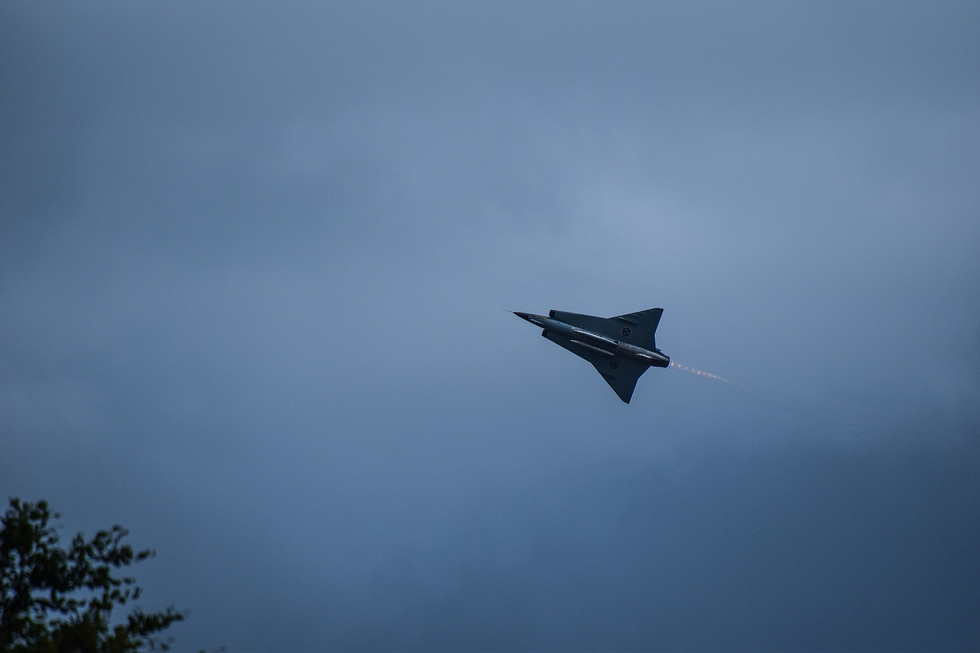
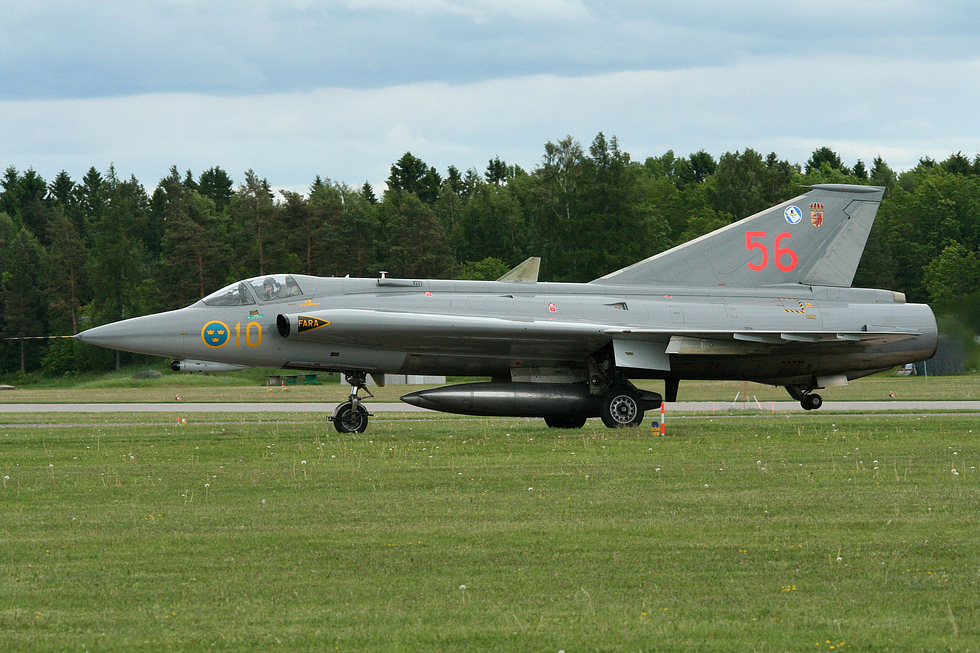
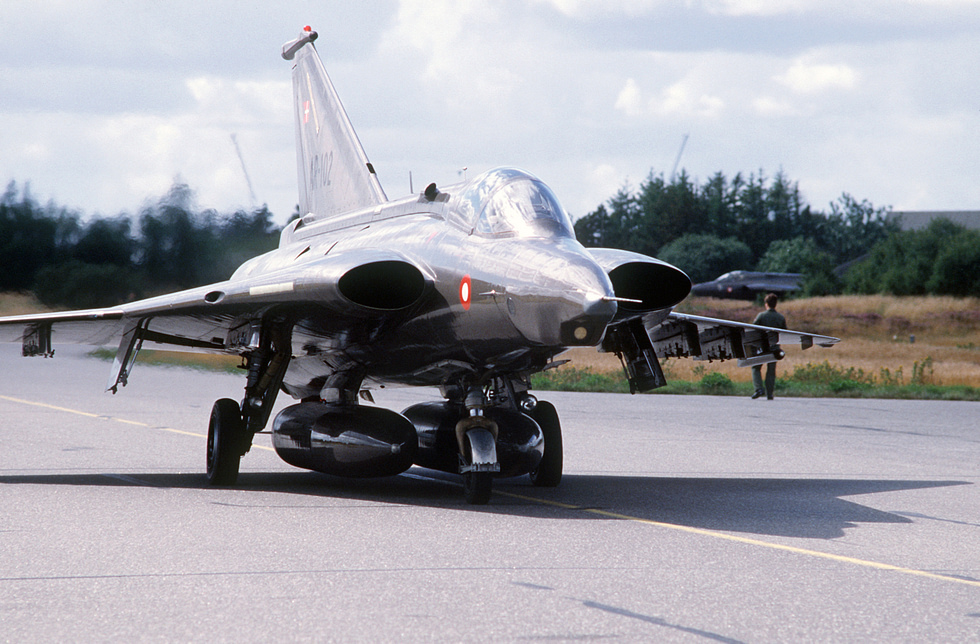
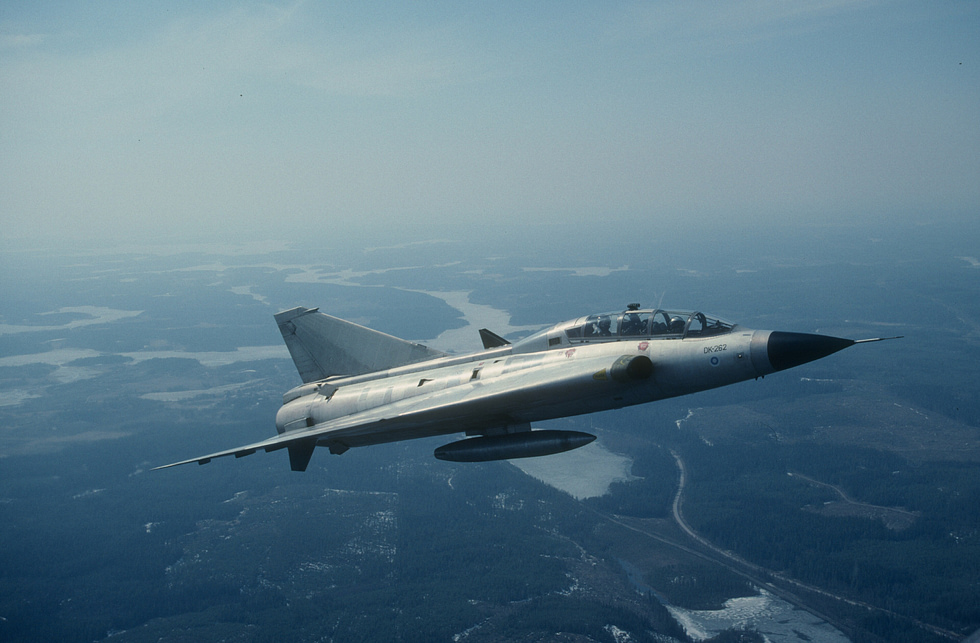
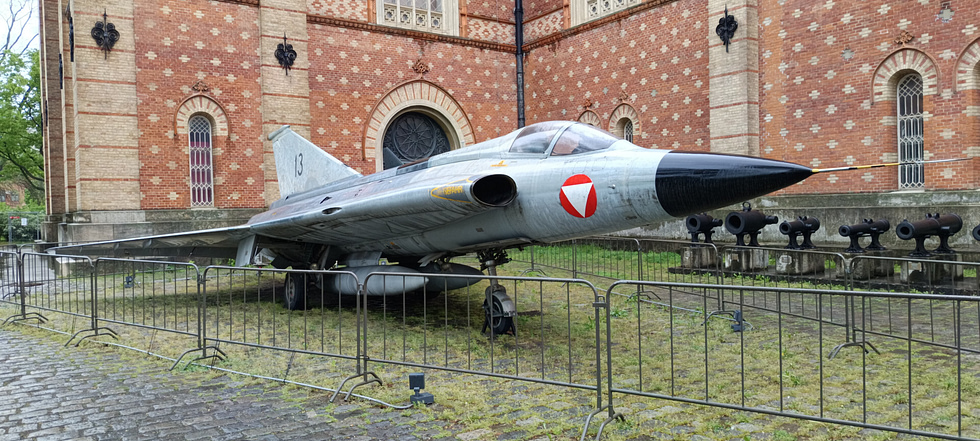
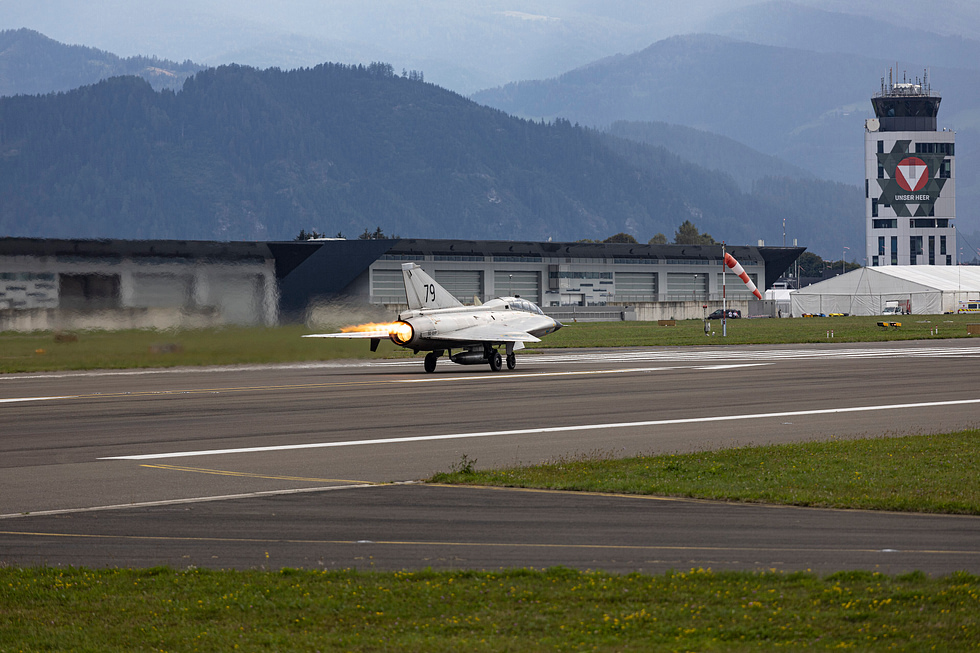
The Draken in motion
A hand-picked video feature on the Saab 35 Draken is coming soon. In the meantime, explore the photo gallery above and the operations map below to see where the dragon flew.
The Draken in motion
Megaprojects — one of the most-watched Draken films on YouTube.
Where the Draken flew
The record it never had to write
The Saab 35 Draken never fired a shot in anger. No operator — Swedish, Danish, Finnish or Austrian — ever used it in combat. Its whole career was written in interception, reconnaissance and quick-reaction alert: shadowing Cold-War intruders over the Baltic, standing neutral watch over the Alps, and once photographing American stealth jets it was never supposed to find. Its victories were the ones where nothing happened.
Compare the combat record of every military aircraft. Figures as of July 2026.
Everything people ask about the Saab 35 Draken
Can I fly in a Saab 35 Draken?
How fast is the Saab 35 Draken?
What makes the double-delta wing special?
Did the Saab 35 Draken ever see combat?
Could a Draken really catch an SR-71?
Who operated the Saab 35 Draken?
Is the Saab 35 Draken still flying?
When and why was the Draken retired?
You can’t fly the Draken.
These, you can.
Some legends only live in museums — others are fuelled and waiting. MiGFlug has put civilians in real military jet cockpits since 2004.
 Fly the L-39 AlbatrosThe world’s most-flown jet trainer — aerobatics included
 Fly the F-104 Starfighter“The missile with a man in it”
 Fly the MiG-21The Cold War’s most-produced jet
 驾驶T-33流星战斗机America’s first jet trainer
 Fly the DH VampireA piece of early jet history
 Fly the S.211Agile Italian jet trainer
 Fly the MB-326The classic Aermacchi jet
 Fly the MiG-15The Soviet legend of the Korean War
Continue the tour
Every fact, checked
- Saab — “Draken: 50 years in the air”The manufacturer’s own account of the design, Erik Bratt’s team, and Swedish service.
- The Aviationist — “Sweden’s Flying Dragon”Overview of the wing angles, road-base doctrine, high-alpha handling and US test use.
- Hush-Kit — “Saab Draken: Swedish Stealth Fighter?”Jim Smith’s expert analysis of the double-delta and the type’s low head-on radar signature.
- PlaneHistoria — “Saab 35 Draken”Development, aerodynamics, engine detail and the dispersed-basing concept.
- Vintage Aviation NewsFirst-flight milestones, variant history and production figures.
- The Aviation Geek ClubContext on the Viggen’s SR-71 radar locks — correcting the common Draken attribution error.
- 19FortyFiveThe 2002 F-117 intercept and Austria’s neutrality and missile restrictions.
- Plane-Encyclopedia — “Saab 35 Draken”Detailed variant, operator and specification cross-check.