
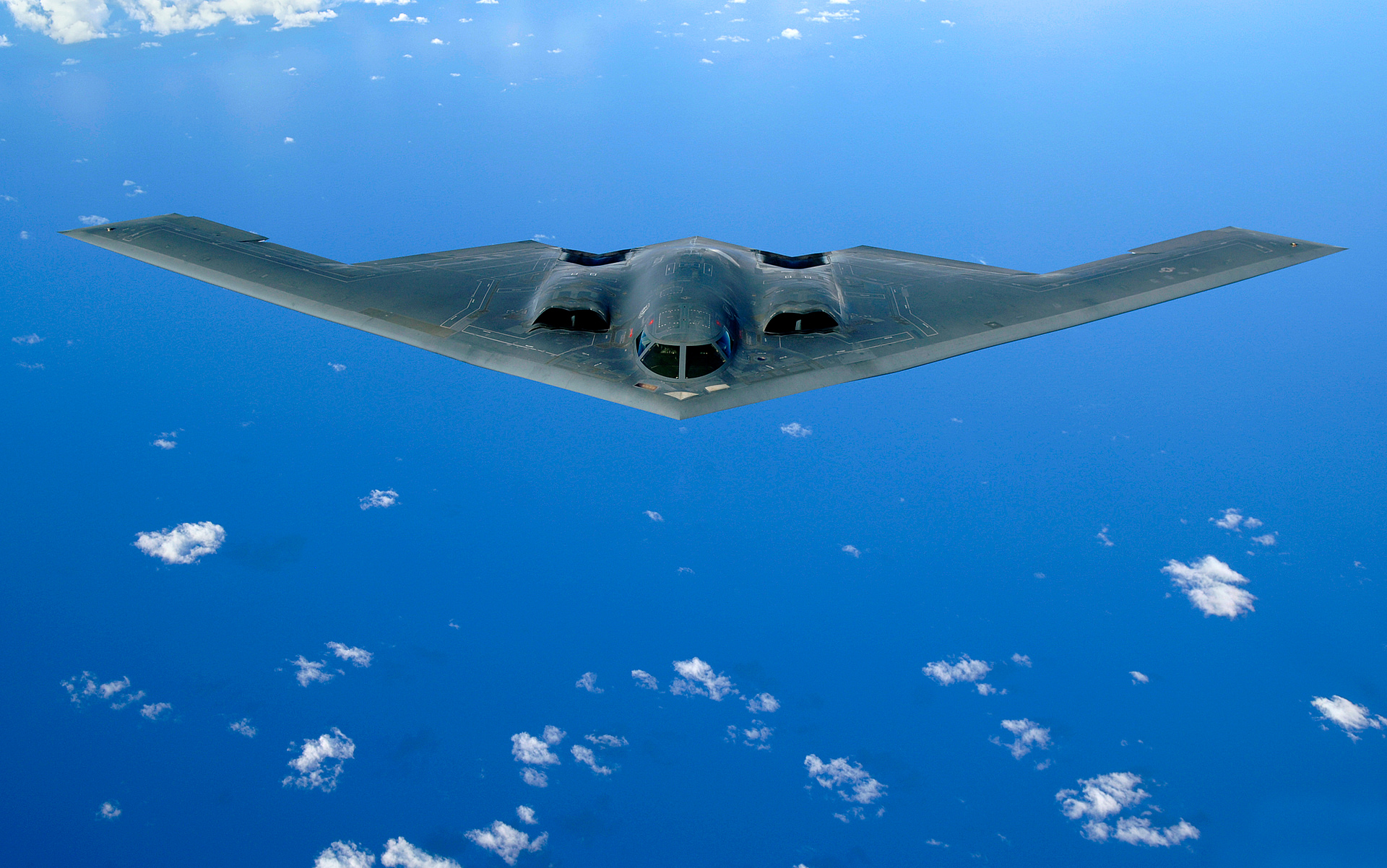
Northrop Grumman B-2
“Spirit”
The stealth flying wing that gave the United States a way to strike anywhere on Earth from the American heartland — the most expensive aircraft ever built, and for a quarter-century the only bomber that could slip through modern air defences unseen.
A bomber the radar cannot see
The B-2 Spirit began as an answer to a Cold-War problem: by the late 1970s Soviet air defences had grown so dense that even fast, high-flying bombers could no longer be sure of reaching their targets. The United States needed an aircraft that could get through not by outrunning the radar, but by being nearly invisible to it. In 1981 the US Air Force awarded Northrop the contract for the Advanced Technology Bomber (ATB) — a black programme so secret that its very shape was classified for years.
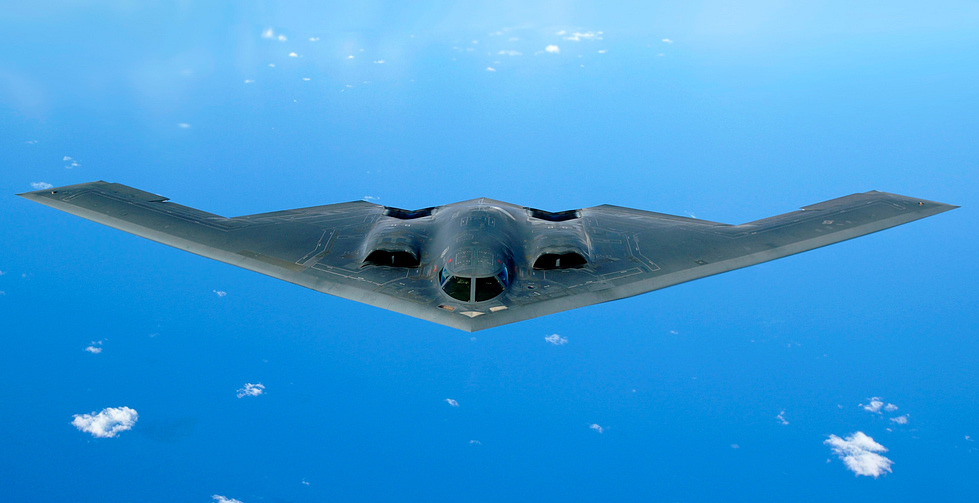
The shape, when it was finally rolled out in 1988, was startling: a smooth, tailless flying wing, all leading edges and blended curves, with no vertical surfaces for radar to bounce off. It was also a homecoming. Northrop’s founder Jack Northrop had championed the flying wing in the 1940s with the YB-35 and jet-powered YB-49, only to see the programme cancelled. Digital fly-by-wire finally tamed the configuration his generation could not, and the B-2 vindicated his vision decades later.
It first flew on 17 July 1989 and entered service in 1997 with the 509th Bomb Wing at Whiteman AFB, Missouri. Only 21 were ever built — the end of the Cold War gutted a planned fleet of 132 — and at a programme cost of roughly two billion dollars each, the Spirit remains the most expensive aircraft ever flown. Even so, for more than twenty-five years it has been the only aircraft on Earth able to carry heavy stealthy strikes deep into defended airspace.
01The B-2 Spirit and Jack Northrop’s fifty-year flying-wing dream
Jack Northrop believed the flying wing was the most aerodynamically efficient shape an aircraft could take: no fuselage, no tail, nothing but lift-generating wing. In the 1940s he built the piston YB-35 and the jet YB-49 to prove it, but the aircraft were unstable and hard to fly, and the programme was cancelled in 1949. The story goes that Northrop, by then frail and near the end of his life, was quietly shown a model of the still-classified B-2 in 1980 and understood at last that his idea would fly.
What changed between the YB-49 and the B-2 was electronics. A tailless flying wing is inherently unstable, constantly trying to wander in yaw. The B-2 is kept pointing straight by a quadruple-redundant digital fly-by-wire system making tiny corrections thousands of times a second, using split “deceleron” surfaces at the wingtips for both drag and steering. The shape Jack Northrop chose for efficiency turned out to be almost perfect for stealth as well — a happy accident that made the flying wing the ideal form for a bomber meant to vanish from radar.
What makes the B-2 special
A flying wing built to disappear
The B-2 has no tail and no flat vertical surfaces — nothing for radar to reflect straight back. Its blended, curved shaping, saw-tooth trailing edge and skin of radar-absorbent material scatter and soak up radar energy. Public estimates of its radar cross-section are famously vague, often likened to a small bird or a marble; the true figure stays classified, but the effect is a heavy bomber that defended radars struggle to detect until it is far too late.
Global reach from the American heartland
Four non-afterburning GE F118 turbofans, buried inside the wing with shielded intakes and exhausts, give the Spirit a range of about 6,000 nautical miles unrefuelled — and roughly 10,000 with a single aerial refuelling. Flying from Whiteman AFB in Missouri, a B-2 can reach targets on the far side of the planet and return, missions that routinely run past 30 hours in the air with rotating two-pilot crews.
A huge, flexible internal payload
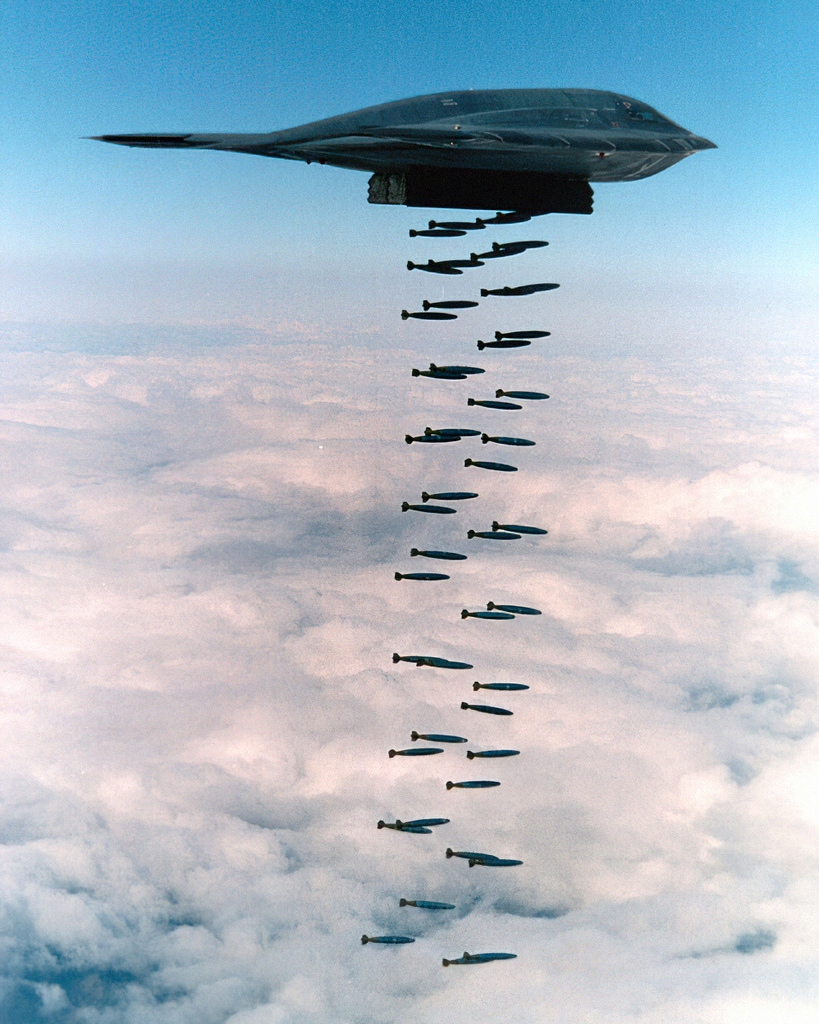
Everything the B-2 carries rides inside two internal bays, keeping it stealthy. That payload — cited at more than 40,000 lb by Northrop Grumman and up to 60,000 lb by the Air Force — spans nuclear gravity bombs like the B61 and B83, scores of precision GBU bombs, and the 30,000-lb GBU-57 Massive Ordnance Penetrator, the deep bunker-buster no other aircraft can drop.
02The B-2 Spirit’s stealth: shaping, materials and a costly kind of magic
Stealth is not one trick but several working together. The B-2’s shape does most of the work — every edge on the aircraft is aligned to a handful of angles so that radar energy is scattered away in a few narrow directions rather than back at the transmitter. On top of that, the airframe is coated and built with radar-absorbent materials that convert radar energy to heat, and the engine intakes and exhausts are hidden on the upper surface to mask the hot, radar-bright turbines. The price is maintenance: the special coatings historically needed climate-controlled hangars and painstaking care after every flight, one reason the B-2 has always been costly to keep mission-ready. Exact radar-cross-section figures remain classified, and any single number you see quoted should be treated with caution.
03Why the B-2 needs four engines and a computer just to fly straight
A tailless flying wing has no fin to keep it tracking straight, so left to itself the B-2 would yaw and wallow. It stays controllable only because a quadruple-redundant fly-by-wire flight-control system constantly nudges its control surfaces — including split deceleron panels at each wingtip that open like clamshells to create drag on one side and swing the nose. Its four General Electric F118 turbofans have no afterburners; the B-2 is a subsonic aircraft that trades speed for stealth and efficiency, cruising high and quiet rather than dashing. That combination of computerised stability and clean, buried engines is what lets a shape Jack Northrop could never quite fly become a dependable long-range bomber.
Full B-2 Spirit specifications
Baseline note: the figures below describe the B-2A Block 30, the standard every surviving airframe was rebuilt to by 2000 and the only configuration the type has fought in. Where a number is officially classified — radar cross-section, true unrefuelled combat radius, the real maximum take-off weight — that is said plainly rather than filled in with a circulating estimate, and the estimates that do circulate are marked as such in grey. Deltas for the earlier Block 10 和 Block 20 aircraft, and for the flying-wing ancestors, appear in grey as well.
Dimensions & weights
- 全体人员
- 2 — pilot in the left seat, mission commander in the right (a third seat position exists but is not normally manned; a lavatory and a space to lie flat are fitted, because the sorties run past 30 hours)
- 长度
- 21.0 m (69 ft 0 in)
- 翼展
- 52.4 m (172 ft 0 in) — exactly the span of the Northrop YB-49 of 1947, which is not a coincidence
- 高度
- 5.18 m (17 ft 0 in) — a bomber you can very nearly look over
- 机翼面积
- 478 m² (5,140 sq ft); leading edge swept 33°, with the whole aeroplane built to just four leading-edge and trailing-edge angles so that radar returns are herded into a few narrow spikes
- 空重
- 71,700 kg (158,000 lb)
- Typical gross weight
- 152,200 kg (336,500 lb)
- 最大起飞重量
- 170,600 kg (376,000 lb) — officially classified. This is the figure reference works derive from Northrop Grumman’s public statement that payload is "at least 40,000 lb", not a released number
- 内燃机
- ~75,750 kg (~167,000 lb), all of it inside the wing; there are no drop tanks and nowhere to hang them
- Weapons bays
- 2, side by side in the centre section — each takes either a Rotary Launcher Assembly of eight heavy stations or a Bomb Rack Assembly for lighter weapons
- Payload
- 18,140 kg (40,000 lb) is the published limit; ~27,200 kg (~60,000 lb) has been carried operationally. Everything is internal — there is not a single external hardpoint on the aeroplane
- Wing loading
- 329 kg/m² (67.3 lb/sq ft) at gross weight — low, and the reason it cruises efficiently at 12,000 m on four unaugmented engines
Performance
- 最高速度
- 1,010 km/h (630 mph; 550 kn) at 12,200 m (40,000 ft), about Mach 0.95. There is no afterburner and no supersonic dash: reheat would light the aircraft up in the infrared, and a shock wave would announce it
- 巡航速度
- 900 km/h (560 mph; 487 kn) at 12,200 m (40,000 ft)
- 设备天花板
- 15,200 m (50,000 ft)
- Range, unrefuelled
- ~11,100 km (~6,000 nmi; ~6,900 mi) — the standard published figure, at an unstated weight and profile
- Range, one refuelling
- ~18,500 km (~10,000 nmi; ~11,500 mi)
- 作战半径
- Not disclosed. Every radius figure in circulation is a reconstruction from range and endurance, not a released number. In practice the aeroplane is treated as having intercontinental reach with tankers and is flown that way
- Longest recorded sortie
- 44.3 hours — October 2001, Whiteman to Afghanistan and on to Diego Garcia, at the time the longest combat mission ever flown
- Typical strike sortie
- 33–37 hours round trip from Missouri — 33 hours for the Libya strike of January 2017, about 37 hours for the Iran strike of June 2025
- Aerial refuelling
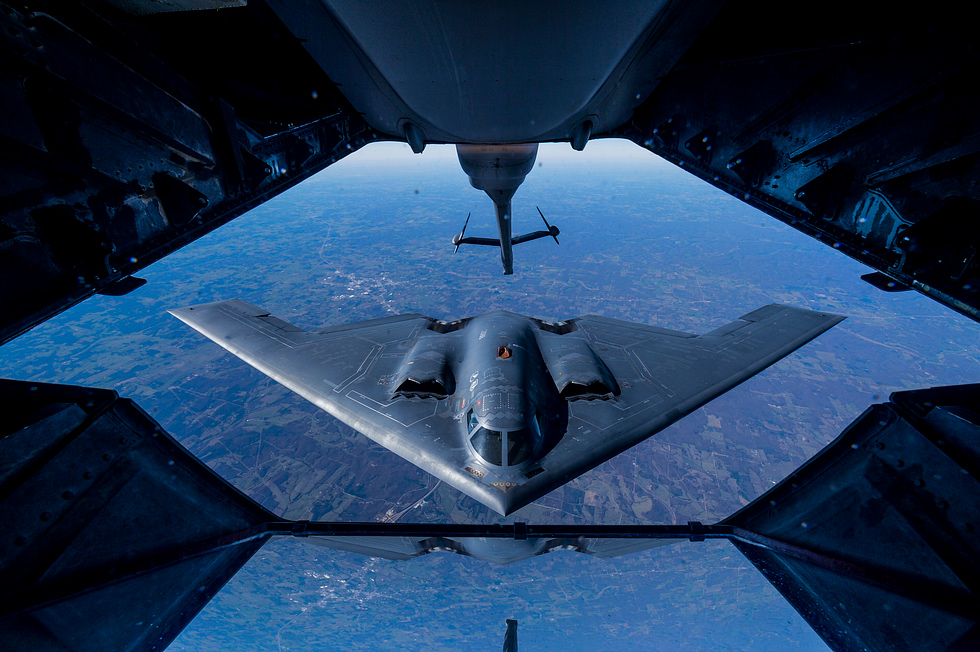
- Boom receptacle behind the cockpit; tops up roughly every six hours in the cruise (the USAF quotes up to about 45,000 kg / 100,000 lb taken on in a single contact)
- Thrust-to-weight
- 0.205 at gross weight — an airliner’s number
- Radar cross-section
- Classified. The figures repeated everywhere — roughly 0.1 m², or the "marble" claim of about 0.0014 m² — have never been confirmed by the USAF or Northrop Grumman, and a single number is in any case meaningless without a frequency and an aspect. Treat all of them as folklore
- Weather limitation
- Must stay about 64 km (40 mi) clear of thunderstorms — the composite structure is vulnerable to static discharge and lightning strike, which is a real planning constraint on a 30-hour sortie
Propulsion & systems
- Engines
- 4 × General Electric F118-GE-100 non-afterburning turbofans, buried deep in the wing with serpentine inlet ducts and shallow over-wing exhausts — the ducts hide the compressor faces from radar, the exhaust position and shape mix the plume with cold air before it leaves the trailing edge
- Thrust, each
- 77 kN (17,300 lbf) — the USAF fact sheet figure. Some Northrop Grumman and USAF material quotes 19,000 lbf per engine; the lower number is the better-attested one and both appear in official documents
- Fuel and refuelling
- ~75,750 kg (~167,000 lb) internal; flying-boom receptacle. No external tanks exist for the type
- Radar
- Raytheon AN/APQ-181 low-probability-of-intercept multi-mode set with terrain-following and ground-mapping modes; rebuilt from 2010 under a US$468 million contract with new active electronically scanned array antennas and a shifted operating band, because the original frequency clashed with commercial users
- Navigation
- NAS-26 astro-inertial system — a star tracker, descended from the guidance of the 1950s SM-62 Snark cruise missile — blended with inertial and GPS, so the aeroplane can find its target with the satellites jammed and never has to ask anyone where it is
- Flight controls
- Quadruplex digital fly-by-wire; nine trailing-edge surfaces and no fin at all. Outboard on each wing is a split drag rudder whose upper and lower halves open like a clam for yaw and as an airbrake; inboard of those, four elevons; on the centreline a wedge-shaped "beavertail" that trims pitch and is the visible end of the gust load alleviation system, which senses vertical accelerations and works the surfaces to damp the wing’s bending in turbulence
- Defensive systems
- ZSR-63 / AN/APR-50 passive defensive management system — warning and situational awareness, not jamming. The Defensive Management System Modernisation contracted in 2013 replaced the antennas and receivers to widen frequency coverage. There is no towed decoy, no jammer pod, no chaff and flare fit of the sort a conventional bomber carries
- Structure and coatings
- Carbon-graphite composite over a titanium and aluminium substructure, assembled to tolerances tight enough to stop fluid seepage, because a fluid film changes the signature. Radar-absorbent material is both applied and built into the structure; the surface is finished with tape, caulk and sprayed coatings that have to be stripped and reapplied whenever a panel is opened. The fleet lives in climate-controlled shelters — deployable B-2 Shelter Systems cost about US$5 million each
- Computing
- 13 EMP-hardened MIL-STD-1750A processors on MIL-STD-1553B buses at entry into service; rebuilt from July 2008 around a fibre-optic network and a single integrated processing unit, with the operational flight programme rewritten out of JOVIAL into C
- First flight
- 17 July 1989 (first public rollout 22 November 1988 at Palmdale, with guests kept away from the rear of the aircraft — whereupon Aviation Week hired an aeroplane and photographed the trailing edge from above, no airspace restriction having been imposed)
- Service entry
- 17 December 1993, Spirit of Missouri to Whiteman AFB; combat debut over Yugoslavia in 1999; full operational capability declared December 2003, four years after the type first went to war
- Number built
- 21 (plus two ground-test articles). 165 were planned under the Advanced Technology Bomber programme, 132 in the mid-1980s plan, cut to 75, then capped at the 21 already ordered when Congress refused further funding
- Unit cost
- ~US$737 million flyaway in 1997 dollars; ~US$929 million procurement cost per aircraft including spares and software support; ~US$2.13 billion apiece once the whole US$44.75 billion programme is divided by 21 — the number that made the B-2 a political synonym for expense
- Maintenance burden
- ~119 maintenance hours per flight hour in September 1997, against ~60 for the B-1B and ~53 for the B-52H, and roughly three times the B-1B’s annual per-aircraft cost. Robotic spray coatings later replaced much of the hand-applied tape and caulk and the ratio fell substantially, but no current audited figure is public
04The B-2 Spirit’s cost: why the “most expensive aircraft ever” has no single price
The B-2 is routinely called the most expensive aircraft ever built, but its price depends entirely on how you count. The pure flyaway cost of one airframe has been cited at roughly $737 million in 1997 dollars, and the Air Force has quoted around $1.16 billion per aircraft in fiscal-1998 terms. But because the enormous research-and-development bill was spread across just 21 aircraft after the fleet was slashed from a planned 132, the total programme cost per aircraft climbs above $2 billion — the figure most often quoted in headlines. All of these are legitimate; they simply answer different questions. Treat any single dollar figure for the B-2 as one accounting choice among several.
Armament & payload
The B-2 carries no gun and no missile it could point at another aeroplane, and everything it has ever done it has done with what fits inside two bays
Strip away the mystique and the B-2’s armament is a short list: two weapons bays, two kinds of carriage hardware inside them, and no external stores of any kind. That constraint is the design. A pylon is a radar reflector, a drop tank is a radar reflector, and a bomb hanging in the airflow is the largest reflector of all, so Northrop put the entire war load inside the wing and accepted a hard ceiling on it. What the aeroplane bought with that discipline was the ability to go first, alone, into airspace that would need a package of thirty aircraft to open for anything else.
The weapon that matters most is also the newest. The 13,600 kg GBU-57 Massive Ordnance Penetrator exists because the B-2 exists: no other aircraft in the world can carry it, and on 22 June 2025 seven B-2s put fourteen of them into Fordow and Natanz on a 37-hour round trip from Missouri. That was the type’s most consequential day, and it was also an argument — a fleet of nineteen aeroplanes did something no other force structure could have done. Nuclear certifications and conventional clearances have shifted repeatedly across Blocks 10, 20 and 30, and some current weapon integrations remain classified; the lists below describe the Block 30 standard as publicly documented, not a complete inventory.
Gun
- None carried. The B-2 has never had a gun of any kind, and none was ever proposed for it.
- This is not an oversight but the whole doctrine: a gun implies being close enough to be shot at, and a B-2 that is being shot at has already failed.
- There is no strafing role, no gun pod, no provision in the structure — every kilogram and every square centimetre of skin was spent on range, payload and signature.
- For comparison, the B-52 kept a tail turret until 1991 and the B-1B was designed without one. The B-2 was the first American bomber conceived from the first sketch with no defensive gun at all.
Air-to-air
- None carried. The type had no air-to-air capability at any point in its service life.
- No air-to-air missile has ever been integrated, cleared or trialled on the aircraft, and the bays are not wired for one.
- Self-defence is entirely passive: shape, coatings, buried engines, an inlet geometry that hides the compressor faces, and the ZSR-63 defensive management system, which listens rather than jams.
- As of the last public USAF statement on the subject, no missile of any kind had ever been fired at a B-2 in flight — which is either the strongest possible endorsement or simply a statement about where it has been sent.
Air-to-surface guided
- AGM-158A JASSM and AGM-158B JASSM-ER stealthy cruise missiles, up to 16 on the two rotary launchers — the stand-off half of the mission, for targets not worth flying over
- AGM-158C LRASM anti-ship missile, disclosed for the B-2 in a surprise USAF announcement in 2024 — a maritime strike role few people knew the aircraft had
- AGM-154 Joint Standoff Weapon, up to 16, a glide dispenser rather than a powered missile
- No nuclear cruise missile. The B-2 was never given the AGM-86B ALCM and is not a candidate for the AGM-181 LRSO, which goes to the B-52H and the B-21 — the B-2’s nuclear role is gravity delivery, by design
- Some further integrations under the B-2’s recent weapons-modernisation work have not been publicly detailed.
Bombs
- Carriage. Two Rotary Launcher Assemblies, one per bay, eight heavy stations each; or two Bomb Rack Assemblies for lighter weapons. The Smart Bomb Rack Assembly fielded in 2004 raised the small-JDAM count to 80. Nothing hangs outside
- Nuclear. Up to 16 B61 or B83 bombs on the rotary launchers. The B-2 was the first aircraft certified for the guided B61-12, and was the only aircraft in the inventory cleared for the megaton-class B83-1, whose retirement was announced in 2023 — retiring it effectively ended the United States’ last very-high-yield gravity weapon
- GBU-57A/B Massive Ordnance Penetrator, 13,600 kg (30,000 lb), one per bay and two per aircraft. The B-2 is the only aircraft that can carry it. Fourteen were dropped on Fordow and Natanz on 22 June 2025 by seven aircraft flying 37 hours from Whiteman — twelve on Fordow, two on Natanz
- Conventional Block 30 loads. 16 × 2,000 lb GBU-31 JDAM or Mk 84; 80 × 500 lb GBU-38 JDAM or Mk 82; 36 × 750 lb class CBU. Over Libya in January 2017 two aircraft dropped 108 GBU-38s in a single pass on one camp
- Mines and dispensers. GATOR mine system (CBU-89/104), CBU-87 Combined Effects Munition and CBU-97 Sensor Fuzed Weapon — area weapons the aeroplane can lay from inside the bay without breaking its signature
Rockets
- None carried. No unguided rocket pod has ever been a fit on the B-2, and none could be.
- There is nowhere to put one. The wing has no hardpoints, and a rocket pod cannot be fired from inside a weapons bay.
- The tactic rockets exist to serve — a shallow dive, a second pass, a target attacked by eye — is precisely what a B-2 crew is trained never to do.
- Where another aircraft would use rockets for area effect, the B-2 uses cluster dispensers and mines, released level from altitude with the bay doors open for seconds at a time.
Pods & other stores
- No external stores whatsoever. No pylon, no rail, no hardpoint, no drop tank. This is the single most important sentence about the aeroplane’s payload and it is easy to skip past
- No targeting pod, because the AN/APQ-181 radar and the aircraft’s own navigation do the work of one; no jammer pod, because a jammer is a beacon; no reconnaissance pod, because there is nowhere to hang it
- The only "stores" are the carriage hardware itself — the two rotary launchers, the bomb rack assemblies and the adapters for the Massive Ordnance Penetrator — swapped between missions inside a shelter
- Ground support counts here more than pods do: deployable climate-controlled B-2 Shelter Systems at about US$5 million each, sent ahead to Diego Garcia and RAF Fairford, without which the coatings cannot be maintained away from Whiteman
Three typical loadouts
- Hard-target attack (Operation Midnight Hammer, 22 June 2025)
- 2 × GBU-57A/B Massive Ordnance Penetrator, one per bay, no other stores. Seven aircraft, 37 hours from Missouri and back, six more flown west over the Pacific as a decoy, and something over 100 supporting aircraft including roughly 50 tankers. Fourteen weapons delivered in about 30 minutes.
- Strategic nuclear alert (the mission it was actually built for)
- Up to 16 B61-12 guided nuclear bombs on the two rotary launchers, eight per bay, penetrating rather than standing off. This is the load that justified the programme, and the one the aeroplane has never flown in anger.
- Conventional interdiction (Libya 2011 and 2017, Yemen 2024)
- Up to 80 × GBU-38 500 lb JDAM on the smart bomb racks, or 16 × GBU-31 2,000 lb JDAM on the rotary launchers, aimed at dispersed or buried targets in one pass. In January 2017 two aircraft put 108 GBU-38s onto a single camp south-west of Sirte.
Sourcing caveat: weapon counts come from the USAF fact sheet, Northrop Grumman technical material and the standard reference works (Pace; Spick), cross-checked against USAF and CENTCOM statements on specific strikes. Nuclear certification details and any recent classified integrations are not public, and the maximum ordnance figure of about 27,200 kg (60,000 lb) is an operational figure that exceeds the published 18,140 kg (40,000 lb) limit — both are quoted because the difference is real and unexplained in open sources. Nothing here is derived from a single secondary aggregator.
Variants
There is only one B-2, in three build standards, at the end of a flying-wing line that Northrop had been trying to finish since 1946
The B-2 has almost no variant history, which is itself the story. Twenty-one aircraft were built in three configurations that differed mainly in software and weapons clearance, and every survivor was brought up to Block 30 by 2000. There is no export version, no trainer, no reconnaissance conversion, no second-source build. The programme was too small and too secret to fork.
Its ancestry, though, runs a long way back. Jack Northrop built flying wings in the 1940s because he believed a wing with nothing else attached to it was the most efficient aeroplane possible — the piston-engined XB-35 of 1946 and the jet YB-49 of 1947, which was cancelled in 1949 amid accusations that have never been settled. The YB-49 spanned 172 ft. So does the B-2. When Northrop was shown the classified design in 1980, shortly before his death, he is said to have replied that he now knew why God had kept him alive for twenty-five years.
The direction the programme actually took was decided by arithmetic rather than engineering. A planned 165 aircraft became 132, then 75, and finally 21 — not because the aeroplane failed but because the Soviet Union did. By 1992 President George H. W. Bush was calling for cancellation outright, and in 1997 a motion to cap production at the aircraft already ordered was defeated only narrowly. Congress then simply stopped appropriating money, which achieved the same thing without anyone having to vote for it.
- Northrop XB-35 (first flight 25 June 1946; 2 prototypes, 13 pre-production)
- Jack Northrop’s piston-engined flying-wing bomber, defeated by contra-rotating propeller gearbox vibration it never solved. The aerodynamic argument survived the aeroplane.
- Northrop YB-49 (first flight 21 October 1947; 2 converted from XB-35 airframes)
- The jet flying wing, 172 ft in span and cancelled in 1949 after a fatal crash. Its directional instability without a fin is exactly the problem the B-2 solved with computers thirty years later.
- Advanced Technology Bomber (programme launched 1979; Northrop team selected 20 October 1981)
- The black programme that produced the B-2, run out of a rebuilt Ford plant at Pico Rivera under the cover name "Advanced Systems Division", with polygraphs, front companies and almost nothing shared with Congress or the GAO until the mid-1980s.
- B-2A Block 10 (10 aircraft delivered from 1993)
- Initial standard, and a limited one: Mk 84 conventional bombs and B83 nuclear weapons only, no precision conventional weapon, no mines. Useful for training and for holding nuclear alert, not much else.
- B-2A Block 20 (3 aircraft, plus conversions)
- Interim capability: GATOR mines, the earth-penetrating B61-11, and a first GPS-aided targeting capability that let the aircraft drop conventional weapons with meaningful accuracy.
- B-2A Block 30 (the definitive standard; whole fleet converted by 2000)
- Full conventional and nuclear clearance, JDAM, JSOW, later JASSM, terrain-following radar modes, revised trailing-edge surfaces and improved coatings. Every aeroplane discussed on this page is a Block 30.
- Air Vehicles AV-1 to AV-6 (1989–1993, test airframes)
- The development aircraft, later refurbished to operational standard and issued to Whiteman — which is how a fleet of twenty-one combat aircraft came from a programme that also had to fly a full test campaign.
- Proposed additional buy (1995–1997, 20 aircraft, not built)
- Advocates argued more B-2s would save money by substituting cheap short-range weapons for expensive stand-off ones. The Congressional Budget Office found the saving under US$2 billion against a life-cycle cost of US$26.8 billion. The argument ended there.
- Export variants (none, ever)
- The B-2 has never been offered to, studied for, or sold to any foreign operator. It is one of the very few significant post-war American combat aircraft with no export history whatsoever, and the technology release question was never seriously opened.
- Static test articles (2 built, no engines or instruments)
- One of them, s/n AT-1000, was restored and put on display at the National Museum of the United States Air Force in 2004. No operational B-2 has ever been retired to a museum, and on current plans none will be for years yet.
Closing caveat, and the fleet arithmetic, since there is no operator chart on this page: the United States Air Force is the sole operator and always has been. Twenty-one aircraft were delivered between 1993 and 1997. AV-12 Spirit of Kansas was destroyed on take-off from Andersen AFB, Guam on 23 February 2008 after rain-soaked port-side pressure transducers fed the flight control system false air data at rotation; both crew ejected, and the US$1.4 billion loss remains the most expensive aviation accident on record. AV-16 Spirit of Hawaii suffered a hydraulic coupling failure and a landing gear collapse at Whiteman on 10 December 2022, caught fire, sustained more than US$300 million of damage and was written off as uneconomic to repair; the whole fleet was grounded for roughly five months and returned to flight on 22 May 2023. That leaves 19 airframes, eighteen at Whiteman with the 509th Bomb Wing and its Air National Guard associate, one at Edwards for test, and about 80 qualified pilots. The successor is flying: the B-21 Raider first flew on 10 November 2023, is in low-rate production at Palmdale with a programme of record of at least 100 aircraft, and will stand up first at Ellsworth before reaching Whiteman. The FY2019 budget moved B-2 retirement to "no later than 2032"; nothing since has made that date look firm, and until the B-21 arrives in numbers these nineteen aeroplanes carry the entire penetrating strike mission by themselves.
From secret programme to global striker
The black programme begins
The US Air Force awards Northrop the contract for the Advanced Technology Bomber — a deep-secret stealth flying wing.
Rollout
The first B-2 is unveiled at Palmdale, California, revealing the tailless shape kept classified for years.
First flight
The Spirit makes its maiden flight on 17 July 1989, from Palmdale to Edwards AFB.
Enters service
The B-2 reaches initial operating capability with the 509th Bomb Wing at Whiteman AFB, Missouri.
Combat debut over Kosovo
B-2s fly non-stop from Missouri to strike targets in Serbia during Operation Allied Force.
Iraq, Afghanistan and Libya
The Spirit flies opening-night strikes in Iraq, ultra-long missions over Afghanistan, and airfield strikes in Libya.
The Guam crash
Spirit of Kansas crashes on takeoff at Andersen AFB after moisture corrupts its air-data sensors; both crew eject safely.
Bunker-busters over Iran
Seven B-2s drop the GBU-57 MOP for the first time in combat against Iranian nuclear sites, as the B-21 Raider prepares to replace the fleet.
From the ramp: twelve B-2 Spirit stories
The wing that came back
Jack Northrop’s cancelled 1940s flying wing was reborn as the B-2 fifty years later.
Read the full story
A shape hidden for years
The B-2’s planform was so secret that even its silhouette was classified until rollout.
Read the full story
Flying straight by computer
A tailless wing cannot fly straight on its own — the B-2 is stabilised thousands of times a second.
Read the full story
The marble on the radar
The B-2’s radar signature is famously described in terms of small birds and marbles.
Read the full story
Home is Missouri
Every operational B-2 flies from a single base in the American Midwest.
Read the full story
Thirty hours in two seats
B-2 crews routinely fly missions longer than a full day, with a cot behind the seats.
Read the full story
The combat debut
The B-2 first went to war flying non-stop from Missouri to Serbia and back.
Read the full story
The longest missions
After 9/11, B-2s flew some of the longest combat sorties in the history of air power.
Read the full story
Opening night
B-2s were part of the first-night strikes of the 2003 invasion of Iraq.
Read the full story
The one that was lost
The only B-2 ever destroyed crashed on takeoff after water fooled its sensors.
Read the full story
The bunker-busters
In June 2025 the B-2 dropped its heaviest bomb in combat for the first time.
Read the full story
The Raider takes over
The B-2 is beginning to retire in favour of its stealthy successor, the B-21.
Read the full story
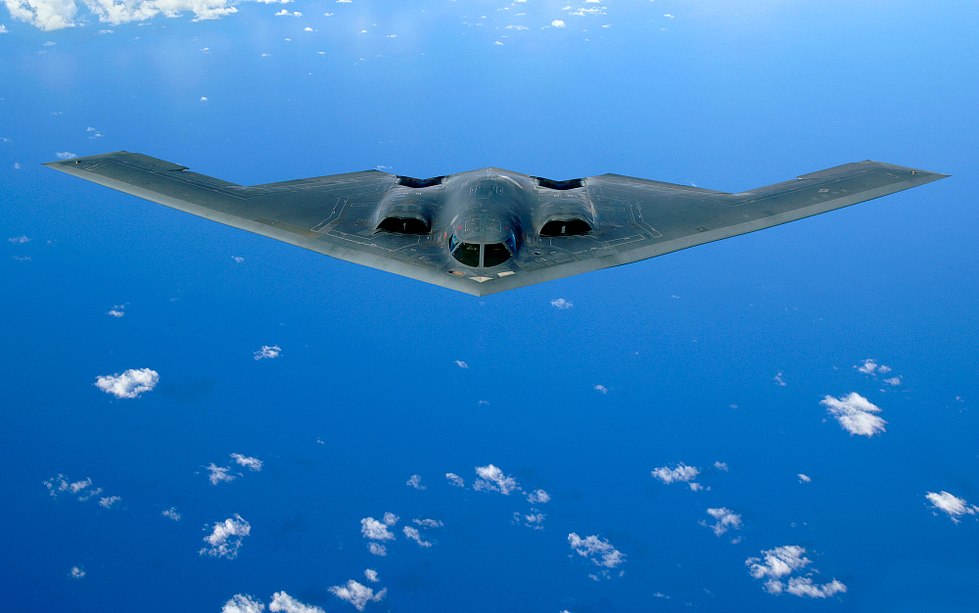
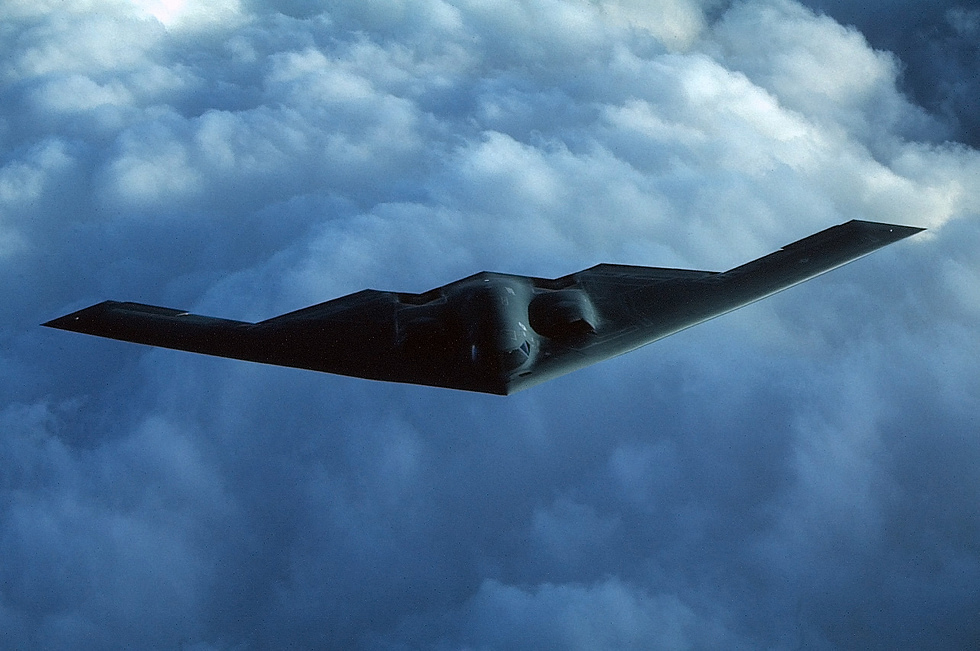
The B-2 Spirit in pictures
The B-2 Spirit in motion
A hand-picked B-2 Spirit video is coming soon. In the meantime, explore the gallery above and the twelve stories from three decades of stealth operations.
The B-2 Spirit in motion
Extreme Mysteries — one of the most-watched B-2 Spirit films on YouTube.
Where the B-2 Spirit flies
The score that defines the B-2
The B-2 has never fought another aircraft — it has no air-to-air record and no gun. Its score is written in the targets it has reached and the distances it has flown to hit them, striking heavily defended sites in five conflicts across a quarter-century without a single Spirit lost to enemy fire.
Compare the combat record of every military aircraft. Figures as of July 2026 and, for recent operations, provisional.
Everything people ask about the B-2 Spirit
Can I fly in a B-2?
How stealthy is the B-2 really?
How much does a B-2 cost?
How many B-2s were built?
What weapons can the B-2 carry?
Did the B-2 really bomb Iran in 2025?
How fast is the B-2?
What is replacing the B-2?
You can’t fly the B-2.
These, you can.
Some legends only live in museums — others are fuelled and waiting. MiGFlug has put civilians in real military jet cockpits since 2004.
 Fly the L-39 AlbatrosThe world’s most-flown jet trainer — aerobatics included
 Fly the F-104 Starfighter“The missile with a man in it”
 Fly the MiG-21The Cold War’s most-produced jet
 驾驶T-33流星战斗机America’s first jet trainer
 Fly the DH VampireA piece of early jet history
 Fly the S.211Agile Italian jet trainer
 Fly the MB-326The classic Aermacchi jet
 Fly the MiG-15The Soviet legend of the Korean War
Continue the tour
Every fact, checked
- U.S. Air Force — B-2 Spirit fact sheetOfficial specifications, unit cost, service history and combat record.
- Northrop Grumman — B-2 Stealth BomberManufacturer technical details: dimensions, engines, range and payload.
- Encyclopaedia Britannica — B-2Development, ATB programme, flying-wing design and cost overview.
- Air & Space Forces MagazineOperation Midnight Hammer: the 2025 B-2 mission against Iran, in detail.
- The War Zone (TWZ)Independent reporting on the 2025 strike, decoy flights and damage caveats.
- The AviationistJack Northrop’s flying wings and their lineage to the B-2.
- National Museum of the U.S. Air ForceReference for the 2008 Guam loss and preserved-airframe history.
- The National InterestProgramme cost analysis and why the B-2 is called the most expensive aircraft ever.