
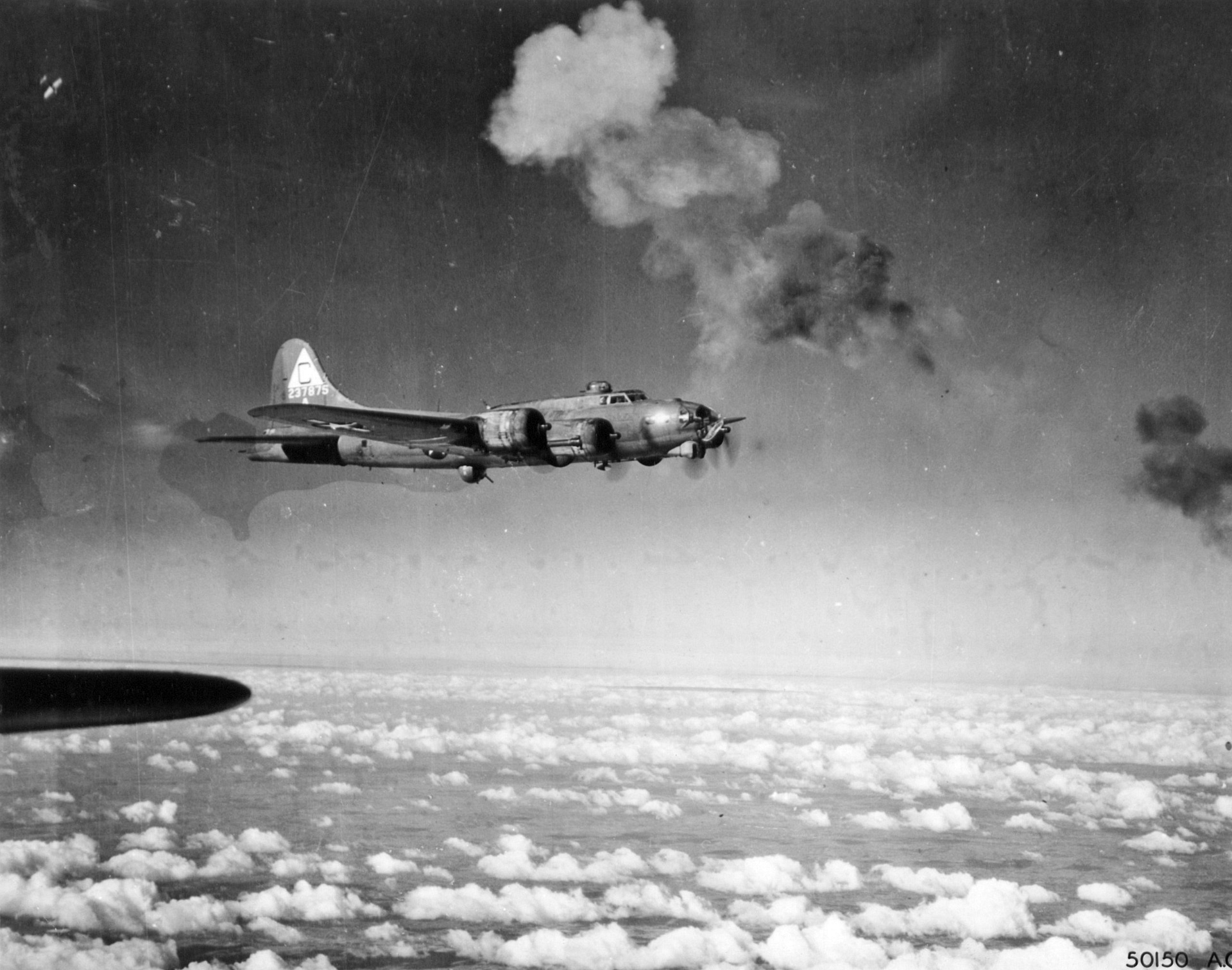
Boeing B-17
“Flying Fortress”
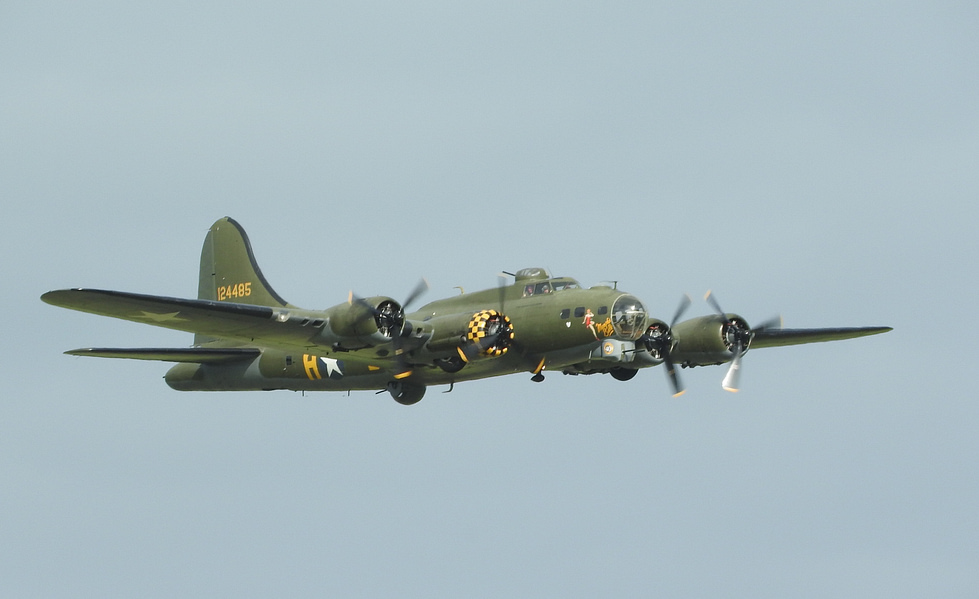
The four-engined heavy bomber at the heart of the American daylight bombing war over Europe — famous for its bristling guns, its high-altitude precision doctrine, and an almost mythical ability to bring its crew home in pieces.
The B-17 Flying Fortress: backbone of the daylight bombing war
In 1934 the US Army Air Corps asked American industry for a new multi-engine bomber. Where rivals offered twin-engined designs, Boeing gambled the company’s future on four engines — a bigger, longer-ranged, heavier-armed machine designated the Model 299. When it was rolled out in Seattle in 1935, a reporter looking at its many defensive machine guns called it a “flying fortress,” and the name stuck. The prototype first flew on 28 July 1935. It crashed that October after a test crew took off with the controls still locked — nearly killing the whole programme — but the Air Corps had seen enough promise to press on, and the B-17 entered service in the late 1930s.
When the United States entered the Second World War, the Fortress became the instrument of a distinctly American idea: high-altitude daylight precision bombing. While RAF Bomber Command bombed German cities by night, the US Army Air Forces — above all the Eighth Air Force flying from bases in England — set out to hit specific factories, refineries and rail yards in daylight, aiming through the closely guarded Norden bombsight. B-17s flew in tight, mutually supporting “combat box” formations so that their massed .50-calibre guns could beat off fighters, climbing to bomb from around 25,000–30,000 feet where flak was less accurate.
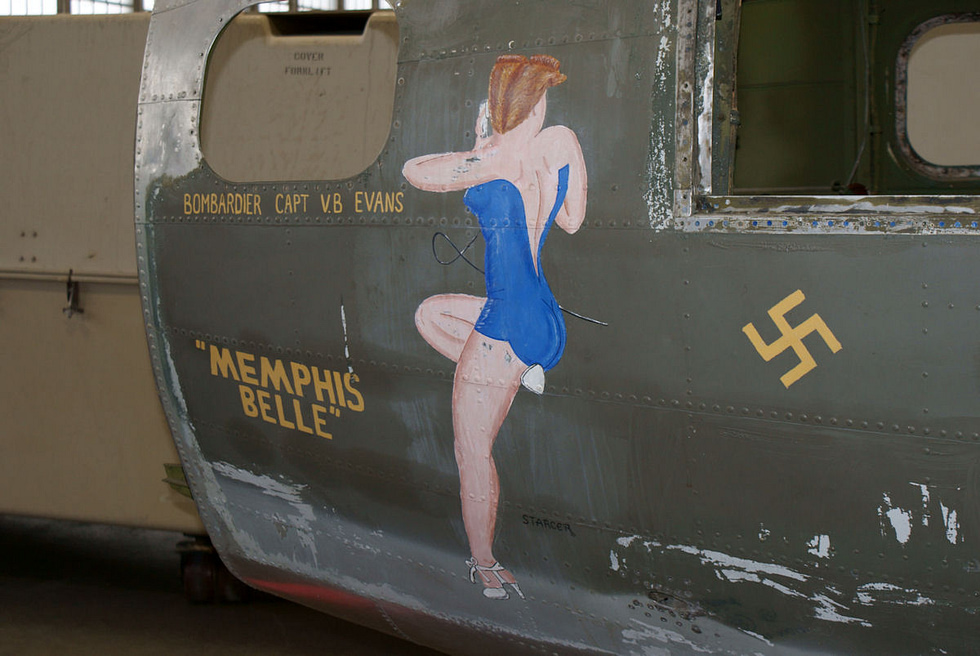
The doctrine’s fatal flaw was escort range. On unescorted deep raids the bombers were savaged: the Schweinfurt ball-bearing raids of 1943 — especially “Black Thursday,” 14 October, when 60 of 291 B-17s were lost in a single mission — showed that daylight bombing beyond fighter cover was unsustainable. The turning point came in early 1944, when the long-range P-51 Mustang could finally escort the bombers all the way to the target and back. Through it all the Fortress earned its enduring legend for ruggedness, staggering home with engines dead, tails shot away and control cables severed. Around 12,731 were built; the most famous, the Memphis Belle, became a symbol of the crews who flew a full tour and lived.
01The B-17 Flying Fortress and the daylight bombing gamble: Schweinfurt and the escort gap
American planners believed a tight formation of heavily armed bombers could fight its way to any target in daylight without escort — the “self-defending bomber.” Reality was harsher. Once B-17s flew beyond the range of their short-legged escorts, German fighters could attack almost at will. The two 1943 raids on the ball-bearing works at Schweinfurt exposed the flaw: the second, on 14 October 1943, cost 60 bombers shot down out of 291 dispatched, with dozens more written off — loss rates that no force could absorb for long. Unescorted deep daylight raids were effectively suspended.
The answer was not a better bomber but a better escort. Fitted with drop tanks, the P-51 Mustang could accompany the bombers to Berlin and back from early 1944, and in the “Big Week” battles of February 1944 the escorts began to break the Luftwaffe fighter force in the air. The B-17 remained the tool; the Mustang made the daylight campaign survivable.
What makes the B-17 Flying Fortress special
Four engines and legendary toughness
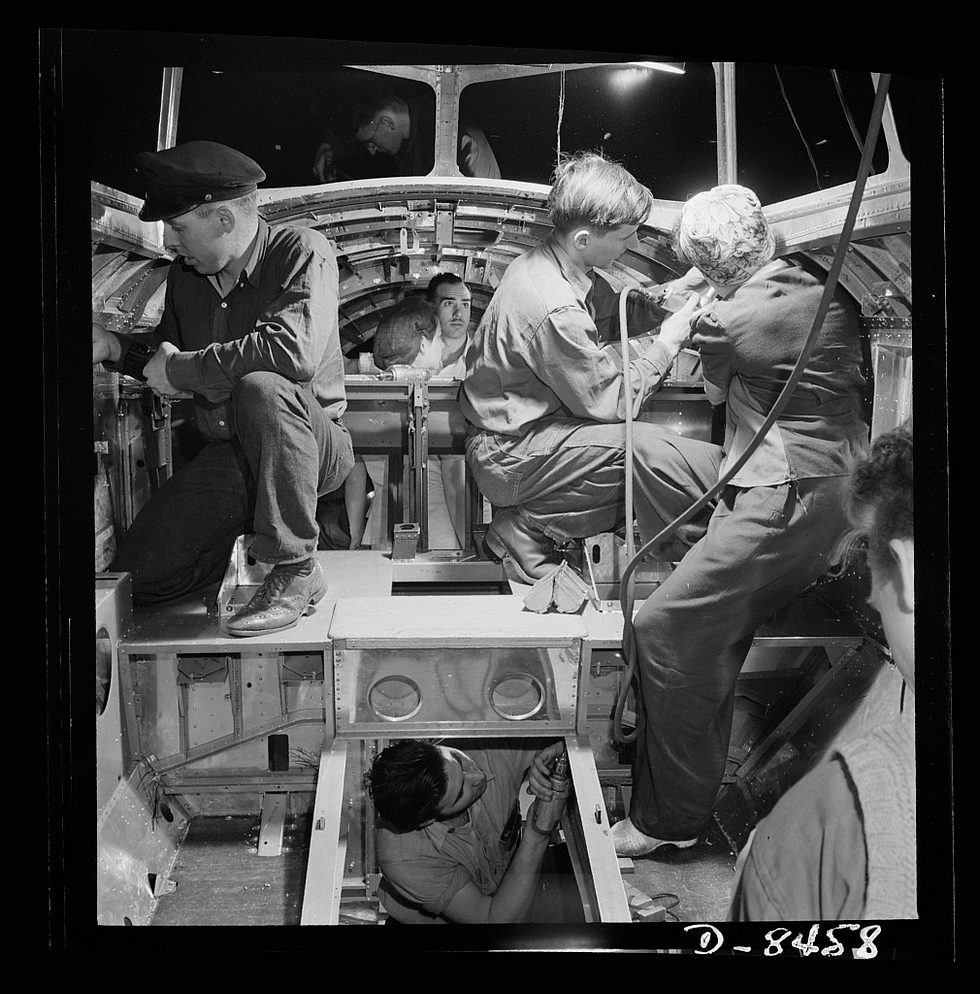
Boeing’s decision to build a four-engined bomber gave the B-17 the height, load and — crucially — the survivability that made its name. Crews routinely nursed Fortresses home on two or three engines, with huge holes torn in wings and fuselage, tail surfaces shot away and control cables severed. The airframe’s ability to absorb battle damage and still fly became the aircraft’s defining trait and the reason its crews trusted it.
The Norden bombsight and daylight precision
The B-17 was the airframe built around a doctrine: high-altitude daylight precision bombing. Its bombardier aimed through the secret Norden bombsight, an analogue computer that factored altitude, speed and wind to release bombs at the calculated instant. In clear conditions it was remarkably accurate for its day; in the cloud, smoke and chaos of combat, real-world accuracy was far coarser — but the whole American strategy rested on it.
Turbo-supercharged, stratospheric bomber
Four Wright R-1820 Cyclone radials, each fed by an exhaust-driven turbo-supercharger, let the B-17 cruise and bomb from around 25,000–30,000 feet, where thin air blunted flak and enemy fighters struggled to climb. Operating there meant unpressurised crews on oxygen in cabin temperatures far below freezing — frostbite was a constant hazard — but altitude was one of the Fortress’s best defences.
02The B-17 Flying Fortress’s defensive firepower: thirteen fifties and the combat box
The definitive B-17G carried thirteen 0.50-calibre M2 Browning machine guns — in the nose “chin” turret added to counter head-on attacks, in dorsal and ball turrets, at the waist, in the tail and cheek positions. The idea was collective defence: bombers flew in a stacked, overlapping combat box so that an attacking fighter faced fire from many aircraft at once. It helped, but it was never enough on its own against determined, cannon-armed German fighters attacking from head-on — which is why long-range escort mattered so much.
03The B-17 Flying Fortress’s turbo-supercharged Cyclones: bombing from the stratosphere
Each Wright R-1820-97 Cyclone produced around 1,200 horsepower, but its real trick was the General Electric exhaust-driven turbo-supercharger that maintained power in the thin air of high altitude. That let the Fortress operate far higher than most contemporaries. The cost was borne by the crew: cabins were unpressurised, temperatures could fall below −40 °C, and men worked on bottled oxygen in heated suits that frequently failed — frostbite injuries sometimes outnumbered wounds from enemy fire.
Full B-17 Flying Fortress specifications
Airframe & Performance (B-17G)
- 全体人员
- 10 (pilot, co-pilot, bombardier, navigator, radio, gunners)
- 长度
- 22.66 m (74 ft 4 in)
- 翼展
- 31.62 m (103 ft 9 in)
- 高度
- 5.82 m (19 ft 1 in)
- Max takeoff weight
- ~29,700 kg (~65,500 lb)
- Max speed
- ~486 km/h (302 mph) at altitude
- 巡航速度
- ~293 km/h (182 mph)
- 设备天花板
- ~10,850 m (35,600 ft)
- Range with bombs
- ~3,220 km (2,000 mi)
- Typical bomb load
- ~2,000–2,700 kg (deep raids lighter)
Propulsion, Armament & Programme
- Engines
- 4 × Wright R-1820-97 Cyclone radials
- Power (each)
- ~1,200 hp, turbo-supercharged
- Defensive guns
- 13 × 0.50 in (12.7 mm) M2 Browning
- Bombsight
- Norden M-series (daylight precision)
- First flight
- 28 July 1935 (Model 299)
- Built
- ~12,731 (1935–1945)
- Unit cost
- ~$238,000 (1945; commonly cited ~$204k earlier)
- Cost per flight hour
- No reliable wartime figure; warbird operation only today
04The B-17 Flying Fortress’s cost: what a wartime Fortress cost — and what one costs to fly today
A wartime B-17 was, by modern standards, astonishingly cheap: mass production drove the flyaway price down to roughly $204,000–$238,000 across the war years — figures often quoted from US government wartime accounting, so treat them as order-of-magnitude rather than precise. There is no meaningful “cost per flight hour” for the type in its service life; it was a wartime state product built by the thousand.
Today the relevant number is the cost of keeping one of the handful of airworthy survivors flying. Operators of warbirds such as Sally B and (formerly) the Collings Foundation fleet have cited running costs of the order of several thousand US dollars per flight hour once fuel, insurance, maintenance and overhaul are counted — which is why B-17 flights are rare charity-supported events, not a commercial ride you can simply book.
From Model 299 to the last Fortresses
First flight
Boeing’s four-engined Model 299 flies on 28 July; a reporter dubs it the “Flying Fortress.” The prototype crashes that October with the controls locked.
Enters service
Early Y1B-17s reach the US Army Air Corps, which develops high-altitude daylight bombing doctrine around the type.
Combat debut
The RAF flies early Fortress Mk I raids — with disappointing results — and later uses the type mainly with Coastal Command. The US enters the war in December.
Eighth Air Force begins
On 17 August the Eighth Air Force flies its first heavy-bomber raid from England, opening the American daylight campaign over occupied Europe.
Schweinfurt and Black Thursday
The ball-bearing raids peak on 14 October, when 60 of 291 B-17s are lost. Unescorted deep daylight bombing proves unsustainable.
Escorts change everything
Long-range P-51 Mustangs escort the bombers to Berlin and back; “Big Week” in February begins breaking the Luftwaffe in the air.
War’s end
With Germany defeated, the strategic campaign winds down and B-17 production ends after roughly 12,731 aircraft.
Second lives and warbirds
Surplus Fortresses serve as air-sea rescue, drones, mapping and transport aircraft with several nations; a handful survive today as treasured airworthy warbirds.
From the cockpit: twelve Flying Fortress stories
The name that stuck
A Seattle reporter looking at the Model 299’s guns called it a “flying fortress.”
Read the full story
The crash that almost killed the programme
The prototype took off with its controls still locked, and crashed on 30 October 1935.
Read the full story
The self-defending bomber
American planners believed massed guns and tight formation could beat off fighters without escort.
Read the full story
The Norden secret
The Norden bombsight was so classified that bombardiers swore an oath to protect it.
Read the full story
“All American” flew home cut nearly in two
A B-17 named All American returned after a mid-air collision almost severed its tail.
Read the full story
25 missions and a ticket home
Completing a full tour of 25 (later 30) missions was a coin-flip with death.
Read the full story
The bomber that became a legend
The Memphis Belle completed 25 missions and toured America as a symbol of the crews.
Read the full story
Sixty lost in a day
On 14 October 1943 the second Schweinfurt raid cost 60 of 291 B-17s.
Read the full story
The Mustang closes the gap
Drop-tank P-51s could finally escort the bombers to Berlin and back.
Read the full story
The RAF’s Fortresses
Britain flew the B-17 too — but mostly hunting U-boats and jamming radar, not bombing cities.
Read the full story
Fortresses in strange colours
Surplus B-17s flew as rescue aircraft, drones, mapmakers — and for Israel, Brazil and Portugal.
Read the full story
The handful still flying
Of nearly 12,731 built, only a tiny number remain airworthy today.
Read the full story
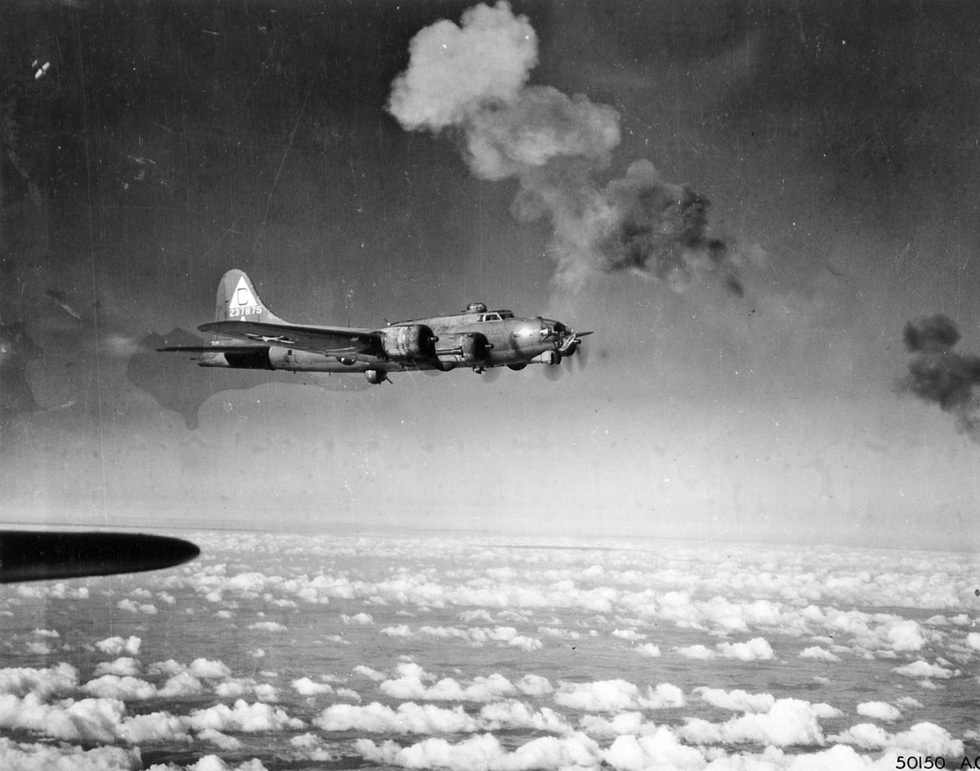
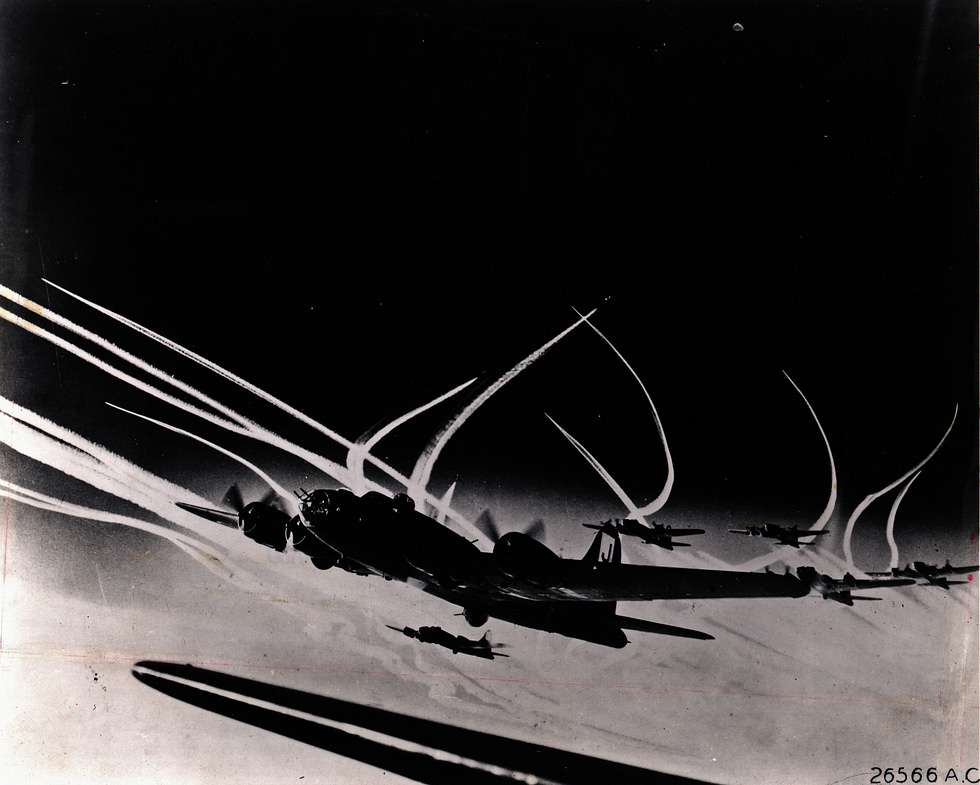
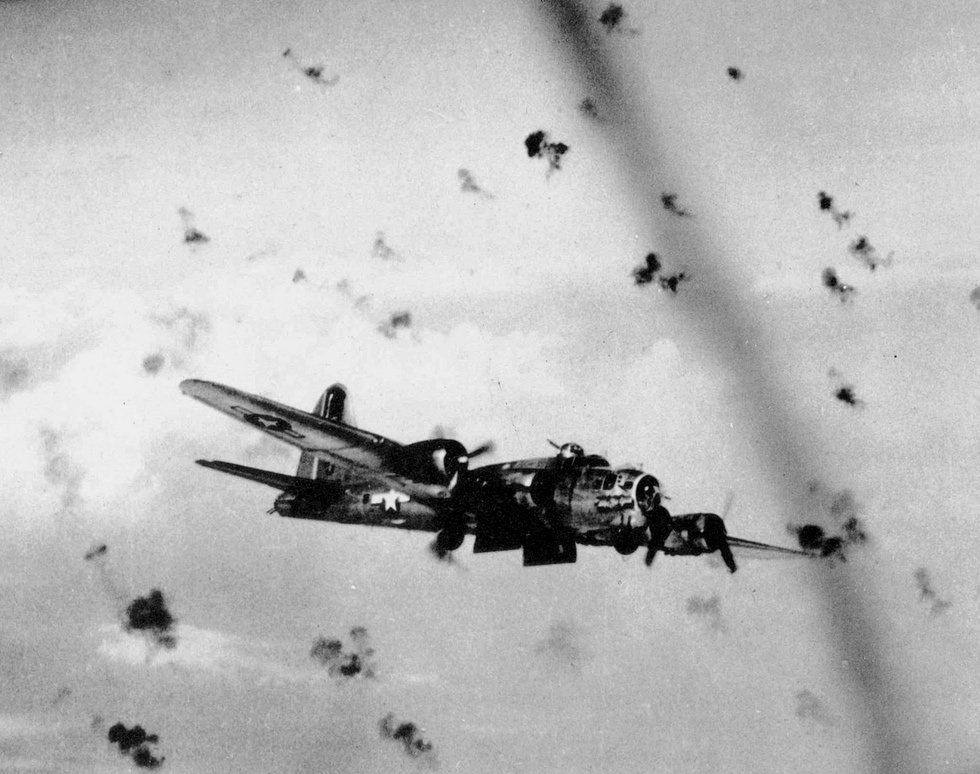
The Flying Fortress in pictures
The Flying Fortress in motion
Video coming soon — we are sourcing a properly licensed, high-quality B-17 film to feature here. In the meantime, explore the photo gallery above and the operations map below to see where the Fortress flew.
Where the Flying Fortress flew
The score that defines the B-17
The Fortress is not measured in air-to-air kills but in tonnage dropped and punishment survived. It was the principal weapon of the Eighth Air Force’s daylight campaign over Europe — a campaign that cost thousands of bombers and tens of thousands of airmen, yet ultimately helped wreck German war industry and draw the Luftwaffe into a battle of attrition it could not win.
Compare the combat record of every military aircraft. Figures as of July 2026.
Everything people ask about the B-17 Flying Fortress
Can I fly in a B-17?
Why is the B-17 called the “Flying Fortress”?
How many .50-calibre guns did the B-17 carry?
Why did the B-17 suffer such heavy losses?
What was the Norden bombsight?
What was the Memphis Belle?
How many B-17s were built, and how many survive?
Was the B-17 better than the B-24 Liberator?
You can’t fly the B-17.
These, you can.
Some legends only live in museums — others are fuelled and waiting. MiGFlug has put civilians in real military jet cockpits since 2004.
 Fly the L-39 AlbatrosThe world’s most-flown jet trainer — aerobatics included
 Fly the F-104 Starfighter“The missile with a man in it”
 Fly the MiG-21The Cold War’s most-produced jet
 驾驶T-33流星战斗机America’s first jet trainer
 Fly the DH VampireA piece of early jet history
 Fly the S.211Agile Italian jet trainer
 Fly the MB-326The classic Aermacchi jet
 Fly the MiG-15The Soviet legend of the Korean War
Continue the tour
Every fact, checked
- National Museum of the US Air Force — Boeing B-17GCanonical B-17G specifications, armament and the ~12,731 total built.
- The National WWII Museum — Boeing B-17 Flying FortressDevelopment, the 1935 first flight, crew of ten and thirteen .50-cal guns.
- Imperial War Museums — B-17 vs B-24Specifications, turbo-supercharged Cyclones and the ruggedness reputation.
- National Museum of the US Air Force — Norden M-9 BombsightThe Norden bombsight and the daylight-precision doctrine.
- Imperial War Museums — How the Eighth Air Force defeated the LuftwaffeThe daylight campaign, 1943 losses and the P-51 escort turning point.
- The National WWII Museum — “Black Thursday”The second Schweinfurt raid and the catastrophic unescorted loss rates.
- National Museum of the US Air Force — Memphis BelleThe Memphis Belle and its 25 completed combat missions.
- The Aviation Geek Club — The “headless” B-17A vivid example of the Fortress’s legendary battle-damage survivability.