
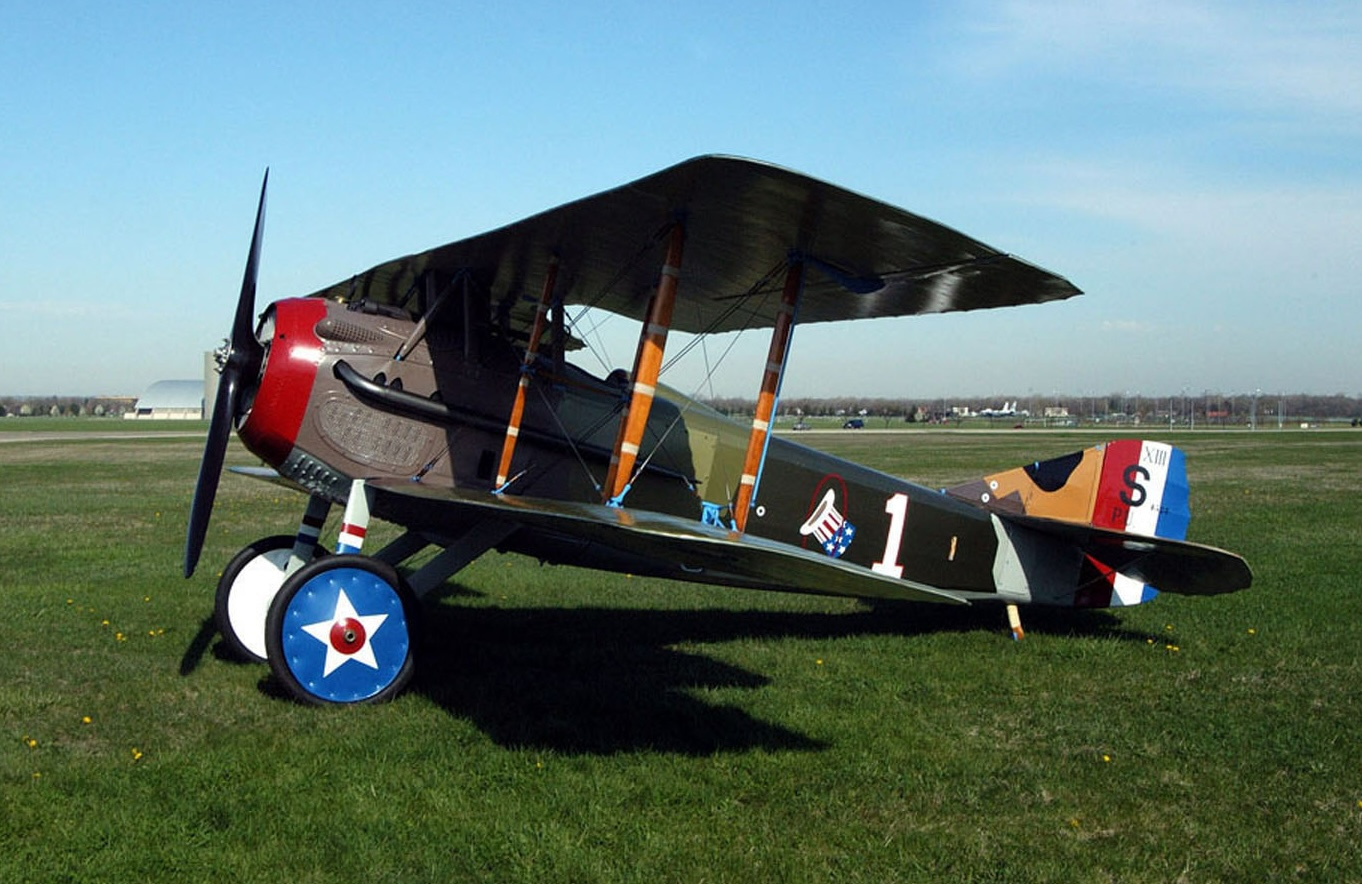
SPAD S.XIII
“the ace-maker”
The fast, rugged French biplane that carried the Allied aces of 1918 — and re-armed the American squadrons that went to war without a fighter of their own.
The fighter that made the aces — and re-armed America
By 1917 the air war had settled into a brutal arithmetic. The nimble rotary-engined fighters that had ruled 1916 — the Nieuports, the early Sopwiths — could out-turn almost anything, but they were lightly built and short on speed. The Germans answered with faster, heavier machines. France needed a fighter that could meet them on their own terms: fast, strong, and hard-hitting. The answer came from a quiet engineer named Louis Bechereau.
Bechereau’s SPAD S.VII had already proved the formula in 1916: build the airframe around a powerful, water-cooled Hispano-Suiza V-8 rather than a rotary, and accept less agility in exchange for speed and structural strength. The SPAD S.XIII, first flown on 4 April 1917, took that idea further — a bigger wing, more power, and a second machine gun. It was not a dogfighter in the turning sense. It was a diving predator.
The tactic that defined it was simple and deadly: climb high, dive on the enemy at speed, fire a hard burst from two synchronized guns, and zoom away before he could react. The SPAD could not turn with a Fokker, but few aircraft of the war could take punishment and out-dive it. In the hands of a disciplined pilot it was a machine for fighting on your own terms, and the best pilots of the war made it famous.
France’s leading aces flew SPADs. Rene Fonck, the Allied “ace of aces” with 75 confirmed victories, and Georges Guynemer, the frail national hero who vanished over Belgium in September 1917, both did their killing in Bechereau’s fighters. Italy’s Francesco Baracca flew them on the Italian Front. Nearly every French fighter escadrille converted to the type.
Then America arrived. The United States entered the war in 1917 with no combat aircraft of its own worth the name, and its squadrons went into battle in French equipment. The SPAD XIII armed the U.S. Army Air Service — including the 94th Aero Squadron, the “Hat in the Ring” squadron, whose pilots included the top American ace Eddie Rickenbacker and the Medal-of-Honor “balloon buster” Frank Luke. Some 893 SPAD XIIIs were shipped to the AEF.
It was not a flawless aircraft. The geared Hispano-Suiza that gave the SPAD its speed was, in its early forms, temperamental — reduction gears failed, engines were grounded, and production of reliable powerplants lagged behind the airframes waiting for them. Pilots also had to respect its handling: heavy, fast, and unforgiving of the sloppy low-speed flying that a rotary fighter would forgive.
But the numbers tell the story. By the Armistice, SPAD and eight other French firms had built roughly 8,472 of them — one of the most-produced fighters of the entire war. The SPAD XIII did not win the air war by being the most agile machine in the sky. It won by being fast enough, strong enough, and available in enough numbers to put a modern fighter under every good pilot the Allies had.
01The SPAD S.XIII’s lineage: from the SPAD S.VII to the ace-maker
The S.XIII was the high point of a family, not a bolt from the blue. Louis Bechereau’s SPAD S.VII of 1916 established the recipe — a strong wooden airframe wrapped around a water-cooled Hispano-Suiza V-8 and armed with a single synchronized Vickers gun. It was fast and tough where its rotary rivals were agile and fragile.
这 S.XIII scaled the idea up: a larger wing, rounded lower wingtips, a more powerful geared Hispano-Suiza, and a second Vickers gun for double the firepower. Between the two came experiments and parallel SPAD designs, but it was the S.XIII that became the standard Allied fighter of 1918, ultimately outnumbering and replacing the S.VII in French service.
What makes the SPAD S.XIII special
A wing built to dive, not to turn
The SPAD traded agility for strength. Its robust wire-braced wooden structure let pilots dive hard and pull out at speeds that would have shed the wings of a lighter rotary fighter — the foundation of its dive-and-zoom fighting style.
A Hispano-Suiza V-8, not a rotary
Where most 1916 fighters spun a whole rotary engine around a fixed crank, the SPAD used a stationary, water-cooled Hispano-Suiza 8 V-8 of roughly 220 hp. More power and no gyroscopic torque — at the cost of weight and, early on, reliability.
Two guns through the propeller
The S.XIII carried two synchronized .303 Vickers machine guns firing forward through the propeller arc, 400 rounds each. Double the firepower of the single-gun S.VII, delivered in the brief window of a diving pass.
02The SPAD S.XIII’s Hispano-Suiza engine: power, gearing and gremlins
The SPAD’s speed came from Marc Birkigt’s Hispano-Suiza 8, a cast-aluminium-block water-cooled V-8 that was one of the great engineering achievements of the war. The S.XIII used geared 8B variants — a reduction gear let the crankshaft turn faster than the propeller, extracting more power — rated at about 220 hp, with later engines pushing toward 235 hp.
The gearing was also the SPAD’s weak point. Early geared Hispano-Suizas suffered reduction-gear failures and lubrication problems, and supply of reliable engines lagged so badly that airframes sat waiting for powerplants. Once the bugs were worked out, the combination was formidable; but the “Hisso” gremlins are a real part of the SPAD story, not a footnote.
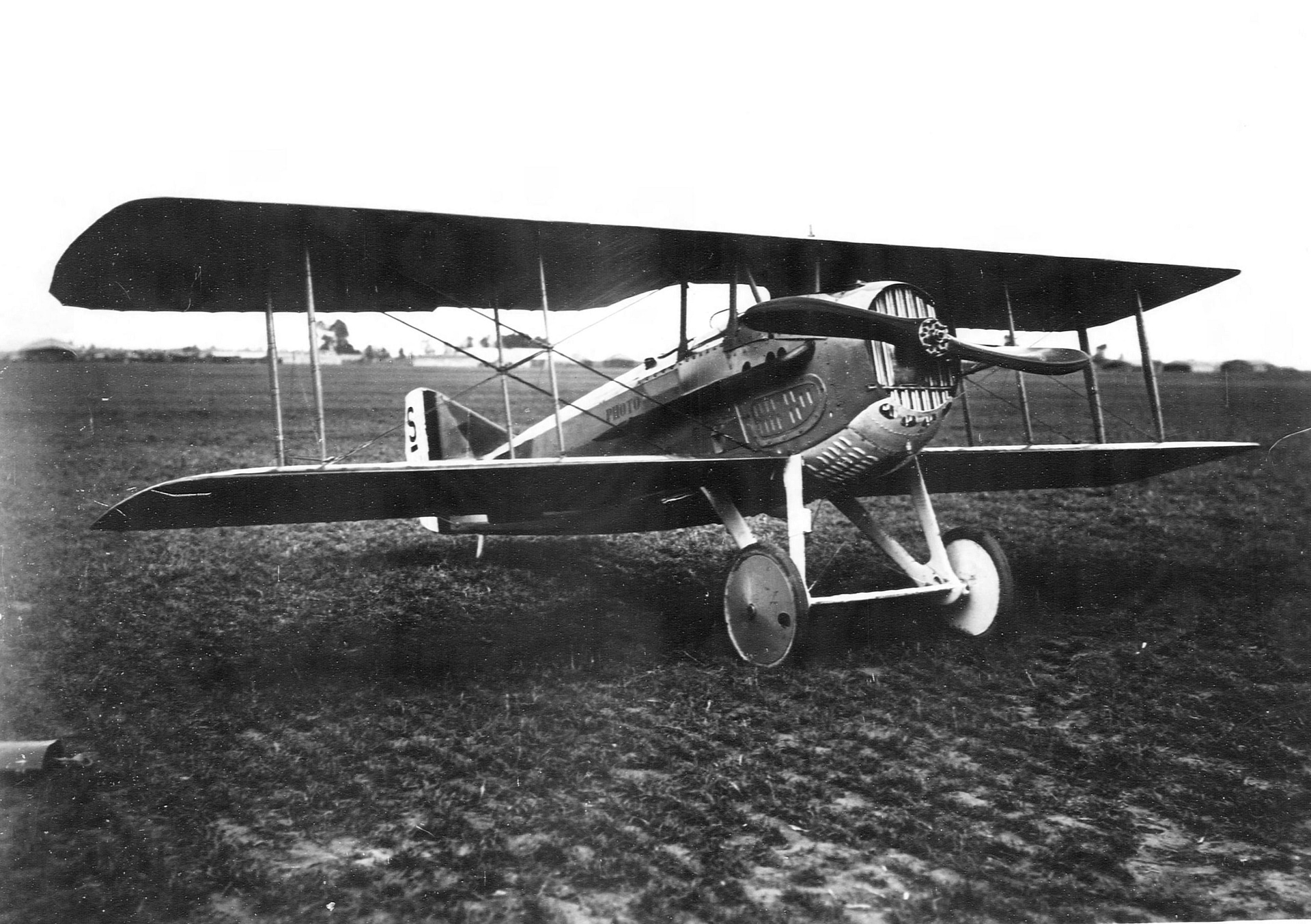
Head-on, the SPAD’s blunt radiator nose gives away the water-cooled V-8 inside. Photo: Air Service, U.S. Army (public domain).
03The SPAD S.XIII’s fighting style: dive-and-zoom versus the turn-fighters
Fighter tactics in 1918 split along a fault line the SPAD helped define. Rotary-engined machines like the Sopwith Camel and Fokker Dr.I were turn-fighters: light, agile, able to whip around inside an opponent. The SPAD was the opposite — heavy, fast, and happiest in the vertical.
A SPAD pilot who tried to dogfight a turning Fokker on its terms would lose. So he didn’t. He used energy: hold the height advantage, dive, fire, and climb away to set up again. It is the same “boom-and-zoom” logic that heavier fighters would use for the next thirty years, and the SPAD XIII was one of the first aircraft fast and strong enough to make it a doctrine.
04The SPAD S.XIII’s aces: Guynemer, Fonck, Rickenbacker and the Hat in the Ring
Georges Guynemer, France’s frail and beloved national hero, scored the bulk of his 54 victories in SPADs before disappearing over Poelkapelle, Belgium, on 11 September 1917 — no wreck, no grave, a legend that told French schoolchildren he had simply flown too high to come down.
Rene Fonck, colder and more methodical, became the Allied ace of aces with 75 confirmed victories, an economical marksman who often downed enemies with a handful of rounds. Italy’s Francesco Baracca flew SPADs on the Italian Front.
For the Americans, the SPAD XIII was the fighter of the 94th Aero Squadron — the “Hat in the Ring” squadron — whose pilots included top U.S. ace Eddie Rickenbacker (26 victories) and Medal of Honor recipient Frank Luke, the “Arizona Balloon Buster.”
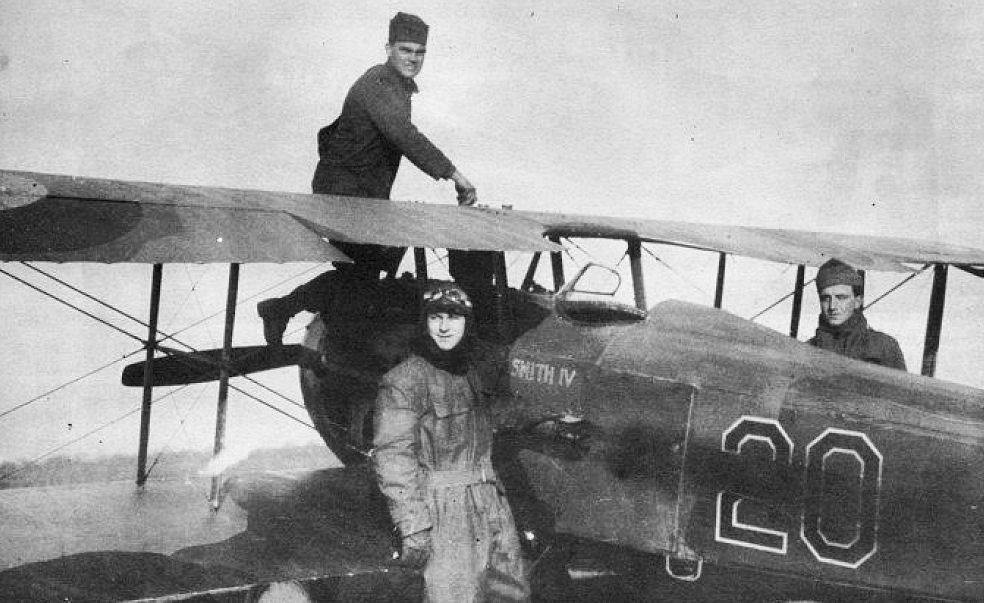
A SPAD XIII of a U.S. Aero Squadron. Photo: Air Service, U.S. Army (public domain).
SPAD S.XIII full specifications
Airframe & Performance
- 全体人员
- 1
- 长度
- 6.25 m (20 ft 6 in)
- 翼展
- ~8.1 m (some sources 8.25 m)
- 高度
- 2.60 m (8 ft 6 in)
- 机翼面积
- ~21.1 m²
- 空重
- ~602 kg (1,326 lb)
- Gross weight
- ~857 kg (1,888 lb)
- Max speed
- ~218 km/h (135 mph) · sources 211–222
- 设备天花板
- ~6,800 m (22,300 ft)
- Endurance
- ~2 hours
- Climb to 5,000 m
- ~20 minutes
Powerplant, Armament & Programme
- 引擎
- Hispano-Suiza 8 (geared) water-cooled V-8
- Power
- ~220 hp (late variants ~235 hp)
- 武器
- 2 × .303 Vickers, 400 rounds each
- Designer
- Louis Bechereau (SPAD)
- First flight
- 4 April 1917
- Built
- ~8,472 (893 to U.S. Army Air Service)
- Unit cost
- Not reliably recorded (1917)
- Cost per flight hour
- ~$500–$1,500 (rough modern airworthy-reproduction estimate, not a 1917 figure)
- Status
- Retired (1920s)
05The SPAD S.XIII’s numbers: how 8,472 fighters were built
The SPAD XIII was not just good — it was buildable. Its wooden, wire-braced structure suited France’s dispersed furniture-and-carriage workshops, and SPAD licensed production to eight other firms. By the Armistice roughly 8,472 had been completed, making it one of the most-produced fighters of the war.
Around 893 went to the United States Army Air Service, which had entered the war without a homegrown fighter. Postwar, surplus SPADs served on as trainers and second-line fighters in air forces from Poland and Czechoslovakia to Japan, Belgium, Greece, Brazil and Siam.
06The SPAD S.XIII’s cost: why there is no reliable price tag
Unlike modern aircraft, the SPAD XIII has no reliably recorded unit cost. It was built by many manufacturers under wartime contracts in a rapidly inflating economy, and consistent per-airframe figures simply were not preserved in a way historians trust.
The “cost per flight hour” figure in the table above is included only for consistency with the rest of the encyclopedia. It is a rough modern estimate for operating an airworthy SPAD reproduction on the warbird circuit — on the order of a few hundred to well over a thousand dollars an hour once fuel, insurance and specialist maintenance are counted — and should not be read as a historical 1917 cost.
The SPAD S.XIII through history
The SPAD S.VII proves the formula
Bechereau’s first Hispano-Suiza-powered SPAD enters service — fast, strong, and single-gunned.
SPAD S.XIII first flight
The enlarged, twin-gun prototype flies for the first time.
Into French squadrons
Production ramps up; French escadrilles begin re-equipping with the type.
Guynemer is lost
France’s national hero disappears over Belgium; his legend outlives him.
America goes to war on SPADs
The U.S. Army Air Service arms squadrons including the 94th “Hat in the Ring” with the SPAD XIII.
Armistice
Around 8,472 have been built — among the most-produced fighters of the war.
Retirement and export
Withdrawn from front-line use; surplus airframes serve on abroad as trainers and second-line fighters.
A handful survive
Four originals and a few airworthy reproductions remain, in museums and specialist collections.
SPAD S.XIII: the people and the legends
Guynemer flies too high
Georges Guynemer, tubercular and slight, was France’s most beloved airman. On 11 September 1917 he took off over Flanders and never returned. No confirmed wreck was ever found, and a myth grew that he had simply climbed so high he could not come back down.
阅读更多
Rene Fonck, the marksman
Rene Fonck ended the war as the top Allied ace with 75 confirmed victories — and possibly many more unconfirmed. He was a cold, precise shot who prided himself on downing enemies with only a few rounds.
阅读更多
Rickenbacker’s 94th
The U.S. 94th Aero Squadron — the “Hat in the Ring” squadron — fought the last months of the war on SPAD XIIIs. Its star was Eddie Rickenbacker, a former race-car driver who became America’s top ace with 26 victories.
阅读更多
Frank Luke’s last flight
Frank Luke, the “Arizona Balloon Buster,” specialised in the most dangerous target of the war: hydrogen observation balloons ringed by anti-aircraft guns. In eight days he destroyed 14 balloons and four aircraft before being killed.
阅读更多
Baracca’s prancing horse
Italy’s top ace, Francesco Baracca, flew SPADs against Austro-Hungarian aviation. His personal emblem, a prancing black horse, was later given to a young Enzo Ferrari — and became the Ferrari badge.
阅读更多
Dive, fire, disappear
The SPAD could not out-turn a rotary fighter, so its pilots refused to try. Instead they used height and speed: dive on the enemy, fire a hard burst from two guns, and zoom away before he could react.
阅读更多
The Hisso’s reduction gear
The geared Hispano-Suiza that gave the SPAD its speed was also its curse. Early engines suffered reduction-gear failures and lubrication troubles, and reliable powerplants were in such short supply that finished airframes sat idle waiting for engines.
阅读更多
8,472 fighters
The SPAD XIII’s wooden, wire-braced construction suited France’s network of small workshops. SPAD licensed the design to eight other firms, and by the Armistice roughly 8,472 had been built.
阅读更多
The AEF’s French fighter
The United States entered the war in 1917 with no modern fighter of its own. Its squadrons went into combat in French aircraft — and the SPAD XIII became the standard American fighter of 1918.
阅读更多
Nungesser’s scars
Charles Nungesser, a flamboyant and repeatedly-wounded French ace with 43–45 victories, flew SPADs among many types. He survived the war despite a catalogue of injuries that would have grounded most men.
阅读更多
The 1918 match-up
In 1918 the SPAD XIII’s great rival was Germany’s superb Fokker D.VII. The Fokker was more forgiving and a better all-round dogfighter; the SPAD was faster in a dive and hit hard.
阅读更多
Four originals, a few flyers
Of the thousands built, only about four genuine SPAD XIIIs survive — at the Smithsonian, the National Museum of the U.S. Air Force, and the Musee de l’Air at Le Bourget among them.
阅读更多
SPAD S.XIII in photographs
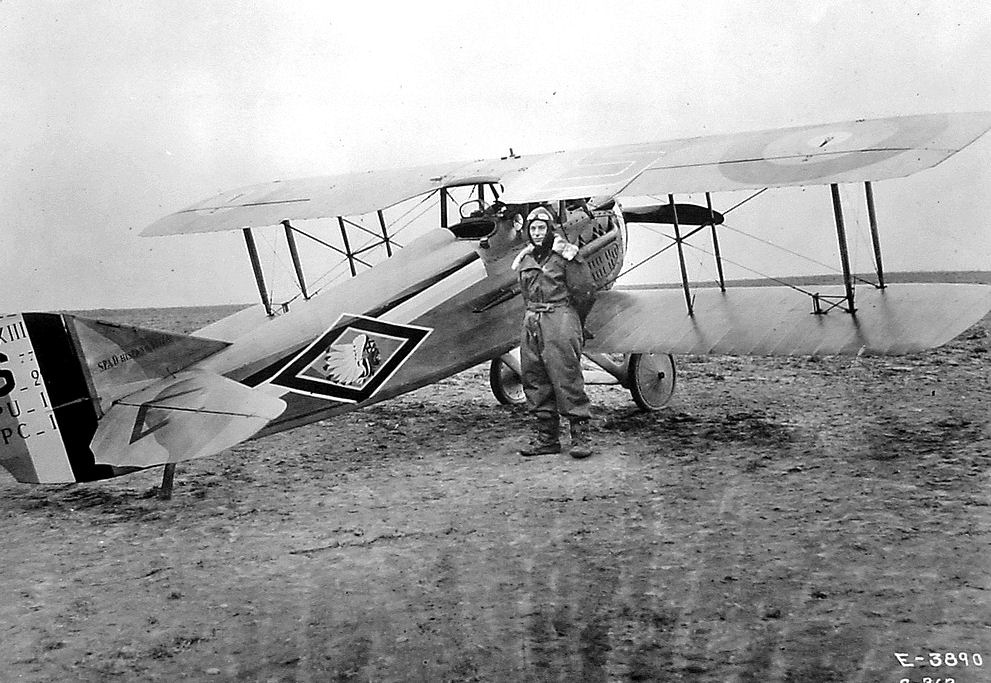
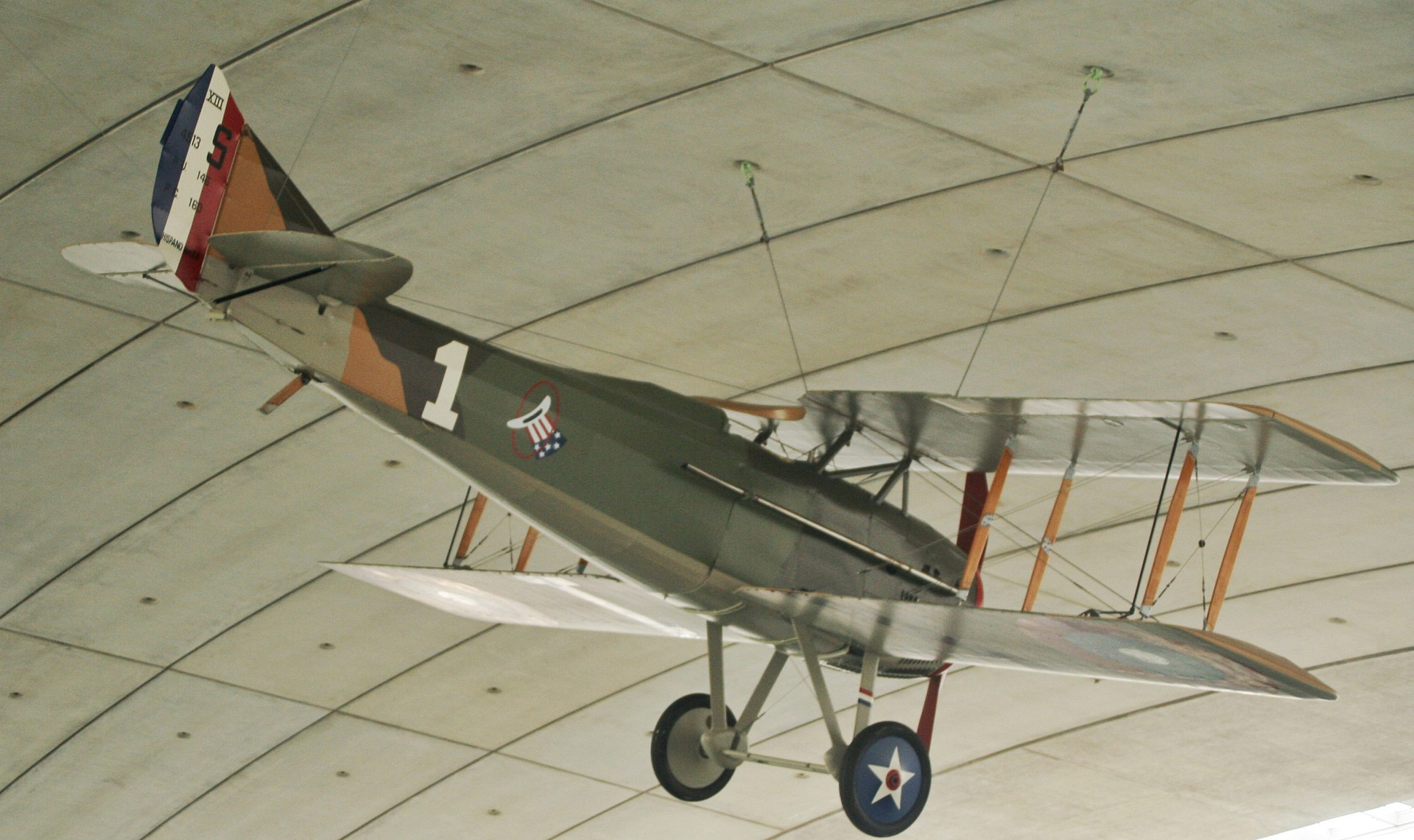
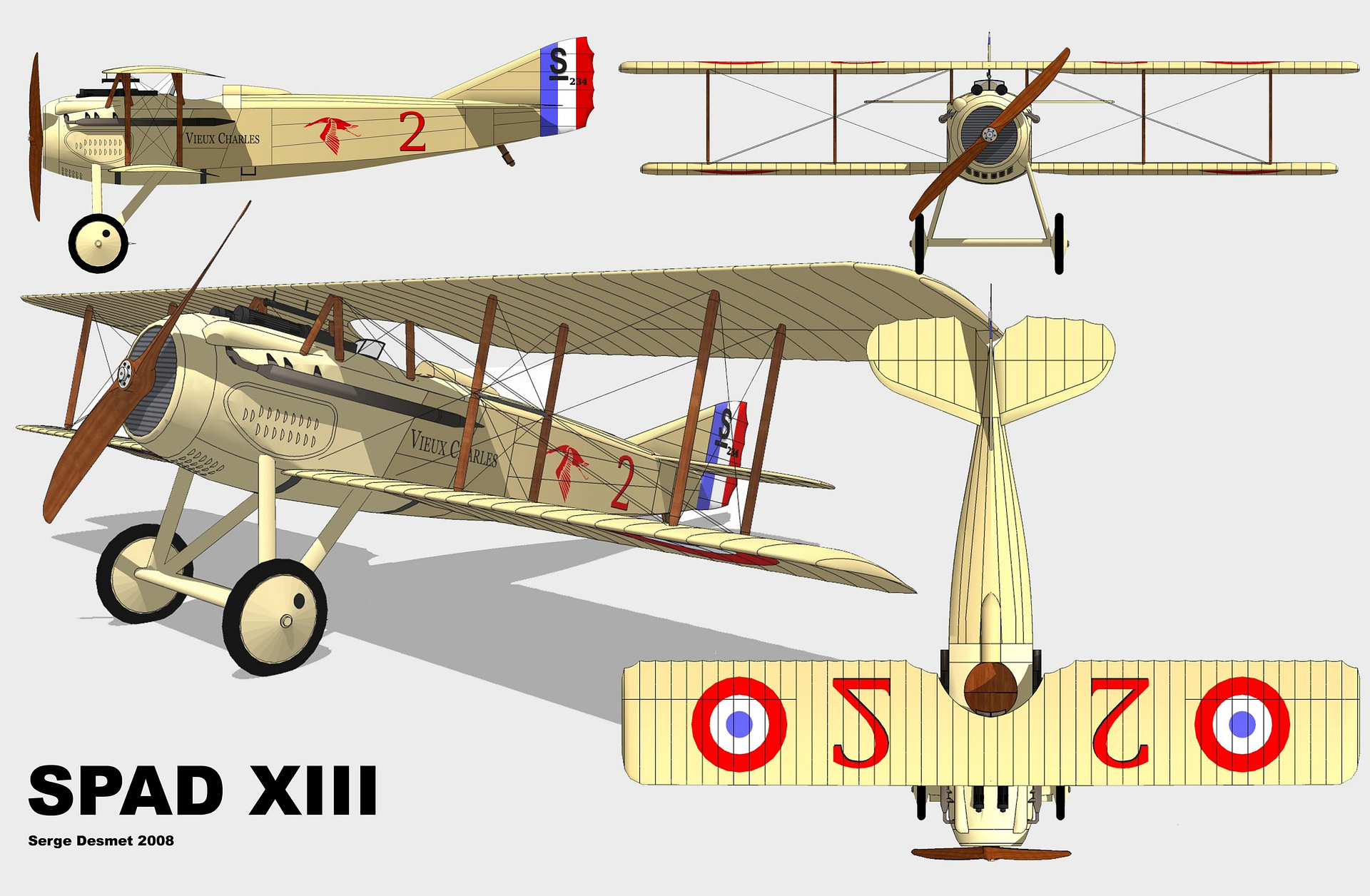
SPAD S.XIII in flight
Video: “Spad XIII in flight” — Memorial Flight (~84,600 views). Memorial Flight is a French association that restores and operates one of the very few airworthy SPAD XIII aircraft in the world.
Where the SPAD S.XIII flew
The SPAD S.XIII was the standard Allied fighter of 1918: built and flown above all by France, adopted by the American squadrons of the AEF, used on the Italian Front, and passed on to a dozen air forces after the war. Toggle the categories to explore operators, combat theatres and surviving airframes. Colours follow the highest-priority category; tooltips list every role a country played.
SPAD S.XIII combat record
SPAD S.XIII: your questions answered
Can I fly in a SPAD S.XIII?
Not as a paying passenger. The SPAD S.XIII is a single-seat World War I fighter, it was retired in the 1920s, and it is not offered as a ride anywhere. A very small number of airworthy original and reproduction SPAD XIIIs do still fly at airshows in the hands of specialist warbird collections and preservation groups such as France’s Memorial Flight, but these are not bookable experiences.
If you want to actually fly in a fast military aircraft yourself, you can. MiGFlug flies civilians in genuine jet fighters and warbirds today — see the currently available aircraft and prices at migflug.com/flights-prices/.
Who designed the SPAD S.XIII?
The SPAD S.XIII was designed by Louis Bechereau, chief engineer at SPAD, as an enlarged and more powerful development of his earlier SPAD S.VII. The prototype first flew on 4 April 1917.
How fast was the SPAD S.XIII?
Roughly 218 km/h (about 135 mph), among the fastest fighters of the war. Published figures vary by source and variant, generally between about 211 and 222 km/h. It was especially strong and fast in a dive.
What engine did the SPAD S.XIII use?
A water-cooled Hispano-Suiza 8 V-8. The S.XIII used geared 8B versions of about 220 hp, with later engines around 235 hp. The gearing delivered the speed but caused early reliability and reduction-gear troubles.
How many SPAD S.XIIIs were built?
关于 8,472 were built by SPAD and eight other French manufacturers by the end of 1918, one of the most-produced fighters of the war. Some 893 went to the U.S. Army Air Service.
Who were the famous SPAD XIII aces?
They included Rene Fonck (75 victories) and Georges Guynemer (54) of France, Francesco Baracca of Italy, and Americans Eddie Rickenbacker 和 Frank Luke of the U.S. 94th Aero Squadron, the “Hat in the Ring” squadron.
Are any SPAD S.XIIIs still flying?
Only about four genuine SPAD XIIIs survive, most as static museum exhibits at the Smithsonian National Air and Space Museum, the National Museum of the U.S. Air Force and the Musee de l’Air et de l’Espace at Le Bourget. A very small number of airworthy originals and reproductions fly, but they are not available for passenger rides.
You can’t fly the SPAD S.XIII. These, you can.
No SPAD is available for passenger flights — but MiGFlug puts civilians in the cockpit of genuine jet fighters and warbirds around the world. Real aircraft, real G, real speed.
More from the encyclopedia
Where this came from
- Smithsonian National Air and Space Museum — SPAD XIII “Smith IV” collection record.Designer, engine, armament, production total and surviving-airframe figures.
- National Museum of the United States Air Force — SPAD XIII fact sheet.U.S. Army Air Service service and 94th Aero Squadron history.
- Musee de l’Air et de l’Espace, Le Bourget.French service history and preserved SPAD XIII airframe.
- Memorial Flight (association).Operator of an airworthy SPAD XIII; source of the in-flight video.
- The Aviators Database — SPAD XIII data sheet.Dimensions, weights and armament figures.
- Vintage Aviation News — SPAD S.XIII warbird profile and first-flight feature.Development history and surviving aircraft.
- This Day in Aviation — SPAD S.XIII entries.Performance testing and dates.
- Eddie Rickenbacker, Fighting the Flying Circus (1919).First-hand account of flying SPADs with the 94th Aero Squadron.
Figures for a 1917 aircraft vary between sources; where they are contested (wingspan, top speed, exact horsepower) the ranges are noted in the text and specifications. No reliable period unit cost survives; the cost-per-hour figure is a flagged modern reproduction estimate. Photographs via Wikimedia Commons, credited individually. This page is an independent encyclopedia entry; MiGFlug does not operate the SPAD S.XIII.