
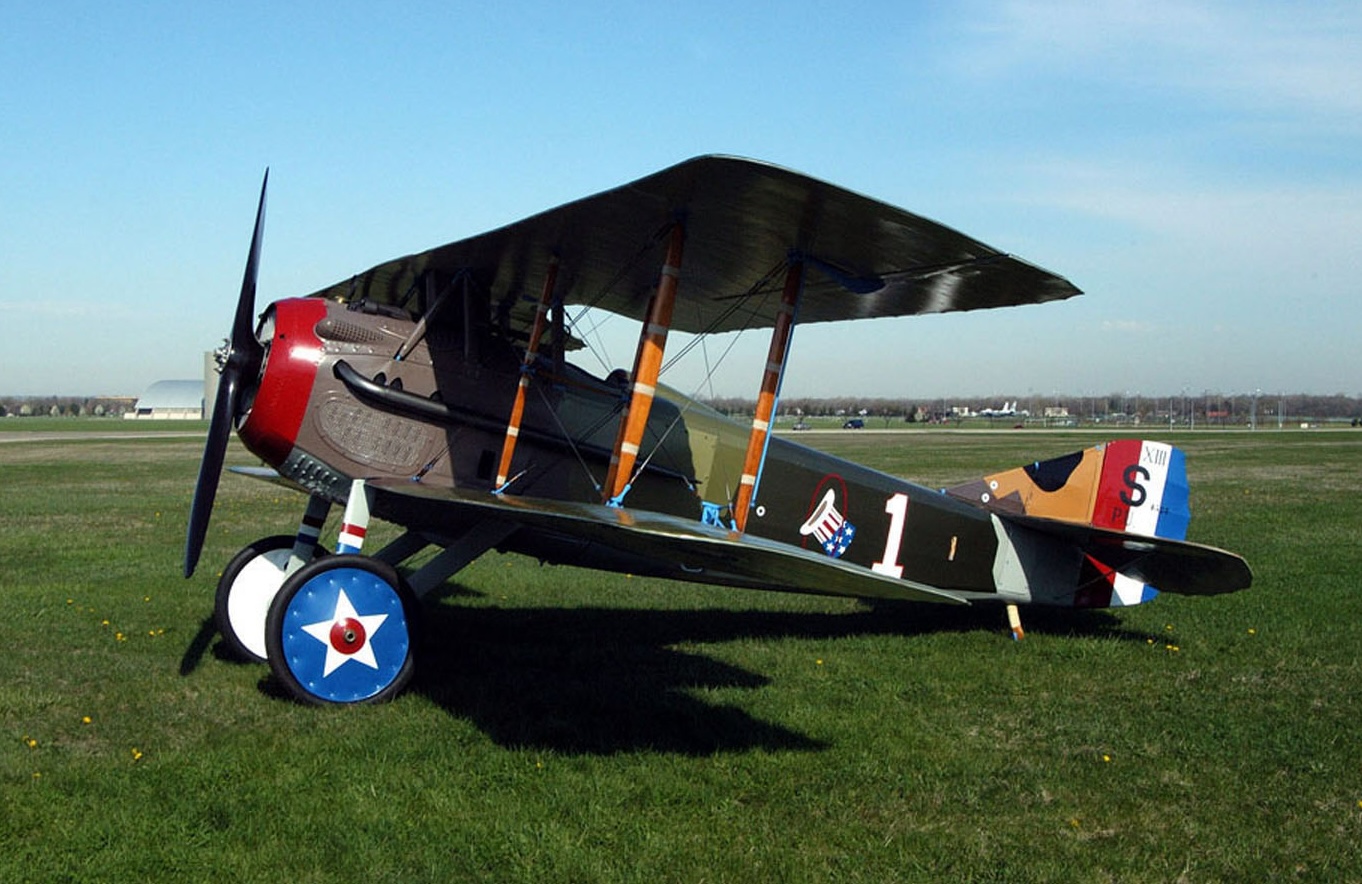
SPAD S.XIII
“the ace-maker”
The fast, rugged French biplane that carried the Allied aces of 1918 — and re-armed the American squadrons that went to war without a fighter of their own.
The fighter that made the aces — and re-armed America
By 1917 the air war had settled into a brutal arithmetic. The nimble rotary-engined fighters that had ruled 1916 — the Nieuports, the early Sopwiths — could out-turn almost anything, but they were lightly built and short on speed. The Germans answered with faster, heavier machines. France needed a fighter that could meet them on their own terms: fast, strong, and hard-hitting. The answer came from a quiet engineer named Louis Bechereau.
Bechereau’s SPAD S.VII had already proved the formula in 1916: build the airframe around a powerful, water-cooled Hispano-Suiza V-8 rather than a rotary, and accept less agility in exchange for speed and structural strength. The SPAD S.XIII, first flown on 4 April 1917, took that idea further — a bigger wing, more power, and a second machine gun. It was not a dogfighter in the turning sense. It was a diving predator.
The tactic that defined it was simple and deadly: climb high, dive on the enemy at speed, fire a hard burst from two synchronized guns, and zoom away before he could react. The SPAD could not turn with a Fokker, but few aircraft of the war could take punishment and out-dive it. In the hands of a disciplined pilot it was a machine for fighting on your own terms, and the best pilots of the war made it famous.
France’s leading aces flew SPADs. Rene Fonck, the Allied “ace of aces” with 75 confirmed victories, and Georges Guynemer, the frail national hero who vanished over Belgium in September 1917, both did their killing in Bechereau’s fighters. Italy’s Francesco Baracca flew them on the Italian Front. Nearly every French fighter escadrille converted to the type.
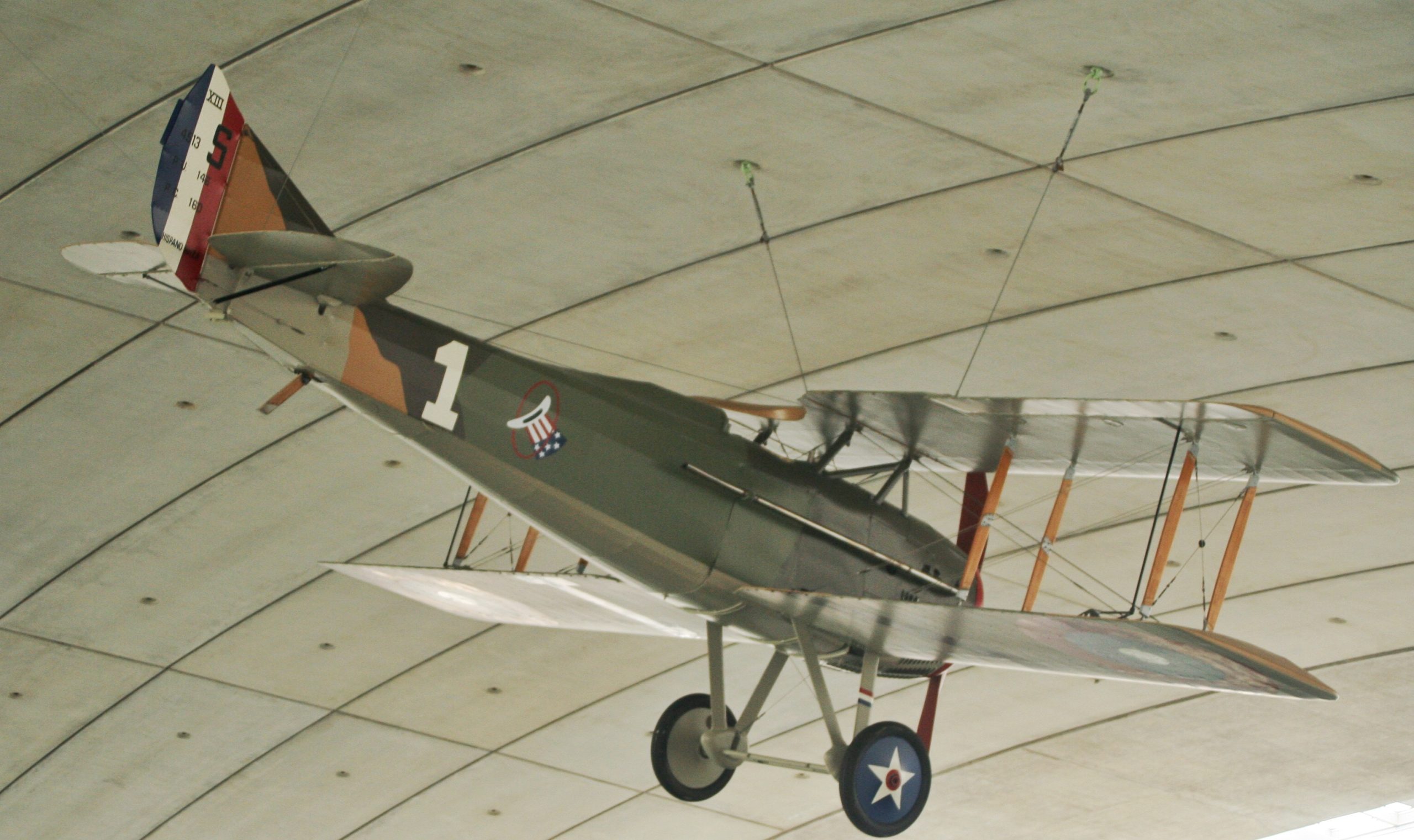
Then America arrived. The United States entered the war in 1917 with no combat aircraft of its own worth the name, and its squadrons went into battle in French equipment. The SPAD XIII armed the U.S. Army Air Service — including the 94th Aero Squadron, the “Hat in the Ring” squadron, whose pilots included the top American ace Eddie Rickenbacker and the Medal-of-Honor “balloon buster” Frank Luke. Some 893 SPAD XIIIs were shipped to the AEF.
It was not a flawless aircraft. The geared Hispano-Suiza that gave the SPAD its speed was, in its early forms, temperamental — reduction gears failed, engines were grounded, and production of reliable powerplants lagged behind the airframes waiting for them. Pilots also had to respect its handling: heavy, fast, and unforgiving of the sloppy low-speed flying that a rotary fighter would forgive.
But the numbers tell the story. By the Armistice, SPAD and eight other French firms had built roughly 8,472 of them — one of the most-produced fighters of the entire war. The SPAD XIII did not win the air war by being the most agile machine in the sky. It won by being fast enough, strong enough, and available in enough numbers to put a modern fighter under every good pilot the Allies had.
01The SPAD S.XIII’s lineage: from the SPAD S.VII to the ace-maker
The S.XIII was the high point of a family, not a bolt from the blue. Louis Bechereau’s SPAD S.VII of 1916 established the recipe — a strong wooden airframe wrapped around a water-cooled Hispano-Suiza V-8 and armed with a single synchronized Vickers gun. It was fast and tough where its rotary rivals were agile and fragile.
The S.XIII scaled the idea up: a larger wing, rounded lower wingtips, a more powerful geared Hispano-Suiza, and a second Vickers gun for double the firepower. Between the two came experiments and parallel SPAD designs, but it was the S.XIII that became the standard Allied fighter of 1918, ultimately outnumbering and replacing the S.VII in French service.
What makes the SPAD S.XIII special
A wing built to dive, not to turn
The SPAD traded agility for strength. Its robust wire-braced wooden structure let pilots dive hard and pull out at speeds that would have shed the wings of a lighter rotary fighter — the foundation of its dive-and-zoom fighting style.
A Hispano-Suiza V-8, not a rotary
Where most 1916 fighters spun a whole rotary engine around a fixed crank, the SPAD used a stationary, water-cooled Hispano-Suiza 8 V-8 of roughly 220 hp. More power and no gyroscopic torque — at the cost of weight and, early on, reliability.
Two guns through the propeller
The S.XIII carried two synchronized .303 Vickers machine guns firing forward through the propeller arc, 400 rounds each. Double the firepower of the single-gun S.VII, delivered in the brief window of a diving pass.
02The SPAD S.XIII’s Hispano-Suiza engine: power, gearing and gremlins
The SPAD’s speed came from Marc Birkigt’s Hispano-Suiza 8, a cast-aluminium-block water-cooled V-8 that was one of the great engineering achievements of the war. The S.XIII used geared 8B variants — a reduction gear let the crankshaft turn faster than the propeller, extracting more power — rated at about 220 hp, with later engines pushing toward 235 hp.
The gearing was also the SPAD’s weak point. Early geared Hispano-Suizas suffered reduction-gear failures and lubrication problems, and supply of reliable engines lagged so badly that airframes sat waiting for powerplants. Once the bugs were worked out, the combination was formidable; but the “Hisso” gremlins are a real part of the SPAD story, not a footnote.
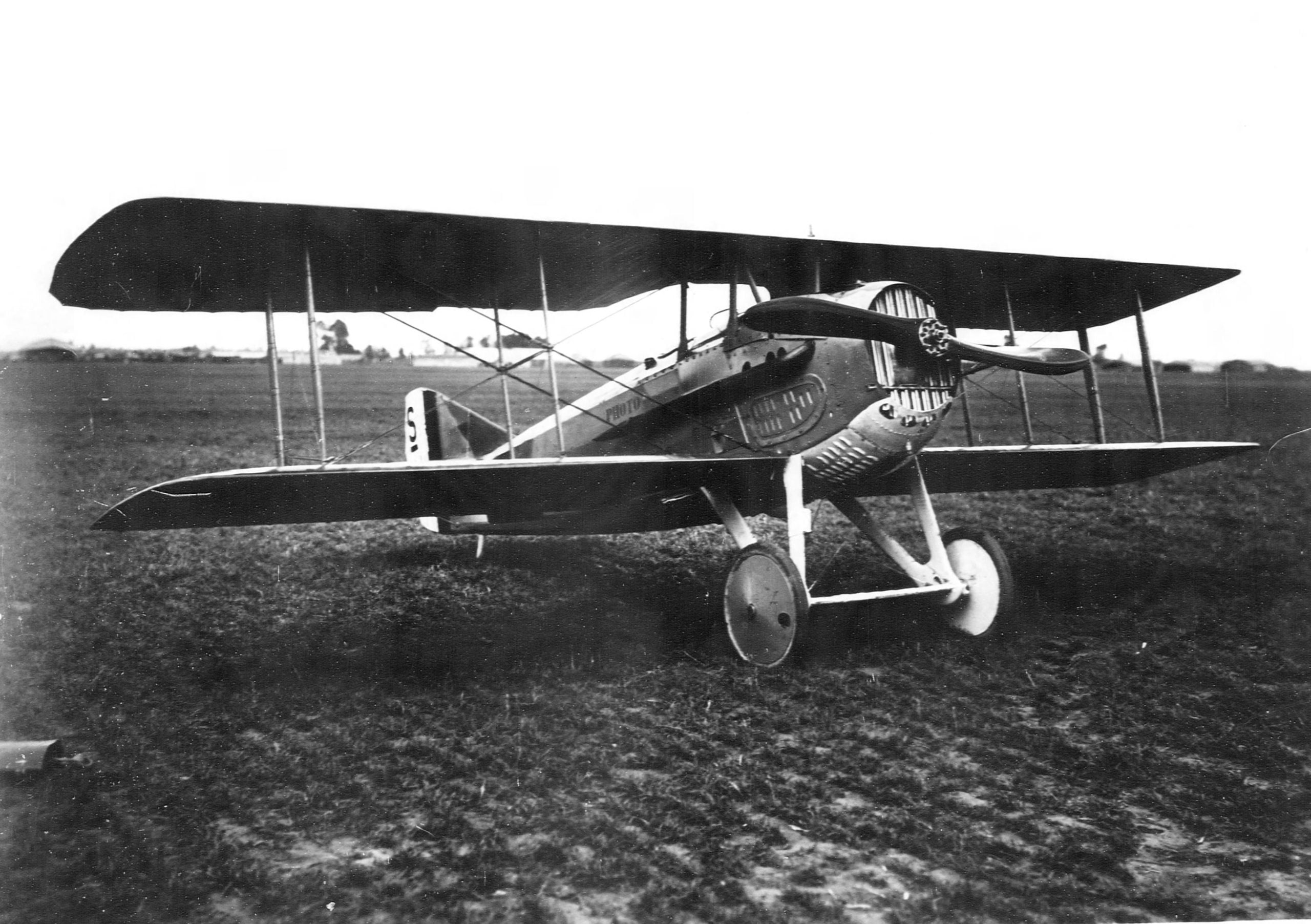
Head-on, the SPAD’s blunt radiator nose gives away the water-cooled V-8 inside. Photo: Air Service, U.S. Army (public domain).
03The SPAD S.XIII’s fighting style: dive-and-zoom versus the turn-fighters
Fighter tactics in 1918 split along a fault line the SPAD helped define. Rotary-engined machines like the Sopwith Camel and Fokker Dr.I were turn-fighters: light, agile, able to whip around inside an opponent. The SPAD was the opposite — heavy, fast, and happiest in the vertical.
A SPAD pilot who tried to dogfight a turning Fokker on its terms would lose. So he didn’t. He used energy: hold the height advantage, dive, fire, and climb away to set up again. It is the same “boom-and-zoom” logic that heavier fighters would use for the next thirty years, and the SPAD XIII was one of the first aircraft fast and strong enough to make it a doctrine.
04The SPAD S.XIII’s aces: Guynemer, Fonck, Rickenbacker and the Hat in the Ring
Georges Guynemer, France’s frail and beloved national hero, scored the bulk of his 54 victories in SPADs before disappearing over Poelkapelle, Belgium, on 11 September 1917 — no wreck, no grave, a legend that told French schoolchildren he had simply flown too high to come down.
Rene Fonck, colder and more methodical, became the Allied ace of aces with 75 confirmed victories, an economical marksman who often downed enemies with a handful of rounds. Italy’s Francesco Baracca flew SPADs on the Italian Front.
For the Americans, the SPAD XIII was the fighter of the 94th Aero Squadron — the “Hat in the Ring” squadron — whose pilots included top U.S. ace Eddie Rickenbacker (26 victories) and Medal of Honor recipient Frank Luke, the “Arizona Balloon Buster.”
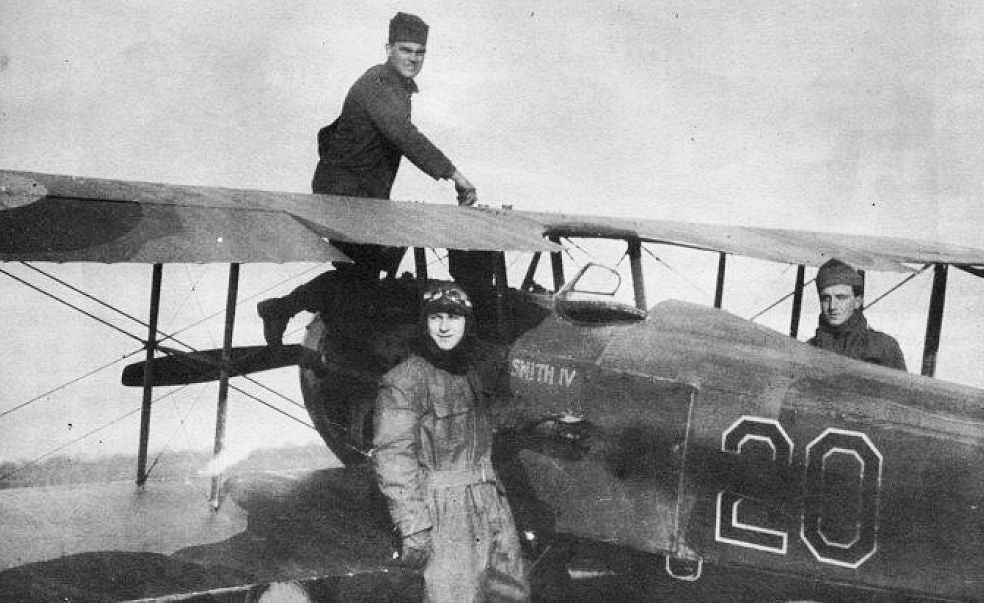
A SPAD XIII of a U.S. Aero Squadron. Photo: Air Service, U.S. Army (public domain).
SPAD S.XIII full specifications
Baseline note: the figures below describe the SPAD S.XIII C.1 with the 220 hp Hispano-Suiza 8Be, the high-compression geared V8 fitted to later production aircraft and the engine most people mean when they say "SPAD XIII". Deltas for the early 200 hp 8Ba aircraft (the first year of production, and the version that generated most of the type’s reliability scandal), for the earlier S.VII and for the S.XVII with the 300 hp direct-drive 8Fb are in grey. Speed figures below are the French official ones and carry a stated altitude, which matters: most published First World War performance does not.
Dimensions & weights
- Crew
- 1
- Wingspan
- 8.25 m (27 ft 1 in) — late-production aircraft 8.08 m (26 ft 6 in)
- Length
- 6.25 m (20 ft 6 in)
- Height
- 2.60 m (8 ft 6½ in) — the National Museum of the United States Air Force quotes 2.41 m (7 ft 11 in) for its own airframe, which is a fair illustration of how much individual First World War aircraft differed
- Wing area
- 21.11 m² (227 sq ft) — late aircraft 20.2 m² (217 sq ft)
- Wing arrangement
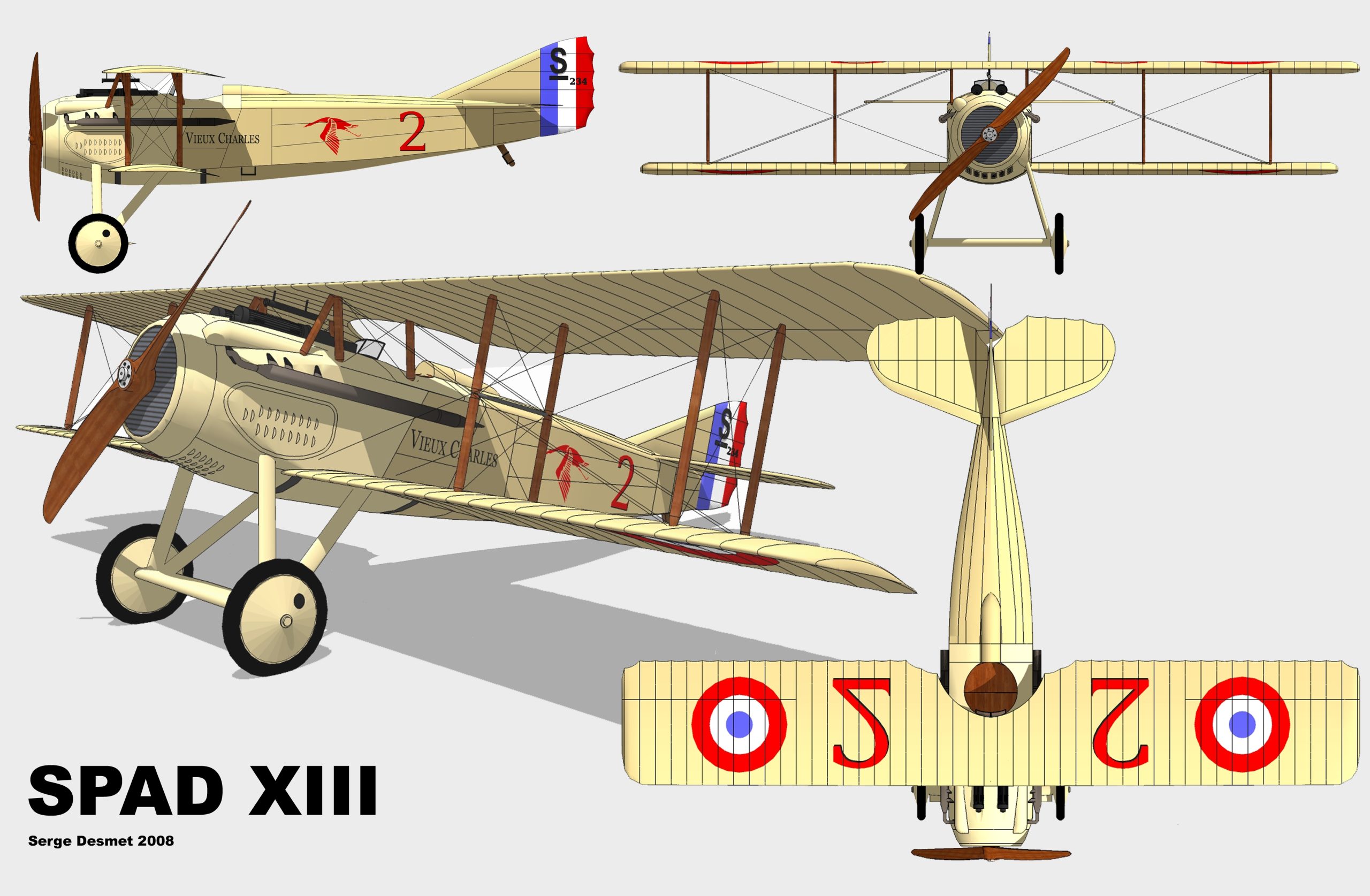
- Genuinely single-bay, but with slender tie struts halfway along the span to stop the bracing wires whipping and chafing. They make the aeroplane look like a two-bay machine in photographs and in most drawings, and they carry no flight loads
- Fuselage structure
- Wooden box girder of four square-section longerons with wooden struts and cross-members, braced with heavy-gauge piano wire and fabric-covered. Conventional, and built very strong
- Upper wing
- Made in one piece, with hollow box spars joined by linen-wrapped scarf joints because long runs of clear spruce were hard to get by 1917. Plywood webs, spruce capping strips, internal piano-wire bracing
- Aileron drive
- Ailerons on the upper wing only, worked by vertical push-rods with external 90° bellcranks standing proud of the top of the lower wing — an odd-looking arrangement that is the quickest way to identify a SPAD in a photograph
- Empty weight
- 602 kg (1,326 lb)
- Loaded weight
- 857 kg (1,888 lb) — a heavy fighter for 1918; a Sopwith Camel loaded weighed about 660 kg (1,455 lb)
- Wing loading
- 40.6 kg/m² (8.3 lb/sq ft) — high, and the arithmetic behind everything good and everything bad about this aeroplane
- Structural strength
- Exceptional. The SPAD could be dived at speeds that would have taken the wings off a Nieuport or an Albatros, and the type has no reputation for structural failure of any kind. It is the strongest of the major 1918 fighters
Performance
- Maximum speed at 1,000 m
- 211 km/h (131 mph at 3,280 ft) — faster than the Camel, faster than the Fokker D.VII, and about level with the S.E.5a
- Maximum speed at 2,000 m
- 208 km/h (130 mph at 6,560 ft)
- Maximum speed at 3,000 m
- 206 km/h (128 mph at 9,840 ft)
- Maximum speed at 4,000 m
- 201 km/h (125 mph at 13,120 ft)
- Maximum speed at 5,000 m
- 190 km/h (118 mph at 16,400 ft) — note how little it falls away. The SPAD held its speed with height better than almost anything else flying
- Climb to 2,000 m
- 5 min 17 sec (6,560 ft)
- Climb to 3,000 m
- 8 min 45 sec (9,840 ft)
- Climb to 5,000 m
- 20 min 10 sec (16,400 ft)
- Service ceiling
- 6,800 m (22,300 ft) — among the highest of any single-seater of the war
- Endurance
- 2 hours, from several fuselage tanks feeding a gravity tank in the upper wing centre section by engine-driven pump
- Diving
- The SPAD’s defining virtue. It accelerated downhill like nothing else and could be pulled out hard, which made the dive-and-zoom attack the natural way to fight it and made disengagement a matter of pushing the nose over
- Low-speed handling
- The defining vice. Heavy, sluggish at low speed, with a sharp stall and a vigorous spin, and a landing approach that had to be flown under power — a Nieuport 27 could be glided in with the engine off, a SPAD could not. Novice pilots were hurt on landing in numbers
Propulsion & systems
- Engine
- One Hispano-Suiza 8Be water-cooled 90° V8, 11.76 litres, 164 kW (220 hp), compression 5.3:1, with a 0.75:1 propeller reduction gear. Marc Birkigt’s design, with monobloc aluminium cylinder blocks and screwed-in steel liners — a genuinely advanced engine for 1917 and the ancestor of a whole family that ran to 1940
- The reduction gear
- This is the aircraft’s real weakness and it deserves to be stated bluntly. The gear that let a fast-turning engine swing an efficient propeller was fragile. It suffered vibration and poor lubrication, and it failed — on occasion throwing the propeller, drive shaft and driven gear clean off the front of a flying aeroplane. The Sopwith Dolphin and the early S.E.5a, both built around the same engine, had exactly the same trouble.
- What it cost
- In November 1917 the S.XIII was officially described as "incapable of giving dependable service". In April 1918 a French report stated that two-thirds of the 200 hp SPADs were unserviceable at any one time because of engine problems. Deliveries ran far behind plan: 764 aircraft against 2,230 planned by the end of March 1918. Squadrons sat on the ground
- Alternative engines
- Hispano-Suiza 8Ba and 8Bb, 149 kW (200 hp), on early aircraft; 8Bc and 8Bd, 164 kW (220 hp); post-war American aircraft re-engined with 112–134 kW (150–180 hp) Wright-Hispano engines, which could not match the original
- Propeller
- Two-blade fixed-pitch wood, turning anticlockwise seen from the cockpit — a left-hand tractor, because the reduction gear reversed the rotation. That is the reliable way to tell a geared-Hispano aeroplane from a direct-drive one in a photograph
- Cooling
- Circular frontal radiator in the nose with vertical Venetian-blind shutters to regulate temperature, and a header tank in the upper wing with an engine-driven circulating pump
- Guns
- Two fixed 7.7 mm (0.303 in) Vickers with 400 rounds each; American aircraft frequently substituted 7.62 mm (0.30-06) Marlin-Rockwell M1917 or M1918 guns
- Synchronisation
- The Birkigt gear, officially Système de Synchronisation pour Vickers Type II (moteurs fixes) — an oscillating torsion shaft rather than a push rod, designed by the same man who designed the engine
- Sights
- Ring-and-bead as standard, with Aldis-pattern telescopic tube sights fitted by some units and many American aircraft
- First flight
- 4 April 1917; deliveries to the Aéronautique Militaire began in May 1917, a month after the first flight
- Number built
- 8,472 by nine companies, with orders for roughly ~10,000 more cancelled at the Armistice. One of the largest production runs of any aircraft of the war
- Operators
- 74 French escadrilles; 15 of the 16 operational United States pursuit squadrons at the Armistice; Italy, Belgium, Britain, and after the war Japan, Poland, Czechoslovakia, Siam and Brazil
05The SPAD S.XIII’s numbers: how 8,472 fighters were built
The SPAD XIII was not just good — it was buildable. Its wooden, wire-braced structure suited France’s dispersed furniture-and-carriage workshops, and SPAD licensed production to eight other firms. By the Armistice roughly 8,472 had been completed, making it one of the most-produced fighters of the war.
Around 893 went to the United States Army Air Service, which had entered the war without a homegrown fighter. Postwar, surplus SPADs served on as trainers and second-line fighters in air forces from Poland and Czechoslovakia to Japan, Belgium, Greece, Brazil and Siam.
06The SPAD S.XIII’s cost: why there is no reliable price tag
Unlike modern aircraft, the SPAD XIII has no reliably recorded unit cost. It was built by many manufacturers under wartime contracts in a rapidly inflating economy, and consistent per-airframe figures simply were not preserved in a way historians trust.
The “cost per flight hour” figure in the table above is included only for consistency with the rest of the encyclopedia. It is a rough modern estimate for operating an airworthy SPAD reproduction on the warbird circuit — on the order of a few hundred to well over a thousand dollars an hour once fuel, insurance and specialist maintenance are counted — and should not be read as a historical 1917 cost.
Armament & payload
Two Vickers, four hundred rounds each, and an aeroplane steady enough to make them count at range
The S.XIII’s armament is the plainest possible statement of the twin-gun standard that every combatant had converged on by mid-1917: two belt-fed 7.7 mm Vickers side by side on the upper fuselage decking, 400 rounds apiece, synchronised through the propeller, breeches within the pilot’s reach. Its predecessor the S.VII had carried one gun; adding the second is essentially the whole armament story of the S.XIII.
What made the installation effective was the airframe under it. The SPAD was heavy, stiff and naturally stable, and a stable aeroplane holds an aiming point. C. F. Andrews, who wrote the standard early monograph on the type, put the SPAD’s success down to precisely this: it was a steady gun platform, and a steady gun platform lets an average pilot hit something at a range where a twitchy one would waste the belt. René Fonck, the highest-scoring Allied ace of the war with 75 victories, was a marksman rather than a dogfighter, and he flew SPADs.
The one significant variation is American. Vickers guns ran short in the last months of the war, so United States squadrons fitted the lighter Marlin-Rockwell M1917 and M1918 in their place; by the Armistice roughly half of American S.XIIIs had been converted. Beyond that, and the choice of sight, fits were essentially uniform across the French, American, Italian, Belgian and British aircraft — this was a mass-produced weapon with very little squadron-level variation.
Gun
- Two fixed 7.7 mm (0.303 in) Vickers machine guns on the upper fuselage decking, belt-fed, air-cooled, firing through the propeller arc.
- 400 rounds per gun — a generous supply by 1918 standards, and enough for several separate engagements on a two-hour patrol.
- Both breeches were within reach of a seated pilot for clearing the stoppages that were a routine part of operating a synchronised Vickers.
- American substitution: 7.62 mm (0.30-06) Marlin-Rockwell M1917 and M1918, at about 11.3 kg against roughly 30 kg for an installed Vickers. Adopted for availability first and weight second; around half of American S.XIIIs carried them by November 1918.
- No third gun, no overwing gun, no flexible mount. The 37 mm cannon belongs to the S.XII, which is a different aeroplane.
Ammunition & sights
- 800 rounds total in belts, stowed in the fuselage forward of the cockpit; a mix of ball, armour-piercing and tracer, with incendiary loaded for balloon work.
- Ring-and-bead sights as standard on French aircraft. Aldis non-magnifying telescopic tube sights were fitted by many units and were common on American machines; the gunsight from Frank Luke’s last SPAD is preserved at the National Museum of the United States Air Force.
- The synchronised Vickers could not safely fire phosphorus incendiary in the way an open-bolt Lewis could, which is one reason balloon attack meant closing to very short range with ordinary tracer and incendiary rather than standing off.
- The aircraft’s stability is properly part of its armament. It is the reason SPAD pilots could take deflection shots at range that a Camel pilot would not have attempted.
Synchronisation gear
- The Birkigt gear, always called the "SPAD gear", designed by Marc Birkigt for use with his own Hispano-Suiza engine and first fitted to the single-gun S.VII in September 1916.
- Unlike almost every other mechanical synchroniser it used no push rod. The firing impulse was transmitted torsionally by an oscillating shaft that rotated back and forth through about a quarter turn.
- That is mechanically more efficient than a reciprocating rod, which does not bend, whip or wear out of time, and it allowed higher rates of fire. It was later adapted to control two guns for the S.XIII.
- Officially the Système de Synchronisation pour Vickers Type II (moteurs fixes), for fixed as opposed to rotary engines — the rotary-engined French fighters used the Alkan-Hamy gear instead. The Birkigt gear stayed in French service until the Second World War.
Balloon attack
- Observation balloons were the most heavily defended targets on the Western Front — ringed with anti-aircraft guns and covered by standing fighter patrols — and destroying one required closing to a range where the gunners could hardly miss.
- The SPAD was well suited to it for one reason: it could dive in fast, fire, and dive out faster than anything sent after it. Speed and structural strength were worth more than agility in that particular job.
- Frank Luke of the 27th Aero Squadron was credited with 18 victories, fourteen of them balloons, in ten sorties across eight days in September 1918, flying a SPAD S.XIII. He was killed on 29 September 1918 and became the first airman to receive the Medal of Honor.
- No Le Prieur rockets. Those were a 1916 expedient carried on Nieuports and some S.VIIs; by the time the S.XIII was in service, incendiary ammunition had made them obsolete.
Bombs and other stores
- Not a bomber, and not equipped as one. No bomb rack formed part of the standard French fit, and the S.XIII was never assigned to the trench-strafing role the way the late-war Camel was.
- Where small bombs were carried — four light bombs of around 9 kg under the fuselage — the installation was a unit-level improvisation during the 1918 offensives, not a factory item.
- The "four 25 lb Cooper bombs" that appears in a good many references is worth flagging: the Cooper was a British weapon of 20 lb, not 25, and quoting it as standard SPAD equipment overstates a capability the aeroplane barely had.
- Nothing else was hung on it. No pods, no cameras, no external tanks — the wings were clean and the SPAD’s whole design argument was speed.
Not carried
- No cannon. The moteur-canon 37 mm through the propeller boss was the S.XII, built in small numbers and disliked: the gun had to be reloaded by hand, one round at a time, and it filled the cockpit with fumes.
- No radio, no oxygen equipment, no armour, no self-sealing tank — and the S.XIII routinely operated above 5,000 m, where an unacclimatised pilot is measurably impaired.
- No parachute. French and American single-seat pilots were given none for the whole war, while German pilots had the Heinecke harness type from the spring of 1918. Men burned in aircraft that were still flying.
- No arrester gear, no flotation equipment, no naval fit of any kind. The S.XIII was a land fighter from first to last.
Three typical loadouts
- French escadrille offensive patrol, 1918
- Two Vickers with 400 rounds each, full fuel for two hours, nothing else. Flown high in a formation of five or six, working on the dive-and-zoom principle the aircraft was built for: arrive above, take the shot at speed, keep the speed, climb away. René Fonck, Georges Guynemer and Charles Nungesser all built their scores this way.
- Hat in the Ring, autumn 1918
- Identical armament, often with Marlin guns and an Aldis sight. The 94th Aero Squadron began operations on Nieuport 28s in the spring of 1918 and re-equipped with SPAD S.XIIIs that summer, after the Nieuport’s habit of shedding upper-wing fabric in a dive became intolerable. Eddie Rickenbacker took command on 25 September 1918 and finished the war as America’s leading ace with 26 victories — more than a third of the 94th’s total of 70 — the great majority of them on this aeroplane.
- Balloon attack, Meuse-Argonne, September 1918
- Both guns loaded with incendiary and tracer, flown low and fast against the German balloon line behind the front. A single pass, at very close range, through concentrated ground fire, with the escape made in a dive. This is the one mission where the SPAD’s combination of speed and structural strength mattered more than any other quality it had, and it is how Frank Luke made his name and lost his life.
Sourcing caveat: performance figures for First World War aircraft vary widely between sources because they were measured on individual hand-built airframes with individual hand-built engines, and the altitude at which a speed was recorded is frequently not stated at all — which is how the same type is quoted honestly at two different top speeds in two respectable books. The speeds and climb times here are the French official series reproduced in Davilla and Soltan’s French Aircraft of the First World War precisely because each one carries a stated altitude. Dimensions vary between early and late production and between individual museum airframes, and both are given where they differ. Serviceability statements are from contemporary French and American reports rather than from later summaries. Victory totals are the officially credited ones, and credited totals on every side of this war were generous.
Variants
The S.XIII was the anti-Camel, and it was built in numbers no other Allied fighter came close to
Louis Béchéreau designed the SPAD around a philosophy that was the exact opposite of Sopwith’s. The Camel was small, light, short-coupled and murderously agile, with all its mass concentrated in seven feet of nose; it turned inside anything and it killed a great many of its own pilots. The SPAD was heavy, stiff, fast and stable, and it did none of the things a Camel did. It could not turn with a Camel or a Fokker D.VII, it could not be flown slowly, and its stall and landing were unforgiving. What it could do was outrun almost everything, out-dive absolutely everything, hold its performance at 5,000 m where other fighters were wallowing, and be aimed.
That was the right set of compromises for the way the air war had actually developed by 1918. Formation dive-and-zoom attacks had replaced the individual turning fight, and in that method speed and strength beat agility. It is also the set of compromises that made the SPAD survivable for an ordinary pilot in combat and dangerous to him on the aerodrome — a trade most air forces would take now and did take then.
The engine is the honest asterisk on all of it. Marc Birkigt’s geared Hispano-Suiza was the most advanced aero engine of its generation and, for over a year, one of the least dependable. The gear train broke. Serviceability collapsed. Squadrons that were supposed to be re-equipping sat with hangars full of aeroplanes that could not fly, and an official French assessment in April 1918 put two-thirds of the 200 hp SPADs out of action at any given time. Build quality improved through 1918 and the 220 hp engines were better, but the type’s reputation for unreliability was earned and should not be smoothed away. The S.XIII was a magnificent aeroplane with a bad engine, in the same way and for the same reason as the S.E.5a — and the British solved it by deleting the gearbox, which the French never did.
- SPAD S.VII C.1 (1916–18, ~3,500 French-built plus licence production abroad)
- The direct-drive ancestor, one Vickers, 150 hp and later 180 hp Hispano-Suiza 8A. Fast, strong, thoroughly reliable, and by early 1917 outclassed by the Albatros D.III. Guynemer’s complaint to Béchéreau — "the 150 hp SPAD is not a match for the Halberstadt, more speed is needed" — is what started the S.XIII.
- SPAD S.XII Ca.1 (1917, ~300 built)
- The geared engine’s first application, with a 37 mm cannon firing through the hollow propeller shaft. Guynemer and Fonck both scored with it. The cannon had to be hand-loaded round by round in flight, the fumes were foul, and pilots wanted none of it — which is precisely why the conventionally armed S.XIII took over.
- SPAD S.XIII C.1, early production (1917–18, 200 hp 8Ba)
- First flight 4 April 1917, deliveries from May. Larger and heavier than the S.VII, with two Vickers, revised ailerons, rounded tailplane tips, a bigger fin and rudder and the deeper cowling the geared engine needed. Fast, and frequently unserviceable.
- SPAD S.XIII C.1, late production (1918, 220 hp 8Bc, 8Bd, 8Be)
- Higher compression, better build quality, slightly reduced span and wing area on the last aircraft. The definitive machine, and the one the specifications above describe.
- SPAD S.XVII C.1 (1918, 20 built)
- The S.XIII airframe strengthened and cleaned up around the 300 hp direct-drive Hispano-Suiza 8Fb, built to a French requirement for a more powerful fighter. All twenty went to Groupe de Combat 12, the Storks. The Armistice ended it.
- American service aircraft (1918–20s, 893 purchased)
- Equipped 15 of the 16 operational United States pursuit squadrons at the Armistice. Roughly half were re-armed with Marlin guns. Nearly half of the 893 were still in American service in 1920, and a number were re-engined with 150 hp Wright-Hispano engines to prepare pilots for the Thomas-Morse MB-3, which used SPAD-type wings.
- Italian and Belgian service (1917–18)
- Italy’s Corpo Aeronautico Militare bought the type but its pilots generally preferred the more manoeuvrable Hanriot HD.1 — a revealing preference, given the Italian front’s mountain flying. Belgium flew it too, and the Belgian ace Edmond Thieffry made his name on it.
- British service (1917–18)
- No. 23 Squadron RFC equipped with S.XIIIs in December 1917 and kept them until April 1918, when Sopwith Dolphins arrived; No. 19 Squadron operated at least one. A stopgap while British-built aircraft were awaited, and a reminder that Britain bought French fighters throughout the war.
- Post-war exports (1919–30)
- Surplus S.XIIIs went to Japan, Poland, Czechoslovakia, Siam and Brazil, among others; Brazilian Army Aviation flew them from 1920 to 1930. France kept the type as a first-line fighter until 1923, because deliveries of its intended replacement, the Nieuport-Delage NiD 29, ran late.
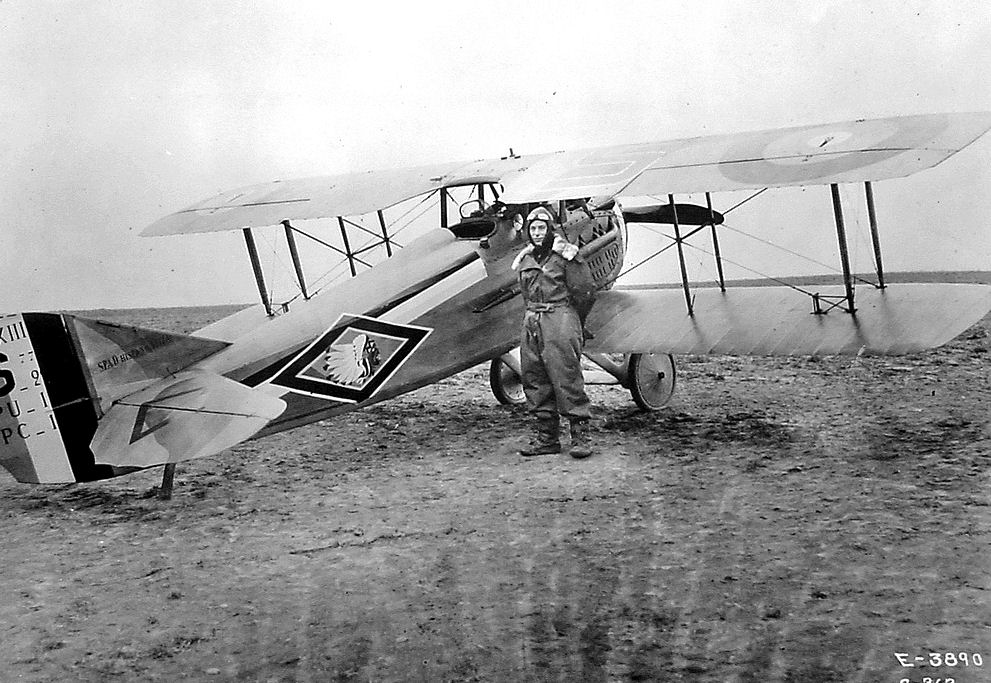
Survivors, and what is actually original: about six original SPAD S.XIIIs are publicly accounted for out of 8,472 built, and exactly one of them flies. S4377, the oldest known S.XIII airframe, is airworthy with the Memorial Flight association at La Ferté-Alais in France; its fuselage and its 220 hp Hispano-Suiza are original, its wings were largely rebuilt to original specification, and it flew again on 3 May 1991 after 73 years on the ground. It is the only original SPAD S.XIII in flying condition anywhere. The static originals are SP49 at the Royal Museum of the Armed Forces in Brussels; S5295 at the Musée de la Grande Guerre at Meaux, on loan from the Musée de l’Air et de l’Espace; S7689 "Smith IV" at the National Air and Space Museum in Washington; S16594 at the National Museum of the United States Air Force, built by the Kellner et ses Fils piano works in October 1918, never in combat, and now painted as Rickenbacker’s aircraft; and S15155 at Phoenix Sky Harbor, assembled from parts of three airframes and painted as Frank Luke’s. Every other SPAD S.XIII you will see, flying or static, is a reproduction — and for First World War types that is the normal case rather than the exception, which is why it is worth saying plainly rather than leaving to be inferred.
The SPAD S.XIII through history
The SPAD S.VII proves the formula
Bechereau’s first Hispano-Suiza-powered SPAD enters service — fast, strong, and single-gunned.
SPAD S.XIII first flight
The enlarged, twin-gun prototype flies for the first time.
Into French squadrons
Production ramps up; French escadrilles begin re-equipping with the type.
Guynemer is lost
France’s national hero disappears over Belgium; his legend outlives him.
America goes to war on SPADs
The U.S. Army Air Service arms squadrons including the 94th “Hat in the Ring” with the SPAD XIII.
Armistice
Around 8,472 have been built — among the most-produced fighters of the war.
Retirement and export
Withdrawn from front-line use; surplus airframes serve on abroad as trainers and second-line fighters.
A handful survive
Four originals and a few airworthy reproductions remain, in museums and specialist collections.
SPAD S.XIII: the people and the legends
Guynemer flies too high
Georges Guynemer, tubercular and slight, was France’s most beloved airman. On 11 September 1917 he took off over Flanders and never returned. No confirmed wreck was ever found, and a myth grew that he had simply climbed so high he could not come back down.
Read more
Rene Fonck, the marksman
Rene Fonck ended the war as the top Allied ace with 75 confirmed victories — and possibly many more unconfirmed. He was a cold, precise shot who prided himself on downing enemies with only a few rounds.
Read more
Rickenbacker’s 94th
The U.S. 94th Aero Squadron — the “Hat in the Ring” squadron — fought the last months of the war on SPAD XIIIs. Its star was Eddie Rickenbacker, a former race-car driver who became America’s top ace with 26 victories.
Read more
Frank Luke’s last flight
Frank Luke, the “Arizona Balloon Buster,” specialised in the most dangerous target of the war: hydrogen observation balloons ringed by anti-aircraft guns. In eight days he destroyed 14 balloons and four aircraft before being killed.
Read more
Baracca’s prancing horse
Italy’s top ace, Francesco Baracca, flew SPADs against Austro-Hungarian aviation. His personal emblem, a prancing black horse, was later given to a young Enzo Ferrari — and became the Ferrari badge.
Read more
Dive, fire, disappear
The SPAD could not out-turn a rotary fighter, so its pilots refused to try. Instead they used height and speed: dive on the enemy, fire a hard burst from two guns, and zoom away before he could react.
Read more
The Hisso’s reduction gear
The geared Hispano-Suiza that gave the SPAD its speed was also its curse. Early engines suffered reduction-gear failures and lubrication troubles, and reliable powerplants were in such short supply that finished airframes sat idle waiting for engines.
Read more
8,472 fighters
The SPAD XIII’s wooden, wire-braced construction suited France’s network of small workshops. SPAD licensed the design to eight other firms, and by the Armistice roughly 8,472 had been built.
Read more
The AEF’s French fighter
The United States entered the war in 1917 with no modern fighter of its own. Its squadrons went into combat in French aircraft — and the SPAD XIII became the standard American fighter of 1918.
Read more
Nungesser’s scars
Charles Nungesser, a flamboyant and repeatedly-wounded French ace with 43–45 victories, flew SPADs among many types. He survived the war despite a catalogue of injuries that would have grounded most men.
Read more
The 1918 match-up
In 1918 the SPAD XIII’s great rival was Germany’s superb Fokker D.VII. The Fokker was more forgiving and a better all-round dogfighter; the SPAD was faster in a dive and hit hard.
Read more
Four originals, a few flyers
Of the thousands built, only about four genuine SPAD XIIIs survive — at the Smithsonian, the National Museum of the U.S. Air Force, and the Musee de l’Air at Le Bourget among them.
Read more
SPAD S.XIII in photographs
SPAD S.XIII in flight
Video: “Spad XIII in flight” — Memorial Flight (~84,600 views). Memorial Flight is a French association that restores and operates one of the very few airworthy SPAD XIII aircraft in the world.
Where the SPAD S.XIII flew
The SPAD S.XIII was the standard Allied fighter of 1918: built and flown above all by France, adopted by the American squadrons of the AEF, used on the Italian Front, and passed on to a dozen air forces after the war. Toggle the categories to explore operators, combat theatres and surviving airframes. Colours follow the highest-priority category; tooltips list every role a country played.
SPAD S.XIII combat record
SPAD S.XIII: your questions answered
Can I fly in a SPAD S.XIII?
Not as a paying passenger. The SPAD S.XIII is a single-seat World War I fighter, it was retired in the 1920s, and it is not offered as a ride anywhere. A very small number of airworthy original and reproduction SPAD XIIIs do still fly at airshows in the hands of specialist warbird collections and preservation groups such as France’s Memorial Flight, but these are not bookable experiences.
If you want to actually fly in a fast military aircraft yourself, you can. MiGFlug flies civilians in genuine jet fighters and warbirds today — see the currently available aircraft and prices at migflug.com/flights-prices/.
Who designed the SPAD S.XIII?
The SPAD S.XIII was designed by Louis Bechereau, chief engineer at SPAD, as an enlarged and more powerful development of his earlier SPAD S.VII. The prototype first flew on 4 April 1917.
How fast was the SPAD S.XIII?
Roughly 218 km/h (about 135 mph), among the fastest fighters of the war. Published figures vary by source and variant, generally between about 211 and 222 km/h. It was especially strong and fast in a dive.
What engine did the SPAD S.XIII use?
A water-cooled Hispano-Suiza 8 V-8. The S.XIII used geared 8B versions of about 220 hp, with later engines around 235 hp. The gearing delivered the speed but caused early reliability and reduction-gear troubles.
How many SPAD S.XIIIs were built?
About 8,472 were built by SPAD and eight other French manufacturers by the end of 1918, one of the most-produced fighters of the war. Some 893 went to the U.S. Army Air Service.
Who were the famous SPAD XIII aces?
They included Rene Fonck (75 victories) and Georges Guynemer (54) of France, Francesco Baracca of Italy, and Americans Eddie Rickenbacker and Frank Luke of the U.S. 94th Aero Squadron, the “Hat in the Ring” squadron.
Are any SPAD S.XIIIs still flying?
Only about four genuine SPAD XIIIs survive, most as static museum exhibits at the Smithsonian National Air and Space Museum, the National Museum of the U.S. Air Force and the Musee de l’Air et de l’Espace at Le Bourget. A very small number of airworthy originals and reproductions fly, but they are not available for passenger rides.
You can’t fly the SPAD S.XIII. These, you can.
No SPAD is available for passenger flights — but MiGFlug puts civilians in the cockpit of genuine jet fighters and warbirds around the world. Real aircraft, real G, real speed.
More from the encyclopedia
Where this came from
- Smithsonian National Air and Space Museum — SPAD XIII “Smith IV” collection record.Designer, engine, armament, production total and surviving-airframe figures.
- National Museum of the United States Air Force — SPAD XIII fact sheet.U.S. Army Air Service service and 94th Aero Squadron history.
- Musee de l’Air et de l’Espace, Le Bourget.French service history and preserved SPAD XIII airframe.
- Memorial Flight (association).Operator of an airworthy SPAD XIII; source of the in-flight video.
- The Aviators Database — SPAD XIII data sheet.Dimensions, weights and armament figures.
- Vintage Aviation News — SPAD S.XIII warbird profile and first-flight feature.Development history and surviving aircraft.
- This Day in Aviation — SPAD S.XIII entries.Performance testing and dates.
- Eddie Rickenbacker, Fighting the Flying Circus (1919).First-hand account of flying SPADs with the 94th Aero Squadron.
Figures for a 1917 aircraft vary between sources; where they are contested (wingspan, top speed, exact horsepower) the ranges are noted in the text and specifications. No reliable period unit cost survives; the cost-per-hour figure is a flagged modern reproduction estimate. Photographs via Wikimedia Commons, credited individually. This page is an independent encyclopedia entry; MiGFlug does not operate the SPAD S.XIII.