
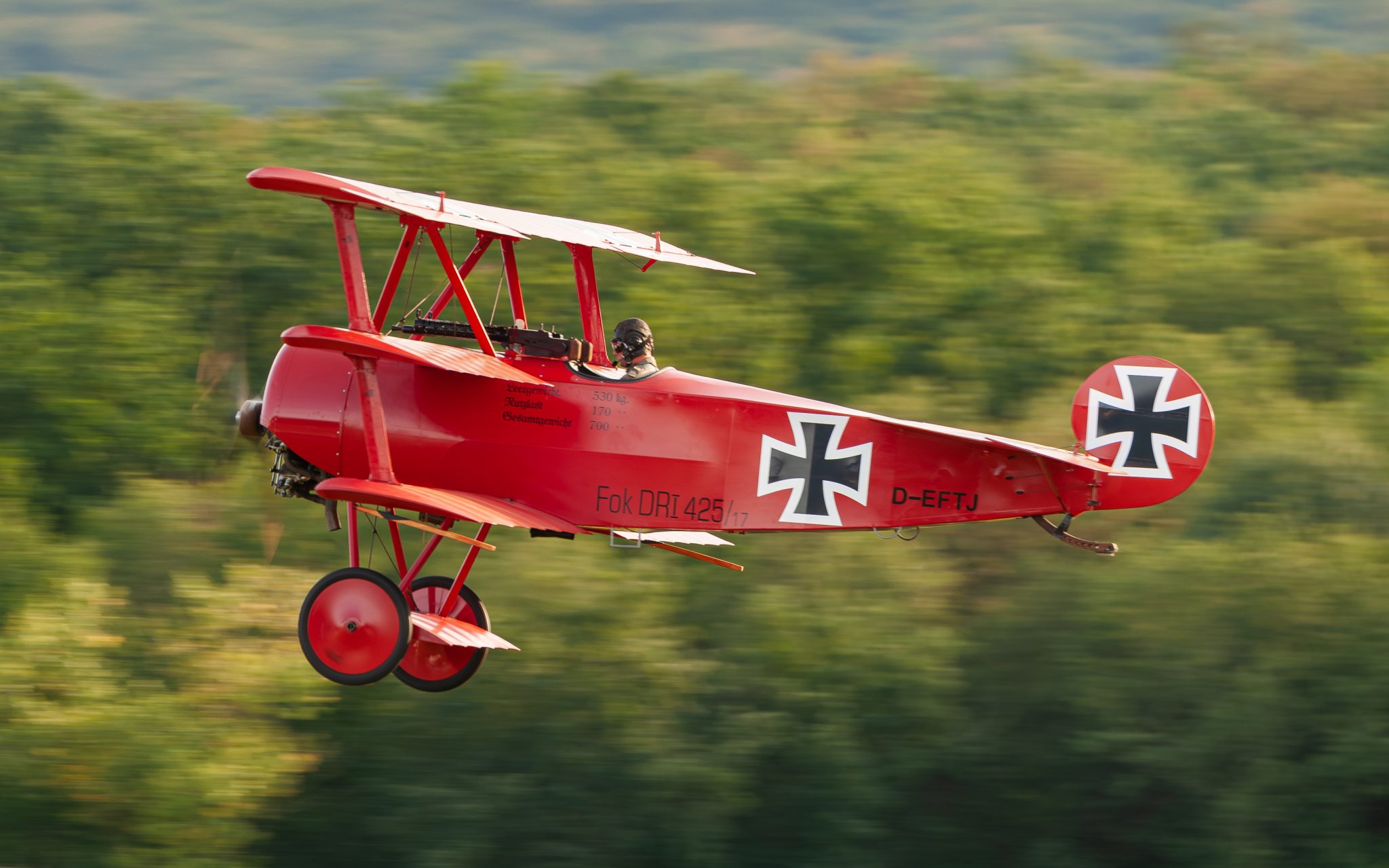
Fokker Dr.I Triplane
“The Red Baron’s three-winged fighter”
The Fokker Dr.I was the three-winged German scout that carried Manfred von Richthofen — the “Red Baron” — to his last victories and his death in April 1918. Slow in a straight line but astonishingly agile, it could out-climb and out-turn almost anything in the sky in expert hands, and its silhouette became the most recognisable shape of First World War aviation.
The Fokker Dr.I Triplane: the Red Baron’s three-winged fighter
In early 1917 the British Sopwith Triplane gave the Royal Naval Air Service a fighter that could climb and turn better than the German scouts it met. German aces, Manfred von Richthofen among them, were impressed — and Germany’s aircraft firms were asked to answer it. At Fokker, the self-taught designer Reinhold Platz produced a triplane of his own: the V.4 prototype, which matured into the Fokker Dr.I — “Dr” for Dreidecker, three-decker.
The formula was extreme. Three short, stacked wings gave a large lifting area on a very compact, light airframe. The result climbed hard and turned tighter than almost any contemporary, even if its top speed — around 185 km/h (115 mph) — left it slower than the SPAD XIII and S.E.5a it fought. In the hands of an expert dogfighter who fought in the vertical, that agility was worth more than speed.
Two men made the type a legend. On 23 September 1917 the 20-year-old ace Werner Voss, flying an early pre-production triplane, held off a whole flight of British S.E.5a scouts single-handed in one of the most famous dogfights of the war before he was finally shot down. And it was in an all-red Dr.I, serial 425/17, that Manfred von Richthofen — already the war’s top-scoring ace — flew his final combats. He was killed on 21 April 1918 over the Somme.
The Dr.I’s front-line career was short and troubled. A run of fatal upper-wing failures in late 1917 grounded the fleet within weeks of its debut; the wings had to be rebuilt before the type flew again. Only about 320 were built, and by mid-1918 it was outclassed and being replaced. Yet no aircraft of the war is more instantly recognised — the shape of the Red Baron’s triplane became, and remains, the very symbol of the 1914–18 air war.
01Why the Fokker Dr.I exists: the Sopwith Triplane and the race to answer it
The Sopwith Triplane stunned German pilots in the spring of 1917 with its rate of climb and manoeuvrability. The German high command issued a requirement for triplane fighters, and several firms responded. Fokker’s Reinhold Platz, working from the company’s welded steel-tube fuselage and thick cantilever wooden wings, built the V.3 and refined V.4 prototypes in mid-1917.
Two pre-production examples, designated F.I, were sent to the front for evaluation in August 1917 — one flown by Richthofen, one by Werner Voss. Their enthusiastic reports led to a production order for the aircraft that became the Dr.I. Ironically, by the time it reached the squadrons in numbers, the Sopwith Triplane that inspired it had already been withdrawn from front-line British service.
02The Fokker Dr.I’s markings: Richthofen’s all-red 425/17 and the “Flying Circus”
Manfred von Richthofen led Jagdgeschwader 1, a grouping of four fighter squadrons whose brightly-painted aircraft and habit of moving by train to wherever the fighting was hottest earned it the Allied nickname “the Flying Circus”. Richthofen’s own machines were famously painted overall red — giving him the names der Rote Baron (the Red Baron) and le petit rouge.
His last aircraft, Dr.I 425/17, is the most-modelled aeroplane of the war. Period German markings were the straight-armed black-and-white Balkenkreuz and earlier cross-pattée (the “Iron Cross”) national insignia. These are authentic historical markings and appear on museum aircraft and replicas today.
How the Fokker Dr.I worked: three wings, a rotary engine and twin Spandaus
Three stacked wings
The Dr.I’s defining feature was its three short, thick cantilever wooden wings, one above the other. Stacking the lift this way gave a big wing area on a tiny, light airframe with a short span, so the triplane could climb steeply and turn in a very small circle — at the cost of extra drag and a low top speed. Small “wings” on the landing-gear axle even added a little more lift.
A rotary engine and knife-edge handling
Power came from a rotary engine — usually the Oberursel Ur.II of about 110 hp, a copy of the French Le Rhône, with the whole engine spinning with the propeller. Its gyroscopic effect made the Dr.I turn viciously fast one way and reluctantly the other, a quirk expert pilots exploited in a dogfight but which could catch out the unwary.
Steel-tube fuselage, twin machine guns
Behind Fokker’s trademark welded steel-tube fuselage sat the pilot and two synchronised 7.92 mm LMG 08/15 “Spandau” machine guns firing through the propeller arc. The cockpit put the guns right under the pilot’s eyes for close-range aiming — the triplane was built to fight at knife-fighting distance, not to run.
03The Fokker Dr.I’s wing failures: why the triplane was grounded in 1917
Within weeks of reaching the front, Dr.Is began shedding their upper wings in flight. In late October 1917 two well-known pilots — Heinrich Gontermann and Günther Pastor — were killed when their wings broke up, and the whole type was grounded pending investigation.
The inquiry blamed poor workmanship and moisture: water had got into the wooden wing structure, weakening the ribs and the glue and letting the upper wing flex and fail. Fokker was ordered to rebuild the wings with better sealing and construction. The modified aircraft returned to service around the end of 1917, but the episode dented confidence in the design and slowed its deployment.
04Rotary engines and castor oil: the Fokker Dr.I’s engine problems
Rotary engines were lubricated with castor oil, which was total-loss — sprayed out through the engine and breathed in by the pilot. By 1917 the Allied blockade had cut Germany off from natural castor oil, and the synthetic substitutes used in its place were poor. This hurt reliability and performance and is one reason production and serviceability of the Oberursel-engined Dr.I were limited.
Some Dr.Is were fitted with captured or licence-built Le Rhône engines, which ran better. Power across the type was broadly similar — on the order of 110 hp — but the engine supply was a constant headache.
05Who designed and built the Fokker Dr.I: Reinhold Platz and Anthony Fokker
The Dr.I was built by the Fokker company of the Dutch entrepreneur Anthony Fokker, working in Germany. The detailed design is credited to Reinhold Platz, a gifted welder and self-taught engineer who favoured thick, internally-braced cantilever wings and welded steel-tube structures — ideas well ahead of the wire-braced norm of the day and visible in later Fokker fighters such as the D.VII.
Fokker Dr.I specifications: dimensions, performance and cost
Baseline note: the figures below describe the production Fokker Dr.I with the 110 hp Oberursel Ur.II rotary, which is what all 320 series aircraft were built with and what every Dr.I on the Western Front flew. The two F.I pre-production machines (102/17 and 103/17, the aircraft Richthofen and Voss evaluated in September 1917) differed only in the curved tailplane leading edge and the absence of wingtip skids. Where a delta is worth noting — captured Le Rhône 9J engines, the Siemens-Halske-engined V.7, the Goebel-engined trainers — it is in grey. German type-test figures were measured at Adlershof on individual aircraft; German and Allied sources for the same aeroplane differ by up to 20 km/h and by 400 m of ceiling, and much of that spread is real variation between airframes rather than error.
Dimensions & weights
- Crew
- 1
- Upper wingspan
- 7.19 m (23 ft 7 in)
- Middle wingspan
- 6.23 m (20 ft 5 in)
- Lower wingspan
- 5.73 m (18 ft 10 in) — the three decreasing spans are what let a triplane carry a large wing area on a very short span, and short span is what buys roll rate
- Length
- 5.77 m (18 ft 11 in)
- Height
- 2.95 m (9 ft 8 in)
- Wing area
- 18.7 m² (201 sq ft) across all three wings
- Aspect ratio
- 4.04
- Wing structure
- Thick-section wooden wings built around a hollow box spar, internally braced and carrying no external bracing wires at all — the feature that defines the aeroplane. Light interplane struts were added on the V.5 to damp wing flexing, not to carry load
- Fuselage structure
- Welded steel tube, fabric covered — Reinhold Platz’s signature, cheap, quick to build and far more crash-tolerant than a wooden box girder
- Axle fairing
- The undercarriage axle was enclosed in an aerofoil-section fairing that generated useful lift of its own. German pilots and mechanics called it the fourth wing, and it was not entirely a joke
- Empty weight
- 406 kg (895 lb)
- Loaded weight
- 586 kg (1,291 lb)
- Wing loading
- 31.0 kg/m² (6.35 lb/sq ft) — almost identical to the Sopwith Camel’s, and the reason the two turned so alike
Performance
- Maximum speed, sea level
- 165 km/h (103 mph) — slower than a Camel, far slower than an S.E.5a or a SPAD XIII, and the number that decided the type’s fate
- Maximum speed at 2,800 m
- 160 km/h (99 mph at 9,200 ft)
- Maximum speed at 4,200 m
- 140 km/h (87 mph at 13,800 ft) — the low compression of the Ur.II meant performance collapsed with altitude rather than tapering
- Climb to 1,000 m
- 2 min 54 sec (3,280 ft) — genuinely outstanding for 1917, and better than anything the Allies had in squadron service that winter
- Climb to 4,000 m
- About fifteen minutes (13,120 ft). The rate falls away sharply above 3,000 m; the triplane’s climb advantage was a low-altitude advantage
- Service ceiling
- 6,100 m (20,000 ft); German sources commonly give 6,500 m (21,300 ft). Neither figure meant much, because the engine had almost nothing left up there
- Endurance
- 1 hr 30 min — short even by 1917 standards, and a real operational constraint on a defensive fighter flying over its own lines
- Stalling speed
- 72 km/h (45 mph)
- Manoeuvrability
- Exceptional. Rudder and elevator were light and powerful; ailerons were not. Marked directional instability made rapid turns easy, particularly to the right, in the same way and for the same reason as on the Camel
- Diving
- Poor and, after October 1917, distrusted. The Dr.I was slow in a dive and could not follow an S.E.5a or a SPAD downhill — which is precisely how Allied pilots learned to break off a fight with one
- Peak front-line strength
- 171 aircraft on the Western Front in late April 1918, with only fourteen Jastas ever using the type as primary equipment
Propulsion & systems
- Engine
- One Oberursel Ur.II nine-cylinder air-cooled rotary, 82 kW (110 hp), 15.1 litres, 140 kg dry
- Engine provenance
- The Ur.II was an unlicensed copy of the French Le Rhône 9J, and an inferior one: lower compression, poorer materials and worse quality control. Captured Le Rhône 9J engines were fitted wherever the Germans could get them and were universally preferred by the pilots who flew behind them
- Propeller
- Two-blade fixed-pitch laminated wood — Axial and Wolff patterns — bolted to the rotating crankcase
- Lubrication
- Total-loss castor oil. Germany’s castor oil supply was cut off by the blockade, and the Ersatz mineral substitutes were poor. Engine failures rose sharply through the summer of 1918 and rotary operation became progressively harder to sustain
- Synchronisation gear
- Fokker Zentralsteuerung central-control gear — a flexible drive from the engine to a separate trigger motor at each gun, with a clutch per gun. Available in quantity from mid-1917, first installed on the Dr.I, and standard on every German fighter thereafter. It was a real advance on the earlier Stangensteuerung push-rod gear, which had never worked properly with two guns
- Sights
- Ring-and-bead only. No telescopic sight was fitted as standard, in contrast to the Aldis tube that British pilots had
- Cockpit
- Cramped, poorly finished, with the gun butts close to the pilot’s face and inadequate crash padding — a combination that turned survivable forced landings into serious head injuries
- Visibility
- Excellent in combat, because the three narrow wings blocked less of the sky than two broad ones. Poor on take-off and landing, and the aircraft ground-looped readily, which is why production machines gained wingtip skids
- Experimental engines
- Siemens-Halske Sh.III bi-rotary on the V.7 (exceptional climb and ceiling, difficult to handle); 160 hp Goebel Goe.III on 108/17; 145 hp Oberursel Ur.III on 469/17; 100 hp Goebel Goe.II on training conversions. None reached production
- First flight
- 5 July 1917 (V.4 prototype; the revised V.5 followed and was ordered in 20 pre-production examples on 14 July 1917)
- Service entry
- 28 August 1917, when F.I 102/17 and 103/17 reached Jastas 11 and 10 at Markebeeke. Production Dr.I deliveries to Jagdgeschwader I began in October 1917
- Number built
- 320, plus the two F.I pre-production aircraft. Production ended in May 1918 — the structural scandal killed any prospect of a large order, and the Fokker D.VII superseded it
06Fokker Dr.I performance: why three wings meant great climb but low speed
The triplane layout traded speed for agility. Three wings meant a large lifting area and low wing loading, so the Dr.I climbed and turned superbly but generated a lot of drag and could not chase down faster Allied fighters. Contemporary scouts like the S.E.5a and SPAD XIII were 30–40 km/h faster and could dive away from a triplane at will.
Performance figures in the sources vary — different engines, loads and individual aircraft give different numbers — so treat the quoted top speed and climb as approximate.
07What a Fokker Dr.I costs today: originals, replicas and flying reproductions
There is no meaningful modern “cost per flight hour” for an original Fokker Dr.I, because none survive in airworthy condition — every flying triplane is a modern reproduction. Reliable wartime unit-cost figures are also not consistently documented.
What can be said is that airworthy replicas are hand-built to order and are expensive to construct and maintain, with rotary or substitute engines that need specialist care. Any single “operating cost” number would be an estimate for one particular replica, not a figure for the historic aircraft — so we deliberately do not quote one.
Armament & payload
Two Spandau guns, no bombs and nothing else — the Dr.I was a pure interceptor and made no pretence otherwise
The Dr.I carried the standard German fighter armament of 1917 and 1918: a pair of 7.92 mm LMG 08/15 machine guns on the upper decking, firing through the propeller by way of the Fokker central-control synchronisation gear. There is nothing unusual in it. What was unusual was the platform — a fighter that could be pointed almost anywhere almost instantly, and which therefore let a good shot bring those two guns to bear in positions no Albatros pilot could have reached.
That is the whole of the Dr.I’s weapons story, and the honest version of the aeroplane is that the armament was ordinary and the airframe was extraordinary in exactly one dimension. It could not carry bombs, it had no camera, no radio and no means of attacking anything on the ground beyond strafing. It was built to climb quickly to meet an intruder over German lines and to out-turn whatever it found there, and when Allied fighters stopped turning with it and started using their thirty miles an hour of superior speed instead, the Dr.I had no second card to play. Ammunition loads and sight fits varied between units and there was no meaningful mark-to-mark variation, because there was effectively only one mark.
Gun
- Two fixed 7.92 mm LMG 08/15 machine guns — the aircraft version of the Maxim, universally called the "Spandau" after the arsenal marking, mounted side by side on the upper decking ahead of the cockpit.
- Both breeches lay within the pilot’s reach so that stoppages could be cleared in flight, which they frequently had to be.
- Cyclic rate around 450 rounds per minute per gun, reduced by the synchronisation gear; each gun could be fired independently because each had its own drive and clutch.
- A small number of aircraft flew with a single gun to save weight for high-altitude work, but this was a unit-level expedient, not a variant.
Ammunition & sights
- 500 rounds per gun in disintegrating-link belts — twice a Camel’s allowance, and a meaningful advantage in a long fight.
- Belts mixed ball and armour-piercing with tracer; German incendiary ammunition was reserved chiefly for balloon work.
- Ring-and-bead sight only. German fighters generally did without the telescopic tube sight the RFC used, which made long-range deflection shooting harder and encouraged the close-range attack German doctrine already preferred.
- Ammunition counters were not fitted. A pilot knew he was empty when the guns stopped.
Synchronisation gear
- Fokker Zentralsteuerung, the central-control gear that reached service in quantity in mid-1917 and was first installed on the Dr.I.
- A clutch at the engine drove a flexible shaft to a trigger motor mounted at each gun. Because the timing adjustment lived at the gun rather than at the engine, each weapon could be set independently to fire at the point of the propeller disc it was aimed at.
- This mattered: twin synchronised guns were deliberately not fired in unison, but each as it came into the safe window, and the earlier Stangensteuerung push-rod gear could not manage that. Fokker’s attempts to make it do so with extra cam followers had been unsatisfactory with two guns and dangerous with three.
- A failure in one gun’s gear left the other unaffected — a genuinely good piece of engineering, and the German gear remained standard for the rest of the war.
Bombs
- None carried. The Dr.I had no bomb rack, no release gear and no reserve of power to lift external stores.
- Ground attack, when a triplane did it, meant strafing with the two machine guns and nothing else.
- This was a deliberate choice rather than an oversight. The Dr.I was procured as a defensive interceptor for the Jagdstaffeln; German ground-attack work went to the armoured Junkers J.I and the Halberstadt and Hannover CL types.
- Its short 90-minute endurance would have made it a poor bomber even had the fittings existed.
Structural limits on how it could be fought
- After the wing failures of October 1917 the triplane was flown by pilots who knew what it had done, and the type was never entirely trusted in a hard dive again.
- Lothar von Richthofen suffered an upper-wing leading-edge failure in combat on 18 March 1918 — four months after the modifications and the official clearance — and was badly injured in the forced landing.
- The Dr.I was slower than its opponents in level flight and in a dive, so it could neither catch an enemy who ran nor safely follow one down. Its whole tactical repertoire was the climbing turn.
- NACA work in 1929 finally explained part of the problem: at high speed the upper wing could carry up to 2.55 times the lift coefficient of the lower, loading the top wing far more heavily than the designers had assumed.
Not carried
- No radio, no camera, no oxygen equipment, no armour, no self-sealing tank.
- No landing or navigation lights — the Dr.I was not a night fighter, although Josef Jacobs of Jasta 7 kept flying his black triplanes long after other units had given the type up.
- No guided or unguided air-to-ground weapon of any kind existed for it.
- The Heinecke static-line parachute began reaching German single-seat units in the spring of 1918, at the very end of the Dr.I’s front-line career; most triplane pilots, Richthofen included, flew without one.
Three typical loadouts
- Jasta defensive patrol, Flanders, winter 1917–18
- Two LMG 08/15 with 500 rounds a gun, full 72 litres of fuel, no external load. Flown in Ketten of four to six over German-held ground, climbing to meet Allied formations rather than seeking them out — a doctrine the Dr.I’s ninety-minute endurance made compulsory.
- Balloon attack
- Same fit, incendiary belts loaded, flown low and fast at an observation balloon and its ring of anti-aircraft guns. Josef Jacobs made a speciality of it and took 30 of his victories on the type, more than any other triplane pilot.
- Home defence and training, mid-1918 onward
- Surviving airframes passed to Kest home-defence units and to the fighter schools at Nivelles and Valenciennes, some re-engined with the 100 hp Goebel Goe.II and some with guns removed. This is where most of the 320 ended the war.
Sourcing caveat: Dr.I performance figures come from Idflieg type tests at Adlershof on individual aircraft, and they were not repeated often. German and Allied sources disagree by up to 20 km/h on maximum speed and by 400 m on ceiling, and the altitude at which a speed was measured is often simply not recorded. Genuine airframe-to-airframe variation was large, and it grew worse through 1918 as engine quality and lubricant quality both deteriorated. Figures here follow the German type-test data as given in the standard German and Idflieg-derived literature, cross-checked against Imrie and the Fokker monographs; the frequently quoted 180 km/h maximum appears to reflect a different aircraft or a different measurement altitude and has not been used.
Variants
The Dr.I existed in one production form, and its history is the history of what happened to that one form
The triplane came from a specific shock. In February 1917 the Sopwith Triplane appeared over Flanders with the Royal Naval Air Service, and despite carrying only one Vickers gun it comprehensively outclimbed and out-turned the Albatros fighters. Anthony Fokker saw a captured example at Jasta 11 in April 1917, went back to Schwerin and told Reinhold Platz to build a triplane — giving him, by Fokker’s own account, no drawings and no details of the Sopwith.
What Platz produced was not a copy. The Sopwith had thin wings, external bracing and a wooden fuselage; the Fokker had thick cantilever wings with no bracing wires and a welded steel-tube fuselage. At least a dozen German firms built triplane prototypes in the same panic. Fokker’s was the only one that mattered, and it mattered for about seven months.
The structural failures of October 1917 deserve to be stated plainly, because they are usually either suppressed or exaggerated. On 29 October Leutnant der Reserve Heinrich Gontermann, a 39-victory ace and Staffelführer of Jasta 15, was performing aerobatics when his triplane came apart; he died of his injuries. Two days later Günther Pastor of Jasta 11 was killed when his broke up in straight and level flight. Idflieg grounded the entire fleet on 2 November and convened a Sturzkommission. Its finding was not a design fault: the wings had been badly built, the spars and ribs inadequately varnished, and moisture had got into the structure and rotted the ribs until the ailerons tore away. Fokker was made to tighten quality control, improve the varnishing, strengthen the rib structure and the auxiliary spar attachments, and repair every existing aircraft at his own expense. Idflieg cleared the type to fly again on 28 November 1917. The verdict was workmanship, not conception — but a manufacturer’s workmanship is a manufacturer’s responsibility, and the episode destroyed any prospect of large orders.
- V.4 (1917, one prototype)
- Platz’s first triplane: small, rotary-powered, steel-tube fuselage, thick cantilever wings developed during Fokker’s government-mandated collaboration with Hugo Junkers. Unbalanced ailerons and elevators gave unacceptable control forces and it was never submitted for type test.
- V.5 (1917, prototype, serial 101/17)
- Horn-balanced ailerons and elevators, longer-span wings, and light interplane struts added to damp flexing rather than to carry load. Tested to destruction at Adlershof on 11 August 1917; twenty pre-production aircraft were ordered on 14 July.
- F.I (1917, two aircraft: 102/17 and 103/17)
- The only machines to carry the F.I designation, distinguished by a convex tailplane leading edge. Sent to Jastas 10 and 11 on 28 August 1917. Richthofen flew 102/17 on 1 September and claimed two aircraft in two days; Kurt Wolff was shot down and killed in it on 15 September, and Werner Voss was killed in 103/17 on 23 September in the celebrated ten-minute fight against seven S.E.5as of 56 Squadron.
- Dr.I (1917–May 1918, 320 built)
- The production aircraft: straight tailplane leading edge, wingtip skids added because the type ground-looped easily, Oberursel Ur.II. Grounded 2–28 November 1917 pending the crash inquiry, then modified and returned to service. Richthofen took his last seventeen victories on it and was killed in 425/17 on 21 April 1918.
- V.6 (1917, one prototype)
- Enlarged triplane with a stationary Mercedes D.II inline. Heavier, slower and pointless; abandoned.
- V.7 (1917–18, small number)
- Siemens-Halske Sh.III bi-rotary installation. Climb and ceiling were exceptional — genuinely better than anything else flying — but handling was difficult and the engine was not mature. Not adopted.
- Engine testbeds (1918, individual aircraft)
- 108/17 with the 160 hp Goebel Goe.III, 469/17 with the 145 hp Oberursel Ur.III, and one aircraft with an experimental Schwade gear-driven supercharger. None entered production.
- Trainer conversions (1918–19)
- Surviving front-line aircraft passed to fighter schools, several re-engined with the 75 kW (100 hp) Goebel Goe.II. Allied pilots who tested captured examples after the Armistice reported the handling as genuinely impressive.
- Vagel Grip SP.5 Greif (post-war, Germany)
- A two-seat civil copy of the Dr.I built after the war — the type’s only derivative and a curiosity rather than an aircraft of consequence.
Richthofen and the triplane, factually: Manfred von Richthofen was mortally wounded at about 11:00 on 21 April 1918 in Dr.I 425/17, at very low altitude over the Morlancourt Ridge near the Somme, while pursuing the novice Canadian pilot Wilfrid "Wop" May of No. 209 Squadron. Captain Roy Brown of the same squadron dived on him briefly; Richthofen turned away, then resumed his chase before crashing near Vaux-sur-Somme in a sector held by the Australian Imperial Force. The RAF credited Brown. It is now generally accepted by historians, pathologists and ballistics analysts that the fatal shot came from the ground: the bullet entered under the right arm and exited beside the left nipple, a track inconsistent with Brown’s attack from above and behind on the left, and Richthofen went on flying for up to two minutes after Brown broke away — longer than that wound would have permitted. Australian machine gunners of the 24th Machine Gun Company and the 53rd Battery were firing at him; Sergeant Cedric Popkin is the most frequently favoured candidate, though the case cannot be closed. What can be said without qualification is that the Dr.I did not kill him and neither did the aeroplane’s reputation: he was flying too low, too far over enemy ground, with too much easterly wind behind him, and he had broken his own mentor’s rules. Survivors: no original Fokker Dr.I exists anywhere in the world. Serial 152/17 was destroyed in an Allied bombing raid on the Zeughaus in Berlin during the Second World War; 528/17, retained as a research aircraft at Adlershof, is believed to have crashed in the late 1930s; the aircraft Fokker assembled from spare components in 1932 for the Deutsche Luftfahrt-Sammlung was destroyed by bombing in 1943. Only fragments and individual artefacts survive in museums. Every Dr.I that flies today, and almost every one on display, is a reproduction — most powered by a Warner Scarab or Continental R-670 radial, a handful by vintage Le Rhône 9J or newly built Oberursel Ur.II rotaries. Any museum triplane described as "Richthofen’s aircraft" is a representation of it.
The Fokker Dr.I: a timeline from the Sopwith Triplane to the Red Baron’s death
The Sopwith Triplane sparks a response
The British Sopwith Triplane’s climb and agility prompt Germany to seek a triplane fighter of its own.
The V.4 prototype flies
Fokker’s Reinhold Platz flies the V.4 prototype that will become the Dr.I.
F.I triplanes go to the front
Two pre-production F.I triplanes reach the front; Richthofen and Werner Voss fly them in combat.
Werner Voss’s last fight
Werner Voss is killed after a legendary lone dogfight against British S.E.5as while flying a triplane.
Wing failures ground the type
A series of fatal upper-wing failures grounds the Dr.I; the wings are investigated and rebuilt.
The triplane returns with the Flying Circus
Modified Dr.Is return to service and equip Jagdgeschwader 1, Richthofen’s “Flying Circus”.
The death of the Red Baron
Manfred von Richthofen is killed over the Somme flying all-red Dr.I 425/17.
Outclassed and withdrawn
Outclassed and replaced by the Fokker D.VII; only about 320 Dr.Is were ever built.
The Fokker Dr.I in action: aces, legends and the wings that failed
23 September 1917: one triplane against a whole flight
The war’s most famous dogfight was fought in a Fokker triplane.
Read the full account
Richthofen and the all-red 425/17
The top-scoring ace of the war flew his last combats in a triplane.
Read the full account
The death of the Red Baron
How Richthofen was shot down over the Somme is still debated.
Read the full account
The wings that fell off
A run of fatal accidents nearly ended the triplane’s career.
Read the full account
Inspired by the enemy
The German triplane was a direct answer to a British one.
Read the full account
A machine that turned like no other
The triplane’s agility was its whole reason for being.
Read the full account
Speed was never the point
The Dr.I fought in the vertical, not the straight line.
Read the full account
A legend built in a matter of months
The Dr.I’s front-line life was surprisingly brief.
Read the full account
Jagdgeschwader 1 and its painted triplanes
Richthofen’s wing turned bright paint into psychology.
Read the full account
How a comic strip kept the triplane famous
The Dr.I flew on long after the war — in the funny pages.
Read the full account
Why every flying Dr.I is a replica
Not one genuine Fokker Dr.I remains airworthy.
Read the full account
Fokker Dr.I photos: the Red Baron’s triplane, period and preserved
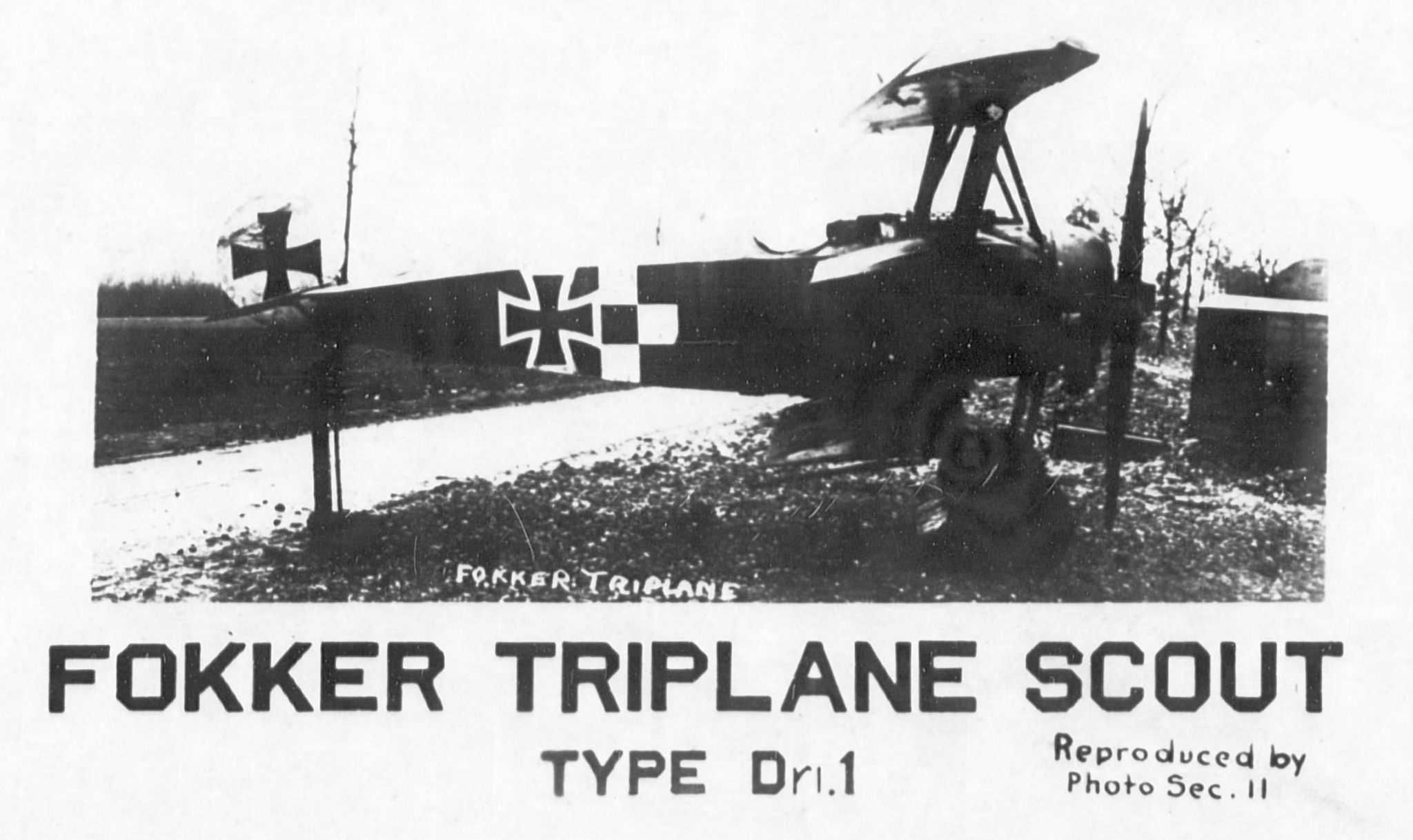
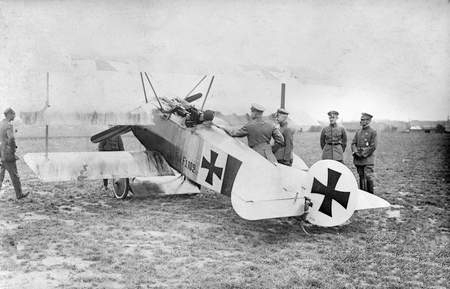
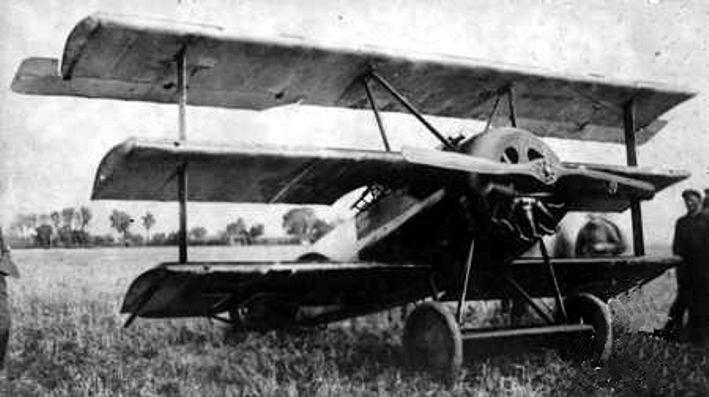
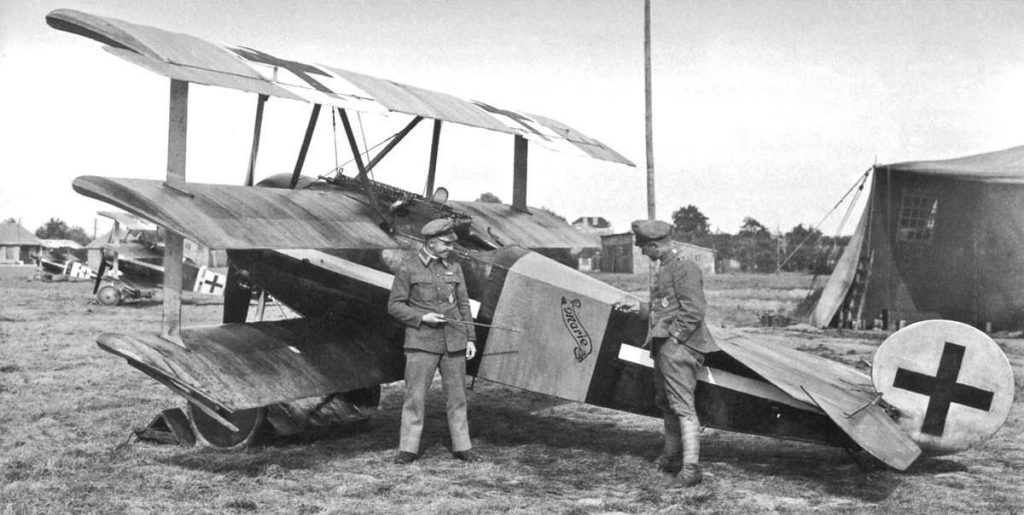
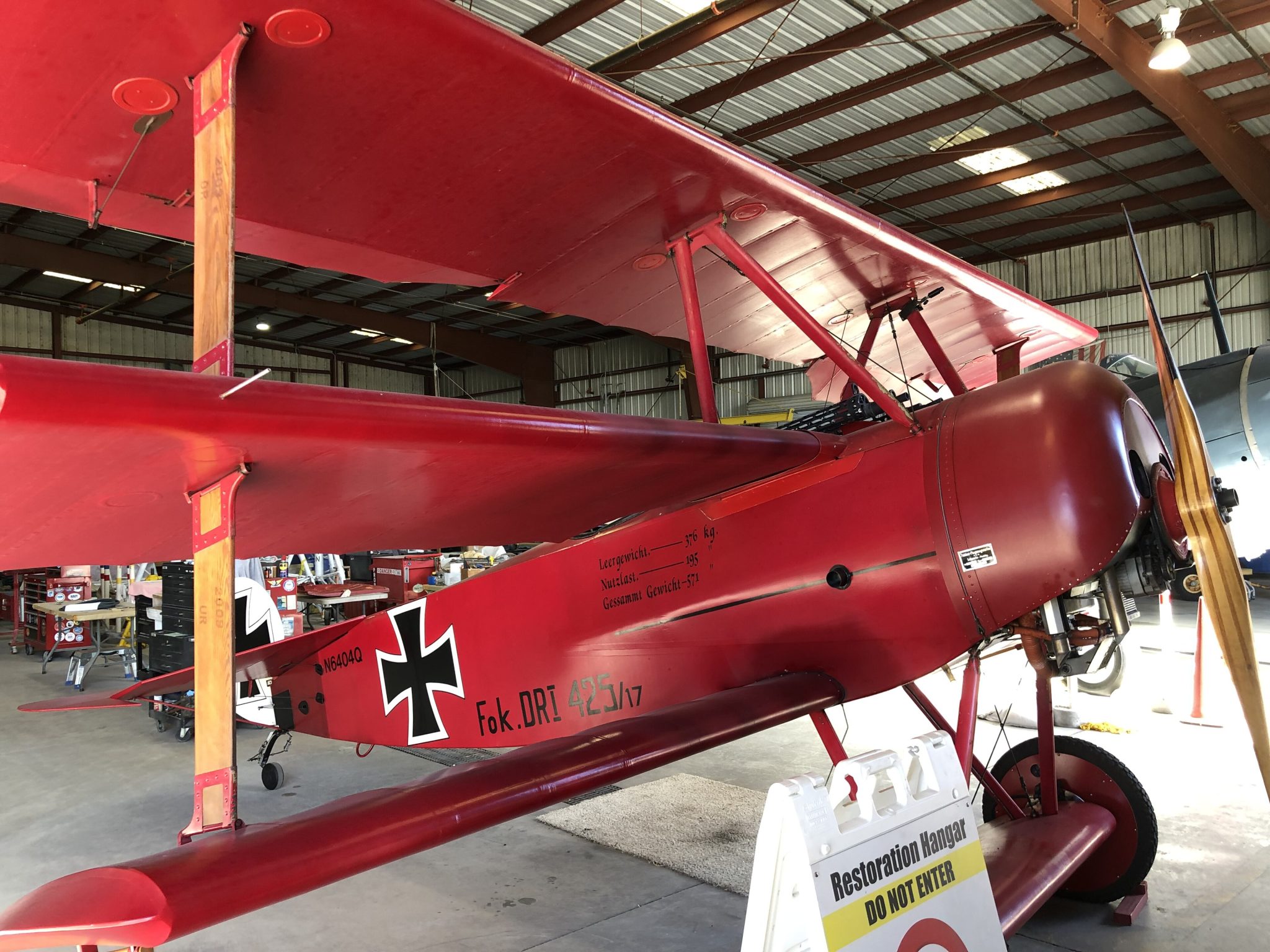
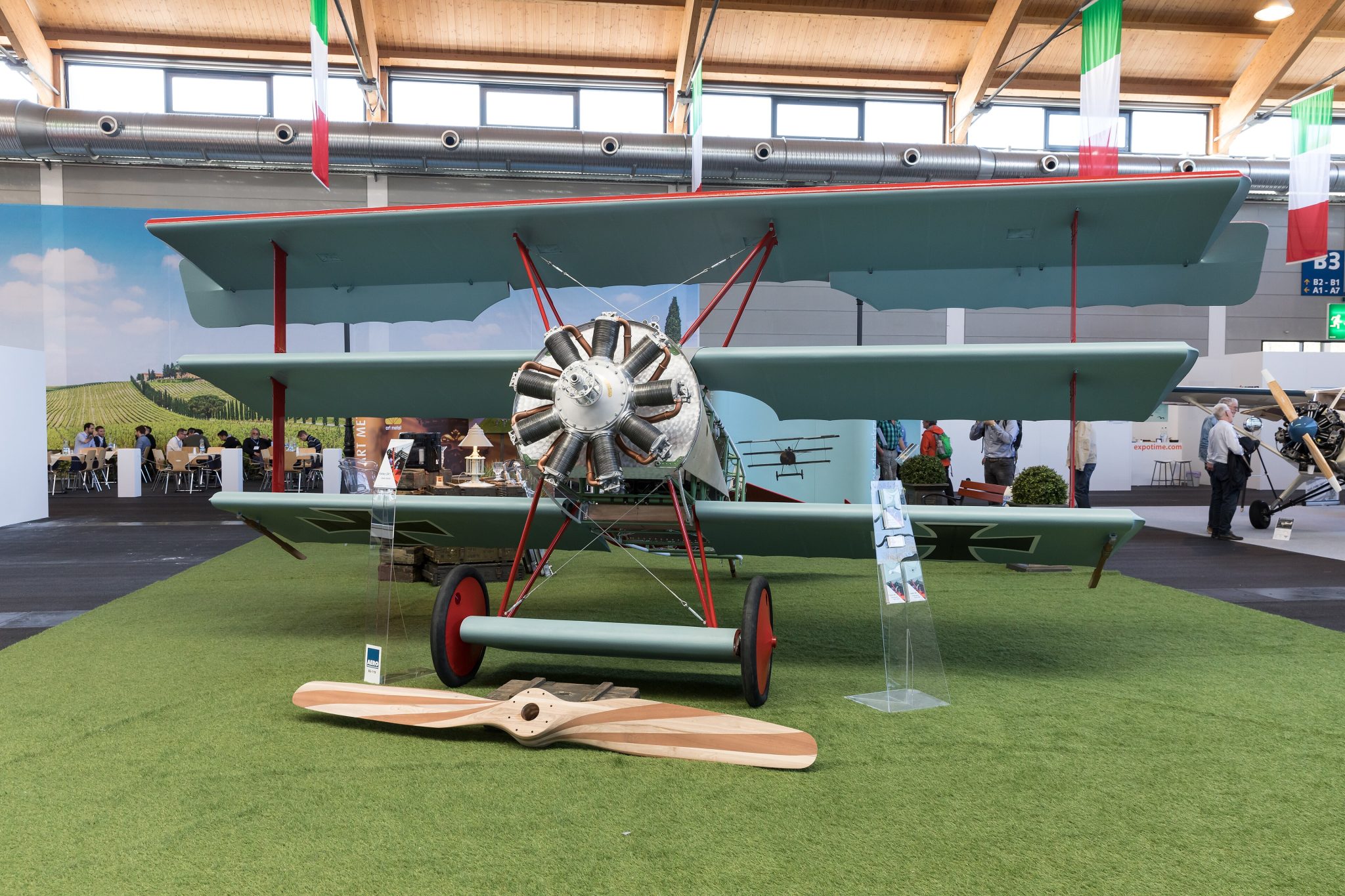
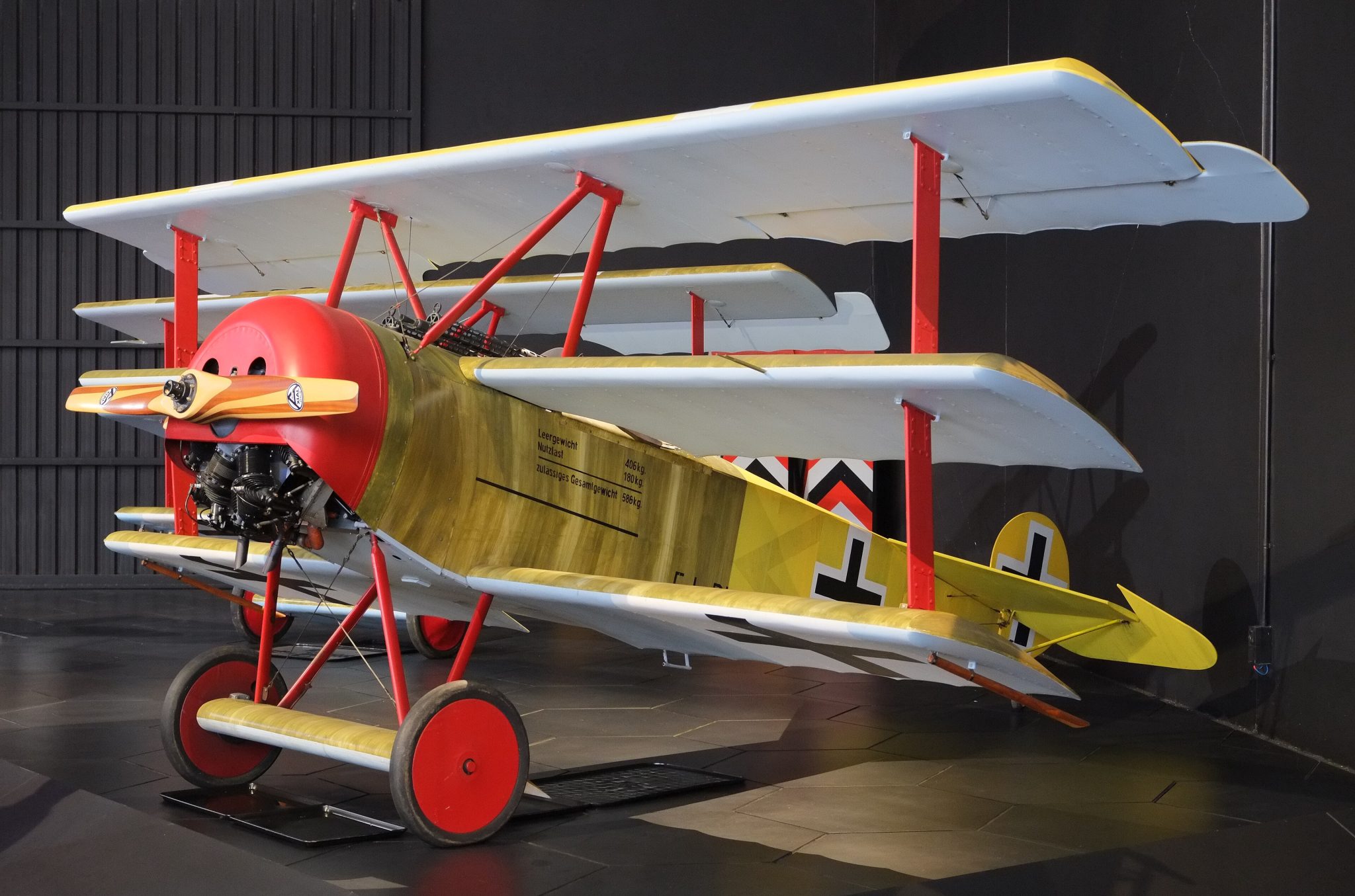
The Fokker Dr.I in the air: an airworthy triplane replica flies
Historical Aviation Film Unit · “The Red Baron’s Fokker Dr.1 Triplane” — a widely-viewed film from a respected vintage-aviation channel showing an airworthy Fokker Dr.I replica start up and fly.
Where the Fokker Dr.I flew: origin, combat use and surviving replicas
The Fokker Dr.I in combat: a short, storied front-line career
The Fokker Dr.I fought on the Western Front from late 1917 into 1918 in the hands of Germany’s best fighter pilots. It was never a war-winning weapon — it was slow, few were built, and its front-line career was short — but in expert hands it was a deadly close-in dogfighter, and it is forever tied to Werner Voss’s last stand and to Manfred von Richthofen, the top-scoring ace of the war. Victory and loss figures for individual aircraft and units vary between sources and should be treated as estimates.
Compare the Explore the combat record of every military aircraft. Data as of July 2026.
Fokker Dr.I Triplane: frequently asked questions
Can I fly in a Fokker Dr.I Triplane?
What is the Fokker Dr.I Triplane?
Why did the Fokker Dr.I have three wings?
Who flew the Fokker Dr.I?
How did the Red Baron die?
Why was the Fokker Dr.I grounded in 1917?
How many Fokker Dr.I were built?
Are there any original Fokker Dr.I aircraft left?
What engine did the Fokker Dr.I use?
You can’t fly the Fokker Dr.I.
These, you can.
Some legends only live in museums — others are fuelled and waiting. MiGFlug has put civilians in real military jet cockpits since 2004.
 Fly the L-39 AlbatrosThe world’s most-flown jet trainer — aerobatics included
 Fly the F-104 Starfighter“The missile with a man in it”
 Fly the MiG-21The Cold War’s most-produced jet
 Fly the T-33 Shooting StarAmerica’s first jet trainer
 Fly the DH VampireA piece of early jet history
 Fly the S.211Agile Italian jet trainer
 Fly the MB-326The classic Aermacchi jet
 Fly the MiG-15The Soviet legend of the Korean War
More from the Military Aircraft Encyclopedia
Fokker Dr.I: sources & further reading
- Military Aviation MuseumMilitary Aviation Museum — Fokker Dr.I history, design and the aces who flew it.
- The Museum of FlightThe Museum of Flight — Fokker Dr.I reproduction: specifications and background.
- Smithsonian National Air and Space MuseumSmithsonian National Air and Space Museum — context on First World War fighters and aces.
- Imperial War MuseumsImperial War Museums — the air war of 1914–18 and Manfred von Richthofen.
- Royal Air Force MuseumRoyal Air Force Museum — the aircraft and combats of the Western Front.
- National WWI Museum and MemorialNational WWI Museum and Memorial — aviation of the First World War.
- Deutsches Museum, MunichDeutsches Museum, Munich — holdings and history of early German aviation.
- MiGFlug AfterburnerMiGFlug Afterburner — the magazine behind this encyclopedia, on military aviation and flying legendary aircraft.
Hero and gallery photography: U.S. Air Force / NASA, public domain. Combat statistics as of July 2026. Spotted an error? Every page in the Aircraft Museum is fact-checked before publication — write to us and we'll correct it.