
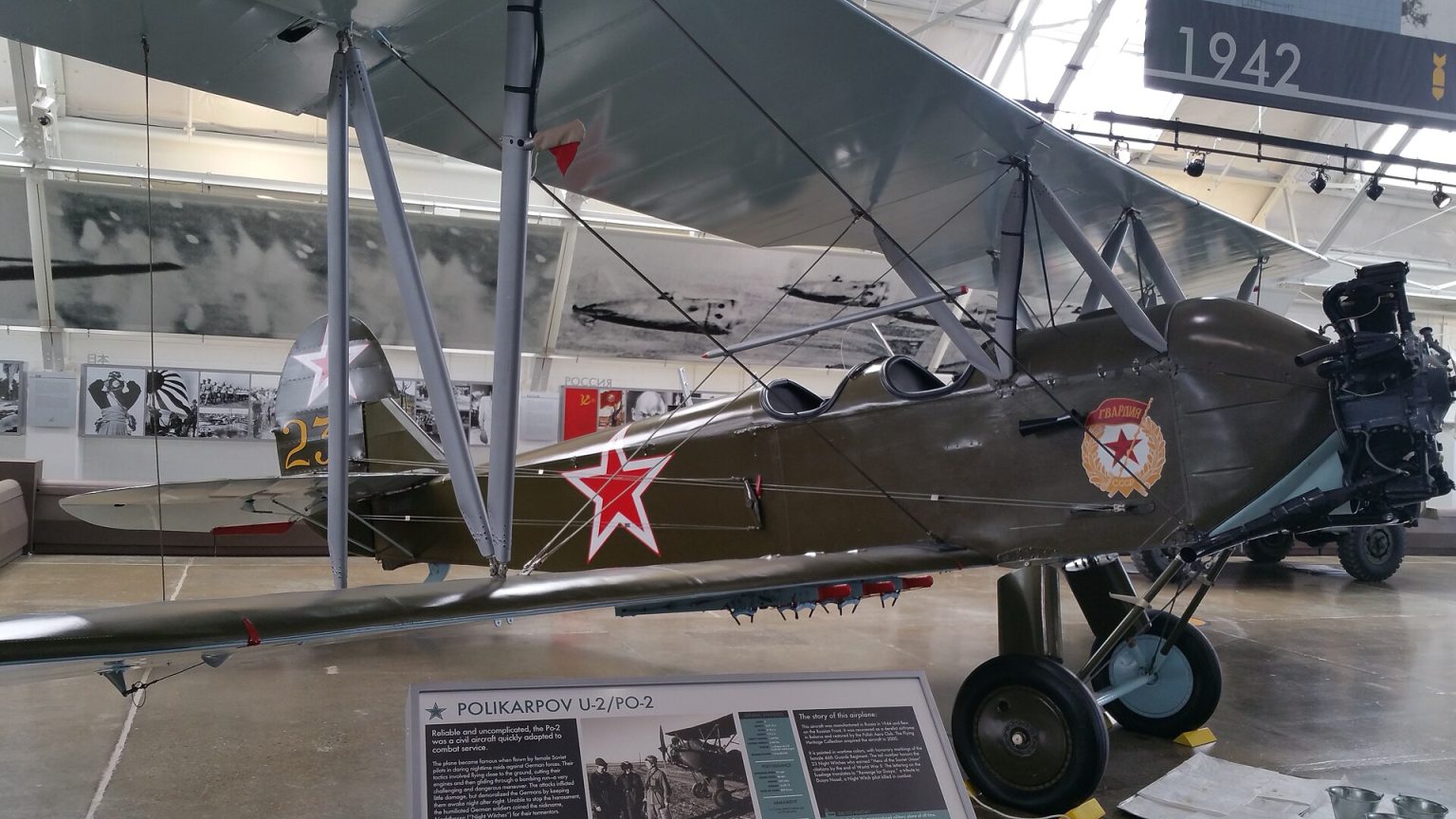
Polikarpov Po-2
“Kukuruznik”
A cheap wood-and-fabric trainer of 1928 that became one of the most-produced aircraft in history — and, flown by the all-female “Night Witches,” a night bomber so slow that fast fighters could barely catch it.
The little biplane that outlived almost everything
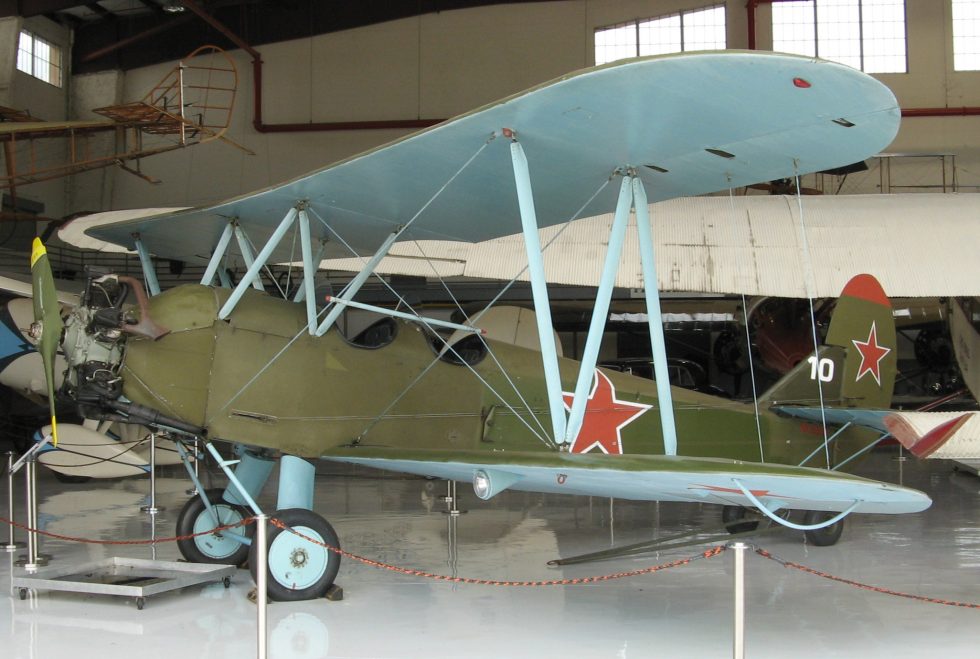
In 1927–1928 the Soviet designer Nikolai Polikarpov set out to build the simplest useful aeroplane he could: a primary trainer to replace the ageing British Avro 504 then teaching Soviet pilots to fly. The result, first designated the U-2, was a small single-engine biplane of wire-braced wood covered in doped fabric, powered by a modest five-cylinder Shvetsov M-11 radial. It was cheap, forgiving, almost impossible to spin unintentionally, and it could take off and land on rough grass. The refined production aircraft flew on 7 January 1928.
That humility was its genius. The same qualities that made it a good trainer made it a superb workhorse: it dusted and sprayed crops across the USSR in such numbers that it earned the affectionate nickname “Kukuruznik” — roughly “corn-duster.” It flew as an air ambulance, a liaison hack, an artillery spotter and a light transport. Built almost continuously from 1928 into the late 1950s — in the USSR and, under licence, in Poland as the CSS-13 — it became, by most counts, the most-produced biplane in history, with totals commonly cited between about 20,000 and 40,000.
Then came the war that made it famous. From 1941 the little biplane was pressed into service as a night harassment bomber, and one unit turned it into legend: the all-female 588th Night Bomber Aviation Regiment, later the 46th Guards. German troops called its crews the “Nachthexen” — the Night Witches. Flying at night, they would throttle back or idle the engine and glide toward their targets in near silence, releasing a couple of small bombs before opening up and slipping away. The biplane’s very slowness was its shield: a modern fighter that slowed enough to aim at it risked stalling out of the sky.
The Po-2 refused to retire. In the Korean War, North Korean examples flew low, slow night raids on United Nations airfields that the exhausted defenders nicknamed “Bedcheck Charlie.” Ironically, the jet age struggled to swat a 1920s biplane: interceptors built for supersonic combat could barely fly slowly enough to engage it. Long after its contemporaries were scrapped, the Kukuruznik was still puttering across fields and front lines — and a handful of restored examples fly to this day.
01The Polikarpov Po-2’s Night Witches: how a wood-and-fabric trainer became a feared night bomber
The idea of women’s combat aviation regiments came from Marina Raskova, a celebrated Soviet navigator who used her fame — and reported access to Stalin — to win approval on 8 October 1941. She raised three regiments and trained them at Engels, near Saratov. One of them, the 588th Night Bomber Regiment, flew the Po-2 and remained entirely female throughout the war. It flew its first combat missions in June 1942 and, redesignated the 46th Guards “Taman” Regiment in early 1943, went on to fly more than 24,000 combat sorties.
Crews often flew eight to eighteen short sorties a night, each lasting well under an hour, carrying only a light bomb load and frequently no parachutes because of weight and their low altitude. Raskova herself did not survive the war — she was killed on 4 January 1943 crash-landing a Pe-2 — and received the first state funeral of the war. About two dozen women of the regiment became Heroes of the Soviet Union, the most of any Soviet women’s unit. The name “Night Witches” and the glide-and-bomb tactic are historically documented; some individual per-night tallies are best treated as commonly repeated figures rather than exact records.
What makes it special
A biplane anyone could fly, build and fix
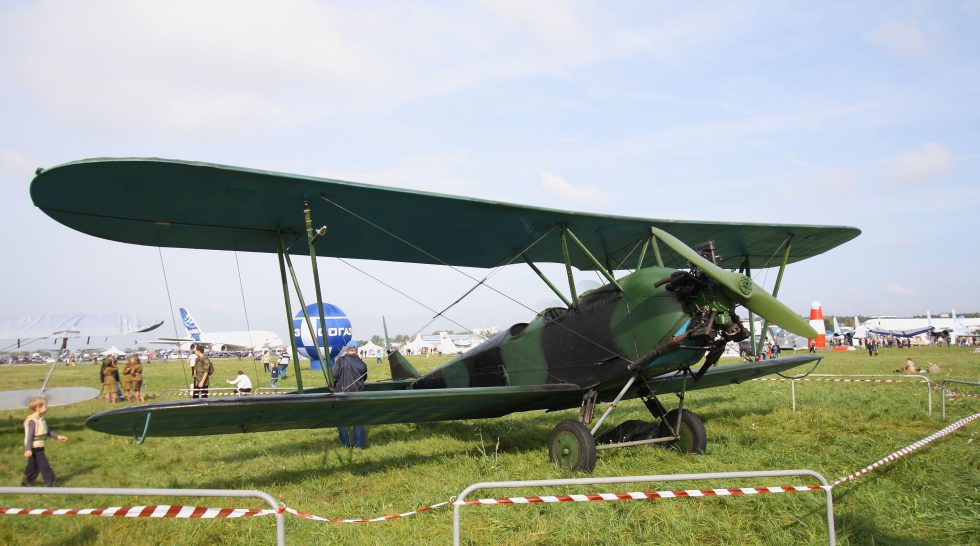
The Po-2 was deliberately simple: a wire-braced wood-and-fabric airframe a field mechanic could patch, and a five-cylinder air-cooled Shvetsov M-11 radial of roughly 100–125 hp with no liquid cooling to freeze or leak. It was docile and hard to spin, could operate from rough grass strips, and was cheap to build in vast numbers. Those humble traits made it an ideal trainer — and, later, a remarkably survivable frontline aircraft.
Too slow to catch
With a top speed of only about 150 km/h and a very low stall speed, the Po-2 was a nightmare target at night. Crews would idle or cut the engine and glide silently onto a target, then throttle up to escape. A fast fighter such as a Bf 109 that slowed enough to aim risked stalling itself. Its wood-and-fabric structure also gave a small radar and heat signature — a real advantage, though the popular idea that it was “invisible” overstates it.
The most-produced biplane in history
Estimates of total production range from about 20,000 to 40,000, commonly rounded to around 30,000 — more than any other biplane ever built. It was manufactured in the USSR from the late 1920s into the early 1950s and in Poland as the CSS-13 into the late 1950s, giving the design a production life of roughly three decades and a service life longer still.
02The Polikarpov Po-2 in combat: why fast fighters struggled to shoot it down
Intercepting a Po-2 at night was genuinely dangerous for the interceptor. Modern monoplane fighters had high stall speeds; to line up a firing pass on a biplane crawling along near 100–150 km/h, a fighter had to slow so much that it risked stalling and departing controlled flight, especially at low altitude in the dark. The Po-2 could also turn tightly and fly low among terrain where fast aircraft dared not follow. The frequently repeated claim that it flew “below a Messerschmitt’s stall speed” is a simplification, but it captures a real tactical problem that recurred from the Eastern Front in WWII to the jet-age skies over Korea.
03The Polikarpov Po-2’s production run: the most-built biplane ever
Exact totals are uncertain because production spanned decades, multiple factories and several designations (U-2, Po-2 and the Polish CSS-13). Figures in the literature range from roughly 20,000 to as many as 40,000, with about 30,000 the most commonly cited round number. Whatever the precise figure, aviation references consistently describe the Po-2 as the most-produced biplane in history and one of the most-produced aircraft of any kind. Polish licence production of the CSS-13 alone (around 560 aircraft, 1949–1956) extended the type’s manufacturing life into the late 1950s.
Full specifications
Baseline note: the figures below describe the standard two-seat U-2/Po-2 trainer and utility machine with the 125 hp Shvetsov M-11D, the configuration behind the overwhelming majority of the tens of thousands built and the one every wartime photograph shows. Deltas for the early 100 hp M-11 aircraft, the U-2VS and U-2LNB night bombers, the U-2ShS staff transport, the agricultural U-2AP, the ambulance and floatplane conversions and the Polish CSS-13 are given in grey. Two figures in general circulation need correcting before the table starts. First, the date. The Po-2 is universally called a 1927 design, and in one sense it is: the first U-2 prototype flew on 24 June 1927. But that aeroplane — built around a thick, straight-edged aerofoil chosen for no aerodynamic reason at all, only because it let every rib in the wing be identical — flew so poorly that it was rejected. The machine that entered production and stayed there for a quarter of a century was the rewinged second prototype, first flown on 7 January 1928. Both dates are correct; they describe different aeroplanes. Second, the production total. The commonly quoted band is 20,000 to 33,000, older English-language sources go past 40,000, and the brief for this page said 20,000 to 30,000. The honest answer is that nobody knows. Soviet factories built U-2s and Po-2s from 1929 to 1953, and repair workshops went on rebuilding wrecks and assembling fresh airframes from spare parts until about 1959, a process that produced aeroplanes without always producing paperwork. Only the Il-2 and a handful of American types are in the same class, and the Po-2 may well lead all of them.
Dimensions & weights
- Crew
- 2 — instructor and pupil in tandem open cockpits with full dual controls. Night bomber crews were pilot and navigator/bomb-aimer; the U-2ShS staff aircraft carried a pilot and three or four passengers in an enclosed cabin; the ambulance versions took one or two stretcher cases
- Length
- 8.17 m (26 ft 10 in)
- Wingspan, upper
- 11.40 m (37 ft 5 in)
- Wingspan, lower
- 10.65 m (34 ft 11 in) — single-bay, unequal span, with the bracing laid out as plainly as it could be drawn. Constant chord, straight edges, identical ribs: the wing was shaped by the cost accountant as much as by the aerodynamicist
- Height
- 3.10 m (10 ft 2 in)
- Wing area
- 33.2 m² (357 sq ft) — an enormous cellule for an aeroplane of this weight, and the single number that explains everything the Po-2 could do
- Empty weight
- 770 kg (1,698 lb); the early M-11 trainers came out nearer 740 kg, the U-2ShS and armed night bombers considerably heavier
- Loaded weight
- 1,030 kg (2,271 lb) at normal trainer loading
- Max take-off weight
- 1,350 kg (2,976 lb) — a night bomber with full racks, and a weight at which the aeroplane climbed like a tired pigeon
- Wing loading
- 31 kg/m² (6.4 lb/sq ft) at normal loaded weight, rising to 41 kg/m² (8.4 lb/sq ft) at maximum. Tables that quote only the higher figure are using the overload weight without saying so. For scale: a Bf 109E sat near 160 kg/m² and a Piper Cub near 33. The Po-2 is lighter on its wing than a Cub
- Power loading
- 8.2 kg/hp (18.1 lb/hp) at normal weight — poor by any standard. The Po-2 was never fast and was never meant to be
- Fuel capacity
- ~125 litres (33 US gal) in a gravity tank in the upper-wing centre section; no fuel pump, no self-sealing, no protection of any kind. Long-range and ferry aircraft carried additional tankage in the rear cockpit
Performance
- Maximum speed
- 152 km/h (94 mph, 82 kn) at sea level, clean, M-11D. Night bombers with racks, gun ring and blast tubes fitted managed perhaps 130–140 km/h, and crews rarely saw even that with a load on
- Cruising speed
- 110 km/h (68 mph, 59 kn) — slower than the wind speed of a strong gale, and slower than the stalling speed of most 1943 fighters
- Stalling speed
- about 60 km/h (37 mph) — and it stalled straight ahead, with the nose dropping and the wings level
- Time to 1,000 m
- 6 min at normal loaded weight, in the period practice of quoting climb as time to height rather than a rate
- Time to 2,000 m
- 15 min — the climb decays sharply with altitude; a loaded night bomber took well over twenty minutes to reach its bombing height
- Initial rate of climb
- 2.8 m/s (551 ft/min), quoted here only for comparison with modern tables
- Service ceiling
- 3,000 m (9,800 ft); a light, empty aircraft would go higher and some sources quote 4,000 m, but that is a stripped trainer on a cold day, not an operational figure
- Endurance
- about 3 h 45 min at economical cruise — the meaningful number for a type used for training circuits, artillery spotting and multiple short night sorties. Night bombing sorties typically lasted 30 to 50 minutes from take-off to landing
- Range
- 630 km (390 mi, 340 nmi) on internal fuel with no load; ~400 km is the realistic figure with a bomb load or three people aboard
- Take-off run
- 70–100 m at trainer weight, into any wind at all. Sources give figures across that band, and the disagreement is genuine: on an aeroplane whose flying speed is close to a stiff breeze, the wind matters more than the aeroplane
- Landing run
- 100–120 m — and it could be put into a field, a road, a forest clearing or a village street, which it routinely was
- Sortie rate, night bombing
- 8–12 per crew per night was normal practice in the night bomber regiments; the 46th Guards recorded 18 sorties in a single night by Yekaterina Ryabova and Nadezhda Popova. The aeroplane could not carry much, so it went back again
Propulsion & systems
- Engine
- 1 × Shvetsov M-11D, five-cylinder air-cooled radial, direct drive — a Soviet-designed engine of 1923–25, the first indigenous aero engine to reach large-scale production. Early aircraft had the 100 hp M-11; agricultural machines used the M-11K; the postwar M-11FR gave 160 hp at take-off and provision for a variable-pitch propeller
- Displacement
- 8.6 litres (525 cu in); bore 125 mm (4.92 in), stroke 140 mm (5.51 in); compression ratio 5:1
- Output
- 93 kW (125 hp) at take-off on the M-11D. Five cylinders, one carburettor, no supercharger, no reduction gear, no constant-speed unit. There is almost nothing on this engine that can go wrong that a mechanic with hand tools cannot put right
- Engine dry weight
- 165 kg (364 lb) — more than a fifth of the aeroplane’s empty weight, which is what a low-compression cast-iron-barrelled radial of the 1920s costs you
- Overhaul life
- 50 hours on the earliest M-11s, extended substantially on the D and FR. That original figure is the reason the aircraft was designed to be repaired rather than maintained. Total M-11 family production ran past 100,000 engines between 1923 and 1952
- Propeller
- Two-blade fixed-pitch wooden airscrew — laminated birch, hand-carved in the early years, and replaceable in the field by a unit that had a spare and a spanner
- Starting
- By hand, swinging the propeller — no electric starter and no battery on the basic trainer. In the night bomber regiments the armourers who loaded the bombs also swung the props, in the dark, between eight and twelve times a night
- Airframe structure
- Pine and plywood, fabric-covered, with mild-steel fittings — effectively no light alloy of consequence. Timber and glue were available in the Soviet Union in 1941 in a way that duralumin was not, and a village carpenter could repair a Po-2 wing
- Undercarriage
- Fixed split-axle main gear on rubber-cord shock absorbers, with a tailskid — interchangeable with skis for winter operations, and with twin floats on the U-2M and Po-2P. The skis were standard equipment, not a modification
- Systems
- None worth the name on the basic aircraft — no hydraulics, no electrical system, no flaps, no brakes on early machines, no radio, no blind-flying panel. Specialised versions added what they had to: the U-2NAK artillery spotter carried an RSI radio, the night bombers navigation lights and a compass, the U-2ShS a cabin heater
- Handling
- Deliberately, famously docile — the type was reputed to be almost impossible to spin, and would recover from a mishandled stall largely on its own if the pupil simply let go. That is not folklore but the design brief being met: the Soviet Union needed to convert peasant conscripts into pilots at scale, quickly, with instructors who were themselves barely trained
04The Polikarpov Po-2’s operating costs: why no reliable price exists
The Po-2 was a Soviet state product built across three decades, never sold on an open dollar market, so there is no meaningful flyaway unit price or cost-per-flight-hour figure in the public record. What is clear is the design philosophy: it was engineered to be as cheap and easy to build, maintain and repair as possible — wood, fabric and a simple air-cooled radial, assembled in the tens of thousands. Any precise modern cost you see attached to a Po-2 relates to restoring or operating a rare surviving warbird, not to the original mass-produced aircraft.
Armament & payload
The Po-2 was a primary trainer with bomb racks bolted under the lower wing, and that is precisely why it worked as a night bomber
Nothing about the U-2 was designed for combat. It was drawn in 1926–27 against a requirement for the simplest, cheapest, most forgiving primary trainer the Soviet air force could imagine, to replace the licence-built Avro 504K then teaching everybody to fly. Polikarpov delivered exactly that, and the armament story of the type is the story of what a determined air force can hang on a trainer when it has nothing else and a war to fight.
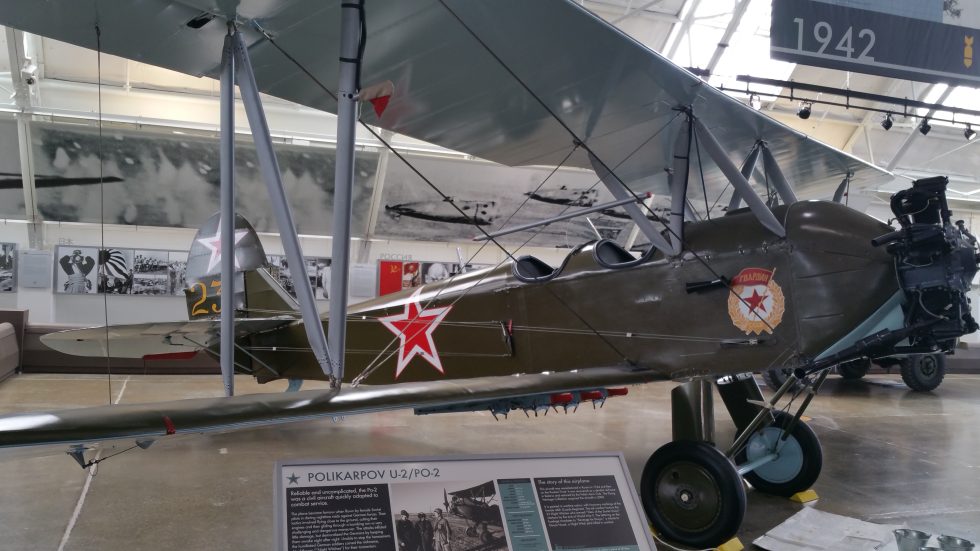
The first improvised bomb racks appeared in 1941, during the defence of Odessa. By 1942 the fit was standardised as the U-2VS and U-2LNB: light racks under the lower wing for 50 kg and 100 kg bombs up to about 300–350 kg total, and a single ShKAS or DA machine gun on a ring in the rear cockpit. There was no bomb sight worth the name, no armour, no self-sealing tanks and no protection whatsoever. The aiming method was to throttle back, glide, look over the side and pull the release when the target looked right.
It should not have worked, and it worked extremely well. The Po-2 flew at 100 metres over the front line at 110 km/h, below the speed at which a Bf 109 or Fw 190 could hold formation with it, invisible to the crude airborne radar of the day because it was made of wood and cloth, and impossible to hear coming once the engine was throttled back. Each aeroplane carried almost nothing; each crew flew eight, ten, twelve sorties a night, from a strip fifteen kilometres behind the line, all night, every night. The cumulative effect on German troops was not primarily destruction but exhaustion — and the Luftwaffe paid the type the sincerest possible compliment by forming its own Nachtschlachtgruppen around obsolete Go 145, Ar 66 and He 46 biplanes to do the same thing back. Fits varied enormously by unit, year and improvisation. Rack types, gun types and even whether a gun was carried at all differed between regiments and often between aircraft on the same strip; treat any single armament list, this one included, as one configuration among many.
Gun
- 1 × 7.62 mm ShKAS machine gun on a flexible ring or pintle in the rear cockpit, firing aft and upward — the standard fit on the U-2VS, U-2LNB and U-2LSh from 1942
- Some aircraft carried the older 7.62 mm DA (Degtyaryov Aviatsionny) instead, a drum-fed weapon of the late 1920s; availability rather than preference decided which
- The ShKAS is genuinely remarkable in itself — roughly 1,800 rounds per minute, the fastest rifle-calibre aircraft gun of its generation — and completely irrelevant to what this aeroplane was doing. A 1943 night fighter that got into firing position was not going to be driven off by a rifle-calibre gun
- Very many night bomber aircraft flew with the mount empty, or with no mount at all, because thirty kilogrammes of gun and ammunition was another 50 kg bomb, and the crews knew which was more use
- The basic trainer, the agricultural, ambulance, liaison, survey and postwar civil versions carried no gun of any kind, which is the overwhelming majority of all Po-2s ever built
Ammunition, mounting and sights
- Belt-fed for the ShKAS, drum-fed for the DA; the ammunition supply was whatever fitted in the rear cockpit alongside the navigator, his map, his torch and his flare pistol
- Ring-and-bead sighting on the flexible mount. No reflector sight, no gyro computing sight, and no realistic expectation of hitting anything
- No bomb sight on the standard night bomber. Aiming was visual, over the side, from a shallow glide, using the target’s own fires and any flares dropped by the leading aircraft
- The U-2NAK night artillery observation version of 1943 was the exception: it carried an RSI radio set, illumination flares and a proper observer’s position, and its job was to make somebody else’s guns accurate rather than its own bombs
- Accuracy was, by any 1944 standard, dreadful. It did not matter much: the targets were troop concentrations, supply dumps, horse lines, road columns and sleeping men, and a 50 kg bomb landing somewhere in a bivouac area at three in the morning achieves most of its purpose before it detonates
Synchronisation gear — and why there is none
- The Po-2 had no forward-firing gun and therefore no synchronisation gear, no interrupter mechanism and no Constantinesco-type hydraulic gear. It is the one signature piece of 1920s combat-aircraft engineering that this 1920s aeroplane never needed
- That is a design decision, not an oversight. The U-2 was specified as a primary trainer; the armed fighter-training role went to other types, and Polikarpov was simultaneously drawing the I-3 and I-5 fighters, which did carry synchronised guns
- The consequence for the night bombing role was total: the Po-2 could not strafe, could not make a firing pass, and had no offensive weapon that could be aimed by pointing the aeroplane. Everything it delivered came off a rack and fell
- The one attempt to change this was the U-2LSh ground-attack conversion, which added forward-firing armament and RS-82 rockets for daylight strafing. It was built in small numbers and went nowhere, for the obvious reason: a 150 km/h wood-and-fabric biplane over a defended battlefield in daylight is a target, not an attacker
- The absence of a fixed gun is also why the type survived. An aeroplane that has to point itself at the enemy has to be seen; an aeroplane that only drops things can stay in the dark
Bombs and underwing racks
- Light racks beneath the lower wing, typically four to six stations, taking FAB-50 (50 kg) and FAB-100 (100 kg) general-purpose bombs
- Nominal maximum load around 300 kg, with up to ~350 kg quoted for the U-2VS and often cited for the 46th Guards. Six FAB-50s is the commonly quoted operational fit; two FAB-100s was equally normal
- AO-type fragmentation bombs, incendiaries and small-bomb containers were all used; the 46th Guards Night Bomber Regiment alone is credited with dropping over 3,000 tonnes of bombs and roughly 26,000 incendiary devices across 23,672 sorties
- Release was mechanical, by cable, from a lever in the cockpit. Hung bombs were dealt with by manoeuvring the aeroplane, which on a Po-2 usually worked
- The load is trivial — one Lancaster carried more than twenty Po-2 sorties’ worth. The Po-2’s contribution was never tonnage; it was that the tonnage arrived in fifty-kilogramme instalments, all night, on men trying to sleep
Rockets, containers and mission loads
- RS-82 unguided rockets on the U-2LSh ground-attack conversion — the only rocket armament the type carried, and only in small numbers
- VAP-type chemical spray containers and, on the agricultural U-2AP, a hopper of about 250 kg with distribution gear beneath the fuselage for dusting and spraying. 1,235 U-2APs were built between 1930 and 1940, and agricultural work outlasted every combat role
- Stretcher panniers: the U-2S and Po-2S ambulances carried casualties in an enclosed rear cab, and the Po-2S-3 (Po-2SKF) carried two of them in streamlined containers slung under the lower wing — a stretcher case in a plywood coffin-shaped pod on each side, which worked and which nobody enjoyed
- Loudspeaker installation on the Po-2GN, the "voice from the sky", used for propaganda broadcasts over German lines and, in the rear areas, over villages
- Cameras on the U-2SP survey aircraft and the U-2NAK; supply containers, mail, spare parts, medical stores and, repeatedly and unofficially, whatever a unit needed moved and had no other way to move
What the Po-2 never carried
- No armour. A handful of aircraft received belly plating — the Germans nicknamed those "Eiserner Gustav", Iron Gustav — but the standard machine had none, and its structure was pine, plywood, fabric and dope. German troops called it the "Kerosinka", the paraffin lamp, for what happened when tracer found it
- No self-sealing fuel tank, no fire suppression, no protected fuel lines. A gravity tank in the upper wing sits directly above the crew
- No parachutes, in the 46th Guards, until 1944 — the weight was traded for bombs, and the bombing altitude was in any case too low for a parachute to open. That was a decision made by the crews and their commander, and it killed people
- No radar, no radio navigation, no blind-flying instruments on the standard machine, no oxygen, no de-icing, no heating. Navigation at night was by compass, watch, map and the shape of a river
- No defence against a night fighter that found it. When Josef Kociok of NJG 200 caught the 46th Guards on the night of 31 July–1 August 1943, he shot down four aircraft in a single sortie and eight women died. The Po-2’s survival depended entirely on not being found
Three typical loadouts
- Night harassment, 46th Guards, Kuban and Taman, 1943
- 4 × FAB-50 or 2 × FAB-100 on the underwing racks; gun frequently left off to save weight; no parachutes; take-off from a field strip 10–15 km behind the line at dusk, bombing height 400–800 m, sortie length 30–50 minutes, eight to twelve sorties per crew before dawn. Aircraft worked in threes: two drew the searchlights and the flak while the third throttled back and glided in on the aiming point in silence.
- Night artillery observation and liaison, U-2NAK, 1943–45
- RSI radio set, illumination flares and SAB parachute flares, a hand-held or fixed camera, 2 × FAB-50 for targets of opportunity, one ShKAS aft. The aeroplane loitered over the German rear at low level, found batteries and columns by their own lights and muzzle flashes, and talked Soviet artillery onto them. Unglamorous, and worth more in aggregate than the bombs.
- Utility, ambulance and agricultural, 1930s and postwar
- No armament of any kind. Either two stretcher cases in an enclosed cab or underwing panniers with a medical attendant; or a ~250 kg chemical hopper and spraybars for crop dusting; or three passengers, mail and freight into a strip that was a mown field with a windsock. This is what most Po-2s did for most of their lives, and it is the reason the type outlived every aircraft it flew alongside.
Sourcing caveat: Soviet-era unit records, postwar Soviet histories and Western secondary accounts do not always agree on Po-2 bomb loads, and the difference between a nominal rack capacity, a certified maximum and what a regiment actually hung on the aeroplane on a given night is real and rarely stated. Figures for the 46th Guards Night Bomber Regiment given here (23,672 sorties, 28,676 flying hours, over 3,000 tonnes of bombs, 261 women served, 32 killed, 28 aircraft lost) are the regiment’s own returns as reproduced in the standard accounts; they have not been independently audited against German loss records and should be read as the unit’s claim rather than as verified fact.
Variants
Polikarpov drew one aeroplane and the Soviet Union turned it into about thirty, from crop duster to night bomber to flying loudspeaker
The U-2 was renamed Po-2 in 1944, after Nikolai Polikarpov’s death on 30 July of that year — an honour granted to a designer whose fighters had mostly been overtaken, and whose trainer outlived them all. What follows is a selection; the full list of designations runs past thirty, and Soviet repair workshops produced local variations that were never designated at all.
The type’s second life was in Korea. The Korean People’s Air Force flew Po-2s on night nuisance sorties that UN forces christened "Bedcheck Charlie", and the results were entirely out of proportion to the aeroplane. On the night of 17 June 1951 two Po-2s bombed Suwon air base at 01:30; an F-86A Sabre, 49-1334, was hit on the wing and burned out, and eight more Sabres were damaged, four of them seriously. The North Koreans credited Lieutenant La Woon Yung. Raids on other UN fields destroyed and damaged Mustangs on the ground. The counter-measures were awkward: jets could not slow down enough to shoot at a wood-and-fabric biplane, and at least one F-94 Starfire was lost after decelerating to around 110 mph in pursuit and departing controlled flight. The US answer was to bring back piston-engined night fighters, and Lieutenant Guy Bordelon of VC-3, flying an F4U-5N Corsair, became the US Navy’s only ace of the Korean War hunting these raiders. On 16 June 1953 a Marine AD-4 of VMC-1, flown by Major George H. Linnemeier with CWO Vernon S. Kramer, shot down a Po-2 — the only documented air-to-air victory ever scored by a Skyraider.
Licence production mattered too. Poland built the CSS-13 at WSK Okecie and elsewhere — about 500 aircraft between 1948 and 1956 — plus the CSS S-13 ambulance version, of which 53 were built new in 1954–55 and 38 more converted from existing airframes. Polish CSS-13s served as primary trainers, glider tugs, agricultural aircraft and aeroclub hacks well into the 1960s, and a disproportionate share of the Po-2s flying today are in fact Polish-built.
- U-2 (1928–41, the great majority of prewar output)
- The basic two-seat primary trainer with the 100 hp M-11, later the 115–125 hp M-11K and M-11D. Over 13,000 had been completed by the German invasion in June 1941.
- U-2AP / U-2A (1,235 built 1930–40)
- Agricultural aircraft with a chemical hopper of about 250 kg and distribution gear; the M-11K-engined U-2A was the developed version. Crop dusting was a serious Soviet requirement and the Po-2 met it for four decades.
- U-2S / Po-2S series (from 1934, built throughout and after the war)
- Air ambulance. Enclosed rear cab for one or two stretcher cases in the S-1 and S-2; the S-3 or Po-2SKF carried two casualties in underwing containers instead. Soviet military medicine relied on it heavily. The parallel civil line was the U-2SP light transport, 861 of which were built in 1934–39 with two extra open cockpits, and the enclosed U-2SPL limousine.
- U-2VS and U-2LNB (from 1942, very large numbers)
- The night bomber. Underwing racks for 50 and 100 kg bombs to 300–350 kg total, ShKAS or DA machine gun aft, flame-damped exhaust on some aircraft. Redesignated Po-2VS after 1944. This is the aeroplane the Night Witches flew.
- U-2NAK (from 1943)
- Night artillery observation and correction, with an RSI radio, flares and a proper observer’s station. Arguably the type’s most militarily valuable specialised role, and the least remembered.
- U-2ShS / Po-2ShS (from 1943)
- Staff and communications transport with a widened fuselage and an enclosed cabin for three or four passengers. Slower and heavier, and the aircraft in which a great many Soviet senior officers were moved about the front.
- U-2M / Po-2P (limited production)
- Twin-float seaplane versions for training and utility work on rivers and lakes. Related is the RV-23 of 1937, a heavily modified floatplane with a 710 hp Wright R-1820-F3 built purely for altitude records — the Po-2 airframe pushed as far from its origins as it ever went.
- Po-2GN (wartime and postwar)
- "Golos Neba", voice from the sky: a loudspeaker installation for propaganda broadcasts over enemy lines and, later, over civilian areas. Genuinely a flying public address system.
- CSS-13 and CSS S-13 (Poland, ~500 in 1948–56 plus 53 ambulances 1954–55)
- Polish licence production at WSK Okecie and associated works, of the trainer and of a dedicated ambulance version with an enclosed casualty cab. Poland kept the type flying in aeroclubs and agricultural work long after Soviet military use ended.
- Po-2W (Yugoslavia, 62 built by Utva 1958–59)
- Yugoslav-built development with a 160 hp Walter Minor 6-III inverted inline engine in place of the radial — the last new-build member of the family, thirty-one years after the second prototype flew.
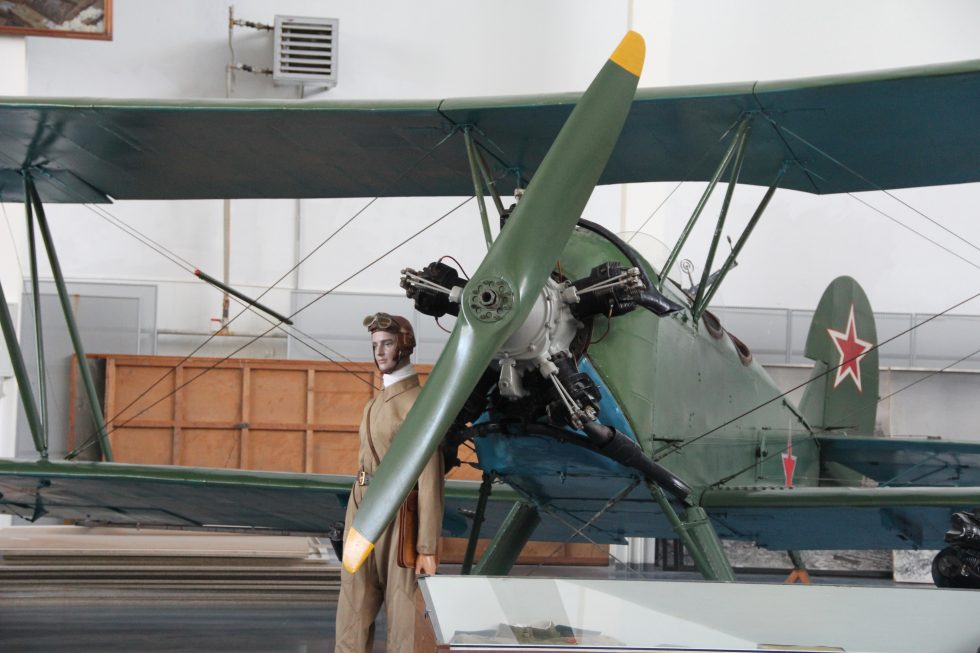
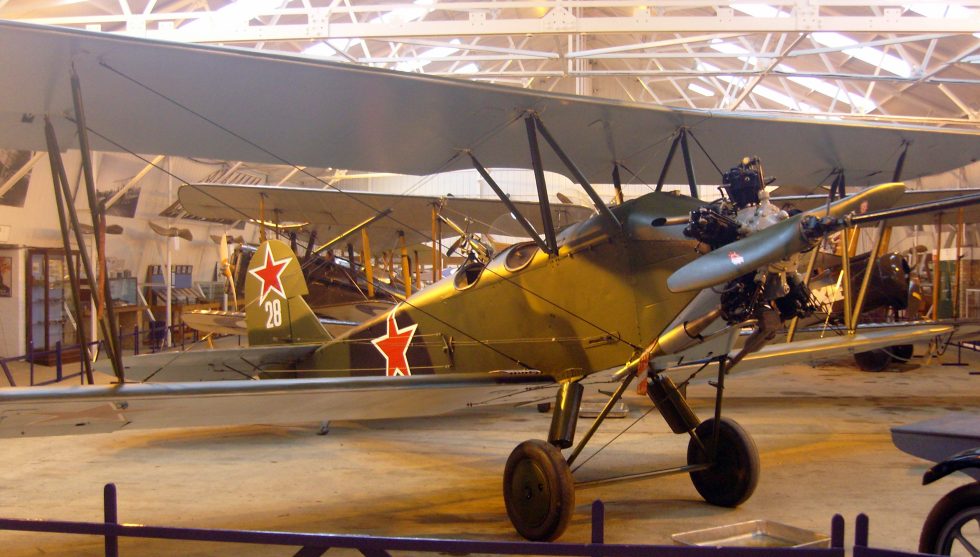
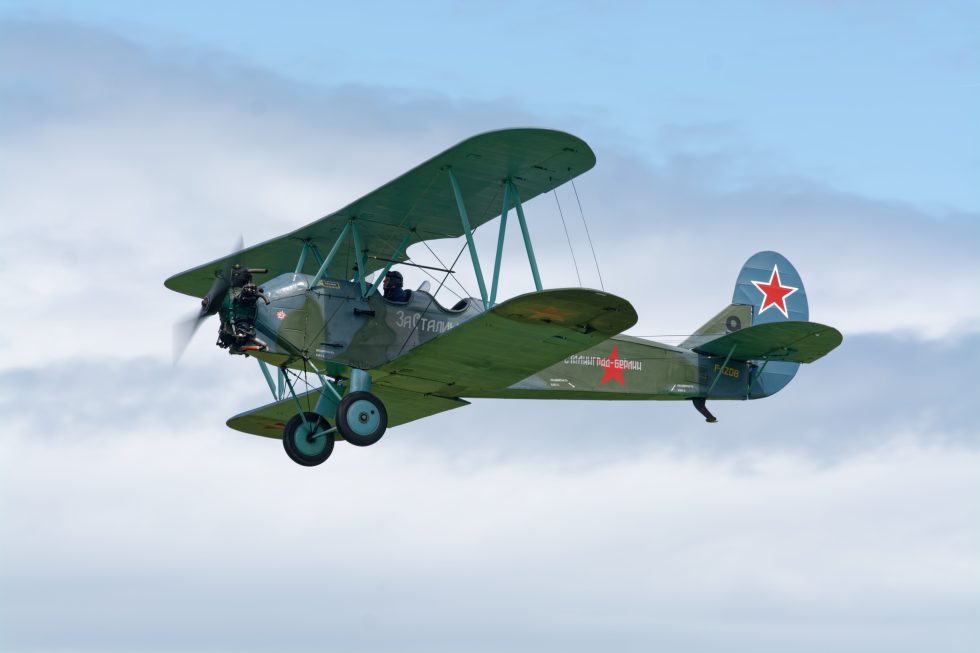
Survivors, and what "survivor" means here. The Po-2 population is large by warbird standards and awkward to count. Several dozen airframes are preserved in museums across Russia, Poland, Serbia, Croatia, Hungary, the Czech Republic, Germany, New Zealand, the United Kingdom and the United States — among them the Central Air Force Museum at Monino, the Polish Aviation Museum in Krakow (which holds a Po-2LNB night bomber), the Aviation Museum in Belgrade, the Szolnok collection in Hungary and the Omaka Aviation Heritage Centre in New Zealand. Somewhere between ten and twenty-five are airworthy at any given moment, including the Shuttleworth Collection’s aircraft at Old Warden, which flew again on 10 January 2011 after restoration, and machines at Fantasy of Flight in Florida and the Military Aviation Museum at Virginia Beach, plus a working group of Russian-registered aircraft. The distinction that matters: very few of these are unrebuilt original Soviet wartime airframes. A wood-and-fabric aeroplane that has been flying since the 1940s has been rebuilt repeatedly by definition, and many flying examples are either Polish-built CSS-13s of the 1950s, postwar Soviet Po-2s, or airframes reconstructed in Russia from the 1980s onward around original M-11 engines, fittings and data plates. Reproductions with modern engines also exist. Anyone quoting a precise count of "original Po-2s" is drawing a line that the aeroplane itself never respected.
From training field to legend
Designed as a trainer
Nikolai Polikarpov designs the U-2 to replace the Avro 504; the refined production biplane first flies on 7 January 1928.
Mass production begins
Series production starts; the cheap, forgiving biplane becomes the standard Soviet primary trainer and civil workhorse.
The “Kukuruznik”
Built in huge numbers, it dusts crops, carries mail and casualties, and spots for artillery across the USSR.
Raskova’s regiments
On 8 October, Marina Raskova wins approval to form women’s aviation regiments; the future Night Witches begin training at Engels.
Night Witches in combat
The all-female 588th Night Bomber Regiment flies its first night harassment missions on the Southern Front.
Guards honours & a new name
The regiment becomes the 46th Guards “Taman” Regiment; the U-2 is renamed Po-2 in 1944 to honour Polikarpov.
Built in Poland
Poland produces the type under licence as the CSS-13, extending the design’s manufacturing life into the late 1950s.
“Bedcheck Charlie”
North Korean Po-2s fly night harassment raids on UN airfields; slow biplanes prove maddeningly hard for jets to intercept.
Into history
Gradually retired from first-line and training use across the Soviet bloc; a number survive today as flying warbirds.
Twelve stories of the Kukuruznik
A petition to Stalin
The Night Witches began with one woman lobbying the dictator himself.
Read the full story
Cut the engine, glide in
They attacked in near silence, engines idled or off.
Read the full story
Why “Night Witches”?
The name came from a sound in the dark.
Read the full story
Too slow to catch
Its greatest weapon was how slowly it flew.
Read the full story
Eighteen missions in one night
One of the Witches’ most famous names flew until dawn.
Read the full story
The corn-duster
Before it terrified armies, it dusted crops.
Read the full story
The most-built biplane ever
No biplane was ever made in greater numbers.
Read the full story
Bedcheck Charlie
A 1920s biplane haunted a jet-age war.
Read the full story
The biplane that “downed” a jet
The most famous Po-2 story is also the least certain.
Read the full story
Made in Poland: the CSS-13
The Po-2’s life stretched on behind the Iron Curtain.
Read the full story
The flying ambulance
It did not just drop bombs — it saved lives.
Read the full story
The honest little radial
Simplicity was the whole point.
Read the full story
The Po-2 in pictures
The Po-2 in motion
Video coming soon. A verified documentary feature on the Polikarpov Po-2 and the Night Witches will be added here.
Where the Po-2 flew
A harassment bomber, not a dogfighter
The Po-2 was never built to fight other aircraft. Its combat value lay in persistence and nuisance: gliding in at night to drop small bombs, spotting for artillery, resupplying partisans and evacuating the wounded. Its defining quality in combat was how hard it was to shoot down — it flew too slowly for fast fighters to engage safely, a problem German pilots faced in WWII and UN jet pilots faced again over Korea.
Compare the combat record of every military aircraft. Figures as of 2026.
Everything people ask about the Po-2
Can I fly in a Po-2?
How many Po-2s were built?
Why were the pilots called “Night Witches”?
How fast was the Po-2?
What engine did it use?
Did it really fly in the Korean War?
Did a Po-2 really shoot down a jet?
Is the Po-2 still flying?
You can’t fly the Po-2.
These, you can.
Some legends only live in museums — others are fuelled and waiting. MiGFlug has put civilians in real military jet cockpits since 2004.
 Fly the L-39 AlbatrosThe world’s most-flown jet trainer — aerobatics included
 Fly the F-104 Starfighter“The missile with a man in it”
 Fly the MiG-21The Cold War’s most-produced jet
 Fly the T-33 Shooting StarAmerica’s first jet trainer
 Fly the DH VampireA piece of early jet history
 Fly the S.211Agile Italian jet trainer
 Fly the MB-326The classic Aermacchi jet
 Fly the MiG-15The Soviet legend of the Korean War
Continue the tour
Every fact, checked
- The National WWII Museum — The Night WitchesRaskova’s regiments, tactics, the Nachthexen name and the 24,000+ sortie figure.
- This Day in AviationDesign, first-flight date, construction and engine detail for the U-2 / Po-2.
- Military Aviation Museum“Most abundant biplane in history,” production years and specifications.
- The Aviation Geek ClubKorean-War “Bedcheck Charlie” night harassment raids and countermeasures.
- Key.Aero — The Night WitchesPopova, Ryabova, the glide-and-bomb tactic and per-night sortie counts.
- Military FactoryDimensions, weights and performance data for the Po-2.
- All-AeroProduction totals, variants and the Polish CSS-13 licence run.
- Military MattersThe disputed 1953 F-94 Starfire incident, hedged and contextualised.