
Petlyakov Pe-2
“Peshka”
The sleek twin-engine dive bomber that began life as a high-altitude fighter in a Soviet prison design bureau — and became the most-produced Soviet bomber of the Second World War.
The Petlyakov Pe-2: from a prison drawing board to the Red Army’s spearhead
The Pe-2 is one of the stranger success stories of Soviet aviation. Its designer, Vladimir Petlyakov, did not begin the project a free man. Swept up in Stalin’s purges in 1937 and accused of sabotage over delays to the ANT-42 heavy bomber, Petlyakov was imprisoned and set to work in a “sharashka” — a design bureau run inside the NKVD prison system, where jailed engineers worked under guard. It was there, as prisoner-designer, that he led the aircraft that would carry his name.
The machine did not start as a bomber at all. Petlyakov’s team designed the VI-100, a pressurised, twin-engine high-altitude fighter, which first flew on 22 December 1939. But in mid-1940, impressed by how effectively German Junkers Ju 87 Stukas had dive-bombed during the Battle of France, Soviet leadership ordered the design rapidly reworked into a dive bomber. The pressurisation and turbochargers were stripped out; a glazed nose for a bombardier and perforated dive brakes were added. The conversion, commonly said to have taken around 45 days, produced the PB-100 — and, redesignated, the Pe-2. The production aircraft flew in December 1940 and reached front-line units in 1941; Petlyakov was released for the work.
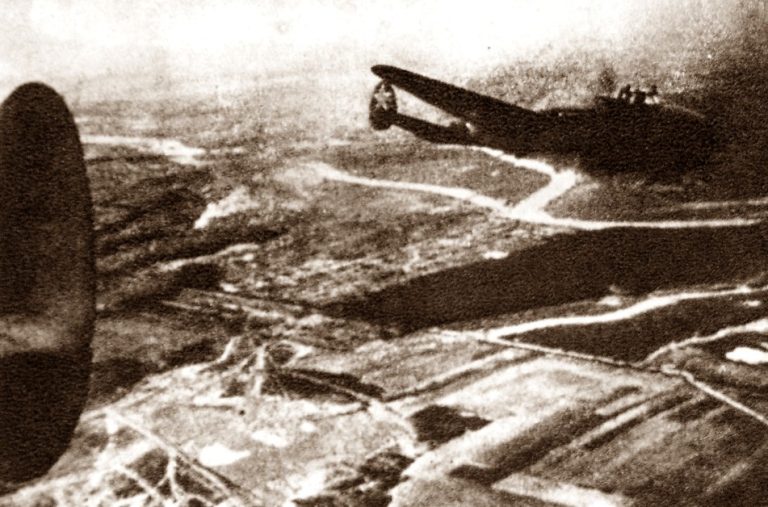
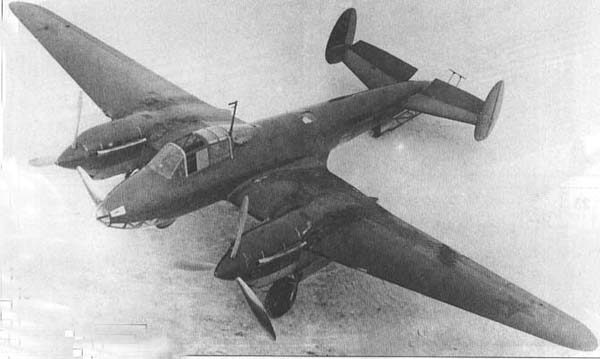
What emerged was fast, sleek and, for a bomber, hard to intercept. The Pe-2 became the mainstay of the Soviet front-line bomber force, flying level and dive-bombing missions across the Eastern Front from 1941 to 1945. Roughly 11,400 were built — more than any other Soviet bomber — and the airframe also spawned the Pe-3 heavy fighter. Among its many crews was the 587th Bomber Aviation Regiment, one of the women-organised units raised by Marina Raskova. Petlyakov himself did not see the aircraft’s greatest years: he was killed in a Pe-2 crash in January 1942.
01The Pe-2’s origins: how an NKVD prison bureau turned a fighter into a bomber
Petlyakov was one of several senior Soviet aircraft designers arrested during the Great Terror. He was held in TsKB-29, a special design bureau operated by the NKVD secret police — the kind of institution later nicknamed a “sharashka,” where imprisoned specialists designed weapons in exchange for the hope of release. His group’s brief was a high-altitude twin-engine fighter, the VI-100, complete with a pressurised cockpit and turbo-supercharged engines.
When the German Blitzkrieg in the West showcased the dive bomber, Soviet priorities shifted almost overnight. The VI-100 was ordered converted into a dive bomber, the high-altitude equipment deleted in favour of a bomb bay, a bombardier’s glazed nose and dive brakes. The speed of that redesign — measured in weeks, not years — is part of the type’s legend, though exact figures vary between accounts. The result entered production as the Pe-2, and Petlyakov earned his freedom by delivering it.
What makes the Pe-2 special
A fast dive bomber with dive brakes
The Pe-2 was built to dive-bomb accurately and get away quickly. Slatted, perforated dive brakes under the wings let it enter a steep dive under control, and an automated system helped manage the dive and pull-out. With a top speed of roughly 540 km/h, it was fast enough that intercepting it was difficult — a bomber that could sometimes outrun the fighters sent after it.
Born a high-altitude fighter
Before it was a bomber it was the VI-100, a pressurised twin-engine high-altitude fighter first flown in December 1939. When Soviet leaders demanded a dive bomber in mid-1940, the fighter was reworked in a matter of weeks — a rare case of a front-line bomber that started life as an interceptor and kept the clean, fighter-like lines to show for it.
Built in huge numbers — and a fighter spin-off
About 11,400 Pe-2s were built between 1940 and 1945, making it the most-produced Soviet bomber of the war and, at its peak, the bulk of the Soviet twin-engine bomber force. The same airframe was developed into the Pe-3, a long-range heavy and night fighter — the fighter idea returning, in a way, to where the design began.
02The Pe-2’s dive-bombing system: brakes, a glazed nose and an automated pull-out
Accurate dive bombing demands a stable, controllable dive and a reliable recovery — the aircraft plunges toward the target, releases, and must pull out before the ground. The Pe-2 used perforated air brakes that extended from under the wings to hold the dive at a safe speed, together with a glazed nose position for the bombardier. Contemporary accounts credit it with an automatic dive-and-recovery aid to help the crew avoid over-speeding or pulling out too late. In practice many Pe-2 sorties were flown as fast level bombing rather than steep dives, but the dive-bomber pedigree shaped the airframe.
03The Pe-2 and the Pe-3: how one design became both bomber and fighter
Because the Pe-2 was fast and clean, it lent itself to a fighter conversion. The Pe-3 replaced the bomb-aimer’s station with a heavier forward-firing gun battery to create a twin-engine long-range and night fighter, used for tasks such as reconnaissance escort and interception. It was never built in Pe-2 numbers, but it closed a curious loop: a design that began as a high-altitude fighter, became the Soviet Union’s standard dive bomber, and then spun back off into a fighter again.
Full Petlyakov Pe-2 specifications
Baseline note: the figures below describe a standard production Pe-2FT of 1943 as it left State Aircraft Factory No. 22 at Kazan — two Klimov M-105PF, the shielded dorsal turret with a 12.7 mm UBT, and the reduced nose glazing that came with the Frontovoye Trebovaniye standard. Deltas for the original M-105RA aircraft of 1941, for the Pe-3 heavy fighter, and for the late Pe-2B and Pe-2I are given in grey. Three cautions apply before anything below is quoted. First, the production total is genuinely unsettled: the figure most often printed is 11,427, and aviastar states explicitly that this covers Pe-2s and Pe-3s together; Medved and Khazanov’s Pikiruyushchiy bombardirovshchik Pe-2 (Eksmo, 2007) gives 11,070 Pe-2s plus 360 Pe-3s, 11,430 in all; some Russian references give 11,247 with a factory breakdown (10,144 from Kazan No. 22, 896 from No. 39, 144 from No. 125 at Irkutsk, 104 from No. 124) that sums correctly to its own total. The 11,247 and 11,427 pair differ by a transposed digit and one of them is almost certainly a typographical ghost that has been copied for decades. The honest statement is “a little over 11,400, including the Pe-3s”. Second, dimensions vary between sources: 17.16 m span and 12.66 m length are the best-attested, but airwar.ru prints 17.60 m and 12.60 m, and museum placards follow whichever book was to hand. Third, speed fell steadily through the war as weight, armour and drag were added — a 1941 aircraft and a 1944 aircraft with nominally the same engine were not the same aeroplane.
Dimensions & weights
- Crew
- 3 — pilot, navigator-bombardier beside him, and a radio operator-gunner lying prone at the ventral hatch — the VI-100 it was converted from carried two, in a pressurised cabin; the Pe-3 heavy fighter went back to two, deleting the ventral position and its gun
- Length
- 12.66 m (41 ft 6 in) — airwar.ru prints 12.60 m and a Russian series-by-series table 12.78 m; the difference is where the tail fairing is measured to, not a real change
- Wingspan
- 17.16 m (56 ft 4 in), unchanged from the VI-100 through the Pe-3 and every bomber series; some Russian sources print 17.60 m (57 ft 9 in)
- Height
- 3.42 m (11 ft 3 in) at rest on the tailwheel; about 4.00 m (13 ft 1 in) is quoted where the twin fins are measured with the tail raised
- Wing area
- 40.50 m² (435.9 sq ft)
- Aerofoil
- NACA 23012 series, a thin high-speed section chosen for the high-altitude fighter the aeroplane was originally meant to be — and the root of the Pe-2’s worst vice. Optimised for speed at height, it gave poor lift low down, which is precisely where a dive bomber takes off, lands and recovers from a dive
- Structure
- All-metal stressed skin, duralumin throughout, twin fins and rudders, retractable tailwheel — an expensive way to build in 1941, and one of the reasons Pe-2 output was concentrated in the two best-equipped plants rather than dispersed like the wooden fighters
- Empty weight
- 5,950 kg (13,118 lb); airwar.ru gives 6,200 kg (13,668 lb) for a later series aircraft, and the drift upward through the war is real
- Normal take-off weight
- 7,536 kg (16,614 lb) with 600 kg of bombs
- Maximum take-off weight
- 8,520 kg (18,783 lb) with 1,000 kg of bombs, of which 400 kg hung externally; the Pe-3bis, stripped of the ventral crewman and carrying three extra fuel tanks, was flown at comparable weights on a fighter’s mission
- Wing loading
- 186 kg/m² (38.1 lb/sq ft) at normal weight, rising to 210 kg/m² (43.1 lb/sq ft) fully loaded — high for 1941, and unforgiving on a rough forward strip
- Internal fuel
- Nine self-sealing tanks in the wing and centre section, roughly 1,500 litres (330 imp gal, 396 US gal). Published capacities vary by series and by whether the ferry tanks are counted; treat any single figure with suspicion. From 1942 the empty space above the fuel was filled with cooled, scrubbed engine exhaust as an inerting measure, after fire proved to be the type’s commonest cause of loss
- Armour and protection
- Armour plate behind the pilot and around the gunners, thickened repeatedly through the war on direct front-line complaint; armour glass in the pilot’s screen — and still not enough. Soviet analysis found ten Pe-2 gunners wounded for every pilot wounded, and two to three gunners killed for every pilot killed. The rear crew, not the pilot, paid for this aeroplane
Performance
- Maximum speed, at altitude
- 540 km/h (336 mph, 292 kn) at 5,000 m (16,400 ft) for an early M-105RA aircraft. Series production degraded this steadily: a 205-series machine was measured at 521 km/h (324 mph), and the M-105PF restored some of it at lower altitude rather than high up
- Maximum speed, sea level
- 452 km/h (281 mph, 244 kn) — the number that actually mattered, because Pe-2 regiments spent the war low
- Cruising speed
- 428 km/h (266 mph, 231 kn) maximum continuous; formation cruise was flown nearer 380 km/h (236 mph)
- Speed against fighters
- Fast enough to matter, not fast enough to be safe. In 1941 the Pe-2 was quicker than the SB it replaced by well over 100 km/h and quicker at low level than several Soviet fighters, and a Bf 109E at 570 km/h had very little margin on it. The popular claim that Bf 109s could not catch a Pe-2 is too strong: a Bf 109F did 615 km/h and an F-4 or G comfortably ran one down. What the speed bought was escape after the fact — a Pe-2 that saw the attack coming, pushed the nose down and ran for its own lines was a hard, slow interception, and German pilots said so. Claims of “over 640 km/h” in the literature are dive figures, not level speed
- Landing speed
- About 150 km/h (93 mph, 81 kn) — roughly 25 km/h higher than the SB bomber crews had trained on, and the single figure that killed the most Pe-2 crews outside combat. Combined with under-damped oleos, it produced the type’s notorious bounce, which could turn into a ground loop or a broken back if the pilot was not ready for it
- Time to altitude
- 3.76 min to 3,000 m (9,840 ft) for a lightly loaded early aircraft; nearer 7 min at full bomb load and later weights
- Service ceiling
- 8,800 m (28,900 ft) — against the 12,500 m the VI-100 had been designed for. Deleting the turbo-superchargers and the pressure cabin cost roughly 3,700 m of ceiling and nobody minded, because the war was being fought below 4,000 m
- Range
- 1,315 km (817 mi, 710 nmi) with 1,000 kg of bombs; airwar.ru gives 1,500 km (932 mi) for a lighter configuration. The Pe-3bis, with three additional 700-litre tanks, was credited with about 1,500 km on a fighter mission
- Typical combat radius
- ~350 km (217 mi, 189 nmi) with a useful load and a reserve — a tactical bomber’s reach, deliberately. The Pe-2 was built to hit the ground immediately behind the German front line, not to conduct a strategic campaign, and Soviet doctrine never asked it to
- Take-off and landing run
- About 480 m (1,575 ft) to unstick at normal weight and about 650 m (2,130 ft) to stop. Soviet field figures for both scatter widely with surface, load and technique; the pattern that matters is that both were long for a front-line strip, and rough forward aerodromes wrote off Pe-2s at a rate that combat did not explain
- Dive limits
- Attack dives were flown at 50 to 70 degrees with the brakes out, release at 1,000 to 1,500 m, structural limit around 720 km/h (447 mph) indicated in the dive. Regiments increasingly bombed in shallow dives of 30 to 45 degrees or from level flight in formation, because true dive-bombing demanded a standard of crew training the wartime Soviet training system could not supply
- Life expectancy
- General Ivan Turkel put it at 30 combat flights in December 1942. Replacing the rifle-calibre ShKAS defensive guns with 12.7 mm UBTs is recorded as lifting it from about 20 sorties to about 54. These are staff estimates from a service that had every reason to be optimistic, and losses in specific corps were worse: 1st Bomber Aviation Corps lost 52 aircraft in July 1943 and 59 in August, from a starting strength of 179
Propulsion & systems
- Engines
- 2 × Klimov M-105PF, liquid-cooled 60-degree V-12 of 35.1 litres, a licence descendant of the Hispano-Suiza 12Y — the same engine family that powered the Yak-1, Yak-7 and Yak-9, which is why it was available in the quantities the Pe-2 programme needed, and why it was never uprated as far as the Pe-2 deserved
- Power
- 1,210 hp (900 kW) for take-off and 1,260 hp (940 kW) at low altitude for the M-105PF. The 1941 M-105RA gave 1,100 hp (820 kW); the Pe-2I of 1944 used the VK-107A at 1,650 hp (1,230 kW) and reached about 656 km/h, which is what the airframe had always been capable of given the power
- Supercharging
- Gear-driven two-speed centrifugal supercharger, single stage — the VI-100 had carried two TK-3 exhaust-driven turbo-superchargers in the nacelles. They went in the 1940 conversion, along with the altitude performance they existed to provide
- Propellers
- Three-blade VISH-62 constant-speed metal airscrews, 3.25 m (10 ft 8 in) diameter, electrically controlled like almost everything else on the aeroplane
- Fuel and fire protection
- Self-sealing tanks with an inert-gas system that pumped cooled, filtered exhaust into the tank ullage — retrofitted and progressively improved because burning was the way Pe-2s most often died. Crews and inspectors kept reporting fire risk as the type’s defining weakness right through 1943
- Cooling
- Wing-mounted radiators in the centre section with electrically actuated exit flaps, oil coolers in the nacelle chins — a clean installation, and a major reason the aeroplane was as fast as it was on modest power
- Electrical system
- The most heavily electrified Soviet aircraft of the war: on the order of fifty electric motors driving flaps, trim tabs, dive brakes, radiator shutters, propeller pitch, bomb doors and release, undercarriage and more — inherited from the VI-100, elegant on the drawing board, and a maintenance liability in mud and 30 degrees of frost. Ground crews cursed it; the alternative, on an aeroplane this size, was cable runs nobody had time to design
- Dive brakes
- Slatted “venetian blind” brakes under the outer wings, electrically extended, linked to an AP-1 automatic device that put the brakes out, held the dive angle and initiated the pull-out after release — a genuinely advanced piece of kit for 1941. From the Pe-2FT onwards many aircraft left the factory or the field with the brakes removed, because regiments had stopped dive-bombing properly and the weight and complication were no longer earning their keep
- Sights and bombing equipment
- PBP-1b reflector sight for the pilot in the dive, OPB-1M vector sight for the navigator in level flight — the standard Soviet fit, and a comparatively weak one. Accuracy in the Pe-2 depended overwhelmingly on the crew, and the average crew arriving from training in 1942 to 1943 had flown a handful of hours on type
- Radio
- RSB-bis transmitter-receiver for the leader with RSI receivers in the wingmen, intercom between the three crew positions; RPK-2 radio compass on reconnaissance and lead aircraft — better provisioned than most Soviet aircraft of 1941, because a bomber formation without radio cannot manoeuvre as a formation
- Undercarriage
- Electrically retracted main gear into the nacelles, retractable tailwheel, oleo-pneumatic shock struts of inadequate travel — the bounce was a design defect, not a pilot defect, and it was never fully cured
04The Pe-2’s cost: why no reliable dollar price exists
The Pe-2 was a wartime Soviet state product, built to plan rather than sold on an open market, so there is no meaningful flyaway unit price or cost-per-flight-hour figure in the public record. What is well documented is the scale: production of roughly 11,400 aircraft over five years made it, by output, one of the most cost-effective ways the Soviet Union could put a fast twin-engine bomber over the front. Any precise dollar cost attached to a Pe-2 should be treated as an estimate, not a sourced figure.
Armament & payload
The Pe-2 carried a modest bomb load quickly, and spent four years growing guns it had never been designed to mount
One thousand kilogrammes was the ceiling, and 600 kg was the normal load. That is small — a Ju 88 lifted two to three times as much, and the Pe-2’s own bay was so shallow that only four 100 kg bombs would go inside it, with a further 100 kg tucked into a small cell at the rear of each engine nacelle and everything heavier hung on external racks that cost speed. This was not a design failure so much as a design inheritance: the fuselage had been drawn around a pressure cabin and a cannon bay for a high-altitude fighter, and a bomb bay was cut into it afterwards.
The defensive armament is the part of the story worth following, because it is where the front line rewrote the aeroplane. The Pe-2 entered service in 1941 with four rifle-calibre 7.62 mm ShKAS — two fixed in the nose, one in a crude dorsal mount, one firing down through a ventral hatch. Against a Bf 109F this was close to useless, and the ventral gunner in particular had almost no field of view or fire, which German pilots learned to exploit within weeks. From Series 13 the heavy 12.7 mm Berezin appeared, and the Pe-2FT of 1942 — the letters stand for Frontovoye Trebovaniye, front-line demand, and Leonid Selyakov drew it at Zavod 22 in response to what regiments were saying — gave the dorsal gunner a proper shielded turret with a UBT. Soviet staff work credits that single change with lifting a Pe-2’s expected life from roughly 20 sorties to roughly 54. Fits varied enormously by series, by factory and by field workshop; a 1941 aircraft, a 1943 Pe-2FT, a Pe-3bis and a Pe-2B were four different armament standards wearing the same silhouette, and no single table describes them all.
Gun
- 2 × 7.62 mm ShKAS fixed in the nose, 450 rounds per gun — the original 1940 to 1941 fit, and inadequate from the first week
- From Series 13: the right-hand nose ShKAS replaced by a 12.7 mm Berezin UBK with 150 rounds; later aircraft carried two UBK
- Dorsal: 1 × 7.62 mm ShKAS on the early MV-3 mount, replaced from 1942 by 1 × 12.7 mm UBT in the shielded FT turret and later the VUB-1
- Ventral: 1 × ShKAS through a hatch, later 1 × UBT on the FZ mounting — the worst position on the aeroplane, with the narrowest arc, and the one that killed most gunners
- Pe-3bis: 1 × 20 mm ShVAK with 250 rounds plus 2 × 12.7 mm UBK relocated to the centre-section, and 1 × UBT aft. The Pe-2MV ground-attack conversion added a ventral gondola with 2 × ShVAK
Air-to-air
- No guided air-to-air weapon existed anywhere in Soviet service during this aircraft’s life. The card is kept because the Pe-2 fought in the air constantly, and sometimes won
- The defensive machine guns were the whole of it. On 1 July 1941 six Pe-2s beat off four Bf 109s and claimed two shot down without loss — an early-war Soviet claim, and to be read as one, but the engagement is real
- RS-82 rockets were trialled as an air-to-air weapon against bomber formations on the Pe-3, following pre-war Soviet doctrine. Nothing came of it
- DAG-10 launchers in the tail cone threw ten AG-2 grenades on small parachutes into the path of a pursuing fighter — a genuinely odd weapon, occasionally credited with a kill, more often ignored by the crews who carried it
- The Pe-3 and Pe-3bis were the air-to-air variant proper: a two-seat long-range heavy fighter with the ventral crewman deleted and the guns moved forward
Air-to-surface guided
- None. No Soviet guided air-to-surface weapon reached service in the Second World War, and the Pe-2 never carried one
- The nearest thing to precision the type possessed was the dive itself: brakes out, 60 to 70 degrees, release at 1,000 to 1,500 m with the AP-1 automatic device holding the angle and starting the recovery
- That capability decayed through the war rather than improving, as crew training shortened and regiments reverted to shallow dives and level formation bombing
- Post-war Soviet guided weapons work drew on captured German Hs 293 and Fritz X material, not on anything the Pe-2 had flown
- Kept in place rather than deleted, because the absence is the point: the Pe-2 was an accurate bomber only in the hands of a well-trained crew, and there were never enough of those
Bombs
- Normal load 600 kg, maximum 1,000 kg — internal bay for 4 × FAB-100, one further 100 kg bomb in a cell at the rear of each engine nacelle, four external racks under the centre section
- FAB-100, FAB-250 and FAB-500 general-purpose bombs; 2 × FAB-500 was the heaviest practical external fit and it cost 30 to 40 km/h
- AO-10 and AO-25 fragmentation bombs and ZAB incendiaries for troops, transport and airfield targets
- RRAB rotating dispersal containers for small bombs and bomblets, including PTAB-2.5-1.5 shaped-charge anti-tank bomblets from mid-1943 — the PTAB was overwhelmingly an Il-2 weapon and Pe-2 use of it was secondary
- Naval Aviation Pe-2s in the Baltic and Northern Fleets flew anti-shipping and mining sorties with the same general-purpose bombs; the Pe-2 was never a torpedo carrier
Rockets
- From Series 32, provision for up to ten RS-82 or RS-132 unguided rockets on underwing rails
- Rarely fitted on bomber-regiment aircraft: the rails cost speed, the rockets were inaccurate, and a Pe-2 pilot pointing his aeroplane at a ground target long enough to salvo them was in the flak envelope longer than doctrine allowed
- More often seen on Pe-3 and Pe-2 ground-attack conversions operating over Karelia and the far north, where flak was thinner
- Rocket-assisted take-off gear was trialled on overloaded aircraft; it did not enter general use
- The Pe-2K RD-1 was a single aircraft with a 300 kg-thrust Glushko RD-1 liquid-fuel rocket in the tail cone, flown as a research machine for boosted performance. It never approached service
Pods & other stores
- Pe-2R reconnaissance aircraft carried AFA-B and AFA-33 vertical and oblique cameras in the bomb bay with additional fuel — the role in which the type was arguably most valuable, and the one the Finns used their captured aircraft for
- Pe-2 Paravan: a small number fitted with a steel cable-cutting frame projecting some six metres ahead of the nose and braced back to the wingtips, for cutting barrage-balloon cables. Ungainly, effective, and quickly obsolete
- VAP and UKhAP chemical and smoke containers on the external racks, for laying smoke screens over river crossings
- Ferry and long-range tanks on the Pe-3bis — three additional 700-litre tanks, which is where the fighter variant’s 1,500 km range came from
- No gun pods in the Western sense: where extra guns were wanted, as on the Pe-2MV, a fixed ventral gondola was built onto the airframe rather than hung from a pylon
Three typical loadouts
- Divisional strike, Kursk salient, July 1943
- 4 × FAB-100 internally plus 2 × FAB-100 in the nacelle cells and 2 × FAB-250 externally — 1,000 kg total, flown in nine-aircraft formations at 2,000 to 3,000 m against German assembly areas and armour on the roads behind the front, with a Yak or La-5 escort overhead and the whole regiment releasing on the leader.
- True dive attack, bridge or battery
- 2 × FAB-250 externally and the bay empty — 500 kg, brakes deployed, entry at 3,000 m, 60 to 70 degrees, release at 1,200 m, AP-1 pulling the aircraft out. Flown by regiments with the training to do it, which through 1942 and 1943 meant a minority.
- Pe-2R photo-reconnaissance sortie
- No bombs, cameras and a supplementary tank in the bay, defensive guns loaded, flown high and fast and alone. The Finnish Air Force flew its captured Pe-2s this way over the Karelian Isthmus in June 1944, escorted by four Bf 109 Gs, and the photographs fed the artillery at Tali-Ihantala.
Sourcing caveat: Soviet armament tables were written by series and amended by field workshops, and captured-aircraft reports describe what one aeroplane carried on one day. Ammunition counts in particular are quoted inconsistently across sources. Where a figure above is given without a range, it is the one most consistently attested across Peter C. Smith’s Crowood monograph Petlyakov Pe-2 ‘Peshka’ (2003), the 1945 NKAP structural description of the Pe-2, and aviastar; where sources conflict outright, the conflict is stated rather than averaged away.
Variants
Vladimir Petlyakov designed a pressurised high-altitude fighter in a prison, and was given 45 days to turn it into a dive bomber
On 21 October 1937 Vladimir Petlyakov was arrested alongside Andrei Tupolev and much of the TsAGI leadership on fabricated charges of sabotage, espionage and assisting the Russian Fascist Party. It is often written that he was imprisoned for the failure of the ANT-42 — the four-engined high-altitude bomber that eventually flew as the TB-7 and then the Pe-8 — and the project’s troubles, particularly its awkward fifth-engine supercharger installation, certainly supplied a pretext. But it is worth being exact: the charge sheet was an NKVD fiction of the kind being issued in thousands that autumn, and Petlyakov was swept up in the destruction of the Tupolev bureau rather than prosecuted for an engineering failure. The distinction matters, because the Soviet state did not conclude that he was a bad designer. It concluded that he was a useful one who could be worked without wages.
Rather than being shot, he was put into TsKB-29 — the NKVD’s aviation sharashka, a prison design bureau in Moscow where Tupolev, Myasishchev, Korolev and Petlyakov each ran a brigade under guard. Petlyakov’s section, STO and later KB-100, was given a twin-engined pressurised high-altitude interceptor to answer the German high-altitude bombers Soviet intelligence believed were coming. That aircraft, the VI-100, flew on 22 December 1939: all-metal, turbo-supercharged, pressure-cabined, packed with electric actuators, designed for 630 km/h at 10,000 m, and unlike almost anything else in Soviet service. It was shown over Red Square on May Day 1940. The second prototype caught fire in the air after a fuel-line nut was left loose and crashed into a kindergarten.
Then the requirement vanished. Soviet intelligence established that Germany had no serious high-altitude bomber programme, while the Blitzkrieg in France demonstrated exactly what a dive bomber did to an army. In May 1940 the order came down to convert the VI-100 into a three-seat dive bomber, the PB-100, and to do it in 45 days. Around 300 engineers were drafted in from other bureaux. The pressure cabin and turbo-superchargers were deleted as, in the phrase of the time, an inessential luxury; the nose was reglazed for a bombardier, a bay was cut into the fuselage, dive brakes were added and a ventral gunner was found room. It went into production without a flying prototype — static test only — and was redesignated Pe-2 in December 1940 under the new practice of naming aircraft after their designers. Petlyakov was released in 1940 and given a Stalin Prize in 1941 for the aeroplane he had designed in prison. He did not live to see it mature: on 12 January 1942 he was killed when the Pe-2 carrying him to Moscow, where he intended to argue about production problems, caught fire and crashed near Arzamas.
In service the type was fast, clean, structurally sound and thoroughly demanding. It needed real force on the wheel to rotate — in the 587th Regiment, where the crews were women, navigators routinely reached over and hauled on the control column with the pilot — and it came back onto the ground at about 150 km/h onto shock struts that bounced. It killed inexperienced crews on aerodromes as well as over targets. It was, nevertheless, the backbone: at its peak the Pe-2 made up around three-quarters of the Soviet twin-engined bomber force, it flew at Stalingrad, Kursk, Bagration and Berlin, and the 587th Bomber Aviation Regiment — formed by Marina Raskova on 8 October 1941, one of her three women’s regiments, and the only one given a modern combat aircraft rather than hand-me-downs — became the 125th Guards in September 1943, flew 1,134 missions, dropped over 980 tonnes of bombs and produced five Heroes of the Soviet Union. Raskova herself never reached the front with it: on 4 January 1943, leading two other Pe-2s to a forward airfield near Stalingrad, she went in attempting a forced landing on the bank of the Volga. She was given the first Soviet state funeral of the war and her ashes were placed in the Kremlin wall.
- VI-100 (1939–40, 2 prototypes)
- The original: a two-seat pressurised high-altitude heavy fighter on M-105R engines with TK-3 turbo-superchargers, armed with two 20 mm ShVAK and two ShKAS and carrying experimental KS-76 and KS-100 aerial-shell weapons. First flight 22 December 1939. The second prototype was lost to an in-flight fire.
- PB-100 / Pe-2 2M-105 (1940–41)
- The 45-day conversion: three seats, glazed bombardier’s nose, internal bay, nacelle bomb cells, dive brakes, no pressure cabin, no turbo-superchargers. Ordered straight into production off the drawing board with static test only; first two aircraft completed at Zavod 39 in late autumn 1940, trials from 15 December 1940, redesignated Pe-2 that same month. About 458 had been delivered by the German invasion.
- Pe-2 early series (1941–42, Series 1 to about 82)
- Four rifle-calibre ShKAS, M-105RA engines, thin armour, high fire risk. From Series 13 the 12.7 mm UBK and UBT began to appear; from Series 32, rocket rails. The version that took the catastrophic losses of 1941, largely because crews were sent in low against flak in aircraft they had barely flown.
- Pe-2FT (1942–45, the main production standard, over 4,000 built)
- Frontovoye Trebovaniye, front-line demand: Leonid Selyakov’s answer at Zavod 22 to what regiments were asking for. Shielded dorsal turret with a 12.7 mm UBT, better ventral mounting, thicker armour, uprated M-105PF engines, simplified nose glazing, and on many aircraft the dive brakes deleted. Standard from Series 83. The single change that most improved crew survival.
- Pe-2B (1944, production standard)
- Late refinement of the FT with further aerodynamic clean-up, revised armament mountings and improved crew accommodation. The last major bomber standard before the Tu-2 began displacing the type.
- Pe-2R and Pe-2 Paravan (1941–45, small numbers)
- Pe-2R: three-seat photo-reconnaissance conversion with AFA cameras and extra fuel in the bay, and among the most useful things the airframe ever did. Paravan: a handful fitted with a projecting steel cable-cutting frame for barrage-balloon work.
- Pe-2UT / UPe-2 (1943–45)
- Dual-control conversion trainer with a raised instructor’s cockpit in place of the dorsal position. Built in quantity precisely because the standard aeroplane was too difficult to convert onto directly, which is an admission in metal.
- Pe-2I and Pe-2M (1944–45, 5 and a handful)
- Vladimir Myasishchev’s redesign after Petlyakov’s death: VK-107A engines, deeper fuselage with a 1,000 kg internal bay, defensive armament reduced to remotely sighted guns, and about 656 km/h — faster than the Bf 109 G at the altitudes it worked. Too late, and the Tu-2 had the ground.
- Pe-3 and Pe-3bis (1941–44, about 360 in total)
- The heavy fighter the airframe had originally been: two seats, ventral position deleted, extra fuel, guns moved forward. Authorised in four days after the July 1941 night raids on Moscow and flown on 7 August 1941. Production ran 196 in 1941, 132 Pe-3bis in 1942, 13 in 1943 and 19 lightly armed aircraft in 1944. The Pe-3bis added a 20 mm ShVAK and 136 kg of armour. Roughly 50 were lost in the first three months, a quarter of those built, after which the survivors were pushed into long-range reconnaissance and navigation-leader work, where they were genuinely valuable — the 9th Regiment led over 2,000 aircraft to their targets.
- B-32 / CB-32 (Czechoslovakia, 1946–51, 32 and 3)
- Czechoslovak service designations, not licence-built aircraft: 32 Pe-2FT and 3 UPe-2 operated from May 1946 to mid-1951. Yugoslavia flew 123 Pe-2FT and 9 UPe-2 from 1945 to 1954, and Poland operated the type with both its air force and its navy. Finland was the odd operator out, buying six captured aircraft from Germany in 1941 and one more in 1944 and flying them on reconnaissance, not as bombers.
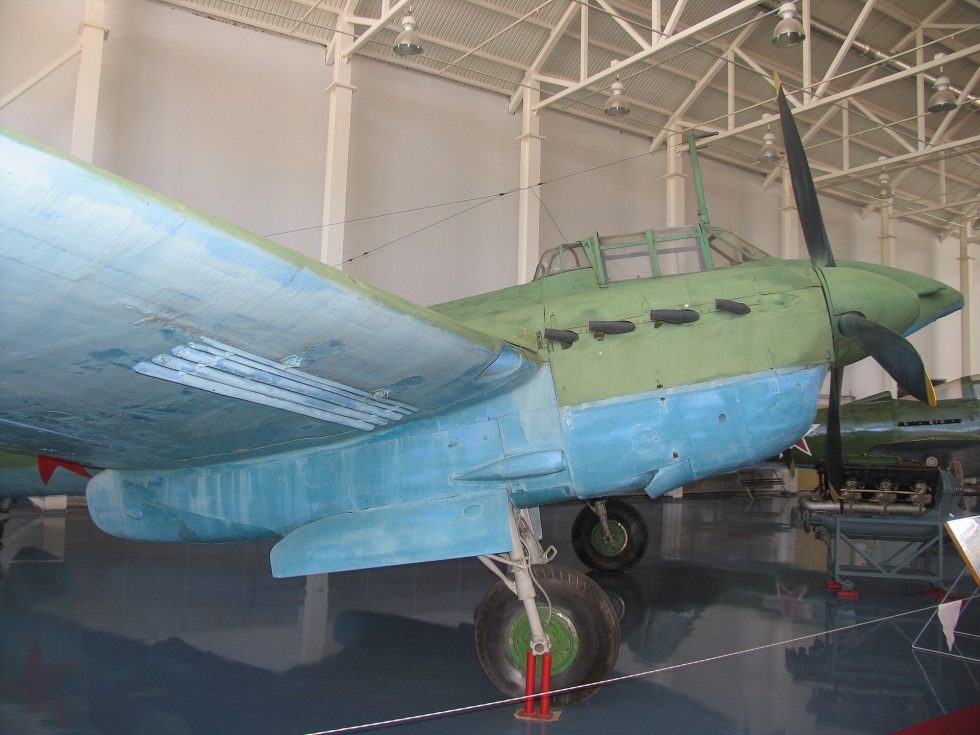
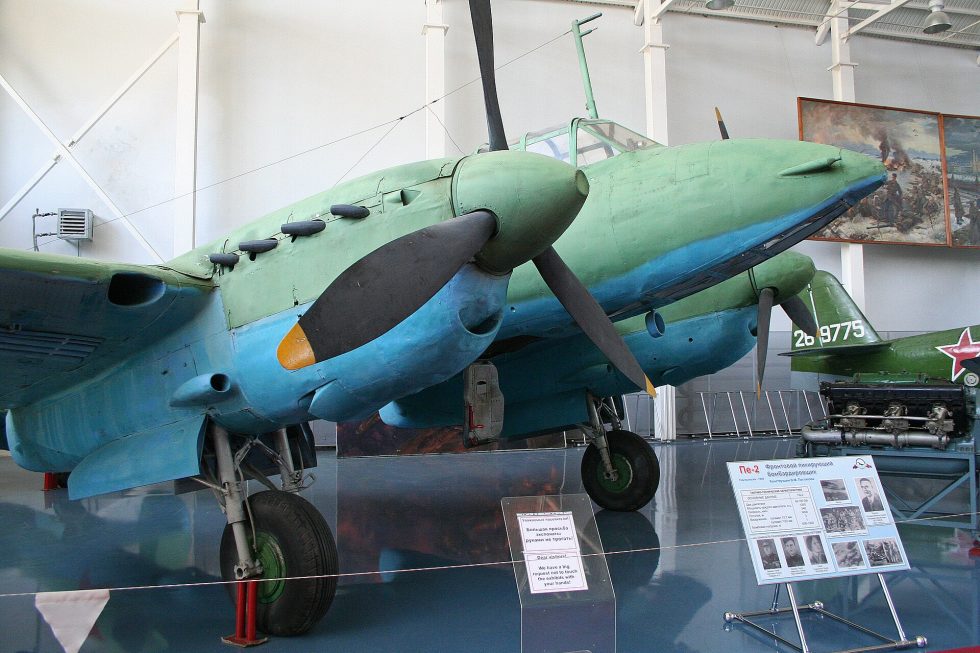
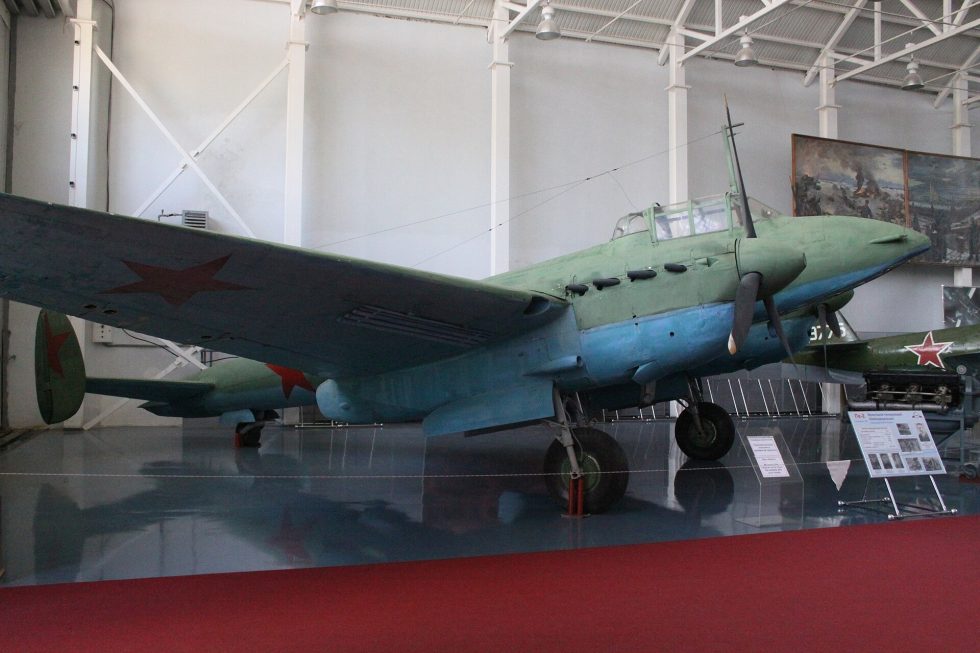
Survivors, counted carefully, because almost nothing about this type survived intact. There is no airworthy Pe-2 anywhere in the world, and there never has been since the last Yugoslav aircraft were retired in 1954. Every complete airframe on display today is either a post-war service survivor left outdoors or a wreck lifted out of a lake or a forest and rebuilt. The most substantially original aircraft is the Pe-2FT with works number 2-225, built at Kazan in August 1943 and flown by the 29th Bomber Aviation Regiment of the Soviet Northern Fleet as tactical number 33: it force-landed on the frozen lake Koshkayavr in the Murmansk region on 2 December 1943, sank, was lifted out by helicopter crane in October 1996, was conserved in Norway, and passed to the Czech Military History Institute in September 2013 for a restoration at the Kbely aviation museum in Prague. The Museum of the Polish Army in Warsaw holds a Pe-2FT from post-war Polish service, displayed outdoors and carrying no published works number — the most complete airframe that was not dug out of a crash site. The Central Air Force Museum at Monino has a Pe-2FT that is openly described as a composite assembled from parts of several recovered airframes, with no original identity. The UMMC Museum Complex at Verkhnyaya Pyshma in the Urals displays a Pe-2 rebuilt from recovered wreckage. The Norwegian Aviation Museum at Bodø holds the nose and cockpit section of Pe-2FT 16/141, shot down on 29 March 1943, the rest of the aircraft being unrecoverable. That is essentially the complete list: two rebuilt composites, one post-war survivor, one recovered original under restoration and one nose section, from a production run of more than 11,000. Treat museum placards with care — several of these aircraft have carried markings and unit histories over the years that their airframes cannot support, and where a works number has not been published the safe description is “a Pe-2FT of unrecorded identity”.
The Petlyakov Pe-2 through the war and after
Petlyakov arrested
Designer Vladimir Petlyakov is caught up in Stalin’s purges and set to work in an NKVD prison design bureau.
VI-100 first flight
The pressurised high-altitude fighter that would become the Pe-2 first flies on 22 December.
Reworked into a dive bomber
Impressed by German Stukas, Soviet leaders order the design converted; the Pe-2 production prototype flies in December.
Enters service
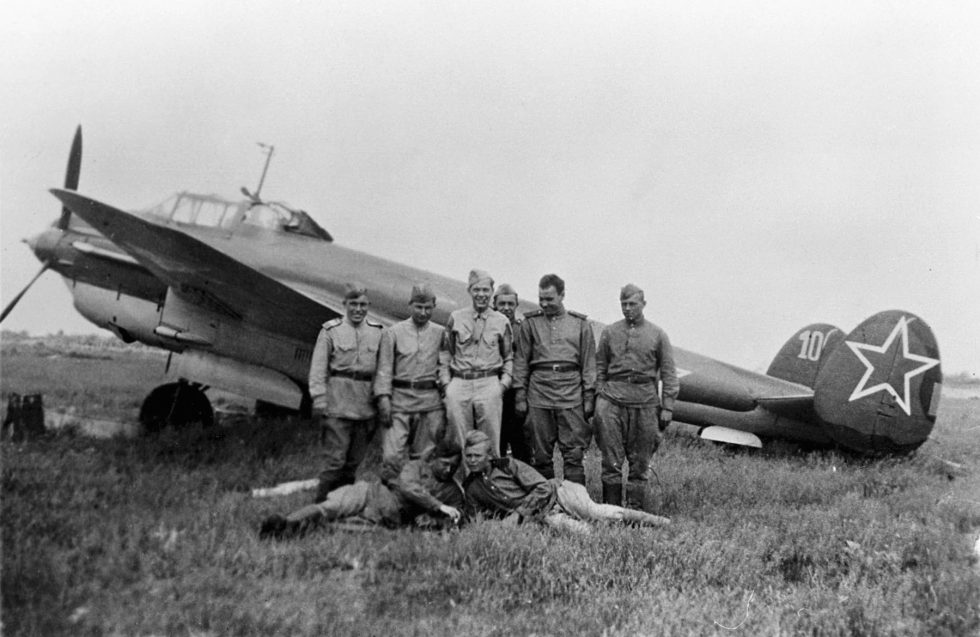
The Pe-2 reaches front-line units and is in action from the German invasion of the USSR in June.
Petlyakov is killed
On 12 January, Vladimir Petlyakov dies in the crash of a Pe-2 while flying to Moscow.
The 587th enters combat
The women-organised 587th Bomber Aviation Regiment, raised by Marina Raskova, flies its Pe-2s into action and later earns Guards status.
Backbone to Berlin
The Pe-2 serves as the Soviet Union’s standard front-line bomber through to victory in Europe.
Foreign service
Poland, Czechoslovakia, China, Bulgaria and Yugoslavia operate Pe-2s after the war before the type is retired in the 1950s.
Twelve stories of the Petlyakov Pe-2
The bomber designed in a prison
Vladimir Petlyakov led the design while imprisoned in an NKVD “sharashka” bureau.
Read the full story
It began as the VI-100
Before it was a bomber, the design was a pressurised high-altitude fighter.
Read the full story
Reworked in weeks, not years
After the fall of France, the fighter was ordered turned into a dive bomber.
Read the full story
Dive brakes and a glazed nose
Perforated air brakes and an automated pull-out aid defined its dive-bombing role.
Read the full story
Hard to intercept
For a bomber, the Pe-2 was fast — sometimes faster than its pursuers at low level.
Read the full story
Why “Peshka”
Soviet crews nicknamed the Pe-2 the “little pawn.”
Read the full story
The designer’s death
Vladimir Petlyakov was killed in a Pe-2 crash in January 1942.
Read the full story
The 587th Regiment
Marina Raskova raised a women-organised regiment that flew Pe-2s — distinct from the “Night Witches.”
Read the full story
More than any other Soviet bomber
About 11,400 were built — the most of any Soviet bomber of the war.
Read the full story
The Pe-3 fighter
The same airframe became a twin-engine heavy and night fighter.
Read the full story
Postwar operators
Several countries flew the Pe-2 after 1945.
Read the full story
The backbone bomber
The Pe-2 anchored the Soviet bomber effort from 1941 to 1945.
Read the full story
The Petlyakov Pe-2 in pictures
The Petlyakov Pe-2 in motion
A verified, high-authority video feature for the Pe-2 is still being sourced. Video coming soon.
Where the Petlyakov Pe-2 flew
The Pe-2’s place in the war
The Pe-2’s significance is measured less in individual duels than in scale and endurance: it was the Soviet Union’s standard front-line bomber for four years, flown on every major front by thousands of crews. Its speed made it hard to intercept, and its numbers made it indispensable.
Compare the combat record of every military aircraft. Figures as of 2026.
Everything people ask about the Petlyakov Pe-2
Can I fly in a Pe-2?
How fast was the Petlyakov Pe-2?
Why was the Pe-2 designed in a prison?
Did women fly the Pe-2? Was it the “Night Witches”?
How many Pe-2s were built?
Who flew the Pe-2 after the war?
Are any Pe-2s left today?
You can’t fly the Pe-2.
These, you can.
Some legends only live in museums — others are fuelled and waiting. MiGFlug has put civilians in real military jet cockpits since 2004.
 Fly the L-39 AlbatrosThe world’s most-flown jet trainer — aerobatics included
 Fly the F-104 Starfighter“The missile with a man in it”
 Fly the MiG-21The Cold War’s most-produced jet
 Fly the T-33 Shooting StarAmerica’s first jet trainer
 Fly the DH VampireA piece of early jet history
 Fly the S.211Agile Italian jet trainer
 Fly the MB-326The classic Aermacchi jet
 Fly the MiG-15The Soviet legend of the Korean War
Continue the tour
Every fact, checked
- World War II Database — Pe-2 PeshkaSpecifications, the sharashka origin and the 45-day conversion story.
- Wing Web — The Petlyakov Pe-2VI-100 origins, dive brakes and Petlyakov’s fatal 1942 crash.
- Wright Museum of WWII — The 587th Bomber Aviation RegimentThe women-organised Pe-2 regiment and its Guards designation.
- Defense Media Network — Soviet Female AviatorsDistinguishing the 587th Pe-2 unit from the Po-2 “Night Witches.”
- The Aviation Geek Club — Petlyakov Pe-2The Pe-2 as the backbone of the Soviet light-bomber force.
- Military Factory — Petlyakov Pe-2Production figures, variants and the Pe-3 heavy-fighter derivative.
- WW2 Weapons — Pe-2Engine, performance and service data for the type.
- Imperial War MuseumsGeneral reference on Eastern Front air operations and Soviet aircraft.