
Boeing (McDonnell Douglas)
T-45 “Goshawk”
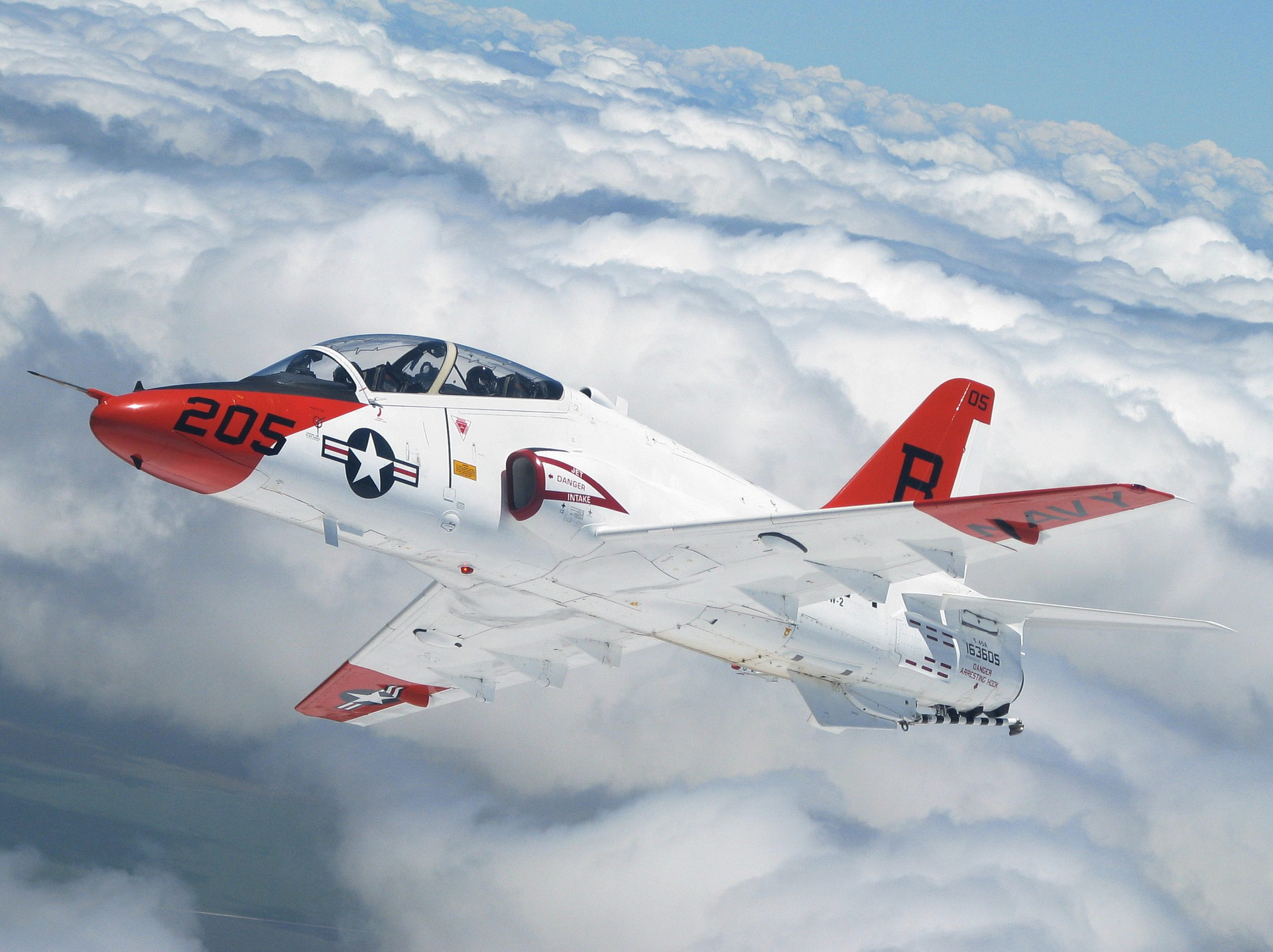
The U.S. Navy’s carrier-capable jet trainer — a navalised British Hawk rebuilt to be catapulted off, and trapped back onto, a carrier deck, and the aircraft every Navy and Marine jet aviator learns the boat on.
The T-45 Goshawk: how the U.S. Navy turned a British trainer into a carrier jet
By the late 1970s the U.S. Navy needed to replace an ageing patchwork of jet trainers — the T-2 Buckeye and TA-4 Skyhawk — with a single modern aircraft that could take a student from basic jets all the way to the one thing no other air arm has to teach: landing a jet on a moving aircraft carrier. Rather than design a clean-sheet trainer, the Navy went shopping, and in November 1981 it chose an unlikely winner — the British Aerospace Hawk, the nimble RAF trainer better known abroad as the mount of the Red Arrows.
The Hawk was a superb land-based trainer, but it had never been near a carrier. Turning it into the T-45 Goshawk was a far bigger job than a coat of grey paint. McDonnell Douglas, teamed with British Aerospace, rebuilt the airframe around the brutal loads of catapult launches and arrested landings: a strengthened structure, a full-stroke twin-wheel nose gear that could be slammed onto a steam catapult, beefed-up twin-wheel main gear, and an arrestor hook to catch the wire on recovery. The low-speed handling needed for a carrier approach was reworked too, with revised aerodynamics and added devices to keep the jet stable and controllable behind the boat.
The first T-45A flew on 16 April 1988 and reached training squadrons in the early 1990s. It was not a fast or a fighting aircraft — subsonic, unarmed, powered by a single non-afterburning Rolls-Royce Adour turbofan — but that was never the point. The Goshawk exists to make naval aviators. The analog-cockpit T-45A was followed by the digital “glass-cockpit” T-45C from the late 1990s, and today — after McDonnell Douglas merged into Boeing — the roughly 221 Goshawks built remain the U.S. Navy and Marine Corps’ only carrier-capable jet trainer, the last gate every strike aviator passes before the fleet.
01The T-45 Goshawk’s British roots: from RAF Hawk to Navy carrier trainer
The Hawk first flew in 1974 and entered RAF service as a fast-jet trainer and light attack aircraft; it is the aircraft the Red Arrows display team flies to this day. When the U.S. Navy’s VTXTS trainer competition picked the Hawk in 1981, it launched one of the more unusual transatlantic defence programmes of the era: a British design, navalised and largely built in the United States by McDonnell Douglas, with British Aerospace as partner and Rolls-Royce providing the engine.
The result kept the Hawk’s clean lines but changed enough underneath that the T-45 is best understood as a carrier-specific cousin rather than a straight copy. Where the RAF Hawk was optimised for economical land-based flying, the Goshawk was rebuilt for the single most demanding routine in military aviation — the catapult shot and the arrested landing — repeated by students who have never done it before.
What makes the T-45 Goshawk special
A British Hawk, rebuilt for the boat
The Goshawk keeps the Hawk’s shape but not its structure. To survive carrier operations McDonnell Douglas gave it a strengthened airframe, an arrestor hook to catch the arresting wire on landing, and hard points to absorb the shock of a catapult launch — loads a normal trainer never sees. It is the naval conversion, not the airframe, that defines the aircraft.
New gear and carrier-approach aerodynamics
Carrier work meant a catapult-capable twin-wheel nose gear and stronger twin-wheel main gear, plus reworked low-speed aerodynamics — revised flaps, added lift and drag devices and twin side-mounted airbrakes — so a student can hold a stable, controllable approach at the precise speed the deck demands.
One Rolls-Royce Adour, no afterburner
Power comes from a single Rolls-Royce F405 Adour non-afterburning turbofan of roughly 26 kN (about 5,845 lbf). It is deliberately modest: the Goshawk is subsonic and unarmed, built for reliability, predictable handling and low running cost rather than raw performance.
02The T-45 Goshawk’s carrier gear: the hook, the cat and the twin-wheel nose
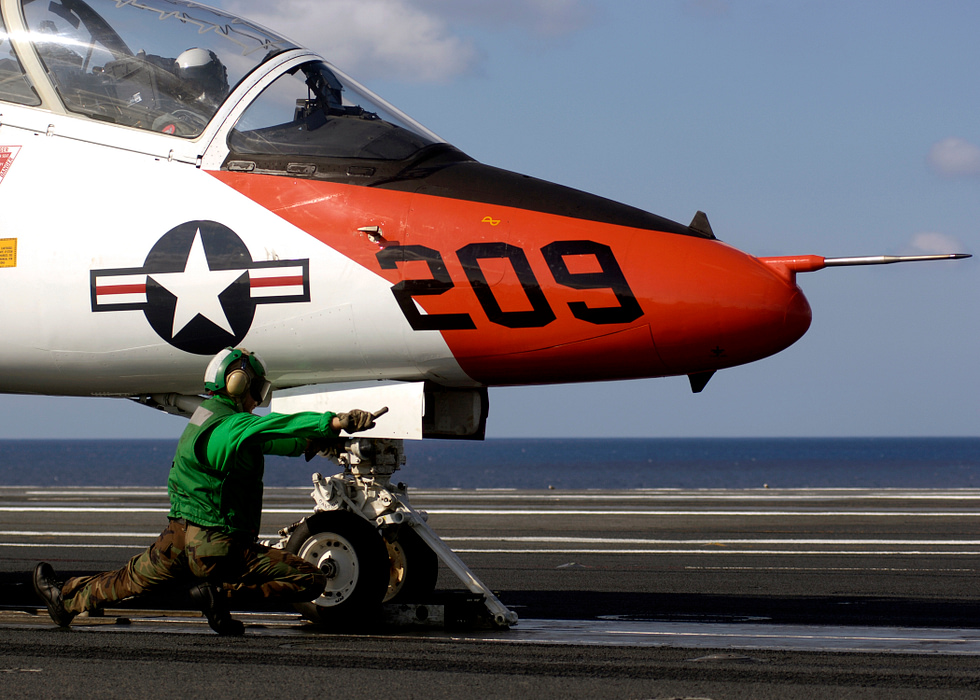
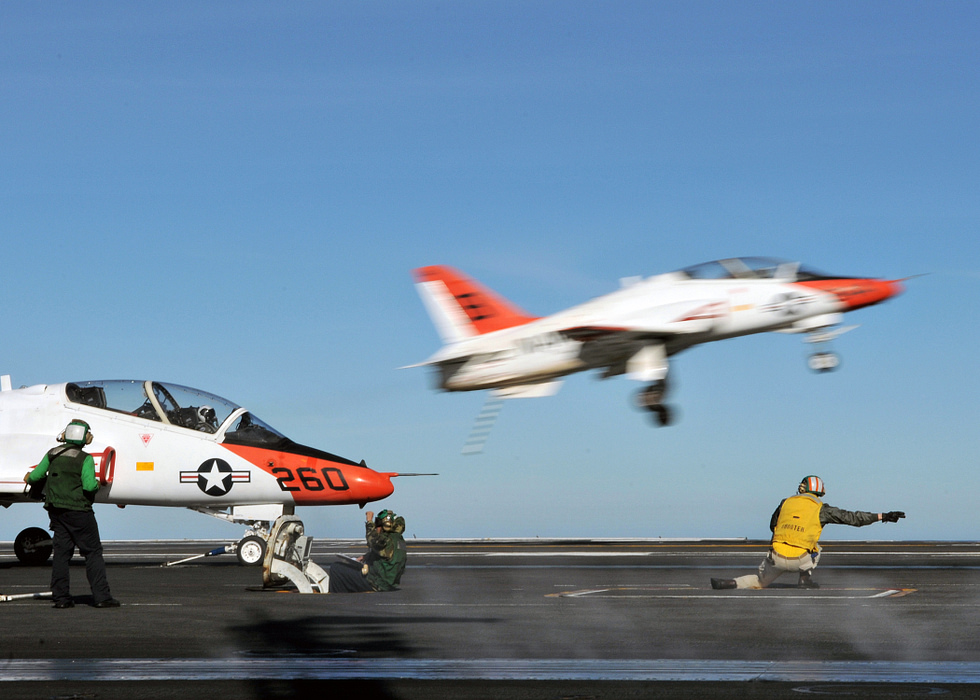
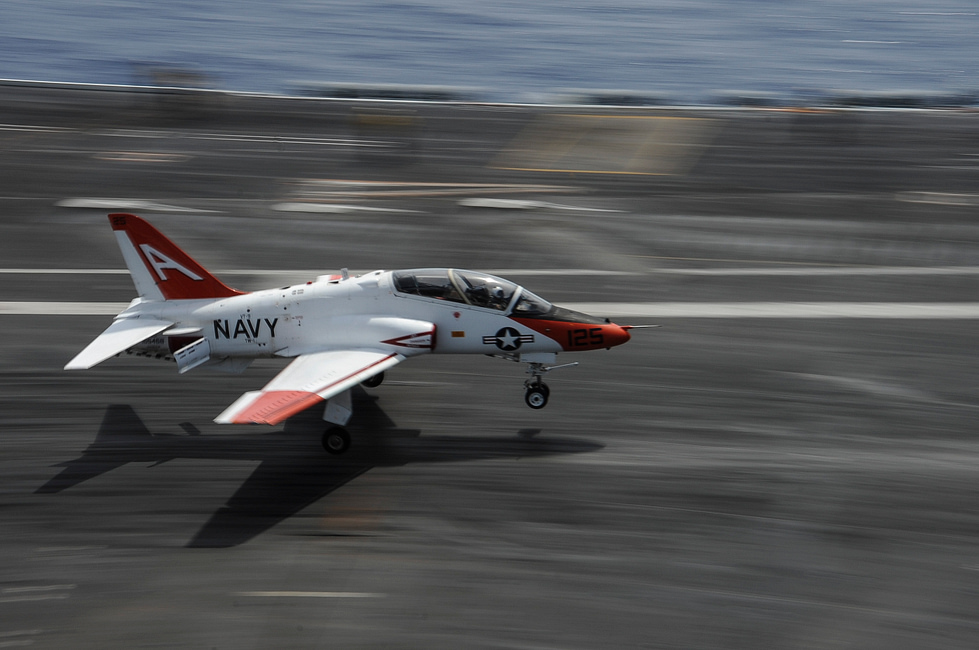
Two changes turn a land trainer into a carrier aircraft: the hook and the nose gear. The Goshawk’s arrestor hook drops to snag one of the deck’s arresting wires, decelerating the jet from approach speed to a stop in about two seconds. Its nose gear is a long-stroke, twin-wheel unit strong enough to be attached to a steam catapult and flung down the deck, and to take the jolt of a firm, no-flare carrier landing that would punish a conventional trainer’s undercarriage. The main gear was similarly reinforced with twin wheels. None of this makes the T-45 faster — it makes it survivable at the boat.
03The T-45A and T-45C: the Goshawk’s analog and glass cockpits
The first Goshawks, the T-45A, had a conventional analog cockpit. From the late 1990s the Navy introduced the T-45C, built around a modern digital “glass” cockpit — often referred to as Cockpit 21 — with multi-function displays in place of dials. This let students train on the kind of digital displays they would meet in front-line aircraft such as the F/A-18 Super Hornet, and earlier T-45As were progressively brought up to a comparable standard. The T-45C is the version that carries the fleet’s training today.
Full T-45 Goshawk specifications
Airframe & Performance
- 全体人员
- 2 (student & instructor, tandem)
- 长度
- 11.97 m (39 ft 3 in)
- 翼展
- 9.39 m (30 ft 10 in)
- 高度
- 4.08 m (13 ft 5 in)
- Max takeoff weight
- ~5,787 kg (~12,760 lb)
- Max speed
- ~997 km/h · Mach 0.85
- 设备天花板
- ~12,875 m (42,250 ft)
- Range (ferry)
- ~1,850 km (~1,000 nmi)
- First flight
- 16 April 1988
- 武器
- None (unarmed trainer)
Propulsion, Cost & Systems
- 引擎
- 1 × Rolls-Royce F405-RR-401 Adour turbofan
- 推力
- ~26 kN (~5,845 lbf), no afterburner
- Cockpit
- T-45C: digital “glass” (Cockpit 21)
- 制造商
- McDonnell Douglas / BAE (now Boeing)
- Built
- ~221 (1988–2009)
- Variants
- T-45A (analog), T-45C (digital)
- Unit cost
- ~$17–18 million (commonly cited estimate)
- Cost per flight hour
- ~$5,000 (U.S. Navy estimate; varies, hedged)
04The T-45 Goshawk’s operating costs: what a carrier trainer costs to fly
As a training aircraft the T-45 was chosen partly because it is comparatively cheap to run, but exact figures are slippery. A rough flyaway unit cost of around $17–18 million is commonly cited, though numbers vary with year, batch and how support is counted. For hourly operating cost, U.S. Navy budget and readiness documents have pointed to figures in the region of a few thousand dollars per flight hour — often quoted around $5,000 — but there is no single authoritative public number, and any precise dollar figure should be treated as an estimate. What is not in doubt is the comparison: an hour in the Goshawk costs a small fraction of an hour in the front-line fighters its graduates go on to fly.
The T-45 Goshawk: from British trainer to fleet fixture
The Hawk flies
The British Aerospace Hawk, the T-45’s parent design, makes its first flight and enters RAF service as a jet trainer.
The Navy picks the Hawk
In November the U.S. Navy’s VTXTS trainer competition selects the McDonnell Douglas / British Aerospace Hawk to become its new carrier-capable trainer.
First flight of the T-45A
The navalised T-45A Goshawk flies for the first time on 16 April 1988.
Into training service
Deliveries begin and the T-45A enters the Navy’s undergraduate jet-training pipeline, taking on carrier qualification duties.
The glass-cockpit T-45C
The digital-cockpit T-45C arrives, the same year McDonnell Douglas merges into Boeing.
Production ends
The last of roughly 221 Goshawks is delivered, closing the production line.
The oxygen stand-down
Concern over the on-board oxygen system (OBOGS) and hypoxia-like “physiological episodes” leads instructor pilots to pause flying; the Navy grounds and then reforms the fleet with corrective fixes.
Still on the wire
Decades on, the Goshawk remains the U.S. Navy and Marine Corps’ only carrier jet trainer while the Navy studies its eventual replacement.
From the flight line: twelve T-45 Goshawk stories
The Navy buys British
How an RAF trainer won America’s VTXTS competition.
Read the full story
More than grey paint
Turning a land trainer into a carrier jet meant rebuilding it.
Read the full story
The hardest thing in aviation
The Goshawk exists to teach the arrested carrier landing.
Read the full story
From dials to glass
The T-45C swapped analog gauges for digital displays.
Read the full story
One Adour, no reheat
A single British turbofan, chosen for economy over speed.
Read the full story
Kingsville and Meridian
The Goshawk trains from a handful of Navy air stations.
Read the full story
The oxygen revolt
In 2017 T-45 instructors refused to fly over hypoxia fears.
Read the full story
Cousin of the Red Arrows
The T-45 shares its bloodline with a world-famous display jet.
Read the full story
A warplane that never fights
The Goshawk carries no weapons and flies no missions.
Read the full story
The only one of its kind
No other U.S. jet trainer can go to the carrier.
Read the full story
221 and counting down
A modest fleet that has punched far above its size.
Read the full story
What comes after the Goshawk
The Navy is studying how to replace an irreplaceable trainer.
Read the full story
The T-45 Goshawk in pictures
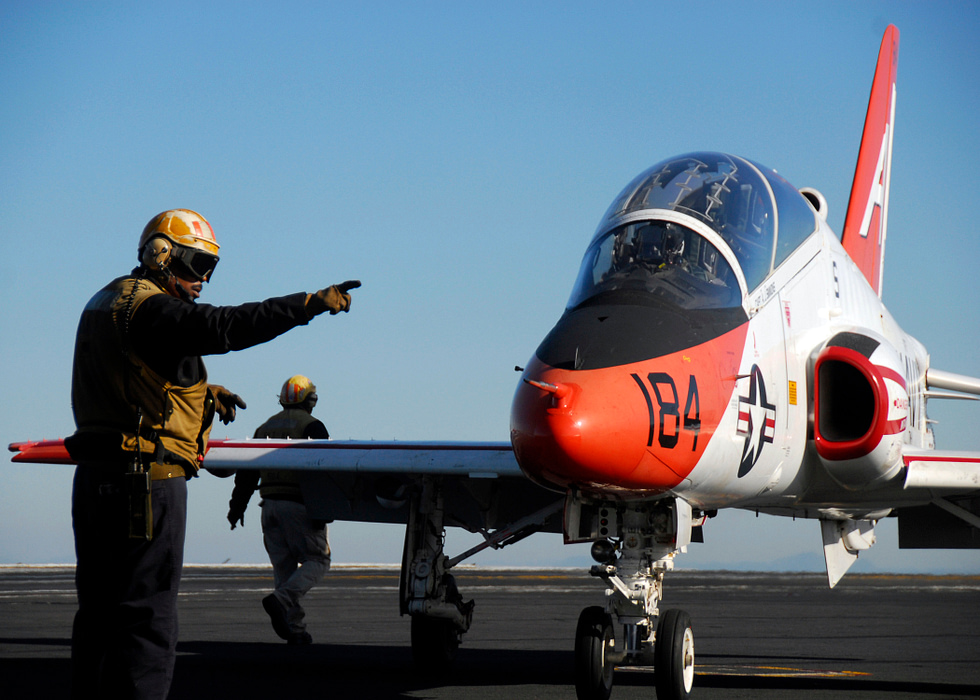
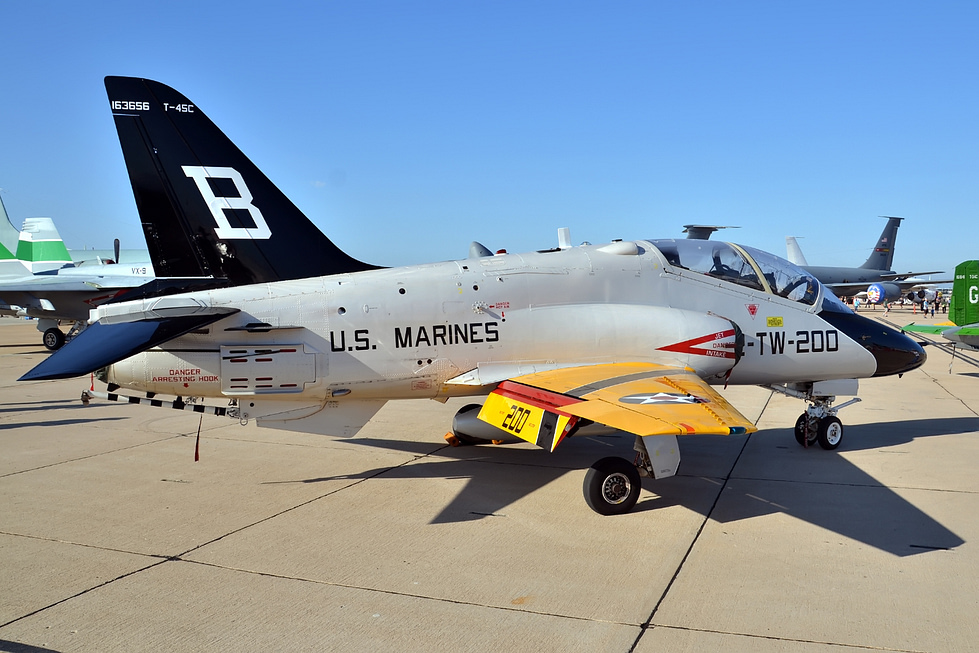
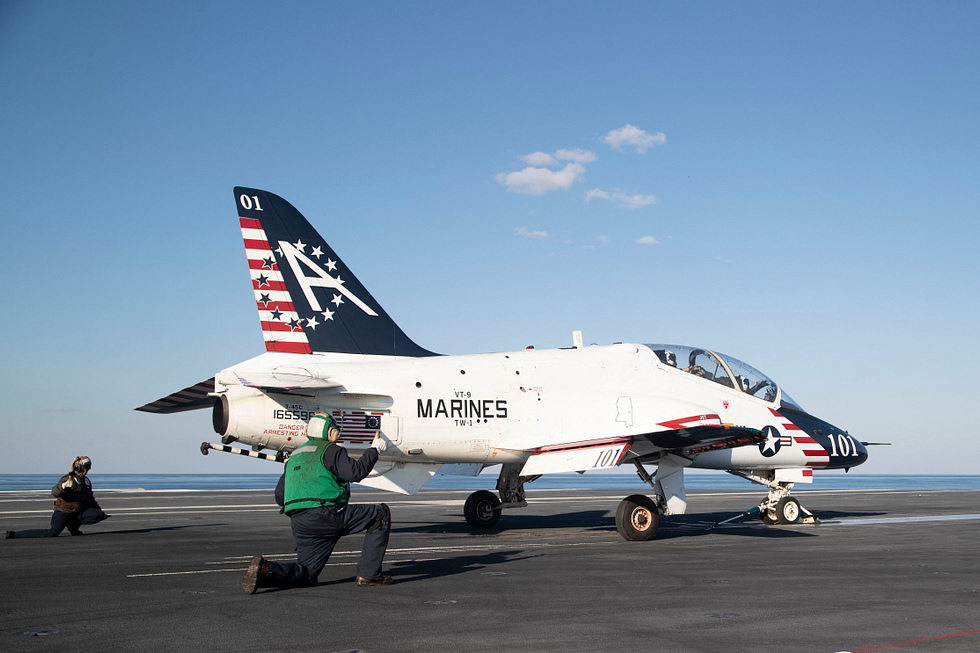
The T-45 Goshawk in motion
Media Magik Entertainment: authentic head-up display footage from a U.S. Navy T-45C Goshawk — a dramatic look at the trainer from the cockpit during a bird-strike emergency. Over 1.1 million views.
Where the T-45 Goshawk flies
The T-45 Goshawk: a trainer, not a warplane
The Goshawk has no combat record and carries no weapons — that was never its job. Its record is written in students trained and carrier landings logged. Almost every U.S. Navy and Marine strike and carrier aviator of the last three decades passed through it on the way to the fleet.
See how the front-line jets its graduates go on to fly compare in the combat record of every military aircraft.
Everything people ask about the T-45 Goshawk
Can I fly in a T-45 Goshawk?
Who makes the T-45 Goshawk?
What is the T-45 based on?
What is the difference between the T-45A and T-45C?
Is the T-45 the only carrier-capable jet trainer?
What was the 2017 T-45 oxygen problem?
How fast is the T-45 Goshawk?
Is the T-45 still in service or being replaced?
You can’t fly the T-45 Goshawk.
These, you can.
Some legends only live in museums — others are fuelled and waiting. MiGFlug has put civilians in real military jet cockpits since 2004.
 Fly the L-39 AlbatrosThe world’s most-flown jet trainer — aerobatics included
 Fly the F-104 Starfighter“The missile with a man in it”
 Fly the MiG-21The Cold War’s most-produced jet
 驾驶T-33流星战斗机America’s first jet trainer
 Fly the DH VampireA piece of early jet history
 Fly the S.211Agile Italian jet trainer
 Fly the MB-326The classic Aermacchi jet
 Fly the MiG-15The Soviet legend of the Korean War
Continue the tour
Every fact, checked
- Naval Air Systems Command (NAVAIR) — T-45 GoshawkThe U.S. Navy programme office reference for the aircraft’s role and status.
- U.S. Navy Fact FileOfficial Navy data on the T-45 as its carrier-capable training aircraft.
- Boeing — T-45 Goshawk historyThe manufacturer’s account of the McDonnell Douglas / BAE programme.
- BAE Systems — HawkBackground on the parent Hawk design the Goshawk was developed from.
- Rolls-Royce — Defence aerospace (Adour)Reference for the Adour turbofan that powers the T-45.
- USNI NewsReporting on the 2017 T-45 OBOGS physiological-episode stand-down and the Navy’s response.
- National Naval Aviation Museum (Pensacola)Naval aviation history and preserved training aircraft, including the T-45.
- Chief of Naval Air Training (CNATRA)The command that runs T-45 undergraduate jet training at Kingsville and Meridian.