
Boeing (McDonnell Douglas)
T-45 “Goshawk”
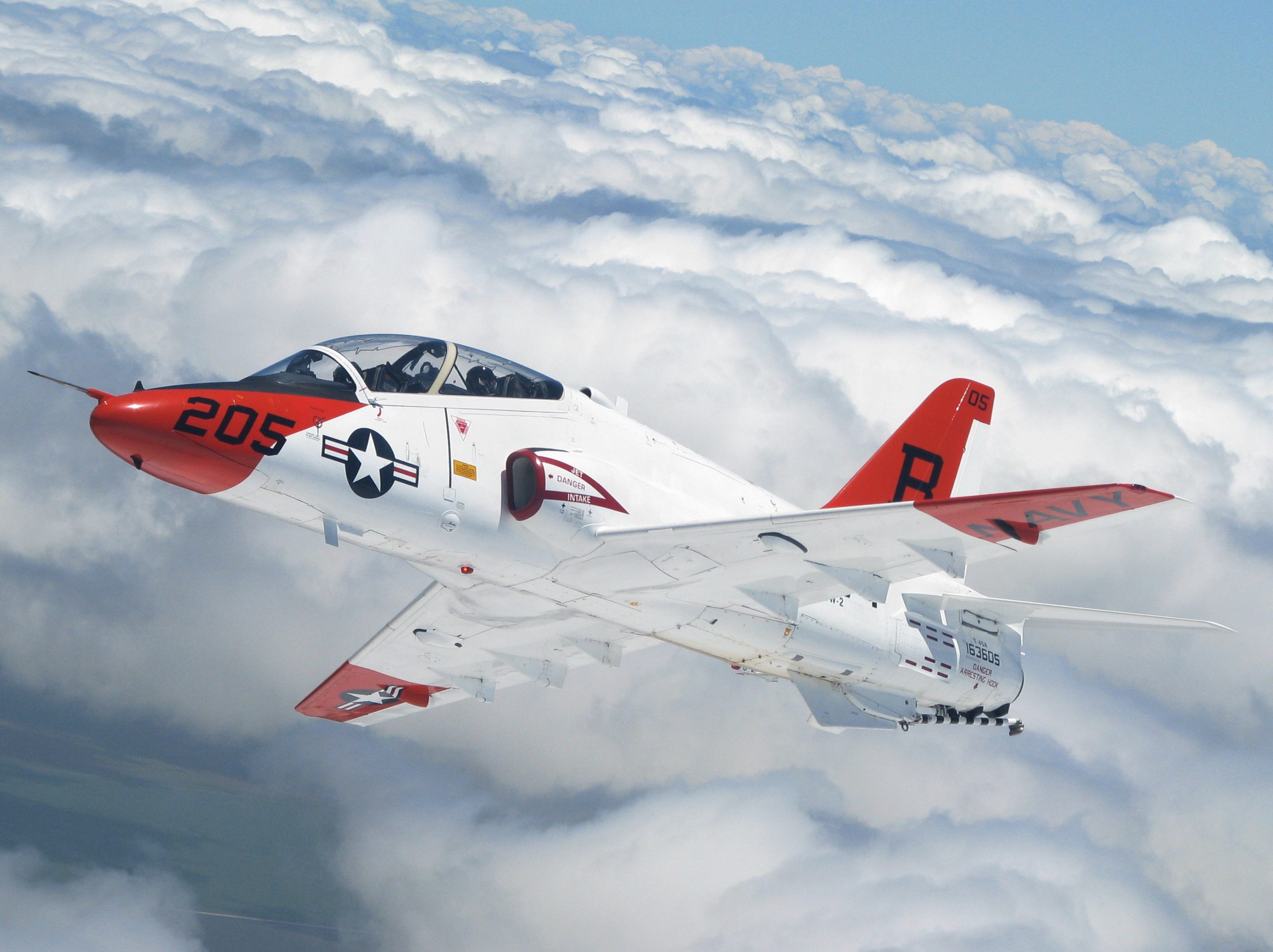
The U.S. Navy’s carrier-capable jet trainer — a navalised British Hawk rebuilt to be catapulted off, and trapped back onto, a carrier deck, and the aircraft every Navy and Marine jet aviator learns the boat on.
The T-45 Goshawk: how the U.S. Navy turned a British trainer into a carrier jet
By the late 1970s the U.S. Navy needed to replace an ageing patchwork of jet trainers — the T-2 Buckeye and TA-4 Skyhawk — with a single modern aircraft that could take a student from basic jets all the way to the one thing no other air arm has to teach: landing a jet on a moving aircraft carrier. Rather than design a clean-sheet trainer, the Navy went shopping, and in November 1981 it chose an unlikely winner — the British Aerospace Hawk, the nimble RAF trainer better known abroad as the mount of the Red Arrows.
The Hawk was a superb land-based trainer, but it had never been near a carrier. Turning it into the T-45 Goshawk was a far bigger job than a coat of grey paint. McDonnell Douglas, teamed with British Aerospace, rebuilt the airframe around the brutal loads of catapult launches and arrested landings: a strengthened structure, a full-stroke twin-wheel nose gear that could be slammed onto a steam catapult, beefed-up twin-wheel main gear, and an arrestor hook to catch the wire on recovery. The low-speed handling needed for a carrier approach was reworked too, with revised aerodynamics and added devices to keep the jet stable and controllable behind the boat.
The first T-45A flew on 16 April 1988 and reached training squadrons in the early 1990s. It was not a fast or a fighting aircraft — subsonic, unarmed, powered by a single non-afterburning Rolls-Royce Adour turbofan — but that was never the point. The Goshawk exists to make naval aviators. The analog-cockpit T-45A was followed by the digital “glass-cockpit” T-45C from the late 1990s, and today — after McDonnell Douglas merged into Boeing — the roughly 221 Goshawks built remain the U.S. Navy and Marine Corps’ only carrier-capable jet trainer, the last gate every strike aviator passes before the fleet.
01The T-45 Goshawk’s British roots: from RAF Hawk to Navy carrier trainer
The Hawk first flew in 1974 and entered RAF service as a fast-jet trainer and light attack aircraft; it is the aircraft the Red Arrows display team flies to this day. When the U.S. Navy’s VTXTS trainer competition picked the Hawk in 1981, it launched one of the more unusual transatlantic defence programmes of the era: a British design, navalised and largely built in the United States by McDonnell Douglas, with British Aerospace as partner and Rolls-Royce providing the engine.
The result kept the Hawk’s clean lines but changed enough underneath that the T-45 is best understood as a carrier-specific cousin rather than a straight copy. Where the RAF Hawk was optimised for economical land-based flying, the Goshawk was rebuilt for the single most demanding routine in military aviation — the catapult shot and the arrested landing — repeated by students who have never done it before.
What makes the T-45 Goshawk special
A British Hawk, rebuilt for the boat
The Goshawk keeps the Hawk’s shape but not its structure. To survive carrier operations McDonnell Douglas gave it a strengthened airframe, an arrestor hook to catch the arresting wire on landing, and hard points to absorb the shock of a catapult launch — loads a normal trainer never sees. It is the naval conversion, not the airframe, that defines the aircraft.
New gear and carrier-approach aerodynamics
Carrier work meant a catapult-capable twin-wheel nose gear and stronger twin-wheel main gear, plus reworked low-speed aerodynamics — revised flaps, added lift and drag devices and twin side-mounted airbrakes — so a student can hold a stable, controllable approach at the precise speed the deck demands.
One Rolls-Royce Adour, no afterburner
Power comes from a single Rolls-Royce F405 Adour non-afterburning turbofan of roughly 26 kN (about 5,845 lbf). It is deliberately modest: the Goshawk is subsonic and unarmed, built for reliability, predictable handling and low running cost rather than raw performance.
02The T-45 Goshawk’s carrier gear: the hook, the cat and the twin-wheel nose
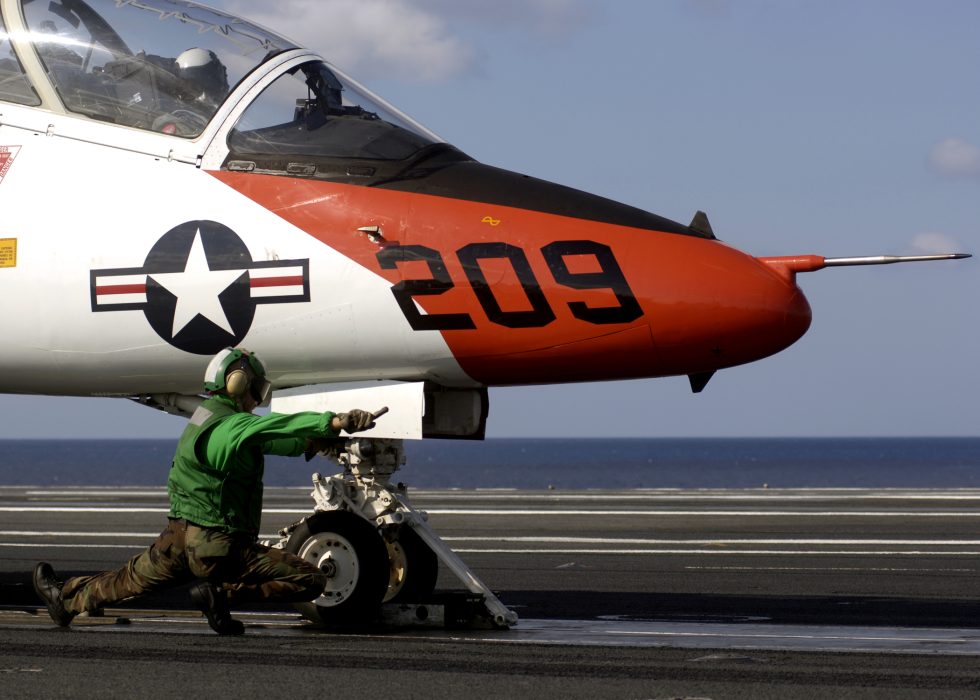
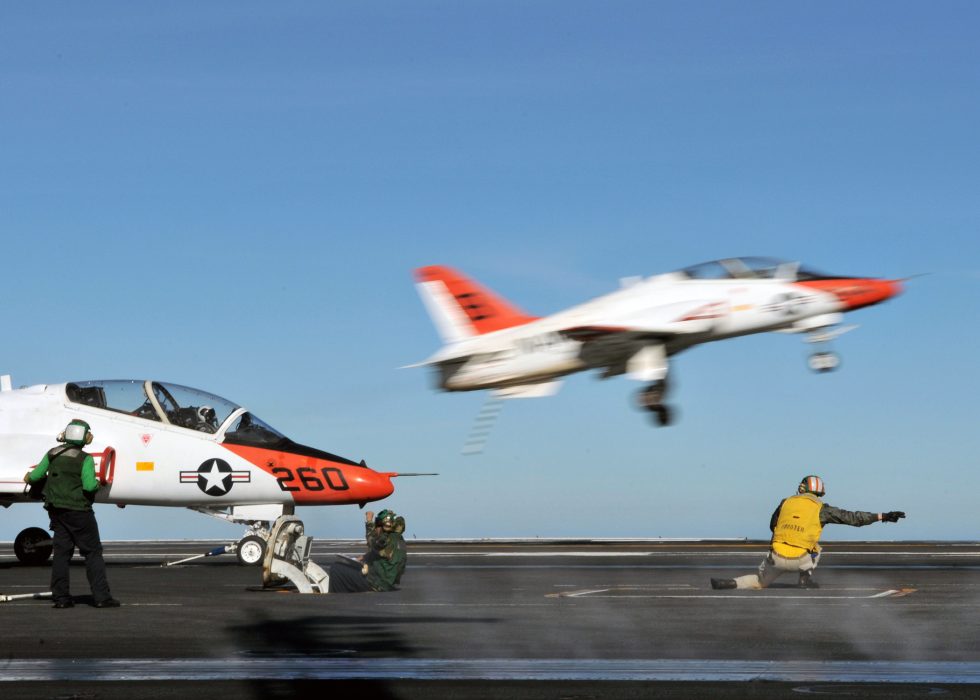
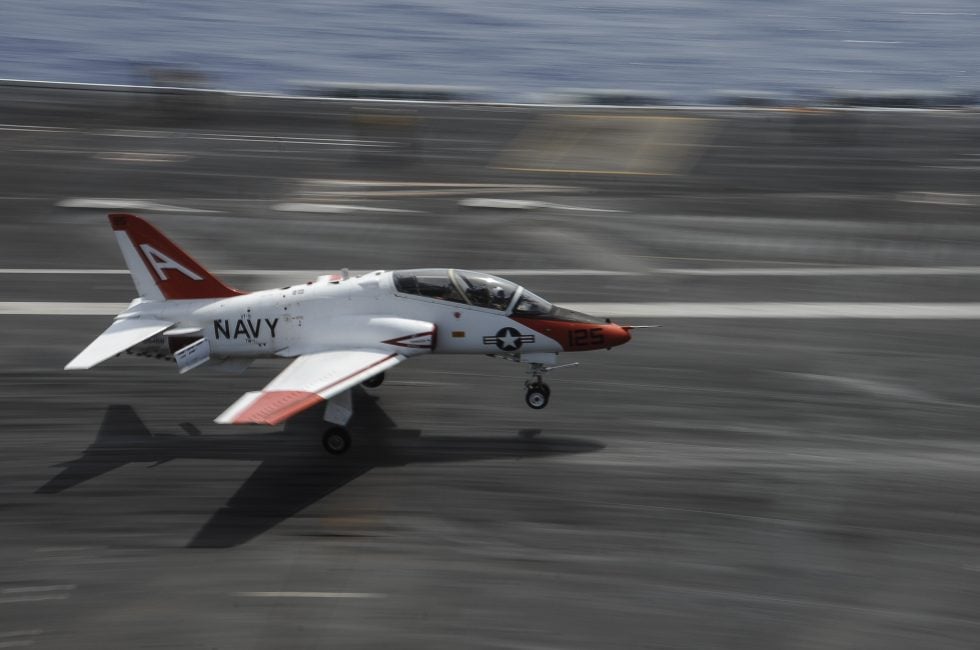
Two changes turn a land trainer into a carrier aircraft: the hook and the nose gear. The Goshawk’s arrestor hook drops to snag one of the deck’s arresting wires, decelerating the jet from approach speed to a stop in about two seconds. Its nose gear is a long-stroke, twin-wheel unit strong enough to be attached to a steam catapult and flung down the deck, and to take the jolt of a firm, no-flare carrier landing that would punish a conventional trainer’s undercarriage. The main gear was similarly reinforced with twin wheels. None of this makes the T-45 faster — it makes it survivable at the boat.
03The T-45A and T-45C: the Goshawk’s analog and glass cockpits
The first Goshawks, the T-45A, had a conventional analog cockpit. From the late 1990s the Navy introduced the T-45C, built around a modern digital “glass” cockpit — often referred to as Cockpit 21 — with multi-function displays in place of dials. This let students train on the kind of digital displays they would meet in front-line aircraft such as the F/A-18 Super Hornet, and earlier T-45As were progressively brought up to a comparable standard. The T-45C is the version that carries the fleet’s training today.
Full T-45 Goshawk specifications
Baseline note: the figures below describe the T-45C Goshawk as it stands in United States Navy service today — the glass-cockpit standard, either built that way from December 1997 or converted from a T-45A under the avionics modernisation programme that began in 2003, and since 2018 fitted with the redesigned Cobham GGU-25 oxygen generator. Every Goshawk still flying is a T-45C; the T-45A no longer exists as a distinct aeroplane. Deltas for the original analogue-cockpit T-45A, for the cancelled land-based T-45B and for the land-based BAE Hawk the type was carved out of are given in grey. Two warnings about T-45 numbers. First, thrust: the Adour is installed de-rated for training life, so a nominal figure and an installed figure are both published and they are not the same number. Second, weights: the Goshawk gained mass steadily through its production life as structure, fuel and equipment were added, so a single empty weight covers a range of airframes. Where authorities disagree, it is said so.
Dimensions & weights
- Crew
- 2 — student forward, instructor aft on a raised seat with a full duplicate instrument fit and its own head-up display repeater. Unlike the two-seat conversions of front-line fighters, the Goshawk was designed from the outset as a two-seater and neither station is an afterthought
- Length
- 11.99 m (39 ft 4 in) — some 450 mm shorter than a Hawk T1, because the Goshawk carries no braking parachute housing and the tail was rebuilt around the arrestor hook
- Wingspan
- 9.39 m (30 ft 9.75 in) over the squared-off tips adopted during carrier trials; the land-based Hawk has rounded tips and a marginally greater span
- Height
- 4.11 m (13 ft 6 in), including the 152 mm (6 in) fin extension added during development to recover the directional stability lost when the side airbrakes were fitted
- Wing area
- 17.66 m² (190.1 sq ft)
- Aerofoil
- Hawker 10.9 per cent at the root, Hawker 9 per cent at the tip — the Hawk section, but with full-span leading-edge slats added after early flight test showed uncommanded roll at the stall exceeding 90°. The slats are the single most important aerodynamic change made for the Navy and the one that cost the most time
- Undercarriage
- Retractable tricycle, twin nosewheels — the Hawk has one. The pair carries the nose-tow launch bar and the loads a steam catapult puts through it. Track and stroke were both increased and the legs are new, not strengthened Hawk legs
- Empty weight
- 4,261 kg (9,394 lb) — several hundred kilogrammes above the land-based Hawk of the same generation. Published Hawk weights vary so widely between marks that a precise delta is not worth quoting, but the direction is not in doubt: navalisation made the aeroplane heavier everywhere it touched
- Gross weight
- 5,783 kg (12,750 lb) — the normal training weight, clean
- Maximum take-off weight
- 6,123 kg (13,500 lb)
- Wing loading
- 328 kg/m² (67.1 lb/sq ft) at gross weight — deliberately kept low. Approach speed is the whole argument in a carrier trainer, and every kilogramme of hook, launch bar and structure had to be paid for by keeping the wing large and adding slats
- Internal fuel
- ~1,640 L (432 US gal, 360 imp gal), about 1,433 kg (3,159 lb). Early production aircraft carried ~1,312 kg (2,893 lb); the increase came with later blocks
- External fuel
- 2 × 590 L (156 US gal, 130 imp gal) underwing tanks — carried for ferry and cross-country, rarely for a syllabus sortie
- Design sink rate at touchdown
- 4.3 m/s (14 ft/s) — the number that drove the entire redesign. A land-based trainer is built for roughly a third of that. This one figure explains the new undercarriage, the strengthened keel and frames, the reinforced engine mounting and most of the added weight
Performance
- Maximum speed
- 1,006 km/h (543 kn, 625 mph) at 2,440 m (8,000 ft)
- Maximum Mach number
- M0.84 at 9,145 m (30,000 ft) — the Goshawk is subsonic, and deliberately so. Students learn supersonic flight in the fleet aeroplane, not in the trainer
- Never-exceed speed
- 1,065 km/h (575 kn, 662 mph); the design dive limit is M1.04 at 3,050 m (10,000 ft)
- Approach speed
- 232 km/h (125 kn) — the figure the whole aeroplane exists to achieve. Getting it down to this from the Hawk baseline took the slats, the squared tips and years of flight test
- Minimum catapult end speed
- 224 km/h (121 kn) — low enough for the short-stroke catapults of USS Lexington, the elderly training carrier that set the requirement
- Rate of climb
- 41 m/s (8,000 ft/min) at sea level, clean
- Time to 9,145 m (30,000 ft)
- 7 min 40 s
- Service ceiling
- 12,950 m (42,500 ft)
- Range
- ~1,300 km (700 nmi, 810 mi) — ferry and maximum range are quoted as the same figure, which tells you the type carries no meaningful reserve of endurance. Sorties are measured in tens of minutes, not hours
- Load factor limits
- +7.33 / −3.0 g — enough to teach the fleet manoeuvring envelope without teaching the fatigue habits that a 9 g aeroplane would
- Take-off distance to 15 m (50 ft)
- 1,100 m (3,610 ft)
- Landing distance from 15 m (50 ft)
- 1,010 m (3,310 ft) ashore; aboard ship the number is the length of a Fresnel lens pass and three wires
- Thrust-to-weight ratio
- 0.41 at gross weight — modest, and the source of the type’s most persistent complaint. Slow spool-up on a wave-off is the thing every T-45 instructor mentions first
Propulsion & systems
- Engine
- 1 × Rolls-Royce Turbomeca F405-RR-401 non-afterburning turbofan — the naval designation for the Adour Mk 871. Two-shaft, unreheated, and the same family that powers the Jaguar and the land-based Hawk. The casing and mounting were strengthened for catapult and arrested-landing loads
- Thrust
- 24.6 kN (5,527 lbf) as installed and de-rated for engine life; 26.0 kN (5,845 lbf) is the nominal rating. Published T-45 thrust figures disagree almost entirely because writers pick one of these two without saying which
- Engine handling
- Documented through development for self-clearing pop stalls, pop surges and occasional locked-in surges during hard manoeuvring — a higher-bypass engine was flown in 1997 to cure it and did not. An F124-powered T-45A also flew on 7 October 1996 as an alternative; the Navy pursued neither
- Fuel system
- Smiths Industries fuel management, single-point pressure refuelling; no in-flight refuelling capability of any kind
- Oxygen
- Cobham GGU-25 onboard oxygen generating system — the replacement for the GGU-7 that caused the 2017 crisis. The Goshawk carries no liquid-oxygen converter and no bottled backup beyond the emergency supply in the seat pack
- Cockpit displays
- Two 127 mm (5 in) Elbit monochrome multi-function displays per cockpit plus a Smiths Industries head-up display with recording video camera — the "Cockpit 21" fit that defines the T-45C. The T-45A had round dials and a simple HUD, and by the late 1990s that was already a generation behind the F/A-18 the students were going to
- Navigation
- AN/ASN-166 inertial guidance set with Litton LN-100G ring laser gyro and Rockwell Collins GPS; AN/ASN-180 navigation guidance system replacing the earlier AN/USN-2(V) attitude and heading reference; AN/ARN-144 VOR/ILS; AN/APN-194 radar altimeter
- Communications and identification
- AN/ARC-182 UHF/VHF radio; AN/APX-100 IFF transponder
- Virtual Mission Training System
- Elbit synthetic radar, contracted in July 2008 and fully operational at NAS Pensacola in January 2014 — it paints a simulated mechanically scanned tactical radar picture with air-to-air and air-to-ground modes on the MFDs, and data-links aircraft to each other and to an instructor station on the ground. This is what lets a naval flight officer learn radar intercepts in an aeroplane that has no radar at all
- Escape system
- Martin-Baker Mk 14 NACES zero-zero ejection seats, command-selectable sequencing — the same seat family fitted to the F/A-18, which is the point: the student learns one set of drills and keeps it
- Carrier equipment
- Nose-tow launch bar on the twin nosewheel, A-frame arrestor hook, approach-power compensation and an angle-of-attack indexer — none of this exists on a land-based Hawk, and none of it could simply be bolted on
- Airbrakes and strakes
- Twin fuselage side airbrakes replacing the Hawk’s single ventral brake, which would have fouled the hook; a ventral fin ahead of the hook; and SMURFS — side-mounted upper rear fuselage strakes — on the tailplane roots to keep the airflow attached over the horizontal tail with the brakes deployed. The SMURFS are the visible scar of a problem that only appeared once the brakes had been moved
04The T-45 Goshawk’s operating costs: what a carrier trainer costs to fly
As a training aircraft the T-45 was chosen partly because it is comparatively cheap to run, but exact figures are slippery. A rough flyaway unit cost of around $17–18 million is commonly cited, though numbers vary with year, batch and how support is counted. For hourly operating cost, U.S. Navy budget and readiness documents have pointed to figures in the region of a few thousand dollars per flight hour — often quoted around $5,000 — but there is no single authoritative public number, and any precise dollar figure should be treated as an estimate. What is not in doubt is the comparison: an hour in the Goshawk costs a small fraction of an hour in the front-line fighters its graduates go on to fly.
Armament & payload
The Goshawk carries no weapons, and that is a deliberate design decision rather than an omission
The T-45 is an unarmed aeroplane. It has one hardpoint under each wing and one on the centreline, and in Navy service those three stations see practice bomb racks, rocket pods for practice rounds, ferry tanks and a baggage pod — nothing else. There is no gun, no gun pod, no missile rail, no radar and no self-protection suite. The land-based Hawks the Goshawk descends from can be and often are armed: the RAF fitted a centreline 30 mm ADEN pod and Sidewinder rails to its Hawk T1As for point defence, and export Hawk 100 and 200 series aircraft are genuine light attack aeroplanes. The Navy wanted none of that. It bought a machine to teach carrier aviation, and every kilogramme spent on weapons capability was a kilogramme not spent on the structure needed to survive a catapult stroke twice a day for thirty years. Because the type is unarmed, the six cards below are repurposed to describe what the Goshawk actually carries and what it deliberately does not; a reader looking for a weapons fit will find honest blanks rather than padding.
Gun
- None. No internal cannon, no gun pod, no provision for either. The T-45 has never carried a gun in United States Navy service.
- The parent Hawk can. RAF Hawk T1A aircraft carried a centreline pod with a single 30 mm ADEN cannon and 120 rounds; the Hawk 200 has twin 25 mm ADEN cannon internally.
- Air-to-air and air-to-ground gunnery is taught in the fleet replacement squadron on the F/A-18, not in the trainer.
- The centreline station that would carry a gun pod on a Hawk is used on the Goshawk for a crew baggage container.
Practice bombs
- Mk 76 practice bomb, 11 kg (25 lb) — the standard blue inert store with a spotting charge. Up to 12 can be carried on multiple ejector racks.
- BDU-33 practice bomb, 11 kg (25 lb) — the equivalent store in general United States service, used interchangeably on the same racks.
- Aero 7 series practice multiple bomb racks on the two underwing stations; a typical range sortie carries six.
- No live ordnance of any kind is cleared. The wiring, the release logic and the software are all present, because the point of the exercise is to teach the switchology; the store on the rack is inert.
Rockets
- 70 mm (2.75 in) rocket pods for practice rounds on the underwing stations — carried for weapons-delivery training at Meridian and Kingsville range complexes.
- Practice heads only; the Goshawk is not cleared for high-explosive or flechette warheads.
- In practice, rocket sorties are a small minority of the syllabus. Most T-45 flying is instruments, formation, air combat manoeuvring and the landing pattern.
- Nothing larger has ever been cleared. There is no 127 mm Zuni capability.
Fuel and cargo stores
- 2 × 590 L (156 US gal, 130 imp gal) underwing drop tanks — carried for cross-country transits and detachments, not for syllabus sorties.
- Centreline baggage pod for aircrew kit on cross-country and carrier-qualification detachments. Two pilots deploying to a ship for a week need somewhere to put their bags.
- No conformal tanks, no buddy refuelling store, no in-flight refuelling probe or receptacle.
- With tanks fitted the type’s quoted range is unchanged at ~1,300 km (700 nmi), which suggests the published figure already assumes them.
Sensors and simulated weapons
- No radar. The Goshawk has never carried one, in any mark, in any configuration.
- Elbit Virtual Mission Training System — a synthetic radar picture generated in software and drawn on the multi-function displays, with air-to-air and air-to-ground modes matched to the F/A-18 presentation. Operational from January 2014 at NAS Pensacola.
- VMTS aircraft are data-linked to each other and to a ground instructor station, so a formation can be flown against threats that exist only in the network.
- Head-up display video recording for debrief; weapons-delivery symbology on the MFDs driven by the mission computer rather than by anything on the rack.
What the Goshawk deliberately does not carry
- No air-to-air missiles. No AIM-9 Sidewinder rails, despite the parent Hawk carrying them for RAF point defence from 1983.
- No guided air-to-surface weapons of any description, and no targeting pod to cue them.
- No radar warning receiver, no chaff and flare dispensers, no jamming pod, no defensive aids at all.
- No in-flight refuelling. A Goshawk that runs low on fuel lands; there is no other option, which is itself a teaching point in a carrier syllabus.
Three typical loadouts
- Instrument and formation sortie
- Clean. No external stores whatever, full internal fuel of ~1,433 kg (3,159 lb), roughly 1.2 hours airborne. This is the great majority of T-45 flying and the configuration in which the type spends most of its life.
- Weapons-delivery syllabus sortie
- Two practice multiple bomb racks with six Mk 76 or BDU-33 practice bombs, clean centreline, reduced internal fuel for weight. Flown to the Meridian or Kingsville target complexes to teach dive-bombing patterns, roll-in geometry and pickle switchology that will transfer directly to the F/A-18.
- Carrier-qualification detachment transit
- Centreline baggage pod, both underwing stations either clean or carrying 590 L drop tanks, two aircrew and their kit. Flown from Kingsville or Meridian to the coast and then to the ship, where the aeroplane will make its ten or twelve arrested landings and two catapult launches per student, day and night.
Sourcing caveat: the Navy has never published a formal stores clearance list for the T-45 in the way it does for combat types, because there is very little to publish. The store types above are drawn from the manufacturer’s and Naval Air Systems Command descriptions of the wing and centreline stations and from training-command practice; specific rack designations and round counts vary between the two training air wings and have changed over the type’s life. Any account that credits the T-45 with combat capability is describing a different aeroplane — an export Hawk, most likely the Hawk 100 or 200 series — and not the Goshawk.
Variants
Navalising the Hawk took ten years, cost more than the Navy expected, and produced a case study the acquisition community still teaches
The T-45 story begins as a shortcut and ends as a warning. In the mid-1970s the Navy went looking for a single aeroplane to replace both the North American T-2 Buckeye and the Douglas TA-4J Skyhawk, and in 1978 formalised the search as VTXTS. The competition was never for an airframe alone: it was for the aircraft, the simulators, the academic courseware, the integrated logistic support and the programme management, all bought as one system. In November 1981 the Navy chose the British Aerospace Hawk, offered by an Anglo-American team with McDonnell Douglas as prime contractor and systems integrator, BAe as principal airframe subcontractor, Rolls-Royce on the engine and Sperry on the simulators. Around 60 per cent of the work would be done in Britain. The Hawk had first flown in 1974, was already in RAF service and was a known, sweet-handling machine. Buying a proven trainer and putting a hook on it looked like the cheap answer.
It was not. The design driver was USS Lexington, then the Navy’s dedicated training carrier — a Second World War hull with a 277 m (910 ft) flight deck, short-stroke steam catapults and undamped arrester gear. An aeroplane that could operate from her had to launch at 121 kn and absorb a 4.3 m/s sink rate, and almost nothing in the land-based Hawk was built for either. The undercarriage was replaced rather than reinforced, with twin nosewheels to carry the launch bar. The airframe was rebuilt around the catapult and hook loads. The single ventral airbrake, which would have fouled the hook, was replaced by two fuselage side brakes — which upset the airflow over the tailplane, which required strakes on the tailplane roots, which the programme christened SMURFS. A ventral fin went in ahead of the hook, the fin was extended 152 mm, the wingtips were squared off, and when early flight test at Patuxent River in 1988 showed uncommanded roll at the stall exceeding 90 degrees, the wing had to be redesigned around full-span leading-edge slats. Approach speed and thrust response were both judged inadequate. By 1990 the programme carried significant cost, schedule and performance risk, and Congress declined to appropriate the money requested for fiscal year 1991 on the grounds that a stable design had not yet been demonstrated.
Full-scale engineering development had been awarded in September 1982. First flight came on 16 April 1988, nearly six years later; the type entered service in 1991 and reached the fleet in numbers the following year — a decade after selection, for a derivative of an aeroplane that had already been flying for seven years when it was chosen. Meanwhile the economics collapsed from the other end: the T-45B, a land-based version without carrier equipment that was supposed to carry the bulk of the buy and dilute the unit cost, was abandoned in 1984 in favour of cheaper updates to the TA-4J and T-2C. What was left was an all-carrier fleet, bought in smaller numbers at a higher price. Average procurement cost worked out at roughly $26.6 million per aeroplane in then-year terms. This is the case study: navalisation is not a modification, it is a redesign, and the fact that the parent aircraft already exists saves far less than anyone budgets for.
- Hawk Mk 60 (VTXTS submission, 1981)
- The starting point. A conventional land-based Hawk of the export Mk 60 series, offered by BAe and McDonnell Douglas against the Dassault-Dornier Alpha Jet and a Lockheed entry, and selected in November 1981. Almost nothing structural survived the navalisation unchanged.
- T-45A Goshawk (first flight 16 April 1988, in service 1991; 83 built)
- The original carrier-capable production aeroplane, with an analogue cockpit of round dials and a simple head-up display. Deliveries began in January 1992. Serviceable, well liked in the pattern, and obsolescent in the cockpit almost from the day it arrived.
- T-45B (proposed 1982–84, cancelled; none built)
- A land-based Goshawk with the Navy cockpit but no hook, launch bar or carrier structure, intended to make up the bulk of the buy and get training capability into service sooner and cheaper. Abandoned in 1984 in favour of updating the existing TA-4J and T-2C fleets — a decision that removed the volume the whole programme’s unit cost depended on.
- T-45C Goshawk (new-build from December 1997; 138 built to November 2009)
- The "Cockpit 21" standard: two monochrome multi-function displays and a video-recording head-up display in each cockpit, driven by a mission computer, deliberately laid out to resemble the F/A-18 the student is going to. Training on the type began in August 1998 at NAS Meridian.
- T-45C by conversion (programme from 2003; all surviving T-45A airframes)
- The required avionics modernisation programme, which rebuilt every remaining T-45A to T-45C standard. It is the reason no T-45A survives in service: the designation refers to a cockpit, and every cockpit was changed.
- T-45C with Virtual Mission Training System (contracted July 2008; operational January 2014)
- Elbit synthetic radar and data link, initially on a batch of ~19 aircraft, concentrated at NAS Pensacola for naval flight officer training. It gave a radar-less aeroplane a credible radar-training capability and is arguably the single most cost-effective thing ever done to the type.
- T-45D (studied from the late 2000s; never funded)
- A tentative designation for a further upgrade with helmet-mounted display, production improvements and additional mission systems. It never became a programme, and the money went instead into keeping the existing fleet flying.
- F124-powered testbed (single aircraft, first flew 7 October 1996)
- A T-45A re-engined with the ITEC F124 turbofan, flown as an alternative to the Adour after the Navy terminated a partially completed United States Adour production line in September 1997. A higher-bypass Adour was also tried in 1997 to cure engine surging and did not. Neither route was adopted; the Goshawk kept the F405.
- Export proposals (1990s–2007; none sold)
- McDonnell Douglas and Rockwell bid a Goshawk derivative to Australia in the mid-1990s against the standard Hawk and lost. Israel was courted from 2003, Greece in late 2006 and the Indian Navy in early 2007. Not one order resulted. The T-45 is the rare modern Western combat-adjacent aircraft with exactly one customer, and the reason is simple: the expensive part of the aeroplane is the part only a carrier navy needs, and the carrier navies that wanted a jet trainer either had one or bought Hawks.
- Service life extension (from FY2019; up to ~24 aircraft per year through FY2027)
- Structural rework raising certified fatigue life from 14,400 to 19,800 flight hours, bought because the replacement kept slipping. The type was once meant to retire around 2018; the current plan begins phase-out in 2035 and completes it in 2042.
Closing caveat on totals: the usual figure is 221 aircraft delivered, the 200th in March 2007 and the last in November 2009. Forecast International’s breakdown counts 223 airframes overall — two development aircraft, 83 T-45A and 138 T-45C — and the difference is simply whether the prototypes are included in the production run. Neither figure is wrong; they are counting different things. Against that, roughly 34 Goshawks have been destroyed in accidents as of 2026, about 15 per cent of the fleet at close to one aircraft per year. Five of the first ten Class A mishaps happened on the ground, a consequence of the type’s awkward directional control during ground handling and a run of pilot-induced oscillations. That loss rate is not unusual for a jet trainer flown hard by students for thirty-five years, but it should be read alongside the accident record of the aeroplanes the T-45 replaced rather than against a front-line squadron’s.
Operators today
One customer, one fleet, and a chart with a single bar — which is the honest picture of the Goshawk
The chart below has one row because the type has one operator and never had another. Every T-45 ever built went to the United States Navy, which flies them for both Navy and Marine Corps strike aviators and for naval flight officers. Cirium fleet data puts the current inventory at ~194 airframes; working from the other direction, 221 delivered less roughly 34 destroyed gives ~187, and the gap between those two numbers is the usual one between airframes on the books and airframes that fly. Treat anything in the region of 190 as right and any single precise figure as false precision.
They live at four places. Training Air Wing One at NAS Meridian, Mississippi and Training Air Wing Two at NAS Kingsville, Texas run intermediate and advanced strike training; Training Air Wing Six at NAS Pensacola, Florida has run advanced naval flight officer training on the type since 2008, using the Virtual Mission Training System aircraft; and a small number sit with Naval Air Systems Command at NAS Patuxent River, Maryland for test. The replacement, the Undergraduate Jet Training System, went to final request for proposals in March 2026 with a contract award targeted for March 2027, ~216 aircraft, and four bidders: Beechcraft with Leonardo’s M-346N, Boeing’s T-7A, Lockheed Martin with KAI’s TF-50N, and a Sierra Nevada, Northrop Grumman and General Atomics team. The most telling requirement in that document is what is missing from it. The UJTS aircraft must fly field carrier landing practice to a wave-off. It will not be required to make an arrested landing on a ship. After everything the Navy spent to put a hook on a Hawk, it has decided not to do it again.
These are estimates. Many airframes counted on paper are stored, in deep overhaul, or not operational; the T-45 has been running a service life extension programme since FY2019 that takes up to two dozen aircraft off the line each year. Sources: Cirium fleets data as cited in open programme reporting, IISS The Military Balance and FlightGlobal World Air Forces, cross-checked against delivery and loss totals; entries that could not be corroborated are omitted. There is no second row to add — export campaigns to Australia, Israel, Greece and India all failed, and no T-45 has ever worn another country’s markings.
The T-45 Goshawk: from British trainer to fleet fixture
The Hawk flies
The British Aerospace Hawk, the T-45’s parent design, makes its first flight and enters RAF service as a jet trainer.
The Navy picks the Hawk
In November the U.S. Navy’s VTXTS trainer competition selects the McDonnell Douglas / British Aerospace Hawk to become its new carrier-capable trainer.
First flight of the T-45A
The navalised T-45A Goshawk flies for the first time on 16 April 1988.
Into training service
Deliveries begin and the T-45A enters the Navy’s undergraduate jet-training pipeline, taking on carrier qualification duties.
The glass-cockpit T-45C
The digital-cockpit T-45C arrives, the same year McDonnell Douglas merges into Boeing.
Production ends
The last of roughly 221 Goshawks is delivered, closing the production line.
The oxygen stand-down
Concern over the on-board oxygen system (OBOGS) and hypoxia-like “physiological episodes” leads instructor pilots to pause flying; the Navy grounds and then reforms the fleet with corrective fixes.
Still on the wire
Decades on, the Goshawk remains the U.S. Navy and Marine Corps’ only carrier jet trainer while the Navy studies its eventual replacement.
From the flight line: twelve T-45 Goshawk stories
The Navy buys British
How an RAF trainer won America’s VTXTS competition.
Read the full story
More than grey paint
Turning a land trainer into a carrier jet meant rebuilding it.
Read the full story
The hardest thing in aviation
The Goshawk exists to teach the arrested carrier landing.
Read the full story
From dials to glass
The T-45C swapped analog gauges for digital displays.
Read the full story
One Adour, no reheat
A single British turbofan, chosen for economy over speed.
Read the full story
Kingsville and Meridian
The Goshawk trains from a handful of Navy air stations.
Read the full story
The oxygen revolt
In 2017 T-45 instructors refused to fly over hypoxia fears.
Read the full story
Cousin of the Red Arrows
The T-45 shares its bloodline with a world-famous display jet.
Read the full story
A warplane that never fights
The Goshawk carries no weapons and flies no missions.
Read the full story
The only one of its kind
No other U.S. jet trainer can go to the carrier.
Read the full story
221 and counting down
A modest fleet that has punched far above its size.
Read the full story
What comes after the Goshawk
The Navy is studying how to replace an irreplaceable trainer.
Read the full story
The T-45 Goshawk in pictures
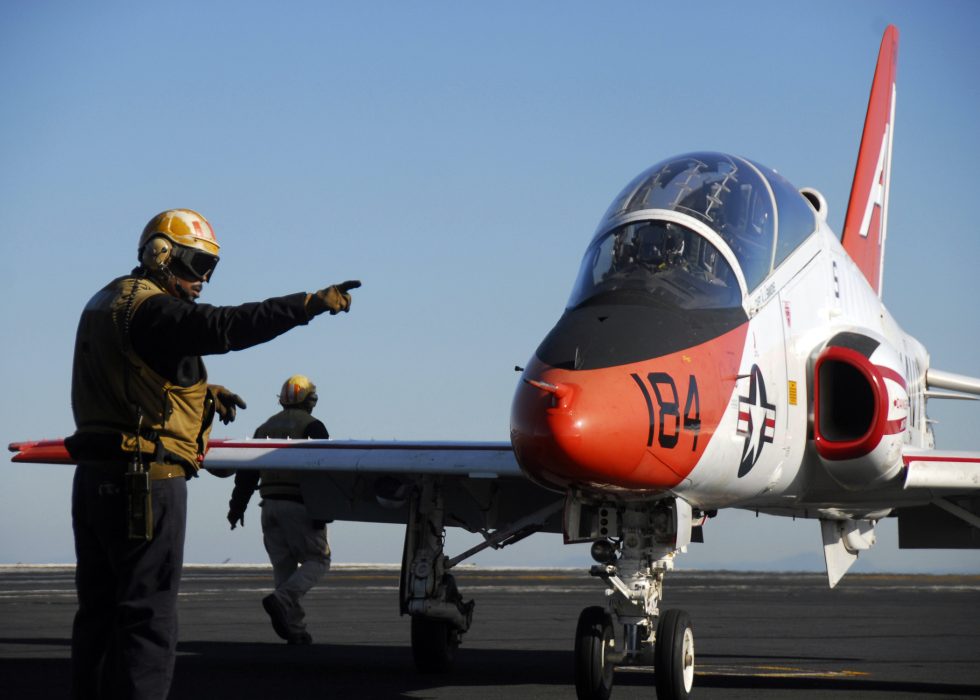
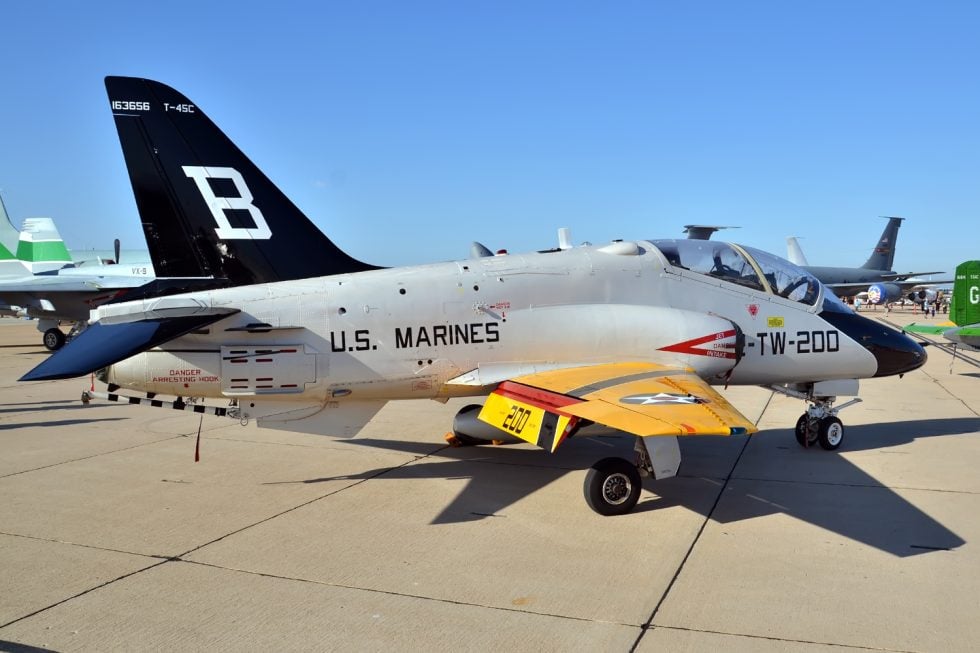
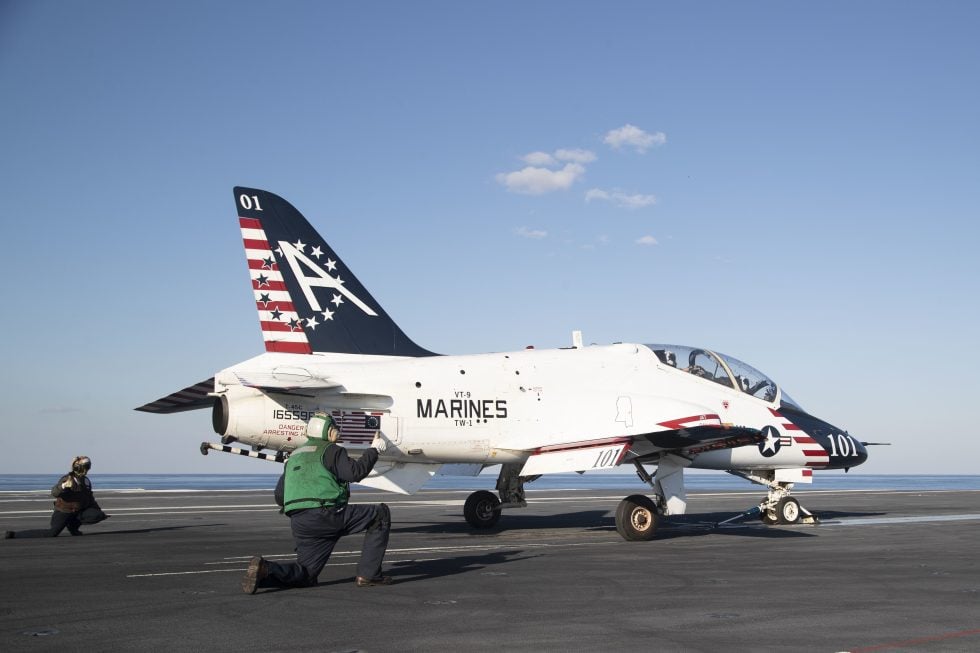
The T-45 Goshawk in motion
Media Magik Entertainment: authentic head-up display footage from a U.S. Navy T-45C Goshawk — a dramatic look at the trainer from the cockpit during a bird-strike emergency. Over 1.1 million views.
Where the T-45 Goshawk flies
The T-45 Goshawk: a trainer, not a warplane
The Goshawk has no combat record and carries no weapons — that was never its job. Its record is written in students trained and carrier landings logged. Almost every U.S. Navy and Marine strike and carrier aviator of the last three decades passed through it on the way to the fleet.
See how the front-line jets its graduates go on to fly compare in the combat record of every military aircraft.
Everything people ask about the T-45 Goshawk
Can I fly in a T-45 Goshawk?
Who makes the T-45 Goshawk?
What is the T-45 based on?
What is the difference between the T-45A and T-45C?
Is the T-45 the only carrier-capable jet trainer?
What was the 2017 T-45 oxygen problem?
How fast is the T-45 Goshawk?
Is the T-45 still in service or being replaced?
You can’t fly the T-45 Goshawk.
These, you can.
Some legends only live in museums — others are fuelled and waiting. MiGFlug has put civilians in real military jet cockpits since 2004.
 Fly the L-39 AlbatrosThe world’s most-flown jet trainer — aerobatics included
 Fly the F-104 Starfighter“The missile with a man in it”
 Fly the MiG-21The Cold War’s most-produced jet
 Fly the T-33 Shooting StarAmerica’s first jet trainer
 Fly the DH VampireA piece of early jet history
 Fly the S.211Agile Italian jet trainer
 Fly the MB-326The classic Aermacchi jet
 Fly the MiG-15The Soviet legend of the Korean War
Continue the tour
Every fact, checked
- Naval Air Systems Command (NAVAIR) — T-45 GoshawkThe U.S. Navy programme office reference for the aircraft’s role and status.
- U.S. Navy Fact FileOfficial Navy data on the T-45 as its carrier-capable training aircraft.
- Boeing — T-45 Goshawk historyThe manufacturer’s account of the McDonnell Douglas / BAE programme.
- BAE Systems — HawkBackground on the parent Hawk design the Goshawk was developed from.
- Rolls-Royce — Defence aerospace (Adour)Reference for the Adour turbofan that powers the T-45.
- USNI NewsReporting on the 2017 T-45 OBOGS physiological-episode stand-down and the Navy’s response.
- National Naval Aviation Museum (Pensacola)Naval aviation history and preserved training aircraft, including the T-45.
- Chief of Naval Air Training (CNATRA)The command that runs T-45 undergraduate jet training at Kingsville and Meridian.