

Martin B-26 Marauder
The fast, feared American medium bomber that began the war as the “Widowmaker” and its crews learned to trust — then finished the fight with the lowest loss rate of any USAAF bomber over Europe.
Martin B-26 Marauder by the numbers
The essential figures on the Martin B-26 Marauder
The story
The Martin B-26 Marauder: from “Widowmaker” to the safest bomber over Europe
In January 1939 the U.S. Army Air Corps issued Circular Proposal 39-640 for a fast medium bomber. A young Glenn L. Martin Company engineer named Peyton M. Magruder answered it with the Model 179: a cigar-smooth fuselage, a shoulder-mounted wing of remarkably small area, and two of the biggest engines available bolted to the front. On paper it promised speeds no medium bomber had reached. The Army was so impressed it ordered 1,100 aircraft straight off the drawing board, before a single example had flown.
That confidence cut both ways. The first B-26 flew on 25 November 1940, and the design that looked brilliant on paper turned out to be unforgiving in the air. To hit its speed targets the Marauder carried a wing of just over 600 square feet — tiny for a 30,000-pound aircraft. The result was very high wing loading, which meant high approach and landing speeds and little margin for error. A pilot stepping up from trainers or from the docile B-18 suddenly had to fly numbers he had never seen.
The reputation formed fast and stuck hard. Crews called it the “Widowmaker” and the “Martin Murderer.” Because the stubby wing seemed far too small to hold the fuselage up, they joked it had “no visible means of support” and nicknamed it the “Flying Prostitute” and the “Baltimore Whore.” At MacDill Field near Tampa, where accidents piled up during conversion training, the grim phrase “One a day in Tampa Bay” was born.
The truth behind the slogans is more complicated than the legend. Many early losses came down to training rather than the airframe: engine-out procedures were mishandled, approaches were flown too slow, and props were feathered incorrectly. When the Truman Committee investigated whether to cancel the programme, the answer was not to scrap the Marauder but to fix how men were taught to fly it — and to fix the aeroplane where it genuinely needed help.
Martin lengthened the wing from about 65 to 71 feet and raised the tail from the B-26B-10 block onward, easing the handling without throwing away the speed. Dedicated transition schools drilled crews on single-engine work until it became routine. The accident rate fell sharply. The type that had terrified trainees became an aircraft veteran crews spoke of with real affection.
Combat told the same story. The Marauder first fought in the Pacific in 1942, flew a famous and costly torpedo attack at Midway, and then found its true home over the Mediterranean and Western Europe. Flying with the Ninth and Twelfth Air Forces at medium altitude, tightly formed and heavily gunned, it hammered bridges, marshalling yards, airfields and coastal defences ahead of and during the Normandy landings.
And it did so while being hit less often than any other American bomber in the theatre. By the end of the war the Army Air Forces recorded a combat loss rate for the Marauder of well under one half of one percent per sortie — the lowest of any USAAF bomber. The “Widowmaker” had quietly become the survivor.
Around 5,270 Marauders were built before production ended in 1945. The type was retired quickly after the war, and within three years its very designation was handed to a completely different aircraft — a twist of history that still causes confusion today, and one we untangle further down this page.
01Why the B-26 Marauder earned the name “Widowmaker” — and why it was unfair+
The Marauder’s bad reputation was rooted in physics and timing. Its small wing gave it a high wing loading, so it stalled at a higher speed than the trainers young pilots came from. On one engine, at low speed, with the wrong technique, it could roll and drop before a crew could react — and in 1941–42 there simply were not enough experienced instructors or standard procedures to teach that technique safely.
The concentration of training at MacDill Field near Tampa produced the crashes that gave rise to “One a day in Tampa Bay.” The phrase was memorable, but the real figures were lower than the legend, and most accidents traced to pilot conversion rather than to a flaw that made the aircraft fundamentally unflyable.
Once the wing and tail were enlarged and crews were properly schooled in single-engine handling, the Marauder’s accident record fell into line with other types — and its combat survivability turned out to be exceptional. It is one of the clearest cases in aviation history of a reputation outliving the facts that created it.
02How the Martin B-26 Marauder finished the war with the lowest loss rate of any USAAF bomber+
The Smithsonian’s National Air and Space Museum puts it plainly: the Army Air Forces “lost fewer Marauders than any Allied bomber it flew — less than one-half of one percent.” That figure is usually quoted as a per-sortie loss rate in the European theatre, and it is worth treating carefully: it reflects the Marauder’s later career as a medium-altitude tactical bomber, flown in tight, well-escorted formations, not its rocky early months.
Several things drove the low losses. The Marauder was fast and structurally tough, it bristled with heavy .50-calibre guns, and it typically operated with fighter cover against targets inside the range of Allied escorts. Its crews, by 1944, were among the best-trained medium-bomber crews in the world. The combination made it a genuinely hard aircraft to shoot down.
The claim “lowest loss rate of any USAAF bomber” is widely repeated and well supported, but exact percentages vary between sources and between theatres, so we present it as the strong consensus it is rather than a single fixed number.
Design & engineering
How the Martin B-26 Marauder was built for speed
Everything about the Marauder was subordinated to one goal: go fast. That single-mindedness gave it its performance, its looks and its early reputation in equal measure.
A wing built for speed, not forgiveness
To reach its target speeds the Marauder used a wing of only about 600 square feet. On an aircraft weighing some 30,000 pounds loaded, that meant very high wing loading, a fast approach and an unforgiving stall. Later blocks stretched the span from roughly 65 ft (19.8 m) to 71 ft (21.6 m) and enlarged the tail to tame it.
Two Double Wasps up front
The Marauder was hung on a pair of Pratt & Whitney R-2800 Double Wasp eighteen-cylinder radials — the same family that powered the P-47 and F4U. Early aircraft had about 1,850 hp per side; later B-26G blocks used 2,000 hp engines turning four-blade props, giving a top speed around 285 mph (459 km/h).
Heavily gunned, glass-nosed, hard to kill
A bombardier’s glazed nose, a powered dorsal turret, tail and waist positions gave late Marauders as many as eleven .50-calibre machine guns. Combined with a rugged structure and real speed, that defensive weight is a large part of why so few were lost in combat.
03The bigger wing and taller tail: how Martin fixed the B-26 Marauder’s handling+
The most important change in the Marauder’s life was quiet and structural. From the B-26B-10 production block, Martin increased the wingspan by roughly six feet and raised the fin and rudder. The larger wing lowered stall and approach speeds a little and improved low-speed control; the taller tail improved directional stability, particularly with an engine out.
The changes cost a few miles per hour of top speed but transformed the aircraft’s manners. Combined with better training, they turned the Marauder from a machine that frightened rookies into one that seasoned crews flew with confidence. It is a textbook example of how a modest aerodynamic fix, applied at the right moment, can rescue an entire programme.
04Inside the Martin B-26 Marauder: the crew of seven and how they worked+
A typical Marauder carried a crew of around seven: pilot and co-pilot side by side, a bombardier-navigator in the glazed nose, a radio operator, an engineer, and gunners manning the dorsal turret, tail and waist positions. Exact numbers varied by variant and mission — some sources quote five to seven — but seven was the common wartime figure.
The cockpit sat high and well forward, giving good visibility for the fast approaches the aircraft demanded. Behind the flight deck ran the bomb bay, flanked by fuel, with the gun positions covering the rear hemisphere. It was a compact, densely packed aircraft — part of why it was strong, and part of why there was little room for error inside it.
Full specifications
Martin B-26 Marauder specifications
Figures below are for the late-war B-26G unless noted, drawn from the National Museum of the U.S. Air Force. Early Marauders were smaller-winged and lighter; where a value changed over the production run, both are shown.
| Posádka | 7 typical (sources cite 5–7 by variant/mission) estimate varies |
|---|---|
| Délka | 58 ft 6 in (17.8 m) |
| Rozpětí křídel | 71 ft (21.6 m) late blocks · 65 ft (19.8 m) early |
| Výška | 20 ft 3 in (6.2 m) |
| Plocha křídla | ~658 sq ft (61 m²) late · ~602 sq ft early approx |
| Prázdná hmotnost | ~24,000 lb (10,900 kg) approx |
| Loaded weight | 37,000 lb (16,780 kg) |
| First flight | 25 November 1940 |
| Number built | ~5,270 (NMUSAF cites 5,266; other references 5,288) |
| Engines | 2× Pratt & Whitney R-2800 Double Wasp radials, 2,000 hp each |
|---|---|
| Maximální rychlost | 285 mph (459 km/h) |
| Cruising speed | 190 mph (306 km/h) |
| Rozsah | 1,100 miles (1,770 km) |
| Servisní strop | 19,800 ft (6,035 m) |
| Bomb load | Up to 4,000 lb (1,815 kg) |
| Defensive armament | Up to 11× .50-calibre machine guns (late blocks) |
| Wing loading | High — a defining trait; ~56 lb/sq ft loaded estimate |
05The Martin B-26 Marauder variants: from B-26 to B-26G explained+
The line began with the short-wing B-26 a B-26A of 1941–42. The major change came with the B-26B: from the B-10 sub-block it gained the longer wing, taller tail and, in late aircraft, the full battery of guns. The B-26C was the same aircraft built at Martin’s Omaha plant rather than Baltimore.
The final major service versions were the B-26F a B-26G, which raised the wing’s incidence to improve take-off and low-speed behaviour. Trainer and target-tug conversions were designated TB-26 a AT-23, and photo-reconnaissance machines F-26/RB-26. The Royal Air Force and Commonwealth called their Lend-Lease aircraft Marauder I, II and III according to the block they received.
06The Martin B-26 Marauder’s cost: what a wartime Marauder was worth+
Like most mass-produced wartime aircraft, the Marauder got cheaper as production matured. A unit cost of roughly $260,000 is commonly cited for 1942, falling toward around $190,000 for late B-26G aircraft as tooling and experience improved. Treat both figures as approximate: wartime accounting rolled airframe, engines and government-furnished equipment together in ways that are hard to compare with modern list prices.
A meaningful modern “cost per flight hour” does not exist for the Marauder, because none is operated today. With no airworthy example flying, there is no ownership or charter market to price — unlike, say, a warbird Mustang or a jet trainer. The cost data below reflects that reality.
Cost & ownership data
What the Martin B-26 Marauder cost — then and now
A standard cost snapshot for the comparison tool. Wartime prices are approximate and hedged; present-day operating figures do not exist because no Marauder flies.
| Unit cost (1942) | ~$260,000 (widely cited, approximate) flagged estimate |
|---|---|
| Unit cost (late B-26G) | ~$190,000 as production matured approximate |
| Cost per flight hour (today) | Not applicable — no airworthy example exists |
| Approx. value in today’s money | Roughly $4–5 million equivalent per airframe very rough, inflation only |
| Production | ~5,270 built 1941–1945; production ended 1945 |
| Operating status | Retired; museum survivors only, none in flying condition |
Wartime unit costs are notoriously hard to compare: figures combine airframe, engines and government-furnished equipment differently between sources and years. The ~$260,000 (1942) figure is the most commonly cited and is presented as an approximation, not an audited price.
How it compares
The Martin B-26 Marauder against its contemporaries
A rough side-by-side with the other twin-engine medium bombers of the era. Figures are representative late-war values and vary by variant.
| Letadlo | Top speed | Bomb load | Posádka | Poznámky |
|---|---|---|---|---|
| Martin B-26 Marauder | ~285 mph (459 km/h) | ~4,000 lb | ~7 | Lowest USAAF bomber loss rate in Europe |
| North American B-25 Mitchell | ~275 mph (443 km/h) | ~3,000–4,000 lb | ~6 | More forgiving; served in every theatre |
| Douglas A-26 Invader | ~355 mph (571 km/h) | ~6,000 lb | 3 | Later, faster; confusingly re-designated B-26 in 1948 |
| Junkers Ju 88 | ~280 mph (450 km/h) | ~4,000–6,600 lb | 4 | German multi-role equivalent |
| Vickers Wellington | ~235 mph (378 km/h) | ~4,500 lb | ~6 | Slower RAF medium; geodetic structure |
Comparative figures are indicative only, drawn from museum and reference sources; each type spanned many variants with different engines and equipment.
Family tree
The Martin B-26 Marauder marks at a glance
The short-wing originals
The first 1941–42 aircraft, with the small 65 ft wing that made the type so fast and so demanding. Fought at Midway and in the early Pacific campaign.
The definitive version
From the B-10 sub-block, the longer 71 ft wing, taller tail and heavier gun battery arrived. The B-26B is the Marauder that made the type’s combat reputation over Europe.
Omaha-built B
Mechanically the same aircraft as the late B-26B, but produced at Martin’s Omaha, Nebraska plant. B and C together were the mainstay of the fleet.
Raised incidence
The wing’s angle of incidence was increased to shorten the take-off run and improve low-speed handling — a further step in taming the early reputation.
Final production mark
The last major service version, standardised for Allied use with 2,000 hp engines. Surviving examples at Dayton and elsewhere are G-model aircraft.
Trainers & tugs
Gun-less conversions used for crew training and as high-speed target tugs, helping turn out the well-drilled crews behind the type’s low losses.
RAF & Commonwealth
Lend-Lease designations for aircraft supplied to the Royal Air Force, South African Air Force and others, used mainly in the Mediterranean.
Reconnaissance
Camera-equipped photo-reconnaissance conversions. Note: the post-war “RB-26” most people picture is actually the Douglas A-26 Invader — see the disambiguation section below.
Timeline
The Martin B-26 Marauder: a wartime timeline
Stories & eyewitnesses
Martin B-26 Marauder stories: the men, the myths and the missions
1,100 ordered before it flew
The Army was so sure of Magruder’s design that it ordered eleven hundred Marauders before the prototype had left the ground.
Číst dále
It was an extraordinary act of faith in 1939 — and it meant that when the aircraft turned out to be a handful, there was no going back. Thousands of crews would have to be taught to fly a demanding machine that was already in mass production.
“One a day in Tampa Bay”
Conversion training at MacDill Field near Tampa produced enough crashes to spawn one of aviation’s darkest slogans.
Číst dále
The phrase was memorable rather than literal — the real accident numbers were lower — but it captured how frightening the early Marauder was to inexperienced pilots. Most losses came from mishandled engine-out approaches, not from an unflyable aircraft.
Should the Marauder be cancelled?
Wartime investigators, including the Truman Committee, weighed scrapping the whole programme.
Číst dále
The conclusion was not to cancel the aircraft but to fix how crews were trained and to enlarge the wing and tail. It was one of the better decisions of the American air war: the aircraft they nearly cancelled became the safest bomber over Europe.
Flying it on one engine
To prove the Marauder was safe, senior pilots demonstrated calm single-engine flying to nervous trainees.
Číst dále
Accounts credit figures such as Jimmy Doolittle with flying single-engine passes to restore confidence in the type. The details vary between tellings, so we present it as the well-known story it is: the message was that the aircraft was trustworthy in trained hands.
Four Marauders and a torpedo run
On 4 June 1942, four Army B-26s made a low torpedo attack on the Japanese carriers at Midway.
Číst dále
It was not the aircraft’s intended role, and it was brutally costly — two of the four were lost. But it showed the Marauder could absorb punishment: Lt. James Muri flew his aircraft through withering fire and brought it home riddled with holes.
Muri’s battered survivor
Lt. James Muri’s Marauder came back from Midway so shot up it was later stripped for parts.
Číst dále
The story of that aircraft — pressed low over the enemy fleet, hammered by anti-aircraft fire, yet still flying — became an early sign that the “Widowmaker” was also remarkably tough. Toughness, as much as speed, would define its combat record.
“No visible means of support”
The stubby wing looked far too small for the fuselage, earning the Marauder a string of unflattering names.
Číst dále
Crews called it the “Flying Prostitute” and the “Baltimore Whore” — because, they joked, it had no visible means of support. Behind the barrack humour was a real aerodynamic fact: the high-loaded wing was the source of both the speed and the fear.
202 missions and still counting holes
The Marauder “Flak-Bait” flew more combat missions than almost any other American aircraft of the war.
Číst dále
According to the Smithsonian, Flak-Bait completed 202 combat missions with the 322nd Bomb Group, absorbing repeated battle damage and always bringing its crews home. Its forward fuselage was displayed for decades in Washington; the full aircraft is now being restored at the National Air and Space Museum.
RAF and SAAF Marauders
Royal Air Force and South African squadrons flew Lend-Lease Marauders across the Mediterranean.
Číst dále
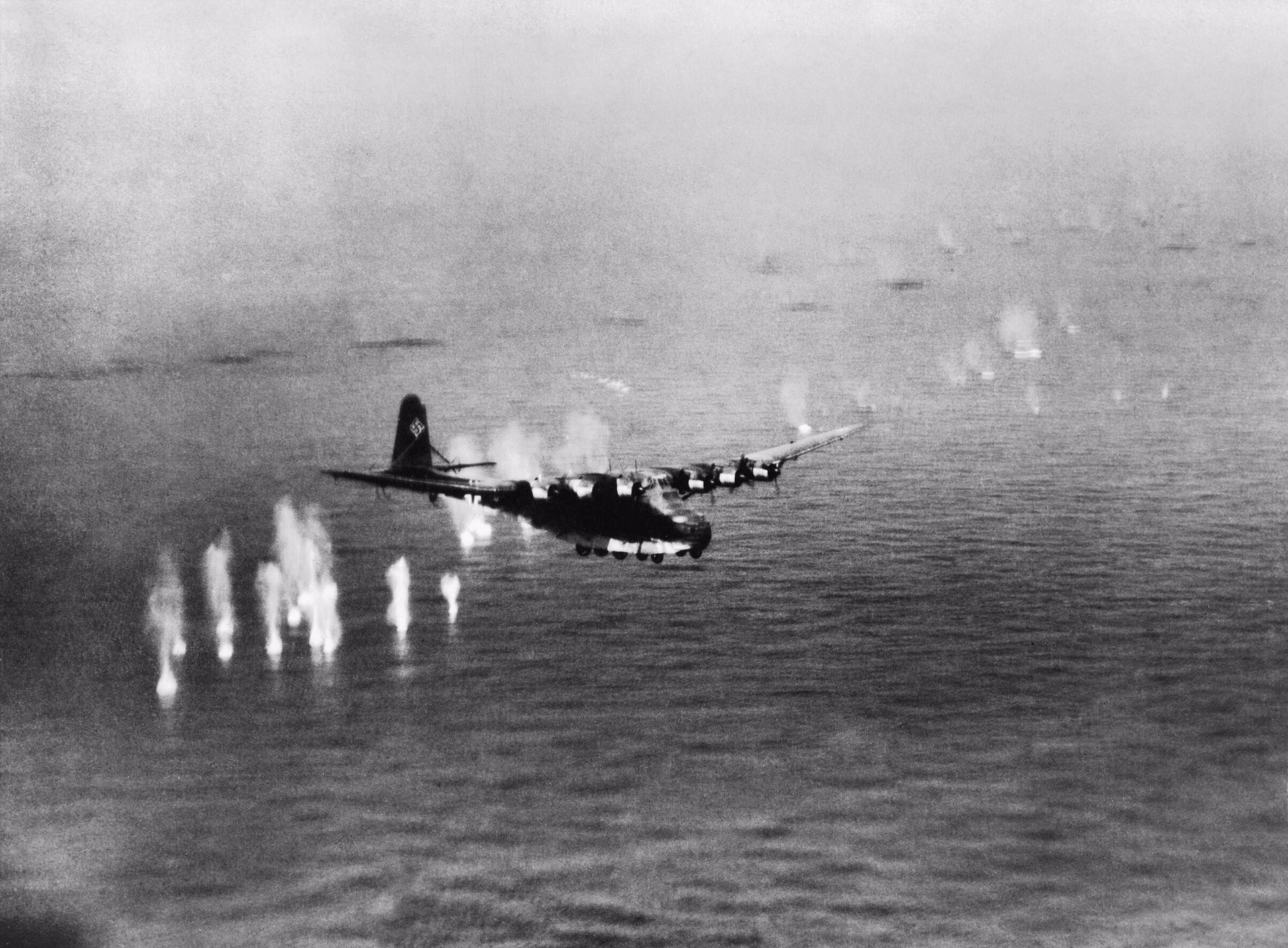
Operating from North Africa, Sardinia and Italy, RAF and South African Air Force Marauders attacked shipping, airfields and communications. In one celebrated action, an RAF No. 14 Squadron aircraft helped destroy a formation of giant Luftwaffe Me 323 transports off Corsica in 1943.
The road back to France
Rebuilt French bomber groups flew Marauders in the campaign to liberate their own country.
Číst dále
Equipped under Lend-Lease, Free French Armee de l’air units flew the Marauder in the Mediterranean and over southern France in 1944. For their crews the aircraft was not just a tool of war but a symbol of France returning to the fight.
The Ninth Air Force’s hammer
On 6 June 1944 Marauders struck coastal defences and communications behind the Normandy beaches.
Číst dále
Flying at medium altitude in tight formation, Ninth Air Force Marauders bombed gun batteries, bridges and marshalling yards ahead of and during the invasion, then followed the armies across France and into Germany as a tactical strike force.
The statistic that changed the story
By 1945 the Marauder had the lowest loss rate of any USAAF bomber — the exact opposite of its reputation.
Číst dále
Less than one half of one percent of Marauder sorties over Europe ended in a loss, the Smithsonian records. The aircraft crews once feared had become the one they were most likely to come home in — a reversal almost unique in the history of the air war.
The 322nd’s darkest day
A low-level raid on IJmuiden cost the 322nd Bomb Group virtually its entire attacking force in a single mission.
Číst dále
It was one of the worst days any Marauder unit endured — and it ended low-level medium bombing in Europe for good. The disaster forced a rethink that ultimately made the aircraft far safer.
Precision from 12,000 feet
After IJmuiden the Marauder moved up to medium altitude, bombing in tight, escorted formations.
Číst dále
The new doctrine traded treetop drama for survivability and accuracy. It was the direct origin of the type’s celebrated low loss rate — proof that how an aircraft is used matters as much as the aircraft itself.
The gunners’ wall of fire
A Martin powered dorsal turret and up to eleven .50-calibre guns let a formation cover every angle.
Číst dále
Flown as a disciplined box, a group of Marauders threw up interlocking fields of fire that made attacking them genuinely dangerous — a key ingredient in the aircraft’s survivability.
Vanishing act
Despite its record, the Marauder was scrapped by the thousand almost as soon as the war ended.
Číst dále
Overtaken by jets and by the Douglas Invader, the type disappeared within a few years. That mass scrapping is why only around seven Marauders survive today — and why the aircraft is less remembered than it deserves.
Two aircraft, one name
In 1948 the “B-26” designation was handed to the Douglas A-26 Invader — a different aeroplane entirely.
Číst dále
Ever since, captions and books have mixed the two up. The Korea and Vietnam “B-26” is the Invader; the WWII Marauder never fought in either war. Keeping the two apart is the key to understanding the story.
Photo gallery
Martin B-26 Marauder in photographs
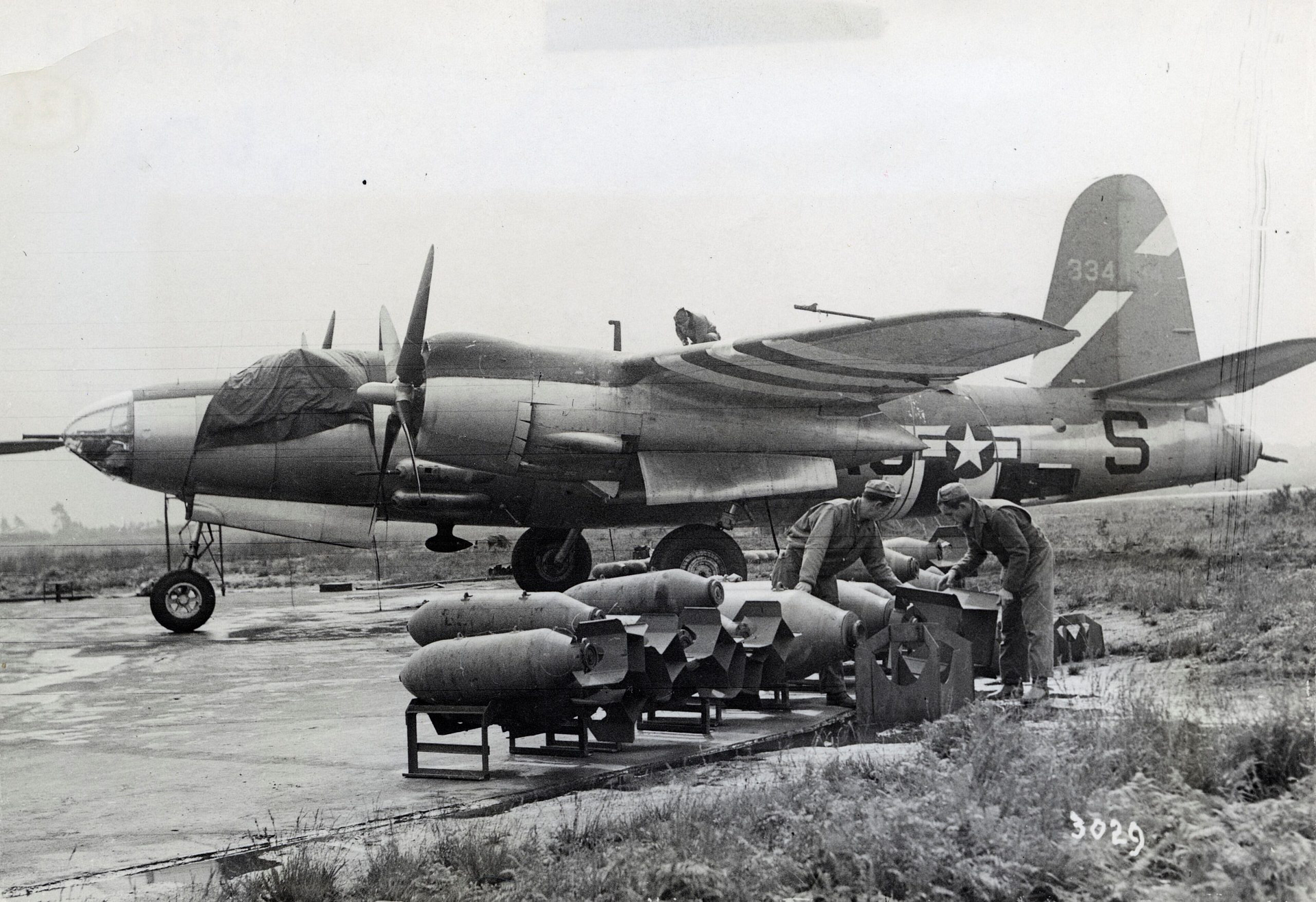
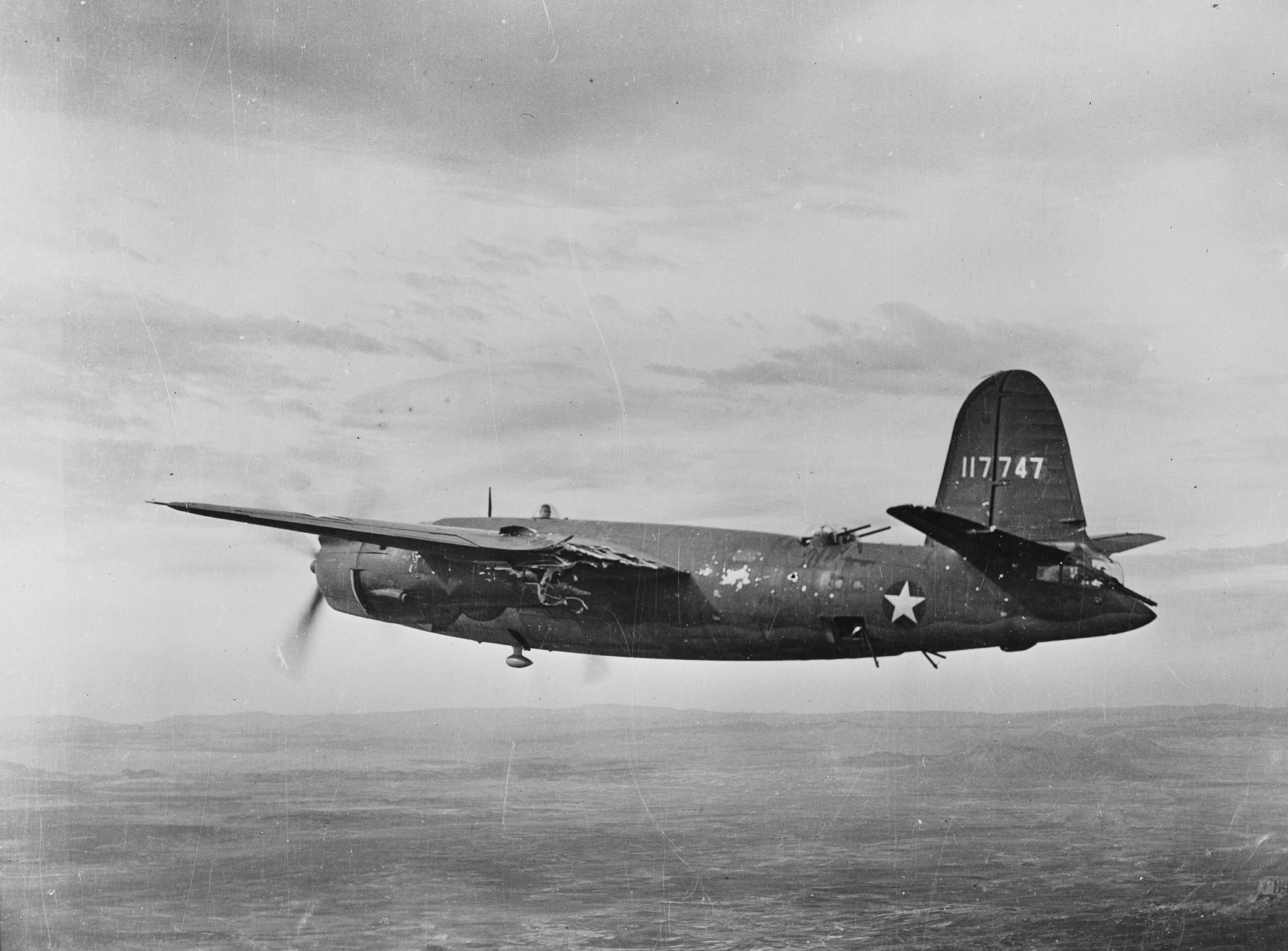
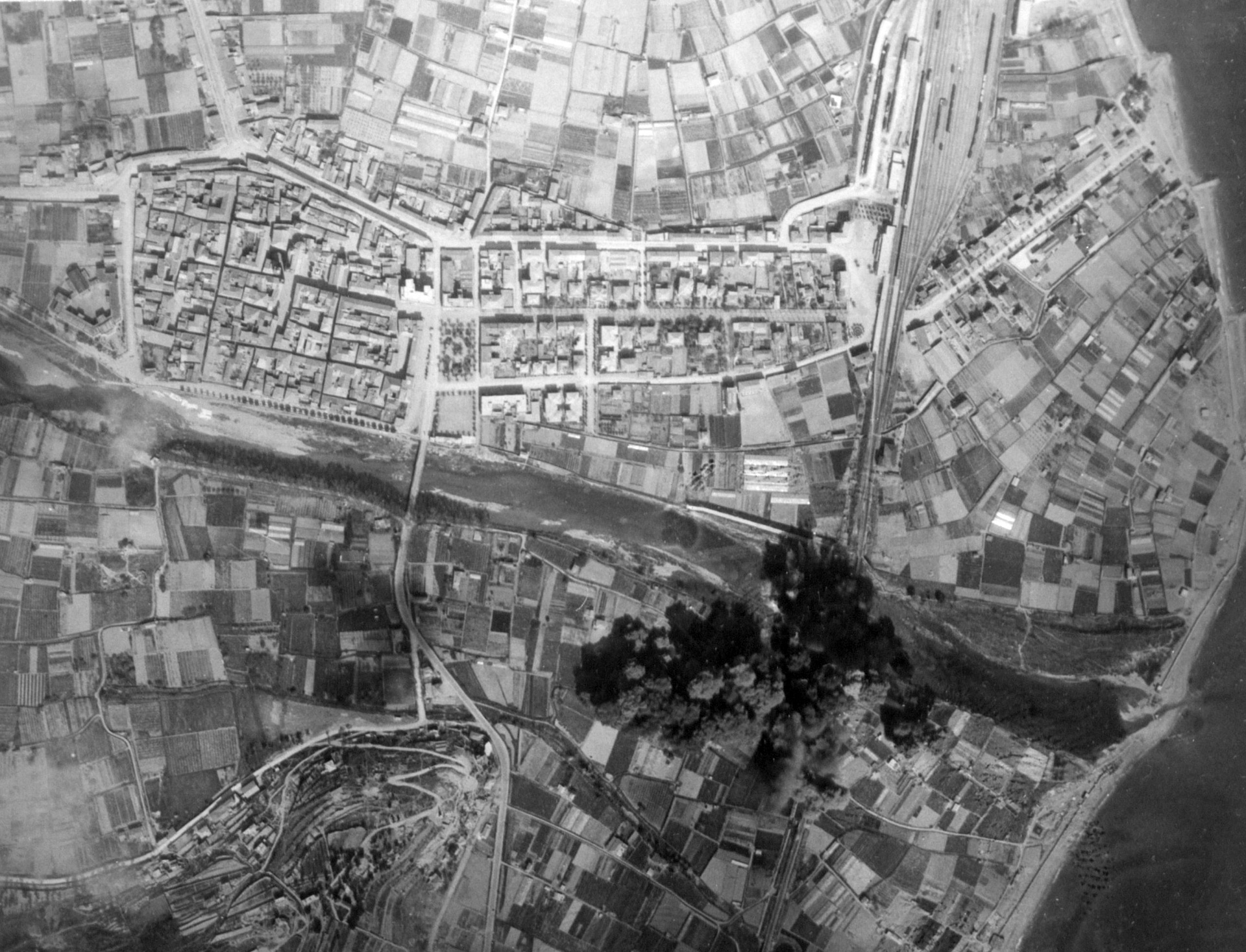
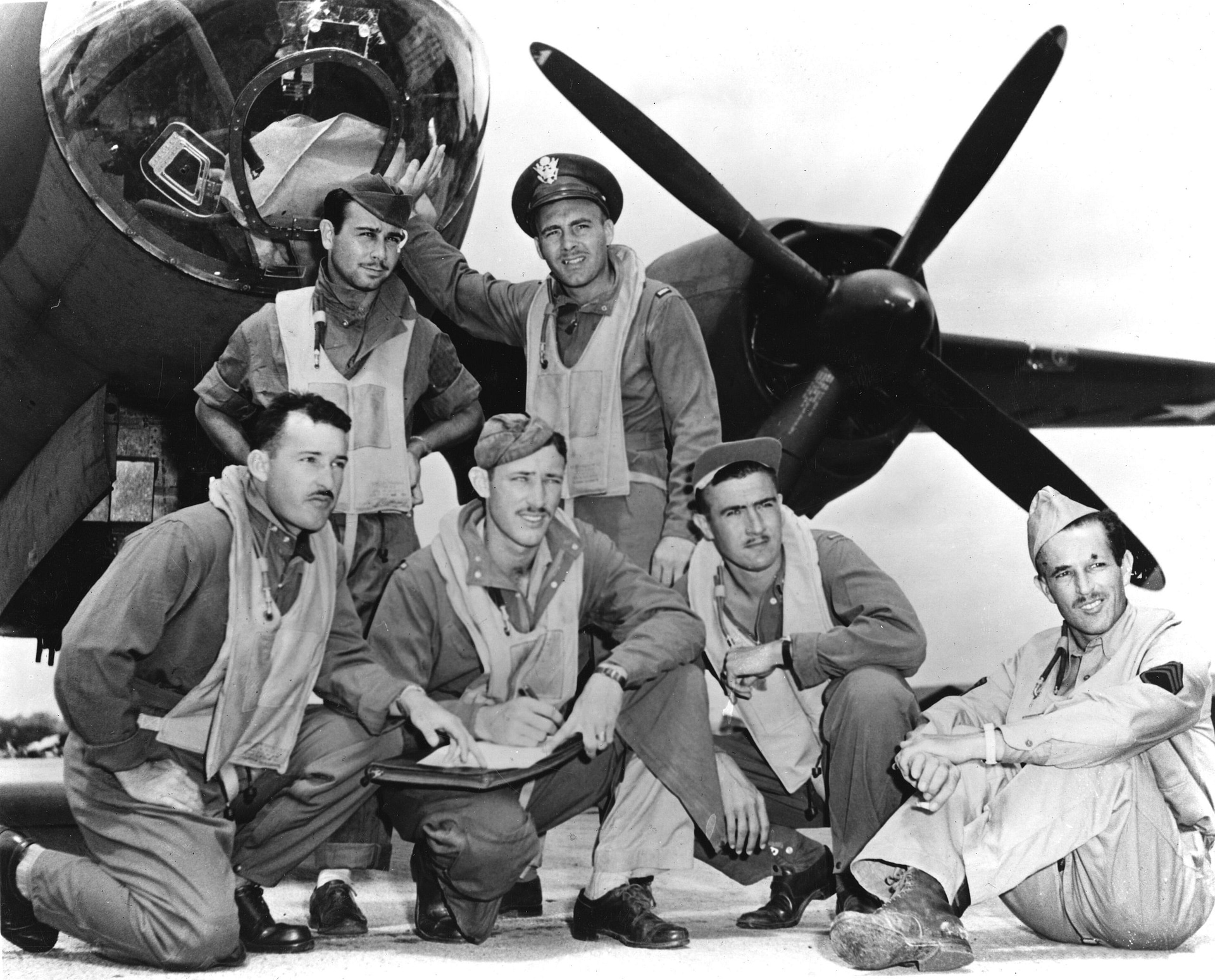
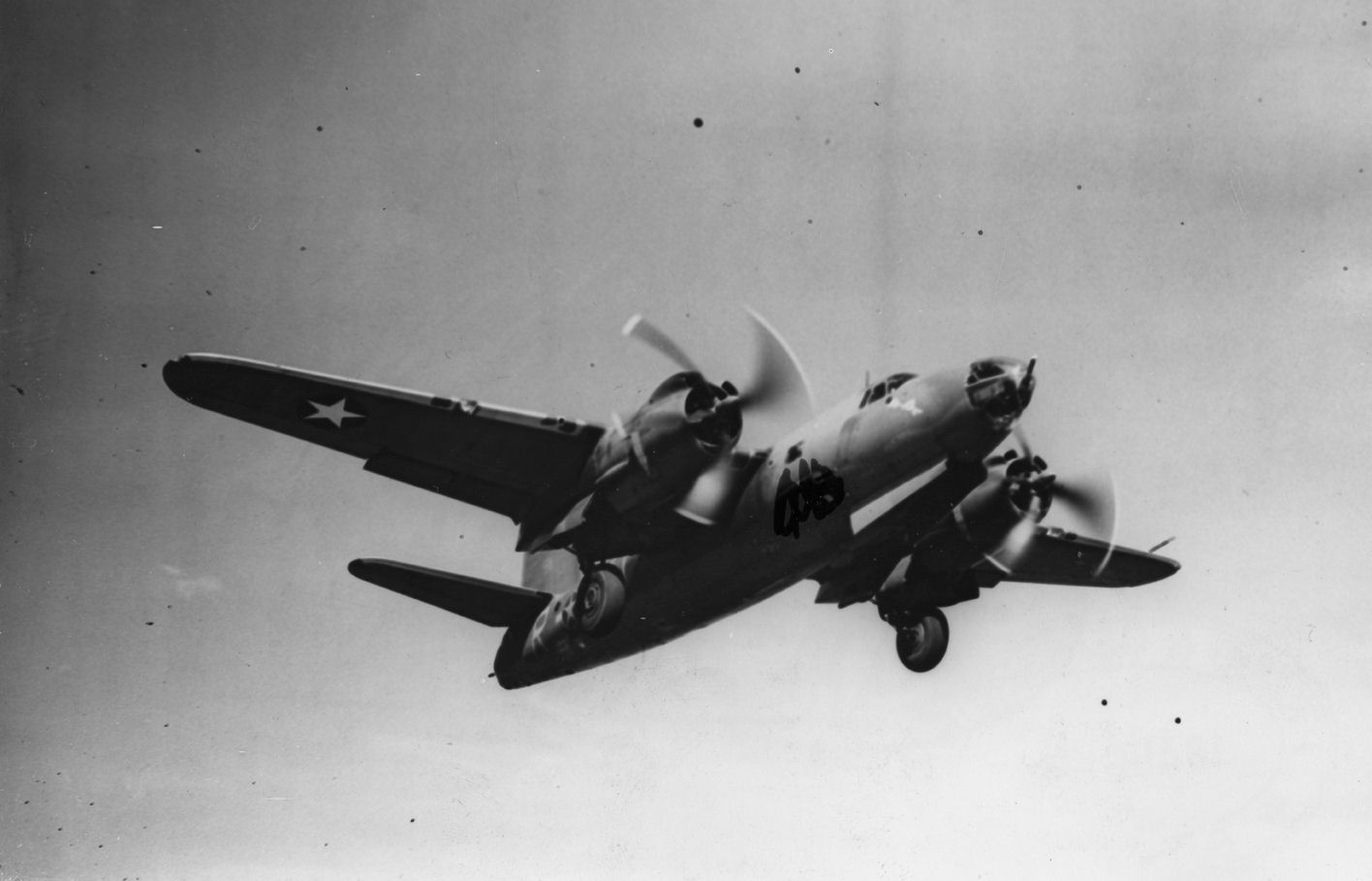
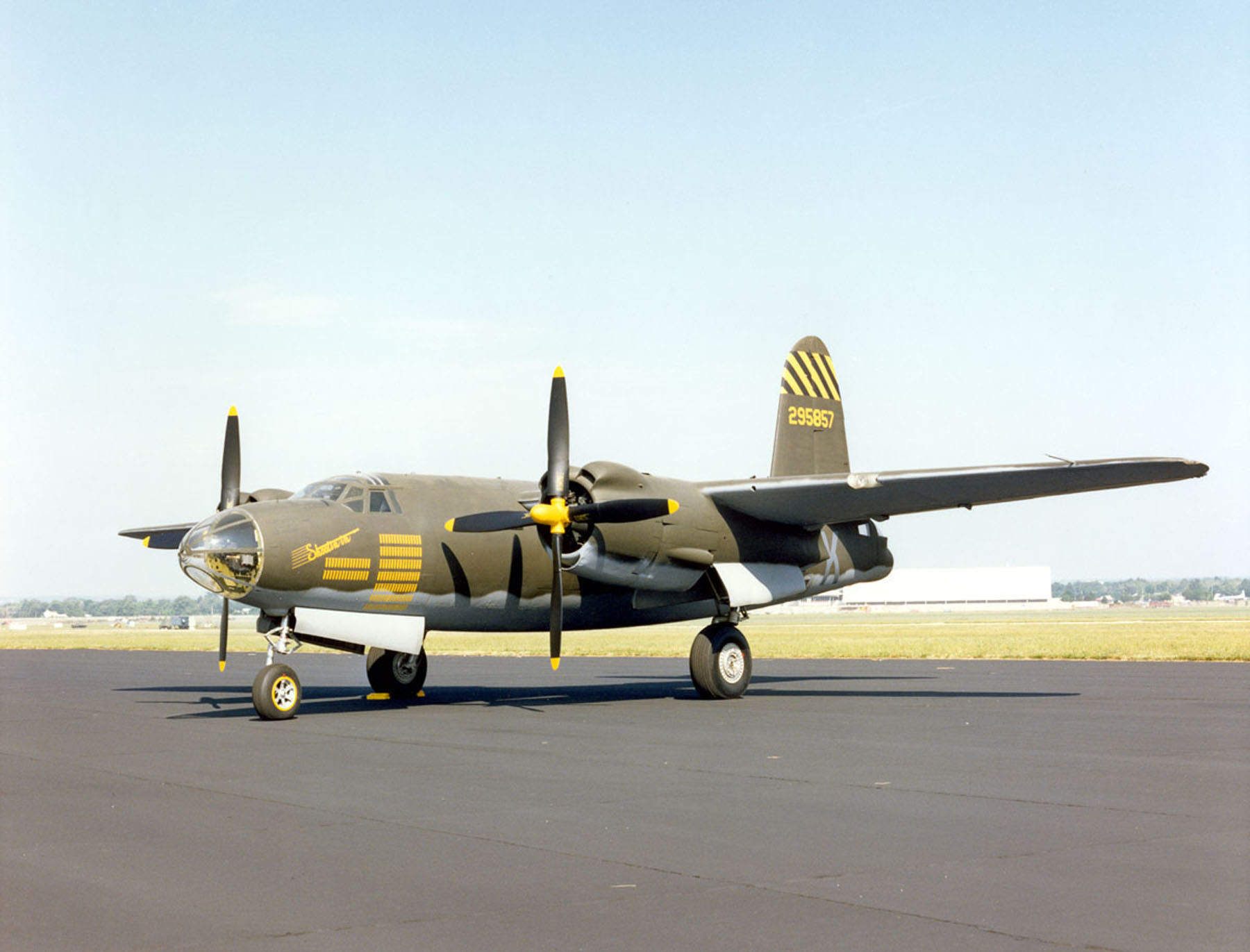
All images are in the public domain (U.S. Army Air Forces / U.S. Air Force / RAF) sourced via Wikimedia Commons. Credits appear in each caption.
Watch
The Martin B-26 Marauder on film: veterans in their own words
Rather than a modern re-cut, we chose an authoritative documentary built around the men who flew and serviced the Marauder.
“Marauder Men: In Their Own Words” — the official PBS Western Reserve documentary, featuring B-26 veterans recounting the aircraft first-hand (roughly 201,000 views and a 4.9/5 like ratio at time of writing). An authoritative public-broadcasting source rather than a re-uploaded clip.
Operations map
Where the Martin B-26 Marauder flew and fought
The Marauder was overwhelmingly an American aircraft, but it fought across two hemispheres and served with several Allied air forces. Toggle the categories to explore its operators, its combat theatres and where the last airframes survive today.
Combat theatres
Where the Martin B-26 Marauder went to war
The Marauder’s war fell into three chapters. It began badly in the Pacific, matured in the deserts and mountains of the Mediterranean, and reached full stride over occupied Western Europe. In each theatre the aircraft did the same essential job — fast, medium-altitude tactical bombing — but the conditions, and the lessons, were very different.
In the South-West Pacific in 1942, small numbers of early short-wing Marauders flew long over-water missions in punishing conditions from bases in Australia and New Guinea. The torpedo attack at Midway that June showed both the aircraft’s toughness and the folly of using a fast level bomber as a torpedo plane. The Pacific was never the Marauder’s natural home, and the type was gradually concentrated elsewhere.
The Mediterranean is where the Marauder found its feet. From late 1942 the Twelfth Air Force flew it over Tunisia, Sicily, Sardinia and Italy, joined by Royal Air Force, South African Air Force and Free French squadrons. Here the medium bomber’s speed and toughness paid off against bridges, airfields, ports and rail links, and crews developed the tight formation tactics that would define the type.
The greatest chapter was Western Europe. The Ninth Air Force built a large Marauder force in England for the tactical air campaign, and from 1943 it pounded targets across France and the Low Countries. On D-Day and through the advance that followed, Marauders struck coastal batteries, headquarters, bridges and marshalling yards, working hand-in-glove with the armies on the ground.
Through it all, the statistic that would redeem the aircraft kept improving: fewer Marauders were lost, sortie for sortie, than any other American bomber in the European theatre.
07The Martin B-26 Marauder in the Pacific: New Guinea and Midway+
The Marauder’s combat debut came with the 22nd Bomb Group, which flew missions over New Guinea from Australian bases in early 1942. These were gruelling operations: long stretches of open ocean, primitive fields, and an aircraft still in its demanding short-wing form.
The most famous Pacific action was the torpedo attack at Midway on 4 June 1942, when four Army Marauders joined Navy torpedo bombers against the Japanese carriers. Two were shot down; the survivors, including Lt. James Muri’s aircraft, came home badly damaged. It was a costly, arguably misconceived use of a fast level bomber — but it demonstrated how much punishment the airframe could absorb.
After 1942 the Marauder was largely withdrawn from the Pacific in favour of the more suitable B-25 Mitchell, and its centre of gravity shifted to the Mediterranean and Europe.
08The Martin B-26 Marauder in the Mediterranean: RAF, SAAF and Free French crews+
The Mediterranean turned the Marauder into a war-winner. Flying with the U.S. Twelfth Air Force alongside Commonwealth and French units, it attacked the bridges, ports, airfields and rail networks that supplied Axis forces across North Africa and Italy.
The Royal Air Force and South African Air Force flew Lend-Lease Marauders on anti-shipping and interdiction work — one celebrated RAF No. 14 Squadron action helped destroy a formation of huge Luftwaffe Me 323 transports off Corsica in 1943. Free French bomber groups, rebuilding with American equipment, flew the type in the Mediterranean and over southern France in 1944.
It was here that the tight, mutually supporting formations and disciplined medium-altitude bombing that kept losses low were perfected.
09The Martin B-26 Marauder over Normandy: the Ninth Air Force and D-Day+
In England, the Ninth Air Force assembled the largest Marauder force of the war for the tactical air campaign over occupied Europe. From 1943 its groups bombed airfields, bridges, V-weapon sites and rail yards, softening the ground for invasion.
On 6 June 1944 Marauders struck coastal gun batteries and communications behind the beaches, and in the campaign that followed they ranged across France, Belgium, the Netherlands and, finally, into Germany. Operating within range of Allied fighter escort and in strong formation, they proved extremely hard for German defences to stop.
By VE-Day the Marauder had become one of the workhorses of the Allied tactical air forces — and the safest bomber a crew could be assigned to in that theatre.
10Why so few Martin B-26 Marauders were shot down: guns, speed and formation+
The Marauder’s survivability came from a stack of advantages. It was fast for a medium bomber, structurally robust, and heavily armed — late aircraft carried as many as eleven .50-calibre machine guns in nose, dorsal turret, waist and tail positions.
Tactics mattered as much as hardware. Marauders flew in tight boxes that concentrated defensive fire, bombed from medium altitude where light flak was less lethal and heavy flak less accurate, and operated inside the umbrella of Allied fighter cover. Their crews, by 1944, were superbly trained.
The result was the lowest loss rate of any USAAF bomber over Europe — the physics of speed and firepower, multiplied by good tactics and good training.
Survivors
The surviving Martin B-26 Marauders — and why none of them fly
Of more than five thousand built, only a handful of Marauders survive. All are museum pieces or restoration projects; none is in flying condition today.
“Flak-Bait” — NASM
The most famous survivor. Its nose was displayed in Washington for decades; the complete aircraft is now being restored at the National Air and Space Museum’s Udvar-Hazy Center in Virginia.
“Shootin’ In” — NMUSAF
A restored B-26G on public display at the National Museum of the U.S. Air Force, Dayton, Ohio — the airframe most visitors will actually see complete.
MAPS Air Museum
A Marauder held at the MAPS Air Museum in Canton, Ohio, one of a small number of preserved examples in the United States.
“Dinah Might” — Utah Beach
Displayed at the Utah Beach Landing Museum in Normandy — a fitting home for a type that helped make D-Day possible.
Fantasy of Flight
An early, rare short-wing Marauder in the Kermit Weeks collection in Polk City, Florida. Sometimes described as potentially airworthy, it is not a flying aircraft.
Restoration projects
Further airframes are under long-term restoration, including examples associated with the Pima Air & Space Museum in Arizona and private restorers in California.
11“Flak-Bait”: the Martin B-26 Marauder that flew more than 200 missions+
Flak-Bait is the Marauder the world remembers. A B-26B of the 322nd Bomb Group, it completed 202 combat missions according to the Smithsonian — more than almost any other American aircraft of the war — while being hit again and again and always bringing its crews home. Its name came, the story goes, from a crewman’s dog, “Flea Bait.”
After the war its forward fuselage, still wearing its mission tally and battle scars, was preserved by the Smithsonian and displayed in Washington for decades. The National Air and Space Museum is now carrying out a painstaking full-airframe conservation at its Mary Baker Engen Restoration Hangar — preserving the damage and repairs rather than erasing them, so that the aircraft tells its own story.
Mission counts of 200, 202 and 207 all appear in print for Flak-Bait; we follow the Smithsonian’s own figure of 202 and note the others as variations in the record.
12Is any Martin B-26 Marauder airworthy today? An honest answer+
No. As of today, there is no Martin B-26 Marauder in flying condition anywhere in the world. That is a genuine rarity for a famous American warbird: unlike the B-25 Mitchell, the P-51 Mustang or the B-17, of which flyable examples tour the airshow circuit, the Marauder simply does not fly.
You will occasionally see the early short-wing aircraft at Fantasy of Flight described as “the only airworthy Marauder.” Treat that carefully: the airframe is a superb restoration, but it is not a flying aeroplane, and no original Marauder has been in continuous airworthy service in the post-war era. If seeing one matters to you, the reliable option is a museum — Dayton, Normandy, or the Smithsonian’s restoration hangar.
So if the question is “can I book a flight in a B-26 Marauder?”, the honest answer is no — but there are plenty of other genuine military aircraft you can fly in, which we cover below.
Important disambiguation
Two aircraft, one designation: the B-26 Marauder is not the A-26 Invader
This is the single most common confusion in the Marauder story, so it deserves to be spelled out clearly. There are two completely different American aircraft that have carried the designation “B-26,” and they are not the same machine.
Ten/Ta/To Martin B-26 Marauder — the aircraft this page is about — is the fast, twin-engine, seven-crew medium bomber of the Second World War, first flown in 1940 and retired soon after 1945.
Ten/Ta/To Douglas A-26 Invader is a different, later aircraft: a sleeker twin-engine attack bomber that entered service in 1944 with a crew of three. In June 1948, with the Martin B-26 already out of service, the U.S. Air Force reused the now-vacant “B-26” designation for the Douglas Invader. So the “B-26” that fought in Korea and later in Vietnam is the Douglas A-26 Invader — not the Martin Marauder, which never served in either war.
The rule of thumb is simple. Second World War, European and Mediterranean theatres, medium bomber, “Widowmaker” = Martin B-26 Marauder. Korea and Vietnam, attack bomber, three crew = Douglas A-26 / B-26 Invader. When a source says “B-26” without a date, check which war it is describing.
13How the Douglas A-26 Invader came to be called “B-26” — and why it still confuses people+
U.S. military aircraft designations were periodically reshuffled, and designations of retired types could be recycled. When the Martin B-26 Marauder left service, its designation became available. In 1948 the Air Force dropped the separate “A” (attack) category and redesignated the Douglas A-26 Invader as the B-26 Invader.
The consequences echo to this day. Photographs, books and even museum captions sometimes mix the two aircraft up; a “B-26” shot down over Korea in 1951 or flown in Southeast Asia in the 1960s is an Invader, while a “B-26” bombing Normandy in 1944 is a Marauder. If you keep the two aircraft, their shapes and their wars separate in your mind, the confusion dissolves — which is exactly why we gave the Invader its own page in this museum.
Deeper into the machine
The Martin B-26 Marauder in detail: engines, guns and production
14The Pratt & Whitney R-2800 Double Wasp: the engine that made the Marauder fast+
The Marauder’s speed came straight from its engines. The Pratt & Whitney R-2800 Double Wasp was an eighteen-cylinder, twin-row air-cooled radial of 2,800 cubic inches — one of the great piston aero-engines of the war, also used on the P-47 Thunderbolt, the F4U Corsair and the F6F Hellcat.
Early Marauders used versions of around 1,850 horsepower; later B-26F and B-26G aircraft ran 2,000 hp engines driving four-blade propellers. That reserve of power let a heavy, small-winged aircraft reach roughly 285 mph and, just as importantly, gave it the muscle to keep flying on one engine once crews were trained to manage the asymmetry.
The R-2800 was famously rugged, which fed directly into the Marauder’s reputation for bringing crews home. An engine that kept running after taking damage was worth as much as any armour plate.
15The Martin B-26 Marauder’s defensive armament: up to eleven .50-calibre guns+
Early Marauders were relatively lightly armed, but the type grew progressively more bristling with guns. Late aircraft carried as many as eleven .50-calibre (12.7 mm) Browning machine guns: in the nose, a powered dorsal turret, waist positions and a manned tail position, with additional fixed “package” guns on the fuselage sides of some B and C models for strafing.
That heavy defensive fit, concentrated by tight box formations, made attacking a Marauder box a dangerous business for enemy fighters. Combined with the aircraft’s speed and the medium altitudes it favoured, it is a central reason the type’s combat losses stayed so low.
The bomb bay carried a typical load of around 4,000 lb (1,815 kg) of bombs, tailored to the tactical targets — bridges, rail yards, gun positions — that the Marauder specialised in hitting accurately from medium height.
16Building the Marauder: Baltimore, Omaha and the wartime production line+
The Marauder was a product of the Glenn L. Martin Company, whose main plant was at Middle River near Baltimore, Maryland. As demand grew, a second line was opened at Omaha, Nebraska — the origin of the B-26C designation, which was mechanically identical to the Baltimore-built B-26B.
Across both plants roughly 5,270 Marauders were completed between 1941 and the end of production in 1945 (the National Museum of the U.S. Air Force cites 5,266; other references give 5,288). It was a substantial programme, though smaller than the vast runs of the B-24 or B-17 heavy bombers.
The scale of production is part of why the early accident scare mattered so much: with so many aircraft already ordered and building, cancelling was never simple. Fixing the training and the aircraft was the only sensible course — and it worked.
17“Widowmaker,” “Flying Prostitute,” “Baltimore Whore”: where the Marauder’s nicknames came from+
Few aircraft collected as many grim or bawdy nicknames as the Marauder. “Widowmaker” and “Martin Murderer” came from the early training accidents. “One a day in Tampa Bay” referred to the crashes during conversion training at MacDill Field near Tampa, Florida.
The bawdier names — the “Flying Prostitute” and the “Baltimore Whore” — came from a running joke among crews that the small, high-loaded wing gave the aircraft “no visible means of support.” It was gallows humour about the very feature, high wing loading, that made the aircraft both fast and unforgiving.
What makes the nicknames worth remembering is the irony behind them. The aircraft the names mocked went on to have the lowest loss rate of any USAAF bomber over Europe. Few reputations in aviation history have been so thoroughly, and so quietly, overturned by the facts.
Combat record
The Martin B-26 Marauder’s war in numbers
The figures that turned a feared trainer into a respected combat aircraft. Contested numbers are hedged.
Legacy
The Martin B-26 Marauder’s place in history
The Marauder’s story is really a story about reputation and reality. It arrived with a fearsome name and a genuine handling problem, and for a year or two the two reinforced each other. Then better engineering and better training pulled them apart — and the aircraft that crews had dreaded became the one that carried them home more reliably than any other.
It was retired quickly after 1945, overtaken by the faster Douglas Invader and by the coming jet age, and its very designation was handed on to another aircraft within three years. That fast disappearance is part of why the Marauder is less remembered today than the B-17 or the B-25, and why so few survive.
But among those who study the air war, the Marauder holds a particular place: proof that a difficult aircraft is not necessarily a bad one, and that training and small design fixes can rescue a programme the headlines have already written off. The “Widowmaker” that finished the war as the safest bomber over Europe is one of aviation’s great reversals of fortune.
Questions & answers
Martin B-26 Marauder: frequently asked questions
Can I fly in a Martin B-26 Marauder?
No. There is no airworthy Martin B-26 Marauder anywhere in the world, so there is no way to book a flight in one. Unlike the B-25 Mitchell or the P-51 Mustang, of which flyable warbirds still tour airshows, the Marauder survives only as museum aircraft and restoration projects. To see one, visit the National Museum of the U.S. Air Force in Dayton, the Utah Beach Landing Museum in Normandy, or the Smithsonian’s restoration of “Flak-Bait.”
If what you want is the real experience of flying in a genuine military aircraft, that absolutely is possible — just in a different type. MiGFlug arranges flights in real fighter jets and warbirds, from the L-39 Albatros to a MiG-29 at the edge of space. Explore what is available at migflug.com/flights-prices.
Why was the B-26 Marauder called the “Widowmaker”?
The Marauder had a small, highly loaded wing that gave it high take-off and landing speeds and an unforgiving stall. In 1941–42, inexperienced crews converting onto it — often without standardised single-engine procedures — suffered a spate of accidents, especially at MacDill Field near Tampa, which produced the slogan “One a day in Tampa Bay.” The names “Widowmaker,” “Flying Prostitute” and “Baltimore Whore” all date from this period.
The reputation was largely overtaken by events: once the wing and tail were enlarged and crews were properly trained, the accident rate fell and the aircraft went on to have the lowest combat loss rate of any USAAF bomber over Europe.
Is the B-26 Marauder the same as the A-26 Invader?
No — and this is the most common confusion about the aircraft. The Martin B-26 Marauder is the WWII medium bomber described on this page. The Douglas A-26 Invader is a different, later attack bomber that was redesignated “B-26” in 1948, after the Martin aircraft had retired. The “B-26” that fought in Korea and Vietnam is the Douglas Invader, not the Martin Marauder.
Did the B-26 Marauder really have the lowest loss rate of any USAAF bomber?
Yes, that is the strong consensus. The Smithsonian’s National Air and Space Museum states the Army Air Forces “lost fewer Marauders than any Allied bomber it flew — less than one-half of one percent.” The figure usually refers to the per-sortie loss rate in the European theatre during the aircraft’s mature career. Exact percentages vary between sources and theatres, so it is best stated as a well-supported claim rather than a single fixed number.
How many B-26 Marauders were built?
Roughly 5,270, at Martin’s plants in Baltimore, Maryland and Omaha, Nebraska, between 1941 and 1945. The National Museum of the U.S. Air Force cites 5,266; other references give 5,288. Production ended in 1945 and the type was retired shortly after the war.
How many B-26 Marauders survive, and where can I see one?
Only about seven Marauders survive worldwide, all as static exhibits or restoration projects. Complete examples on public display include the B-26G “Shootin’ In” at the National Museum of the U.S. Air Force in Dayton, Ohio, and “Dinah Might” at the Utah Beach Landing Museum in Normandy, France. The famous “Flak-Bait” is being conserved at the Smithsonian’s National Air and Space Museum. Others are held by the MAPS Air Museum, Fantasy of Flight and the Pima Air & Space Museum.
What engines did the B-26 Marauder use, and how fast was it?
Two Pratt & Whitney R-2800 Double Wasp eighteen-cylinder radial engines — about 1,850 hp each in early aircraft and 2,000 hp in later B-26G models. Top speed was around 285 mph (459 km/h), with a cruising speed near 190 mph (306 km/h), a range of about 1,100 miles (1,770 km) and a service ceiling near 19,800 ft.
Who flew the B-26 Marauder besides the U.S. Army Air Forces?
The Marauder served with several Allied air forces under Lend-Lease. The Royal Air Force operated it as the Marauder I, II and III, mainly in the Mediterranean and Middle East; the South African Air Force flew it in the Mediterranean theatre; and the Free French Armee de l’air used it in the Mediterranean and over southern France in 1944.
What was “Flak-Bait”?
“Flak-Bait” was a B-26B of the 322nd Bomb Group that completed 202 combat missions — more than almost any other American aircraft of the war — while surviving repeated battle damage. Its nose was displayed at the Smithsonian for decades, and the full aircraft is now undergoing a careful, conservation-focused restoration at the National Air and Space Museum.
How much did a B-26 Marauder cost?
Wartime unit costs are approximate and vary by source and year. A figure of roughly $260,000 is commonly cited for 1942, falling toward about $190,000 for late B-26G aircraft as production matured. There is no meaningful modern “cost per flight hour,” because no Marauder is operated today.
Units, tactics & comparisons
The Martin B-26 Marauder in service: groups, tactics and rivals
18The bomb groups that flew the Martin B-26 Marauder+
By 1944 the Marauder equipped a large slice of the U.S. tactical bomber force. In England, the Ninth Air Force fielded groups such as the 322nd, 323rd, 344th, 386th, 387th, 391st, 394th and 397th Bomb Groups — the units that carried the medium-bomber war across France and the Low Countries.
In the Mediterranean, groups including the 17th, 319th and 320th Bomb Groups flew the type over North Africa, Sardinia and Italy, alongside Royal Air Force, South African and Free French squadrons. The 22nd Bomb Group had earlier pioneered Marauder operations in the South-West Pacific.
Each group developed the same hard-won craft: assemble into tight formations, bomb accurately from medium altitude, and rely on massed defensive fire and fighter escort to get home. It was unspectacular, disciplined work — and it produced the type’s remarkable safety record.
19The torpedo-bomber experiment: the Marauder at Midway+
The Marauder was never designed to drop torpedoes, but at Midway in June 1942 four Army B-26s were pressed into exactly that role, carrying torpedoes against the Japanese carriers alongside Navy TBD Devastators. It was a desperate improvisation.
The attack was costly and achieved little in material terms — two of the four Marauders were shot down — but it entered legend for the sheer aggression of the crews and the punishment the aircraft absorbed. It also confirmed what planners suspected: a fast, high-loaded level bomber was the wrong tool for low-level torpedo work, and the experiment was not repeated.
20Martin B-26 Marauder vs North American B-25 Mitchell: which was better?+
The Marauder and the B-25 Mitchell were the two great American medium bombers of the war, and comparing them reveals a genuine trade-off. The Marauder was faster and, in mature service, had a lower loss rate over Europe. The Mitchell was more forgiving to fly, operated more happily from rough or short strips, and adapted readily to low-level strafing and anti-shipping roles.
That difference shaped where each went. The Mitchell thrived in the Pacific and in every improvised theatre; the Marauder came into its own in the structured, escorted, medium-altitude war over Europe. Neither was simply better — they were optimised for different fights, and between them they covered the whole spectrum of medium bombing.
21Why was the Martin B-26 Marauder retired so quickly after 1945?+
Despite its fine wartime record, the Marauder disappeared from service almost immediately after 1945. Several forces drove that. It was a specialised medium bomber in an air force pivoting toward jets and toward the faster, more versatile Douglas A-26 Invader, which could do much of the same work with a smaller crew.
Thousands of surplus aircraft were simply scrapped. Within three years the “B-26” designation itself was reassigned to the Invader. The speed of that disappearance — and the mass scrapping — is the main reason so few Marauders survive today, and why the type is less celebrated than heavies like the B-17 that lingered longer in the public eye.
Turning point
The raid that changed how the Martin B-26 Marauder was used
The single most important tactical lesson in the Marauder’s European career was written in blood over the Netherlands. In May 1943 the 322nd Bomb Group was ordered to attack a power station at IJmuiden at very low level — the kind of fast, hedge-hopping raid the Marauder’s speed seemed to invite.
The first mission achieved little. The second, on 17 May 1943, was a catastrophe: the formation ran into heavy flak and fighters, and effectively none of the attacking aircraft returned. It was one of the worst single days any Marauder unit suffered, and it happened at the very moment the type’s reputation was already fragile.
The response was decisive and, in hindsight, the making of the aircraft. Commanders abandoned low-level medium bombing in the European theatre and moved the Marauder up to medium altitude, flying in tight, escorted boxes and bombing with precision from around 10,000–12,000 feet. It was less glamorous than roaring in at treetop height — and vastly more survivable.
From that grim lesson grew the doctrine that produced the Marauder’s famous low loss rate. The aircraft that had just suffered a near-total loss went on to become the safest bomber over Europe — because the way it was used had fundamentally changed.
25The IJmuiden raid of 17 May 1943 and the end of low-level Marauder missions+
The IJmuiden disaster is remembered as the moment the U.S. medium-bomber force in Europe abandoned low-level attack. Sending fast but large, tightly packed aircraft in low over a heavily defended coast exposed them to massed light flak and fighters with almost no room to manoeuvre or recover.
After the losses, the Marauder was re-roled to medium-altitude precision bombing under fighter escort. Bomb groups refined formation flying, bombing accuracy and mutual defensive fire until the type became one of the hardest bombers in the theatre to shoot down. The contrast between May 1943 and 1944–45 is the clearest possible illustration that the Marauder’s fate depended on how it was employed, not on some inherent flaw.
26Martin’s powered dorsal turret and the science of the defensive box+
Part of what made the medium-altitude box so effective was firepower, and the Marauder carried a Martin-designed powered dorsal turret with twin .50-calibre guns — one of the first such turrets in American service. Combined with nose, waist and tail guns, it let a formation throw up an interlocking wall of fire.
Flown in a well-drilled box, a group of Marauders could cover almost every approach an enemy fighter might use. That, plus speed, altitude and escort, is the unglamorous engineering-and-tactics reason behind a statistic that still surprises people: the “Widowmaker” was the bomber least likely to be shot down over Europe.
Flying the Marauder
What it was actually like to fly the Martin B-26 Marauder
Ask a Marauder pilot about the aircraft and you tend to get two answers depending on when they flew it. To a nervous 1942 trainee it was a fast, twitchy machine that punished mistakes. To a 1944 veteran who had mastered it, it was a strong, honest aeroplane that did exactly what it was told and brought its crew home.
The key was speed discipline. On approach the Marauder had to be flown by the numbers — too slow, especially on one engine, and it would let go without much warning. Flown correctly, with the power and the airspeed respected, it was stable, fast and steady on the bomb run. The difference between the two experiences was almost entirely training.
That is the enduring lesson of the aircraft: the same machine could be a “Widowmaker” or a war-winner depending on the crew’s preparation. The metal did not change; the men flying it did.
22The Martin B-26 Marauder’s flying qualities: fast, demanding, honest+
The Marauder’s defining characteristic in the air was its high wing loading. That gave it excellent speed and a stable, steady bomb-run platform, but it also meant fast approaches and a stall that arrived with little warning — particularly dangerous with an engine out at low speed.
The enlargement of the wing and tail on later blocks softened the worst of this, and standardised single-engine procedures did the rest. Veterans consistently described the mature Marauder as a strong, trustworthy aircraft — demanding of respect, but not treacherous once understood.
23Ground crews and the Martin B-26 Marauder: keeping the Double Wasps turning+
Behind every low loss rate is an army of mechanics. The Marauder’s big R-2800 radials were powerful and rugged but demanding to maintain, and its densely packed airframe rewarded skilled hands. Ground crews patched flak damage, changed engines in the open, and kept aircraft like Flak-Bait flying mission after mission.
The high sortie rates that the Marauder achieved in 1944 were only possible because of that unglamorous, relentless work on the flight line — a part of the story the veterans in the PBS documentary are careful to honour.
24Reading a “B-26” caption: how to tell a Marauder from an Invader in a photo+
Because both aircraft carried the “B-26” designation, captions and photo archives frequently confuse them. A few cues help. The Martin Marauder is a WWII medium bomber with a deep, cigar-shaped fuselage, a single tall fin, a stepped cockpit and a glazed bombardier nose, usually pictured in 1942–45 European or Mediterranean settings.
The Douglas Invader is sleeker and later, with a smoother nose, a low-set wing and a distinctly post-war look, usually pictured in Korea or Vietnam-era markings. If the caption gives a date after 1948, or mentions Korea or Vietnam, you are almost certainly looking at the Douglas Invader — not the Martin Marauder on this page.
Myth vs fact
The Martin B-26 Marauder: setting the record straight
“It was a death-trap”
Fact: the Marauder finished the war with the lowest combat loss rate of any USAAF bomber over Europe — under one half of one percent per sortie, according to the Smithsonian.
“One a day in Tampa Bay was literal”
Fact: the phrase was a memorable exaggeration. Accidents were real and serious, but the true numbers were lower, and most stemmed from training rather than a fatal design flaw.
“The B-26 fought in Korea and Vietnam”
Fact: that was the Douglas A-26 Invader, redesignated B-26 in 1948. The Martin Marauder had already been retired and never served in either war.
You can’t fly a B-26 Marauder — but these cockpits are open
No Marauder is airworthy today. But MiGFlug puts you in the cockpit of genuine military jets — from the L-39 Albatros to a MiG-29 at the edge of space. Real aircraft, real fighter pilots, real afterburner.
Fighter Jet Flights
Take the controls of a real ex-military jet with an experienced fighter pilot.
L-39 Albatros
The classic jet trainer — aerobatics and low-level fun, in several countries.
MiG-29 Fulcrum
Ride a genuine air-superiority fighter toward the edge of space.
Related aircraft
Explore more of the museum
 North American B-25 MitchellThe Marauder’s more forgiving twin — the medium bomber that raided Tokyo and fought in every theatre.
 Douglas A-26 InvaderThe faster, later attack bomber that inherited the “B-26” designation in 1948 — and caused decades of confusion.
 Boeing B-17 Flying FortressThe USAAF’s legendary heavy bomber that fought the daylight strategic war over Germany.
Sources & further reading
Where this Martin B-26 Marauder profile comes from
Where figures are contested — total built, unit cost, exact loss rate, Flak-Bait’s mission count — this page states the most authoritative value and notes the variation rather than asserting a single disputed number.