
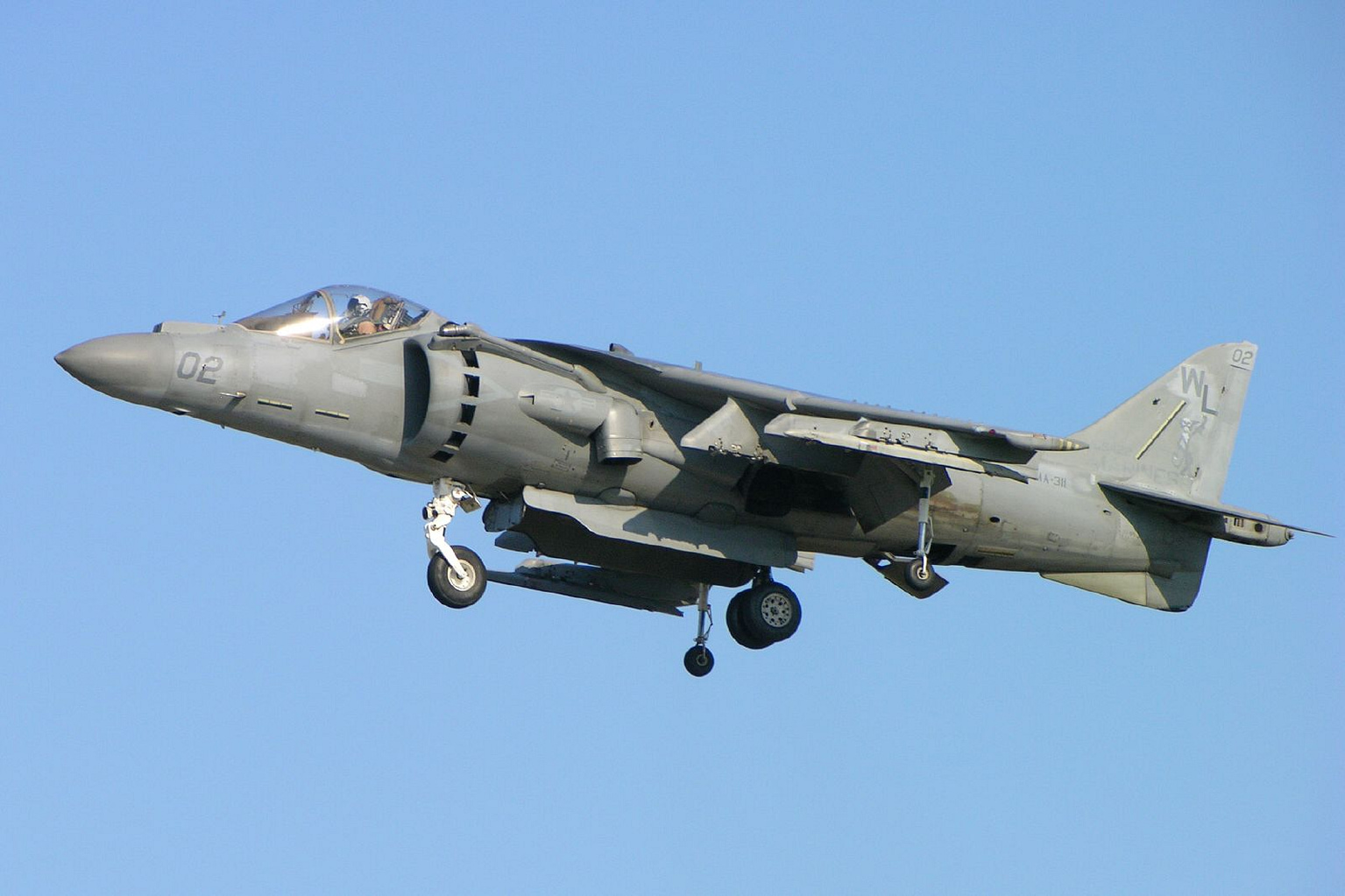
Hawker Siddeley Harrier
& Sea Harrier
The world’s first operationally successful “jump jet” — a vectored-thrust V/STOL fighter that took off vertically, hovered, and in 1982 wrote one of the most lopsided air-combat records of the jet age over the Falklands.
The jet that didn’t need a runway
The Harrier is the aircraft that made vertical take-off, hovering and rolling-vertical landing a battlefield reality. It grew from the Hawker P.1127, designed around the Bristol Siddeley Pegasus vectored-thrust turbofan — a single engine whose four nozzles swivel from aft to straight down. The prototype made its first tethered hover on 21 October 1960 and its first conventional flight in March 1961, and by later that year could transition fully between hover and wingborne flight.
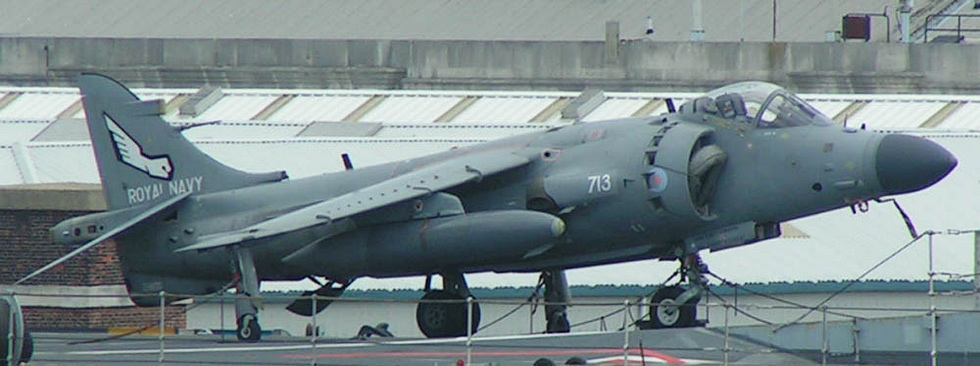
After the supersonic P.1154 was cancelled, the RAF took a developed subsonic version: the Harrier GR.1 entered service on 1 April 1969 as the first fixed-wing combat aircraft able to operate independently of runways. The Royal Navy’s Sea Harrier FRS.1 followed in 1980, and the US Marine Corps bought the type as the AV-8A. Britain, America, India, Spain and Italy all flew Harriers of one generation or another.
Its legend was sealed in the 1982 Falklands War, where 28 subsonic Sea Harriers defended the British fleet 8,000 miles from home against faster Argentine jets — and destroyed roughly 20–23 aircraft for no air-to-air losses. The concept outlived the aircraft: every lesson of Harrier V/STOL fed directly into today’s F-35B.
01The Harrier’s origin: how the P.1127 hovered its way into history
The whole Harrier story rests on a single idea — Michel Wibault’s thrust-vectoring concept, turned into a practical engine by Rolls-Royce’s Stanley Hooker as the Pegasus. Nine evaluation aircraft, the Kestrel FGA.1, were flown by a tripartite squadron of British, American and West German pilots in 1965. When the supersonic P.1154 was axed the same year, the subsonic Harrier survived, first flying in 1966 and entering RAF service with No. 1 Squadron at Wittering in 1969.
No other Western vertical-take-off combat jet ever reached front-line squadrons. The Harrier did — and stayed there, in one form or another, for more than four decades.
What makes the Harrier special
The Pegasus vectored-thrust engine
A single Rolls-Royce Pegasus turbofan with four rotating nozzles — two cold fan, two hot exhaust — that swivel together from horizontal to vertical-down under one lever. It lifts, hovers and propels the Harrier with no separate lift engines: the elegant solution that made the entire jump-jet concept work.
Reaction controls for the hover
At zero airspeed, wings and tail do nothing. The Harrier bleeds high-pressure air to “puffer” reaction jets at the nose, tail and each wingtip, giving the pilot pitch, roll and yaw control while balanced on columns of thrust — one of the most demanding skills in aviation.
VIFFing — vectoring in forward flight
Deflecting the nozzles downward or forward during wingborne flight produces sudden deceleration and tighter turns. A Harrier could brake so violently that a pursuing fighter shot past into its sights — a combat trick no conventional jet could copy, and a decisive edge for a subsonic aircraft.
02The Harrier’s Pegasus: one engine, four nozzles, no lift jets
Rival V/STOL designs bolted separate lift engines into the fuselage — dead weight in cruise. The Pegasus instead split its whole thrust across four swivelling nozzles rotated in unison, so the same engine that flew the aircraft also lifted it. That single decision kept the Harrier light enough to be a useful combat jet rather than a hovering curiosity, and it is why the layout survived unchanged from the 1960s P.1127 to the F402-powered AV-8B.
03The Harrier’s VIFF trick: how a slow jet beat faster ones
The Sea Harrier was slower than the Mirages and Daggers it faced in 1982, and slower is usually fatal in a dogfight. VIFFing changed the maths: by swivelling the nozzles in forward flight the pilot could dump speed almost instantly, forcing a fast attacker to overshoot and become the target. Combined with the all-aspect AIM-9L Sidewinder and aggressive flying, it turned the Harrier’s biggest weakness — a lack of raw speed — into a close-combat advantage.
Full specifications
Airframe & Performance
- Multitud
- 1
- Longitud
- ~14.5 m (47 ft 7 in)
- Envergadura
- ~7.70 m (25 ft 3 in)
- Altura
- ~3.7 m (12 ft 2 in)
- Max speed
- ~1,180–1,200 km/h (~Mach 0.97, low level)
- Techo de servicio
- ~15,000 m (~51,000 ft)
- Empty / MTOW
- ~5,900 kg / ~11,900 kg (Sea Harrier FRS.1)
- Production
- Harrier family >800 (first-gen line ~700)
Propulsion & Armament
- Motor
- 1 × Rolls-Royce Pegasus vectored-thrust turbofan
- Empuje
- ~95.6 kN / 21,500 lbf (FRS.1 Mk 104)
- Gun
- 2 × 30 mm ADEN cannon (pods)
- Missiles
- AIM-9 Sidewinder; Sea Eagle (Sea Harrier)
- Puntos duros
- 5 — bombs, rockets, drop tanks
- First flight
- P.1127: 1960 · Harrier GR.1: 1966
- Unit cost
- Varies widely by variant/year (approximate only)
- Cost per flight hour
- No reliable public figure
04The Harrier’s numbers: what “over 800 built” really counts
Production totals depend on where you draw the line. The first-generation Harrier / Sea Harrier / AV-8A line is commonly cited at around 700 airframes (MilitaryFactory quotes 718 for the early line). Add the second-generation Harrier II / AV-8B and RAF GR5/7/9, and the whole family runs to over 800. Firm unit-cost figures are unreliable: they span multiple variants, decades and currencies, so treat any single dollar figure as approximate. What is certain is the aircraft’s value — it gave small carriers and forward strips a fast jet that nothing else could match.
From tethered hover to the F-35B
The concept
Wibault’s thrust-vectoring idea and Hooker’s Pegasus engine give rise to the Hawker P.1127.
First hover
The P.1127 makes its first tethered hover — a jet rising straight up.
First flight
The P.1127 flies conventionally; full transitions between hover and wingborne flight follow later in 1961.
Kestrel evaluation
A tripartite squadron (UK, USA, West Germany) flies the Kestrel FGA.1; the supersonic P.1154 is cancelled.
Harrier GR.1 flies
The first pre-production Harrier GR.1 takes to the air.
Enters RAF service
No. 1 Squadron at RAF Wittering — the first runway-independent fixed-wing combat aircraft.
Marines get the AV-8A
The first AV-8A is delivered to the US Marine Corps.
Sea Harrier at sea
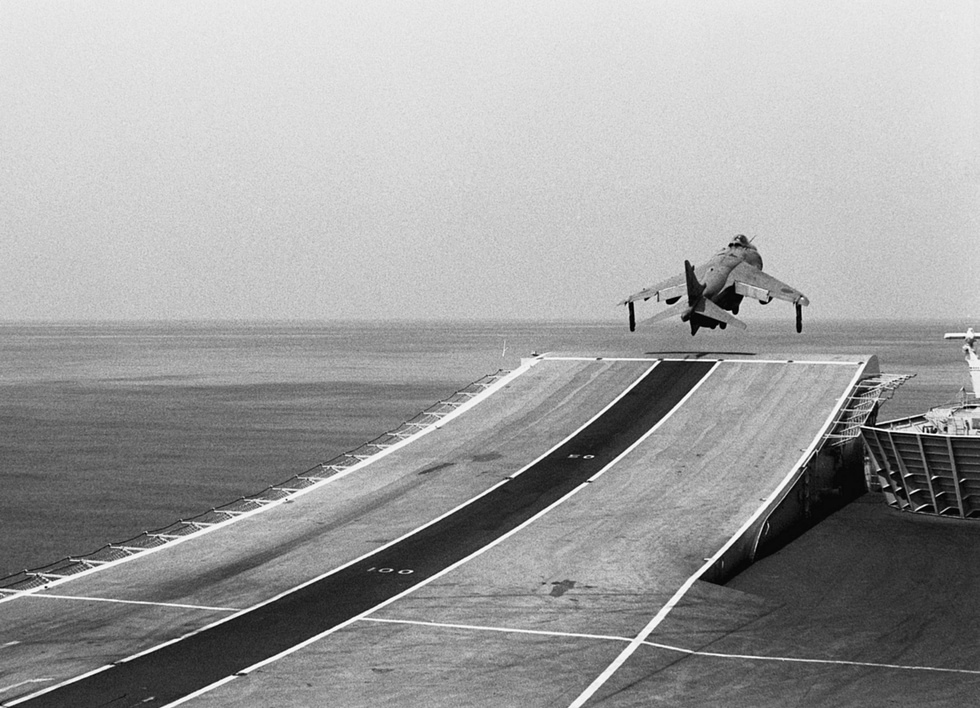
The Sea Harrier FRS.1 enters Royal Navy service aboard the ski-jump carriers.
The Falklands
Sea Harriers down ~20–23 Argentine aircraft for no air-to-air losses — the type’s defining campaign.
Britain bows out
The UK retires its entire Harrier fleet; India follows with the Sea Harrier in 2016. The AV-8B soldiers on toward the F-35B.
From the flight line: twelve Harrier stories
The world’s first jump jet
How the P.1127 hovered in 1960 and rewrote what a fighter could do.
Read the full story
Roughly 20 to 0
The Sea Harrier’s near-perfect air-combat record over the South Atlantic.
Read the full story
VIFFing the enemy
Braking in mid-air to make a pursuer overshoot.
Read the full story
The ski-jump revolution
How a curved ramp turned small decks into fighter carriers.
Read the full story
Marines get their own air power
The AV-8 gives the Corps organic close air support.
Read the full story
Britain grounds its jump jets
The controversial 2010 decision to axe the Harrier.
Read the full story
Fighting from the forest
Dispersed, runway-free operations.
Read the full story
One engine, four nozzles
Inside the Pegasus.
Read the full story
Puffer jets and the hover
How a jet balances at zero speed.
Read the full story
The bow and the hover
A crowd-favourite display act.
Read the full story
The Matador and the Sea Harrier abroad
The Harrier goes global.
Read the full story
From Pegasus to F-35B
The idea that outlived the aircraft.
Read the full story
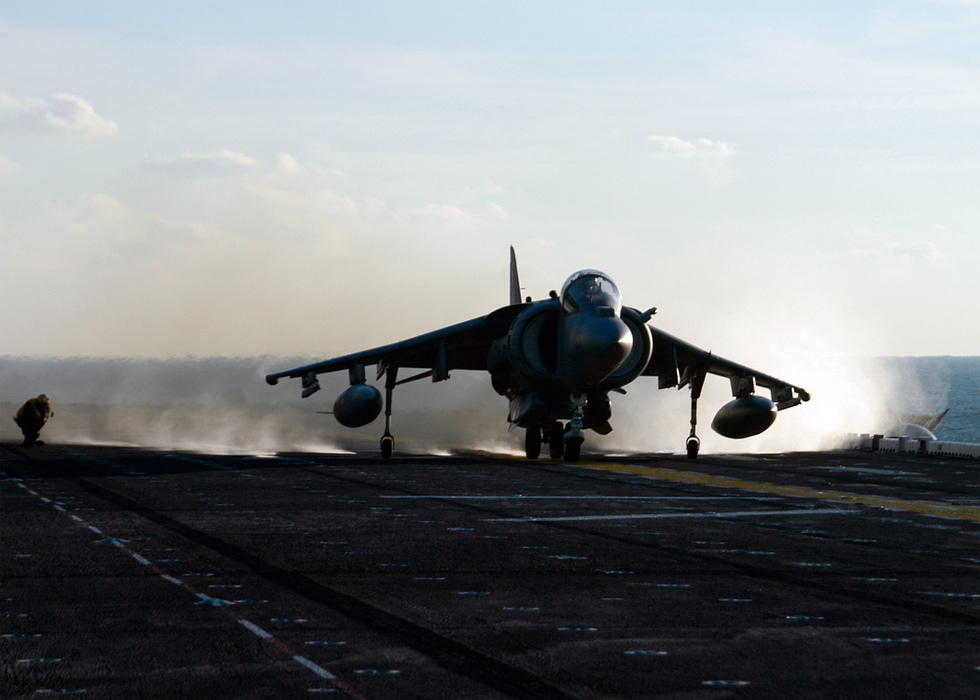
The Harrier in pictures
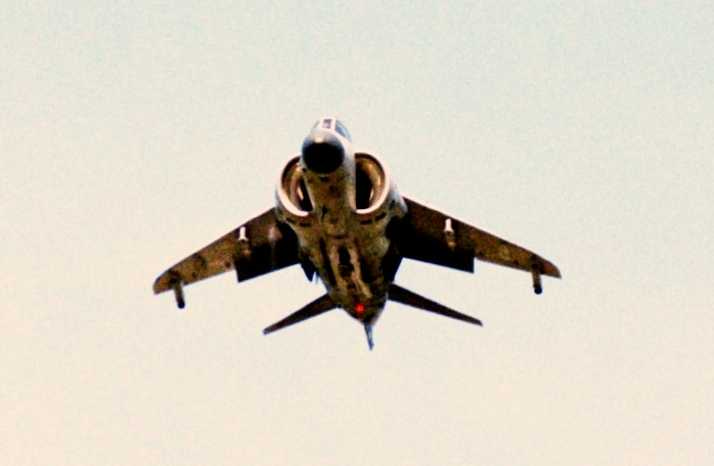
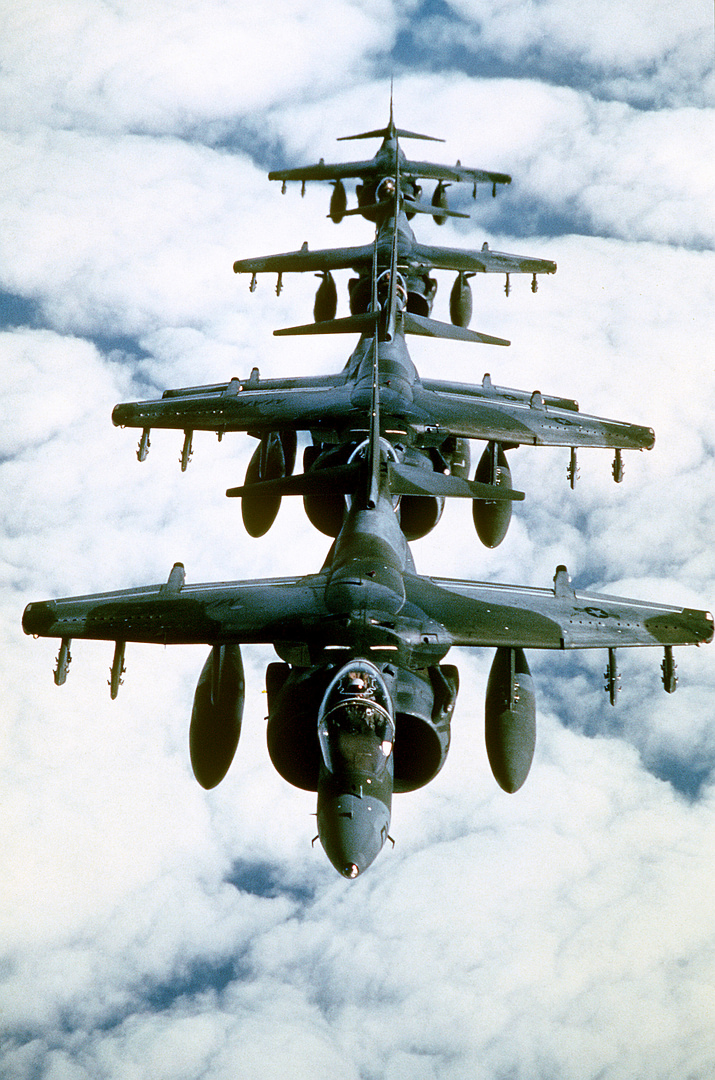
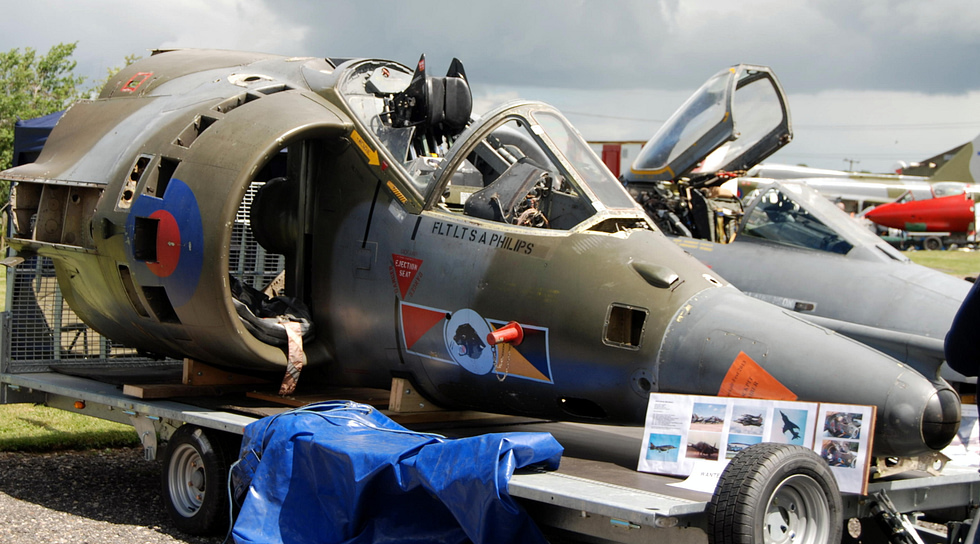
The Harrier in motion
A hand-picked Harrier video is on its way.
Where the Harrier flew
The jump jet that proved itself in battle
The Harrier’s combat career runs from the South Atlantic to the deserts of Iraq. Its most famous chapter is the 1982 Falklands War, where the Sea Harrier defended the British fleet against a numerically superior, faster air force — and won. Kill tallies from that campaign vary by source, so treat them as claims.
Compare the combat record of every military aircraft. Figures as of July 2026.
Everything people ask about the Harrier
Can I fly in a Harrier or Sea Harrier?
How fast is the Harrier?
Is the Harrier supersonic?
How does it hover?
What was its Falklands record?
Is the Harrier still in service?
How many Harriers were built?
What is VIFFing?
You can’t fly the Harrier.
These, you can.
Some legends only live in museums — others are fuelled and waiting. MiGFlug has put civilians in real military jet cockpits since 2004.
 Fly the L-39 AlbatrosThe world’s most-flown jet trainer — aerobatics included
 Fly the F-104 Starfighter“The missile with a man in it”
 Fly the MiG-21The Cold War’s most-produced jet
 Vuela el T-33 Shooting StarAmerica’s first jet trainer
 Fly the DH VampireA piece of early jet history
 Fly the S.211Agile Italian jet trainer
 Fly the MB-326The classic Aermacchi jet
 Fly the MiG-15The Soviet legend of the Korean War
Continue the tour
Every fact, checked
- GlobalSecurity.org — Hawker Siddeley P.1127 KestrelDevelopment history of the P.1127 and Kestrel evaluation aircraft.
- MilitaryFactory.com — Hawker Siddeley Harrier / AV-8AProduction totals, variants and specification cross-check.
- Warfare History Network — The BAe Sea HarrierThe Sea Harrier and its Falklands combat record.
- The Aviationist — Sea Harrier, the forgotten hero of the FalklandsAnalysis of the 1982 air campaign and the AIM-9L.
- The Aviation Geek Club — A tense CAP over the FalklandsFirst-hand account of Sea Harrier combat air patrols.
- Flugzeuginfo.net — BAe Sea Harrier technical dataIndependent specification and performance figures.
- Purdue University Engineering — the Rolls-Royce PegasusHow the vectored-thrust Pegasus engine works.
- Dunsfold Airfield History Society — P.1127The airfield where the Harrier was born and tested.