
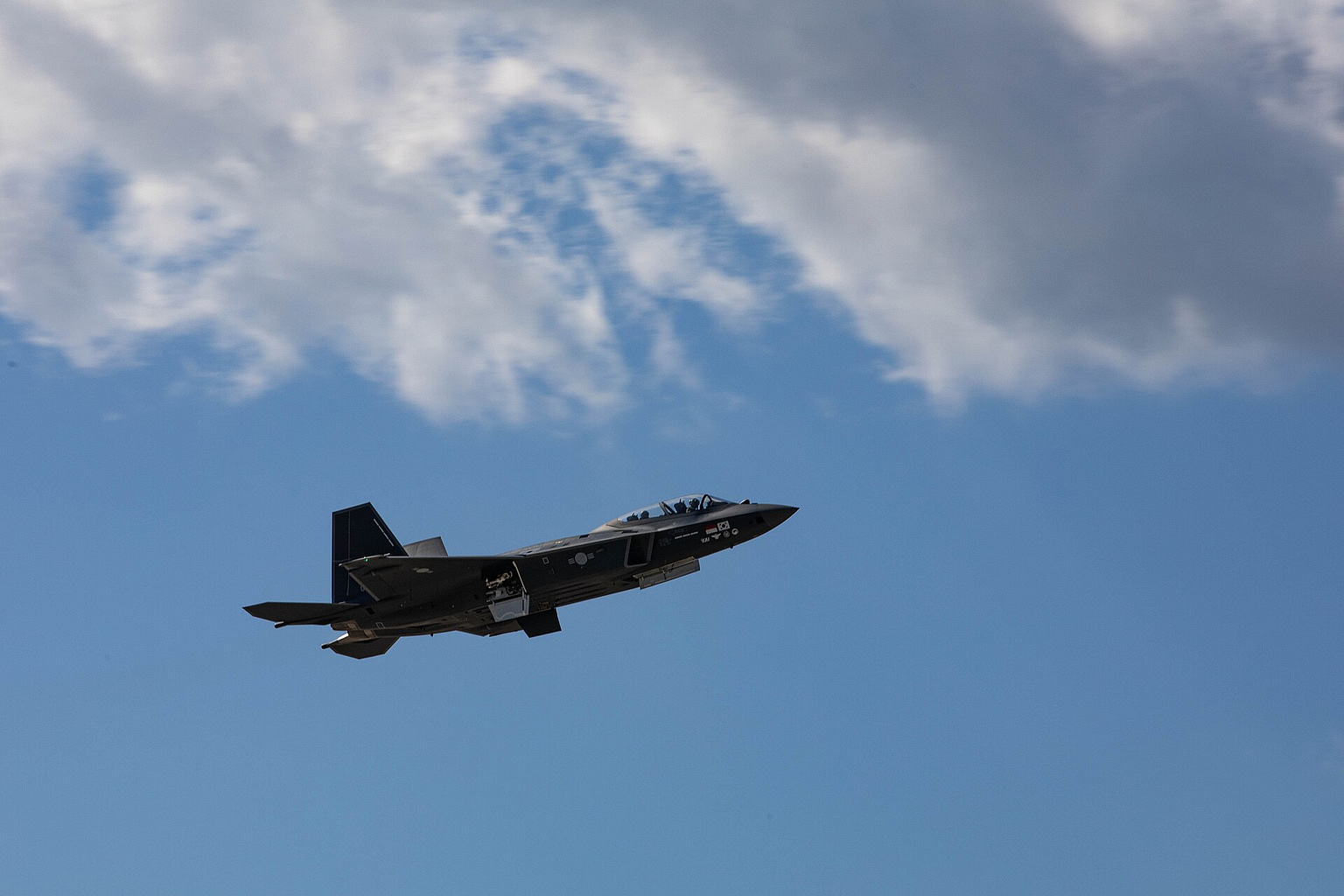
KAI KF-21 Boramae
“Fighting Hawk”
South Korea’s first indigenous fighter — a twin-engine 4.5-generation multirole jet, still maturing through testing and early production, built to retire the ageing F-4 and F-5.
South Korea builds its own fighter
For decades South Korea flew American fighters — F-4 Phantoms, F-5 Tigers, F-16s and later F-15Ks. The ambition to build a home-grown fighter dates to a presidential pledge in 2001, but it took until 2015 for Korea Aerospace Industries (KAI) to win the full-scale development contract for what was then called KF-X. The goal was a twin-engine, 4.5-generati)on multirole fighter to replace the Republic of Korea Air Force’s retiring F-4D/E Phantom II and F-5E/F Tiger II fleets, with a home-built radar and a level of stealth shaping short of a true fifth-generation jet.
The programme is a genuinely new aircraft, and much about it is still being proven. The first prototype was rolled out in April 2021 and made its maiden flight on 19 July 2022. Six prototypes — four single-seat and two twin-seat — flew a development test programme that Korean officials say wrapped up in January 2026 after around 1,600 sorties. The ROKAF has ordered an initial batch of 40 Block I aircraft, with deliveries reported to begin around 2026. These are early days: the KF-21 is best described as in development and entering low-rate production, not as a mature front-line type.
From the start the KF-21 has been an international as well as a national project. Indonesia joined in 2016 as a risk-sharing partner under the parallel IF-X designation, originally committing to roughly a fifth of the development cost in exchange for technology and local assembly. That contribution has been repeatedly contested and, in June 2025, renegotiated sharply downward — a reminder that the aircraft’s programme, like its flight envelope, is still being worked out.
01The KAI KF-21 Boramae’s origins: how South Korea set out to build its own fighter
The idea of a Korean-designed fighter was announced by President Kim Dae-jung in 2001, but the KF-X project spent years in feasibility studies and cost debate before KAI signed the full-scale development contract in 2015. South Korea funds the large majority of the programme; Indonesia signed on in 2016 as a risk-sharing partner, and US firms and Lockheed Martin provided some technology transfer, though several sensitive technologies (including key stealth and AESA elements) were withheld and had to be developed at home.
The result is often described as a stepping stone between the FA-50 light fighter KAI already built and a possible future fifth-generation aircraft. It is important to hedge the claims made for it: many performance and cost figures come from the manufacturer or the Korean government and have not been independently verified in combat or long-term service, because the type is only now entering production.
What makes it special
A largely home-built fighter with an indigenous AESA radar
The KF-21’s headline achievement is that South Korea developed much of it domestically, including an indigenous active electronically scanned array (AESA) radar led by Hanwha Systems with LIG Nex1 — a capability only a handful of countries possess. Several sensitive technologies were denied by the United States during development, so Korea built its own. As with any new radar, its real-world performance is still being validated in flight test.
Two proven GE F414 engines
Rather than gamble on a new powerplant, the KF-21 uses two General Electric F414-GE-400K afterburning turbofans — the same family that powers the F/A-18E/F Super Hornet — each rated at roughly 97.9 kN (about 22,000 lbf) in reheat, assembled in Korea by Hanwha Aerospace. The twin-engine layout gives the reported ~Mach 1.8 top speed and redundancy the single-engine FA-50 lacks.
Semi-stealth now, internal weapons planned later
The KF-21 is a 4.5-generation design: it uses radar-cross-section-reducing shaping and internal-bay provisions, but the early Block I and Block II jets carry weapons externally on ten hardpoints. A future variant (often referred to as KF-21EX) is planned to add an internal weapons bay and greater stealth — so its fifth-generation credentials remain a goal, not a delivered fact.
02The KF-21 Boramae’s radar and sensors: why the home-built AESA matters
When the KF-X programme began, the United States declined to transfer four key technologies — among them the AESA radar, infrared search-and-track and electronic-warfare suites. Rather than abandon the project, South Korea funded domestic development, with Hanwha Systems and the Agency for Defense Development producing a national AESA radar that was fitted to the prototypes and tested in flight from the mid-2020s. Independent verification of its detection range and reliability is limited, and figures cited for it should be read as manufacturer or ministry claims until the type has served operationally.
03The KF-21’s stealth: a 4.5-generation jet, not an F-35 rival
The KF-21 is deliberately positioned as a 4.5-generation fighter. It borrows stealth-influenced shaping — canted tails, a faceted forward fuselage and internal routing — but the initial production aircraft carry missiles and bombs externally, which sharply increases radar cross-section compared with a true fifth-generation type such as the F-35. KAI has spoken of a later variant with an internal weapons bay and reduced signature, sometimes labelled KF-21EX, but that aircraft does not yet exist. Any description of the KF-21 as a “stealth fighter” should be qualified: it is semi-stealthy by design intent, with full low-observability reserved for a future step.
Full specifications
Figures are for the single-seat KF-21 as published by the manufacturer and Korean government. Because the aircraft is still in testing and early production, many values are provisional and should be treated as reported rather than combat-proven.
Airframe & Performance
- Multitud
- 1 (twin-seat variant seats 2)
- Longitud
- ~16.9 m
- Envergadura
- ~11.2 m
- Altura
- ~4.7 m
- Peso vacío
- ~11,800 kg
- Max takeoff weight
- ~25,600 kg
- Max speed
- ~Mach 1.8 (~2,200 km/h, reported)
- Techo de servicio
- ~16,800 m (~55,000 ft)
- Radio de combate
- ~1,000 km (estimated)
- Load factor
- reported +9 / −3 g class
Propulsion, Armament & Cost
- Engines
- 2 × GE F414-GE-400K
- Thrust (each)
- ~97.9 kN (~22,000 lbf) with afterburner
- Radar
- Indigenous AESA (Hanwha Systems)
- Cannon
- 1 × internal M61A2 20 mm Vulcan
- Puntos duros
- 10 · ~7,700 kg external load
- First flight
- 19 July 2022
- Unit cost
- ~US$80–110 million (estimate)
- Cost per flight hour
- No official public figure yet
04The KF-21 Boramae’s cost: what a new indigenous fighter is estimated to cost
Development of the KF-21 has been budgeted at roughly 8.6 trillion won (on the order of US$6–7 billion) for research and development, with total programme spending including procurement reported near 18 trillion won over its life. Per-aircraft flyaway cost has been estimated at around US$80–110 million, though published figures have drifted upward and vary with exchange rates and block standard — treat any single number as an estimate.
No reliable cost-per-flight-hour figure exists in open sources yet, which is unsurprising for an aircraft that has only just finished its development flight-test programme. Operating-cost claims for the type are, for now, projections rather than measured data.
From national ambition to first jets
The ambition is announced
President Kim Dae-jung pledges that South Korea will develop its own fighter — the seed of the KF-X programme.
Development contract
KAI wins the full-scale development contract for the KF-X, beginning detailed design of the aircraft.
Indonesia joins
Indonesia signs on as a risk-sharing partner under the IF-X name, initially committing to about a fifth of the cost.
Roll-out
The first prototype is unveiled in April 2021 and formally named Boramae; ground and taxi testing follow.
First flight
The KF-21 makes its maiden flight on 19 July 2022, opening a multi-year flight-test campaign.
First production contract
South Korea places an initial mass-production order, beginning the shift from prototypes to service aircraft.
Indonesia’s share is cut
Seoul and Jakarta agree to reduce Indonesia’s contribution by roughly two thirds amid unpaid instalments.
Testing done, deliveries begin
Korean officials report the development flight-test programme complete after ~1,600 sorties; early deliveries to the ROKAF begin.
Twelve KF-21 stories
A fighter Korea vowed to build
The KF-21 grew from a 2001 presidential pledge that South Korea would design its own jet.
Read the full story
Indonesia signs on
In 2016 Indonesia joined as a risk-sharing partner under the IF-X designation.
Read the full story
Unveiled before it flew
The first KF-21 was rolled out and named Boramae in April 2021, over a year before its first flight.
Read the full story
19 July 2022
The KF-21 made its maiden flight in July 2022, becoming a genuinely flying prototype.
Read the full story
Six prototypes, 1,600 sorties
A fleet of six prototypes flew the development test programme, reported complete in early 2026.
Read the full story
A homegrown AESA
After the US withheld radar technology, Korea built its own AESA for the jet.
Read the full story
Two American engines
The KF-21 flies on a pair of proven General Electric F414 turbofans.
Read the full story
4.5-gen, not 5th
The KF-21 is semi-stealthy by design, but carries its weapons externally for now.
Read the full story
What Boramae means
The jet’s name comes from a Korean word for a young hunting hawk.
Read the full story
The first orders
South Korea has ordered an initial 40 Block I jets, with more expected.
Read the full story
A contested bill
In 2025 Indonesia’s share of the cost was cut by roughly two thirds.
Read the full story
The road ahead
Korea hopes to grow the KF-21 into a stealthier jet and win export orders.
Read the full story
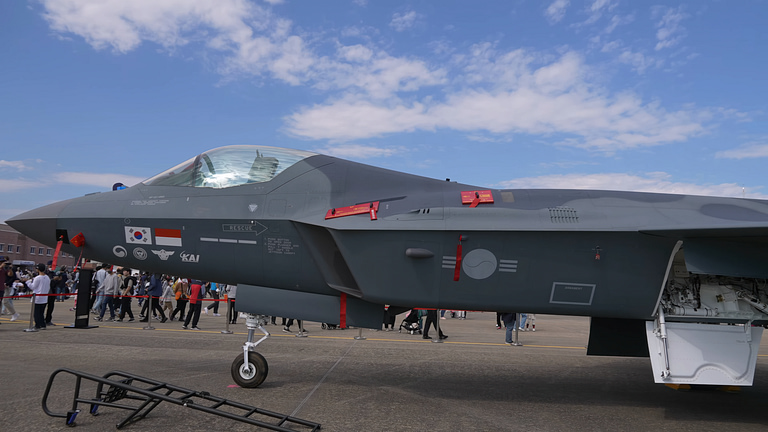
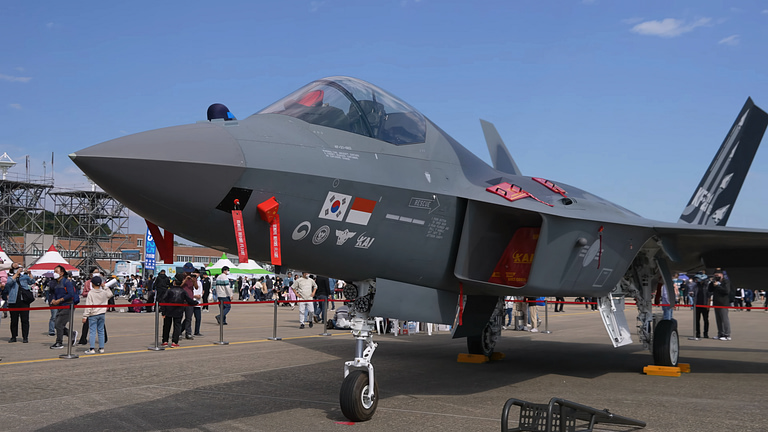
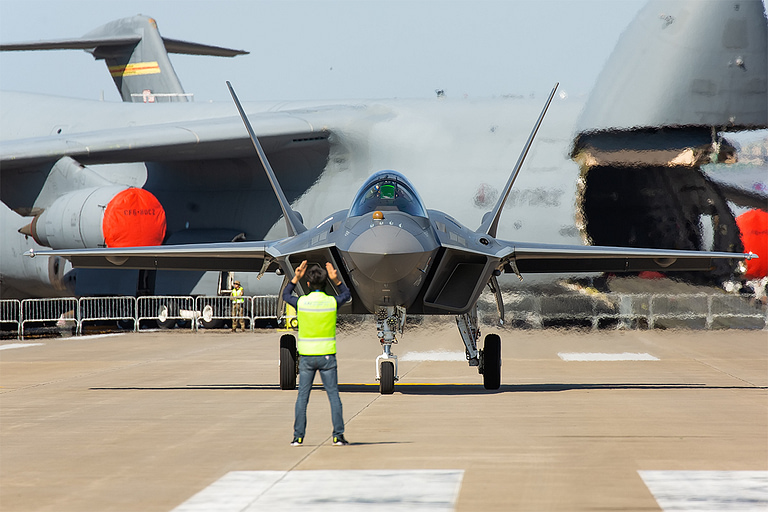
The KF-21 in pictures



The KF-21 in motion
A curated video feature for the KF-21 Boramae is coming soon. In the meantime, explore the photo gallery above and the operator map below.
Where the KF-21 operates
Where the record stands
The KF-21 has no combat record — it is a new aircraft only now entering service, and everything about its capability is, for the moment, based on testing and manufacturer data rather than operational use. Its story so far is measured in prototypes flown, test points cleared and the first production orders placed, not in missions flown. That is exactly what to expect from a fighter in development and early production.
Compare the combat record of every military aircraft. Figures as of July 2026.
Everything people ask about the KF-21
Can I fly in a KF-21?
Is the KF-21 a stealth fighter?
Who builds the KF-21 Boramae?
What engines does the KF-21 use?
Is the KF-21 in service yet?
What is Indonesia’s role in the KF-21?
What will the KF-21 replace?
You can’t fly the KF-21.
These, you can.
Some legends only live in museums — others are fuelled and waiting. MiGFlug has put civilians in real military jet cockpits since 2004.
 Fly the L-39 AlbatrosThe world’s most-flown jet trainer — aerobatics included
 Fly the F-104 Starfighter“The missile with a man in it”
 Fly the MiG-21The Cold War’s most-produced jet
 Vuela el T-33 Shooting StarAmerica’s first jet trainer
 Fly the DH VampireA piece of early jet history
 Fly the S.211Agile Italian jet trainer
 Fly the MB-326The classic Aermacchi jet
 Fly the MiG-15The Soviet legend of the Korean War
Continue the tour
Every fact, checked
- Asian Military Review — KF-21 completes flight-test programmeSix prototypes, ~1,600 sorties and the initial 40-aircraft Block I order.
- The Aviationist — first production KF-21 rolled outThe transition from prototypes to serial production aircraft.
- Breaking Defense — revised Indonesia agreementThe 2025 renegotiation of Jakarta’s cost share.
- KED Global — Indonesia’s cost share cut by two thirdsFigures on the original ~1.7 trillion won share and its reduction to ~600 billion won.
- GlobalSecurity.org — KF-21 programme profileProgramme background, cost estimates and the meaning of “Boramae.”
- Airforce Technology — KF-21 project profileAirframe, engine and systems baseline for the design.
- FlightGlobal — KF-21 development coverageOngoing reporting on flight test and production milestones.
- Defence Security Asia — development flight testing completeDetails of the completed test campaign and sortie count.