
Supermarine Attacker
The Fleet Air Arm’s first operational jet fighter — a transitional design that bolted a jet fuselage to a piston-fighter’s wing, tailwheel and all, and carried the Royal Navy into the jet age.
La historia
The Supermarine Attacker: how the Fleet Air Arm entered the jet age
The Supermarine Attacker is not a famous aircraft, and it was never a great one. It was slow to develop, awkward on a carrier deck, and obsolete almost as soon as it entered service. And yet it holds a genuine and permanent place in history: it was the first jet fighter to enter operational front-line service with the Royal Navy’s Fleet Air Arm. Every carrier jet the Royal Navy has flown since — the Sea Hawk, the Scimitar, the Sea Vixen, the Phantom, the Sea Harrier, the F-35 — traces its lineage back to this stubby, tailwheel-equipped stopgap. The Attacker is the aircraft that carried the Fleet Air Arm across the line from the piston age into the jet age.
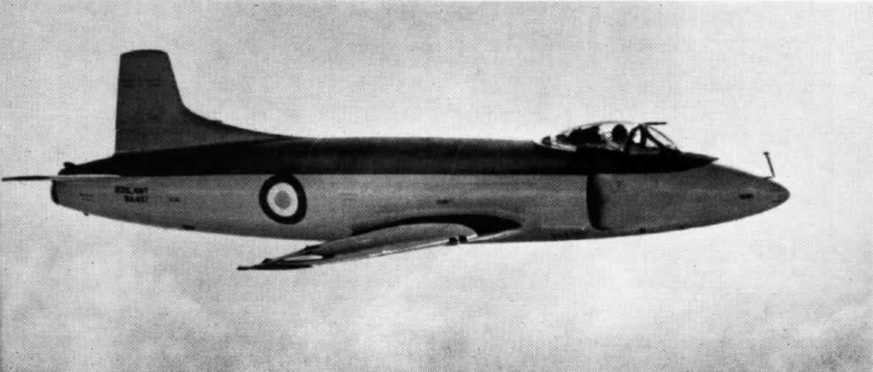
Its origins explain its odd, transitional character. Supermarine — the company that had built the Spitfire — had been developing a new high-performance piston fighter, the Spiteful, as a Spitfire successor, with an advanced laminar-flow wing designed to reduce drag at high speed. The piston Spiteful was overtaken by the jet revolution and never entered large-scale service, but its clever new wing was too good to waste. So Supermarine took that laminar-flow wing, married it to a new fuselage built around a Rolls-Royce Nene turbojet, and produced a jet fighter. The Attacker was, in effect, a jet aircraft with a piston fighter’s wing — a very literal bridge between two eras.
“A jet fuselage, a piston fighter’s laminar wing, and a tailwheel — the Attacker was a bridge between two ages, and it looked it.”— the Attacker’s transitional design, in a sentence
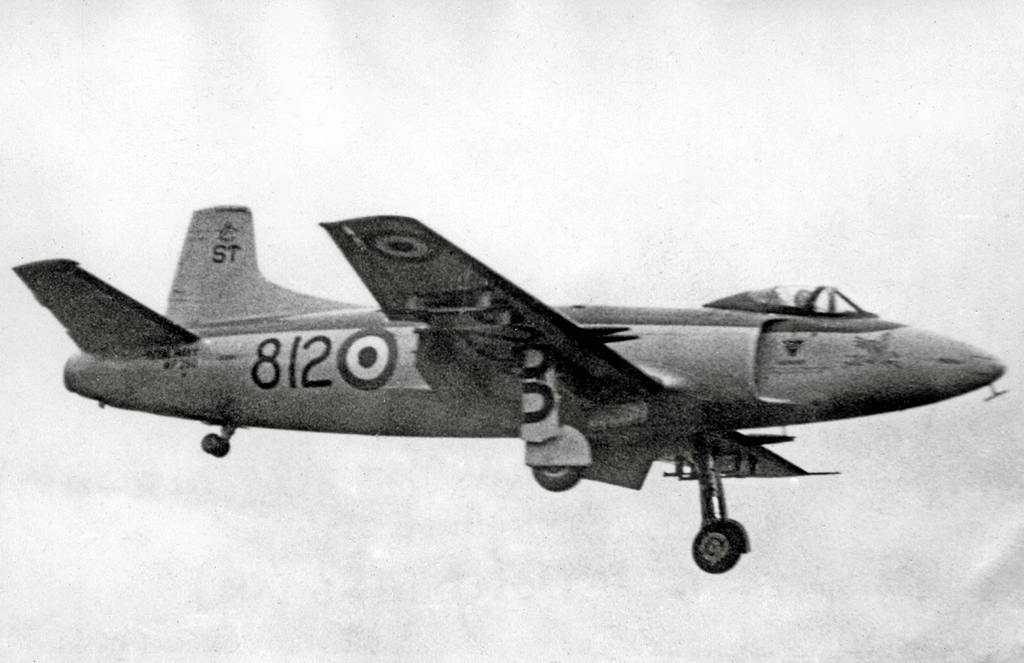
That heritage left its most awkward mark at the back of the aircraft. Because the wing came from the Spiteful, the Attacker inherited a tailwheel undercarriage — a “taildragger” layout, in which the aircraft sits nose-high on the ground with a small wheel under the tail. By the late 1940s this was already going out of fashion; the new generation of jets was adopting the tricycle undercarriage, with a nosewheel, which sits level on the ground and is far easier to handle. On a carrier, the tailwheel was a real drawback: it gave the pilot a poor view forward over the raised nose, made taxiing and deck handling clumsy, and its jet exhaust angled down at the deck. The Attacker’s tailwheel, more than anything, marked it out as a first-generation aircraft — a stopgap, not a mature design.
The Attacker also arrived comparatively late. Britain’s Royal Air Force had been flying jets since the Gloster Meteor entered service in 1944, and land-based jet fighters were well established by the time the Attacker reached the Fleet Air Arm in 1951. Naval jet operations were simply harder: the aircraft had to be strengthened for catapult launches and arrested landings, and flying a jet from a pitching deck was a formidable new challenge. So the Royal Navy came to the jet age a few years behind the RAF, and the Attacker was the aircraft that finally closed that gap.
The Attacker first flew in 1946, but development was slow, and it did not enter front-line Fleet Air Arm service until August 1951, when it equipped 800 Naval Air Squadron. It was a straightforward straight-wing jet, powered by the reliable Rolls-Royce Nene and armed with four 20 mm Hispano cannon; the later fighter-bomber version, the FB.2, could also carry bombs and rockets. It was fast enough for its day and pleasant enough to fly in the air, if not on the deck, and for the first time it gave Royal Navy carrier squadrons jet performance.
In the air the Attacker was a reasonable performer for its moment. The Nene gave it a good turn of speed, the laminar wing helped it along, and pilots generally found it pleasant enough to fly once airborne. Its problems were on the ground and on the deck rather than in flight: the tailwheel, the deep fuselage and the limited forward view all belonged to an earlier era. It was, in short, an aircraft that flew like an early jet but sat on its wheels like a wartime fighter — the compromise of its mixed parentage made visible.
But the pace of aviation in the early 1950s was brutal, and the Attacker was overtaken almost immediately. The swept wing, which allowed much higher speeds, was transforming fighter design, and even among straight-wing jets more refined aircraft were arriving — notably the Hawker Sea Hawk, which had a modern tricycle undercarriage and was a far better carrier aircraft. The Attacker’s front-line career with the Royal Navy was correspondingly short: it served with just three front-line squadrons and was withdrawn from front-line duty by around 1954, only about three years after it had entered service.
Yet operating the Attacker taught the Fleet Air Arm hard lessons that fed directly into everything that followed. Landing a jet on a carrier is a very different task from landing a piston aircraft: the approach speeds are higher, the engine responds more slowly to the throttle, and there is less margin for error. The Attacker’s tailwheel and modest deck manners made those lessons harder than they needed to be, but they were learned all the same — and the pilots, deck crews and procedures the Royal Navy developed on the Attacker were exactly what it needed for the far more demanding jets to come.
It was not quite finished, though. The Attackers passed to the squadrons of the Royal Naval Volunteer Reserve — the “weekend flyers” of the RNVR air branch — where they gave reserve pilots valuable experience of jet flying, and they soldiered on in that role until about 1957. It was a fitting second life for a transitional aircraft: no longer front-line material, but still useful for building the jet experience the Fleet Air Arm now needed throughout its ranks.
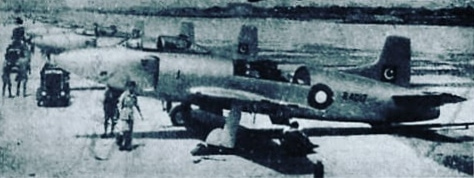
The Attacker’s one significant export went to Pakistan. The Pakistan Air Force ordered a land-based version — without the carrier equipment such as the arrester hook — and operated a squadron of them from the early 1950s. It was the only substantial foreign sale of the type, and it gave the Attacker a brief career as a land-based fighter far from the sea it was designed to fly over.
By the standards of the aircraft that followed it, the Attacker was a modest machine, and it is easy to dismiss. That would be a mistake. Its importance is not in what it could do but in what it began: it proved that the Fleet Air Arm could operate jets from carriers, it gave the Royal Navy its first hard-won experience of the new technology, and it opened the door for the far more capable carrier jets that came after. One Attacker survives today, preserved at the Fleet Air Arm Museum at Yeovilton — a quiet monument to the aircraft that took the Royal Navy into the jet age.
01The Attacker’s origins: from the Spiteful to a jet+
The Attacker’s story begins not with a jet but with a piston fighter. Supermarine, the maker of the Spitfire, had developed the Spiteful as a high-performance Spitfire successor, fitted with a new laminar-flow wing intended to cut drag and raise top speed. But the jet revolution overtook the piston Spiteful, which was built only in small numbers and never became a major type.
Rather than waste the advanced wing, Supermarine adapted it. The company designed a new fuselage around a Rolls-Royce Nene turbojet and mated it to the Spiteful’s laminar-flow wing, creating a jet fighter from proven and new components combined. This pragmatic approach got a jet into the air relatively quickly, but it also baked the piston fighter’s characteristics — including its tailwheel — into the new aircraft.
02The laminar-flow wing inherited from the Spiteful+
The Attacker’s wing was its most direct inheritance from the piston Spiteful. A laminar-flow wing is shaped so that the airflow stays smooth (laminar) over more of its surface before becoming turbulent, which reduces drag and helps at higher speeds. It was an advanced idea for the mid-1940s, and it was the reason Supermarine thought the wing worth carrying over to a jet.
In practice, laminar-flow wings of the era were sensitive to manufacturing imperfections and surface finish, and their benefits were not always fully realised. But the wing gave the Attacker respectable straight-line performance, and its use is a neat illustration of how the earliest jets were often assembled from the best available pieces of the piston era rather than designed wholly afresh.
03The Rolls-Royce Nene turbojet+
Power came from the Rolls-Royce Nene, one of the most important early jet engines. The Nene was a centrifugal-flow turbojet — a robust, reliable layout typical of first-generation jet engines — and it was powerful for its time, giving the Attacker brisk performance for the early 1950s. The same engine, in various forms and licensed copies, powered a whole generation of early jets around the world.
The Nene made the Attacker a genuine jet fighter with real performance, and it was dependable. But a centrifugal engine is relatively bulky in cross-section, which shaped the Attacker’s deep, portly fuselage — another mark of the first jet generation, before the slimmer axial-flow engines of later aircraft allowed sleeker designs.
04The tailwheel problem: why a taildragger jet was awkward+
The Attacker’s most notable drawback was its tailwheel undercarriage, inherited along with the Spiteful’s wing. A “taildragger” sits nose-high on the ground, with a small wheel under the tail, whereas the new tricycle layout — with a nosewheel — sits level. For a jet, and especially for a carrier jet, the tailwheel was a genuine handicap.
Nose-high on the deck, the pilot had a poor view forward for taxiing and for lining up on the carrier; the aircraft was clumsier to handle on deck; and the jet exhaust was angled down towards the deck. The tricycle undercarriage that rival jets adopted was simply better for jet operations, and the Attacker’s tailwheel is the clearest sign of its status as a transitional, first-generation aircraft.
05The Fleet Air Arm’s first jet: entering service in 1951+
The Attacker’s place in history rests on a single fact: it was the first jet fighter to enter operational front-line service with the Royal Navy’s Fleet Air Arm. After a first flight in 1946 and a long development, it equipped 800 Naval Air Squadron in August 1951, giving the Royal Navy’s carrier air groups jet performance for the first time.
This mattered a great deal. Operating jets from carriers was a demanding new discipline — different speeds, different handling, different deck procedures — and the Attacker was the aircraft on which the Fleet Air Arm learned it. Whatever its shortcomings, it was the machine that carried the Royal Navy across the threshold into the jet age, and everything that followed built on that first step.
06Armament: four 20mm Hispano cannon and the FB.2+
The Attacker was armed with four 20 mm Hispano cannon, the standard heavy fighter armament of the British forces in the period and a hard-hitting battery for its day. This gave it real firepower as an interceptor and gun fighter, in line with the fighters of the immediate post-war years.
The definitive version was the FB.2, a fighter-bomber that added the ability to carry bombs and rockets under the wings, broadening the aircraft’s usefulness to ground- and ship-attack work as well as air fighting. The FB.2 was the most numerous variant and the one that equipped most Attacker squadrons, both in front-line and later reserve service.
07A short front-line career, quickly superseded+
The Attacker’s front-line career was brief, and that was no accident — aviation was advancing at breakneck speed in the early 1950s. The aircraft served with only three front-line Fleet Air Arm squadrons and was withdrawn from front-line duty by around 1954, roughly three years after entering service. Few operational aircraft have had so short a front-line life.
The reason was simply that better aircraft arrived almost at once. The Hawker Sea Hawk, a more refined straight-wing jet with a modern tricycle undercarriage, was a much better carrier aircraft, and the swept-wing revolution was pushing performance higher still. The Attacker was overtaken before it had really settled in — the fate of many pioneering designs that arrive at a moment of rapid change.
08Second life with the RNVR reserve squadrons+
Retirement from the front line was not the end of the Attacker’s Royal Navy service. The aircraft passed to the squadrons of the Royal Naval Volunteer Reserve (RNVR), the reserve air branch whose part-time pilots flew at weekends and in training periods. There the Attacker gave reserve aircrew experience of jet flying, which the Fleet Air Arm increasingly needed throughout its ranks.
The RNVR Attackers flew in this role until around 1957, when the reserve air branch itself was wound down. It was an appropriate second career for a transitional aircraft — no longer suited to front-line combat, but still perfectly useful for building the jet experience that the whole of naval aviation now depended on.
09The Pakistan Air Force export+
The Attacker’s only substantial export customer was Pakistan. The Pakistan Air Force ordered a land-based version of the aircraft — stripped of the naval equipment such as the arrester hook needed for carrier operations — and operated a squadron of them from the early 1950s. It was the type’s sole significant foreign sale.
The Pakistani Attackers served as land-based fighters, giving the young air force early jet experience of its own, before being replaced by more modern types later in the decade. It was a modest export, but it gave the Attacker a second national operator and a brief career far from the carrier decks and grey northern seas it had been designed for.
Design & Engineering
How the Attacker was built: a jet from piston-era parts
The Attacker was a pragmatic, transitional design — a new jet fuselage married to a proven piston-fighter wing — and both its strengths and its awkwardness flowed directly from that compromise.
A borrowed wing
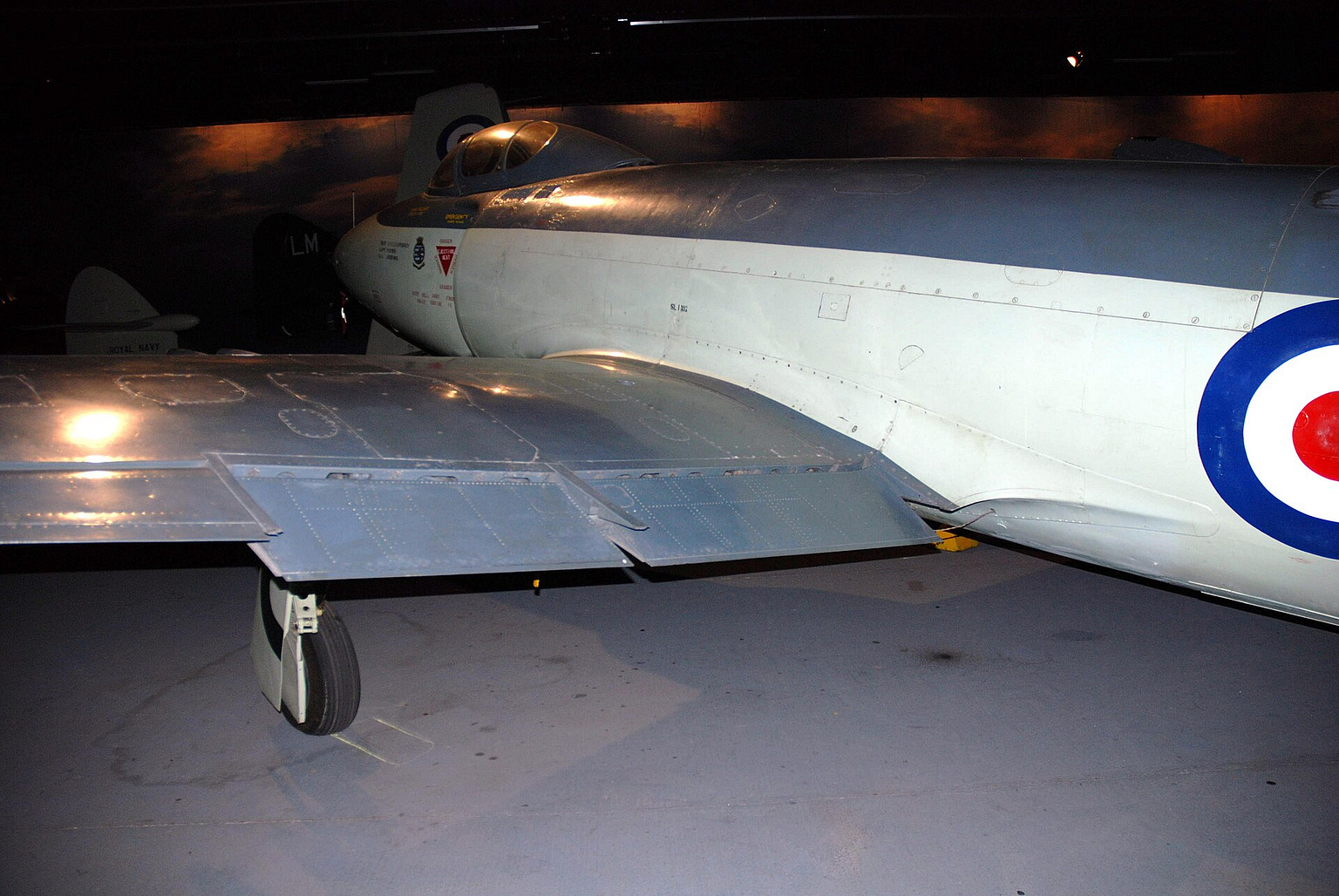
The advanced laminar-flow wing came straight from the piston Supermarine Spiteful — and with it came the tailwheel undercarriage that marked the Attacker as first-generation.
Nene jet power
A reliable Rolls-Royce Nene centrifugal turbojet gave real jet performance, but its bulk shaped the Attacker’s deep, portly fuselage.
Carrier fighter
Folding wings, arrester hook and four 20 mm cannon made it a carrier fighter — though the tailwheel made deck handling awkward from the start.
Presupuesto
Supermarine Attacker specifications: dimensions, performance and cost
| Tipo | Single-seat carrier-based jet fighter (and fighter-bomber) |
| Multitud | 1 |
| Longitud | ~11.4 m (37 ft 6 in) — approx. |
| Envergadura | ~11.25 m (36 ft 11 in) — approx. |
| Altura | ~3.0 m (9 ft 11 in) — approx. |
| Peso vacío | ~3,830 kg (~8,430 lb) — approx. |
| Max takeoff weight | ~5,540 kg (~12,210 lb) — approx. |
| Motor | 1 × Rolls-Royce Nene centrifugal turbojet (~5,000 lbf) |
| Undercarriage | Tailwheel (taildragger) |
| Armamento | 4 × 20 mm Hispano cannon; bombs and rockets (FB.2) |
| Max speed | ~950 km/h (~590 mph) — est. |
| Rango | ~950 km (~590 mi) — est. |
| Techo de servicio | ~13,700 m (~45,000 ft) — est. |
| First flight | 27 July 1946 (prototype) |
| Introduced | August 1951 (Fleet Air Arm) |
| Retired | ~1954 (front line); ~1957 (RNVR reserve) |
| Number built | ~185 |
| Main variants | F.1, FB.1, FB.2; land-based export version |
| Operators | United Kingdom (Royal Navy) and Pakistan |
| Unit cost | not reliably recorded (early Cold War procurement) |
| Cost per flight hour | not reliably recorded |
10The Attacker’s variants: F.1 to FB.2+
The Attacker was produced in a small number of closely related variants. The initial fighter version, the F.1, was followed by the FB.1 and then the definitive FB.2 fighter-bomber, which added the ability to carry bombs and rockets and became the most numerous version. In total only around 185 were built — a modest run reflecting the aircraft’s short front-line life.
There was also the land-based export version supplied to Pakistan, which dispensed with the naval equipment. The Attacker never spawned the sprawling family of sub-types that longer-lived aircraft accumulate; its variants are few, and they mark the aircraft’s straightforward evolution from pure fighter to fighter-bomber over its brief career.
11The Supermarine Attacker’s operating costs: what the records show+
As with most early Cold War military aircraft, there is no single reliable, transparent public figure for the Attacker’s unit cost, cost per flight hour or total programme cost. It was procured in small numbers in the early 1950s through government contracts rather than at a published list price, and consistent cost data for so short-lived a type is not available. Any single figure quoted for it should be treated with caution.
What can be said is that the Attacker was, by design, a relatively economical way for the Royal Navy to acquire a jet capability quickly — reusing the Spiteful’s wing and a proven engine rather than developing an all-new aircraft. Rather than invent numbers, we list the cost fields here as “not reliably recorded.”
12Why the Attacker was obsolete so quickly+
The Attacker entered service in 1951 and was gone from the front line by about 1954 — an unusually short career that reflects just how fast fighter technology was moving. Two developments overtook it almost at once. First, the swept wing, which delayed the drag rise near the speed of sound and allowed much higher speeds, was rapidly becoming standard; the Attacker’s straight wing left it behind. Second, even among straight-wing jets, the tricycle undercarriage made rivals far better carrier aircraft.
The Hawker Sea Hawk, arriving at almost the same time, showed the difference: a cleaner, tricycle-undercarriage straight-wing jet that was a much better naval aircraft. Behind it came the swept-wing generation — the Supermarine Scimitar, the de Havilland Sea Vixen — that made the Attacker look thoroughly of the past. The Attacker was a victim of its timing, arriving at the very moment the ground was shifting beneath it.
13The surviving Attacker at the Fleet Air Arm Museum+
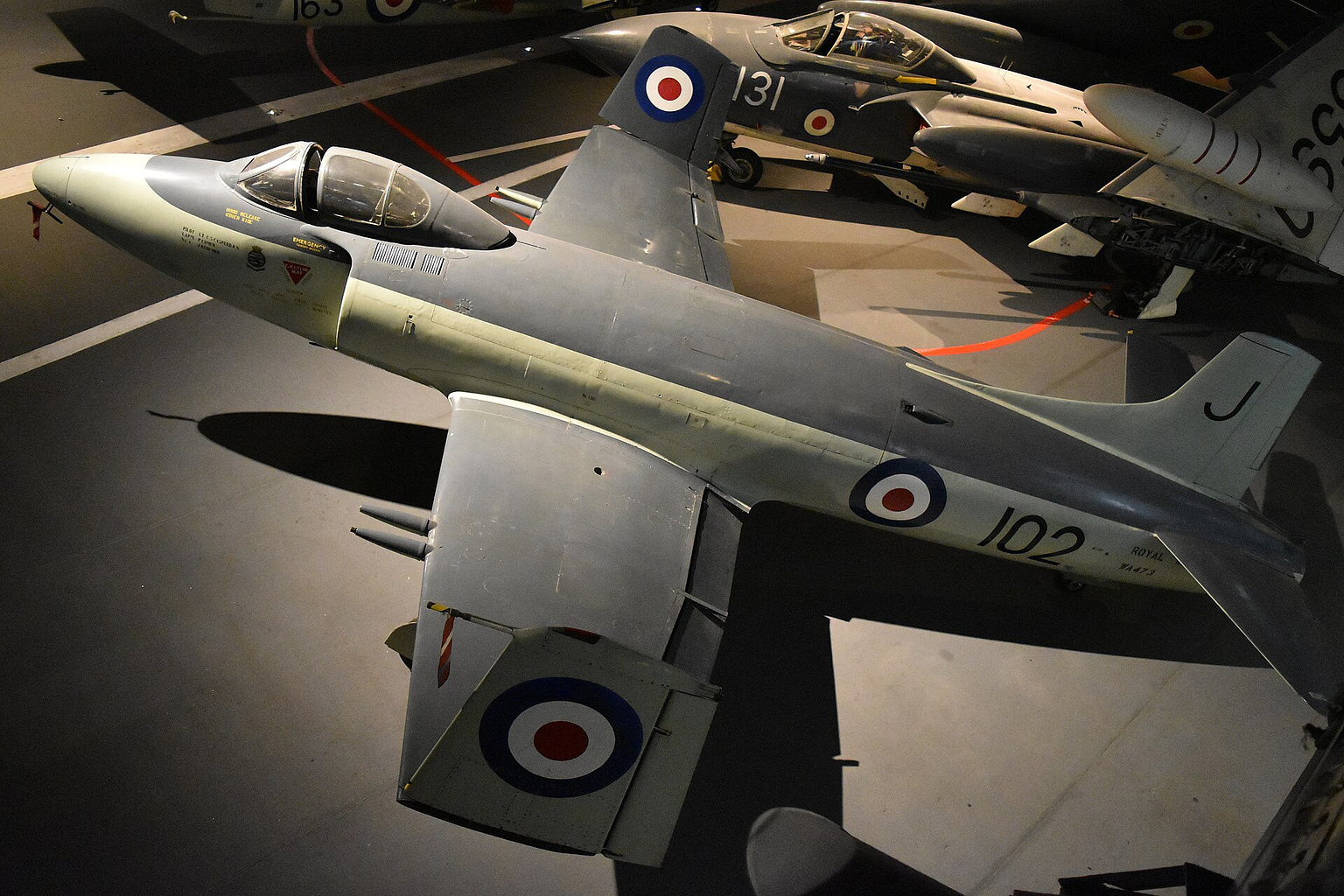
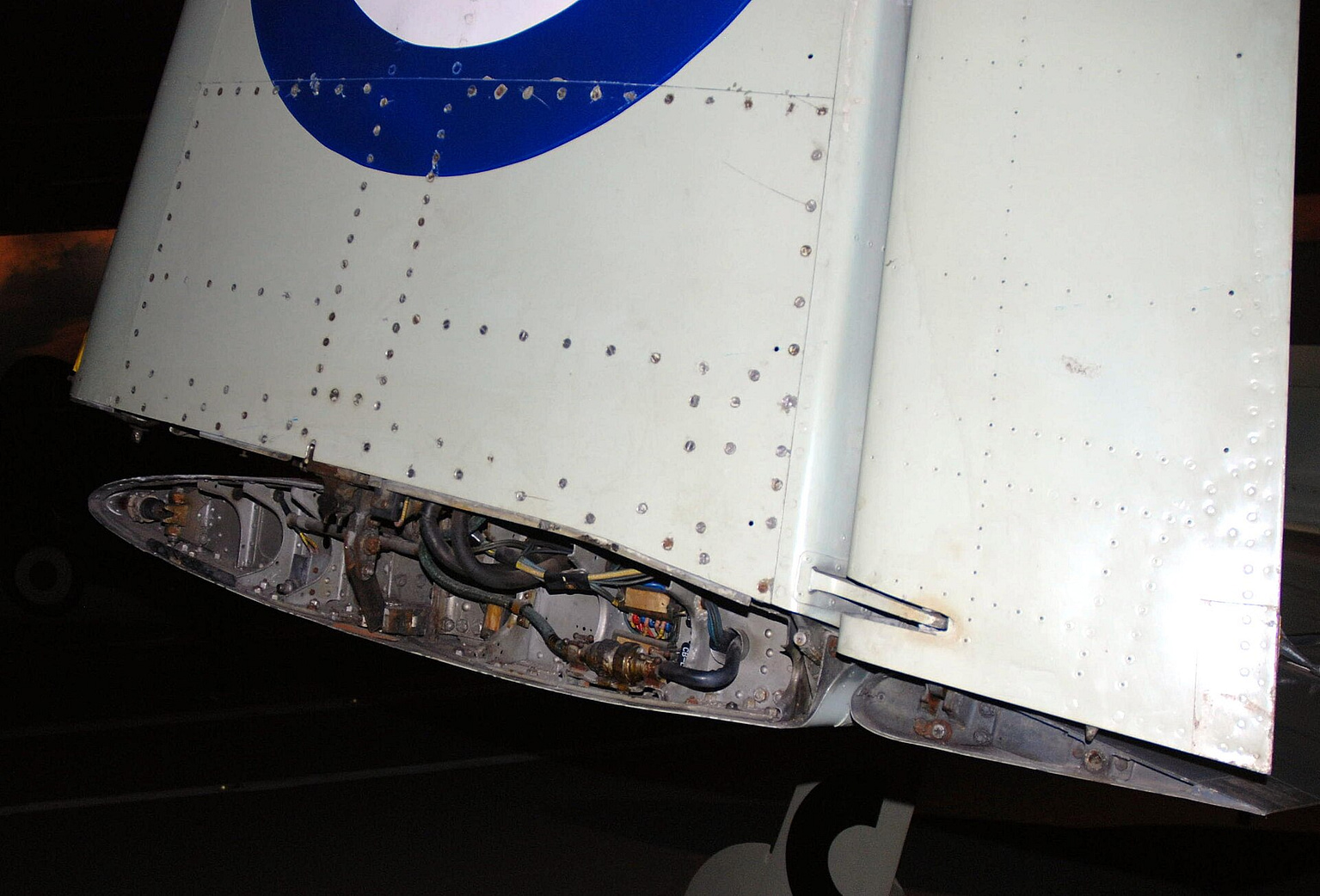
Because so few were built and the type was retired early, survivors are extremely rare. One complete Attacker is preserved in the United Kingdom at the Fleet Air Arm Museum at RNAS Yeovilton, displayed in Royal Navy markings as a record of the aircraft that took the Fleet Air Arm into the jet age.
For an aircraft with so brief and modest a career, the survival of even a single example is valuable, and the preserved Attacker lets visitors see for themselves the transitional design — the deep Nene fuselage, the laminar wing borrowed from a piston fighter, and the tailwheel that marked it out as a machine caught between two eras. It is a quiet but important piece of Royal Navy history.
Timeline
The Supermarine Attacker through the years
Supermarine develops the piston Spiteful with an advanced laminar-flow wing — the wing that will later be carried over to the Attacker.
The Supermarine Attacker prototype flies on 27 July 1946, mating a Nene-powered jet fuselage to the Spiteful’s laminar-flow wing.
Development stretches over several years as the naval jet is refined for carrier service.
The Attacker enters front-line service with 800 Naval Air Squadron in August 1951 — the Fleet Air Arm’s first operational jet fighter.
The Pakistan Air Force orders a land-based version — the Attacker’s only substantial export.
The definitive FB.2 adds bombs and rockets, becoming the most numerous Attacker variant.
Attackers serve with front-line squadrons aboard Royal Navy carriers such as HMS Eagle.
Superseded by better jets like the Hawker Sea Hawk, the Attacker is withdrawn from front-line service after only about three years.
Attackers pass to Royal Naval Volunteer Reserve squadrons, giving reserve pilots jet experience until about 1957.
A single Attacker is preserved at the Fleet Air Arm Museum, Yeovilton — a monument to the Royal Navy’s first carrier jet.
Stories & Eyewitnesses
The Supermarine Attacker in stories: the moments that defined it
A piston fighter’s wing on a jet, a tailwheel on a carrier deck, the Fleet Air Arm’s first jet squadron, a brief front-line life and an export to Pakistan — the Attacker’s history told through the moments that stuck.
From the Spiteful
A wing looking for an aircraft
The Attacker’s wing came from a piston fighter.
Supermarine’s piston Spiteful, a Spitfire successor, had an advanced laminar-flow wing but was overtaken by the jet age and never mass-produced.
Rather than waste the wing, Supermarine bolted it to a new jet fuselage — and the Attacker was born, half piston-era, half jet.
Nene Power
A proven jet engine
The reliable Rolls-Royce Nene gave real jet performance.
The Attacker was powered by the Rolls-Royce Nene, a robust centrifugal-flow turbojet that powered a whole generation of early jets around the world.
It gave brisk performance, but its bulk helped make the Attacker’s fuselage deep and portly — a mark of the first jet generation.
The Tailwheel
A taildragger jet
The Attacker kept an old-fashioned tailwheel undercarriage.
Inherited from the Spiteful, the Attacker’s tailwheel undercarriage left it sitting nose-high on the ground — awkward on a carrier deck, with a poor forward view and clumsy handling.
It was the clearest sign that the Attacker was a first-generation, transitional aircraft.
First FAA Jet
Into the jet age, 1951
The Attacker was the Fleet Air Arm’s first operational jet.
In August 1951 the Attacker equipped 800 Naval Air Squadron — the first jet fighter to enter operational front-line service with the Royal Navy’s Fleet Air Arm.
It gave Royal Navy carrier squadrons jet performance for the first time, and the FAA learned carrier jet operations on it.
Four Cannon
A hard-hitting battery
The Attacker carried four 20mm Hispano cannon.
The Attacker was armed with four 20 mm Hispano cannon, a heavy and hard-hitting battery in line with the fighters of the immediate post-war years.
The FB.2 fighter-bomber version added bombs and rockets, broadening the aircraft to ground- and ship-attack work.
On the Deck
Jets go to sea
Attackers flew from carriers like HMS Eagle.
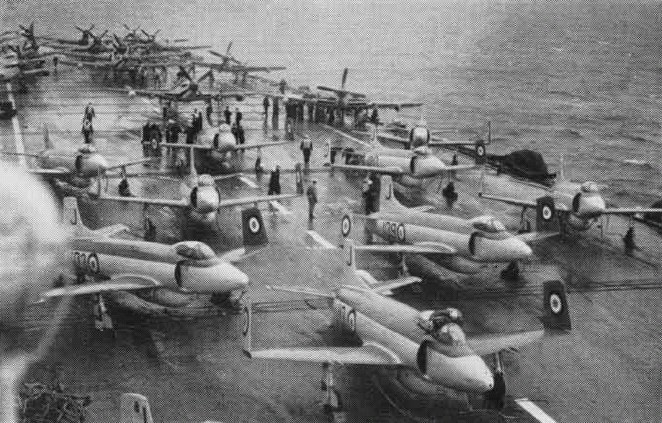
Attacker squadrons embarked on Royal Navy carriers such as HMS Eagle, where crews grappled with the new discipline of operating jets from a moving flight deck.
The tailwheel made it clumsy on deck, but it was the aircraft on which the Fleet Air Arm learned to go to sea with jets.
Overtaken at Once
A three-year front line
Better jets superseded the Attacker almost immediately.
Aviation was moving so fast that the Attacker was obsolete almost as soon as it arrived. It served with just three front-line squadrons and left front-line duty by around 1954.
The tricycle-undercarriage Hawker Sea Hawk and the coming swept-wing jets simply did the job better.
Weekend Flyers
The RNVR reserve
Attackers gave reserve pilots jet experience.
After front-line withdrawal the Attackers passed to the Royal Naval Volunteer Reserve squadrons, whose part-time pilots flew them at weekends and in training.
They served the RNVR until about 1957, building the jet experience the whole Fleet Air Arm now needed.
Sold to Pakistan
A land-based Attacker
Pakistan was the Attacker’s only substantial export.
The Pakistan Air Force ordered a land-based version of the Attacker — without the naval arrester hook — and flew a squadron of them from the early 1950s.
It was the type’s only significant foreign sale, giving the young air force early jet experience.
A Bridge Between Eras
Half piston, half jet
The Attacker literally combined two ages.
With a jet fuselage, a piston fighter’s laminar wing and a tailwheel, the Attacker was a very literal bridge between the piston and jet ages — and it looked the part.
Its importance lies not in performance but in being the first step across that divide for the Fleet Air Arm.
The Starting Point
Where FAA jets began
Every later FAA carrier jet traces back to the Attacker.
The Sea Hawk, Scimitar, Sea Vixen, Phantom, Sea Harrier and F-35 all descend from the moment the Fleet Air Arm first flew jets operationally — and that moment was the Attacker.
Modest as it was, the Attacker is the starting point of Royal Navy jet carrier aviation.
The Survivor
Preserved at Yeovilton
One Attacker survives, at the Fleet Air Arm Museum.
Because so few were built and it was retired early, only one complete Attacker survives, preserved at the Fleet Air Arm Museum at RNAS Yeovilton in Royal Navy markings.
It is a rare, tangible reminder of the aircraft that took the Royal Navy into the jet age.
Photo Gallery
The Supermarine Attacker in photographs
Fleet Air Arm, Pakistan Air Force and museum photographs of the Attacker, each credited to its source and licence. Click any photo to enlarge.

On Film
The Supermarine Attacker on video: a story of fighter development
An archival film on the Attacker — the Fleet Air Arm’s first jet fighter, its Nene engine and laminar wing, and its place at the start of the Royal Navy’s jet age.
“A Story of Fighter Development: Supermarine Attacker” via PeriscopeFilm (approx. 19,000 views at time of writing; running time ~18 minutes) — an archival documentary film on the Attacker’s development.
Operations Overview
Where the Supermarine Attacker flew: an operator map
Designed and built in the United Kingdom for the Royal Navy’s Fleet Air Arm, with a single substantial export to Pakistan — so this is deliberately a small, two-nation map. Hover or tap a country for detail.
Categories: Design, Manufacture & Fleet Air Arm (United Kingdom) · Export Operator (Pakistan) · Surviving Airframe (United Kingdom, Fleet Air Arm Museum). A small two-nation map is correct for this aircraft.
Service Record
The Attacker’s record: a pivotal first step
The Attacker’s significance is measured not in combat or numbers but in being the aircraft that began Royal Navy jet carrier aviation.
Questions & Answers
Supermarine Attacker: your questions answered
Can I fly in a Supermarine Attacker?
No — there is no bookable Attacker flight experience, and MiGFlug does not offer one. Only around 185 were built, they were retired in the 1950s, and just one complete example survives, preserved (not flying) at the Fleet Air Arm Museum. If what you actually want is the real thing — strapping into a genuine military jet and flying it — you very much can do that today in other types. MiGFlug arranges flights in real fighter jets and warbirds around the world. Start here: migflug.com/flights-prices.
Why is the Supermarine Attacker historically important?
The Attacker was the first jet fighter to enter operational front-line service with the Royal Navy’s Fleet Air Arm, equipping 800 Naval Air Squadron in 1951. It gave the Royal Navy its first experience of operating jets from aircraft carriers, and every carrier jet the FAA has flown since builds on that first step. It was a modest aircraft, but a genuinely pivotal one — the starting point of Royal Navy jet carrier aviation.
Why did the Attacker have a tailwheel?
The Attacker inherited its tailwheel undercarriage along with the laminar-flow wing it borrowed from the piston-engined Supermarine Spiteful. By the early 1950s the tailwheel was already old-fashioned — newer jets used a tricycle undercarriage with a nosewheel, which sits level on the ground and is much easier to handle. On a carrier the tailwheel was a real handicap: it left the aircraft nose-high, gave the pilot a poor view forward, and made deck handling awkward. It is the clearest sign of the Attacker’s status as a transitional, first-generation jet.
What was the connection to the Spitfire and Spiteful?
The Attacker was built by Supermarine, the same company that made the Spitfire. Its wing came directly from the Supermarine Spiteful, a late piston-engined fighter developed as a Spitfire successor with an advanced laminar-flow wing. When the jet age overtook the piston Spiteful, Supermarine reused its wing on a new jet fuselage powered by a Rolls-Royce Nene, creating the Attacker. So the Attacker is, in a sense, a jet descendant of the Spitfire line — sharing wing technology with the Spiteful.
Why was the Attacker’s front-line career so short?
Fighter technology was advancing extremely fast in the early 1950s. The Attacker entered service in 1951 and was withdrawn from the front line by about 1954 because much better aircraft arrived almost immediately — the tricycle-undercarriage Hawker Sea Hawk was a far better carrier aircraft, and the swept-wing revolution (leading to types like the Supermarine Scimitar and de Havilland Sea Vixen) was pushing performance far beyond what the straight-wing Attacker could offer. The aircraft then served on with RNVR reserve squadrons until about 1957.
Who operated the Supermarine Attacker?
The Attacker’s main operator was the United Kingdom’s Royal Navy, both in front-line Fleet Air Arm squadrons and later in the Royal Naval Volunteer Reserve. Its only substantial export went to the Pakistan Air Force, which operated a land-based version without the naval arrester hook. So just two nations flew the type — the UK and Pakistan.
How many Attackers were built, and do any survive?
Around 185 Attackers were built in all variants — a small number reflecting its short front-line life. Because so few were made and the type was retired early, survivors are very rare: one complete Attacker is preserved at the Fleet Air Arm Museum at RNAS Yeovilton in the United Kingdom, displayed in Royal Navy markings.
Was the Supermarine Attacker a good aircraft?
Honestly, it was a modest aircraft — a transitional, first-generation jet that was awkward on a carrier deck and obsolete within a few years. But judging it only on performance misses the point. Its importance lies in what it began: it was the aircraft that took the Fleet Air Arm into the jet age, gave the Royal Navy its first carrier jet experience, and paved the way for the far more capable aircraft that followed. As a pioneer rather than a performer, it was genuinely significant.
Fly For Real
You can’t fly the Supermarine Attacker — but these, you can
No Attacker is a bookable ride today. The urge behind it — to strap into a real military aircraft and actually fly — is very much still bookable. MiGFlug puts you in genuine fighters and warbirds around the world.
Fighter Jet Flights
Take the controls of a real ex-military jet with an experienced pilot.
Warbird experiences
Fly in a genuine piston-engined warbird from the Attacker’s era.
All flights are operated by MiGFlug’s vetted partners with professional pilots. Browse every option and current pricing at migflug.com/flights-prices. MiGFlug does not operate Supermarine Attacker flights — no bookable example exists.
Related Aircraft
If the Supermarine Attacker interests you, explore these
Sources & Further Reading
Where this Supermarine Attacker history comes from
Note on figures: dimensions, performance and production numbers for the Attacker vary between sources and are hedged here as approximate. Cost fields are listed as not reliably recorded because trustworthy early Cold War procurement cost data is not consistently available. One complete Attacker survives, preserved at the Fleet Air Arm Museum, Yeovilton. This account aims to present the aircraft honestly — a modest but historically pivotal design — without overstating its capabilities.