
Supermarine Attacker
The Fleet Air Arm’s first operational jet fighter — a transitional design that bolted a jet fuselage to a piston-fighter’s wing, tailwheel and all, and carried the Royal Navy into the jet age.
The Story
The Supermarine Attacker: how the Fleet Air Arm entered the jet age
The Supermarine Attacker is not a famous aircraft, and it was never a great one. It was slow to develop, awkward on a carrier deck, and obsolete almost as soon as it entered service. And yet it holds a genuine and permanent place in history: it was the first jet fighter to enter operational front-line service with the Royal Navy’s Fleet Air Arm. Every carrier jet the Royal Navy has flown since — the Sea Hawk, the Scimitar, the Sea Vixen, the Phantom, the Sea Harrier, the F-35 — traces its lineage back to this stubby, tailwheel-equipped stopgap. The Attacker is the aircraft that carried the Fleet Air Arm across the line from the piston age into the jet age.
Its origins explain its odd, transitional character. Supermarine — the company that had built the Spitfire — had been developing a new high-performance piston fighter, the Spiteful, as a Spitfire successor, with an advanced laminar-flow wing designed to reduce drag at high speed. The piston Spiteful was overtaken by the jet revolution and never entered large-scale service, but its clever new wing was too good to waste. So Supermarine took that laminar-flow wing, married it to a new fuselage built around a Rolls-Royce Nene turbojet, and produced a jet fighter. The Attacker was, in effect, a jet aircraft with a piston fighter’s wing — a very literal bridge between two eras.
“A jet fuselage, a piston fighter’s laminar wing, and a tailwheel — the Attacker was a bridge between two ages, and it looked it.”— the Attacker’s transitional design, in a sentence
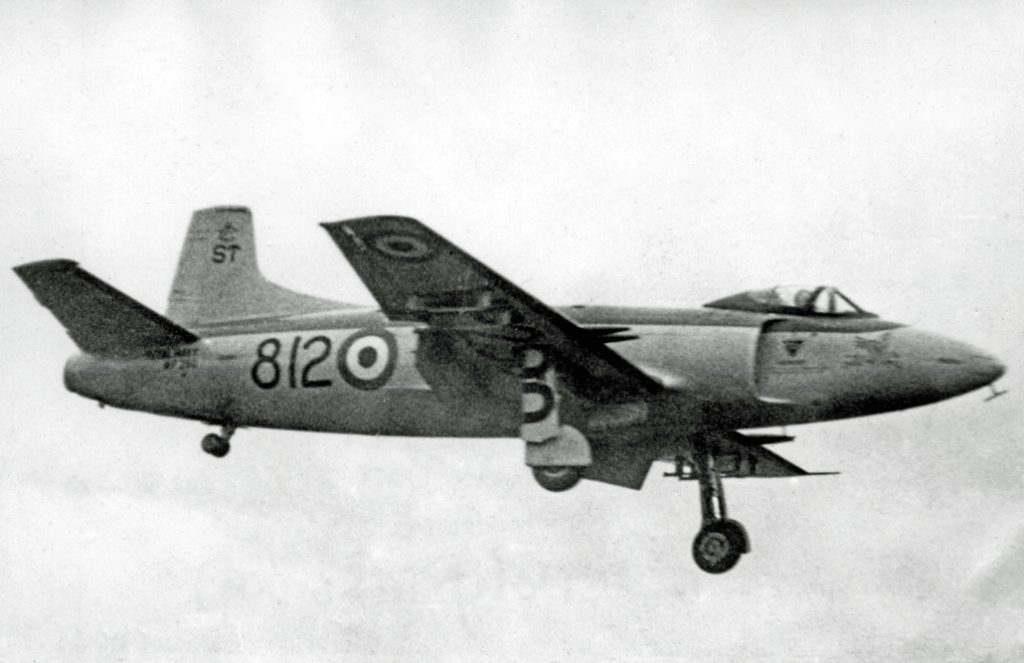
That heritage left its most awkward mark at the back of the aircraft. Because the wing came from the Spiteful, the Attacker inherited a tailwheel undercarriage — a “taildragger” layout, in which the aircraft sits nose-high on the ground with a small wheel under the tail. By the late 1940s this was already going out of fashion; the new generation of jets was adopting the tricycle undercarriage, with a nosewheel, which sits level on the ground and is far easier to handle. On a carrier, the tailwheel was a real drawback: it gave the pilot a poor view forward over the raised nose, made taxiing and deck handling clumsy, and its jet exhaust angled down at the deck. The Attacker’s tailwheel, more than anything, marked it out as a first-generation aircraft — a stopgap, not a mature design.
The Attacker also arrived comparatively late. Britain’s Royal Air Force had been flying jets since the Gloster Meteor entered service in 1944, and land-based jet fighters were well established by the time the Attacker reached the Fleet Air Arm in 1951. Naval jet operations were simply harder: the aircraft had to be strengthened for catapult launches and arrested landings, and flying a jet from a pitching deck was a formidable new challenge. So the Royal Navy came to the jet age a few years behind the RAF, and the Attacker was the aircraft that finally closed that gap.
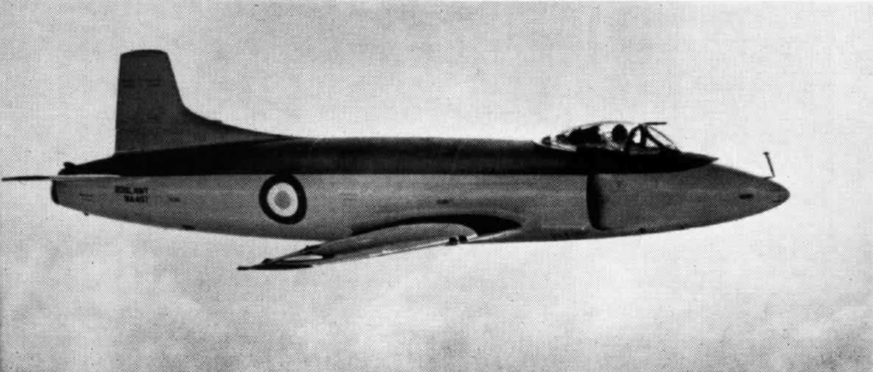
The Attacker first flew in 1946, but development was slow, and it did not enter front-line Fleet Air Arm service until August 1951, when it equipped 800 Naval Air Squadron. It was a straightforward straight-wing jet, powered by the reliable Rolls-Royce Nene and armed with four 20 mm Hispano cannon; the later fighter-bomber version, the FB.2, could also carry bombs and rockets. It was fast enough for its day and pleasant enough to fly in the air, if not on the deck, and for the first time it gave Royal Navy carrier squadrons jet performance.
In the air the Attacker was a reasonable performer for its moment. The Nene gave it a good turn of speed, the laminar wing helped it along, and pilots generally found it pleasant enough to fly once airborne. Its problems were on the ground and on the deck rather than in flight: the tailwheel, the deep fuselage and the limited forward view all belonged to an earlier era. It was, in short, an aircraft that flew like an early jet but sat on its wheels like a wartime fighter — the compromise of its mixed parentage made visible.
But the pace of aviation in the early 1950s was brutal, and the Attacker was overtaken almost immediately. The swept wing, which allowed much higher speeds, was transforming fighter design, and even among straight-wing jets more refined aircraft were arriving — notably the Hawker Sea Hawk, which had a modern tricycle undercarriage and was a far better carrier aircraft. The Attacker’s front-line career with the Royal Navy was correspondingly short: it served with just three front-line squadrons and was withdrawn from front-line duty by around 1954, only about three years after it had entered service.
Yet operating the Attacker taught the Fleet Air Arm hard lessons that fed directly into everything that followed. Landing a jet on a carrier is a very different task from landing a piston aircraft: the approach speeds are higher, the engine responds more slowly to the throttle, and there is less margin for error. The Attacker’s tailwheel and modest deck manners made those lessons harder than they needed to be, but they were learned all the same — and the pilots, deck crews and procedures the Royal Navy developed on the Attacker were exactly what it needed for the far more demanding jets to come.
It was not quite finished, though. The Attackers passed to the squadrons of the Royal Naval Volunteer Reserve — the “weekend flyers” of the RNVR air branch — where they gave reserve pilots valuable experience of jet flying, and they soldiered on in that role until about 1957. It was a fitting second life for a transitional aircraft: no longer front-line material, but still useful for building the jet experience the Fleet Air Arm now needed throughout its ranks.
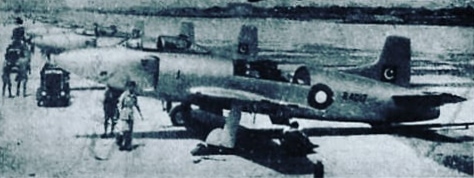
The Attacker’s one significant export went to Pakistan. The Pakistan Air Force ordered a land-based version — without the carrier equipment such as the arrester hook — and operated a squadron of them from the early 1950s. It was the only substantial foreign sale of the type, and it gave the Attacker a brief career as a land-based fighter far from the sea it was designed to fly over.
By the standards of the aircraft that followed it, the Attacker was a modest machine, and it is easy to dismiss. That would be a mistake. Its importance is not in what it could do but in what it began: it proved that the Fleet Air Arm could operate jets from carriers, it gave the Royal Navy its first hard-won experience of the new technology, and it opened the door for the far more capable carrier jets that came after. One Attacker survives today, preserved at the Fleet Air Arm Museum at Yeovilton — a quiet monument to the aircraft that took the Royal Navy into the jet age.
01The Attacker’s origins: from the Spiteful to a jet+
The Attacker’s story begins not with a jet but with a piston fighter. Supermarine, the maker of the Spitfire, had developed the Spiteful as a high-performance Spitfire successor, fitted with a new laminar-flow wing intended to cut drag and raise top speed. But the jet revolution overtook the piston Spiteful, which was built only in small numbers and never became a major type.
Rather than waste the advanced wing, Supermarine adapted it. The company designed a new fuselage around a Rolls-Royce Nene turbojet and mated it to the Spiteful’s laminar-flow wing, creating a jet fighter from proven and new components combined. This pragmatic approach got a jet into the air relatively quickly, but it also baked the piston fighter’s characteristics — including its tailwheel — into the new aircraft.
02The laminar-flow wing inherited from the Spiteful+
The Attacker’s wing was its most direct inheritance from the piston Spiteful. A laminar-flow wing is shaped so that the airflow stays smooth (laminar) over more of its surface before becoming turbulent, which reduces drag and helps at higher speeds. It was an advanced idea for the mid-1940s, and it was the reason Supermarine thought the wing worth carrying over to a jet.
In practice, laminar-flow wings of the era were sensitive to manufacturing imperfections and surface finish, and their benefits were not always fully realised. But the wing gave the Attacker respectable straight-line performance, and its use is a neat illustration of how the earliest jets were often assembled from the best available pieces of the piston era rather than designed wholly afresh.
03The Rolls-Royce Nene turbojet+
Power came from the Rolls-Royce Nene, one of the most important early jet engines. The Nene was a centrifugal-flow turbojet — a robust, reliable layout typical of first-generation jet engines — and it was powerful for its time, giving the Attacker brisk performance for the early 1950s. The same engine, in various forms and licensed copies, powered a whole generation of early jets around the world.
The Nene made the Attacker a genuine jet fighter with real performance, and it was dependable. But a centrifugal engine is relatively bulky in cross-section, which shaped the Attacker’s deep, portly fuselage — another mark of the first jet generation, before the slimmer axial-flow engines of later aircraft allowed sleeker designs.
04The tailwheel problem: why a taildragger jet was awkward+
The Attacker’s most notable drawback was its tailwheel undercarriage, inherited along with the Spiteful’s wing. A “taildragger” sits nose-high on the ground, with a small wheel under the tail, whereas the new tricycle layout — with a nosewheel — sits level. For a jet, and especially for a carrier jet, the tailwheel was a genuine handicap.
Nose-high on the deck, the pilot had a poor view forward for taxiing and for lining up on the carrier; the aircraft was clumsier to handle on deck; and the jet exhaust was angled down towards the deck. The tricycle undercarriage that rival jets adopted was simply better for jet operations, and the Attacker’s tailwheel is the clearest sign of its status as a transitional, first-generation aircraft.
05The Fleet Air Arm’s first jet: entering service in 1951+
The Attacker’s place in history rests on a single fact: it was the first jet fighter to enter operational front-line service with the Royal Navy’s Fleet Air Arm. After a first flight in 1946 and a long development, it equipped 800 Naval Air Squadron in August 1951, giving the Royal Navy’s carrier air groups jet performance for the first time.
This mattered a great deal. Operating jets from carriers was a demanding new discipline — different speeds, different handling, different deck procedures — and the Attacker was the aircraft on which the Fleet Air Arm learned it. Whatever its shortcomings, it was the machine that carried the Royal Navy across the threshold into the jet age, and everything that followed built on that first step.
06Armament: four 20mm Hispano cannon and the FB.2+
The Attacker was armed with four 20 mm Hispano cannon, the standard heavy fighter armament of the British forces in the period and a hard-hitting battery for its day. This gave it real firepower as an interceptor and gun fighter, in line with the fighters of the immediate post-war years.
The definitive version was the FB.2, a fighter-bomber that added the ability to carry bombs and rockets under the wings, broadening the aircraft’s usefulness to ground- and ship-attack work as well as air fighting. The FB.2 was the most numerous variant and the one that equipped most Attacker squadrons, both in front-line and later reserve service.
07A short front-line career, quickly superseded+
The Attacker’s front-line career was brief, and that was no accident — aviation was advancing at breakneck speed in the early 1950s. The aircraft served with only three front-line Fleet Air Arm squadrons and was withdrawn from front-line duty by around 1954, roughly three years after entering service. Few operational aircraft have had so short a front-line life.
The reason was simply that better aircraft arrived almost at once. The Hawker Sea Hawk, a more refined straight-wing jet with a modern tricycle undercarriage, was a much better carrier aircraft, and the swept-wing revolution was pushing performance higher still. The Attacker was overtaken before it had really settled in — the fate of many pioneering designs that arrive at a moment of rapid change.
08Second life with the RNVR reserve squadrons+
Retirement from the front line was not the end of the Attacker’s Royal Navy service. The aircraft passed to the squadrons of the Royal Naval Volunteer Reserve (RNVR), the reserve air branch whose part-time pilots flew at weekends and in training periods. There the Attacker gave reserve aircrew experience of jet flying, which the Fleet Air Arm increasingly needed throughout its ranks.
The RNVR Attackers flew in this role until around 1957, when the reserve air branch itself was wound down. It was an appropriate second career for a transitional aircraft — no longer suited to front-line combat, but still perfectly useful for building the jet experience that the whole of naval aviation now depended on.
09The Pakistan Air Force export+
The Attacker’s only substantial export customer was Pakistan. The Pakistan Air Force ordered a land-based version of the aircraft — stripped of the naval equipment such as the arrester hook needed for carrier operations — and operated a squadron of them from the early 1950s. It was the type’s sole significant foreign sale.
The Pakistani Attackers served as land-based fighters, giving the young air force early jet experience of its own, before being replaced by more modern types later in the decade. It was a modest export, but it gave the Attacker a second national operator and a brief career far from the carrier decks and grey northern seas it had been designed for.
Design & Engineering
How the Attacker was built: a jet from piston-era parts
The Attacker was a pragmatic, transitional design — a new jet fuselage married to a proven piston-fighter wing — and both its strengths and its awkwardness flowed directly from that compromise.
A borrowed wing
The advanced laminar-flow wing came straight from the piston Supermarine Spiteful — and with it came the tailwheel undercarriage that marked the Attacker as first-generation.
Nene jet power
A reliable Rolls-Royce Nene centrifugal turbojet gave real jet performance, but its bulk shaped the Attacker’s deep, portly fuselage.
Carrier fighter
Folding wings, arrester hook and four 20 mm cannon made it a carrier fighter — though the tailwheel made deck handling awkward from the start.
Specifications
Supermarine Attacker specifications: dimensions, performance and cost
Baseline: the Attacker FB.2 as flown by 800 and 803 Naval Air Squadrons from HMS Eagle in 1953 — one Rolls-Royce Nene centrifugal-flow turbojet in a barrel of a fuselage, four 20 mm Hispano Mk V cannon in the wings, eight underwing hard points, folding laminar-flow wings lifted almost unchanged from the piston-engined Spiteful, and a tailwheel. Deltas for the F.1, the FB.1 and Pakistan’s land-based FB.50 are in grey. Four warnings before the figures. First, the published performance for this aeroplane is unusually thin: almost every modern table descends from the same short set of manufacturer’s numbers, and 590 mph is a clean sea-level figure. An operational Attacker carrying a ventral tank, a pair of 1,000 lb bombs and a naval finish was a good deal slower, and its speed fell away sharply with height because the unswept 13 per cent laminar wing met compressibility early. Second, one conversion error is copied everywhere: 12,211 lb is 5,539 kg, not the 5,339 kg printed in several widely reproduced specification tables. The imperial figure is the original and it is the one to trust. Third, the production totals disagree by one — 146 aircraft for the Fleet Air Arm in most accounts, 145 in others — and the order books themselves do not quite reconcile, because eleven airframes from the F.1 contract were completed as FB.1s and a twelfth was ordered separately. Fourth, internal fuel capacity is not consistently published for any mark, so it is given below as a caveat rather than a number; the figure that mattered operationally was the large jettisonable ventral tank. Where the authorities disagree the disagreement is stated rather than averaged away.
Dimensions & weights
- Crew
- 1 — pilot only, under a sideways-hinged hood well forward on the fuselage The FB.2 introduced a revised metal-framed hood. Forward view on the ground was the Attacker’s defining weakness and no canopy change could fix it, because the problem was the attitude of the whole aeroplane rather than the transparency.
- Length
- 11.43 m (37 ft 6 in) Short for a jet of its thrust, because the Nene is a wide engine rather than a long one and the fuselage was built around its diameter.
- Wingspan
- 11.25 m (36 ft 11 in) Almost exactly the Spiteful’s span. Supermarine did not redesign the wing for the jet; it enlarged it slightly and fitted a new fuselage to it, which is the single fact from which most of the Attacker’s virtues and all of its vices follow.
- Height
- 3.02 m (9 ft 11 in) in the tail-down parked attitude That attitude is the whole argument. Sitting on its tailwheel the Attacker pointed its nose at the sky and its jet pipe at the deck.
- Wing area
- 21.0 m² (226 sq ft) The Spiteful wing was 210 sq ft; the Attacker’s is the same Type 371 planform slightly enlarged. Compare the Sea Hawk at 278 sq ft, which is a large part of why the Hawker aeroplane was the better deck machine.
- Wing
- Supermarine Type 371 laminar-flow section, 13 per cent thickness at the root tapering to 8 per cent at the tip, straight taper, no sweep The laminar flow was famously fragile. On the Spiteful, mud, rain or dead insects on the leading edge broke it and cost speed; a naval aircraft living in salt air on an open deck was never going to keep a laminar wing clean.
- Wing folding
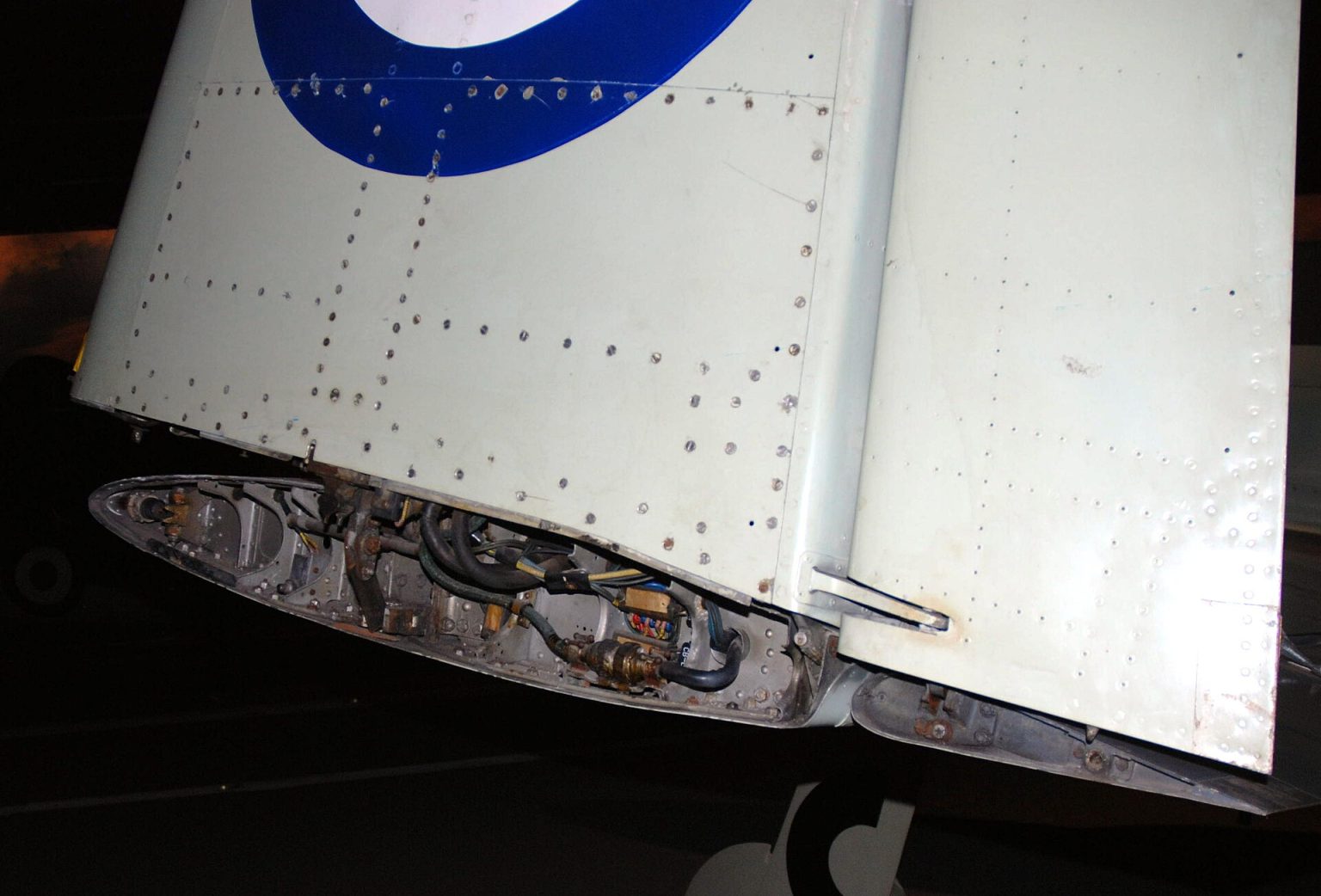
- Manual fold outboard of the main undercarriage bays on all Fleet Air Arm marks Deleted entirely on the Pakistani FB.50, along with the arrester hook and catapult gear. A folded-span figure is not reliably published.
- Undercarriage
- Inward-retracting main legs inherited from the Spiteful, with twin tailwheels aft The Spiteful’s wide-track inward-retracting gear was one of the few unambiguous improvements on the Spitfire, and keeping the Spiteful wing meant keeping its geometry. The tailwheel was the price.
- Fuselage
- All-metal semi-monocoque in heavy-gauge aluminium alloy, with a laminated alloy "lobster-claw" nose structure between the bifurcated intakes The structure was notably robust. That did not prevent the failure of the starboard outer wing on WA469 during high-speed trials in May 1950.
- Empty weight
- 3,826 kg (8,434 lb)
- Normal loaded weight
- 5,539 kg (12,211 lb) This is the number printed as 5,339 kg in several tables. It is a conversion slip, repeated for decades.
- Maximum external load
- ~907 kg (2,000 lb) — two 1,000 lb bombs, one under each wing Nothing was carried internally. There was no bay and never a proposal for one.
- Wing loading
- 264 kg/m² (54.0 lb/sq ft) at normal loaded weight High for 1951 and high for a deck aeroplane, which pushed up approach speed exactly where the Attacker could least afford it.
- Thrust-to-weight
- 0.41 at normal loaded weight Respectable for a first-generation naval jet, and the one column in which the Attacker beat most of its contemporaries.
Performance
- Maximum speed
- 950 km/h (590 mph, 512 kn) at sea level A clean-airframe figure. It is quoted for the F.1 and the FB.2 alike, which is itself a sign of how little independent testing found its way into print.
- Maximum speed, prototype
- 933 km/h (580 mph) recorded by TS409 on early trials in 1946 Fast for 1946 and faster than the Meteor F.3, which is why the Admiralty was interested at all.
- Speed at altitude
- Fell away markedly above roughly 9,000 m (30,000 ft) No trustworthy high-altitude figure is published. The thick unswept wing was the limit; by 1953 swept-wing MiG-15s and Sabres were operating in a regime the Attacker could not enter.
- Rate of climb
- 32.3 m/s (6,350 ft/min) at sea level Genuinely good, and the Attacker’s best quality. The Nene gave it more thrust than any other British naval aircraft of its day.
- Service ceiling
- 13,700 m (45,000 ft) Some tables print 44,950 ft, which is the same number rounded from a different original.
- Range, internal fuel
- 950 km (590 mi, 510 nmi) Short, and the recurring complaint of every early centrifugal-flow jet. The Nene was thirsty at low level, where a naval fighter-bomber does its work.
- Combat radius
- ~240–320 km (~130–175 nmi) on internal fuel, estimated Not an official figure. It is inferred from the published range with a realistic allowance for launch, join-up, reserve and a deck recovery, and it should be read as an order of magnitude rather than a specification.
- Ventral drop tank
- ~1,136 l (250 imp gal) jettisonable tank under the fuselage Carried routinely. Without it the Attacker was a point-defence fighter with very little loiter.
- Endurance
- Short by any later standard Fleet Air Arm practice with the type ran to sorties measured in tens of minutes rather than hours, and the one-month-at-sea, one-month-ashore cycle of the 13th Carrier Air Group reflects how much flying it took to keep pilots current on an aircraft this demanding.
- Take-off
- Catapult launch by strop from the Audacious-class carriers; free deck runs were possible but not the norm The tail-down attitude meant the aircraft began its run in a high-drag, high-incidence pose and had to be flown off rather than rotated.
- Deck landing
- Sting-type arrester hook, curved approach in a nose-high attitude This is the heart of the case against the Attacker. In the landing attitude the pilot could not see the deck or the batsman over the nose without crabbing, and the jet pipe was angled down toward the planking. Every British naval jet after it had a nosewheel.
- Structural limit
- Demonstrated the hard way On 23 May 1950 Vickers test pilot Les Colquhoun lost the outer starboard wing of production F.1 WA469 in a high-speed dive, with the ailerons locked. He landed it at Chilbolton at high speed rather than abandon it and was awarded the George Medal.
- For comparison
- Hawker Sea Hawk F.1: 964 km/h (599 mph) at sea level, 278 sq ft of wing, tricycle undercarriage Same Nene, same thrust, later into service by two years, and a far better carrier aeroplane. That comparison is why the Attacker’s front-line career lasted three years.
Propulsion & systems
- Engine
- 1 × Rolls-Royce Nene centrifugal-flow turbojet The last great centrifugal engine. Simple, robust, fat, and already a dead end when the Attacker entered service — axial-flow engines were slimmer and would let designers build slimmer aeroplanes.
- Thrust
- 22.2 kN (5,000 lbf) static at sea level Described at the time as the most powerful turbojet in the world. The Soviet Union obtained the Nene, copied it as the Klimov VK-1, and put it in the MiG-15 — so the Attacker and its likeliest opponent shared an engine.
- Engine marks
- Nene 3 in the F.1 and FB.1; Nene 101 or 102 in the FB.2; Nene 4 in Pakistan’s FB.50 Published ratings for the 101 and 102 run between 5,000 and 5,100 lbf depending on the source; the difference is within the noise of period rating practice.
- Compressor
- Single-stage double-sided centrifugal impeller, 731 mm (28.8 in) diameter The impeller diameter sets the fuselage diameter, and the fuselage diameter sets the drag. This is the mechanism by which a 1944 engine choice capped the aeroplane’s top speed.
- Combustion
- Nine Lucas can-type chambers around the compressor Reliable and easy to service afloat, which mattered on a carrier with no depth of jet experience in 1951.
- Engine size and weight
- 1.26 m (49.5 in) overall diameter, 2.46 m (96.8 in) long, 726 kg (1,600 lb) dry
- Specific fuel consumption
- 1.06 lb per lbf per hour High. This single number explains the Attacker’s range, its endurance and much of its unpopularity as a strike aircraft.
- Air intakes
- Bifurcated wing-root intakes feeding the double-sided impeller from both sides The arrangement that gave the nose its laminated "lobster-claw" structure and left no room for radar. The Attacker was a clear-weather day fighter and nothing else.
- Exhaust
- Straight jet pipe with a manually operated variable outlet Set by the pilot to suppress jet-pipe resonance during starting. It is a small detail that says a great deal about how early this aeroplane was.
- Fuel
- Internal capacity is not consistently published across the standard references Rather than repeat a figure that cannot be corroborated, note what is certain: internal fuel gave about 590 miles of still-air range, and the 250 imp gal ventral tank was standard fit for anything but a local sortie.
- Naval equipment
- Sting-type arrester hook, catapult strop points, folding wings, naval radio and homing beacon All of it deleted on the FB.50 for Pakistan, which saved weight and left a cleaner, lighter, land-based aeroplane that its operators liked rather better than the Fleet Air Arm liked theirs.
- Armament installation
- Four 20 mm Hispano Mk V in the wings outboard of the undercarriage bays; 167 rounds per gun inboard, 145 per gun outboard, 624 rounds in all
- Escape
- Not consistently recorded Accounts of ejection-seat fitment in the Attacker differ, and the primary evidence is not clear enough to state a mark or a retrofit date here. It is flagged as an open question rather than settled with a guess.
10The Attacker’s variants: F.1 to FB.2+
The Attacker was produced in a small number of closely related variants. The initial fighter version, the F.1, was followed by the FB.1 and then the definitive FB.2 fighter-bomber, which added the ability to carry bombs and rockets and became the most numerous version. In total only around 185 were built — a modest run reflecting the aircraft’s short front-line life.
There was also the land-based export version supplied to Pakistan, which dispensed with the naval equipment. The Attacker never spawned the sprawling family of sub-types that longer-lived aircraft accumulate; its variants are few, and they mark the aircraft’s straightforward evolution from pure fighter to fighter-bomber over its brief career.
11The Supermarine Attacker’s operating costs: what the records show+
As with most early Cold War military aircraft, there is no single reliable, transparent public figure for the Attacker’s unit cost, cost per flight hour or total programme cost. It was procured in small numbers in the early 1950s through government contracts rather than at a published list price, and consistent cost data for so short-lived a type is not available. Any single figure quoted for it should be treated with caution.
What can be said is that the Attacker was, by design, a relatively economical way for the Royal Navy to acquire a jet capability quickly — reusing the Spiteful’s wing and a proven engine rather than developing an all-new aircraft. Rather than invent numbers, we list the cost fields here as “not reliably recorded.”
12Why the Attacker was obsolete so quickly+
The Attacker entered service in 1951 and was gone from the front line by about 1954 — an unusually short career that reflects just how fast fighter technology was moving. Two developments overtook it almost at once. First, the swept wing, which delayed the drag rise near the speed of sound and allowed much higher speeds, was rapidly becoming standard; the Attacker’s straight wing left it behind. Second, even among straight-wing jets, the tricycle undercarriage made rivals far better carrier aircraft.
The Hawker Sea Hawk, arriving at almost the same time, showed the difference: a cleaner, tricycle-undercarriage straight-wing jet that was a much better naval aircraft. Behind it came the swept-wing generation — the Supermarine Scimitar, the de Havilland Sea Vixen — that made the Attacker look thoroughly of the past. The Attacker was a victim of its timing, arriving at the very moment the ground was shifting beneath it.
13The surviving Attacker at the Fleet Air Arm Museum+
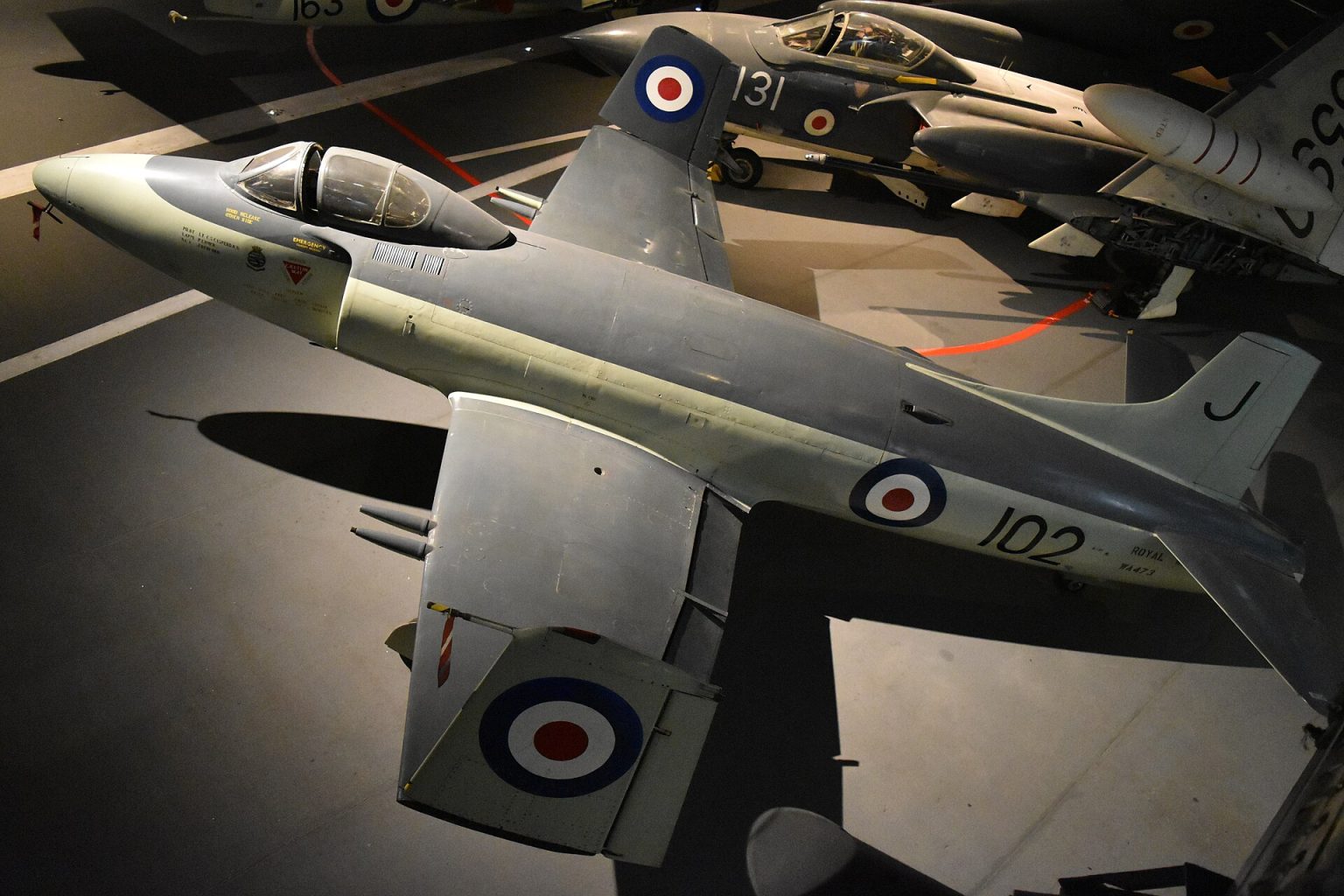
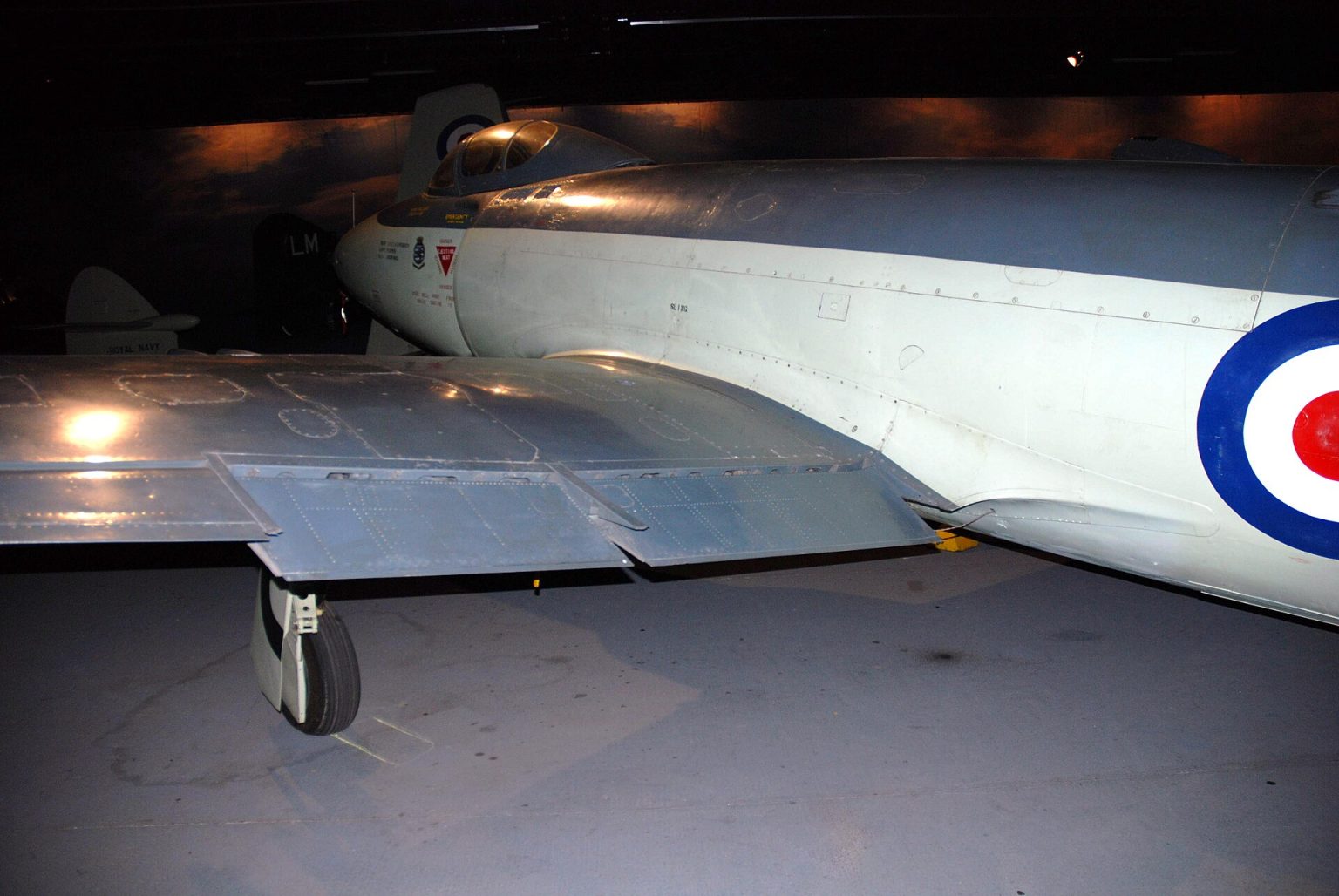
Because so few were built and the type was retired early, survivors are extremely rare. One complete Attacker is preserved in the United Kingdom at the Fleet Air Arm Museum at RNAS Yeovilton, displayed in Royal Navy markings as a record of the aircraft that took the Fleet Air Arm into the jet age.
For an aircraft with so brief and modest a career, the survival of even a single example is valuable, and the preserved Attacker lets visitors see for themselves the transitional design — the deep Nene fuselage, the laminar wing borrowed from a piston fighter, and the tailwheel that marked it out as a machine caught between two eras. It is a quiet but important piece of Royal Navy history.
Armament & payload
The Attacker took a 1941 gun battery to sea in 1951 and never fired it at anything
The Attacker’s armament is the least interesting thing about it, and that is the point. Four 20 mm Hispano Mk V cannon with 624 rounds between them was exactly what the Fleet Air Arm had been carrying since 1941; the fighter-bomber marks added two 1,000 lb bombs or a handful of wartime three-inch rockets on underwing rails. There was no radar, no guided weapon, no second crewman and no camera fit. The Attacker was a day fighter with a bomb rack, and in a service that had just spent six years learning what naval aviation actually required, that was a thin offering.
None of it was ever used in anger. No Attacker fired a shot in combat with the Royal Navy or the Pakistan Air Force, and the type’s entire operational record consists of exercises, armament practice camps and deck qualification. That is not a criticism of the aircraft so much as an accident of timing: the Attacker reached the fleet in August 1951, a year after Korea began, and the carriers sent to Korean waters flew Sea Furies and Fireflies because those were the aircraft that could operate from light fleet carriers and stay over the target. Fits varied by mark: the F.1 as delivered had no underwing stores capability at all, the FB.1 and FB.2 added it, and the Pakistani FB.50 carried the same weapons with all the naval equipment stripped out.
Gun
- Four 20 mm Hispano Mk V cannon, two in each wing outboard of the undercarriage bays
- 167 rounds per gun for the inboard pair, 145 per gun for the outboard pair — 624 rounds in total, roughly fifteen seconds of firing
- The same battery, in the same calibre, that the Fleet Air Arm had carried since the Fulmar II and the Firefly. The Attacker brought a jet engine to the fight and nothing new to the guns
- Adequate against propeller-driven aircraft and light shipping; marginal against a swept-wing jet the Attacker could not catch in the first place
- Retained in full on Pakistan’s FB.50, where the cannon were the aircraft’s principal weapon throughout its service
Air-to-air
- None beyond the four cannon. No air-to-air missile was ever carried, trialled or seriously proposed for the Attacker
- The type entered service in August 1951, four years before the Fleet Air Arm began working with guided air-to-air weapons in earnest
- No Attacker ever fired its guns at another aircraft. Neither the Fleet Air Arm nor the Pakistan Air Force took the type into combat
- This card is kept and left honest: the Attacker belongs entirely to the gun era of naval fighter aviation
- Its successors marked the change — the Sea Venom and then the Sea Vixen brought radar, a second crewman and, eventually, missiles
Air-to-surface guided
- None. No guided air-to-surface weapon was carried by any Attacker of any mark
- Everything the aircraft dropped or fired at a surface target was aimed by the pilot through a fixed sight, in a dive, by eye
- There was no radar, no ranging equipment and no second crewman to work either — the bifurcated wing-root intakes left no volume in the nose for a scanner
- The FB.2’s eight hard points were plumbed and wired for iron bombs and rocket rails, nothing more
- Kept deliberately empty: the gap between what the Attacker could carry and what a Sea Vixen carried nine years later is the clearest measure of how fast this decade moved
Bombs
- Two 1,000 lb (454 kg) bombs, one under each wing — the maximum bomb load and the reason the FB.1 and FB.2 exist
- Two 500 lb (227 kg) bombs as the lighter and commoner alternative
- No internal bay, no bomb-aiming position, no dive brakes worth the name; the pilot aimed in a dive through the gunsight
- The F.1 as first delivered was a pure fighter. The fighter-bomber fit was retrofitted to the last eleven aircraft of the F.1 contract, which became the FB.1
- Not one bomb was dropped in anger by any Attacker in any air force
Rockets
- Underwing rocket rails, on four points for the FB.1 and up to eight on the FB.2
- The standard references describe the earlier fit as four 300 lb rockets and the FB.2 fit as up to eight unguided rockets. Those two descriptions are not easily reconciled and probably reflect different ways of counting the RP-3 three-inch rocket and its heads; the discrepancy is left visible rather than resolved by guesswork
- The weapon itself was the wartime RP-3 three-inch rocket projectile with the 60 lb high-explosive head, unchanged from the Firefly and the Typhoon
- Rocket work was the FB.2’s principal reason for existing and the main armament exercise flown by the Royal Naval Volunteer Reserve squadrons after 1955
- Pakistani FB.50s flew rocket and gunnery training from land bases without the weight and drag penalty of naval equipment
Pods & other stores
- One jettisonable ventral fuel tank of about 250 imp gal (~1,136 l), standard fit for anything beyond a local sortie
- No radar pod of any kind. There was nowhere to put one and no operator to work it
- No reconnaissance camera installation entered service on the Attacker; the fighter-reconnaissance role that the Firefly and later the Scimitar covered was not given to this aircraft
- No gun pods, no napalm, no flare or marker containers — the store list is genuinely as short as it looks
- The eight hard points of the FB.2 were the Attacker’s only real growth in capability across its whole production life
Three typical loadouts
- Fleet air defence, 800 NAS from HMS Eagle, 1952
- Four 20 mm Hispano Mk V with 624 rounds, clean wings, ventral tank of about 250 imp gal. A short-legged clear-weather day interceptor launched by catapult against a shadower or a strike the ship’s radar had already found.
- Fighter-bomber strike, FB.2, 1953
- Two 1,000 lb bombs on the inboard underwing points, full cannon ammunition, no ventral tank. Aimed in a dive through the gunsight; radius of action was under two hundred miles, which limited the type to targets close to the ship.
- Land-based armament training, Pakistan Air Force FB.50, mid-1950s
- Four cannon and a full load of three-inch rockets on underwing rails, no arrester hook, no folding wings, no catapult gear. Roughly a hundredweight of naval equipment deleted, flown from a long dry runway — the Attacker at its most useful and least troubled.
Sourcing caveat: ammunition capacities of 167 rounds for the inboard guns and 145 for the outboard pair come from the manufacturer’s figures and are quoted consistently. The rocket fit is not: published accounts give four rockets for the earlier fighter-bomber and up to eight for the FB.2, but describe them in incompatible terms, and no single authority reconciles the two. Bomb loads are firm. Any statement here about weapons actually expended in action would be invention, because there were none.
Variants
The Attacker was a Spiteful wing with a jet behind it, and the tailwheel was the bill for that decision
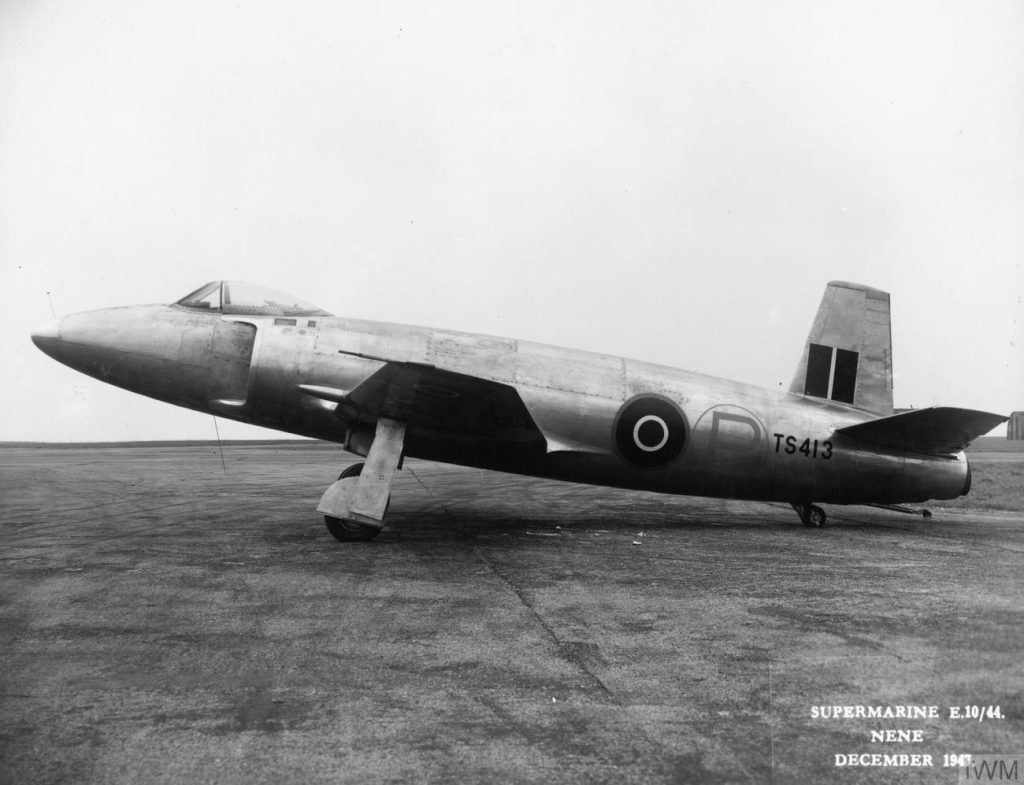
The Attacker began as a land-based Royal Air Force fighter and became a naval one only after the RAF declined it. Specification E.10/44 of February 1945 asked for a single-engined jet fighter on a laminar-flow wing; Supermarine answered by taking the Type 371 wing already built for the Spiteful, mating it to a new fuselage wrapped around the Rolls-Royce Nene, and calling the result the Jet Spiteful. Three prototypes were ordered on 30 August 1944 and TS409 first flew on 27 July 1946 in Jeffrey Quill’s hands. The RAF looked at it alongside the Gloster E.1/44 and concluded that neither improved on the Meteor and the Vampire it already had. Supermarine then offered the aeroplane to the Admiralty, which needed a jet fighter and had no other candidate ready.
That sequence explains the tailwheel. The Spiteful wing carried the Spiteful’s inward-retracting, wide-track main legs — genuinely the best thing about the design, and the fix for the Spitfire’s narrow track — and keeping the wing meant keeping the geometry that went with it. Adding a nosewheel would have meant a new wing, and a new wing would have meant a new aeroplane. Joseph Smith, Supermarine’s chief designer, maintained that trials had shown the tail-dragger arrangement acceptable, and he was not simply wrong: the Heinkel He 178 and the early Me 262 had flown on tailwheels too. But acceptable in trials and right for a carrier are different tests. Nose-high on the deck, the pilot could not see the batsman or the round-down over the nose on the approach; the jet pipe pointed at the planking, and reports of scorched decks and ploughed grass at shore stations followed the type everywhere. Bill Gunston wrote of efflux furrows in grass that three men could lie down in; Flight called such claims exaggerated at the time. The truth is probably in between, and it hardly matters: the operational verdict was delivered by procurement, not by argument, and every British naval jet after the Attacker had a nosewheel.
The rest of the story is short. Naval trials aboard HMS Illustrious in October 1947 passed the aircraft as deck-worthy; production orders came in 1948 and 1950; the first production F.1 flew in the spring of 1950 and 800 Naval Air Squadron re-formed on the type at RNAS Ford in August 1951. 803 followed that November, 890 briefly in 1952. The two front-line squadrons made up the 13th Carrier Air Group aboard HMS Eagle, alternating a month at sea with a month ashore from March 1952 until the spring of 1954. Then it ended: 803 traded its Attackers for Sea Hawk FB.3s in August 1954, 800 recommissioned on Sea Hawks at Brawdy that November, and the Attacker went to the second-line and reserve units. Three years in the front line, and the aircraft that replaced it had the same engine, more wing and a nosewheel.
- Type 392 (1 prototype, first flight 27 July 1946)
- The original land-based E.10/44 machine, TS409, unofficially the Jet Spiteful. Spiteful wing, new Nene fuselage, no naval equipment. Reached about 580 mph on early trials and was rejected by the RAF as offering nothing over the Meteor and Vampire.
- Type 398 (1 prototype, first flight 17 June 1947)
- TS413, the first navalised prototype, flown by Mike Lithgow. Folding wings, sting arrester hook and catapult points. Carried out the deck trials aboard HMS Illustrious in October 1947 that got the type accepted for naval service.
- Type 513 (1 prototype, 1947–48)
- TS416, the third airframe and second navalised prototype, used for the development flying that led to the production standard.
- Attacker F.1 (1948 order; 50 built)
- The pure fighter: Nene 3, four 20 mm Hispano Mk V, no underwing stores. Sixty-three were ordered on 29 October 1948, of which fifty were completed to this standard. First into squadron service with 800 NAS in August 1951.
- Attacker FB.1 (1950; 12 built)
- Fighter-bomber conversion of the F.1 contract: the last eleven airframes of that order completed with underwing carriers for bombs and rockets, plus one further aircraft ordered on 27 March 1950 as a replacement.
- Attacker FB.2 (1950 orders; 84 built)
- The definitive Fleet Air Arm mark and the only one built in quantity. Nene 102, eight underwing hard points for two 1,000 lb bombs or rockets, and a revised metal-framed cockpit hood. Ordered in three batches during 1950 and built at Vickers-Armstrongs, South Marston, near Swindon.
- Type 538 Attacker FB.50 (1951–53; 36 built for Pakistan)
- The only export version and the only land-based one: Nene 4, arrester hook, folding wings and catapult gear deleted. The sole foreign customer, and in flying hours very probably the hardest-worked Attackers of all.
- Ancestry — Spiteful F.14 and Seafang (19 and 2 built; not Attacker variants)
- Listed here because the Attacker cannot be understood without them. The Spiteful gave the Type 371 laminar wing and the undercarriage geometry; the Seafang was its naval version, of which only two prototypes were completed before the Attacker made it pointless. Of 650 Spitefuls ordered, 19 were built.
Totals and survivors. Production reached 182 aircraft: 146 for the Fleet Air Arm — 50 F.1, 12 FB.1 and 84 FB.2 — and 36 FB.50s for Pakistan, plus three prototypes. Some references give 145 rather than 146 for the British total, because the order books and the delivery records do not quite agree over the eleven F.1 airframes finished as FB.1s. Front-line Fleet Air Arm service ran from August 1951 to the spring of 1954; second-line and Royal Naval Volunteer Reserve flying continued with 1831, 1832, 1833 and 1835 Squadrons and the Airwork Fleet Requirements Unit until the RNVR air branch was disbanded in early 1957. Pakistan’s No. 11 Squadron flew the FB.50 in the interceptor role from 1951, and the aircraft also equipped the Paybills, Pakistan’s first aerobatic team, from 1952; the squadron gave them up in 1956, the type is usually recorded as leaving Pakistani service in 1958, and a few accounts claim survivals as late as 1964. Exactly one complete Attacker survives anywhere in the world: F.1 WA473, finished at South Marston in July 1951, flown by 702 and 736 Naval Air Squadrons, later gate guardian at RNAS Abbotsinch, and moved to the Fleet Air Arm Museum at Yeovilton in late 1961, where it remains on display in Fleet Air Arm markings. No FB.2 survives. No FB.50 survives, and claims of a preserved Pakistani example could not be corroborated against any reliable listing and are not repeated here. There is no airworthy Attacker, no reproduction and no known substantial wreck recovery — 181 of the 182 aircraft built are gone.
Timeline
The Supermarine Attacker through the years
Supermarine develops the piston Spiteful with an advanced laminar-flow wing — the wing that will later be carried over to the Attacker.
The Supermarine Attacker prototype flies on 27 July 1946, mating a Nene-powered jet fuselage to the Spiteful’s laminar-flow wing.
Development stretches over several years as the naval jet is refined for carrier service.
The Attacker enters front-line service with 800 Naval Air Squadron in August 1951 — the Fleet Air Arm’s first operational jet fighter.
The Pakistan Air Force orders a land-based version — the Attacker’s only substantial export.
The definitive FB.2 adds bombs and rockets, becoming the most numerous Attacker variant.
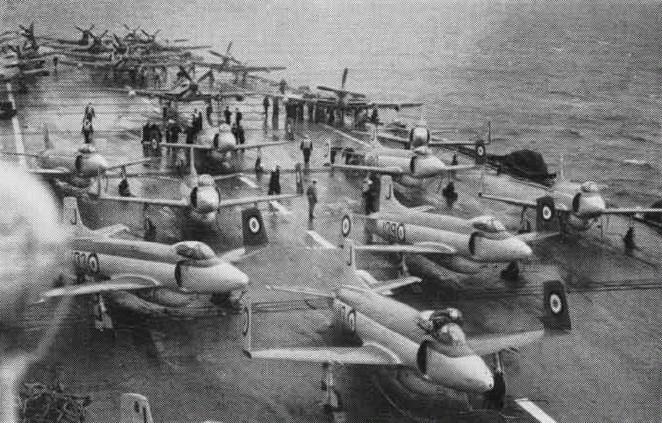
Attackers serve with front-line squadrons aboard Royal Navy carriers such as HMS Eagle.
Superseded by better jets like the Hawker Sea Hawk, the Attacker is withdrawn from front-line service after only about three years.
Attackers pass to Royal Naval Volunteer Reserve squadrons, giving reserve pilots jet experience until about 1957.
A single Attacker is preserved at the Fleet Air Arm Museum, Yeovilton — a monument to the Royal Navy’s first carrier jet.
Stories & Eyewitnesses
The Supermarine Attacker in stories: the moments that defined it
A piston fighter’s wing on a jet, a tailwheel on a carrier deck, the Fleet Air Arm’s first jet squadron, a brief front-line life and an export to Pakistan — the Attacker’s history told through the moments that stuck.
From the SpitefulA wing looking for an aircraft
The Attacker’s wing came from a piston fighter.
Supermarine’s piston Spiteful, a Spitfire successor, had an advanced laminar-flow wing but was overtaken by the jet age and never mass-produced.
Rather than waste the wing, Supermarine bolted it to a new jet fuselage — and the Attacker was born, half piston-era, half jet.
Nene PowerA proven jet engine
The reliable Rolls-Royce Nene gave real jet performance.
The Attacker was powered by the Rolls-Royce Nene, a robust centrifugal-flow turbojet that powered a whole generation of early jets around the world.
It gave brisk performance, but its bulk helped make the Attacker’s fuselage deep and portly — a mark of the first jet generation.
The TailwheelA taildragger jet
The Attacker kept an old-fashioned tailwheel undercarriage.
Inherited from the Spiteful, the Attacker’s tailwheel undercarriage left it sitting nose-high on the ground — awkward on a carrier deck, with a poor forward view and clumsy handling.
It was the clearest sign that the Attacker was a first-generation, transitional aircraft.
First FAA JetInto the jet age, 1951
The Attacker was the Fleet Air Arm’s first operational jet.
In August 1951 the Attacker equipped 800 Naval Air Squadron — the first jet fighter to enter operational front-line service with the Royal Navy’s Fleet Air Arm.
It gave Royal Navy carrier squadrons jet performance for the first time, and the FAA learned carrier jet operations on it.
Four CannonA hard-hitting battery
The Attacker carried four 20mm Hispano cannon.
The Attacker was armed with four 20 mm Hispano cannon, a heavy and hard-hitting battery in line with the fighters of the immediate post-war years.
The FB.2 fighter-bomber version added bombs and rockets, broadening the aircraft to ground- and ship-attack work.
On the DeckJets go to sea
Attackers flew from carriers like HMS Eagle.
Attacker squadrons embarked on Royal Navy carriers such as HMS Eagle, where crews grappled with the new discipline of operating jets from a moving flight deck.
The tailwheel made it clumsy on deck, but it was the aircraft on which the Fleet Air Arm learned to go to sea with jets.
Overtaken at OnceA three-year front line
Better jets superseded the Attacker almost immediately.
Aviation was moving so fast that the Attacker was obsolete almost as soon as it arrived. It served with just three front-line squadrons and left front-line duty by around 1954.
The tricycle-undercarriage Hawker Sea Hawk and the coming swept-wing jets simply did the job better.
Weekend FlyersThe RNVR reserve
Attackers gave reserve pilots jet experience.
After front-line withdrawal the Attackers passed to the Royal Naval Volunteer Reserve squadrons, whose part-time pilots flew them at weekends and in training.
They served the RNVR until about 1957, building the jet experience the whole Fleet Air Arm now needed.
Sold to PakistanA land-based Attacker
Pakistan was the Attacker’s only substantial export.
The Pakistan Air Force ordered a land-based version of the Attacker — without the naval arrester hook — and flew a squadron of them from the early 1950s.
It was the type’s only significant foreign sale, giving the young air force early jet experience.
A Bridge Between ErasHalf piston, half jet
The Attacker literally combined two ages.
With a jet fuselage, a piston fighter’s laminar wing and a tailwheel, the Attacker was a very literal bridge between the piston and jet ages — and it looked the part.
Its importance lies not in performance but in being the first step across that divide for the Fleet Air Arm.
The Starting PointWhere FAA jets began
Every later FAA carrier jet traces back to the Attacker.
The Sea Hawk, Scimitar, Sea Vixen, Phantom, Sea Harrier and F-35 all descend from the moment the Fleet Air Arm first flew jets operationally — and that moment was the Attacker.
Modest as it was, the Attacker is the starting point of Royal Navy jet carrier aviation.
The SurvivorPreserved at Yeovilton
One Attacker survives, at the Fleet Air Arm Museum.
Because so few were built and it was retired early, only one complete Attacker survives, preserved at the Fleet Air Arm Museum at RNAS Yeovilton in Royal Navy markings.
It is a rare, tangible reminder of the aircraft that took the Royal Navy into the jet age.
Photo Gallery
The Supermarine Attacker in photographs
Fleet Air Arm, Pakistan Air Force and museum photographs of the Attacker, each credited to its source and licence. Click any photo to enlarge.
On Film
The Supermarine Attacker on video: a story of fighter development
An archival film on the Attacker — the Fleet Air Arm’s first jet fighter, its Nene engine and laminar wing, and its place at the start of the Royal Navy’s jet age.
“A Story of Fighter Development: Supermarine Attacker” via PeriscopeFilm (approx. 19,000 views at time of writing; running time ~18 minutes) — an archival documentary film on the Attacker’s development.
Operations Overview
Where the Supermarine Attacker flew: an operator map
Designed and built in the United Kingdom for the Royal Navy’s Fleet Air Arm, with a single substantial export to Pakistan — so this is deliberately a small, two-nation map. Hover or tap a country for detail.
Categories: Design, Manufacture & Fleet Air Arm (United Kingdom) · Export Operator (Pakistan) · Surviving Airframe (United Kingdom, Fleet Air Arm Museum). A small two-nation map is correct for this aircraft.
Service Record
The Attacker’s record: a pivotal first step
The Attacker’s significance is measured not in combat or numbers but in being the aircraft that began Royal Navy jet carrier aviation.
Questions & Answers
Supermarine Attacker: your questions answered
Can I fly in a Supermarine Attacker?
No — there is no bookable Attacker flight experience, and MiGFlug does not offer one. Only around 185 were built, they were retired in the 1950s, and just one complete example survives, preserved (not flying) at the Fleet Air Arm Museum. If what you actually want is the real thing — strapping into a genuine military jet and flying it — you very much can do that today in other types. MiGFlug arranges flights in real fighter jets and warbirds around the world. Start here: migflug.com/flights-prices.
Why is the Supermarine Attacker historically important?
The Attacker was the first jet fighter to enter operational front-line service with the Royal Navy’s Fleet Air Arm, equipping 800 Naval Air Squadron in 1951. It gave the Royal Navy its first experience of operating jets from aircraft carriers, and every carrier jet the FAA has flown since builds on that first step. It was a modest aircraft, but a genuinely pivotal one — the starting point of Royal Navy jet carrier aviation.
Why did the Attacker have a tailwheel?
The Attacker inherited its tailwheel undercarriage along with the laminar-flow wing it borrowed from the piston-engined Supermarine Spiteful. By the early 1950s the tailwheel was already old-fashioned — newer jets used a tricycle undercarriage with a nosewheel, which sits level on the ground and is much easier to handle. On a carrier the tailwheel was a real handicap: it left the aircraft nose-high, gave the pilot a poor view forward, and made deck handling awkward. It is the clearest sign of the Attacker’s status as a transitional, first-generation jet.
What was the connection to the Spitfire and Spiteful?
The Attacker was built by Supermarine, the same company that made the Spitfire. Its wing came directly from the Supermarine Spiteful, a late piston-engined fighter developed as a Spitfire successor with an advanced laminar-flow wing. When the jet age overtook the piston Spiteful, Supermarine reused its wing on a new jet fuselage powered by a Rolls-Royce Nene, creating the Attacker. So the Attacker is, in a sense, a jet descendant of the Spitfire line — sharing wing technology with the Spiteful.
Why was the Attacker’s front-line career so short?
Fighter technology was advancing extremely fast in the early 1950s. The Attacker entered service in 1951 and was withdrawn from the front line by about 1954 because much better aircraft arrived almost immediately — the tricycle-undercarriage Hawker Sea Hawk was a far better carrier aircraft, and the swept-wing revolution (leading to types like the Supermarine Scimitar and de Havilland Sea Vixen) was pushing performance far beyond what the straight-wing Attacker could offer. The aircraft then served on with RNVR reserve squadrons until about 1957.
Who operated the Supermarine Attacker?
The Attacker’s main operator was the United Kingdom’s Royal Navy, both in front-line Fleet Air Arm squadrons and later in the Royal Naval Volunteer Reserve. Its only substantial export went to the Pakistan Air Force, which operated a land-based version without the naval arrester hook. So just two nations flew the type — the UK and Pakistan.
How many Attackers were built, and do any survive?
Around 185 Attackers were built in all variants — a small number reflecting its short front-line life. Because so few were made and the type was retired early, survivors are very rare: one complete Attacker is preserved at the Fleet Air Arm Museum at RNAS Yeovilton in the United Kingdom, displayed in Royal Navy markings.
Was the Supermarine Attacker a good aircraft?
Honestly, it was a modest aircraft — a transitional, first-generation jet that was awkward on a carrier deck and obsolete within a few years. But judging it only on performance misses the point. Its importance lies in what it began: it was the aircraft that took the Fleet Air Arm into the jet age, gave the Royal Navy its first carrier jet experience, and paved the way for the far more capable aircraft that followed. As a pioneer rather than a performer, it was genuinely significant.
Fly For Real
You can’t fly the Supermarine Attacker — but these, you can
No Attacker is a bookable ride today. The urge behind it — to strap into a real military aircraft and actually fly — is very much still bookable. MiGFlug puts you in genuine fighters and warbirds around the world.
Fighter Jet Flights
Take the controls of a real ex-military jet with an experienced pilot.
Warbird experiences
Fly in a genuine piston-engined warbird from the Attacker’s era.
All flights are operated by MiGFlug’s vetted partners with professional pilots. Browse every option and current pricing at migflug.com/flights-prices. MiGFlug does not operate Supermarine Attacker flights — no bookable example exists.
Related Aircraft
If the Supermarine Attacker interests you, explore these
Sources & Further Reading
Where this Supermarine Attacker history comes from
Note on figures: dimensions, performance and production numbers for the Attacker vary between sources and are hedged here as approximate. Cost fields are listed as not reliably recorded because trustworthy early Cold War procurement cost data is not consistently available. One complete Attacker survives, preserved at the Fleet Air Arm Museum, Yeovilton. This account aims to present the aircraft honestly — a modest but historically pivotal design — without overstating its capabilities.