
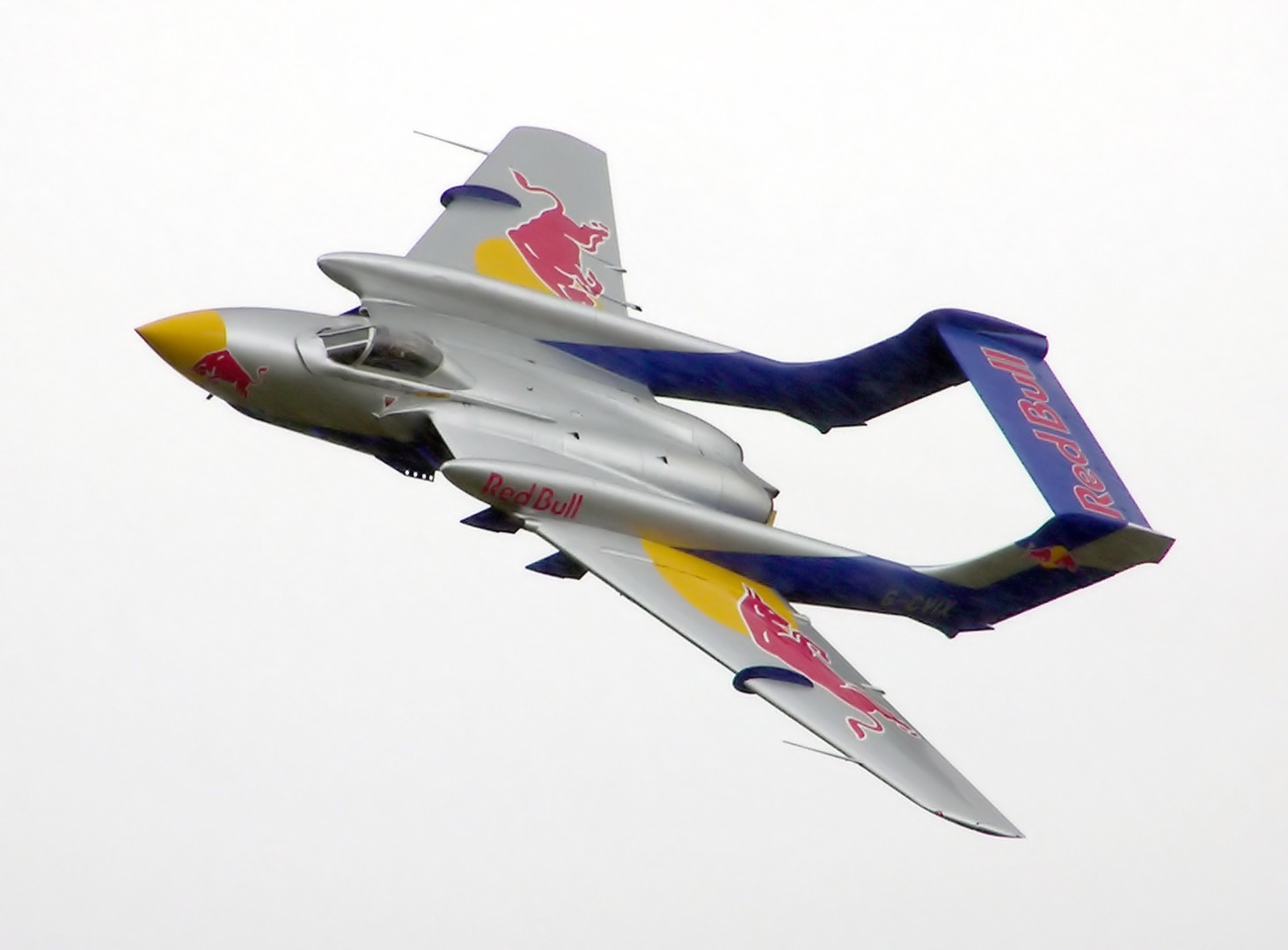
de Havilland Sea Vixen
Britain’s twin-boom, all-weather carrier fighter — the Fleet Air Arm’s first missile-only interceptor, flown by a pilot offset to port and an observer buried in a near-windowless compartment the crews called the coal hole.
The twin-boom guardian of the fleet
The de Havilland Sea Vixen was one of the most distinctive aircraft ever to fly from a British carrier: a big, twin-boom, twin-jet all-weather fighter, designed to intercept Soviet bombers far out over the sea in any weather, by day or night. It grew from the DH.110, a design de Havilland offered to meet both an RAF night-fighter need and a Royal Navy fleet-defence requirement in the late 1940s. The RAF eventually chose the Gloster Javelin, but the Navy stuck with the DH.110 — and turned it into the Sea Vixen.
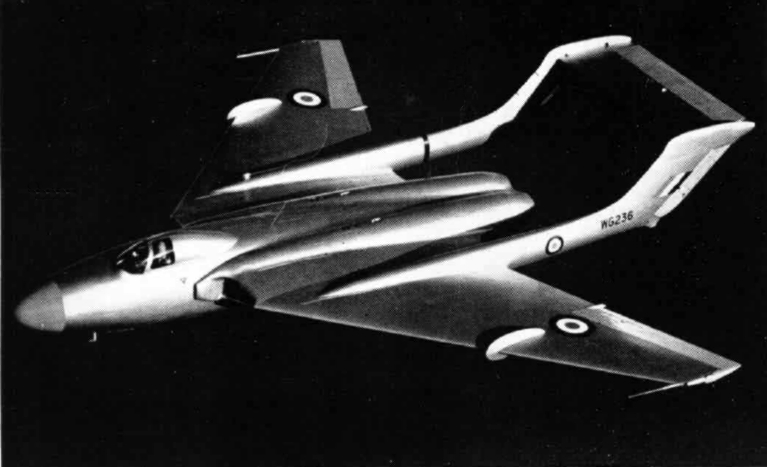
The prototype first flew on 26 September 1951. Barely a year later the programme was scarred by tragedy: on 6 September 1952 the prototype WG236 broke apart during a display at the Farnborough air show, killing test pilot John Derry, his observer Anthony Richards and 29 spectators. The design was extensively strengthened and redesigned, carrier trials followed, and the reworked aircraft finally entered Fleet Air Arm service in July 1959 as the FAW.1.
Two features made it unmistakable. First, the crew layout: the pilot sat under an offset canopy to the port (left) side, while the observer — who worked the interception radar — sat down and to the right, sunk into the fuselage with almost no outside view, in a compartment universally known as “the coal hole.” Second, the armament: the Sea Vixen was the first British aircraft designed to fight with guided missiles and rockets alone — it carried no guns at all, relying on Firestreak and later Red Top heat-seeking missiles.
Sea Vixens flew from carriers including HMS Ark Royal, Eagle, Victorious, Hermes and Centaur, and were present at Cold-War flashpoints from the 1961 Kuwait crisis to the 1967 British withdrawal from Aden. Carrier flying in the 1960s was punishing work: between 1960 and 1970 more than 50 Sea Vixen aircrew were killed in accidents. The improved FAW.2, with all-aspect Red Top missiles and extended tail booms, arrived from 1963. The last front-line squadron disbanded in 1972, the type overtaken by the Phantom. One airframe, XP924 — nicknamed Foxy Lady — flew on as the world’s only airworthy Sea Vixen until a hydraulic failure forced a wheels-up landing in 2017.
01The Sea Vixen’s origins: how the DH.110 became a naval fighter
De Havilland conceived the DH.110 as a twin-boom, twin-engine night and all-weather fighter that might serve both the Royal Air Force and the Royal Navy. When the RAF selected the Gloster Javelin instead, the Navy pressed on with a navalised version tailored for carrier operation: folding wings, an arrester hook, strengthened undercarriage and slower approach handling. The result was renamed the Sea Vixen. Its first arrested deck landing came aboard HMS Ark Royal in 1957, and the type reached the front line with 892 Naval Air Squadron in 1959 — nearly a decade after that first flight, a gap widened by the 1952 Farnborough accident and the redesign it forced.
What makes it special
The twin-boom layout
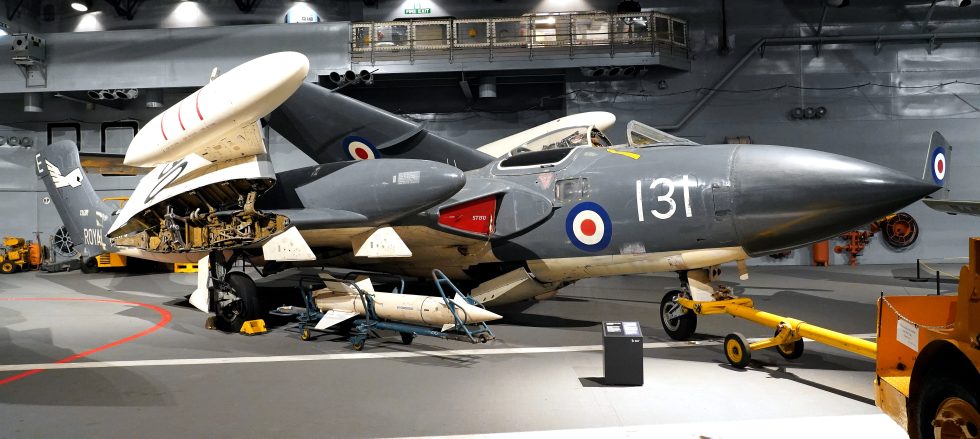
The Sea Vixen carried de Havilland’s signature twin-boom tail, inherited from the Vampire and Venom. Two slim booms carried the tailplane and fins behind the wing, leaving a short, deep central fuselage to house two engines, the crew and a large radar. On the FAW.2 the booms were extended forward of the wing to add fuel and electronics. The whole outer wing folded upward hydraulically for stowage in a carrier hangar.
The offset cockpit and ‘the coal hole’
The pilot sat under a canopy offset to port, giving him a clear forward view for deck landings. The observer sat lower and to starboard, almost entirely inside the fuselage with only a small window, hunched over the radar display. Crews called it “the coal hole” — dark, cramped and blind, but that darkness helped the observer read the radar screen in daylight.
Britain’s first all-missile fighter
The Sea Vixen was the first British aircraft armed entirely with missiles and rockets, with no cannon. It carried four Firestreak infrared missiles (later all-aspect Red Top), plus retractable packs of unguided air-to-air rockets and, for strike work, bombs and Bullpup missiles. Guns were specified early on but never fitted — a bold, controversial choice for 1959.
02The Sea Vixen’s ‘coal hole’: life in the windowless observer’s seat
The observer’s station was one of the least-loved positions in naval aviation. Set into the fuselage to the right of and below the pilot, it had only a small side window and no ejection through a canopy of its own in the way the pilot had — the observer escaped through a hatch. Its nickname, “the coal hole,” captured both the gloom and the sense of being sealed away from the outside world. Yet the darkness was partly deliberate: with no bright cockpit glare, the observer could read the interception radar clearly even in daylight. On a successful night interception, the whole engagement depended on that man in the dark talking his pilot onto the target.
03The Sea Vixen’s missiles: Firestreak, Red Top and no guns
Original specifications called for Aden cannon, but the production Sea Vixen went to sea with none — the first British fighter to do so. Its primary weapons were de Havilland Firestreak infrared air-to-air missiles: rear-aspect heat-seekers that had to be fired from behind a target. The FAW.2 introduced the more capable Red Top, with a larger warhead and a seeker able to engage from a wider range of angles. Backing them up were retractable pods of Microcell unguided rockets in the forward fuselage, and for ground attack the aircraft could carry bombs, rocket pods and Bullpup guided missiles. It was a clean break from the gun-armed fighters that came before — and a bet on the missile age that not everyone was comfortable making.
Full specifications
Baseline note: the figures below describe the Sea Vixen FAW.2, the definitive Fleet Air Arm standard — two Rolls-Royce Avon Mk 208 turbojets, GEC AI.18 radar, four Red Top or Firestreak missiles, and the tail booms extended forward over the wing leading edge to carry more fuel and more electronic countermeasures kit. It is the right baseline because it is the mark that flew the last eight years of the type’s life, the mark 899 Naval Air Squadron took to sea in HMS Eagle until February 1972, and the mark that most surviving airframes represent. Deltas for the two DH.110 prototypes, the semi-navalised XF828, the FAW.1, the TT.2 target tugs and the D.3 drone conversions are in grey. Four things to understand before the numbers, because each one explains a figure that otherwise looks odd. First, the layout. The Sea Vixen is a twin-boom aeroplane not for style but for arithmetic: booms shorten the jet pipes, cut the overall length and height that a carrier hangar has to swallow, keep asymmetric thrust manageable on one engine over a winter Atlantic, and give fitters a clear run at the engine bays. The price is a tailplane slung between two booms and a fuselage with nowhere obvious to put a second crewman. Second, the cockpit. The pilot sits under an offset canopy on the port side; the observer sits lower and to starboard, wholly inside the fuselage, reaching his seat through a flush top hatch that Fleet Air Arm crews called the coal hole. He has a small rectangular window at his right shoulder and another small one over his head, and the overhead one could be blacked out so he could see the radar tube. He had a Martin-Baker Mk.4 seat like the pilot — the frequent claim that he had no way out is wrong — but he had no view of the world he was ejecting into, and in a great many of the type’s accidents the pilot got out and the man in the coal hole did not. Third, the guns. There are none. The DH.110 was drawn with four 30 mm ADEN cannon; the Royal Navy deleted them, and the Sea Vixen entered service as the first British aircraft armed solely with missiles, rockets and bombs and the first Fleet Air Arm fighter with no gun at all. Fourth, the numbers themselves disagree. Green and Swanborough give an empty weight of 27,950 lb; the Thunder and Lightnings compilation, working from service documents, gives 31,715 lb for the same mark, and the two cannot both be a bare airframe. Engine thrust is quoted at 10,000, 11,000 and 11,230 lbf by three respectable sources. Where that happens below, both figures are given rather than one being quietly preferred.
Dimensions & weights
- Crew
- 2 — pilot to port under an offset blown canopy, observer to starboard and lower, buried in the fuselage. No Sea Vixen variant was ever a single-seater and no dual-control trainer was built, so pilots converted on to the type from the Sea Venom and the Hunter with nobody in the other seat to help
- Length
- 16.94 m (55 ft 7 in) — identical for FAW.1 and FAW.2, because the FAW.2 boom extensions grew forward over the wing rather than aft. The radome hinged sideways for hangar stowage, which mattered more on a British carrier than the raw figure does
- Wingspan
- 15.54 m (51 ft 0 in) spread — unchanged across the marks. The outer panels folded upward on powered hinges through two fold joints and six main attachment points
- Height
- 3.28 m (10 ft 9 in) — strikingly low for a 1950s all-weather fighter, and a direct dividend of the twin-boom tail. Hangar deck head-room on Centaur and Hermes was one of the reasons the layout survived the redesign
- Wing area
- 60.2 m² (648 sq ft) — a large wing by the standards of its contemporaries, chosen deliberately for moderate wing loading, deck manners and turning performance at height rather than for speed
- Wing sweep and section
- 45° leading-edge sweep, EC1040 aerofoil — with the cambered leading-edge extension and outer-panel changes forced on de Havilland by the 1952 Farnborough break-up, which traced the failure to the unreinforced leading-edge skin ahead of the main spar
- Wing fold
- Powered upward fold, outer panels — hydraulically driven, with wing-fold and locking indications the pilot had to check before a catapult shot. The preserved XP924 still has a working fold, which is what Bournemouth Aviation Museum wanted to keep alive when the airframe was offered to it
- Empty weight
- 12,678 kg (27,950 lb) as given by Green and Swanborough. Thunder and Lightnings quotes 14,385 kg (31,715 lb) for the FAW.2, a gap of nearly 1.7 tonnes that almost certainly reflects basic empty against operating empty rather than a genuine dispute about the aeroplane
- Gross weight
- 18,858 kg (41,575 lb) — the normal loaded figure, roughly a fully fuelled aeroplane with four missiles and no external tanks
- Maximum take-off weight
- 21,205 kg (46,750 lb), from the FAW.2 flight reference cards of 1968. Thunder and Lightnings gives 20,730 kg (45,700 lb); the difference is small and probably a catapult-limited against a land-limited figure
- Wing loading
- 313 kg/m² (64.2 lb/sq ft) at gross weight — low for a fighter of this era and this size, which is why a Sea Vixen could out-turn a Lightning and why its published tactics against supersonic opponents were to keep turning until the other man ran short of fuel
- Thrust-to-weight ratio
- 0.54 at gross weight — unremarkable, and the number that explains most of the type’s limits. There is no reheat anywhere on a Sea Vixen; everything it did, it did on dry thrust
Performance
- Maximum speed
- 1,110 km/h (690 mph, Mach 0.91) — the most-quoted figure, and a limit set by drag rise and control loads rather than by thrust. The de Havilland Aircraft Museum quotes a lower 1,030 km/h (640 mph) at 3,050 m (10,000 ft)
- Maximum speed, sea level
- 1,132 km/h (611 kt, 703 mph) — from the service compilation. Low down, clean and light, the Sea Vixen was genuinely fast; it was at height that the lack of reheat told
- Mach limit
- Mach 1 in a dive only — the unmodified first DH.110 prototype went supersonic in 1952 and was the first British two-seat combat aircraft to do so. The post-crash redesign, with its all-moving tailplane and cambered leading edge, cost that: the second prototype reached only Mach 0.95 in a steep dive, with controls immovable until it had passed 3,050 m (10,000 ft). No production Sea Vixen was a supersonic aeroplane in level flight
- Rate of climb
- 46 m/s (9,000 ft/min) initial — respectable for a 1959 fleet fighter on dry thrust, and roughly half what a contemporary Lightning managed on reheat
- Service ceiling
- 14,630 m (48,000 ft) — consistently quoted across every source consulted, which for this aeroplane is unusual
- Range on internal fuel
- 1,270 km (790 mi, 686 nm) — the FAW.2 figure. The Sea Vixen design narrative in the same sources gives about 1,000 km (600 mi), which is the FAW.1 before the boom extensions added tankage; the improvement is the whole point of the FAW.2 pinions
- Range with external tanks
- ~2,900 km (1,800 mi) as quoted by the de Havilland Aircraft Museum, with underwing tanks and no reserve for a diversion. Treat it as a ferry figure, not an operational one
- Combat radius
- ~370–550 km (200–300 nm) on a fleet-defence sortie, depending on how much time is spent on station and how much on transit. No authoritative single figure is published; this is the band implied by the range figures and by squadron accounts of Beira Patrol and Aden sorties
- Endurance and air refuelling
- Extended indefinitely by probe-and-drogue refuelling — every Sea Vixen carried a fixed refuelling probe, and the type could also be fitted as a tanker to refuel other aircraft, which is how a small air group on a small deck kept fighters airborne. The famous photographs of one 899 Squadron Sea Vixen refuelling another are not a stunt; they are the operating method
- Launch and recovery
- Steam catapult launch, arrested recovery — there is no meaningful unassisted take-off run figure for this aeroplane in service. What matters is the approach: the Sea Vixen was clean, slippery and slow to decelerate, and holding an accurate approach speed on to a moving deck at night demanded constant work on the throttles
- Handling
- Docile in the air, unforgiving on the deck — a stable weapons platform with good turning performance and fully powered controls, but low-drag and speed-unstable on the approach, and flown at night in the Persian Gulf and the Mozambique Channel by two men, only one of whom could see out. That combination, more than any single design flaw, is what produced the loss record
Propulsion & systems
- Engines
- 2 × Rolls-Royce Avon Mk 208 — single-spool axial-flow turbojets with no afterburner, the same basic engine family that powered the Hunter, the Canberra and the Lightning. The FAW.1 had the same mark, so the FAW.2 gained no thrust at all over its predecessor: everything it gained was fuel, avionics and missiles
- Rated thrust
- 50.0 kN each (11,230 lbf), the figure given by Thunder and Lightnings and by the older technical literature. Green and Swanborough’s Great Book of Fighters (2001) rounds to 48.9 kN (11,000 lbf) and the de Havilland Aircraft Museum quotes 44.5 kN (10,000 lbf), which is probably an earlier rating. The spread is about ten per cent and no source explains it
- Installation
- Buried in the centre fuselage, short jet pipes between the booms — engines were drawn out upward through detachable panels in the upper fuselage. The twin-boom layout keeps the pipes short, which saves thrust, weight and heat, and puts the exhaust well clear of the tail surfaces
- Fuel
- Fuselage, wing and boom tankage — the tail booms are not empty structure; their internal volume carries fuel and avionics. The FAW.2 enlarged them into forward pinion extensions above and ahead of the wing leading edge, which is the quickest way to tell the two marks apart in a photograph. No consistent internal capacity figure is published for either mark
- External tankage and probe
- Underwing drop tanks, fixed refuelling probe, buddy tanker fit — the buddy pack turned a fighter into a tanker, and on Eagle and Hermes that flexibility was worth more than the fuel it carried
- Radar
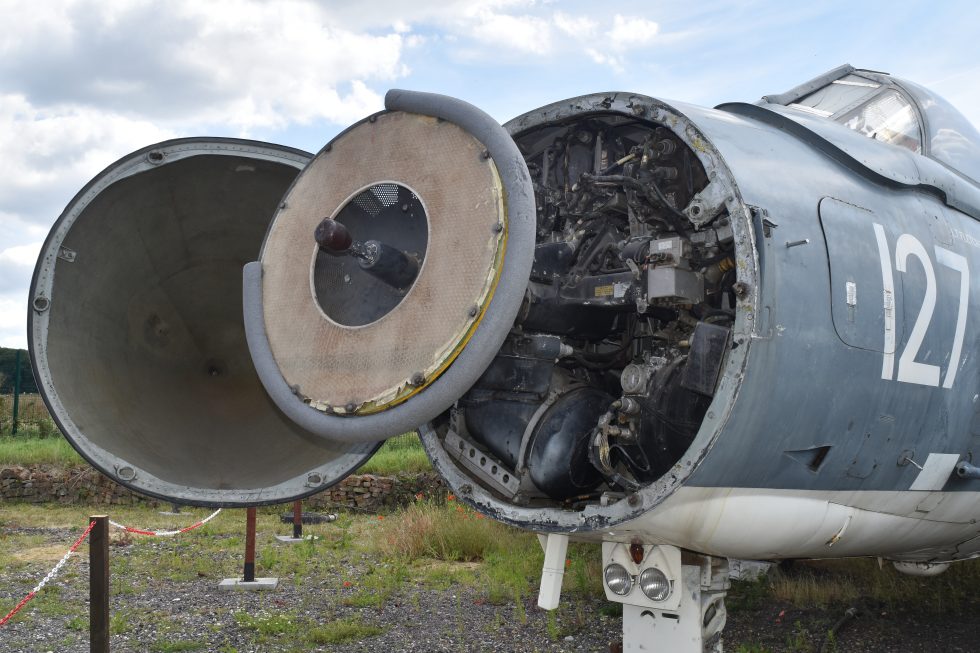
- GEC AI.18 air interception radar — in the nose, under a hinged radome, worked entirely by the observer. The FAW.2 fit was the AI.18R, the R for Red Top, which slaved the missile seeker head on to the radar target so the observer pointed the weapon before the pilot ever saw it. This was the first British fighter designed from the start as an integrated weapon system rather than an airframe with equipment added
- Flight controls
- Fully powered tailplane, ailerons and rudder — twin independent hydraulic systems with variable gearing across the speed range, and control that remained usable with no electrical power at all, including after a double engine failure. An intricate three-section flap arrangement was forced on the designers by the wing geometry
- Airbrake
- Fuselage-mounted, below the pressure floor — sited under the forward fuselage between the nose gear and the cockpit. On a very clean aeroplane joining the circuit, it was worked hard
- Escape system
- 2 × Martin-Baker Mk.4 ejection seats — automatic and height-adjustable, and rated for escape with the aircraft submerged, an unusual and genuinely useful provision for a carrier aeroplane. They are not zero-zero seats. The observer went out through his top hatch, which had to go first; the FAW.2 brought improvements to his escape system specifically because the FAW.1 arrangement had killed people
- Navigation and communications
- Autopilot, TACAN, UHF, ground and air position indicators — with a reference gyro and yaw and pitch damping. Modest by later standards, but a serious all-weather fit in 1959 and one that let the observer navigate a fighter back to a darkened deck in the middle of the Indian Ocean
- Crew services
- Single centralised service connector per crew station — one plug carrying the ventilated g-suit supply, humidity and temperature control. A small thing that mattered on four-hour Beira Patrol sorties in the tropics with the observer sealed into an unventilated black box
04The Sea Vixen’s operating costs: why no reliable figure exists
The Sea Vixen was a 1950s British government defence programme, procured for the Royal Navy rather than sold on an open market, so no meaningful flyaway unit price or cost-per-flight-hour figure survives in the public record. Contemporary British defence budgets did not publish per-airframe or per-hour operating costs in the way modern programmes do. Any precise dollar or pound figure attached to the type today should be treated as an estimate rather than a sourced number. What is well documented is the human cost: carrier operations in the 1960s were dangerous, and more than 50 Sea Vixen aircrew died in accidents during the type’s front-line decade.
Armament & payload
The Sea Vixen was the first British fighter sent to sea with no gun at all, and it made the case for missiles before the missiles were ready
The DH.110 was designed around four 30 mm ADEN cannon. By the time it reached the Fleet Air Arm as the Sea Vixen FAW.1 in July 1959 the guns had gone, and with them a belief that had governed British fighter armament since 1918. What replaced them was four de Havilland Firestreak infrared missiles slaved to an AI.18 radar worked by a man who could not see out, plus two retractable packs of 2-inch rockets buried in the forward fuselage and a set of underwing pylons for bombs, rocket pods and drop tanks. The FAW.2 kept all of it and added the far better Red Top missile and the AGM-12 Bullpup, and lost the 1,000 lb bomb clearance in the process because the new boom extensions changed the aerodynamics.
Whether the gunless decision was right is still arguable. In its actual wars — Tanganyika, the Radfan, Aden, the Beira Patrol — the Sea Vixen was a ground-attack aeroplane firing rockets and dropping iron bombs, and a pair of cannon would have been useful more often than a Firestreak was. Against the target it was actually built for, a Soviet maritime bomber approaching a carrier group, a gun was irrelevant and the missile was the only sensible answer. The Royal Navy was right about the war it expected and wrong about the wars it got, which is the ordinary condition of navies. Fits varied by mark and by squadron: the FAW.1 carried Firestreak only, the FAW.2 carried Firestreak or Red Top, the 1,000 lb bomb was an FAW.1 store, published rocket-pod capacities disagree with one another, and the nuclear clearance described below was an emergency provision that no squadron trained for as a matter of routine.
Gun
- None. Not one gun, of any calibre, on any Sea Vixen of any mark. The card is kept because its emptiness is the single most important fact about the aeroplane’s armament
- The original DH.110 as offered to the Royal Air Force and the Admiralty carried four 30 mm ADEN cannon in the lower forward fuselage. They were deleted during the naval redesign in favour of an all-missile fit
- This made the Sea Vixen the first British aircraft armed solely with missiles, rockets and bombs, and the first Fleet Air Arm fighter with no gun armament at all. The Lightning F.3 followed the same logic into Royal Air Force service five years later
- One curious consequence: with the cannon mountings gone, parts of the forward structure no longer had to absorb recoil, and the Sea Vixen is often described as the last British fighter to use wood in its construction
- The practical cost showed up over the Radfan and Aden, where the aeroplane spent its combat life attacking men and vehicles on the ground with rockets and bombs and would plainly have used a gun had it possessed one
Air-to-air
- 4 × de Havilland Firestreak infrared air-to-air missiles on underwing pylons — the FAW.1 fit and the type’s only air-to-air weapon from 1959. A rear-hemisphere weapon that had to be manoeuvred into a narrow cone behind the target
- 4 × Hawker Siddeley Red Top on the FAW.2 — larger warhead, better seeker, and enough sensitivity to home on the kinetic heating of a supersonic target’s airframe rather than only on its jet pipes, which turned it into something close to an all-aspect weapon against a Tu-22 Blinder
- Red Top was integrated with the AI.18R radar: the observer acquired and tracked, the radar slaved the missile seeker on to the target, and the pilot flew the intercept. Red Top trials were run by 13 Joint Service Trials Unit at Hatfield and Boscombe Down from April 1964
- From 1969, FAW.2 crews practised supersonic intercepts against Concorde in flight test over the Irish Sea — the only realistically fast target in British airspace
- The published tactic against a genuinely supersonic fighter such as a Lightning or a Mirage III was not to chase it but to keep turning, force it to burn fuel in reheat, and take it with Red Top when it finally broke away
Air-to-surface guided
- 2 × AGM-12 Bullpup radio command-guided air-to-surface missiles, FAW.2 only — the type’s single guided air-to-ground weapon, added with the mark that entered service in 1964
- Bullpup demanded that the launching pilot fly towards the target and steer the missile with a thumb controller while watching its flare, which in the face of any serious defence is an unattractive proposition. It was carried far more often than it was fired
- The FAW.1 had no guided air-to-surface capability whatever, and the great majority of Sea Vixen attack sorties over Tanganyika, the Radfan and Aden were flown by FAW.1 aircraft with unguided weapons
- Nothing else guided was ever cleared. The Royal Navy’s serious stand-off strike capability of the period belonged to the Buccaneer, not to the fighter squadrons
Bombs
- 4 × 500 lb (227 kg) conventional bombs on the underwing pylons — the standard load, with contact or proximity fusing, delivered in shallow 10 to 20 degree dives by divisions of four aircraft running through the target in sequence
- 2 × 1,000 lb (454 kg) bombs on the FAW.1. The FAW.2 lost this clearance: the forward boom extensions altered the aerodynamics and the heavier store could no longer be carried, one of the few respects in which the later mark was worse than the earlier
- 1 × Red Beard free-fall nuclear bomb, FAW.1 only, cleared for use in what the paperwork called an extreme operational emergency. It was never a routine role and the Fleet Air Arm’s nuclear strike task properly belonged to the Scimitar and then the Buccaneer
- Lepus high-luminance flares for night illumination, dropped singly to light a target for a following attack
- Practice bombs and carriers for the training squadrons, principally 766 Naval Air Squadron at Yeovilton, which ran the Naval Air Fighter School and provided the aircraft for the Fred’s Five display team
Rockets
- 2 × retractable Microcell packs in the forward fuselage, each of 14 × 2-inch (51 mm) rockets, 28 in total — an internal, flip-out installation that left the aeroplane clean when the packs were stowed. This was the Sea Vixen’s built-in armament and the nearest thing it had to a gun
- 4 × Matra pods of 18 × SNEB 68 mm rockets each on the underwing pylons, giving 72 rockets in a single ripple
- 4 × Microcell pods of 24 or 32 × 2-inch rockets; the seavixen.org operational account describes four pods of 32 high-explosive rockets fired in a ripple lasting about two seconds, which is 128 rockets in the space of a long blink
- Up to 24 × 3-inch RP-3 rockets with 60 lb high-explosive or semi-armour-piercing heads. Squadron opinion recorded on seavixen.org rated the 3-inch as far more accurate and far more dangerous than the 2-inch, particularly against armour, and regretted its gradual withdrawal during the Sea Vixen years
- Glow Worm rocket flares — 3-inch rockets fired to illuminate a target for a self-contained night attack. Flying that profile at low level in the dark, pulling hard, over hostile ground, is precisely the sort of sortie that fills an accident log
Pods & other stores
- Underwing drop tanks — the routine fit for transit, Beira Patrol station-keeping and any sortie beyond the immediate fleet defence radius
- Buddy refuelling pack, turning a Sea Vixen into a tanker for other Sea Vixens. Combined with the fixed probe every aircraft carried, this is how squadrons stretched sorties from a small deck with no dedicated tanker
- Electronic countermeasures equipment, considerably expanded on the FAW.2, which is one of the reasons the tail booms grew forward. The details remain thinly documented in open sources
- Palouste air-start trolleys and pods appear alongside Sea Vixens in almost every deck photograph of the period; they are ground equipment, not stores, but no Sea Vixen went anywhere without one nearby
- What was never carried: a gun pod, a reconnaissance pack, an anti-ship missile, or any air-to-surface guided weapon other than Bullpup. The Sea Vixen was a fleet fighter that did secondary attack work with iron, and nothing was ever bolted on to change that
Three typical loadouts
- Fleet air defence combat air patrol, FAW.2
- 4 × Red Top, 2 × underwing drop tanks, internal 2-inch rocket packs stowed. Launched by catapult from Eagle or Hermes, held on station under fighter direction from the ship, topped up from a buddy tanker, intercept flown by the observer on AI.18R with the pilot following his direction
- Ground attack over the Radfan, FAW.1
- 4 × 500 lb bombs or 4 × rocket pods, no air-to-air missiles, guns not fitted because there were none. Division of four, shallow dives of 10 to 20 degrees, aircraft running through in sequence against dissident positions in the hills behind Aden, flown from HMS Centaur in 1964
- Self-illuminated night attack
- Glow Worm 3-inch flare rockets or a single Lepus flare, plus 2-inch rocket packs and 500 lb bombs. One aircraft lights the target, the others attack in the few seconds of usable light, at low level, in the dark, over the sea or over unlit country. The most demanding profile the type flew and by some margin the most dangerous
Sourcing caveat: rocket-pod capacities in particular do not agree between compilations. A commonly reproduced specification table gives four Matra pods of 18 SNEB or Microcell pods of 24 or 32 2-inch rockets; the Warpaint monograph and the seavixen.org operational pages give slightly different figures again; and the internal fuselage packs are variously described as holding 14 rockets each or as a single installation of 28. The figures above follow the service-derived accounts where they can be identified. Weapon clearances also changed over thirteen years of service and a load legal in 1962 was not necessarily legal in 1970.
Variants
Two service marks, three prototypes and a handful of drones: the Sea Vixen family is small, British and entirely unexported
The Sea Vixen has one of the shortest variant lists of any post-war British combat aircraft, and every one of its sub-types was built for or converted by a single customer. There were no export orders, no licence production, no reconnaissance mark, no trainer and no land-based version. The Royal Air Force, which had commissioned the design in the first place, walked away in 1954 and bought the Gloster Javelin instead, and nobody else ever came.
Production totals need care. A commonly quoted total is 151 airframes including the two DH.110 prototypes and the semi-navalised third machine, which leaves 148 production Sea Vixens; that reconciles exactly with the 119 FAW.1 and 29 new-build FAW.2 aircraft cited elsewhere. But the accident statistic that is quoted everywhere — 55 lost — is stated against a denominator of 145 constructed, and no source explains the missing three. Both figures are given below rather than one being chosen for tidiness.
- DH.110 prototypes (1951–1952 / 2 built)
- WG236 and WG240, land-based night fighters with Avon engines of about 7,500 lbf, four 30 mm ADEN cannon and a straight-through fuselage. WG236 first flew from Hatfield on 26 September 1951 under John Cunningham and broke up over the crowd at Farnborough on 6 September 1952, killing test pilot John Derry, observer Tony Richards and 29 spectators. WG240 was rebuilt with an all-moving tailplane and cambered leading edges and did not fly again until July 1954.
- XF828, semi-navalised prototype (1955 / 1 built)
- First flown from Christchurch on 20 June 1955 with revised wing leading edges, strengthened wings, catapult points and an arrester hook, but no wing fold and no armament racks. It made the type’s first arrested landing aboard HMS Ark Royal in 1956 and settled the question of whether a twin-boom fighter could work off a British deck.
- Sea Vixen FAW.20 (1957 / designation only)
- The original designation of the first fully navalised production aircraft, which flew on 20 March 1957. Renamed FAW.1 before entry into service. No airframe was delivered to a squadron as an FAW.20.
- Sea Vixen FAW.1 (1957–1966 / 119 built)
- The service standard from July 1959: Avon Mk 208 engines, AI.18 radar, four Firestreak missiles, two internal 2-inch rocket packs, four 500 lb or two 1,000 lb bombs, power-folding wings, steerable nosewheel and an emergency clearance for the Red Beard nuclear bomb. Built at Christchurch from March 1957 and at Hawarden near Chester from August 1962. Phased out from 1966.
- Sea Vixen FAW.2 (1962–1972 / 29 new-build plus 67 conversions)
- First flight 1962, front-line service from 1964. Tail booms extended forward into pinion tanks over the wing leading edge for more fuel and more electronic countermeasures kit, AI.18R radar, Red Top as well as Firestreak, Bullpup, SNEB pods and an improved escape system for the observer. It lost the 1,000 lb bomb clearance to the aerodynamic changes. 899 Naval Air Squadron aboard HMS Eagle was the last embarked Sea Vixen unit, disbanding in February 1972.
- Sea Vixen TT.2 (1971–1974 / small number converted)
- Target tugs for the Fleet Requirements Unit at Yeovilton, which took over aircraft when 890 Naval Air Squadron disbanded on 6 August 1971. FRU became the Fleet Requirements and Aircraft Direction Unit on 1 December 1972 and gave up its Sea Vixens on grounds of cost, the last going in January 1974 — two years after the type is usually said to have retired.
- Sea Vixen D.3 (1977 onwards / 4 converted)
- Pilotless target drone conversions by Flight Refuelling at Tarrant Rushton, tested at Llanbedr: XN657, XP924, XS577 and XS587. Three more airframes — XJ494, XN658 and XN688 — were sent for conversion but never converted before the programme was abandoned. Sources conflict over XS587, which is listed as a D.3 conversion in one place and as a TT.2 in the survivors list.
- Unbuilt and abandoned (1947–1960s / none completed)
- The DH.110 was originally to satisfy four requirements at once — F.4/48, F.5/49, N.40/46 and N.8/49 — and thirteen prototypes were authorised in 1949 for a Royal Air Force night fighter, a naval night fighter and a naval strike aircraft. The Royal Air Force cut its order to two prototypes in 1949 and abandoned the type entirely in 1954. No supersonic development was ever built; the Fleet Air Arm bought the Phantom FG.1 instead.
- Export and licence production (none)
- There was none. The Royal Navy Fleet Air Arm was the Sea Vixen’s only operator, ever, and no foreign air arm or civil operator flew one in service. The single overseas Sea Vixen today is a museum airframe in Queensland.
Survivors and the safety record. The loss figures are the ugliest in post-war British naval aviation: of the airframes built, 55 were destroyed in accidents, a loss rate of nearly 38 per cent, and two DH.110 prototypes were lost on top of that. Thirty of the 55 losses were fatal, and in 21 of those both pilot and observer died. The commonly repeated line that 21 aircrew were killed is a misreading of that sentence: the Thunder and Lightnings compilation records no fewer than 51 aircrew killed between 1960 and 1970 alone. About a dozen complete airframes survive, every one an original — no Sea Vixen reproduction has ever been built, and the type is too large and too obscure for anyone to attempt one. In the United Kingdom: XJ482 at the Norfolk and Suffolk Aviation Museum, the first delivered to the Royal Navy; XJ560 at Newark; XJ565 at the de Havilland Aircraft Museum, London Colney; XJ571 at Solent Sky, Southampton; XJ580 at Tangmere; XN685 at the Midland Air Museum; XS576 at IWM Duxford; XS587 at Gatwick Aviation Museum; XS590 at the Fleet Air Arm Museum, Yeovilton, the last production Sea Vixen of all, built in 1966; XJ481 in the Fleet Air Arm Museum reserve collection at Cobham Hall; and XJ494, formerly with the Cold War Jets Collection at Bruntingthorpe, whose future has been uncertain since that site closed in June 2020. Overseas there is exactly one, FAW.2 XJ490 at the Queensland Air Museum, Caloundra, complete but stripped internally. And then there is XP924, civil registration G-CVIX, nicknamed Foxy Lady: a 1963 airframe that flew with 899 Naval Air Squadron from HMS Eagle, was converted to a D.3 drone in 1977, was civil-registered in 1996, wore Red Bull colours in the 2000s, was gifted to the Fly Navy Heritage Trust in September 2014 and was for years the only airworthy Sea Vixen in the world. On 27 May 2017, returning from a display, it suffered a hydraulic failure and made a wheels-up landing at RNAS Yeovilton. The pilot walked away; the aeroplane did not fly again. In November 2020 the trust suspended the return-to-flight fundraising indefinitely, and it was subsequently judged that repair at an estimated 1.5 to 2 million pounds could not be justified. The airframe was offered to Bournemouth Aviation Museum, which hoped to keep systems such as the wing fold working, but the appeal for the roughly 40,000 pounds needed simply to move it failed, and as of the most recent reporting available it remains crash-damaged and in storage at Yeovilton. There has not been a flying Sea Vixen anywhere in the world since that May afternoon in 2017, and on present evidence there will not be another.
From prototype to preserved airframe
First flight
The DH.110 prototype WG236 flies for the first time on 26 September, piloted by John Cunningham.
The Farnborough disaster
On 6 September WG236 breaks apart during a display; pilot John Derry, observer Anthony Richards and 29 spectators are killed.
Redesigned prototype
The strengthened, navalised DH.110 Mk.20X flies on 20 June, clearing the path to production.
First deck landing
The Sea Vixen makes its first arrested landing aboard HMS Ark Royal as carrier trials begin.
Enters service
892 Naval Air Squadron commissions with the FAW.1 in July — the Fleet Air Arm’s new all-weather fighter.
Kuwait crisis
Sea Vixens fly defensive patrols over the carrier group during the summer standoff with Iraq.
FAW.2 arrives
The improved FAW.2 enters service with all-aspect Red Top missiles and extended, fuel-carrying tail booms.
Aden withdrawal
Sea Vixens provide air cover during the British withdrawal from Aden, alongside Buccaneers and Gannets.
Retired
899 Naval Air Squadron disbands; the Phantom takes over fleet air defence and the Sea Vixen leaves front-line service.
Foxy Lady’s last landing
XP924, the world’s only airworthy Sea Vixen, makes a wheels-up landing at Yeovilton after a hydraulic failure, ending its flying career.
Twelve Sea Vixen stories
The fighter both services wanted
The DH.110 was pitched to the RAF and the Royal Navy at once — only the Navy stayed the course.
Read the full story
The Farnborough tragedy
WG236 disintegrated over the crowd, killing the crew and 29 spectators — and changed air-show safety forever.
Read the full story
A seat in the dark
The observer flew buried in the fuselage with almost no view out — but the darkness had a purpose.
Read the full story
No guns at all
The Sea Vixen was the first British fighter designed to fight with missiles and rockets alone.
Read the full story
Wings that folded skyward
Power-folding wings let the big fighter tuck into a crowded carrier hangar.
Read the full story
From Firestreak to Red Top
The FAW.2 swapped tail-chase Firestreaks for the far more capable Red Top.
Read the full story
Guarding the fleet
Sea Vixens flew from Britain’s strike carriers across the world’s oceans.
Read the full story
The Kuwait standoff
When Iraq threatened Kuwait in 1961, Sea Vixens stood guard over the carrier group.
Read the full story
A punishing decade
More than 50 Sea Vixen aircrew died in accidents during the type’s front-line years.
Read the full story
Simon’s Sircus
A Fleet Air Arm aerobatic team turned the big twin-boom fighter into a crowd favourite.
Read the full story
Drones and target tugs
After retirement, some Sea Vixens flew on unmanned as drones and target tugs.
Read the full story
Foxy Lady
For years, one Sea Vixen still flew — the world’s only airworthy example.
Read the full story
The Sea Vixen in pictures
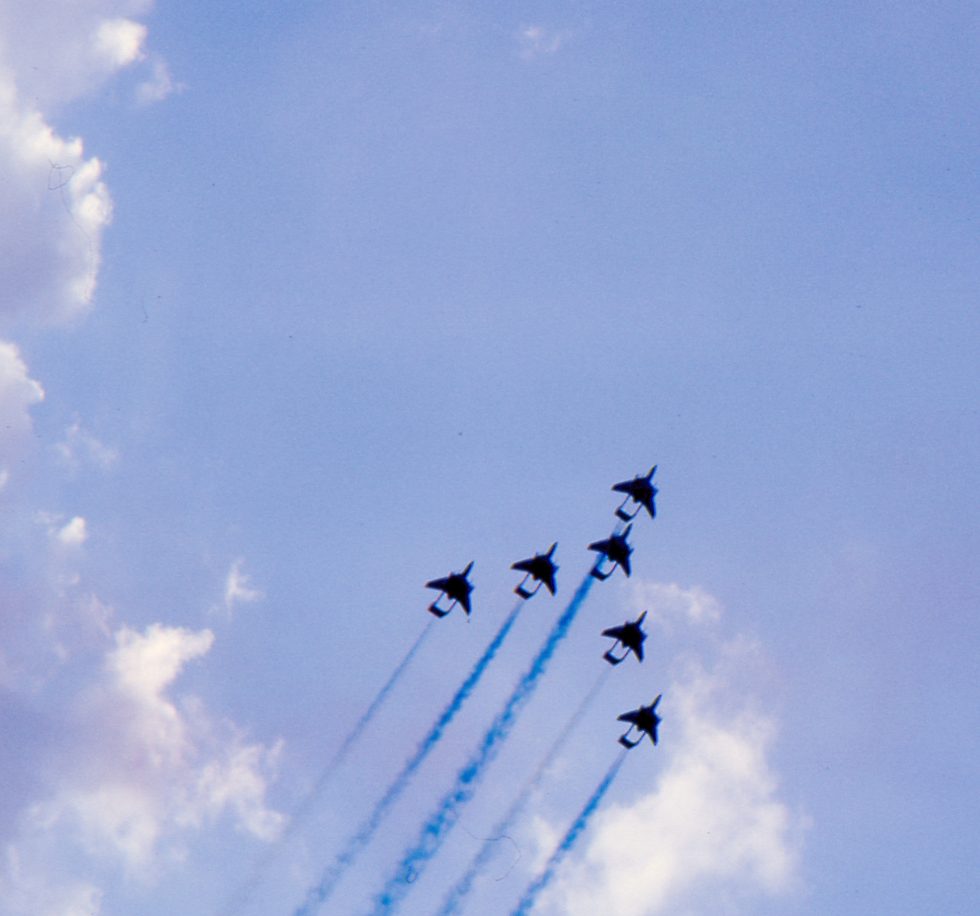
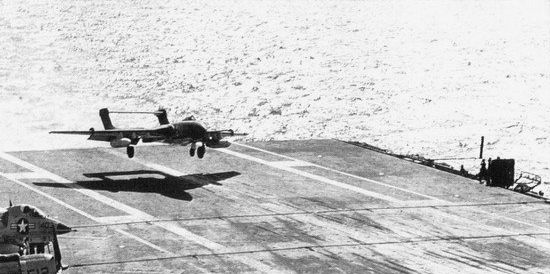
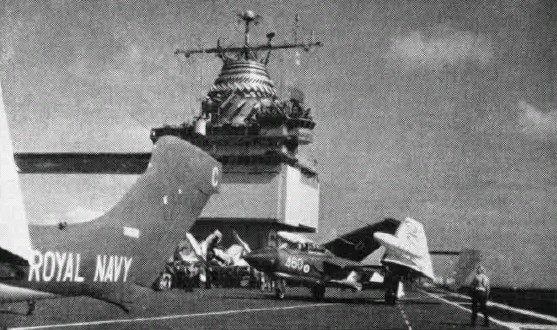
The Sea Vixen in motion
Video coming soon — we are still sourcing a suitably high-quality, authoritative film of the Sea Vixen to feature here. In the meantime, explore the photo gallery above and the stories from the cockpit.
Where the Sea Vixen flew
A guardian, rarely a killer
The Sea Vixen never fought a major air-to-air war and is not credited with shooting down enemy aircraft in combat. Its record is one of deterrence and presence — standing guard over carrier groups at Cold-War flashpoints from Kuwait to Aden, ready to intercept threats that, in the end, mostly stayed away. Its hardest battles were with the sea and the night: carrier flying that cost more than 50 aircrew their lives in a single decade.
Compare the combat record of every military aircraft. Figures as of July 2026.
Everything people ask about the Sea Vixen
Can I fly in a Sea Vixen?
Why is the Sea Vixen called a twin-boom aircraft?
What was “the coal hole”?
Did the Sea Vixen have any guns?
How fast was the Sea Vixen?
Which carriers flew the Sea Vixen?
Are any Sea Vixens left?
What replaced the Sea Vixen?
You can’t fly the Sea Vixen.
These, you can.
Some legends only live in museums — others are fuelled and waiting. MiGFlug has put civilians in real military jet cockpits since 2004.
 Fly the L-39 AlbatrosThe world’s most-flown jet trainer — aerobatics included
 Fly the F-104 Starfighter“The missile with a man in it”
 Fly the MiG-21The Cold War’s most-produced jet
 Fly the T-33 Shooting StarAmerica’s first jet trainer
 Fly the DH VampireA piece of early jet history
 Fly the S.211Agile Italian jet trainer
 Fly the MB-326The classic Aermacchi jet
 Fly the MiG-15The Soviet legend of the Korean War
Continue the tour
Every fact, checked
- Thunder & Lightnings — Sea Vixen HistoryDetailed development, variant and service history of the type.
- Navy Wings — Sea Vixen FAW.2Fleet Air Arm heritage charity: design, the “coal hole” and XP924.
- Sea Vixen (seavixen.org) — HistoryRestoration and display history of the airworthy XP924 “Foxy Lady.”
- de Havilland Aircraft MuseumSpecifications and heritage of the DH.110 / Sea Vixen FAW.2.
- This Day in AviationThe 6 September 1952 Farnborough DH.110 crash in detail.
- Military FactoryReference specifications and operator summary for the Sea Vixen.
- The Past — The de Havilland Sea VixenDesign origins and the DH.110 story.
- Royal Navy / Fleet Air Arm MuseumReference for carrier service and preserved airframes.