
Supermarine Scimitar
The Fleet Air Arm’s heavyweight
The last aircraft from the makers of the Spitfire — a big, brutally powerful twin-Avon naval strike fighter built to fling a nuclear bomb off a carrier deck, and one of the most demanding and accident-prone jets the Royal Navy ever flew.
The last aircraft from the Spitfire’s makers
Supermarine’s name is immortal for one machine: the Spitfire. Yet the firm’s final product was nothing like that elegant Battle-of-Britain thoroughbred. The Scimitar was a big, heavy, twin-jet naval strike fighter — the largest and most powerful single-seat aircraft the Fleet Air Arm had ever flown — and when it left service around 1969, one of the great names in British aviation quietly vanished from production with it.
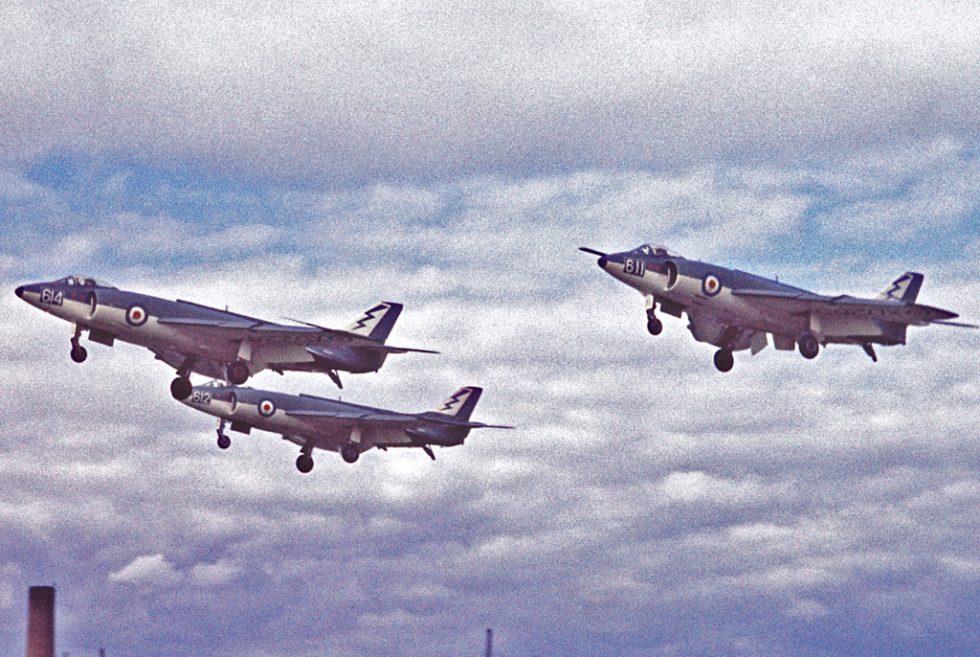
The Scimitar was not designed in a single stroke but evolved through a long line of experimental Supermarine naval jets. It began as the twin-Avon Type 508 of 1951, with a straight wing and a distinctive butterfly tail, conceived partly for undercarriage-less “rubber deck” landings. That idea was dropped; the decisive step was the swept-wing Type 525 of 1954, which introduced boundary-layer-control blown flaps, and then the area-ruled Type 544 prototype of 1956. The first production Scimitar F.1 flew on 11 January 1957, and the type entered front-line service with 803 Naval Air Squadron, which embarked in the newly recommissioned HMS Victorious in 1958.
Its primary job was grim: low-level nuclear strike, lobbing Britain’s Red Beard tactical bomb at a fleet target and running for the horizon, with secondary anti-ship attack and, armed with Sidewinders, fleet air defence. It was fast — commonly cited at around Mach 0.97 at sea level — and pilots rated it a delight to fly down low, if far less forgiving high up. But it arrived just as carrier flying was at its most dangerous, and its record is scarred by it: of 76 built, roughly 39 were lost in accidents, an attrition of about half the fleet.
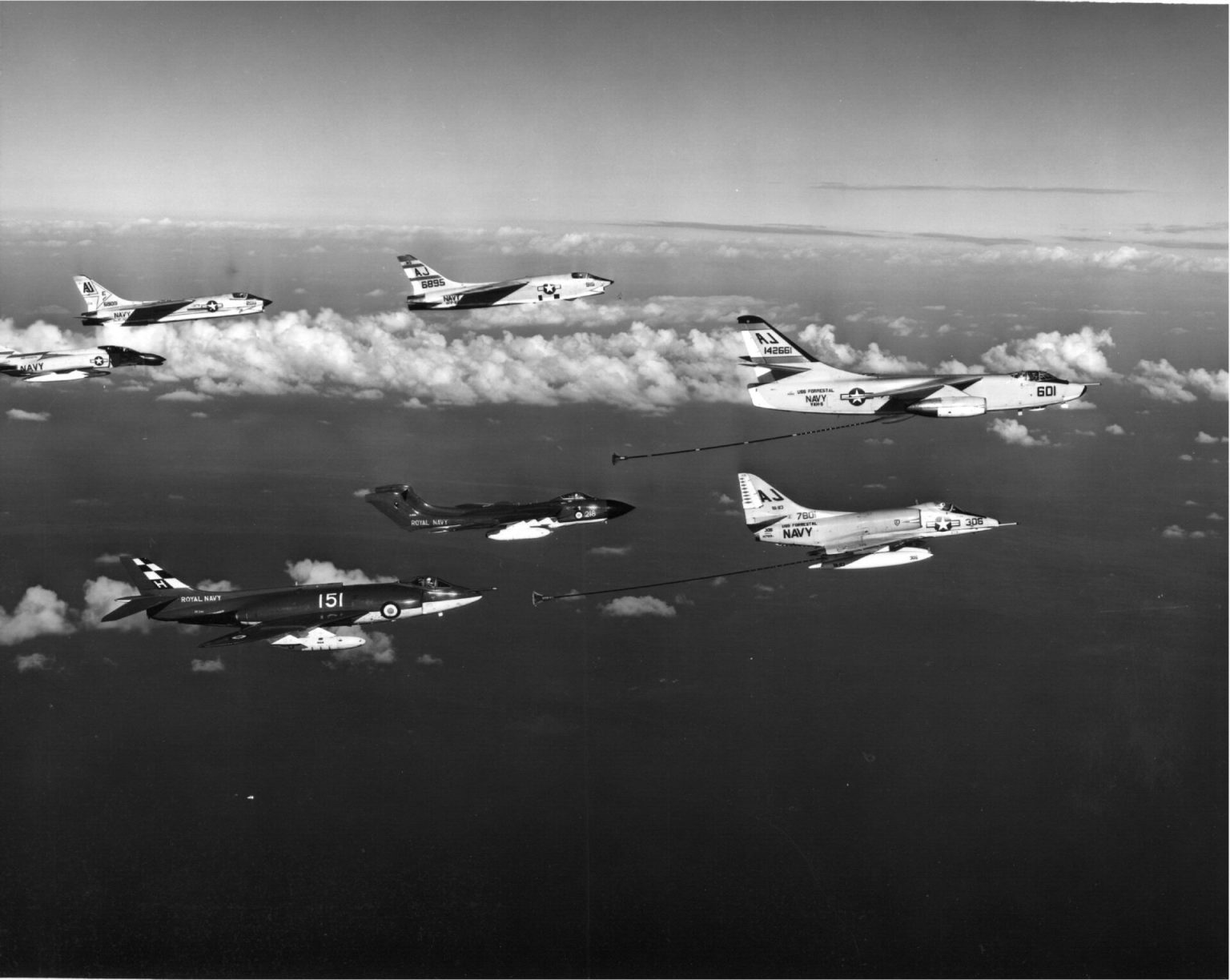
As the supersonic Sea Vixen and then the Buccaneer and Phantom took over, the Scimitar found an unlikely second life as a “buddy” refuelling tanker — launching light to top up the underpowered Blackburn Buccaneer S.1 after it left the catapult. The Fleet’s muscular problem child ended its days as a flying petrol station, and it never fired a shot in anger.
01The Supermarine Scimitar’s lineage: how the Spitfire’s maker ended with a carrier heavyweight
The Scimitar is the end of a story that starts with the elliptical-winged Spitfire of 1936. Through the 1940s and 50s Supermarine built a run of naval jets — the Attacker, the swept-wing Swift for the RAF, and a chain of experimental carrier prototypes (Types 508, 525 and 544) — each feeding into the next. The definitive Scimitar F.1 was the culmination, a genuinely modern transonic strike fighter. But by the time it retired, the British aircraft industry was consolidating and the Supermarine name was absorbed into the wider Vickers/BAC empire. The Scimitar was, in effect, the last aircraft to carry the badge of the company that built the Spitfire — a poignant bookend to one of aviation’s most famous names.
What makes it special
Twin Avon power — the Fleet Air Arm’s brawniest fighter
The Scimitar was driven by two Rolls-Royce Avon 202 turbojets of about 11,250 lbf (50 kN) each — roughly 22,500 lbf combined. At up to 34,200 lb it is commonly cited as the heaviest and most powerful single-seat aircraft the Fleet Air Arm had operated. A well-worn trials story has a pilot getting airborne with the wheel brakes still set — the Avons simply overpowered the locked wheels.
Blown flaps: bleed air to survive the deck
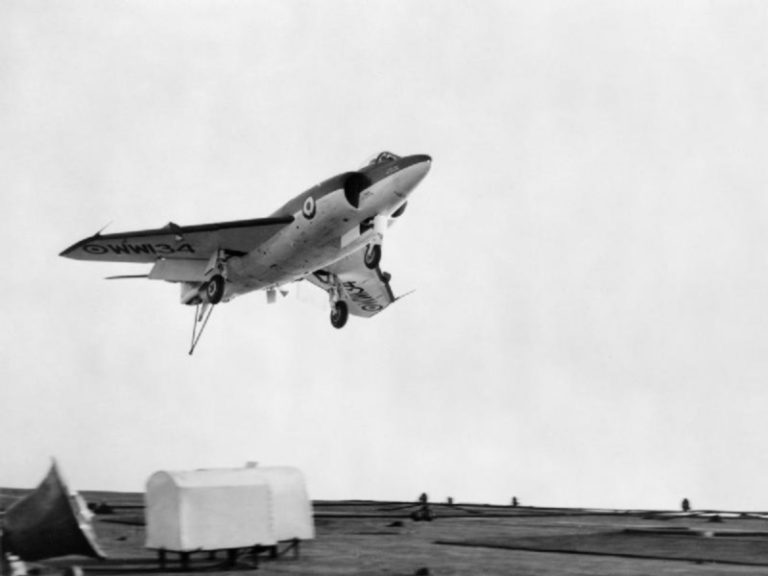
Landing a 15-tonne jet on a 1950s carrier is unforgiving physics. The Scimitar’s answer, developed on the Type 525, was boundary-layer control — high-pressure engine bleed air “blown” over the flaps to keep the airflow attached and cut the approach speed. That system was central to making carrier approaches in a heavy swept-wing jet manageable at all.
An area-ruled airframe built for low-level punishment
The production airframe adopted area-ruling — the “wasp-waist” fuselage — to cut transonic drag, and its structure was engineered stout for the pounding of high-speed flight at low level and violent carrier arrests. Commonly described as the FAA’s first swept-wing single-seat fighter, it could nudge Mach 0.97 in a shallow dive at sea level.
02The Supermarine Scimitar’s guns and weapons: four ADEN cannon and a nuclear option
The Scimitar was heavily armed for its day: four 30 mm ADEN cannon in the lower fuselage, plus four underwing hardpoints. Those pylons could carry iron bombs, rocket pods, AIM-9 Sidewinder air-to-air missiles for self-defence, the radio-command-guided AGM-12 Bullpup air-to-surface missile — which the pilot steered onto the target by eye with a thumb controller — or, in its primary role, Britain’s Red Beard tactical nuclear bomb. It was, in other words, a carrier fighter designed from the outset to deliver the Bomb at low level.
03The Supermarine Scimitar’s accident record: why roughly half the fleet was lost
The Scimitar’s attrition is among the grimmest in post-war British aviation: of 76 built, about 39 were lost in accidents (roughly 51%), with around nine pilots killed. The causes were a mix — a heavy, demanding aircraft flown from straight-deck-era carriers during a period of rapid change, repeated hydraulic failures, in-flight fires and ditchings, and deck-landing accidents including failed arrestor wires. The most famous loss came on 25 September 1958, when the commanding officer of 803 NAS, Commander John Russell, made a good landing on the newly recommissioned HMS Victorious only for the No. 1 wire to fail; his Scimitar rolled slowly over the side and he drowned, trapped in the cockpit, as press and newsreel cameras recorded it. The tragedy drove reforms in underwater-escape training and ejection-seat design.
Full specifications
Baseline note: the figures below describe the Scimitar F.1 with two Rolls-Royce Avon 202 turbojets, and there is nothing else they could describe. The F.1 was the only version ever built — 76 aircraft, all from Vickers-Armstrongs at South Marston, with no sub-mark, no reconnaissance conversion, no two-seat trainer, no export model and not one licence-built airframe. Deltas for the ancestors that led to it — the unflown Type 505, the straight-winged Type 508 and Type 529, the swept-wing Type 525 and the three Type 544 prototypes — are in grey. Three things to understand before the numbers. First, this aeroplane is the end of a fifteen-year argument about how to land jets at sea, and it carries the scars. Work began in 1945 on an aircraft with no undercarriage at all, meant to belly onto a sprung rubber deck; the resulting Type 505 had a butterfly V-tail to keep the tail surfaces clear of the jet efflux and a wide flat fuselage to spread the landing loads. The Admiralty changed its mind in 1948, the undercarriage went back in, the wing thickened from seven to nine per cent and grew in area, and every subsequent step — swept wings, a conventional tail, blown flaps, a strengthened low-level airframe — was a patch on a design that had begun life answering a different question. The flat, broad fuselage the Scimitar carried to the end is a fossil of the rubber-deck idea. Second, the power. Two Avons giving 22,500 lbf between them made the Scimitar the largest, heaviest and most powerful aeroplane the Fleet Air Arm had ever operated, and at low level it was genuinely fast — but it was also thirsty, and the internal fuel that looked generous on paper drained alarmingly at sea level and full throttle. A short-legged strike aircraft is a contradiction in terms, and the Royal Navy spent the Scimitar’s whole career working around it. Third, the loss rate. Thirty-nine of the 76 built were destroyed in accidents, 51 per cent of production, with nine pilots killed. That is the single most important number on this page and no specification table contains it. A big, heavy, fast aeroplane was being flown onto the small, low-powered British carriers of the late 1950s, often by pilots converting straight from the Sea Hawk with no two-seat version to convert them on, and the arithmetic of that mismatch is written across the whole service record.
Dimensions & weights
- Crew
- 1 — a single pilot on a Martin-Baker ejection seat, in an aeroplane with two engines, no radar operator and no navigator, expected to fly a low-level nuclear strike profile by map, stopwatch and Doppler. No two-seat Scimitar was ever built, so every conversion was a first solo on type; the proposed two-seat all-weather Type 556 was ordered in prototype form and cancelled in favour of the Sea Vixen.
- Length
- 16.84 m (55 ft 3 in) — Andrews and Morgan’s Putnam figure, used here. Several reputable tables give 16.87 m (55 ft 4 in); the difference is a pitot boom convention, not two different aeroplanes.
- Wingspan
- 11.33 m (37 ft 2 in) — short for the weight, which is where the high wing loading comes from. The outer panels folded hydraulically upward for hangar stowage in the usual Fleet Air Arm manner; folded width is not quoted in the standard references.
- Height
- 5.28 m (17 ft 4 in) — tall enough to be awkward in the hangars of the older carriers, and one of several reasons the Scimitar never operated from the light fleet carriers at all.
- Wing area
- 45.1 m² (485 sq ft) — grown from the Type 505 wing specifically to bring the approach speed down. It was still not enough on its own, which is why the flaps had to be blown.
- Wing sweep
- 45° at quarter chord — carried over from the Type 525, with flared-out tips and wing fences added on the third Type 544 to tame the pitch-up that swept wings of this generation all suffered. Neither the Putnam nor the Mason tables quote a sweep angle, so this figure comes from general-arrangement drawings rather than a manufacturer’s table; treat it as approximate.
- Empty weight
- 10,869 kg (23,962 lb) — heavier empty than a loaded Sea Hawk. The Scimitar was built deliberately stout: to quote Flight in 1957, "to permit uninhibited manoeuvring in thick turbulent air at low levels while carrying heavy loads of strike weapons, the structure is extremely sturdy".
- Gross weight
- 15,513 kg (34,200 lb) — the figure the Putnam table gives, and the one used for the wing-loading and thrust-to-weight numbers here. No maximum take-off weight is quoted in the standard references; catapult launch limits varied by ship, by wind over deck and by catapult, and a figure quoted for one carrier does not transfer to another.
- Maximum external stores
- ~1,814 kg (~4,000 lb) across four underwing pylons — four 1,000 lb bombs is the usual quoted maximum, and a single Red Beard nuclear bomb of about 794 kg (1,750 lb) was well inside it. Some sources give 1,900 kg (4,200 lb). The limit in practice was rarely the pylons; it was how much fuel had to be traded away to launch with the load on.
- Internal fuel
- ~4,820 l (~1,060 imp gal) — carried in integral main-plane tanks, a genuine Supermarine first on a British naval aircraft, together with an automatic fuel-flow proportioning system that kept the centre of gravity in place as the tanks emptied. It sounds like plenty. At sea level with two Avons at full throttle it was not.
- Drop tanks
- 2 × ~910 l (2 × ~200 imp gal) on the inboard pylons — and on a strike sortie that meant half the pylon capacity was spent buying back the range the airframe did not have, before a single weapon was hung.
- Wing loading
- 344 kg/m² (70.5 lb/sq ft) at gross weight — very high for a carrier aeroplane of 1958, and the number that explains the whole design. It is why the approach was fast, why the flaps had to be blown, and why an arrestor-wire failure or a hook bounce turned into a fatal accident more often than it should have.
Performance
- Maximum speed, sea level
- 1,185 km/h (640 kn, 736 mph) — the Putnam figure and the one used here, roughly Mach 0.97 at sea level. Aviastar, the Military Factory and several other compilations give 1,143 km/h (710 mph) instead; the two figures are close enough that they may simply be different test days at different weights, but they do not reconcile and the disagreement is worth flagging.
- Maximum Mach number
- Mach 0.97 in level flight — the Scimitar was transonic, not supersonic. It would exceed Mach 1 in a shallow dive, which is why it is often described as the Fleet Air Arm’s first supersonic aeroplane, but it could not do it straight and level and no operational profile required it to.
- Rate of climb
- 34.3 m/s (6,751 ft/min) at sea level — respectable rather than startling, and it fell away sharply with altitude. Pilots consistently praised the aeroplane low down and were far less complimentary about it high up.
- Time to altitude
- 13,716 m in 6 min 39 s (45,000 ft) — a clean airframe on a good day. Loaded for strike, with two drop tanks and stores, the figure is academic.
- Service ceiling
- 14,000 m (46,000 ft) — but the Scimitar was a poor high-altitude aeroplane, prone to pitch-up and short of thrust margin where the air was thin. The wing fences, flared tips and anhedral tailplane were fixes for that behaviour, not cures.
- Approach speed
- about 240 km/h (about 130 kn) with flaps blown — the flap-blowing system was worth roughly 18 mph off the approach when it was tested on the Type 525, and without it the Scimitar’s wing loading would have made deck landing on a 1950s British carrier close to impossible. It is the single most important number on this list after the loss rate.
- Range
- 2,291 km (1,237 nmi, 1,424 miles) — the Putnam maximum-range figure, flown high and clean. It is not a strike figure and should never be read as one.
- Combat radius, low level
- Short — no reliable single figure appears in the standard references, and this page will not invent one. What is documented is the consequence: fuel consumption down at sea level was heavy enough that the Royal Navy built its Buccaneer S.1 operating pattern around Scimitar tankers, and the Scimitar’s own strike radius carrying a nuclear weapon at low level was a fraction of the high-altitude range figure above.
- Endurance
- Roughly 1½ hours on internal fuel at high speed, and considerably less at sea level with a strike load. A patrol aeroplane this was not.
- Thrust-to-weight ratio
- 0.66 at gross weight — 22,500 lbf against 34,200 lb. Exceptional for a naval aircraft in 1958 and the reason the Scimitar felt so strong at low level; the Buccaneer S.1 that replaced it in the strike role had markedly less and needed a tanker to get airborne usefully at all.
- Structural design case
- Low-level, high-subsonic, heavily loaded — the airframe was strengthened on the third Type 544 specifically for sustained manoeuvring in turbulent air near the sea with stores aboard. This is why the Scimitar is heavy, and it is the one respect in which the aeroplane was genuinely well matched to the job it was finally given.
- Accident rate
- 39 of 76 airframes lost — 51 per cent of production destroyed in accidents, nine pilots killed, across a career of roughly a decade. It belongs in a performance table because it is the outcome that matters most: no other British production aeroplane of the jet age lost half its fleet without ever going to war.
Propulsion & systems
- Engines
- 2 × Rolls-Royce Avon 202 turbojets — the naval variant of the RA.24 series, non-afterburning, mounted side by side in a broad flat fuselage and reached through removable panels on the upper decking. The side-by-side layout is inherited directly from the undercarriage-less Type 505, where a flat cross-section was wanted for belly landings on a rubber deck.
- Thrust
- 50.0 kN each (11,250 lbf each; 100.1 kN / 22,500 lbf total) — more installed thrust than anything the Fleet Air Arm had flown before. The Type 508 and 529 had made do with 6,500 lbf Avon RA.3s, which is why they were so much slower.
- Flap blowing (boundary layer control)
- Compressor bleed air ducted through a slot ahead of the flap hinge line — the "super-circulation" system proved on the Type 525 in 1955. High-pressure air bled from the engine compressors is blown as a thin sheet along the wing trailing edge; the Coandă effect bends it over the deflected flap, keeping the flow attached and raising the lift coefficient. It was worth about 18 mph off the approach, and the Scimitar was the first British production aeroplane to use it in service. The Buccaneer took the same idea very much further, blowing wing, tailplane and leading edges.
- Flight controls
- Duplicated fully powered irreversible controls — the first British naval aircraft with them. There was no manual reversion worth the name: the aeroplane was flown entirely on hydraulics with artificial feel, which was modern, necessary at these speeds, and one more single-point dependency in an aeroplane that already had several.
- Fuel system
- Integral main-plane tanks with automatic flow proportioning — both genuine Supermarine innovations. Sealing the wing structure itself as a tank saved weight and volume; proportioning the draw between tanks kept the centre of gravity within limits without pilot management. Good engineering, wasted on an aeroplane that drank too fast at the altitude it was meant to fight at.
- Air-to-air refuelling
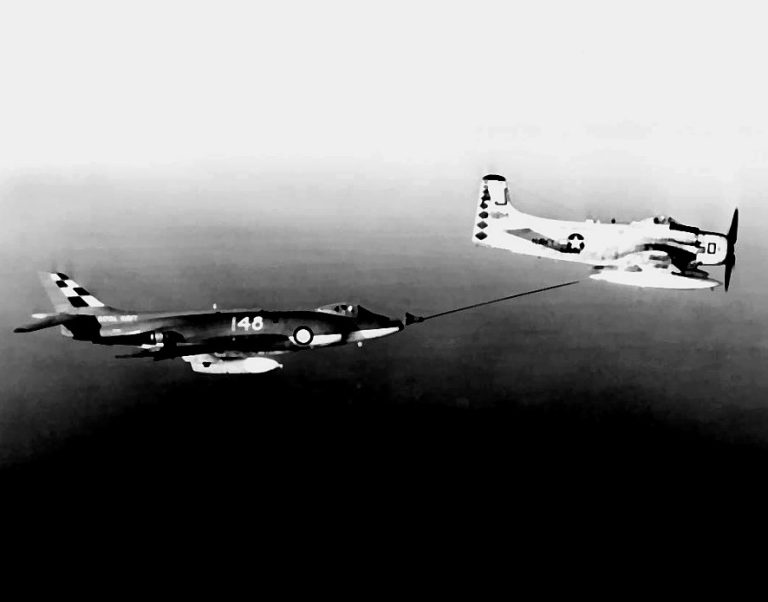
- Probe-and-drogue, both as receiver and as tanker — a fixed refuelling probe on the starboard side of the nose, and provision for a Flight Refuelling hose-drum unit pod on a pylon. From 1964 that pod defined the type’s remaining usefulness.
- Ejection seat
- Martin-Baker, Mk 4 class — and its limitations are part of this aeroplane’s story. On 25 September 1958 Commander John Russell went into the sea off HMS Victorious when an arrestor wire parted; he got the canopy open but drowned, held in the sinking aircraft by his seat leg restraints and the dinghy lanyard. On 19 November 1958 Sub-Lieutenant C. R. Cresswell ejected over the Black Isle, his parachute only partly deployed and he died of his injuries the following day. Two deaths in eight weeks, in the type’s first months of squadron service.
- Navigation and avionics
- No interception radar; Doppler navigation and radio aids — the Scimitar had no nose radar of any kind, which is why the fighter role went to the two-seat, radar-equipped Sea Venom and Sea Vixen. Navigation for the low-level strike role rested on a Doppler set, a compass system and the pilot’s own dead reckoning. Sources differ on the exact equipment fit and this page does not name a specific set.
- Deck equipment
- Arrester hook, catapult strop points, hydraulic wing fold — conventional Fleet Air Arm fittings on a thoroughly unconventional airframe. Hydraulic and hook-related failures feature repeatedly in the accident record, and the combination of a heavy aeroplane, an angled deck rather shorter than the aircraft deserved, and a hook that had to catch first time did the rest.
- Airbrakes
- Fuselage-mounted, used routinely on the approach — necessary on an aeroplane with this much thrust and this little drag, which would otherwise not slow down when asked. Handling low and slow was the Scimitar’s hardest regime and every device on the aeroplane that helped there was working at its limit.
- Structure
- Light alloy with chemically etched skins and machined spars — advanced manufacturing for the mid-1950s, with limited use of titanium in hot areas. The airframe is genuinely strong; nothing about the Scimitar’s loss record is a structural failure story.
- Production
- 76 built, 1957–1961 — against an original order for 100 placed in 1952, cut back as the Buccaneer approached and the Navy’s strike requirement moved on. Add the single Type 508, single Type 529, single Type 525 and three Type 544 prototypes and the whole family runs to 82 airframes.
04The Supermarine Scimitar’s operating costs: why no reliable price exists
The Scimitar was a 1950s British state procurement, never sold on an open market, so no dependable flyaway unit price survives in the public record — and no credible cost-per-flight-hour figure exists for a Fleet Air Arm type of that era either. Any precise dollar or sterling number attached to a Scimitar today should be treated as an estimate rather than a sourced fact. What is clear is that it was an expensive, thirsty, twin-engined machine with a short service life and a very high loss rate — a poor return on a small production run of 76 airframes.
Armament & payload
The Scimitar was armed as a fighter and used as a nuclear bomber, and neither fit was comfortable
The Scimitar carried four 30 mm ADEN cannon and four underwing pylons, which is exactly what a 1952 carrier fighter should have carried. By the time it reached a squadron in 1958 the Royal Navy had already given the fighter job to the radar-equipped Sea Venom and Sea Vixen and rewritten the Scimitar’s requirement as low-level strike with a nuclear weapon — so the gun battery it was designed around became a secondary armament and the pylons became the point of the aeroplane.
What went on those pylons matters historically out of all proportion to how often it was used. 803 Naval Air Squadron, reforming at Lossiemouth on 3 June 1958, became the first Fleet Air Arm operational squadron equipped with a nuclear-capable aircraft, cleared for the Red Beard tactical bomb. The Scimitar was also the first British aircraft to carry a guided air-to-surface missile in squadron service, the American AGM-12 Bullpup. Both were firsts. Neither was ever fired in anger, because the Scimitar never went to war. Weapon clearances came in stages over the type’s short life and no single aeroplane carried the full published list at once; Sidewinder, Bullpup and Red Beard fits in particular belong to different periods and different squadrons, and the rocket load is quoted variously as 16 or 24 rounds depending on the source.
Gun
- Four 30 mm ADEN Mk 4 revolver cannon, 160 rounds per gun, 640 rounds total — the standard British heavy fighter battery of the period, shared with the Hunter, Javelin and Sea Vixen
- Mounted low in the forward fuselage under the cockpit, firing below and outboard of the pilot’s feet, with blast troughs cut into the nose skinning
- A 30 mm ADEN round is a serious weapon against ships’ upperworks, vehicles and parked aircraft; against the fast jets the Scimitar might have met at altitude, the aiming problem was harder than the hitting problem, since the aircraft had no radar ranging in the class of contemporary fighters
- Unchanged across all 76 aircraft. There was no gun-pack variant, no reduced fit, no alternative calibre — one battery, one aeroplane, one mark
- Cannon armament first appeared in this lineage on the Type 529 prototype of 1952, which is what distinguished it from the otherwise similar Type 508
Air-to-air
- Up to four AIM-9B Sidewinder infrared homing missiles on the underwing pylons — American-supplied, and the only guided air-to-air weapon the Scimitar ever carried
- The AIM-9B was a rear-hemisphere weapon with a narrow seeker field of view, no all-aspect capability and a strong dislike of cloud, sun and sea glint; it was a useful bonus, not an interception system
- With no airborne interception radar, the Scimitar had no way of finding a target at night or in weather to shoot at, so the missile fit was for daylight, visual, close-in work only
- This is precisely why the Fleet Air Arm never treated the Scimitar as its fighter: the all-weather interception job went to the two-seat de Havilland Sea Venom and then the Sea Vixen, both of which carried radar and a second crew member to work it
Air-to-surface guided
- Up to four AGM-12 Bullpup radio-command-guided missiles — the first guided air-to-surface weapon carried operationally by a British aircraft
- Bullpup was guided by the launching pilot, who flew the missile onto the target with a thumb controller while watching a flare in its tail and holding his own aircraft pointed at the target throughout
- That technique demanded a straight, predictable run-in over a defended target for the whole time of flight, and it is one of the least survivable things a strike pilot of the era could be asked to do. Its accuracy also depended entirely on the pilot’s hand
- The 250 lb-class AGM-12A and later 1,000 lb-class AGM-12B both appear in Scimitar sources; the type is documented as carrying Bullpup, though it never launched one operationally
- No British-designed guided air-to-surface weapon was ever cleared on the Scimitar — Martel and Sea Eagle belong to the Buccaneer generation that followed
Bombs
- Four 1,000 lb (454 kg) conventional free-fall bombs, one per pylon — the standard British medium bomb of the period
- One Red Beard free-fall tactical nuclear bomb, about 794 kg (1,750 lb) and 3.66 m (12 ft) long — Britain’s first tactical nuclear weapon, a Mk 1 of 15 kilotons or a Mk 2 of 25 kilotons
- Red Beard entered service in 1962 and was withdrawn in 1971; the Royal Navy held 34 weapons distributed among five strike carriers, so the entire naval tactical nuclear stockpile of the period would have fitted under fewer than half the Scimitars ever built
- Delivery was by toss bombing on a LABS-type profile: run in very low, pull up into a loft manoeuvre, release the weapon on an upward trajectory and turn hard away to put distance between the aircraft and the burst. It is a demanding piece of flying that the Scimitar’s strength at low level suited well
- Practice on this profile, night and day, in bad weather, at very low level over the sea, is a plausible contributor to an accident record that no combat ever explains
Rockets
- Up to 16 unguided 2 in (51 mm) or 3 in (76 mm) rockets, four per pylon, on rails or in packs
- Some sources instead give 24 rounds of AP Mk II rockets as the maximum; the figures do not reconcile and probably reflect different rails, different rocket types and different clearance dates
- Against small craft, soft-skinned vehicles and shore targets this was the Scimitar’s bread-and-butter conventional load, and it was well suited to the aeroplane’s steadiness in the dive
- No Scimitar ever fired a rocket at an enemy. The type deployed to the Mediterranean, the Persian Gulf during the Kuwait crisis of 1961 and repeatedly to the Far East, including standing ready during the confrontation with Indonesia, without once being ordered to attack
Pods & other stores
- Flight Refuelling hose-drum unit pod on a pylon, converting the Scimitar into a buddy tanker — the fit that gave the type its last and arguably most valuable job
- Two drop tanks of roughly 200 imp gal (910 l) each on the inboard pylons, effectively compulsory on any sortie that had to go anywhere
- A fixed air-refuelling probe on the starboard nose let the Scimitar receive as well as give, which mattered on transits and long-range exercises
- No electronic countermeasures pod, no targeting pod, no reconnaissance pod, no gun pod, no radar of any kind. The Scimitar’s stores list is short, and the absence of sensors is the most telling thing about it
- The tanker role was not a retirement posting but an operational necessity: the Buccaneer S.1 was so short of thrust that it could not launch with a useful weapon load and full fuel at the same time, so it took off light and topped up from a Scimitar launched ahead of it. Without the Scimitar, the early Buccaneer force would not have worked
Three typical loadouts
- Low-level nuclear strike, 803 Naval Air Squadron from 1958
- One Red Beard free-fall bomb on an inboard pylon, one drop tank on the opposite inboard station, outboard pylons clean, 640 rounds of 30 mm aboard for self-defence and for whatever the pilot met on the way out. Run in at very low level under radar cover, loft the weapon on a toss profile, escape at maximum speed at sea level. Range was the binding constraint on every version of this mission and the reason drop tanks were more or less mandatory.
- Conventional strike and anti-shipping
- Four 1,000 lb bombs, or sixteen rockets across the four pylons, or a pair of Bullpups with a drop tank, plus full cannon. This is the load the Scimitar carried on exercise from HMS Victorious, Ark Royal, Hermes, Centaur and Eagle, and the one it stood ready with off Kuwait in 1961 and off Indonesia in the mid-1960s. It was never used in anger.
- Buddy tanker, 800B Flight and after, from September 1964
- Hose-drum refuelling pod on one pylon, drop tanks on the others, guns loaded or not depending on the day, launched ahead of a lightly fuelled Buccaneer S.1 to fill it up in the circuit. 800B Flight formed at Lossiemouth in September 1964 with four Scimitars and marked its tankers with a foaming tankard badge on the fin. An aeroplane built to deliver a nuclear weapon finished its career giving petrol to the aeroplane that replaced it.
Sourcing caveat: the armament figures here follow Buttler and the Putnam Supermarine history for the gun and pylon fits, and the Red Beard data follow the published British weapons literature. Weapon clearances on this type came in stages and are poorly documented in open sources; rocket loads in particular are quoted as either 16 or 24 rounds by different authorities, and the Bullpup fit is recorded without a clear service-entry date. Nothing on this page was ever employed operationally, because the Scimitar never fired a shot in combat in eleven years of service.
Variants
The Scimitar has only one production mark and five ancestors, and the ancestors are the interesting part
There is no variant list for the Scimitar in the usual sense. One production model was built, the F.1, in a single batch of 76 aircraft, with no sub-marks, no export customers, no licence production and no conversions that earned a new designation. What there is instead is a development lineage of unusual length and unusual strangeness: a fifteen-year chain of Supermarine type numbers running from an aeroplane with no undercarriage to a nuclear-armed swept-wing strike fighter, in which almost every airframe was materially different from the one before it.
Read that chain and the finished aeroplane makes more sense. The flat, broad fuselage and side-by-side engines exist because of rubber decks. The V-tail that gave the first three airframes their odd look was there to keep the tail surfaces out of the jet efflux during a belly landing. The swept wing and conventional tail arrived only on the third prototype, in 1954, seven years after the order was placed. The blown flaps were bolted on to that aircraft in 1955 because the wing loading had become impossible. And the strike role — the reason the aeroplane finally existed — was written into the requirement after 100 aircraft had already been ordered.
- Type 505 (1945–48, design study, none built)
- The starting point: a single-seat naval fighter with no undercarriage at all, intended to land on flexible sprung rubber decks so that the weight of a naval undercarriage could be saved and turned into climb and acceleration. Butterfly V-tail, thin straight wing of seven per cent thickness, two Avons side by side in a deliberately flat fuselage, cockpit derived from the Attacker. It was never built. Note that the Type 505 was not a tailless design, a claim that circulates widely — it had a very prominent tail, just an unconventional one.
- Type 508 (VX133, first flight 31 August 1951, 1 built)
- The Type 505 with a retractable nosewheel undercarriage, after the Admiralty abandoned the rubber-deck idea in 1948. Wing thickness raised from seven to nine per cent and wing area increased to reduce landing speed; wing spars rerouted under the engines to make room for the gear. Three airframes were ordered in November 1947 to Specification N.9/47 and built at Supermarine’s Hursley Park experimental department. Carrier trials aboard HMS Eagle followed in May 1952.
- Type 529 (VX136, first flight 29 August 1952, 1 built)
- The second of the three N.9/47 airframes, redesignated because it differed enough in detail: cannon armament fitted, and an enlarged tailcone to house a proposed tail-warning radar. Still straight-winged and V-tailed. It reached 977 km/h (607 mph), which was the news the programme did not want — modest enough to confirm that the straight wing had no future.
- Type 525 (VX138, first flight 27 April 1954, 1 built, lost 5 July 1955)
- The pivot of the whole programme. The third N.9/47 airframe, taken off the line and rebuilt with swept wings, a conventional swept fin and tailplane in place of the butterfly, and taller undercarriage set further outboard. Flown by Mike Lithgow from Boscombe Down and shown at Farnborough that September. Returned to Hursley Park in early 1955 for the flap-blowing installation, and landed aboard HMS Centaur on 14 June 1955. Three weeks later, on 5 July 1955, it entered a flat spin during low-speed handling trials at 10,000 ft and could not be recovered; it struck the ground from 3,000 ft near Boscombe Down and burned. Lieutenant Commander T. A. Rickell ejected and died of his injuries.
- Type 544 (WT854, WT859, WT869; first flight 19 January 1956, 3 built)
- Prototypes for the production aircraft, built to Specification N.113 at Hursley Park. The first flew on 19 January 1956; the third incorporated the aerodynamic and structural changes that defined the production standard — flared-out wing tips and wing fences to counter high-speed and high-altitude pitch-up, tailplane dihedral changed to anhedral, and a substantially strengthened airframe for the new low-level role with heavy stores.
- Scimitar F.1 (1957–61, 76 built)
- The only production version and the only version that ever wore the name. First flight 11 January 1957, built by Vickers-Armstrongs at South Marston, serials in the XD2 and XD3 ranges. Four 30 mm ADEN, four pylons, blown flaps, duplicated powered controls, integral wing tanks, no radar. The original 1952 order for 100 was cut to 76. Service entry with 803 Naval Air Squadron in June 1958.
- Scimitar tanker fit (1964–66, no separate designation)
- Not a mark, but worth listing because it is what the type ended up doing. Standard F.1 airframes carrying a hose-drum refuelling pod, operated principally by 800B Flight, which formed at RNAS Lossiemouth in September 1964 with four aircraft and served aboard HMS Eagle and HMS Ark Royal until the more powerful Buccaneer S.2 arrived from June 1966 and made the arrangement unnecessary by November that year.
- Type 556 (proposed, prototype ordered, not built)
- A two-seat all-weather fighter development with radar and Firestreak missiles — the Scimitar the Fleet Air Arm might have used as an interceptor. A prototype was ordered and then cancelled when the de Havilland Sea Vixen entered service in the same role. Its cancellation is why every Scimitar pilot converted onto the type solo.
- Type 576 and other studies (1958–59, paper only)
- Late Supermarine studies for a supersonic development of the Scimitar, including one arrangement with rocket boosters at the wing tips, alongside earlier de-navalised and land-based derivatives (Types 526, 560, 562 and 563) offered without success to the Royal Air Force. None was built. With the company absorbed into the British Aircraft Corporation, the Scimitar became the last aeroplane wholly designed and built by Supermarine — the end of a line that runs back through the Spitfire to the Schneider Trophy racers.
- Fleet Requirements Unit aircraft (1965–70, 16 aircraft)
- Sixteen Scimitars flew with the Airwork-operated Fleet Requirements Unit from Bournemouth (Hurn), providing realistic targets and radar training for shore and ship-based naval units after front-line flying had ended. This is where the type actually finished, in civilian hands on a civil airfield, simulating threats for the fleet that had given up on it.
Closing note on service, numbers and survivors. Front-line service was brief: operational training began with 803 Naval Air Squadron at RNAS Lossiemouth on 3 June 1958, first embarkation was aboard HMS Victorious in September 1958, and the last front-line unit, 803 itself, disbanded aboard HMS Ark Royal on 1 October 1966 — eight years and four months. Second-line and Fleet Requirements flying continued at Hurn until the end of the decade; the type is conventionally recorded as retired in 1969, although the Airwork FRU is documented as flying Scimitars from 1965 to 1970 and some sources therefore give the final withdrawal as 1970. Of 76 aircraft built, 39 were destroyed in accidents, 51 per cent of production, with nine pilots killed, in a type that never saw combat. Survivors are correspondingly few and should be counted precisely. Three complete original airframes exist, all Scimitar F.1s and all genuine service aircraft: XD317 with the Fleet Air Arm Museum at Yeovilton, Somerset, held in store rather than on public display; XD332 with Solent Sky of Southampton, also stored, at Timsbury in Hampshire; and XD220 at the Empire State Aerosciences Museum at Glenville, New York, which was for many years on loan to the Intrepid Sea, Air and Space Museum in Manhattan and moved out in 2012. Beyond those three, what remains are fragments: the nose section of Type 544 prototype WT859 with the Boscombe Down Aviation Collection at Old Sarum, the nose of XD235 in a private collection in Buckinghamshire — recovered from the Foulness ranges in 1993 riddled with weapons damage and restored by hand — the nose of XD215 in a private collection in Gloucestershire, and a Scimitar flight simulator at the Solway Aviation Museum at Carlisle. No Scimitar is airworthy, none has flown since 1970, and no replica or reproduction has ever been built, so every surviving piece is an original airframe. Roughly four per cent of the fleet survives in complete form; the rest is on the seabed, on ranges, or was scrapped.
From rubber-deck experiment to buddy tanker
Type 508 flies
The straight-winged, butterfly-tailed twin-Avon Type 508 — the Scimitar’s distant ancestor — first flies on 31 August.
Swept wing arrives
The Type 525 introduces the swept wing and boundary-layer-control blown flaps; it is lost in a spin in 1955.
Definitive prototype
The area-ruled Type 544 / N.113 prototype first flies on 19 January, setting the shape of the production Scimitar.
Scimitar F.1 first flight
The first production Scimitar F.1 flies on 11 January; deliveries to 700X Flight for evaluation begin in August.
Service — and tragedy
803 NAS embarks in the recommissioned HMS Victorious. On 25 September Cdr John Russell is lost when an arrestor wire fails.
Kuwait standby
Scimitars deploy to the Gulf during the Kuwait crisis to help deter an Iraqi move — but never fire a shot.
Buddy tanker
800B Flight aboard HMS Eagle operates Scimitars as air-to-air tankers, nursing the underpowered Buccaneer S.1 aloft.
Retirement
803 NAS gives up the type in October 1966; the Fleet Requirements Unit flies on until about 1970. Retirement is commonly dated 1969.
From the deck: twelve Scimitar stories
The jet that lost half of itself
39 of 76 Scimitars never came home from routine flying.
Read the full story
A perfect landing, then the sea
Cdr Russell died in front of the newsreel cameras.
Read the full story
The end of the Spitfire’s maker
The firm that built the Spitfire signed off with the Scimitar.
Read the full story
Nursemaid to the Buccaneer
The old strike fighter kept the new one flying.
Read the full story
A carrier fighter with a nuclear punch
This naval jet was built to drop the Bomb.
Read the full story
Learning to steer a bomb
The Scimitar carried a radio-guided air-to-ground missile.
Read the full story
The Navy’s first swept-wing single-seater
A leap from straight wings into the transonic age.
Read the full story
Airborne with the handbrake set
Proof of just how much thrust two Avons gave.
Read the full story
Breathing air over the wing to land
Engine bleed air is what let this heavyweight touch down.
Read the full story
The jet that leaked on the deck
A quirk every plane captain knew.
Read the full story
The heavyweight of the flight deck
The largest single-seat fighter the FAA had flown.
Read the full story
Guns loaded, but never fired
The Scimitar went to crisis zones but never to war.
Read the full story
The Scimitar in pictures
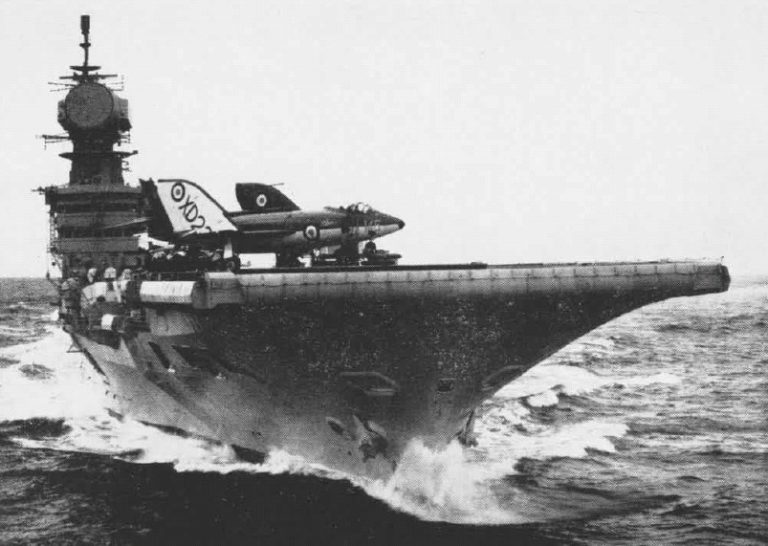
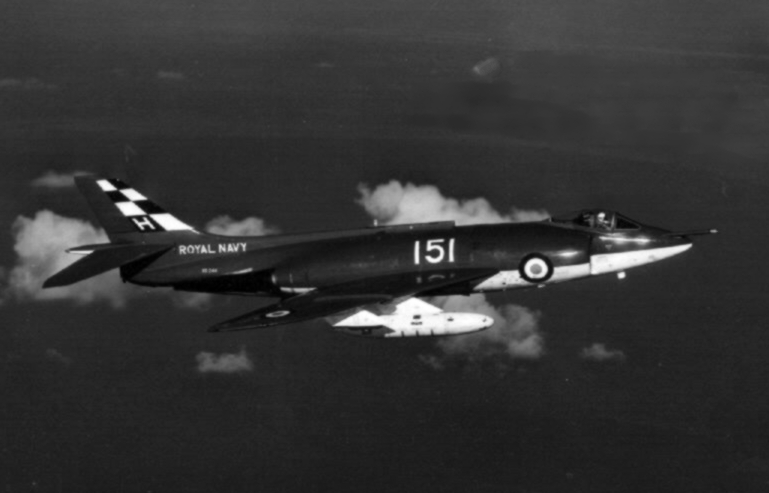
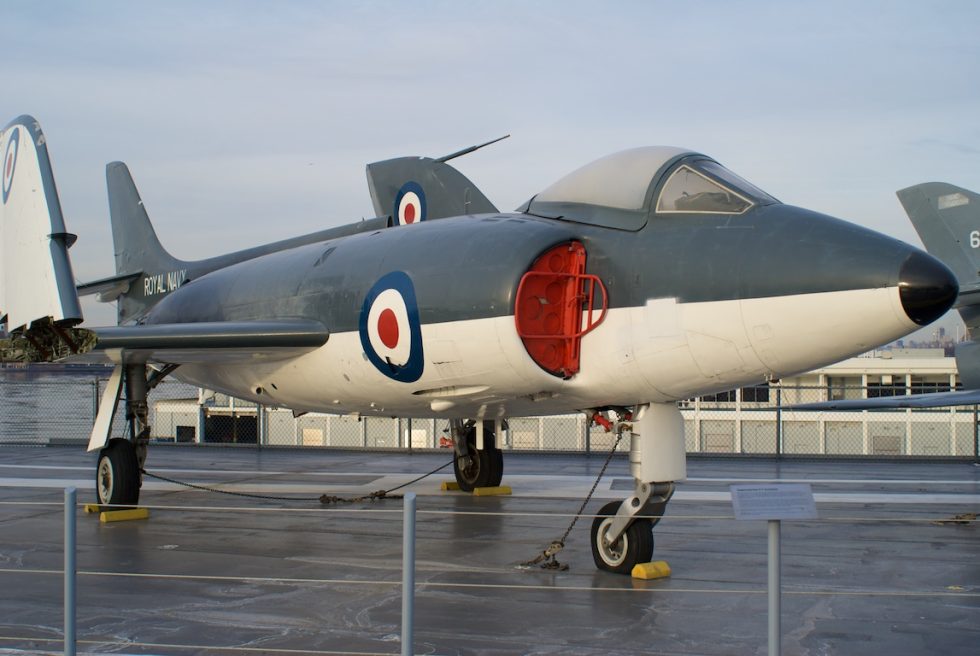
Where the Scimitar flew
The score that defines it
The Scimitar never fired a shot in anger — its record is one of deterrence, hard carrier flying and a punishing accident toll rather than air-to-air kills. It stood ready over the Gulf in 1961 and during the Indonesian Confrontation, carried the nuclear deterrent to sea, and ended its days keeping the Buccaneer aloft as a tanker.
Compare the combat record of every military aircraft. Figures as of July 2026.
Everything people ask about the Supermarine Scimitar
Can I fly in a Scimitar?
How fast was the Supermarine Scimitar?
Why did so many Scimitars crash?
What was the Scimitar for?
Who made the Supermarine Scimitar?
How many Scimitars were built?
Is any Scimitar preserved?
You can’t fly the Scimitar.
These, you can.
Some legends only live in museums — others are fuelled and waiting. MiGFlug has put civilians in real military jet cockpits since 2004.
 Fly the L-39 AlbatrosThe world’s most-flown jet trainer — aerobatics included
 Fly the F-104 Starfighter“The missile with a man in it”
 Fly the MiG-21The Cold War’s most-produced jet
 Fly the T-33 Shooting StarAmerica’s first jet trainer
 Fly the DH VampireA piece of early jet history
 Fly the S.211Agile Italian jet trainer
 Fly the MB-326The classic Aermacchi jet
 Fly the MiG-15The Soviet legend of the Korean War
Continue the tour
Every fact, checked
- Thunder & Lightnings — Scimitar history & survivorsAuthoritative British reference on prototype lineage, the accident record and the three surviving airframes.
- History of War — Supermarine ScimitarType 508/525/544 first-flight dates, squadron formations, specifications and the tanker role.
- Naval-Aviation.com — Supermarine ScimitarFull metric specifications and the carrier and squadron service list.
- Military Factory — Supermarine ScimitarCross-check for dimensions, weights, Avon 202 thrust, armament and the 76-built figure.
- Military Matters — “The Supermarine Scimitar: Not too Sharp”Narrative history, the ~51% loss rate, the Russell accident and the Red Beard / Bullpup roles.
- Aviation Safety Network — Scimitar XD240Record of the 25 September 1958 loss of Cdr John Russell aboard HMS Victorious.
- Fleet Air Arm Museum, YeoviltonHome of preserved Scimitar XD317 and the Royal Navy’s carrier-aviation collection.
- Imperial War MuseumsReference collection for Fleet Air Arm carrier operations of the 1950s and 60s.