
Supermarine Swift
Britain’s first swept-wing fighter and one of its most public procurement embarrassments — a jet that failed as an interceptor, then quietly redeemed itself as a low-level reconnaissance aircraft and, for eight days in 1953, held the world air speed record.
The Supermarine Swift: the insurance policy that briefly became a scandal
In the early 1950s Britain was in a hurry. The Korean War had made it painfully clear that the RAF’s straight-wing jets were a generation behind the swept-wing MiG-15, and Whitehall wanted a modern day-fighter in service as fast as industry could build one.
Rather than bet everything on a single design, the Air Ministry hedged. Two swept-wing fighters were ordered straight off the drawing board as insurance against one another: Hawker’s elegant Hunter, and Supermarine’s Swift. Both were “super-priority” programmes, and both were ordered in quantity before they had been properly tested — a practice the period called “concurrency,” and one the Swift would come to symbolise.
Supermarine, the firm that had given the world the Spitfire, arrived at the Swift by a winding road. Its first jet, the straight-wing Attacker, was already obsolescent. From it grew a series of experimental swept-wing machines — the Type 510, 517, 528 and 535 — that were reworked, stretched and re-engined into the production Swift. On paper the aircraft looked formidable: a powerful Rolls-Royce Avon, a genuine swept wing and a battery of 30 mm ADEN cannon.
Reality was less kind. Rushed into production, the early fighter marks — the F.1, F.2, F.3 and F.4 — proved a bitter disappointment. The Swift tended to tighten alarmingly in hard turns, could pitch up without warning, and its handling deteriorated badly at the high altitudes where an interceptor was supposed to earn its keep. Worse, the guns could not always be fired reliably at height without the engine surging. After a string of accidents the F.1 and F.2 were grounded, and by 1955 the whole affair had become a very public scandal, debated in Parliament and the press as a symbol of wasted money and misplaced haste.
And yet the Swift was not finished. Someone realised that everything wrong with it as a high-altitude interceptor mattered far less down low, where it was fast, stable and strong. The fighter-reconnaissance FR.5, with a lengthened camera nose and reheated Avon, went to the squadrons of RAF Germany and there, at last, the Swift found the job it could do well — and did it until 1961.
At a glance
- First flight
- Type 510: 29 Dec 1948; F.1: Aug 1952
- Into service
- Feb 1954 (No. 56 Sqn)
- Retired
- 1961 (FR.5, RAF Germany)
- Built
- ~197 (of a far larger order)
- Manufacturer
- Supermarine / Vickers-Armstrongs
- Best role
- Low-level tactical recon
01Why Britain ordered the Supermarine Swift and the Hawker Hunter at the same time+
The twin order was deliberate risk management. In 1950–51 the RAF’s front line still rested on the straight-wing Gloster Meteor and de Havilland Vampire, types that the swept-wing MiG-15 had comprehensively out-classed over Korea. The Air Staff wanted a swept-wing day-fighter in numbers, and quickly.
Ordering two competing designs — the Hunter and the Swift — was meant to guarantee that at least one would succeed and to keep two design teams and two production lines warm. Both were placed under the “super-priority” scheme and both were ordered in bulk before flight testing was complete. The Hunter matured into one of the great post-war fighters; the Swift became the cautionary tale that sat beside it. Supporters of the approach point out that the insurance paid off: Britain got the Hunter. Critics point out how much the premium cost.
02The Supermarine Swift’s lineage: from the Spitfire and Attacker to a swept wing+
Supermarine’s jet story began with the Attacker, a naval fighter that mated a jet engine to a wing derived from the piston-engined Spiteful — itself a late-Spitfire descendant. It flew, but it was already behind the times, still using a tail-wheel undercarriage and a straight wing.
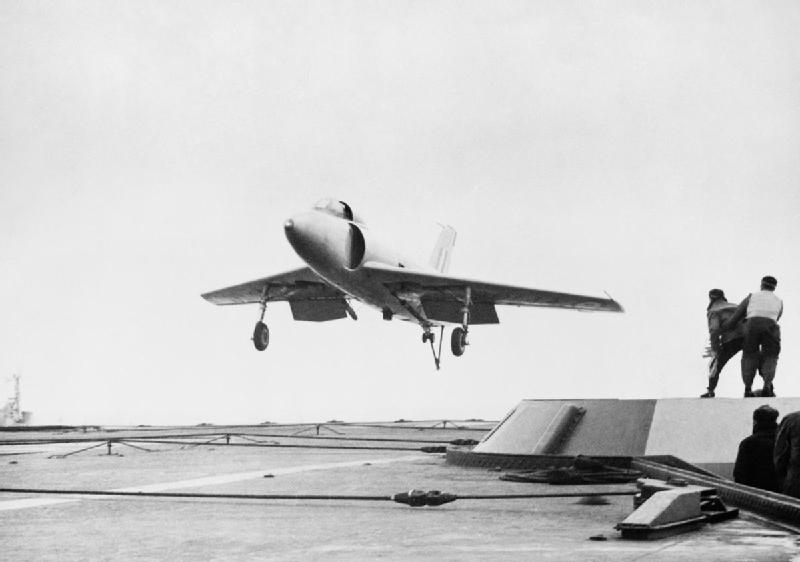
To catch up, Supermarine built a family of research aircraft. The Type 510 was essentially an Attacker fuselage given a swept wing and tail; in 1950 it became the first swept-wing aircraft to take off from and land on an aircraft carrier, HMS Illustrious. The Type 517, 528 and 535 followed, adding an afterburner, a nose-wheel and a revised wing. The production Swift emerged from this line — which is why, for all its faults, it represents a genuine and rapid leap from wartime piston technology to the swept-wing jet age in barely half a decade.
The irony was not lost on contemporaries. Supermarine was the house of R.J. Mitchell and the Spitfire, the most famous fighter Britain ever built. Its designers were talented and its pedigree impeccable. Yet the transition from the piston era to the jet-and-swept-wing era was one of the hardest that any aircraft industry ever made, and pedigree was no guarantee of success. Hawker, another old and distinguished firm, happened to get its swept-wing sums right with the Hunter; Supermarine, working to the same brutal timetable, did not. The Swift is a reminder that in aviation, a great name buys you nothing that the wind tunnel and the flight-test programme do not confirm.
03The Supermarine Swift as a political scandal: the 1950s procurement row+
What lifted the Swift from a technical disappointment to a national story was the money and the manner of its ordering. Because the aircraft had been bought in bulk before it was proven, the failure of the fighter marks meant cancelling or converting a large, already-funded production order — a very visible waste at a time when defence budgets were under intense scrutiny.
Newspapers seized on it, and the affair was raised repeatedly in Parliament as an example of what could go wrong when procurement outran testing. It fed a wider 1950s debate about how Britain chose and paid for its combat aircraft, a debate that would sharpen still further with the notorious 1957 Defence White Paper. For Supermarine the damage was lasting: the Swift was effectively the end of the firm as a supplier of front-line RAF fighters.
It is worth keeping the criticism proportionate, though. The twin-track order that produced the Swift also produced the Hunter, and the Hunter was superb. Judged as a whole, the insurance policy worked — Britain got a world-class day-fighter. The Swift was the premium paid for that certainty, and the argument over whether the premium was worth it has never entirely stopped.
How the Supermarine Swift was built — and where it went wrong
A true swept wing, powered by the Avon
The Swift paired a moderately swept wing with the Rolls-Royce Avon axial turbojet — the same engine family that powered the Hunter, Canberra and Comet. Later marks (F.3, F.4 and FR.5) added an afterburner, making the Swift one of the first British production aircraft with reheat.
Heavy cannon, unreliable at height
Armament was the hard-hitting 30 mm ADEN cannon — two in the F.1 and FR.5, four in the F.2, F.3 and F.4. It was a serious battery, but firing the guns at high altitude could disturb the engine airflow, one of several problems that undermined the aircraft’s value as an interceptor.
Fixes bolted on, mark by mark
Each mark tried to cure the last one’s vices: a “sawtooth” or extended leading edge to tame the wing, a variable-incidence tailplane on the F.4 to address pitch control. The changes helped, but never fully solved the high-altitude handling that a day-interceptor needed.
04The Supermarine Swift’s handling problems: tightening, pitch-up and the guns+
Three faults did most of the damage to the Swift’s reputation as a fighter. The first was a tendency to “tighten” in a hard turn — the aircraft would try to pull harder into the turn than the pilot commanded, a dangerous trait in combat manoeuvring. The second was pitch-up, a sudden nose-rise near the limits of the envelope that could flick the aircraft out of control. The third was gun-firing trouble at altitude, where the disturbance of firing could cause the engine to surge or flame out.
For an interceptor meant to fight at 40,000 feet and above, these were disqualifying. Supermarine chased the problems across successive marks with leading-edge modifications and a powered, variable-incidence tailplane, and the aircraft did improve — but never enough, quickly enough, to save the fighter role.
05The Supermarine Swift’s afterburning Avon and limited high-altitude performance+
The Swift was fast and it climbed well, especially down low, thanks to a reheated Avon that gave it strong acceleration. But its service ceiling — commonly quoted at around 45,000 feet — and its handling in thin air fell short of what Fighter Command wanted from a high-altitude interceptor in the age of high-flying Soviet bombers.
That mismatch is the key to the whole story. The very qualities that made the Swift a poor interceptor — a preference for low, fast flight and a solid, stable ride near the ground — were exactly what a low-level reconnaissance aircraft needed. When the FR.5 was sent down to the weeds over Germany, the Swift stopped fighting its own design and started using it.
The reheat system itself deserves a note. Afterburning — injecting fuel into the hot exhaust for a burst of extra thrust — was still a young technology when the Swift adopted it, and the type was among the first British production aircraft to fly with it. Getting the reheated Avon to light reliably and to behave across the flight envelope was part of the aircraft’s long development struggle, but it also gave the FR.5 the low-level dash that made it competitive in the reconnaissance role.
06The Supermarine Swift FR.5’s camera nose and low-level reconnaissance fit+
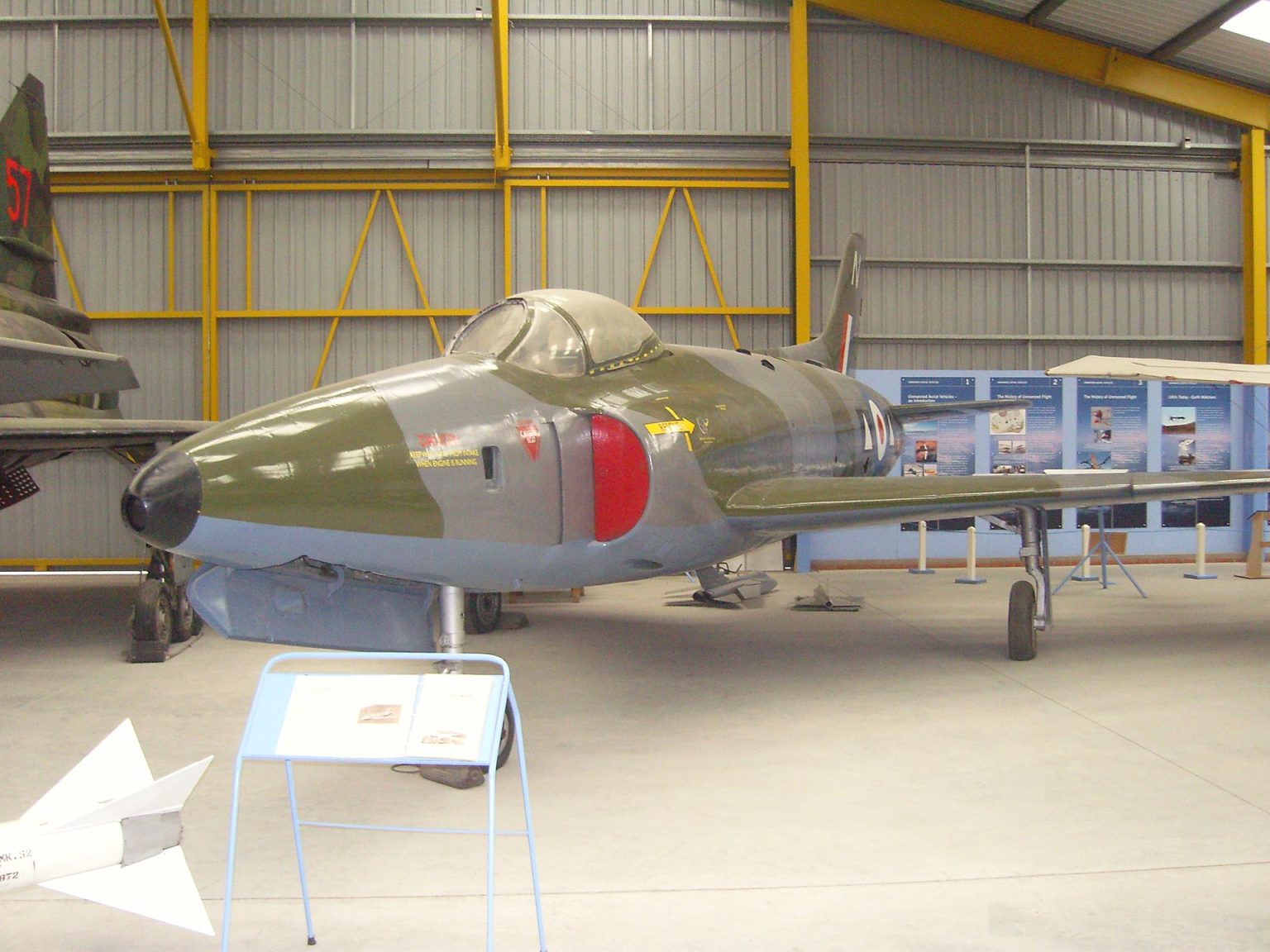
The FR.5 was not simply a fighter with a job change; it was rebuilt for the reconnaissance mission. The most obvious difference was a lengthened, reshaped nose housing a battery of cameras able to shoot obliquely and forward, so a pilot streaking along at low level could photograph targets to the side and ahead without slowing or climbing into danger.
It kept two of its 30 mm ADEN cannon, so it could defend itself or make a strafing pass, and it retained the reheated Avon for the speed that was its main protection down low. In an era before satellites and long before drones, a fast jet skimming the treetops with a camera was one of the few ways NATO could see what lay behind the Iron Curtain’s forward edge — and the Swift, at last, was good at exactly that.
07Supermarine Swift versus Hawker Hunter: why one succeeded and one failed+
The two aircraft were ordered together, used the same Rolls-Royce Avon and were meant to do the same job, which makes their divergent fates all the more instructive. The Hunter had a cleaner aerodynamic solution and, crucially, better high-altitude handling; once early teething troubles with its own gun-firing and engine surge were cured, it became a delight to fly and a superb gun platform. It went on to serve for decades and to be exported around the world.
The Swift never resolved its high-altitude vices in time. Its wing and its longitudinal control simply did not behave well enough in thin air, and no amount of leading-edge sawteeth or tailplane fixes fully cured it within the schedule available. So the Hunter took the fighter role and the export orders, while the Swift was left to find a second life at low level. If you want the shortest possible summary of 1950s British fighter procurement, it is this: the RAF ordered two swept-wing fighters to be safe, and it needed both to find out which one it should have ordered.
Supermarine Swift specifications and cost
Figures below are representative of the afterburning FR.5 / F.4 marks and are drawn from published sources; several vary between references and are flagged as estimates. Crew: 1.
Baseline: the Swift FR.5 as flown by No. 2 (Army Cooperation) and No. 79 Squadrons in RAF Germany between 1956 and 1961 — one reheated Rolls-Royce Avon in a fuselage originally drawn around a fat centrifugal Nene, a 40-degree swept wing descended from the Attacker, a lengthened nose carrying three cameras, a frameless clear-view canopy and two 30 mm ADEN cannon. Deltas for the F.1, F.2, F.3, F.4 and F.7 are in grey. Five warnings before the figures. First, the brief that commissioned this page said four ADEN cannon arrived with the F.4: that is wrong, and the error matters, because the four-gun fit arrived with the F.2 and the structural change made to feed it is the direct cause of the Swift’s most notorious handling fault. Second, published performance for this aeroplane is unusually poor even by 1950s standards, because the fighter marks were withdrawn before a full Service trials report could be written and most modern tables descend from a single manufacturer’s set. Third, sea-level maximum speed is given as 620 kn (713 mph) in the most widely reproduced table and as 685 mph by Rickard’s History of War entry; both are quoted below rather than averaged. Fourth, height is given as 13 ft 2 in in one standard source and 13 ft 6 in in another. Fifth, production totals do not reconcile: the figure of 197 airframes is the one usually printed, but the published per-mark totals and serial blocks sum to about 175, and the difference is almost certainly airframes cut up on the line when the fighter order collapsed. Where the authorities disagree the disagreement is stated.
Dimensions & weights
- Crew
- 1 — pilot only, on a Martin-Baker ejection seat under a rearward-sliding hood The FR.5 traded the fighter marks’ framed canopy for a frameless clear-view hood. That was not a styling change: a low-level reconnaissance pilot at 420 kn and 250 ft spends the whole sortie looking out of the aeroplane, and the FR.5’s view is one of the reasons its pilots liked it as much as the fighter pilots disliked the F.1.
- Length
- 12.88 m (42 ft 3 in) The fighter marks were shorter; the FR.5 and the F.7 both gained nose length, the FR.5 for cameras and the F.7 for a radar scanner.
- Wingspan
- 9.86 m (32 ft 4 in) Short, stiff and thin. The span is a full metre less than the Hunter’s and it is the clearest visual clue that the Swift was conceived as a straight-line interceptor rather than a manoeuvring fighter.
- Height
- 4.01 m (13 ft 2 in) Rickard gives 13 ft 6 in. The discrepancy is probably the F.4 and FR.5 fin, which was raised by a foot over the F.1 and F.2 to recover directional stability, and different sources measuring different marks.
- Wing area
- 30.44 m² (327.7 sq ft) Generous in absolute terms for so short a span, because the wing is deep in chord. That is what makes the root modification of the F.2 possible and what makes it lethal.
- Wing sweep
- 40° at the leading edge (quarter-chord rather less) Inherited directly from the Type 510 of 1948, which took an Attacker and swept its wings and tail by 40 degrees. From the F.3 onward the leading edge was extended at the tips, and on the F.2 forward at the root, so late Swifts carry a compound, kinked sweep rather than a clean one.
- Aspect ratio
- 3.2 Very low. A wing this stubby bleeds energy quickly in a turn and stalls its tips before its roots when swept, which is the textbook recipe for pitch-up. The Swift did not invent this problem, but it met it earlier and harder than its rivals.
- Empty weight
- 6,094 kg (13,435 lb)
- Loaded weight
- 9,831 kg (21,673 lb) Quoted as gross weight with the ventral tank. A Swift carried a great deal of fuel for its size and was correspondingly heavy for its thrust, which is the arithmetic behind its indifferent climb above 30,000 ft.
- Internal fuel
- ~3,540 l (778 imp gal) An unusually large internal load for a single-engined fighter of 1955 and, in the reconnaissance role, a genuine asset: the FR.5 could be flown fast and low for a long way without a tank hanging in the airflow.
- External fuel
- One jettisonable ventral tank of ~1,000 l (220 imp gal) The standard fit for anything but a local sortie. There was no wing pylon tank.
- Wing loading
- 323 kg/m² (66.1 lb/sq ft) at gross weight High for the period, and high enough that sustained turn performance at altitude was poor even before the pitch-up made the pilot unwilling to go looking for it.
- Thrust-to-weight
- 0.44 at gross weight with reheat lit (0.33 dry) Respectable at sea level, which is where the Swift set a world record and where the FR.5 did its work. The number is meaningless above 40,000 ft because the reheat frequently would not light there at all.
Performance
- Maximum speed, sea level
- 1,150 km/h (713 mph; 620 kn) Rickard gives 685 mph. Either way this is a very fast aeroplane at low level and slower than a Hunter higher up, which is exactly the wrong way round for an interceptor and exactly the right way round for a low-level reconnaissance machine.
- Maximum speed, altitude
- Not reliably published for any mark This is the single most telling gap in the literature. The Swift was bought to intercept bombers at height and no trustworthy high-altitude speed figure for it exists, because the fighter marks were withdrawn before the Service finished measuring them.
- World absolute speed record
- 1,184 km/h (735.7 mph) Set by Mike Lithgow in the F.4 WK198 near Tripoli, Libya. Wikipedia and Lithgow’s own entry give 26 September 1953; the Hawker Hunter literature and Rickard give 25 September and 737.3 mph. The aircraft was a specially prepared machine flown at low level over a measured course, not a squadron Swift.
- Rate of climb
- 74.5 m/s (14,660 ft/min) initial, at sea level
- Time to 40,000 ft
- 4 min 41 s Creditable on paper. In practice the last few thousand feet were the problem, not the first forty thousand.
- Service ceiling
- 13,960 m (45,800 ft) The published figure. The useful figure was lower, because the RA.7R’s reheat could not reliably be lit at high altitude and without it the Swift ran out of thrust well below its nominal ceiling.
- Practical operating ceiling
- Substantially below the published figure on the F.4 and FR.5 No single number is attested, and the honest answer is that the ceiling was whatever the engine would give on the day. This is the fault that killed the Swift as a fighter: an interceptor that cannot be relied on to reach the bomber’s height is not an interceptor.
- Gun-firing restriction
- Guns not to be fired above about 25,000 ft on the early marks Widely reported and consistent with the known behaviour of the early Avon, whose compressor would stall and sometimes flame out when gun gas was ingested. Hawker cured it on the Hunter by dipping the fuel flow as the triggers were pressed; on the Swift the restriction was still in force when the fighter marks were withdrawn. A fighter forbidden to shoot at the altitude it was bought to fight at is not a fighter.
- Range
- 1,014 km (630 miles; 547 nmi) Quoted for the FR.5. High-speed low-level flying consumed fuel far faster than this cruise figure implies.
- Combat radius, low level
- ~350 km (~190 nmi) on internal fuel at reconnaissance speeds An estimate derived from the range figure and normal reserves rather than a published number, and marked as such. In practice 2 and 79 Squadrons operated over targets within a short run of Geilenkirchen and Gütersloh, so radius was rarely the binding constraint.
- Endurance
- About an hour on a typical low-level reconnaissance profile with the ventral tank
- Take-off and landing
- Not consistently published The Swift was a heavy, high-wing-loading aeroplane with modest flap and needed a proper runway. This is one reason it never went to sea and never went to a rough strip, and why the reconnaissance role it succeeded in was flown from established RAF Germany airfields.
Propulsion & systems
- Engine, FR.5 and F.4
- One Rolls-Royce Avon RA.7R (Avon 114) axial-flow turbojet with afterburner
- Thrust, dry
- 31.9 kN (7,175 lbf)
- Thrust, reheat
- 42.0 kN (9,450 lbf) Rolls-Royce quote the RA.7R family at 9,090 to 9,740 lbf depending on build standard. The Swift figure sits in the middle of that band.
- Engine, F.1 and F.2
- One Rolls-Royce Avon RA.7 (Avon 109), 33.4 kN (7,500 lbf), no reheat The F.3 introduced the reheated engine and never reached a squadron; the F.4 introduced it operationally and could not always light it.
- Afterburner
- The Swift’s defining mechanical failure Reheat that will not light at height is worse than no reheat at all, because the aeroplane, its tactics and its fuel plan were all built around having it. The variable-incidence tailplane fixed the pitch-up; nothing fixed this.
- Fuselage and intakes
- Bifurcated wing-root intakes feeding a fuselage originally laid out around the wide centrifugal Nene Supermarine then fitted the far slimmer axial Avon into that same broad fuselage. The result was an aeroplane carrying more frontal area and more structure than its thrust justified. Almost every criticism of the Swift’s performance traces back to this single inherited decision.
- Flight controls
- Power-operated ailerons — the first in RAF service — with a variable-incidence tailplane from the F.4 onward The F.1 and F.2 had a fixed tailplane with elevator, and at high indicated speed and high Mach the elevator simply ran out of authority. The all-moving surface, trialled on the Type 517 as early as 1950, was the cure, and it arrived two marks too late.
- Air brakes
- Fuselage-mounted air brakes Adequate. Not the aircraft’s problem.
- Undercarriage
- Retractable tricycle, inward-retracting main units into the wing The Type 510 still had a tailwheel, inherited from the Attacker. The nosewheel arrived with the Type 535 in 1950 and everything from the Type 541 onward had it.
- Cameras, FR.5
- Three, in a lengthened nose — one facing forward in the extreme nose and two obliques on the sides just ahead of the intakes Camera types are inconsistently reported in the secondary literature and are not stated here for that reason. The installation itself is well attested and it is what made the FR.5 useful.
- Radar
- None on any operational mark Only the F.7 carried a scanner, in a nose lengthened for the purpose, and the F.7 never entered squadron service. The Swift went to war games with a gunsight and a pair of eyes.
- Guided-weapon system
- Fairey Fireflash beam-riding installation, F.7 only This made the Swift the first RAF aeroplane to carry a guided air-to-air missile, a distinction it earned on a trials unit rather than a squadron.
| Cost & programme | |
|---|---|
| Unit cost (period) | Not reliably recorded in comparable modern terms |
| Cost per flight hour | Not reliably recorded |
| Development programme cost | Reportedly on the order of £20 million in period money before the fighter order was cut back contested figure |
| Total built | ~197 airframes, from an original order of several hundred that was drastically reduced figures vary |
08Supermarine Swift variants: F.1 through FR.9 explained+
F.1 — first production fighter, two 30 mm ADEN cannon, non-reheated Avon; entered service with No. 56 Squadron in 1954 and was quickly grounded after accidents.
F.2 — four cannon and a revised wing leading edge; introduced new problems and was also grounded.
F.3 — added an afterburner but never entered operational RAF service.
F.4 — reheated Avon and a variable-incidence tailplane; the last fighter mark accepted, and the mark that set the 1953 speed record (WK198). The fighter programme was cancelled soon after.
FR.5 — the success: a lengthened nose housing cameras, reheated engine and two cannon, optimised for low-level tactical reconnaissance. It equipped RAF Germany squadrons from 1956 to 1961.
F.7 — a small batch carrying early Fairey Fireflash guided missiles, used mainly for trials rather than front-line service.
PR.6 / FR.9 — further reconnaissance proposals; the PR.6 was cancelled, and reconnaissance work centred on the FR.5. Designations and totals differ between sources, so treat mark-by-mark counts as approximate.
09The Supermarine Swift’s operating costs: what the record shows+
Unlike modern types, the Swift was never costed in the per-flight-hour terms used today, and any single figure would be a guess dressed up as data. What the record does show is a programme whose political cost was enormous: a large production order placed up front, then cut back drastically when the fighter marks failed, with the write-off and the parliamentary criticism that followed.
The honest entry for the Swift’s cost per flight hour is therefore “not reliably recorded.” The more meaningful cost was reputational — to the Air Ministry, to the RAF procurement system and to Supermarine, whose name never again appeared on a front-line RAF fighter.
10Supermarine Swift facts and myths: what the numbers really say+
“It was simply a bad aeroplane.” Only half true. As a high-altitude interceptor the Swift genuinely failed; as a low-level reconnaissance aircraft the FR.5 succeeded and won competitions. The same airframe was both, depending on the job.
“It held the speed record for years.” No — about eight days, in September and October 1953. Its lasting distinction is being the last British production aircraft to hold the outright record, not the longest holder.
“Exactly 197 were built.” Treat all Swift totals as approximate. Around 197 is the figure most often quoted, from an original order several times larger that was slashed; mark-by-mark totals differ between sources, and prototypes and research aircraft muddy the count further.
“It fought in combat.” No. The Swift never fired its guns in anger and never scored an air-to-air kill. Its entire reputation rests on peacetime events: a speed record, a procurement scandal and a quietly effective reconnaissance career.
11What came after: the Supermarine Type 545 and the end of Supermarine fighters+
Supermarine did not stop trying. It proposed the Type 545, a developed supersonic swept-wing fighter meant to move beyond the Swift’s limitations, and it built the big twin-engined naval Scimitar for the Royal Navy. But the Type 545 was cancelled, and the Scimitar — though it reached the Fleet Air Arm — had a hard and accident-prone career of its own.
Taken together, the Swift, the cancelled 545 and the troubled Scimitar mark the twilight of Supermarine as an independent fighter house. The firm that had built the Spitfire never again produced a successful front-line RAF fighter, and its name was gradually absorbed into the wider British aircraft industry. The Swift stands at the start of that decline — not the cause of it, but its most public early chapter.
Armament & payload
The Swift’s four cannon were the cause of its worst flying fault, not the cure for it
Most fighters get better as guns are added. The Swift got worse, and the mechanism is unusually easy to trace. The F.1 went to No. 56 Squadron in February 1954 with two 30 mm ADEN cannon in the lower fuselage and an ammunition supply the squadron thought derisory. The obvious answer was two more guns, and the Hunter had already shown a four-ADEN battery was practical. But four guns need four ammunition boxes, and to find room for them Supermarine extended the wing leading edge forward at the root. That extension changed the spanwise loading of an already stubby 40-degree wing, and the F.2 acquired a vicious pitch-up: pull hard at speed and the aircraft would rear and flick onto its back within seconds. Two were lost that way at Waterbeach. Ballast was added to the nose as a palliative; the real fix, an all-moving variable-incidence tailplane, arrived with the F.4.
The guns had a second problem that no amount of ballast touched. The early Rolls-Royce Avon would surge and sometimes flame out when it swallowed its own gun gas, a fault the Hunter shared and cured by momentarily dipping the fuel flow as the triggers were pressed. On the Swift the working restriction was still in force when the fighter marks were withdrawn: guns not to be fired above roughly 25,000 ft. Set that beside a reheat that would not reliably light at high altitude and the verdict writes itself. The Swift F.4 was an interceptor that could not be trusted to reach its target’s height, and if it got there could not be trusted to shoot.
No Swift of any mark fired a shot in anger. The type had no combat career at all: no war, no incident, not one round expended in earnest, in thirteen years from the first F.1 delivery to the last airframe leaving charge. Its entire operational record consists of exercises, armament practice camps, NATO competitions and photographic sorties over the North German Plain. Fits varied sharply by mark: two guns on the F.1, four on the F.2, F.3, F.4 and F.7, back to two on the FR.5 to make room for the camera nose, and only the F.7 ever carried a guided weapon.
Gun
- Two 30 mm ADEN Mk 4 revolver cannon in the lower forward fuselage on the F.1, one either side of the nose below the intakes
- Four 30 mm ADEN on the F.2, F.3, F.4 and F.7 — the fit that required the wing-root leading-edge extension and brought the pitch-up with it
- Back to two 30 mm ADEN on the FR.5, the inner pair deleted so the lengthened camera nose and its equipment could be carried
- The ADEN was a good gun: a 30 mm revolver cannon firing at roughly 1,200 to 1,400 rounds per minute, hard-hitting and reliable, and it outlived the Swift by five decades
- The gun was never the weak part of this aeroplane. The airframe that had to carry it and the engine that had to breathe beside it were.
Air-to-air
- Four Fairey Fireflash beam-riding missiles on the F.7, alongside the four ADEN — the only guided air-to-air weapon ever carried by a Swift
- Fireflash flew down a radar beam held on the target by the pilot through his gunsight, was boosted by two jettisonable Stork solid rockets shed 1.5 seconds after launch, and then coasted unpowered at about Mach 2
- Beam riding had one real virtue: it could not be fooled by chaff. It had one fatal vice: the launch aircraft had to fly straight at the target until impact
- The work was done by No. 1 Guided Weapons Development Squadron at RAF Valley from 1957. Fireflash reached limited capability in August 1957 against piston-engined bombers and was superseded within a year by de Havilland Firestreak
- No operational Swift squadron ever held a guided weapon. The F.1, F.2 and F.4 fought with guns alone, and the FR.5 carried its two cannon for self-defence rather than for interception
Air-to-surface guided
- None. No guided air-to-surface weapon was carried, trialled or seriously proposed for any Swift
- There was no radar in the FR.5, no ranging equipment and no second crewman — everything the aircraft did against a ground target it did by eye
- The FR.5’s business was not attack. Its job was to find, photograph and report, and it was measured on the quality of the film it brought home
- The card is kept and left honest: the Swift belongs entirely to the era before precision air-to-ground weapons, and its successor in the same squadrons, the Hunter FR.10, was no better provided
- Any specification table showing guided air-to-surface stores for a Swift is describing an aircraft that did not exist.
Bombs
- Provision existed on the F.4 and FR.5 for underwing bombs, but it was marginal and it was not what the aircraft was bought for
- The standard references say only "provision for rockets and bombs" without stating loads, and no reliable per-station figure is published. That vagueness is itself evidence: this capability was never exercised often enough to generate a settled published figure
- The FR.5’s underfuselage station carried the 220 imp gal ventral fuel tank on almost every operational sortie, which left nothing there for a bomb
- No Swift dropped a bomb operationally in any air force
- The comparison that matters: the Hunter FGA.9, developed in the same years from the aircraft the Swift was meant to insure against, became one of the most successful ground-attack fighters ever built. The Swift never got near that role
Rockets
- Provision for unguided rockets on underwing rails is listed for the later marks, using the wartime RP-3 three-inch rocket projectile then standard across the RAF
- As with bombs, no source gives a firm maximum number of rounds for a Swift, and the fit is described in general terms only
- Rocket work formed part of armament practice camp training on the F.4, but the F.4 was withdrawn from the fighter role in March 1955 before any of this matured
- The FR.5 in RAF Germany flew reconnaissance profiles, not ground-attack profiles. Its wings were clean because clean wings meant speed at 250 ft, and speed at 250 ft was how a reconnaissance pilot survived
- Where the literature is thin here it is thin because the capability was thin. It has not been padded out.
Pods & other stores
- One jettisonable ventral fuel tank of about 220 imp gal (~1,000 l) — the standard and near-universal external store
- The FR.5 camera installation was internal, not a pod: three cameras in a purpose-lengthened nose, one forward-facing and two obliques ahead of the intakes
- No reconnaissance pod, no gun pod, no electronic countermeasures pod, no target-towing or flare equipment entered service on the type
- No Swift was ever fitted for air-to-air refuelling, and none served afloat — despite the type’s ancestor, the Type 510, having been the first swept-wing aeroplane in the world to land on and take off from an aircraft carrier
- The F.7’s nose radar was the only other significant equipment fit, and it went no further than a trials squadron
Three typical loadouts
- Day interception, F.1, No. 56 Squadron, RAF Waterbeach, spring 1954
- Two 30 mm ADEN with a modest ammunition supply, gyro gunsight, ventral tank, no radar and no missile. Guns not to be fired above roughly 25,000 ft, no reheat fitted, and by August the mark was grounded. This is what "the RAF’s first swept-wing fighter" actually meant in the hands of a squadron.
- Low-level tactical reconnaissance, FR.5, No. 2 (AC) Squadron, RAF Geilenkirchen, 1958
- Three cameras in the nose, two 30 mm ADEN for self-defence, clean wings and the 220 imp gal ventral tank. Run in at 420 kn and 250 ft, one pass, film home. This is the Swift doing the job it was good at, and it beat the best of NATO at it twice.
- Guided-weapon trials, F.7, No. 1 Guided Weapons Development Squadron, RAF Valley, 1957
- Four Fairey Fireflash beam-riding missiles, four 30 mm ADEN and a nose radar to hold the guidance beam. The first guided air-to-air weapon ever carried by an RAF aeroplane, flown by a unit whose purpose was to prove the missile rather than to defend the country.
Sourcing caveat: bomb and rocket loads for the Swift are not given in firm numbers by any of the standard references consulted, which state only that provision existed. Rather than invent per-station figures, the gap is left visible. Ammunition capacity per gun is likewise not consistently published for any mark; the F.1’s supply is described in the literature as inadequate, and the F.2’s enlargement of it is documented through the structural change it forced rather than through a stated round count.
Variants
Seven marks, three prototypes and one straight line from a naval fighter’s wing to a national embarrassment
The Swift’s development is a chain of expedients. It begins with the Attacker, a straight-winged naval jet built around the fat centrifugal Nene; sweep is added to make the Type 510; a nosewheel is added to make the Type 535; the slim axial Avon is dropped into the same broad fuselage to make the Type 541; and the whole thing is then ordered into mass production off the drawing board in 1950 as an insurance policy against the Hawker Hunter failing. Under Churchill’s super-priority scheme the initial order of 100 grew to 150 and the paper total eventually reached several hundred. Almost none of it was needed, because the Hunter did not fail.
What followed is the most instructive part of the story. Each mark fixed the previous mark’s worst fault and introduced a new one. The F.2 fixed the F.1’s firepower and created the pitch-up. The F.3 fixed the thrust and could not be made safe enough to issue. The F.4 fixed the pitch-up with a variable-incidence tailplane and inherited a reheat that would not light at height. On 15 March 1955 the RAF ordered the fighter marks withdrawn. On 2 March 1955 the Minister of Supply, Selwyn Lloyd, had already told the Commons that development had cost twenty million pounds.
And then the FR.5 — the same airframe, a different job, and a genuine success. Low down, where its short thick wing was stiff and its Avon breathed properly, the Swift was faster than almost anything NATO could put against it. No. 2 (AC) Squadron took it to Geilenkirchen in early 1956 and No. 79 Squadron to Gütersloh that autumn; 79 was renumbered as No. 4 Squadron on 1 January 1961, so three squadron numbers and two units flew the type. It won the NATO "Royal Flush" reconnaissance competition in 1957 and again in 1959, beating the best the alliance had, and it contributed to the development of low-level terrain-following technique. Its pilots liked it. That is the fact most often left out of the Swift’s obituary.
- Type 510 (1948, 1 built — VV106)
- An Attacker airframe with wings and tail swept 40 degrees, still on a tailwheel, first flown 29 December 1948. The first British aeroplane to fly with both swept wings and a swept tailplane, and the first swept-wing aeroplane anywhere to operate from an aircraft carrier.
- Type 517 (1950, 1 conversion — VV106 again)
- The same airframe rebuilt with a variable-incidence tailplane, the rear fuselage hinged so the whole tail could be pivoted. The cure for the Swift’s pitch-up was thus flying five years before the fault reached a squadron.
- Type 528 and Type 535 (1950, 1 airframe — VV119)
- The second prototype, flown first as the Type 528 and then rebuilt as the Type 535 with a nosewheel undercarriage, longer nose and provision for four cannon. Painted red, it played the fictional "Prometheus" in David Lean’s 1952 film The Sound Barrier and is the reason the Swift is better known to cinema audiences than to aviation ones.
- Type 541 (1951–52, 2 built — WJ960 and WJ965)
- The Swift proper: the Type 535 layout with the axial Rolls-Royce Avon in place of the Nene, first flown 1 August 1951. On 10 July 1952 a prototype set an international point-to-point record between London and Brussels at over 1,071 km/h.
- Swift F.1 (1953–54, 20 built — WK194 to WK213)
- Avon 109 without reheat, fixed tailplane, two 30 mm ADEN. Delivered to No. 56 Squadron at Waterbeach in February 1954, the first British swept-wing fighter in RAF service. Two aircraft and a pilot lost by May, grounded for aileron modifications, grounded again in August.
- Swift F.2 (1954, 16 built — WK214 to WK246)
- Four 30 mm ADEN, with the wing leading edge extended forward at the root to house the extra ammunition. That change gave the aeroplane its pitch-up. It replaced the F.1 on 56 Squadron on 30 August 1954 and two aircraft were promptly lost flicking onto their backs.
- Swift F.3 (1954–55, 25 built)
- Reheated Avon 114 and leading edges extended at the tips. Not one reached a squadron; all were issued as ground instructional airframes. Twenty-five new fighters built and delivered straight to the technical training schools is as clear a statement of failure as the record contains.
- Swift F.4 (1954–55, 9 completed from the WK272–WK315 block)
- Variable-incidence tailplane, fin raised by a foot, reheated Avon. The tailplane cured the pitch-up; the reheat would not light at altitude. WK198 of this mark took the world absolute speed record over Libya in September 1953. Nine aircraft from an order block of more than forty.
- Swift FR.5 (1955–57, 89 built — XD903–XD930, XD948–XD977, WK281 and WK287–WK315, WN124)
- Lengthened nose with three cameras, frameless clear-view canopy, two 30 mm ADEN, reheated Avon. Half the total production of the type, and the only mark that did a real job well. In RAF Germany from January 1956 until 1961, replaced by the Hunter FR.10.
- Swift PR.6 and Swift F.7 (PR.6 cancelled, 1 airframe allocated; F.7 1956–57, 12 to 14 built — from XF113)
- The PR.6 was to be an unarmed high-altitude photographic variant and was abandoned during development — unsurprisingly, given what high altitude did to this aeroplane. The F.7 had a radar nose and four Fairey Fireflash missiles, never entered squadron service, and spent its life on guided-weapon trials at Valley. Sources give 12 or 14 built.
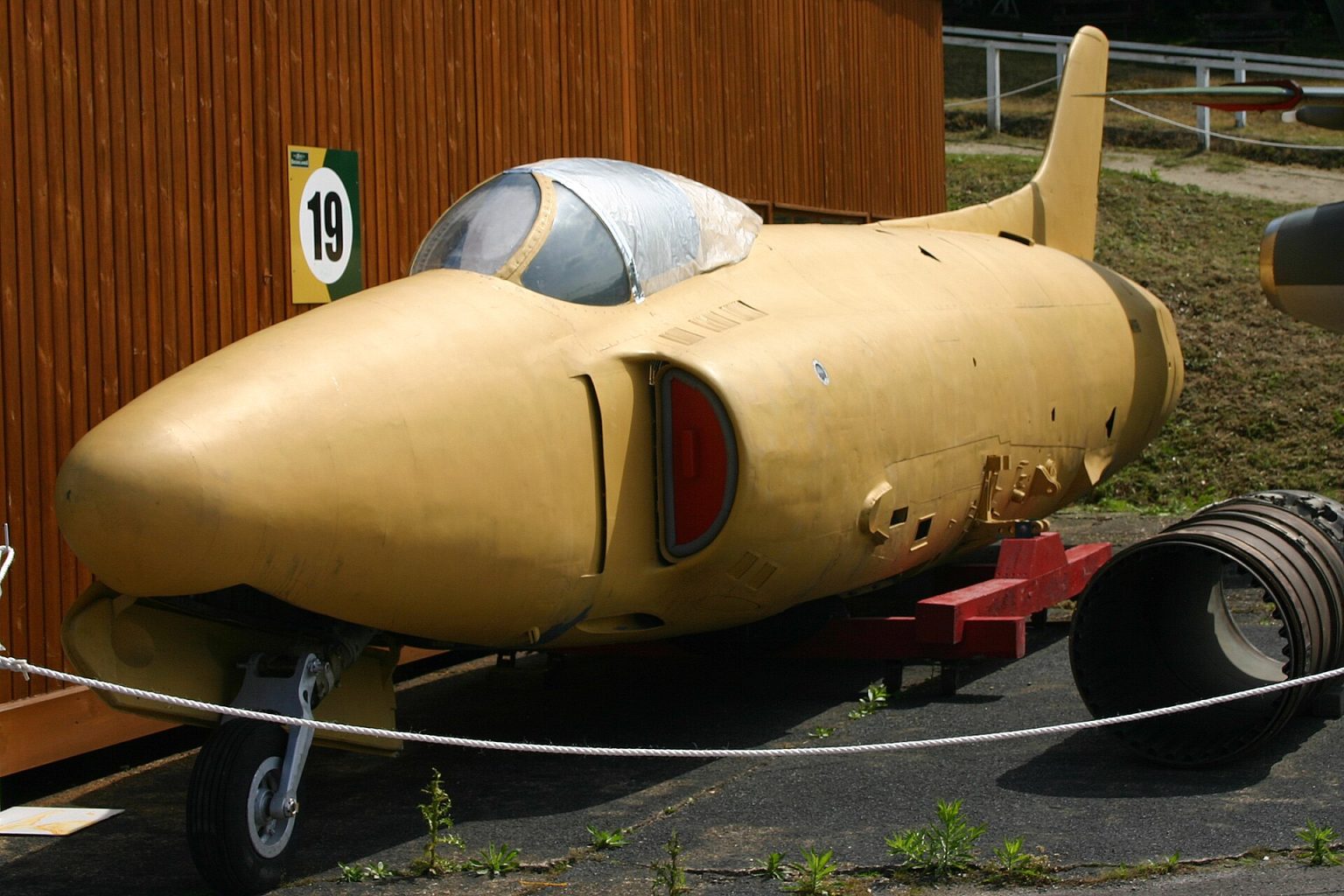
Production and survivors. Total production is usually printed as 197 airframes against an order book that peaked near 500, but the published per-mark totals and serial blocks sum to about 175 including the four prototypes; the difference is most likely airframes cut up incomplete when the fighter contracts were cancelled, and the discrepancy is left visible rather than resolved by guesswork. There were no exports, no licence production and no foreign operators: every Swift ever built was British-built and British-operated, and the type served no air arm but the RAF. Survivors are few and all are original airframes — no reproduction Swift exists and none is airworthy. Four complete aircraft remain: VV106, the Type 510/517 prototype, held in store by the Fleet Air Arm Museum at Yeovilton; WK275, an F.4, in Tim Wood’s private collection in Cumbria after many years outdoors in Herefordshire, restored to exhibition standard; WK277, an FR.5, which spent decades at the Newark Air Museum and moved to the South Wales Aviation Museum at St Athan, recorded there in 2025; and WK281, an FR.5, at the Tangmere Military Aviation Museum in West Sussex. A fifth complete airframe, XF114, the F.7 that later flew on the civil register as G-SWIF, is with Solent Sky at Southampton. Four partial airframes survive: the nose of WK198, the world speed record aircraft, at Brooklands Museum in Weybridge, transferred there in February 2011; the nose of the F.7 XF113 with the Boscombe Down Aviation Collection at Old Sarum; an F.4 cockpit at Solent Sky, variously identified as WK272 or WK282; and an FR.5 simulator at the Newark Air Museum. Note that widely circulated listings still place WK277 at Newark; the more recent survivor records do not. For a type of which nearly two hundred were built inside seven years, that is a thin tail of survivors, and it reflects exactly how the Swift was regarded when it left charge.
The Supermarine Swift: a short, turbulent history
The Supermarine Swift in twelve stories
Ordered before it was tested
Read more
735.7 mph over the Libyan desert
Read more
Mike Lithgow, Supermarine’s chief test pilot
Read more
The turn that tightened itself
Read more
Cannon that could stall the engine
Read more
From front line to grounded in months
Read more
Debated in Parliament
Read more
Sent down to the weeds
Read more
Nos. 2, 4 and 79 Squadrons
Read more
Winning NATO recon contests
Read more
First swept wing to land on a carrier
Read more
The Fireflash guided-missile trials
Read more
Where to see a Swift today
Read more
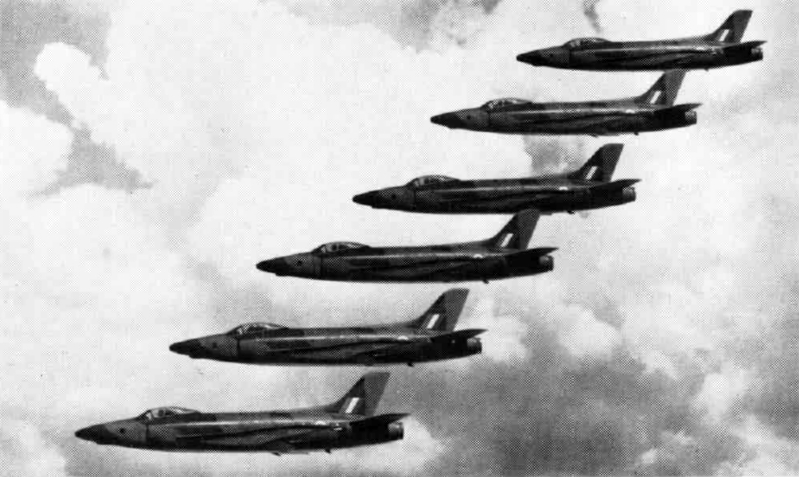
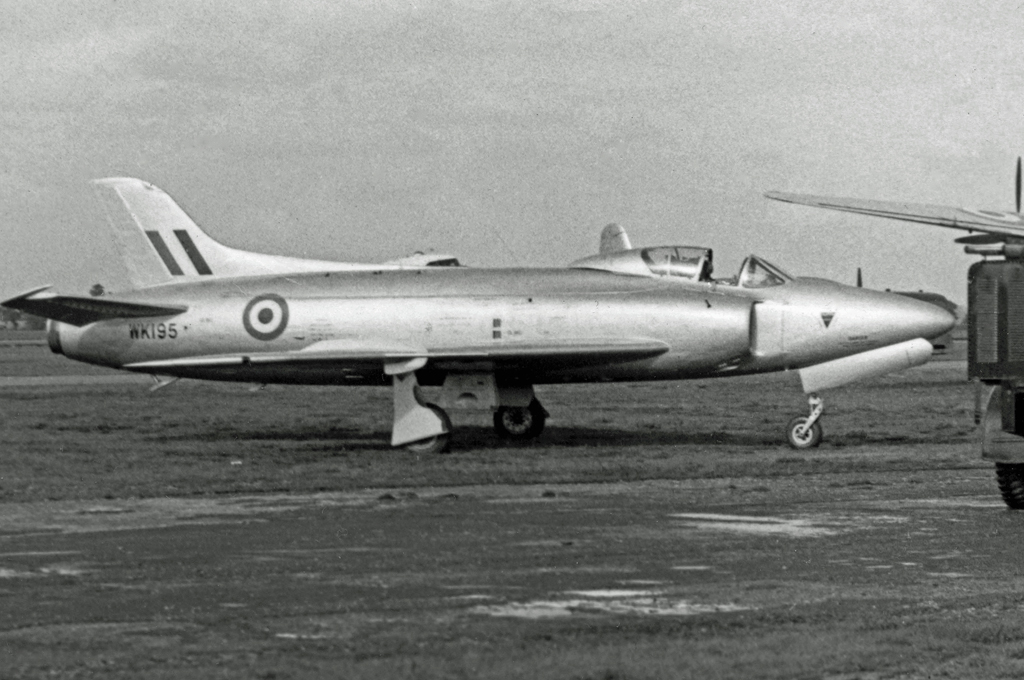
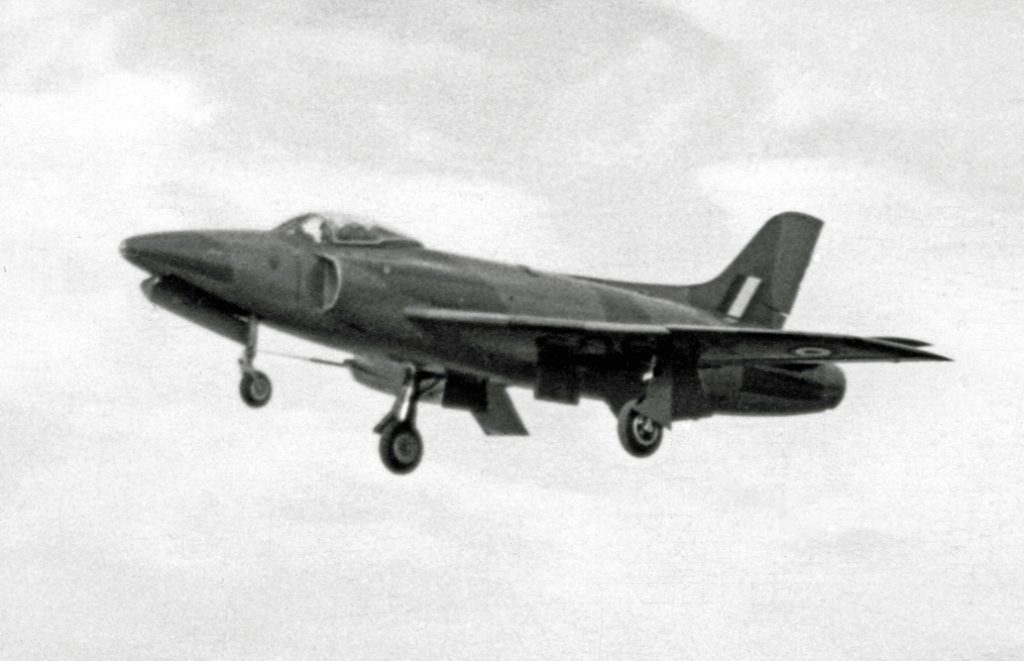
Supermarine Swift in photographs
Every image below is a real, credited photograph. Click any picture to enlarge it.
Watch: the Supermarine Swift’s troubled story
“Flying Failures — Supermarine Swift” by aviation-history channel Ruairidh MacVeigh (about 138,000 subscribers; roughly 17,700 views). A concise, well-sourced account of why the Swift failed as a fighter and succeeded as a reconnaissance aircraft.
Where the Supermarine Swift operated
The Swift was never exported and saw no combat. Its footprint is small but distinct: designed and built in Britain, flown operationally in RAF service at home and in Germany, and holder of a world record set in the Libyan desert. Toggle the categories below.
The Supermarine Swift’s two defining moments: a record and a redemption
The 1953 world air speed record
By the autumn of 1953 the world absolute air speed record had become a fiercely contested prize, traded back and forth between British and American jets. Supermarine wanted it for the Swift, both as a genuine demonstration of the aircraft’s low-level speed and as a badly needed piece of good publicity for a programme already under strain.
The attempt was flown not in Britain’s damp autumn air but over the hot, dense, low-lying desert near Tripoli in Libya, where conditions suited a high-speed low-level run. On 26 September 1953, Supermarine’s chief test pilot, Lieutenant Commander Mike Lithgow, flew the Swift F.4 WK198 down the measured course and set a new world record commonly cited at 735.7 mph — roughly 1,184 kilometres per hour, though sources round the figure slightly differently.
The glory was brief. Only about eight days later the American Douglas F4D Skyray took the record back, and the absolute record would soon climb far beyond anything a gun-armed day-fighter could reach. But the Swift’s run has a permanent place in the record books for one reason: it was the last time a British production aircraft ever held the outright world air speed record. That the same airframe, WK198, survives in part in a British collection gives the story a tangible endpoint.
Redemption over Germany
The FR.5 reached the squadrons of RAF Germany from 1956, equipping units of the 2nd Tactical Air Force whose task was to range low and fast over the potential battlefield of central Europe and bring back photographs. This was among the most demanding flying the RAF asked of anyone: very low, very fast, in European weather, navigating by map and stopwatch with a target you might see for only seconds.
Here the Swift’s character finally fitted the mission. Stable and quick at low level, strongly built and hard to catch near the ground, the FR.5 did the reconnaissance job well enough to win NATO’s low-level reconnaissance competitions in the late 1950s — beating aircraft that, higher up, would have run rings around it. For the pilots who flew it in the role it was designed around, the Swift was not a failure at all but a fast, purposeful tool.
The FR.5 soldiered on until 1961, when it was replaced by the reconnaissance Hunter, the FR.10 — the very rival that had beaten the Swift to the fighter role now inheriting its reconnaissance one too. The Swift left RAF service having never fired a shot in anger, never been exported, and never quite escaped the shadow of its early failure — yet having, in the end, done one difficult job genuinely well.
The Supermarine Swift by the numbers
The Swift is one of very few RAF fighters remembered almost entirely for peacetime events — a speed record and a procurement scandal — rather than for combat. Its real operational value lay in unglamorous, dangerous low-level reconnaissance work that rarely made headlines.
Supermarine Swift: frequently asked questions
Can I fly in a Supermarine Swift?–
Why was the Supermarine Swift considered a failure?+
Was the Supermarine Swift any good at all?+
Did the Supermarine Swift set a world speed record?+
How many Supermarine Swifts were built?+
Why did Britain order the Swift and the Hawker Hunter together?+
Where can I see a Supermarine Swift today?+
What engine did the Supermarine Swift use?+
Did the Supermarine Swift ever see combat?+
The Supermarine Swift is grounded forever. A real fighter-jet flight is not.
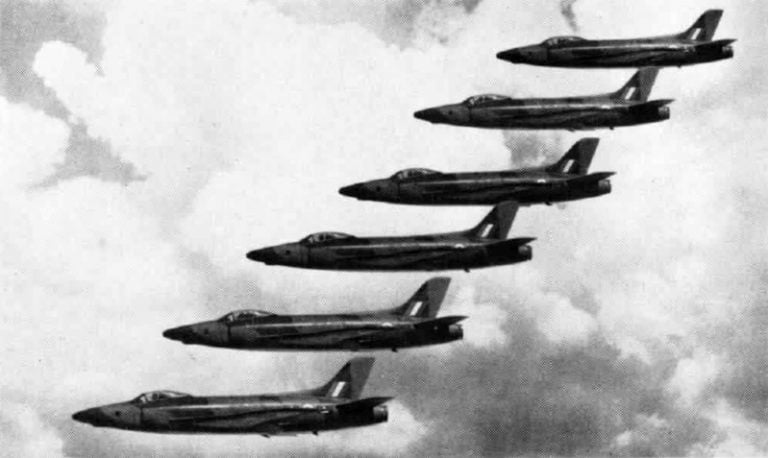
No Swift will ever fly again — but MiGFlug puts you in the cockpit of genuine ex-military jets around the world, from Cold War trainers to a MiG-29 climbing to the edge of space. Here is a selection of aircraft you can actually fly right now.


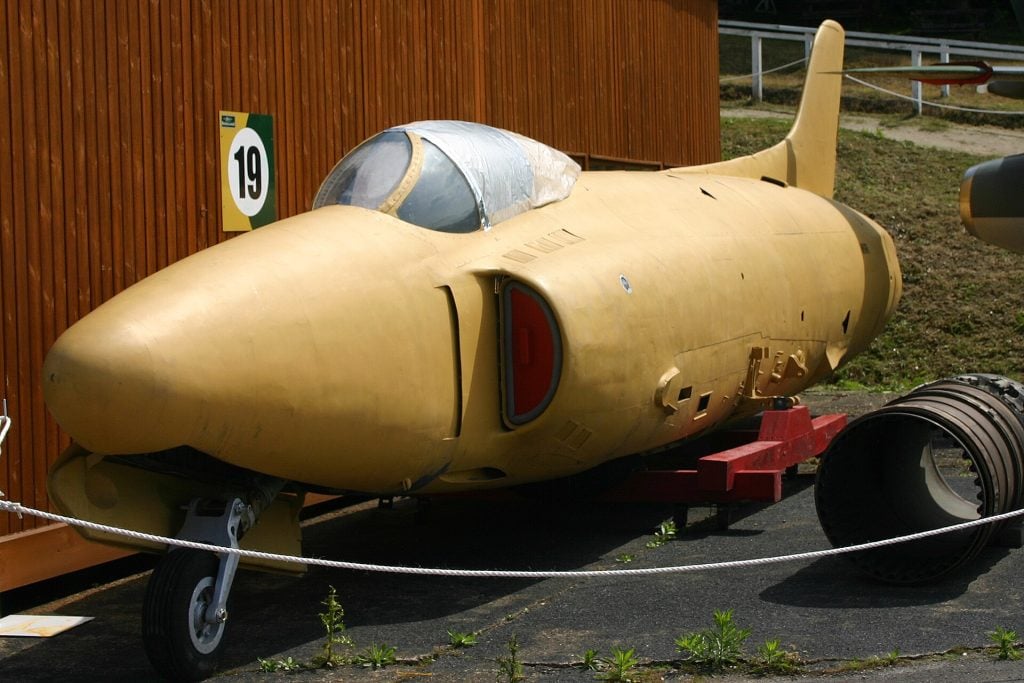
Explore more of the Aircraft Museum
Sources and further reading
- Royal Air Force Museum — institutional history of RAF swept-wing fighters and the Swift’s service record.
- Fleet Air Arm Museum, Yeovilton — holdings including the Supermarine Type 517 research airframe.
- Newark Air Museum — preserved Swift FR.5 WK277 and its service background.
- Tangmere Military Aviation Museum — Swift FR.5 WK281 exhibit notes.
- Solent Sky Museum, Southampton — Supermarine heritage and the F.7 airframe.
- Brooklands Museum — Vickers-Armstrongs / Supermarine production history and the WK198 fuselage.
- Fédération Aéronautique Internationale (FAI) — world air speed record listings for 1953.
- Thunder & Lightnings — detailed British Cold War aircraft type histories and survivor list for the Swift.
- Ruairidh MacVeigh, “Flying Failures: Supermarine Swift” — documentary video summarising the type’s design, service and fate.
- Imperial War Museums (IWM) — collections and photographs documenting RAF jet aircraft of the 1950s.
- Vintage Aviation News — “Today in Aviation History: First Flight of the Supermarine Swift” and related articles.
- Key Aero / Key Publishing — features on the Swift FR.5 and on the preservation of surviving airframes.
- Wikimedia Commons — source of the credited photographs used on this page (licences noted in each caption).
This is an independent aircraft-history exhibit by MiGFlug. Figures marked as estimates or contested vary between published sources and should be treated as approximate. MiGFlug does not operate or offer flights in the Supermarine Swift.