
Gloster Javelin
“Flat Iron”
The world’s first twin-engine delta-wing fighter — a huge, T-tailed all-weather interceptor built to guard Cold-War Britain in the dark, and the first delta ever to enter RAF squadron service.
Britain’s first delta, built for the dark
In the late 1940s the RAF faced a new nightmare: fast, high-flying Soviet bombers that could arrive over Britain at night, in any weather. Existing fighters — even the new Meteor and Vampire — lacked the radar, the ceiling and the endurance to catch them. Air Ministry Specification F.44/46 called for a large, radar-equipped, two-seat all-weather interceptor, and the Gloster Aircraft Company answered with a design unlike anything the RAF had flown before.
The result was the GA.5, first flown on 26 November 1951 by chief test pilot Bill Waterton. It was a giant: a broad delta wing married to a high-set “T” tailplane, two Armstrong Siddeley Sapphire turbojets buried in the fuselage, and a crew of two — pilot and radar navigator. When it entered squadron service in 1956 it became the first delta-wing aircraft to serve operationally with the RAF, and the world’s first twin-engine delta fighter. Crews nicknamed it the “Flat Iron” for its broad, flat planform.
It was never fast — subsonic, heavy and famously docile to fly straight and level — but that was not its job. Its job was to climb through cloud on a radar picture, find a bomber it could not see, and kill it with cannon or the new Firestreak missile. The Javelin did that job through a decade of Cold-War alerts, from Britain to Germany, Cyprus, Singapore and Zambia — and it did it, remarkably, without ever firing a shot in anger.
01How the Gloster Javelin became the RAF’s first delta — and Gloster’s last aircraft
Gloster had built Britain’s first jet, the Meteor, and it staked its future on the Javelin. The delta wing was chosen for a practical reason: it gave enormous internal volume for fuel, radar and cannon while keeping a low wing loading for high-altitude flight. But the tail was the gamble. Placing the tailplane high on the fin — the “T” layout — kept it clear of the wing at low speed on paper, yet in a steep, slow climb the wing’s wake could blanket it entirely, robbing the pilot of pitch control in a deep stall. That flaw would cost lives in testing.
The Javelin was also the end of the line. By the time the definitive FAW.9 was in service, the supersonic English Electric Lightning was already coming, and the 1957 Defence White Paper was busy cancelling manned fighters altogether. Gloster — a name that reached back to 1917 — built no aircraft after the Javelin. When the last squadron stood down in 1968, a 51-year story ended with it.
What makes the Javelin special
A giant delta with a T-tail
The Javelin paired one of the largest wings ever put on a Western fighter — about 86 m² of delta, bigger than almost anything short of the Soviet Tu-128 — with a high-mounted “T” tailplane. The wing gave volume and a gentle high-altitude ride; the tail gave clean airflow at cruise. Together they made the first twin-engine delta to fly, and the first delta to enter RAF service.
Twin Sapphire power
Two Armstrong Siddeley Sapphire turbojets sat side by side in the fuselage. Early marks gave around 8,000 lbf each; the final FAW.9 used the Sa.7R with a simple afterburner good for about 12,300 lbf above 20,000 ft. Two engines mattered for an aircraft that spent hours over the North Sea at night — and the Javelin flew comfortably on just one to stretch a patrol.
Radar, cannon & the Firestreak
The Javelin was a weapons system, not a dogfighter. It carried airborne-interception radar — British AI Mk 17 or the American APQ-43 — worked by a second crewman, and hit with four 30 mm ADEN cannon. From the FAW.7 it could also carry up to four de Havilland Firestreak infra-red missiles, among the RAF’s first guided air-to-air weapons.
02The Gloster Javelin’s deep-stall problem: the flaw that killed test pilots
The high T-tail was the Javelin’s Achilles heel. In a slow, nose-high attitude the delta wing could shroud the tailplane in its own turbulent wake, leaving the elevators biting on dead air — a deep stall from which recovery was almost impossible. On 11 June 1953 the second prototype, WD808, entered exactly this condition; test pilot Peter Lawrence rode it down trying to recover and ejected too late, and was killed. The accident, and later flat-spin losses, drove the fitting of stall-warning devices and shaped how crews were taught to handle the aircraft near its limits.
03The Gloster Javelin’s George Medal landing: Bill Waterton and the missing elevators
Even the first prototype nearly ended in disaster. During early testing the elevators tore away from aerodynamic flutter, leaving chief test pilot Bill Waterton with an aircraft he could barely control in pitch. Using engine thrust and the tailplane trim, he nursed the crippled Javelin back and put it down — then stayed aboard the burning wreck to save the flight-test recorder. He was awarded the George Medal. Waterton had earlier called the machine “as easy to fly as an Anson,” but warned from the start that its power controls were not up to the job.
Full specifications
Baseline note: the figures below describe the Javelin FAW.9, the last and most numerous operational standard and the one nearly every photograph of a Javelin in Cyprus, Germany or Singapore actually shows. A FAW.9 was not a new-build aeroplane: 118 FAW.7 airframes went back through the works and came out with the FAW.8’s drooped wing leading edge, auto-stabiliser and reheated Armstrong Siddeley Sapphire ASSa.7LR engines. Forty-four of those gained a fixed flight-refuelling probe on the starboard side as the FAW.9F/R, and forty of that forty-four were cleared to carry four 230 imp gal underwing tanks as the FAW.9R. Armament in this baseline is two 30 mm ADEN cannon in the wings plus four de Havilland Firestreak infrared missiles on underwing pylons, and the radar is the British AI.17. Deltas for the FAW.1 of 1956 through the FAW.8 of 1959 are in grey. Five warnings before any number below is read. First, the performance line reproduced almost everywhere — 710 mph, Mach 0.93, at 40,000 ft — is internally impossible and should not be quoted as it stands. At 40,000 ft Mach 0.93 is about 616 mph (992 km/h) true airspeed; 710 mph at that height would be Mach 1.07, and the Javelin was never a supersonic aeroplane in level flight. The 710 mph number belongs at low level, where Mach 0.93 is roughly that speed. Read the Mach figure as the real limit and the mph figure as a low-altitude one. Second, the same widely copied data box lists four 30 mm ADEN cannon and a Westinghouse AN/APQ-43 radar for the FAW.9. Both are wrong for that mark. A FAW.9 carried two cannon and four missiles, and its radar was the British AI.17; the American APQ-43, known in RAF service as AI.22, went into the FAW.2, FAW.6 and FAW.8 and never into a FAW.9. Third, the engine designation is a genuine muddle: ASSa.7LR, Sa.7R and the Sapphire 200-series numbers all appear for the same unit, and the reheat behind them is the most misleading single item in the Javelin’s specification. It gave about 12 per cent augmentation, it worked only above 20,000 ft, and below that height the fuel pump could not feed it, so selecting reheat at low level lost cold thrust instead of adding hot. The FAW.9 is a reheated aeroplane that could not use reheat where reheat is most wanted, on take-off and in a low-level chase. Fourth, production totals wobble. The usual grand total is 435 airframes, 302 built by Gloster at Hucclecote and 133 by Armstrong Whitworth at Baginton; the same reference literature also states 427 production aircraft plus seven prototypes, which comes to 434. The gap is bookkeeping over the trainer prototype and the static-test airframe. Quote 435 and say what it includes. Fifth, the deep stall. It killed one test pilot, not a series of them: Peter Lawrence, in the second prototype WD808 on 11 June 1953, who ejected at about 400 ft and did not survive. A second pilot, attached to Gloster from RAE Farnborough, was killed in XA546 on 21 October 1954 in what appeared to be an intentional spin, and Sqn Ldr David Dick ejected safely from an unrecoverable flat spin in XA561 at 40,000 ft on 8 December 1955. Rolling the three together to make the Javelin a serial killer of test pilots overstates a real problem that was serious enough without embroidery.
Dimensions & weights
- Crew
- 2 — pilot and navigator/radar operator in tandem. This was the point of the aeroplane: the RAF’s earlier all-weather fighters were converted day types, and the Javelin was the first British fighter designed from a blank sheet around two men, a radar and an interception problem. Prototype rear cockpits were faired over with an opaque canopy and two small portholes, on the theory that a radar operator had no business looking out; the fifth prototype and all production aircraft got a proper transparency
- Length
- 17.30 m (56 ft 9 in) — FAW.7 onwards, with the extended rear fuselage and the "pen nib" fairing between the jet pipes that cured rudder buffet. Early marks were shorter; the T.3 trainer was longer again, stretched to restore the centre of gravity after the instructor’s bulged canopy and to carry extra fuel
- Wingspan
- 15.85 m (52 ft 0 in) — unchanged across every mark. Some sources round this to 16 m
- Height
- 4.88 m (16 ft 0 in) — the T-tail sits high, which is exactly why the aircraft could be deep-stalled
- Wing area
- 86.1 m² (927 sq ft) — no Western fighter of the period had a larger wing. In the Soviet inventory only the Tupolev Tu-128 beat it, by roughly 10 m². The area bought the Javelin its high-altitude manoeuvre margin and its gentle approach speed, and cost it every knot of level speed
- Aerofoil
- RAE 101, 10 per cent at the root, 8.9 per cent at the tip — thick by the standards of 1954, and the single reason the aircraft was subsonic. The cancelled "thin-wing Javelin" existed to fix precisely this
- Empty weight
- 10,886 kg (24,000 lb)
- Gross weight
- 14,324 kg (31,580 lb) — the clean interception weight
- Maximum take-off weight
- 19,580 kg (43,165 lb) — a FAW.9R with four 230 imp gal tanks. The gap between gross and maximum weight is almost five tonnes, all of it fuel, and it is the measure of how far the type was stretched to reach Borneo
- Wing loading
- 166 kg/m² (34 lb/sq ft) at gross weight — low for a 1950s jet fighter and the reason a Javelin could still turn at 50,000 ft when leaner aeroplanes were mushing
- External fuel
- 4 × 230 imp gal underwing tanks (1,046 l each) on the FAW.9R only, plus a ventral tank fit on earlier marks. Underwing tanks and Firestreak missiles competed for the same pylons, so a fully tanked Far East patrol aircraft was a gun fighter
- Internal fuel
- ~4,500 l (~990 imp gal) in wing and fuselage tanks on the FAW.7 and FAW.9. Figures vary between authorities and by mark: the FAW.5 wing added tankage over the FAW.4, and the T.3 added more again. Treat any single quoted number with suspicion
- Thrust-to-weight
- 0.79 at gross weight with reheat lit — respectable on paper, and unavailable below 20,000 ft
Performance
- Maximum speed
- Mach 0.93 — the honest headline number, and the one to use. The commonly quoted 1,143 km/h (710 mph) is a low-altitude figure that has been mislabelled "at 40,000 ft" in the standard data box; at that height Mach 0.93 is about 992 km/h (616 mph) true
- Supersonic capability
- None in level flight — a prototype exceeded Mach 1 in a dive on 4 July 1954, the pilot having been distracted by an oxygen failure, and service aircraft could be pushed through Mach 1 downhill. Neither makes the Javelin a supersonic fighter. Its replacement, the English Electric Lightning, was roughly twice as fast
- Specification requirement
- 525 kn at 40,000 ft (973 km/h, 605 mph) — the F.44/46 and F.4/48 target. The FAW.9 met it, eight years late
- Rate of climb
- 27.4 m/s (5,400 ft/min) initial. The original requirement asked for 45,000 ft within ten minutes of the pilot pressing the starter, which is a scramble figure rather than a climb figure and was met only by the reheated marks
- Service ceiling
- 16,100 m (52,800 ft) — the reheated FAW.8 and FAW.9. Unreheated marks were meaningfully lower, and the whole reason for fitting reheat was to recover the high-altitude interception performance lost to the drag and weight of four Firestreaks
- Range
- 1,535 km (954 mi, 829 nmi) internal. With four 230 imp gal tanks a FAW.9R roughly doubled that, and with a probe and a tanker the figure became a planning question rather than an aircraft limit
- Endurance
- 2 hours minimum was the specification — in Malaysia during the Confrontation crews routinely shut down one engine on low-level patrol to stretch time on task, a trick the type’s benign asymmetric handling made safe and which few contemporaries could have risked
- Design load factor
- 4g at high speed — the F.44/46 structural requirement. The Javelin was a bomber-destroyer, not a dogfighter, and was never stressed or intended for the sort of manoeuvring the Hunter took for granted
- Deceleration on airbrakes
- about 1g — throttles to idle with the fully variable upper- and lower-surface airbrakes out produced a deceleration crews described as like driving into sand. It made the Javelin unusually good at rapid descents and short-notice approaches
- Deep stall
- Nose above roughly 45° with flaps down — the wing wake blanketed the high-set tailplane, the elevators went dead in low-energy air, and the aircraft descended flat and fast with no pitch authority. A stall-warning device was developed and fitted after the WD808 and XA561 accidents, and the flight envelope was placarded around the problem rather than the problem being designed out
- Take-off distance
- 1,500 yd was the specification maximum (1,372 m). The big wing and the airbrakes made the landing end of the equation easy; the take-off end, at maximum weight on a hot Singapore afternoon with reheat unusable at low level, was not
Propulsion & systems
- Engines
- 2 × Armstrong Siddeley Sapphire ASSa.7LR axial-flow turbojets with limited reheat — also written Sa.7R and given various Sapphire 200-series numbers. Thirteen-stage axial compressor, annular combustor with 24 vaporisers, 3.18 m long, 0.95 m in diameter, about 1,383 kg dry
- Dry thrust
- 48.9 kN (11,000 lbf) each — the ASSa.7 was the first British engine rated above 10,000 lbf
- Reheat thrust
- 54.7 kN (12,300 lbf) each, above 20,000 ft only, an augmentation of about 12 per cent. A few sources give 12,390 lbf. Below 20,000 ft the fuel pump could not sustain the reheat flow and selecting it produced a net loss of cold thrust, which is why FAW.8 and FAW.9 crews treated reheat as a high-level switch and nothing else
- Earlier engines
- FAW.1 to FAW.6: Sapphire Sa.6, usually quoted at 35.6 kN (8,000 lbf) each, occasionally at 8,300 lbf. FAW.7: the unreheated Sa.7 at 48.9 kN (11,000 lbf). Every increase in thrust was consumed by the weight and drag of the equipment the RAF kept adding
- Radar
- AI.17 — British-designed airborne interception radar in a pointed radome, fitted to the FAW.1, FAW.4, FAW.5, FAW.7 and FAW.9. The FAW.2, FAW.6 and FAW.8 instead carried the American Westinghouse AN/APQ-43, designated AI.22 in RAF service, behind a distinctly blunter "snub" nose. The two radar lineages ran in parallel through the entire production run, which is the single most confusing thing about Javelin marks
- Missile system
- de Havilland Firestreak, four rounds — the seeker was slaved to the AI.17 until it locked. Each round needed ammonia coolant and compressor bleed air from the launch aircraft, and there was only about fifteen minutes of coolant, so missiles were spun up on the approach to a target and not before
- Flight controls
- Fully powered, with a hydraulic artificial-feel system — the prototypes flew with inadequate boost and Bill Waterton said so repeatedly. An all-moving tailplane arrived with the FAW.4 and T.3, a powered rudder with the FAW.7, and an auto-stabiliser with the FAW.8. The Javelin was progressively made flyable rather than being born so
- Airbrakes
- Fully variable, wing upper and lower surfaces — among the best of any British aircraft of the period and universally praised by crews
- Escape system
- Martin-Baker ejection seats for both crew from the start of squadron service — a genuine advance over the Meteor night-fighters the type replaced, which had none. Lawrence’s death in WD808 was a demonstration of the seat’s minimum-height limits rather than of its quality
- Refuelling
- Fixed flight-refuelling probe, starboard forward fuselage — on 44 aircraft as the FAW.9F/R. It turned a short-legged home-defence interceptor into an aeroplane that could be flown to Singapore or Zambia behind a tanker instead of shipped, and it is the reason the Javelin was the RAF’s reinforcement fighter of the mid-1960s
- Electrical
- 2 × 6 kW 24 V generators on the auxiliary gearbox, with inverters for AC — feeding the radar, the flight instruments and, on missile-armed marks, the Firestreak heating and cooling circuits
04The Gloster Javelin’s cost: why no clean price survives
The Javelin was a British state procurement of the early 1950s, ordered in batches for the RAF and never sold on an open market, so a tidy modern-style flyaway unit price simply is not part of the public record. Production was split between Gloster and Armstrong-Whitworth, both inside the Hawker Siddeley group, and part of the programme was underwritten by a large U.S. order under the Mutual Defense Aid Program. Any single dollar or pound figure you see attached to one Javelin should be treated as an estimate, not a sourced fact — and no credible public cost-per-flight-hour number exists for the type.
Armament & payload
The Javelin was ordered with four cannon and four missiles, and it took eight years and seven marks to carry both
Specification F.4/48 asked for a two-seat all-weather fighter with four 30 mm cannon and four air-to-air missiles. The FAW.1 that entered squadron service in February 1956 had the cannon and no missiles, because the missile did not exist yet. The FAW.7 of late 1956 was the first mark to carry the full specified fit, and even then two squadrons received their FAW.7s with four cannon and no missile installation at all. By the time the FAW.9 standardised the arrangement — two ADEN in the wings, four Firestreak on underwing pylons — the requirement it satisfied was a decade old and the threat it was written against had moved on.
The Firestreak deserves its reputation as both an achievement and a disappointment. It was the third infrared air-to-air missile in the world to reach service, after the American Falcon and Sidewinder, and it carried a far heavier warhead than either. It was also a rear-aspect pursuit weapon with a field of attack confined to a roughly 20° cone behind the target, it could not be fired in cloud, and its valve electronics needed ammonia cooling supplied from the launch aircraft with only about fifteen minutes of coolant aboard. An all-weather interceptor whose primary weapon could not be used in weather is a fair summary of British air defence in 1958, and it is the central irony of the Javelin.
What the Javelin never acquired was the unguided rocket battery that its direct contemporaries adopted. The Avro Canada CF-100 Mk 5, the Northrop F-89D and the North American F-86D all went to salvoes of folding-fin rockets fired on a computed collision course; Britain skipped that generation entirely and went from cannon straight to the infrared missile. In hindsight that was the right call, because rocket salvoes proved close to useless against anything that manoeuvred. Fits varied sharply by mark and by theatre: FAW.1 to FAW.6 had four cannon and no missiles, early FAW.7s of two squadrons had four cannon only, a standard FAW.7 or FAW.9 had two cannon and four Firestreaks, and a FAW.9R on a Borneo patrol with four underwing tanks had two cannon and nothing else, because the tanks and the missiles wanted the same pylons.
Gun
- 4 × 30 mm ADEN cannon in the wings on the FAW.1, FAW.2, T.3, FAW.4, FAW.5, FAW.6 and the cannon-only FAW.7s — a revolver cannon firing the 30 × 113 mm round at roughly 1,200 to 1,400 rounds per minute, the standard British fighter gun of the era and a genuinely heavy battery against a bomber.
- 2 × 30 mm ADEN on the missile-armed FAW.7, FAW.8 and FAW.9. The outboard pair was deleted to make room and weight for the Firestreak installation, halving the gun armament of the definitive mark.
- Ammunition quantities per gun are quoted inconsistently across the reference literature and no reliable single figure should be repeated; the guns were wing-mounted, well outboard of the intakes, and gun gas ingestion was never the problem it was on nose-gunned types.
- The T.3 trainer retained four cannon despite having no radar at all, so the RAF’s Javelin conversion aircraft was, in gun terms, better armed than its front-line FAW.9s.
- No Javelin ever fired its guns in anger. The type served twelve years across three continents and its combat record consists of one interception that ended in the other aircraft crashing.
Air-to-air
- 4 × de Havilland Firestreak on underwing pylons, from the FAW.7 onwards. Developed under the rainbow code Blue Jay: 3.19 m long, 0.223 m in diameter, 136 kg, a lead-sulphide infrared seeker slaved to the aircraft radar until lock, a Magpie solid motor burning 61 lb of cordite for 1.9 seconds, and a flight time of about 13 seconds to a range of roughly 6.4 km (4 mi).
- Warhead figures disagree between authorities and both are in circulation: the annular blast-fragmentation filling is given as 22.7 kg (50 lb) in the standard data tables and as 19.3 lb (8.8 kg) in the descriptive text of the same reference, with a stated lethal radius of 12 m (40 ft) and a casing that broke into quarter-ounce fragments thrown forward in a 50° cone.
- Its limitations were structural, not teething: rear-aspect only, within about a 20° cone astern of the target, and unusable in cloud. Against a subsonic bomber in clear air over the North Sea it was a serious weapon. Against anything else it was not.
- The FAW.5 was built with provision for missile pylons that were never fitted, and No. 1 Guided Weapons Development Squadron at RAF Valley ran the Firestreak trials on Javelins. The successor weapon, Red Top, went to the Lightning and the Sea Vixen; no Javelin ever carried it.
- No Javelin ever launched a Firestreak at a hostile aircraft.
Air-to-surface guided
- None, on any mark, at any time. The Javelin had no guided air-to-surface weapon, no anti-radiation round and no anti-ship capability.
- The AI.17 and AI.22 radars were pure interception sets. Neither had a ground-mapping mode, a ballistics computer for surface targets or any provision for one.
- This card is kept because the omission was deliberate and permanent. Fighter Command bought the Javelin to shoot down Soviet bombers over the United Kingdom and specified nothing else; when the RAF wanted an all-weather strike aircraft it bought Canberras and later the Buccaneer and Phantom.
- A fighter-bomber Javelin with underwing panniers for bombs was drawn and not built, and the single-seat P.316 study of 1949 that would have carried four 1,000 lb bombs died before the delta layout was even settled.
Bombs
- None in service, on any variant. No bomb bay, no bomb racks, no sight, no release circuits.
- The wing volume that a strike aircraft would have used for stores was occupied by fuel from the FAW.5 onwards, which is the whole reason the later marks had any useful radius at all.
- Even in the Far East, where the RAF was flying Hunters and Canberras against ground targets over Borneo, the Javelin squadrons stayed in the air defence role. Their job was to meet Indonesian intruders, not to attack anything on the ground.
- The unbuilt fighter-bomber proposal with underwing bomb panniers is the only serious study, and it never left paper.
Rockets
- No unguided rocket armament was ever operational on any Javelin. The card is kept because the absence is the interesting part.
- Every close North American contemporary went the other way. The CF-100 Mk 5 carried fifty-eight 70 mm rockets in wingtip pods, the F-89D carried 104 in nose pods and the F-86D twenty-four in a retractable tray, all fired in salvo on a lead-collision course computed by the fire-control system.
- Britain declined the whole concept and went from the 30 mm cannon directly to the infrared missile. Given how badly rocket salvoes performed against manoeuvring targets in American trials, this was one of the Javelin programme’s better decisions.
- Air-to-ground rocket projectiles were equally absent: the Javelin had no ground-attack role and no rocket rails of any kind.
Pods & other stores
- 4 × 230 imp gal (1,046 l) underwing drop tanks on the FAW.9R — forty aircraft, and the reason a Javelin could patrol usefully over the Malacca Strait. They occupied the missile pylons, so a fully tanked aircraft was a cannon fighter.
- Ventral fuel tanks were carried by earlier marks; a Javelin on transit or on a long standing patrol was very often flying with more fuel outside the aeroplane than the FAW.1 had ever carried inside it.
- Fixed flight-refuelling probe on 44 FAW.9F/R aircraft — not a store, but the single most consequential external addition the type received, and what made the reinforcement flights to Zambia and the Far East possible.
- No reconnaissance pod, no jamming pod, no gun pod and no targeting equipment of any sort was ever carried. Reconnaissance Javelins were studied and not built.
- An anti-spin parachute was fitted to trials airframes after the 1953 and 1955 accidents. On XA561 in December 1955 it failed to recover the flat spin and the pilot ejected.
Three typical loadouts
- UK air defence, Leuchars, 1960
- Two 30 mm ADEN plus four Firestreak, clean wing, internal fuel. Scrambled under ground control against a Soviet maritime patrol or bomber track over the North Sea, closing from astern to bring the missiles into their rear-aspect cone, in clear air because in cloud the Firestreak could not be used.
- Borneo and Malacca Strait patrol, Tengah, 1964–1966
- FAW.9R with four 230 imp gal underwing tanks and two 30 mm ADEN; no missiles, because the tanks had the pylons. Low-level standing patrol against Indonesian intruders, frequently flown with one engine shut down to stretch endurance and relit for the intercept.
- Reinforcement transit, United Kingdom to Singapore or Ndola
- FAW.9F/R with probe and underwing tanks, guns loaded, missiles ferried separately. Flown in stages behind tanker support with staging through Cyprus and the Gulf — the deployment method that put 29 Squadron over Zambia in December 1965 and kept Javelins available east of Suez until 1968.
Sourcing caveat: the four-cannon armament and the AN/APQ-43 radar that appear in the most widely copied FAW.9 data box belong to other marks and should not be attributed to the FAW.9. Firestreak warhead mass is quoted at both 22.7 kg and 8.8 kg by the same reference work and neither figure should be given alone. Per-gun ammunition capacity is inconsistently reported and is omitted here rather than guessed. The Javelin’s only recorded air combat outcome — the Indonesian C-130 lost in the Malacca Strait on the night of 2–3 September 1964 — involved no weapon being fired.
Variants
Nine marks in eight years, because the Javelin entered service unfinished and was rebuilt in the field
The Javelin’s variant history is not a story of steady improvement but of an aircraft chasing its own specification. The FAW.1 reached No. 46 Squadron at RAF Odiham in February 1956 with the wrong engines, no missiles, an electrically operated tailplane and a stall behaviour that had already killed a test pilot. Each subsequent mark fixed one thing: the FAW.4 added an all-moving tailplane and vortex generators, the FAW.5 put fuel in the wing, the FAW.7 brought the Sa.7 engine and the missiles the specification had asked for in 1948, the FAW.8 added reheat and a drooped leading edge. Development moved so fast that FAW.8 deliveries began before FAW.7 production ended, and the last eighty FAW.7s went straight from the factory into storage without ever flying in that configuration.
Running underneath the mark numbers are two parallel radar lineages that never merged. Odd-numbered marks from the FAW.1 largely carried the British AI.17 in a pointed nose; the FAW.2, FAW.6 and FAW.8 carried the American Westinghouse AN/APQ-43, known as AI.22 in RAF service, behind a blunt snub nose that is the quickest visual identifier in any photograph. Anyone treating the marks as a single ascending sequence will get the radar wrong.
There were no exports. Several NATO air forces looked at the Javelin and none bought it, and there was never a licence-built version. What there nearly was, instead, was a different aeroplane: the "thin-wing Javelin", ordered as the Gloster P.370 to specification F.153D in 1954, with an area-ruled fuselage, a thinner wing and a new tail, aimed at about Mach 1.6. It grew into the P.376, a large two-seater carrying two Red Dean all-aspect missiles as a contender for Operational Requirement F.155, and it was cancelled with the missile in 1957. Gloster never designed another aircraft. The company was folded into Whitworth Gloster in 1961 and its name vanished into Hawker Siddeley Aviation in 1963, which makes the Javelin the last aircraft designed and built by the firm that had produced Britain’s first jet fighter and the world’s first turbojet-powered aeroplane.
- Gloster GA.5 prototypes (1951–1954, 5 aircraft)
- WD804 first flew from Moreton Valence on 26 November 1951 with Sapphire Sa.3 engines and no armament; WD808 followed on 21 August 1952 and was lost with Peter Lawrence in the deep-stall accident of 11 June 1953; WT827 of 7 March 1953 was the first armed and radar-equipped aircraft; WT830 introduced powered controls; WT836 of 20 July 1954 was to production standard with a proper rear canopy. The first production aircraft flew within two days of the fifth prototype, which tells you how compressed the programme had become.
- FAW.1 (1954–1956, 40 built)
- Sapphire Sa.6 engines, AI.17 radar, four 30 mm ADEN, electrically operated tailplane. First flown 25 July 1954, first delivered to No. 46 Squadron at RAF Odiham; most were used for trials rather than front-line work.
- FAW.2 (1956–1957, 30 built)
- The American Westinghouse AN/APQ-43 radar in place of AI.17, and a hydraulically operated tailplane. The start of the parallel radar line that runs through the FAW.6 and FAW.8.
- T.3 (1956–1959, 22 production plus 1 prototype)
- Dual-control trainer with no radar, a bulged canopy for the instructor, an all-moving tailplane and a lengthened fuselage to restore the centre of gravity, which also bought extra internal fuel. Retained the four-cannon armament. Served with Nos. 226 and 228 Operational Conversion Units.
- FAW.4 (1955–1957, 50 built)
- FAW.1 with vortex generators on the wing to improve stall behaviour and an all-moving tailplane to improve pitch control. AI.17 radar retained. The first mark sent to RAF Germany, equipping Nos. 3, 5 and 11 Squadrons at Geilenkirchen and Laarbruch.
- FAW.5 (1956–1958, 64 built)
- A revised wing structure with additional fuel tanks and provision for missile pylons that were never fitted. The most-built mark that still could not carry the missiles the specification demanded.
- FAW.6 (1957–1958, 33 built)
- The FAW.5 wing married to the FAW.2’s American AI.22 radar and snub nose. Flown by No. 29 Squadron from Acklington and Leuchars until FAW.9s replaced them in April 1961.
- FAW.7 (1956–1958, 142 built)
- The definitive airframe and the largest production batch. Sapphire Sa.7 engines of 11,000 lbf, a powered rudder, an extended rear fuselage, and for the first time the full specified armament of two 30 mm ADEN plus four Firestreak — although the FAW.7s of two squadrons were delivered with four cannon and no missile fit. Eighty of the last aircraft were stored unflown and later rebuilt as FAW.9s.
- FAW.8 (1958–1959, 47 built)
- Sapphire Sa.7LR engines with limited reheat, worth 12,300 lbf above 20,000 ft and a liability below it; a drooped wing leading edge and an auto-stabiliser for better handling; AI.22 radar and the snub nose. The mark that taught the RAF what the FAW.9 needed.
- FAW.9 and FAW.9R (1959–1961, 118 converted from FAW.7)
- FAW.7 airframes rebuilt with the FAW.8’s reheated engines and drooped wing while keeping AI.17 radar. Forty-four received a fixed flight-refuelling probe as the FAW.9F/R and forty of those were cleared for four 230 imp gal underwing tanks as the FAW.9R, R for range. This is the mark that flew to Cyprus, to Ndola and to Tengah, and the mark in which the Javelin finally became a useful long-range instrument of British policy east of Suez.
Closing note on survivors: nine complete Javelins are on public display today, all of them original airframes; no replica or reproduction Javelin exists and none of the survivors will fly again. Eight are in Britain — FAW.1 XA564 at the RAF Museum Cosford, FAW.4 XA634 and FAW.9 XH903 at the Jet Age Museum, Gloucestershire, FAW.5 XA699 at the Midland Air Museum, Coventry, FAW.9 XH767 at the Yorkshire Air Museum, Elvington, FAW.9R XH892 at the Norfolk and Suffolk Aviation Museum, Flixton, FAW.9 XH897 at IWM Duxford and FAW.8 XH992 at the Newark Air Museum — and the ninth, FAW.9 XH768, is at the Parco Tematico e Museo dell’Aviazione at Rimini in Italy, wearing the false serial XH707. Older counts of ten include FAW.1 XA553, long a gate guardian at RAF Stanmore Park and latterly at Thunder City in Cape Town, which was scrapped on 28 April 2024. XH897 was the last Javelin to fly, delivered to Duxford on 24 January 1975 after use by the Royal Aircraft Establishment; several nose and cockpit sections survive separately in private and museum hands and are not counted above.
From drawing board to Cold-War relic
The requirement
Air Ministry Specification F.44/46 calls for a large, radar-equipped, two-seat all-weather interceptor. Gloster answers with the delta GA.5.
First flight
Prototype WD804 flies on 26 November from Moreton Valence, Bill Waterton at the controls — the first twin-engine delta to fly.
Deep-stall tragedy
Second prototype WD808 is lost to a deep stall; test pilot Peter Lawrence is killed. Stall-warning devices follow.
Enters RAF service
No. 46 Squadron at RAF Odiham takes the first Javelins — the RAF’s first operational delta wing.
Firestreak & the FAW.7
The definitive gun-and-missile marks arrive, carrying four Firestreak infra-red missiles alongside the ADEN cannon.
The afterburning FAW.9
The final variant adds reheat and a drooped wing leading edge, squeezing more height and speed from the big delta.
Confrontation & Zambia
Javelins patrol Malaysia and Singapore in the Indonesia-Malaysia Confrontation, and detach to Ndola, Zambia during the Rhodesian crisis.
Retirement
The last Javelins stand down in April, replaced by the supersonic English Electric Lightning. Gloster builds no more aircraft.
Twelve Gloster Javelin stories
Built to catch the night bomber
A 1947 requirement for an all-weather interceptor gave Gloster its last, largest fighter.
Read the full story
The Flat Iron takes off
Bill Waterton lifted the first twin-engine delta into the air on 26 November 1951.
Read the full story
The deep stall
A high T-tail could be blanked by the wing’s wake, trapping the aircraft in an unrecoverable stall.
Read the full story
Waterton’s George Medal
His elevators flew off in flight — and he still brought the prototype home.
Read the full story
The biggest wing in the West
Only the Soviet Tu-128 carried a bigger wing than the Javelin among contemporary fighters.
Read the full story
Cannon and the Firestreak
Four 30 mm ADEN guns, later joined by Britain’s first infra-red guided missiles.
Read the full story
Standing the QRA alert
Round-the-clock readiness against Soviet intruders over Britain and West Germany.
Read the full story
Single-engine over the jungle
In the Confrontation, Javelins throttled back one engine to stretch their patrols.
Read the full story
The Hercules intercept
A Javelin shadowed an intruding Indonesian C-130 — which crashed, though not from its guns.
Read the full story
Guarding Zambia
After Rhodesia’s UDI, Javelins deployed to Ndola to defend newly exposed Zambian skies.
Read the full story
A killer that never killed
Across twelve years of alerts the Javelin never scored an air-to-air kill in anger.
Read the full story
The last Gloster
When the Javelin retired in 1968, the Gloster name retired with it.
Read the full story
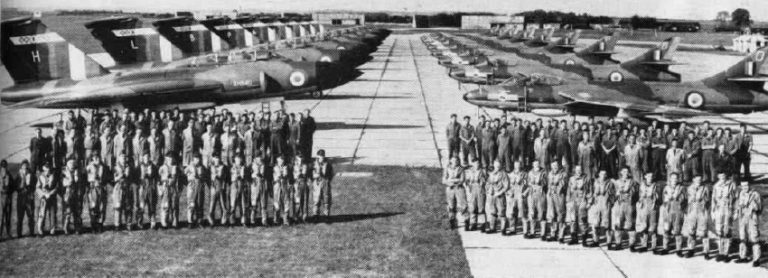
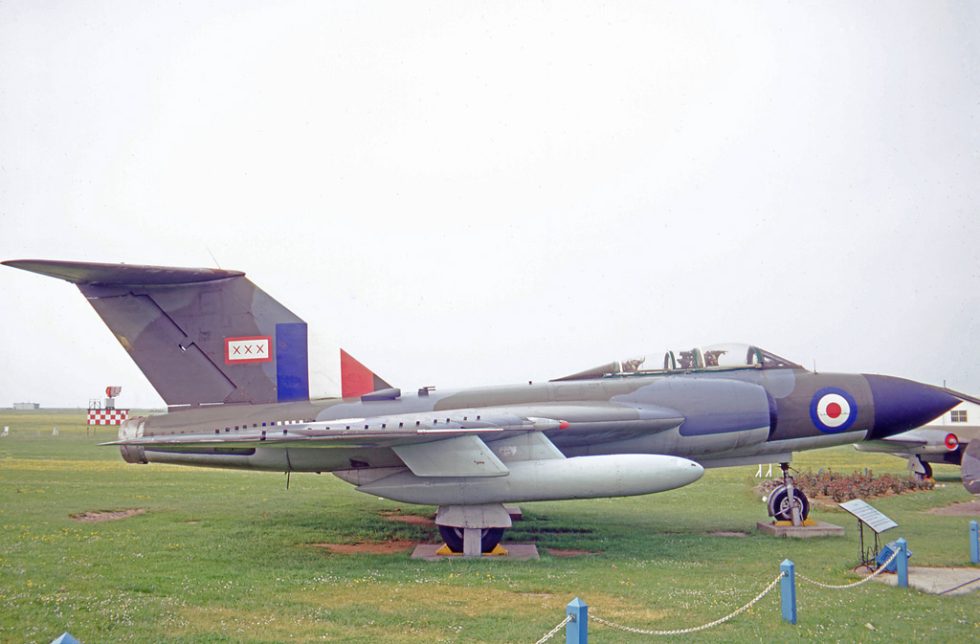
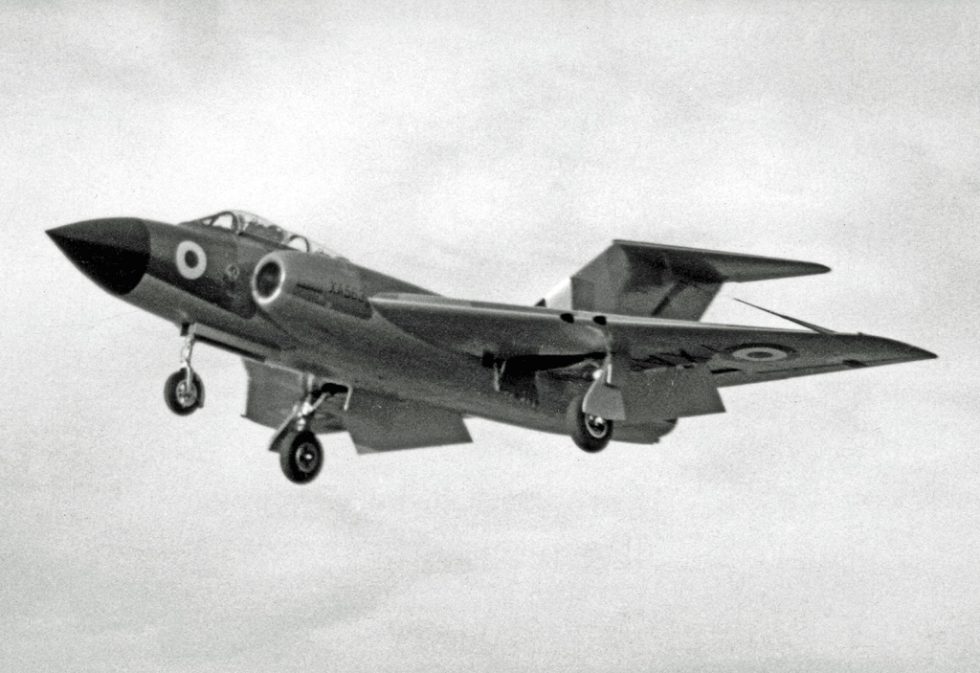
The Javelin in pictures
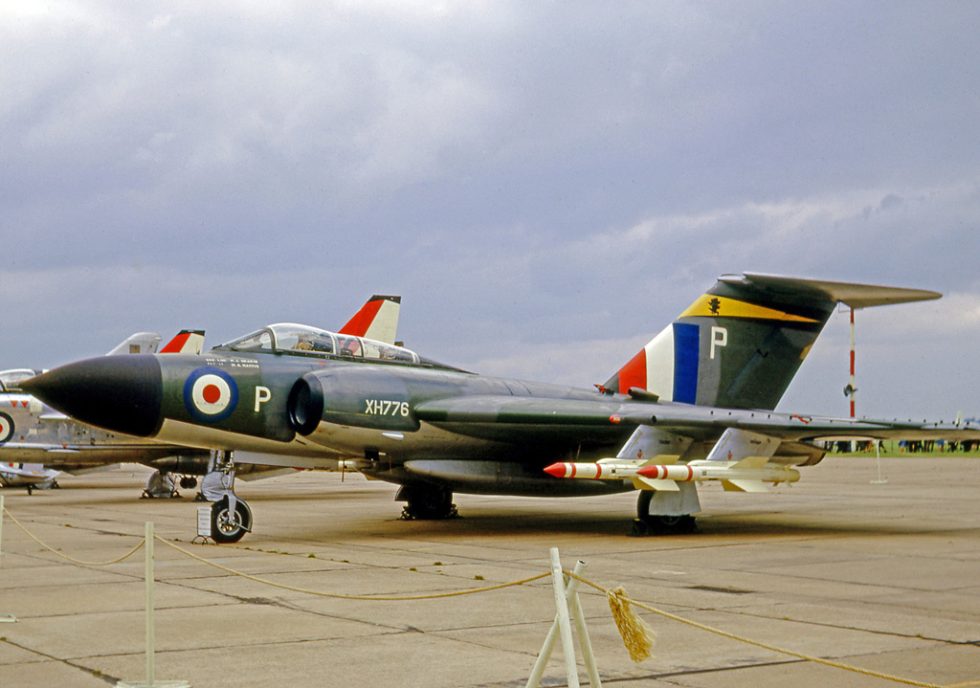
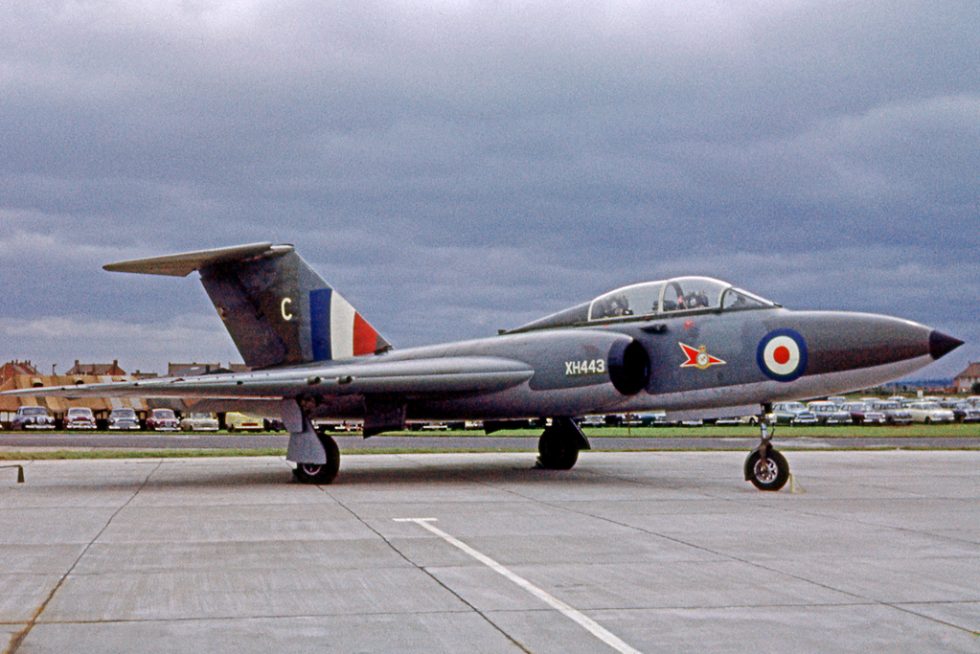
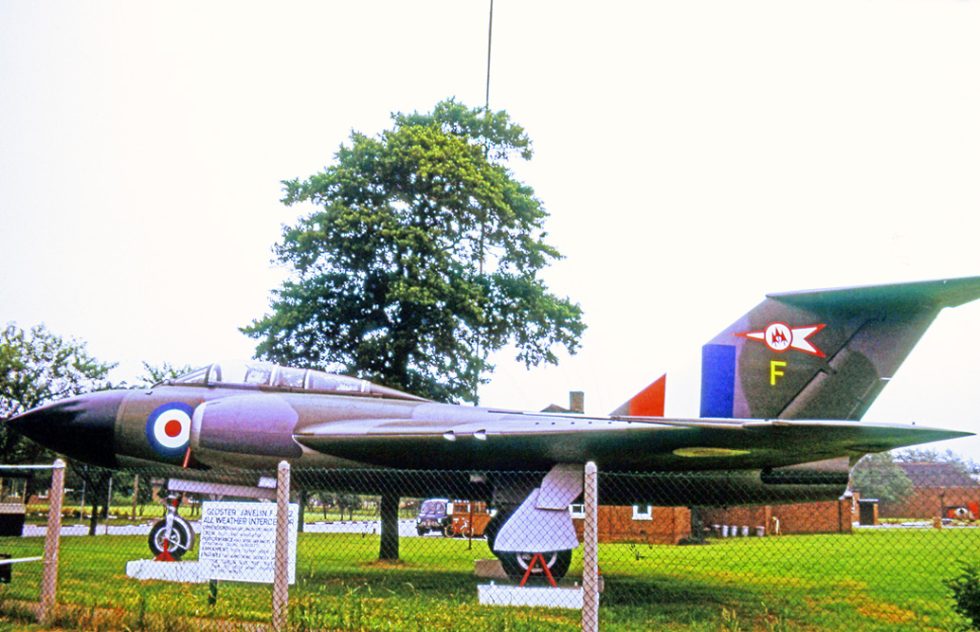
The Javelin in motion
A dedicated Gloster Javelin video feature is coming soon. In the meantime, explore the photo gallery above and the twelve stories from the “Flat Iron’s” career.
Where the Javelin flew
The score that defines it
The Javelin’s combat record is, in a sense, a blank sheet — and that is the point. Across twelve years of Cold-War alerts, from the North Sea to Borneo, no RAF Javelin ever destroyed an enemy aircraft in the air. It intercepted, shadowed and deterred, but the bomber war it was built to fight never arrived. Its real claim is a first, not a kill.
Compare the combat record of every military aircraft. Figures as of July 2026.
Everything people ask about the Gloster Javelin
Can I fly in a Gloster Javelin?
Can a civilian fly the Gloster Javelin?
Why was the Gloster Javelin called the “Flat Iron”?
Was the Javelin really the first delta-wing fighter?
How fast was the Gloster Javelin?
Did the Gloster Javelin ever shoot down an enemy aircraft?
Why did the Javelin have two crew?
What replaced the Gloster Javelin?
You can’t fly the Javelin.
These, you can.
Some legends only live in museums — others are fuelled and waiting. MiGFlug has put civilians in real military jet cockpits since 2004.
 Fly the L-39 AlbatrosThe world’s most-flown jet trainer — aerobatics included
 Fly the F-104 Starfighter“The missile with a man in it”
 Fly the MiG-21The Cold War’s most-produced jet
 Fly the T-33 Shooting StarAmerica’s first jet trainer
 Fly the DH VampireA piece of early jet history
 Fly the S.211Agile Italian jet trainer
 Fly the MB-326The classic Aermacchi jet
 Fly the MiG-15The Soviet legend of the Korean War
Continue the tour
Every fact, checked
- Key Aero — Gloster Javelin retrospectiveDevelopment, T-tail deep-stall history, service and retirement.
- RAF Museum — Gloster Javelin FAW.1Design origins, specification F.44/46 and the first delta in RAF service.
- Imperial War Museums — Javelin FAW.9Reference for the preserved FAW.9 and technical details.
- Hush-Kit — Flying the Flat IronFirst-hand RAF pilot account of handling and Far East operations.
- Four Prop — Gloster JavelinPrototype accidents, production numbers and the Confrontation deployment.
- Military Matters — The Flying FlatironThe “Flat Iron” nickname and the end of the Gloster company.
- Key Aero — Taming the Flat IronSpin and stall trials and how crews learned to handle the type.
- National / RAF museum referencesPreserved Javelin airframes and variant data.