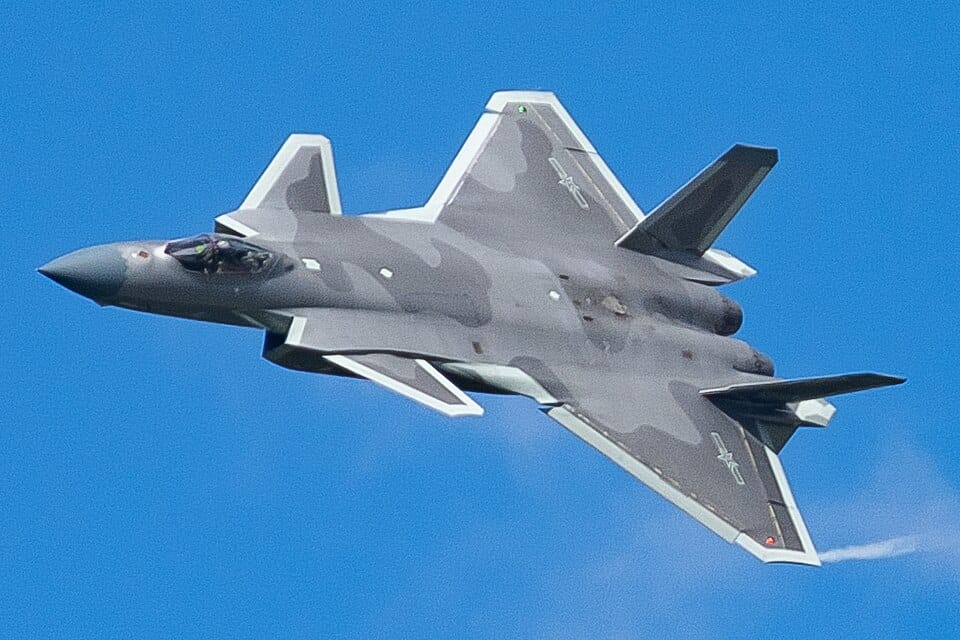
The numbers are almost too clean to be believable. In a Chinese computer simulation pitting a lone J-20 stealth fighter against a simulated F-22, the win rate sat at a dismal 10 per cent. Add AI-controlled drone wingmen to the same scenario, and the win rate climbed to 95 per cent. That is not a marginal improvement. That is a different kind of war.
The data, reported by Chinese state-affiliated media and analysed by Western defence researchers, comes from a simulation study led by researchers at Northwestern Polytechnical University — a key institution in China’s military aerospace research — designed to test collaborative combat between manned fighters and autonomous drones. The J-20 — China’s premier fifth-generation stealth fighter — served as the command aircraft, directing a formation of AI-controlled unmanned combat air vehicles (UCAVs) through engagement scenarios.
The implications have set off alarm bells from the Pentagon to Canberra.
Quick Facts
- Aircraft: Chengdu J-20 stealth fighter + AI drone wingmen
- Solo J-20 win rate: ~10%
- J-20 + AI drones win rate: ~95%
- Country: People’s Republic of China (PLAAF)
- Context: Computer-simulated air combat (J-20 vs simulated F-22) with manned-unmanned teaming
- US equivalent programme: Collaborative Combat Aircraft (CCA) — YFQ-42A, YFQ-44A
- J-6W programme: 500+ retired J-6 fighters converted to drones near Taiwan
How AI Drones Changed the Kill Chain
The solo J-20’s poor performance was not a reflection of the aircraft’s quality — it is a world-class fighter. The problem was numbers. In contested airspace against multiple adversaries with advanced radar and missiles, even a stealth fighter is vulnerable once detected. One aircraft can only track and engage so many threats simultaneously. The pilot becomes the bottleneck.
Adding AI drones transformed the equation. The unmanned wingmen acted as sensor nodes, decoys, and weapons carriers simultaneously. They extended the J-20’s situational awareness far beyond what a single pilot could achieve, drew fire away from the manned aircraft, and engaged targets from multiple vectors. The pilot shifted from doing everything to directing everything — a force multiplier, not a lone wolf.
The Zombie Fleet at the Strait
The J-20 drone wingman programme is only half the story. Separately, the PLA has converted over 500 retired Shenyang J-6 fighters — designs from the 1950s — into one-way attack drones designated J-6W. Satellite imagery shows at least 200 of them positioned at six air bases in Fujian and Guangdong provinces, all within striking distance of Taiwan.
The J-6W concept is simple and terrifying. Launch them in waves of hundreds. Even at an 80 per cent interception rate, a swarm of 1,000 J-6Ws would still deliver 200 penetrating attacks — roughly 50,000 kilograms of explosives — against Taiwanese and allied air defences. The sheer volume is designed to exhaust missile inventories before the real attack begins.
The American Response
The U.S. Air Force is racing to match this capability. Its Collaborative Combat Aircraft (CCA) programme has two competing prototypes: General Atomics’ YFQ-42A and Anduril’s YFQ-44A Fury. Both are designed to fly alongside F-35s and the forthcoming F-47 as autonomous wingmen — essentially the American version of what China just simulated with the J-20.
But Beijing may have a head start. Chinese drone development benefits from a massive domestic manufacturing base, lower labour costs, and a willingness to field “good enough” systems at scale rather than perfecting a smaller number of exquisite platforms. The 95 per cent figure, if even approximately accurate, suggests China is treating manned-unmanned teaming as an integrated capability — not just a research exercise.
The drone wingman race is no longer theoretical. Both sides are flying.
Sources: 19FortyFive, Army Recognition, Taipei Times, Newsweek

 English
0 Comments