
Thirteen miles above Southern California, moving at roughly a mile every two seconds, Major Brian Shul and his backseat reconnaissance officer Walt were monitoring Los Angeles Center radio traffic when the entertainment started. A Cessna pilot had asked for a ground speed check. The controller obliged: 90 knots. Then a Twin Beech checked in. 125 knots. Then a Navy F/A-18 — Dusty 52 — cut in with a fighter pilot’s swagger and asked for his speed. The controller came back: 620 knots on the ground.
Walt glanced at Shul. Then he keyed the radio: “LA Center, Aspen 20, request ground speed check.”
The Answer Nobody Expected
The controller paused. Then: “Aspen 20, I show you at 1,842 knots across the ground.”
The radio went quiet. No one else checked in for a speed reading. Shul, for his part, noted that their instruments were “showing closer to 1,900 on the money.” He reflected later: “For just one day, it truly was fun being the fastest guys out there.”
1,842 knots. That is approximately 2,120 miles per hour. Mach 2.78. The Cessna below was doing 90.
What 1,900 Knots Actually Feels Like
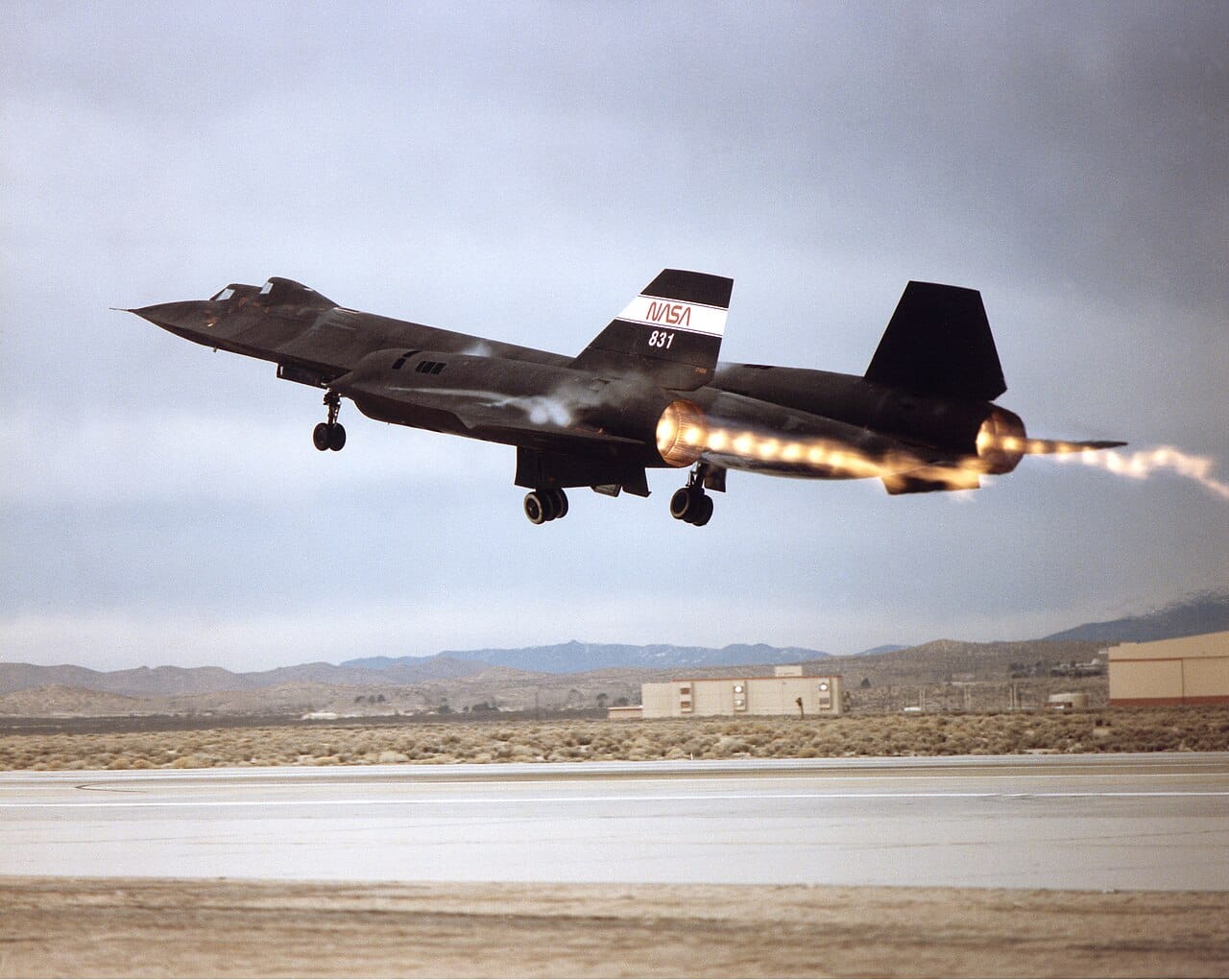
The SR-71 Blackbird was not fast in the way that other fast things are fast. It was fast in a way that bent the rules. At full cruise, the airframe heated to over 316°C (600°F) from friction alone — the titanium skin glowing a dull red in some sections. The aircraft had to be built with expansion gaps in the fuselage panels to allow for this thermal growth; on the ground, the SR-71 actually leaked fuel slightly through those gaps until the heat of flight sealed them shut.
The pilots wore full pressure suits — not unlike astronaut equipment — because at 80,000 feet, the atmosphere is too thin to breathe and the temperature outside is around -57°C. They were not flying an aircraft in any conventional sense. They were piloting a machine that existed at the edge of what human engineering could sustain.
The Best Defence: Speed
During its operational life from 1966 to 1998, the SR-71 flew over hostile territory across the Soviet Union, the Middle East, North Korea, and Vietnam. In all those flights, not a single SR-71 was ever shot down. Dozens of missiles were fired at it. None came close. The standard procedure for a missile launch was simply to accelerate — the SR-71 could outrun anything fired at it.
Brian Shul knew that better than most. He had been shot down in a different aircraft over Southeast Asia in 1972 and suffered burns over 40% of his body. Doctors told him he would never fly again. He flew the Blackbird for years. On the day of the LA speed check, he was completing the final requirement of his 100-hour SR-71 training programme.
The Cessna pilot had no idea what had just checked in above him. That, too, was part of the magic.
Sources: Brian Shul, Sled Driver; theSR71Blackbird.com; National Interest; SOFREP
 English
0 Comments