
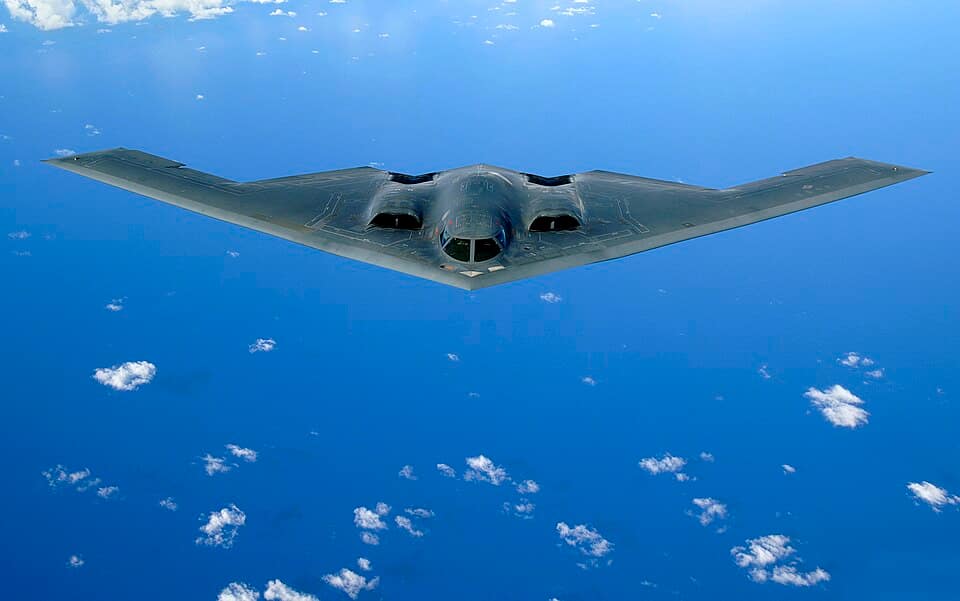
| Quick Facts | |
|---|---|
| Aircraft | Northrop Grumman B-2A Spirit stealth bomber |
| Mission Duration | Over 30 hours non-stop (some missions exceeded 33 hours) |
| Distance | ~11,000 miles round trip |
| Origin | Whiteman Air Force Base, Missouri, USA |
| Target Area | Serbia and Kosovo — Operation Allied Force, 1999 |
| Crew | Two pilots (no relief crew, no crew rest area) |
| Aerial Refuelling | Multiple mid-air refuellings from KC-135 and KC-10 tankers |
| Record | Longest combat mission in aviation history at the time — since matched by later B-2 missions |
| Amenities | A camp cot behind the seats, a chemical toilet, packed meals, and caffeine |

On the evening of March 24, 1999, two pilots strapped into a B-2 Spirit at Whiteman Air Force Base in central Missouri. They taxied out, took off into the dark, and pointed the flying wing east. Thirty-plus hours later, they would land back on the same runway, having crossed the Atlantic, bombed targets in Serbia, crossed the Atlantic again, and never once shut down the engines. No pilot change. No landing. No rest stop.
It remains the longest combat mission ever flown — a feat of endurance, engineering, and sheer human stubbornness that the Air Force has repeated but never surpassed.
Why Missouri to Kosovo?
The answer is simple: the B-2 had nowhere else to go. In 1999, Whiteman was the only base in the world equipped with the climate-controlled hangars the Spirit needs. The B-2’s stealth coating is delicate — it degrades in rain, sun, and temperature extremes. Every aircraft lives in its own air-conditioned shelter. Forward-deploying the fleet to a European base wasn’t an option. If the B-2 was going to fight in Kosovo, it had to fly from Missouri.
That meant an 11,000-mile round trip across the Atlantic, into European airspace, over the Balkans, and all the way home. The jet was designed for intercontinental range — it can fly 6,000 nautical miles without refuelling — but the mission profile still required multiple aerial refuellings from KC-135 Stratotankers and KC-10 Extenders positioned along the route. Each refuelling was a rendezvous in the dark, at altitude, with the two-man crew already hours into the flight.
Two Pilots, One Cot, One Chemical Toilet
The B-2 cockpit was designed for two pilots sitting side-by-side. Behind the ejection seats, there’s a narrow space just large enough for a folding camp cot. That’s the “crew rest area.” One pilot flies while the other lies down — not really sleeping, more like drifting in and out of consciousness while the aircraft vibrates at 40,000 feet. Then they swap.
The toilet is a portable chemical unit — essentially a camping toilet wedged behind the seats. Food is pre-packed meals and sandwiches, heated on a small warmer. Pilots have described the experience as “camping at 500 miles per hour.” The physical toll is real: after 30 hours in a pressurised cockpit, pilots report headaches, stiff joints, digestive issues, and a fatigue so deep that the final approach and landing demand every ounce of remaining concentration.

What They Hit
The B-2 missions during Operation Allied Force targeted Serbia’s integrated air defence system, command bunkers, communications nodes, and military infrastructure. The Spirit was the only aircraft in NATO’s arsenal that could penetrate Serbian air defences on the first night — before SEAD operations had degraded the threat. Its radar cross-section is famously tiny; Serbian radars, including the system that shot down an F-117 Nighthawk on March 27, 1999, never detected a B-2.
Each B-2 carried up to sixteen 2,000-pound JDAMs — GPS-guided bombs that could hit individual buildings from 40,000 feet in any weather. The precision was transformative. Previous bombing campaigns had required dozens of sorties to destroy a single target. The B-2 could take out sixteen targets in a single pass, in the dark, through cloud cover, without ever being seen.
Over the 78-day campaign, B-2s flew fewer than 1% of the total sorties but struck 33% of the targets in the first eight weeks. Six aircraft, flying from Missouri, delivered a disproportionate share of the war’s most important strikes.
The Human Cost of Endurance
The Air Force had never asked two-person crews to fly 30-hour combat missions before. The fatigue management protocols were written on the fly — literally. Pilots experimented with caffeine timing, nap schedules, and meal planning. Some swore by energy bars; others by cold sandwiches. All of them agreed on one thing: the last two hours were brutal. You’ve been awake for a day and a half, you’ve just dropped bombs on a country, and now you need to fly a precision approach into Whiteman and put a $2 billion aircraft on a 200-foot-wide runway. The margin for error is measured in inches.
Pilots have described landing after a Kosovo mission as one of the most dangerous moments in the entire sortie — not because of enemy action, but because of pure human exhaustion. The Air Force eventually developed “go pills” (amphetamines) and strict crew rest protocols for long-duration missions, but in 1999, the crews were pioneering the concept in real time.

A Record That Still Stands
The Kosovo missions set the record for the longest combat sorties in aviation history, and the B-2 has matched them several times since — in Afghanistan in 2001, when Spirits flew non-stop from Missouri to Kabul and back, and again in Libya in 2011. The B-2’s successor, the B-21 Raider, is designed for similar endurance. As long as American strategic bombers operate from continental US bases, ultra-long-range missions will remain part of the playbook.
But numbers don’t capture what it felt like. Two people in a cockpit the size of a car, crossing an ocean, dropping bombs, crossing the ocean again, and landing in Missouri while the rest of the base slept. Thirty hours with no relief, no autopilot for the hard parts, and no room for error. The B-2 is an engineering marvel. The pilots who fly it on 30-hour combat missions are something else entirely.
They are the reason the record stands.
Sources: Air & Space Forces Magazine, Smithsonian Air & Space, USAF Historical Division
 English
0 Comments