The bet was always the same. Colonel John Boyd would start from a position of disadvantage — his opponent on his tail, locked in a simulated dogfight — and within forty seconds, Boyd would reverse the situation and be on the other pilot’s tail. He offered a standing wager of forty dollars to any fighter pilot in the Air Force who could beat him. He never paid.
This was not a party trick. Boyd was arguably the greatest air-to-air combat theorist of the twentieth century. He codified the science of dogfighting, designed the F-16, revolutionised military strategy, and in the process made so many enemies in the Pentagon that he was passed over for general and retired as a colonel — a rank far below what his contributions deserved.
His ideas won the Gulf War. His name is barely known outside military circles.
Quick Facts
• Name: Colonel John Richard Boyd, USAF (1927–1997)
• Nickname: “40-Second Boyd” / “The Ghetto Colonel”
• Key contributions: Energy-Maneuverability Theory, OODA Loop, F-16 design, manoeuvre warfare doctrine
• Combat: 22 missions as F-86 pilot in Korea (no confirmed kills)
• Instructor: Fighter Weapons School, Nellis AFB
• Legacy: F-16 Fighting Falcon, manoeuvre warfare adopted by USMC, OODA Loop used across military and business strategy
The Science of the Dogfight
In the early 1960s, Boyd was an instructor at the Fighter Weapons School at Nellis Air Force Base — the Air Force’s equivalent of TOPGUN. He was already famous for his forty-second guarantee, but he wanted to know why he could do it. The intuition wasn’t enough. He wanted the mathematics.
Working with mathematician Thomas Christie, Boyd developed Energy-Maneuverability Theory, or E-M Theory. The core insight was deceptively simple: an aircraft’s combat potential at any given moment is a function of its total energy — the sum of its kinetic energy (speed) and potential energy (altitude). The fighter with a higher energy state has more options. The fighter with a lower energy state has fewer.
By plotting the energy-maneuverability characteristics of different aircraft across their entire flight envelopes — every combination of speed, altitude, and G-loading — Boyd could identify precisely where one fighter held an advantage over another. The F-86 could out-turn the MiG-15 at certain speeds and altitudes. The MiG had the advantage at others. Boyd’s charts mapped the battlefield.
The Pentagon initially classified his work. Then it tried to suppress it. Boyd, characteristically, ignored both responses and briefed anyone who would listen.
Colonel John Boyd, USAF. His Energy-Maneuverability Theory and OODA Loop transformed both fighter design and military strategy. US Air Force / Wikimedia Commons
The F-16: Boyd’s Lightweight Fighter
E-M Theory led Boyd to a radical conclusion: the Air Force was building the wrong fighters. The F-15 Eagle, then in development, was a heavy, expensive, twin-engine air superiority fighter. Boyd argued that a smaller, lighter, more manoeuvrable aircraft — optimised for energy performance rather than raw speed — would be more effective in a dogfight and far cheaper to produce in quantity.
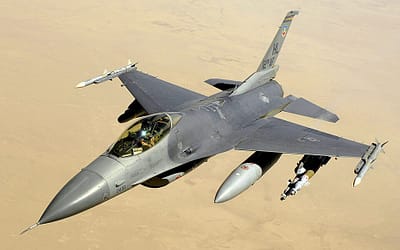
With a small group of like-minded officers and civilians — the so-called “Fighter Mafia” — Boyd championed the Lightweight Fighter programme. The result was General Dynamics’ YF-16, which won a fly-off against the Northrop YF-17 in 1974. The F-16 Fighting Falcon entered service in 1978 and has since become the most produced Western fighter jet of the modern era — over 4,600 built and operated by 25 nations.
Boyd never received public credit for his role in the F-16’s design. The Pentagon’s procurement establishment, which he had antagonised for years, ensured that the official history emphasised institutional decisions rather than individual contributions.
The OODA Loop: Beyond the Cockpit
Boyd’s most enduring intellectual legacy has nothing to do with aircraft. In the 1970s and 1980s, he developed a theory of conflict and decision-making known as the OODA Loop: Observe, Orient, Decide, Act. The concept is that victory goes to the side that can cycle through this loop faster than the adversary — not just in individual engagements, but at every level of warfare.
The OODA Loop was revolutionary because it applied to strategy, not just tactics. Boyd briefed Marine Corps Commandant General Charles Krulak and his predecessors on manoeuvre warfare — the idea that speed, surprise, and disruption of the enemy’s decision-making cycle matter more than attrition and firepower. The Marine Corps adopted manoeuvre warfare as its official doctrine. The Army resisted.
In February 1991, General Norman Schwarzkopf’s “left hook” in Desert Storm — the rapid flanking manoeuvre that bypassed Iraqi defences and collapsed Saddam Hussein’s army in 100 hours — was a textbook Boyd operation. Faster OODA loops. Faster decisions. Faster action. The Iraqi command structure was overwhelmed not by superior firepower but by superior tempo.
Boyd died in 1997, largely unrecognised by the institution he had served and transformed. He retired as a colonel despite contributions that, in a just world, would have earned him four stars. His Pentagon office had been a tiny, windowless room. His colleagues called him “The Ghetto Colonel.”
His ideas run the modern American way of war. His name belongs alongside Mitchell, Douhet, and Mahan — the great military theorists who changed how nations fight. The forty-second bet was just the beginning.
Sources: Robert Coram, “Boyd: The Fighter Pilot Who Changed the Art of War”; USAF Fighter Weapons School; Marine Corps University
From the fjords of northern Norway to the sun-baked runways of southern Spain, NATO is conducting the largest air exercise in Alliance history. Ramstein Flag 2026, which began on 8 June and runs through 19 June, has assembled more than 200 aircraft from 18 nations...
The numbers arrived in Brussels like a cold shower. US fighter jets allocated to NATO: cut from 150 to 100. KC-46 aerial refuelling tankers: all eight withdrawn. Maritime patrol aircraft: slashed from 26 to 15. One carrier strike group, one cruise-missile submarine,...
Forget everything you think you know about how military drones get made. Lockheed Martin's legendary Skunk Works division — the outfit that gave us the U-2, the SR-71 Blackbird, and the F-117 Nighthawk — just showed off an unmanned aircraft that was designed,...



 English
0 Comments