
The Korean morning was cold enough on 20 May 1951 that the ramp crews at Kimpo Air Base could see their breath inside the open cockpits as they buttoned up the F-86 Sabres of the 334th Fighter-Interceptor Squadron. The pilots, climbing into the jets, smelled the same things every fighter pilot of that era smelled at engine start: aviation fuel, oil mist, and the faint, slightly chemical odour of a J47 turbojet beginning its run-up. Among them was Captain James “Jabby” Jabara — a 27-year-old Kansan, four MiG-15 kills already on his record, who was about to fly the most consequential combat mission of his life.
By that afternoon, he would have done what no pilot in the history of military aviation had done before. He would have shot down five enemy jets, in jet-to-jet combat, in the same conflict. He would have made himself the first jet ace in history. Seventy-five years ago today — 20 May 2026 — that achievement turns three-quarters of a century old, and it is still the entry point into modern fighter-aviation lore.
The Squadron That Wrote the Doctrine
The 4th Fighter-Interceptor Wing arrived in Korea in December 1950 carrying the most important aircraft of the war: the F-86 Sabre. The MiG-15 had appeared over Korea earlier that autumn, flown initially by Soviet pilots posing as Chinese, and it had been ripping through the obsolete F-80 Shooting Stars and F-84 Thunderjets that the USAF had been using for air superiority. The Sabre was the answer. Pilots who had flown both said the MiG had a higher service ceiling and tighter low-speed turn; the Sabre had better high-speed handling, better gunsight, and dramatically better systems.
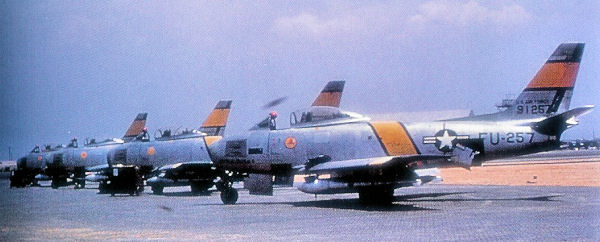
Jabara had arrived with the 334th on 13 December 1950. He was already a combat veteran from World War II — he had flown P-51 Mustangs in Europe in 1944-45, scored 1.5 confirmed kills against the Luftwaffe, and survived a bail-out from a damaged Mustang over Belgium. By Korean War standards he was experienced. By jet-combat standards, like every other pilot in the theatre, he was making it up as he went.
A Streak in April
Jabara's first MiG-15 fell on 3 April 1951, in a 12-versus-12 furball in MiG Alley. Another came on 10 April. A third on 12 April. A fourth on 22 April. Four kills in nineteen days. He needed one more to become an ace under American counting rules. The Air Force then did something unusual: they ordered him home. The political optics of producing the first American jet ace were so important that the brass wanted Jabara on a publicity tour rather than a fifth combat sortie. He protested. He stayed.

On 20 May 1951, the squadron put two flights into the air on a routine MiG Alley patrol. Radio chatter from a separate flight reported MiG-15s engaged east of Sinuiju. Two more flights, including Jabara's, climbed to join the fight. Jabara's flight ordered drop tanks jettisoned to clean up the Sabres for maneuvering combat. Three of the four tanks fell away cleanly. Jabara's right-wing tank stuck.
The Stuck Drop Tank
Standard operating procedure for a Sabre flying with a single asymmetric drop tank still attached was unambiguous: return to base. The aerodynamic penalty of an asymmetric fuel-tank load was severe in a fighter that already operated at the edges of its drag envelope in supersonic combat. The aircraft would handle poorly. Manoeuvring rolls would be biased. The pilot would lose energy faster than the rest of his flight. Against MiG-15s, those penalties could be fatal.

Jabara stayed. The flight engaged a formation of MiG-15s. Jabara, dragging his stuck tank, dropped into the bandit formation. He shot down the first MiG-15 within seconds. The second, manoeuvring hard, was nailed by Jabara minutes later. With six confirmed kills total, he was now the first jet ace in history — and he had done it in an aircraft he should never have flown into combat that day.

The Photograph
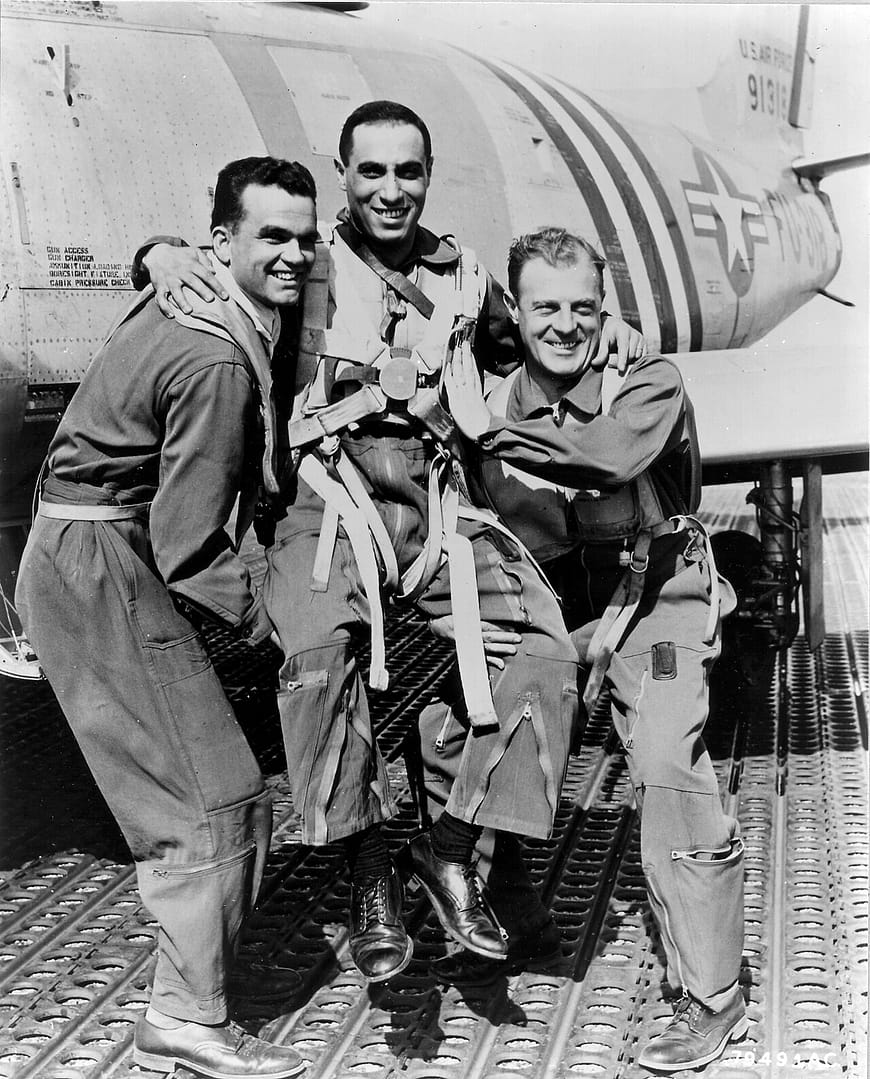
The image taken on the ramp at Kimpo that afternoon is the one that survives. Two squadron mates — Captain James Roberts and Lieutenant Salvadore Kemp — hoisted Jabara out of the Sabre's cockpit by his armpits, the cameras of an Air Force public-affairs detachment shooting frame after frame. Jabara's grin is the grin of every fighter pilot who has just survived something he should not have survived. The Sabre behind him, its right-wing drop tank still stuck in place, was already in the maintenance queue for an inspection.

The next day, the Air Force flew Jabara out of Korea for the publicity tour they had wanted him to do already. Time magazine put him on the cover. He met President Truman. He gave the speeches. Then, the publicity rotation finally over, he insisted on returning to Korea for a second combat tour in 1953. He scored another nine kills in that second tour, bringing his Korean War total to fifteen — making him a triple ace and the war's second-highest-scoring American pilot.
What He Proved
Jabara's 20 May flight settled an open question of post-WWII air combat: could a jet pilot become an ace in a single conflict? Until that afternoon, nobody knew. The MiG-15 had appeared so suddenly, the air combat tempo of jet-versus-jet had been so different from propeller-era dogfighting, and the survival math had been so unforgiving, that some analysts genuinely doubted it would happen. Jabara's answer was: yes, in three months, with a stuck drop tank, while disobeying a flight-safety recommendation.
Forty other American pilots would become jet aces in Korea before the war ended in 1953. Joe McConnell would reach 16 confirmed kills, surpassing Jabara to become the war's top jet ace. But the first was always Jabara — and the first is always remembered.
After Korea
Jabara stayed in the Air Force, flew F-104 Starfighters in the 1960s, served as Commander of the 31st Tactical Fighter Wing at Homestead AFB in Florida, and earned a senior rank in command of the 4th Fighter Wing back at Seymour Johnson. He died on 17 November 1966, not in combat but in a car accident on a Florida highway, alongside his teenage daughter. He was 43.
His name now sits on a fighter-pilot trophy awarded annually to the outstanding instructor at the USAF Weapons School, on the wing of a Kansas airport that bears his name, and on the wall of the National Aviation Hall of Fame. Seventy-five years after the afternoon his stuck drop tank refused to fall away and he chose to fight anyway, James Jabara is still the first jet ace in history. He is the entry that every fighter pilot in every air force on earth has read, on the way to writing his or her own.
Sources: Wikipedia — James Jabara; American Fighter Aces Association; HistoryNet (Captain James Jabara: Ace of the Korean War); Super Sabre Society; AcePilots.com; Military.com; VA News.

 English
0 Comments