
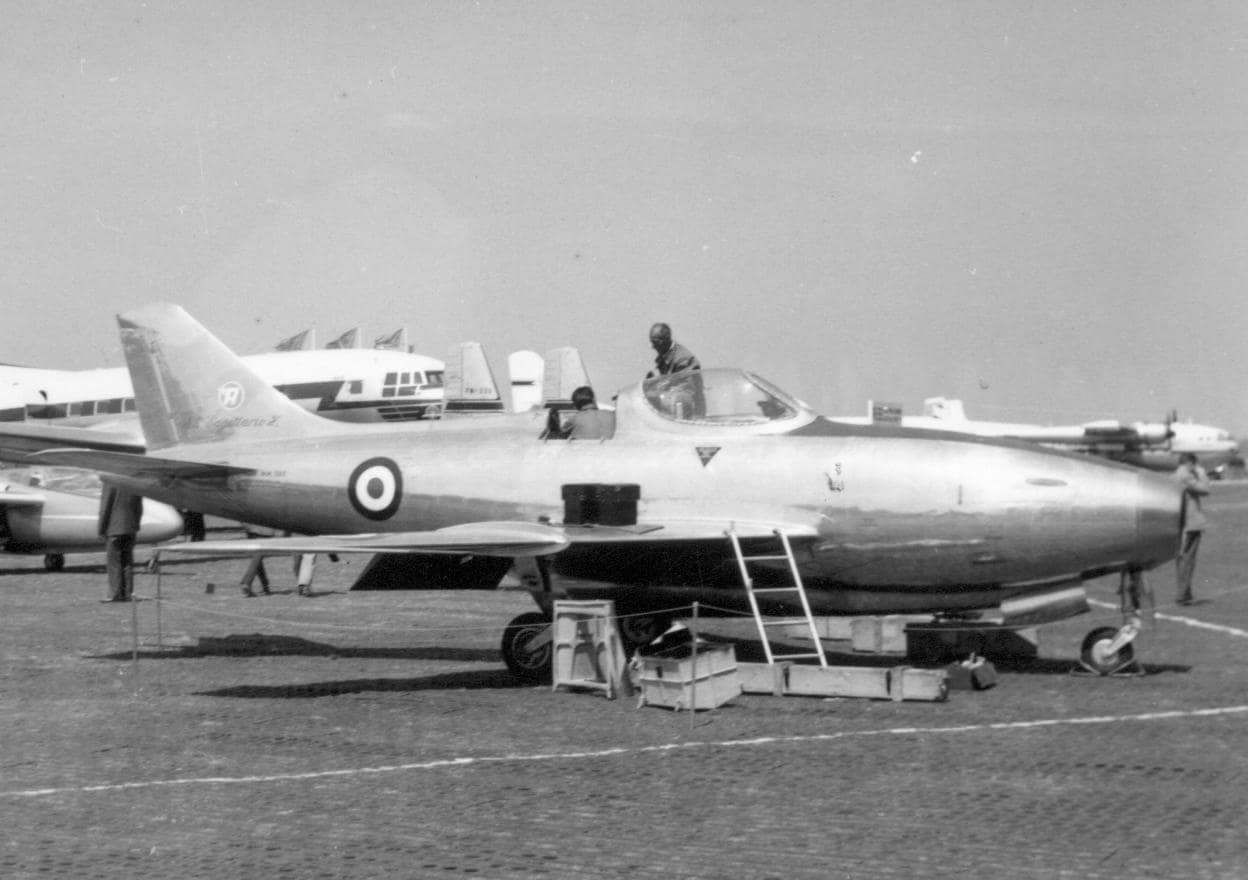
Seventy years ago today — 19 May 1956 — an Italian aeronautical engineer named Sergio Stefanutti watched his answer to a NATO design competition lift off the runway at the Pomigliano d’Arco airfield outside Naples. The aircraft he had spent three years designing was small, elegant, sharp-nosed, and almost ridiculously slim. It was called the Aerfer Sagittario 2 — Archer 2 — and it was about to make Italy the fifth nation in history to fly an aircraft of its own design through the sound barrier.
The story of how that happened is one of the most overlooked chapters of European aviation. Italy in the mid-1950s was not the country most analysts expected to produce a working supersonic prototype. The Italian aircraft industry had been bombed flat in 1944-45. Aerfer itself was a small company in Naples, founded in 1950 from the wreckage of several pre-war manufacturers. Stefanutti had designed wooden gliders before the war and made his name on Ambrosini Supersette trainers in the early 1950s. The Sagittario 2 was the most ambitious thing he had ever attempted.
A Small Country with a Big Ambition
The NATO Basic Military Requirement 1 (NBMR-1), issued in December 1953, asked NATO member nations to design a light tactical support aircraft — a small, cheap, jet-powered close-support fighter that could operate from short, semi-prepared airfields. Eight countries submitted entries. The expected favourites were French (Dassault) and British (Folland, with the eventual Gnat). Italy, with two entries, was the surprise. Fiat submitted the G.91, which would go on to win the competition. Aerfer submitted the Sagittario 2.
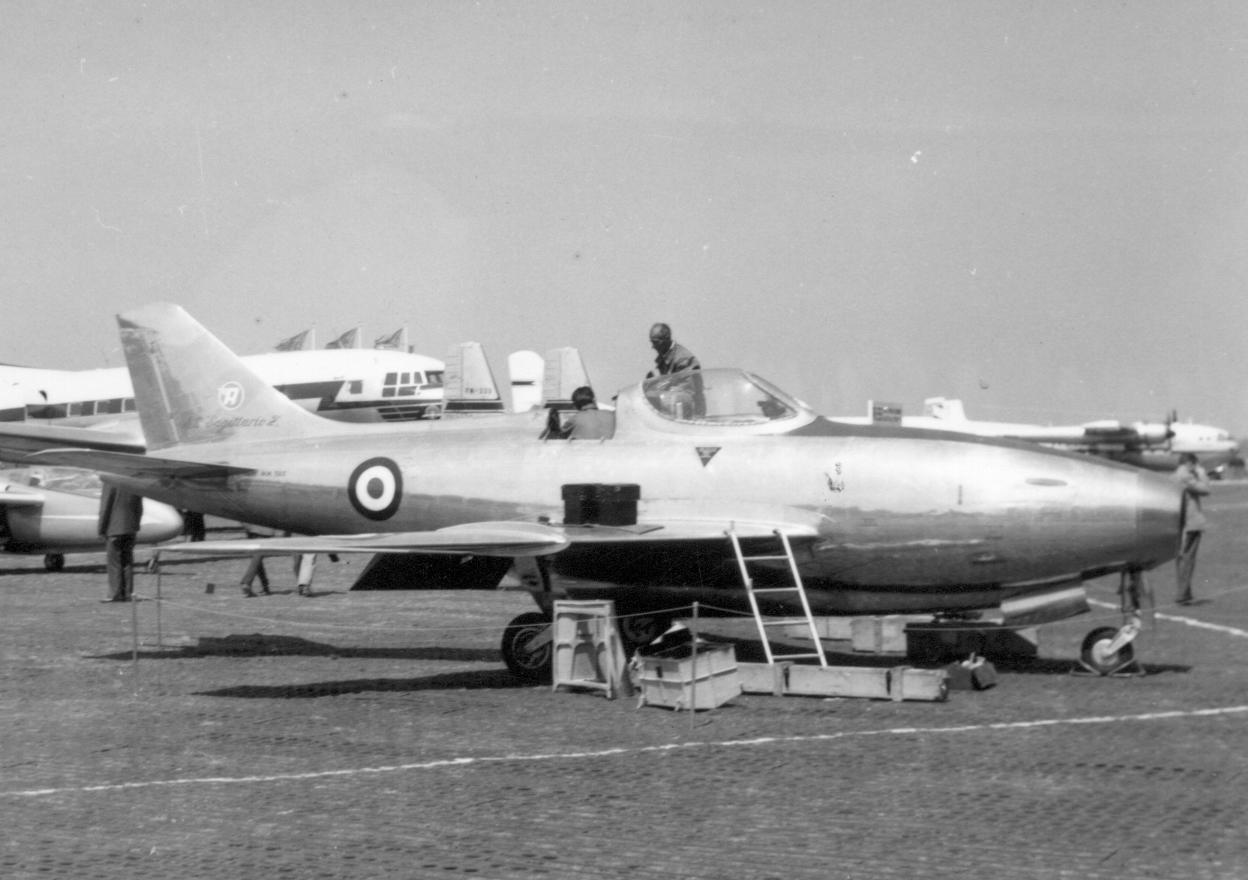
Stefanutti's approach was unconventional. Rather than design a stable, conservative subsonic fighter — which is what NBMR-1 essentially asked for — he designed an aircraft capable of being pushed through the sound barrier in a dive. The reasoning, he later explained, was that supersonic flight capability was inevitably going to be a NATO requirement, and an Italian fighter that could already do it would have a competitive advantage. The argument was strategically correct. The procurement decision, however, came down to manufacturing maturity rather than top speed. Fiat had the production capacity. Aerfer did not.
The First Italian Mach 1
On 4 December 1956, six and a half months after the first flight, Lieutenant Colonel Giovanni Franchini of the Italian Air Force climbed the Sagittario 2 to 13,725 metres (about 45,000 feet) above the Tyrrhenian Sea. He pushed the nose over into a steep dive. The aircraft accelerated through 0.95 Mach, through 1.0, and reached 1.1 Mach before he pulled out. The flight recorder confirmed the speed. Italy had its first supersonic aircraft.

The achievement put Italy in select company. Only the United States (X-1, October 1947), the Soviet Union (Mikoyan I-310, late 1948), Great Britain (English Electric Lightning ancestor F.23/49, August 1954), and France (Dassault Mystère II, 1954) had previously fielded aircraft of their own design that exceeded Mach 1 in controlled flight. The Italian Air Force's contribution to the achievement was Lt. Col. Franchini, who would go on to test the Sagittario 2's successor, the Ariete, before being killed in a Lockheed F-104 crash in 1962.
The Engine That Held It Back
The Sagittario 2's production engine was supposed to be the Bristol Siddeley Orpheus — the same engine that would power the Fiat G.91 and Folland Gnat. Bristol Siddeley delivered the Orpheus on schedule for the G.91 but on a slower timeline for the Sagittario 2 derivative work. Stefanutti, unwilling to wait, fitted the prototype with the older Rolls-Royce Derwent 9, a centrifugal-flow turbojet that had powered late-1940s Meteor fighters and was, by 1956, a generation behind. The Derwent 9 produced 3,500 lb of thrust. The Orpheus would have produced 4,850 lb. The Sagittario 2's supersonic dive was achieved with the older engine, in a power-marginal configuration that prevented level supersonic flight.

Had the Orpheus been available from day one, the Sagittario 2 would have been a level supersonic fighter — comparable in capability to the early Lockheed F-104 and ahead of the Fiat G.91. The Orpheus arrived too late for the Sagittario 2 prototype. Stefanutti began work on a Sagittario 3 derivative, eventually renamed Ariete (Aries), with the Orpheus and an under-fuselage rocket motor for additional acceleration. The Ariete flew in March 1958 and reached supersonic speed in level flight — but by then the NBMR-1 competition was over.
Lost Competition, Quiet Legacy
The Italian Air Force evaluated the Sagittario 2. Test pilots flew it. The handling, by all accounts, was sharp — a small, light aircraft with the kind of nose-pointing authority that made supersonic dives possible. But the competition decision had already been made. The Fiat G.91 was Italy's entry into the NATO light fighter market. Aerfer was directed to support Fiat's production rather than continue with its own design.

The single Sagittario 2 prototype eventually went to the Italian Air Force museum at Vigna di Valle, where it remains today. Aerfer itself merged into Aerfer-Industrie Meridionali, then into the company that eventually became Alenia, then into Leonardo. The current Italian aerospace giant — which builds the M-346 trainer, the Eurofighter Typhoon's structural workshare, the F-35 Italian assembly line, and the GCAP sixth-generation fighter — traces a corporate line directly back through Aerfer to Stefanutti's small design office in Naples.
Why It Matters
The Sagittario 2 did not enter service. Its first flight made no international newspapers in 1956. Its supersonic dive on 4 December that year was reported in three Italian newspapers and ignored by everyone else. The aircraft's contribution to aviation history is, statistically, negligible.
And yet: when modern Italy contributes the Eurofighter's avionics, when Leonardo signs the GCAP treaty alongside BAE Systems and Mitsubishi, when the Italian Air Force's F-35Bs operate from the carrier Cavour, the through-line is the Sagittario 2. A small country with a battered post-war aircraft industry, in 1956, built a fighter that could fly through the sound barrier. Seventy years later, the descendants of the people who built it are partners in the next-generation fighter programmes that will define the 2030s. The Archer 2 was the first arrow in a quiver Italy is still drawing from.
Sources: Wikipedia — Aerfer Sagittario 2; MilitaryFactory; SilverHawkAuthor; Italian Air Force Museum, Vigna di Valle; Volare aviation journal, 1957 issues.
 English
0 Comments