
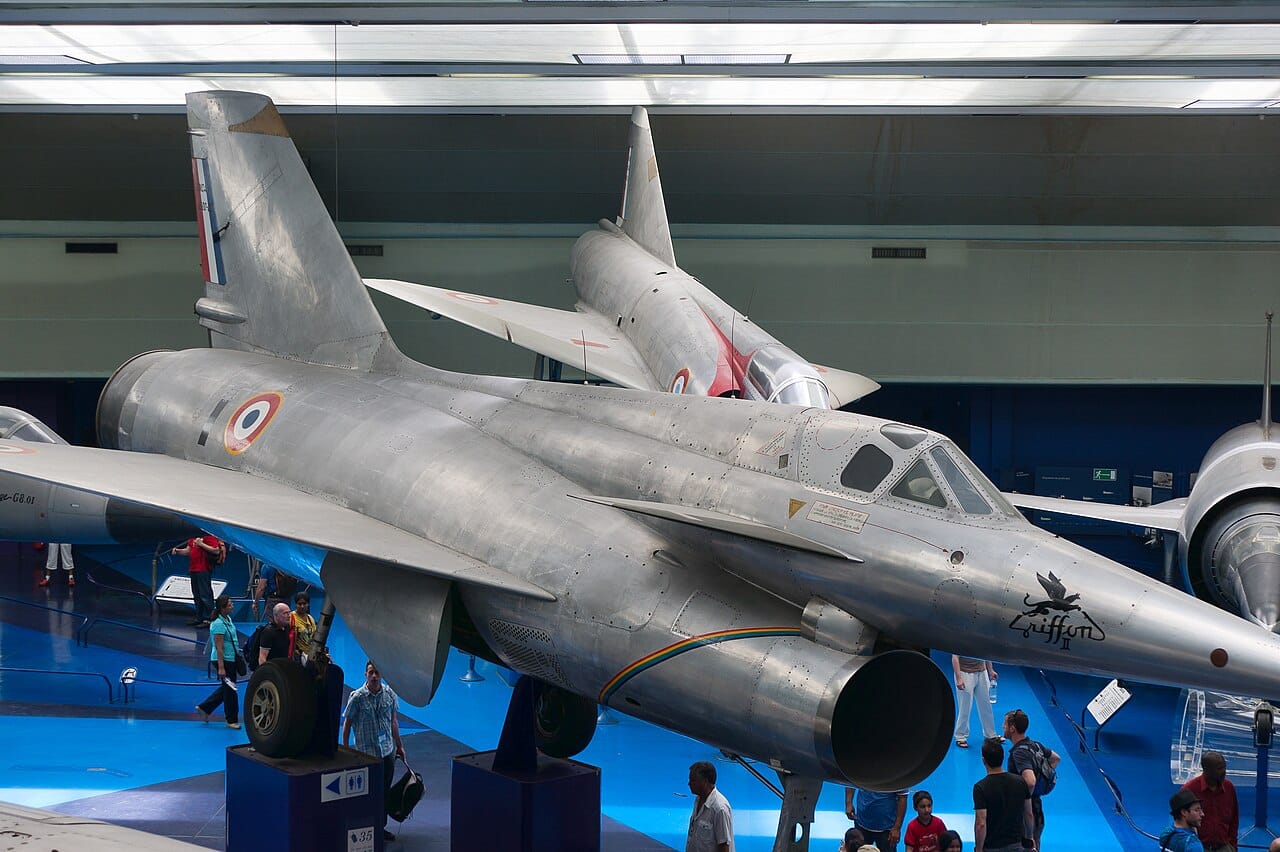
In the late summer of 1957, in the South of France, a 36-year-old test pilot named André Turcat climbed into the cockpit of an aircraft that, by every reasonable standard of aerospace engineering, should not have flown. The Nord 1500 Griffon II had a turbojet engine. It also had a ramjet engine. The two engines were stacked one inside the other, in the same nacelle, sharing the same air intake and the same exhaust nozzle. Turcat would later say, in his memoirs, that the Griffon was “the aircraft I most enjoyed flying and most often expected to die in.” Both statements were accurate.
Over the following two years, Turcat would take the Griffon II to Mach 2.19, a speed exceeded by no other French aircraft of the 1950s. He would prove that a combined turbojet-ramjet propulsion system could work in a piloted aircraft. He would survive flights at temperatures and dynamic pressures that no French airframe had yet been engineered for. And then, in 1961, the French Air Force would quietly cancel the programme, leaving the Nord 1500 Griffon to become the most spectacular orphan of post-war French aerospace.
A French Engineering Bet
The Griffon began as a Nord Aviation research project in 1953, under a French Air Force letter of intent for two experimental aircraft to explore the territory beyond the Nord Gerfaut — France's first supersonic aircraft, which had reached Mach 1.3 in 1954. The new programme's requirement was simple to state and absurdly difficult to engineer: build an aircraft that could routinely fly at Mach 2. The French aerospace establishment's answer was, even by French aerospace standards, audacious. Stack a turbojet inside a ramjet. Use the turbojet for takeoff and low-speed flight. Above Mach 0.9, route the airflow around the turbojet's combustion chamber and ignite it as a ramjet. The exhaust nozzle was the same. The intake was the same. The two engines fired sequentially, not simultaneously.

The concept was not entirely new. Charles Nungesser had patented a similar idea in 1922. René Leduc, the pioneering French ramjet engineer, had been flying ramjet-powered research aircraft (the Leduc 0.10, 0.21 and 0.22) since the late 1940s. But Leduc's aircraft were pure ramjets, dropped from a Languedoc carrier aircraft because ramjets cannot start at zero airspeed. The Griffon was the first piloted aircraft to combine a turbojet (to get the aircraft airborne and up to ramjet ignition speed) with a ramjet (to actually push it through Mach 2) in a single integrated nacelle.
Turcat's Aircraft
André Turcat — who in another twenty years would become the chief test pilot of the Concorde, taking the airliner to Mach 2 in 1969 — was a young French Air Force major in 1955 when he was assigned to the Griffon programme. He flew Griffon I, the turbojet-only first prototype, to Mach 1.3 in 1955. When the Griffon II rolled out of the Nord Aviation factory at Châtillon in January 1957, with its ramjet integrated, Turcat was the only pilot trusted to fly it.

Over the next two years, Turcat flew the Griffon II to progressively higher speeds. Mach 1.7 in late 1957. Mach 1.95 in spring 1958. Mach 2.05 in summer 1958. Finally, in late 1958, Mach 2.19 — the Griffon's maximum recorded speed and, at the time, the fastest any French aircraft had ever flown. The achievement won Turcat the Harmon Trophy, the international aviator award. It also confirmed, definitively, that the combined-cycle propulsion concept worked.

Why the Programme Ended
The Griffon should, by every technical measure, have led to a French Mach 3 interceptor. By 1960 the propulsion concept was proven. The airframe handled. Turcat's flight envelope work had identified the structural and thermal limits. The French Air Force should have, on this evidence, ordered a production interceptor.
It did not. The reason was the SR-71 Blackbird's 1962 first flight, the Soviet Mikoyan Ye-150 series (also Mach 2.65 and never produced), and a clear shift in French strategic thinking toward nuclear deterrence rather than high-speed interception. France was building its own nuclear strike force around the Dassault Mirage IV bomber. The Air Defence Force's requirement for a high-altitude interceptor evaporated when surface-to-air missiles improved enough to do the same job at a fraction of the cost. The Mirage III, in production at Dassault, could intercept Soviet bombers at Mach 2 with off-the-shelf missile armament. The Griffon offered Mach 2.19 and the promise of Mach 3 — but only at the price of an entirely new powerplant supply chain, an entirely new airframe-temperature engineering programme, and entirely new pilot training.

On 5 June 1961, the French Air Force formally closed the Nord 1500 Griffon programme. Nord Aviation merged with Sud Aviation in 1970 to form Aérospatiale, the company that would build Concorde. André Turcat went on to become the man who took Concorde to Mach 2 in 1969 — a career arc that owed everything to the Griffon work he had done a decade earlier.
The Long Shadow
The Griffon's technology never quite disappeared. The combined-cycle propulsion concept resurfaced in the British Reaction Engines SABRE programme in the 2010s — an air-breathing rocket engine that combines turbojet, ramjet and rocket modes in the same nacelle. The Griffon's integrated turbojet-ramjet was the first piloted-aircraft prototype to demonstrate the basic principle Reaction Engines is still working on sixty-five years later.
The Griffon II itself sits today at the Musée de l'air et de l'espace at Le Bourget, near Paris. Visitors who walk past it usually do not realise how unusual its engine is. The single massive air intake hides the dual-stage propulsion system inside. The aircraft looks, from the outside, like a large supersonic delta-wing fighter. Inside the nacelle, the most ambitious propulsion experiment in 1950s European aviation sits silent.
André Turcat died in 2016, aged 94, with the Griffon and the Concorde both behind him as the two aircraft of his career he most enjoyed flying. Both were Mach 2 aircraft. Both were French. Only one ever entered service. The Griffon — the one with a ramjet bolted to a turbojet, the one that nobody else had ever quite tried — deserves more than the footnote it has become.
Sources: Wikipedia — Nord 1500 Griffon; Plane Historia; MilitaryFactory; BuzzHint; Musée de l'air et de l'espace, Le Bourget; André Turcat memoirs (Plus haut, plus loin, plus vite, 1992).

 English
0 Comments