
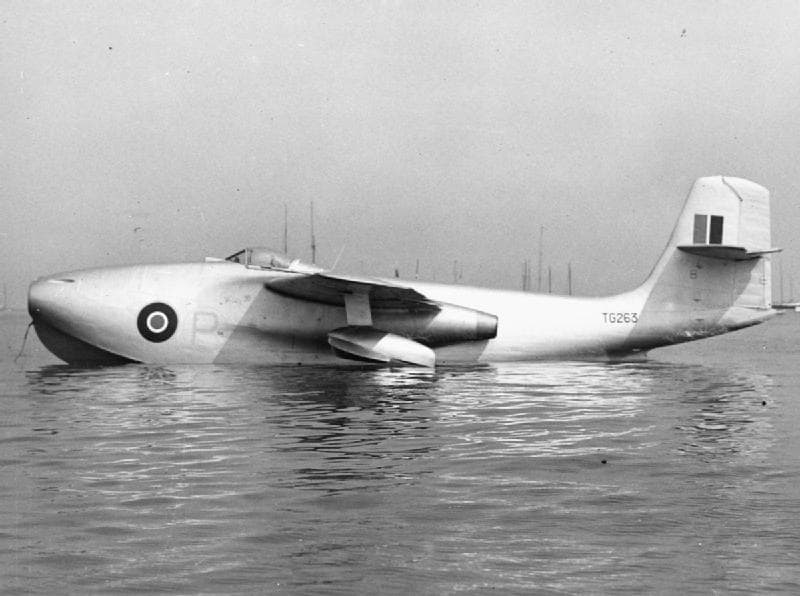
In 1947, a small British company called Saunders-Roe — known mostly for building flying boats and small civil amphibians — flew an aircraft that should not have existed. The SR.A/1 was a shoulder-winged, twin-jet, fighter-grade combat aircraft. Top speed around 820 km/h. Armament: four 20mm cannon. Endurance: nearly two hours. The catch: it took off from water, dogfought from water, and landed back on water. Britain had built the world’s first jet flying-boat fighter.
Quick Facts
Aircraft: Saunders-Roe SR.A/1
First flight: 16 July 1947, Cowes, Isle of Wight
Top speed: ~512 mph (824 km/h)
Engines: Two Metropolitan-Vickers Beryl turbojets, fuselage-mounted
Built: Three prototypes; project finally abandoned in 1951
A Wartime Idea That Refused to Die
The SR.A/1 was born from a Second World War problem. In the Pacific theatre, the Allies fought an air campaign across enormous distances. Airfields were precious. Pacific islands were scarce. The US Navy turned to aircraft carriers. Britain considered an alternative: a fighter that did not need an airfield at all, because it took off and landed on water.
The idea seems ridiculous now. In 1944 it did not. Henry Knowler, Saunders-Roe’s chief designer, was a flying-boat man with decades of experience designing successful amphibians. He proposed a jet-powered single-seat fighter built around a planing hull, with two turbojet engines buried deep in the fuselage to keep them away from spray. The Air Ministry ordered three prototypes.
By the time the SR.A/1 first flew in 1947, the war was over. The Pacific island campaign was a memory. But Saunders-Roe pressed on.
“The only thing we can say is, we took the bull by the horns, accepting the limitations in engine performance, to show jet propulsion was conceivable for naval operations. I was well aware I was making history.”
— Captain Eric “Winkle” Brown, on the first jet carrier landing in a Sea Vampire
The Engineering Was Remarkable
The SR.A/1 actually worked. The aircraft handled crisply in the water and the air. The Beryl turbojets — among the first British jet engines designed for axial flow — produced enough thrust to get the aircraft on the step quickly and into the air within a reasonable run. Test pilots reported handling characteristics comparable to contemporary land-based jet fighters.
The engineering challenges were genuine and well-solved. Spray ingestion into the engines was managed with cleverly designed intakes. The wing was mounted high to keep it clear of water and to provide adequate clearance for the underwing fuel tanks. The pilot sat directly above the engine bays — close enough to feel the heat, far enough above the waves not to take a constant battering.
The cannon armament — four 20mm Hispanos — gave the SR.A/1 the same firepower as an early Meteor or Vampire.
“Easier in every sense to take off, due to the clear view ahead offered by a propeller-less aeroplane and the absence of torque in a jet. The Sea Vampire took off like a scalded cat!”
— Captain Eric Brown, on the advantages of jet-powered carrier operations
The Death of an Idea
The SR.A/1 was killed by the same forces that killed many post-war British military aircraft: budget cuts, fast-moving technology, and the absence of any real mission. By 1949, the strategic case for water-based fighters had collapsed. The carrier-based Sea Hawk and Sea Vixen were faster, more flexible, and operating from much more capable aircraft carriers. Jet engines themselves were improving so rapidly that any specialised airframe became obsolete within months.
Britain cancelled the SR.A/1 programme. Two of the three prototypes were lost in accidents during the test programme. The surviving aircraft (TG263) is preserved at the Solent Sky Museum in Southampton, where you can still see it: small, sleek, and quietly extraordinary.
The SR.A/1 is one of those aircraft that almost everyone who learns about it remembers. It was a brilliant idea, executed competently, that the world had simply moved past before the prototype could find a mission. Britain had built the world’s first jet flying-boat fighter. Only Convair’s Sea Dart ever tried the idea again.
Sources: BAE Systems heritage archives, Solent Sky Museum, RAF Museum technical files.
 English
0 Comments