
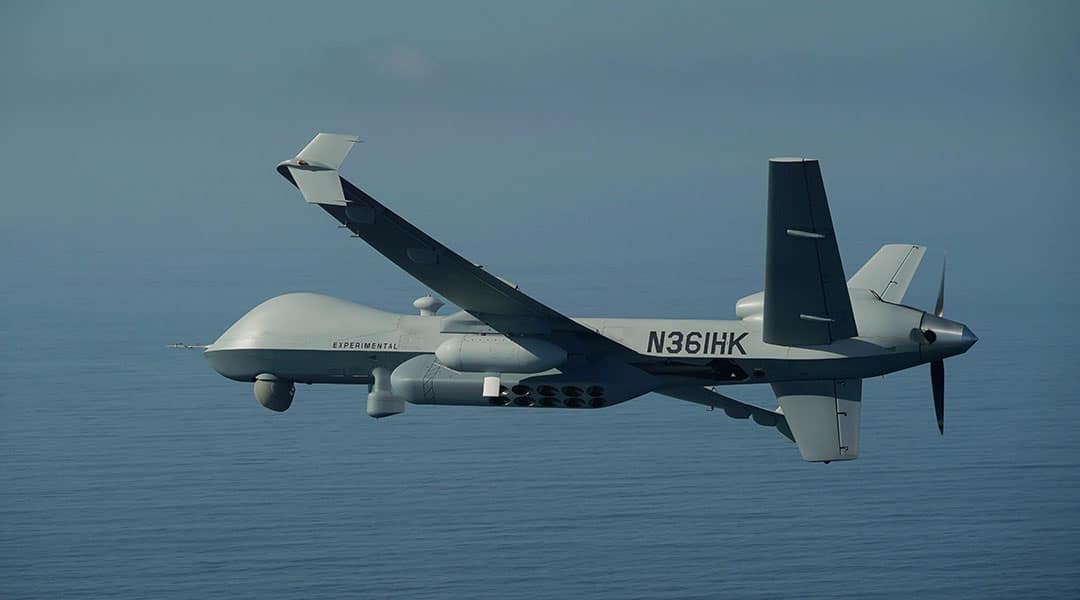
General Atomics Aeronautical Systems has shown its MQ-9B SeaGuardian carrying four Sonobuoy Dispensing System (SDS) pods at once, a configuration that converts a remotely piloted aircraft into a credible anti-submarine warfare platform. Until now, almost every image of the type in the ASW role showed it with two pods. The step to a full complement of four is not cosmetic; it doubles the acoustic sensor load the aircraft drags out over the water.
The arithmetic is straightforward. Each SDS pod carries and dispenses up to 10 U.S. Navy-compliant ‘A’-size sonobuoys or up to 20 smaller ‘G’-size buoys. With one pod on each of the four wing hardpoints, the SeaGuardian holds and deploys up to 40 ‘A’-size or 80 ‘G’-size sonobuoys per sortie.
That is a meaningful number of sensors to lay, re-lay and shift over a maritime box, and the aircraft can do it without a crew on board and for far longer than any helicopter or crewed patrol jet can stay airborne.
Quick Facts
- Platform: General Atomics MQ-9B SeaGuardian, remotely piloted
- Pods: Up to 4 Sonobuoy Dispensing System (SDS) pods, one per wing station
- Capacity: 10 ‘A’-size or 20 ‘G’-size buoys per pod; up to 40 ‘A’-size / 80 ‘G’-size total
- Endurance: Exceeds 18 hours in a maritime ISR/ASW fit; ~1,200 nmi (2,220 km) mission radius
- Milestone: First uncrewed aircraft to drop Multi-static Active Coherent (MAC) buoys, Dec 17 2025
- Lineage: First airborne ASW demo on an MQ-9A in November 2020
From Two Pods to Four
The path here has been incremental and well documented. General Atomics first demonstrated sonobuoy remote processing from an MQ-9A back in 2017, then completed what it called the world’s first self-contained ASW capability for an unmanned aircraft in November 2020, dropping bathythermal, DIFAR and DICASS buoys and tracking a mobile training target for three hours over a Pacific range.
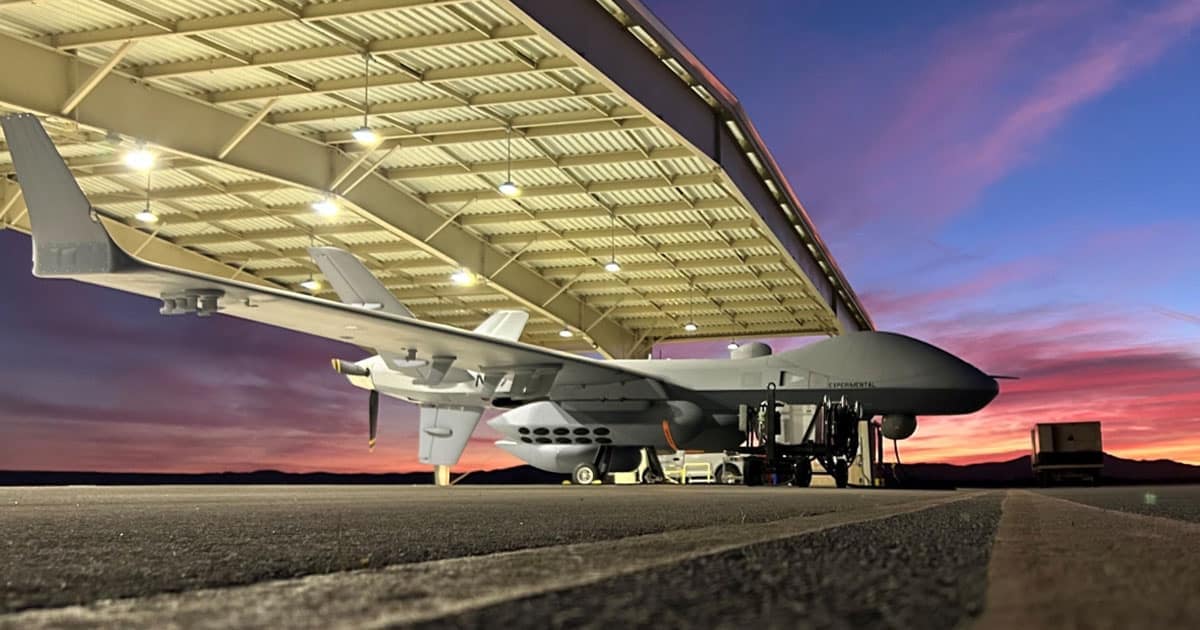
A December 17, 2025 flight test for the U.S. Navy pushed the envelope further, using more SDS pods than previously flown and effectively doubling the buoys carried. That same test marked the first time Multi-static Active Coherent (MAC) sonobuoys had ever been dispensed from an uncrewed aircraft. MAC buoys cover larger areas and need fewer units than legacy DIFAR and DICASS fields, which matters when you are trying to blanket open ocean.
Sensors, Processing and the Network
Carrying buoys is only half the job. The SeaGuardian’s ASW fit pairs the dispensers with a Sonobuoy Monitoring and Control System (SMCS) that receives and processes the acoustic data, generating target tracks with calculated course, speed and depth on board the aircraft.
Crucially, the aircraft pushes those acoustic products out over tactical data links rather than keeping them local. In practice that turns a buoy drop into a shared, networked contribution to the wider maritime picture, capable of cueing a P-8A, an MH-60R helicopter, a surface combatant or a friendly submarine.
Complement, Not Replacement, for the P-8
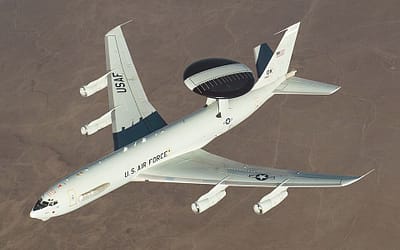
This is where the comparison with crewed maritime patrol aircraft deserves precision. A Boeing P-8A Poseidon remains the high-end tool for prosecution, weapon delivery and complex multi-sensor tactics, but a crewed jet typically manages only around four hours on station before crew endurance becomes the limiting factor.
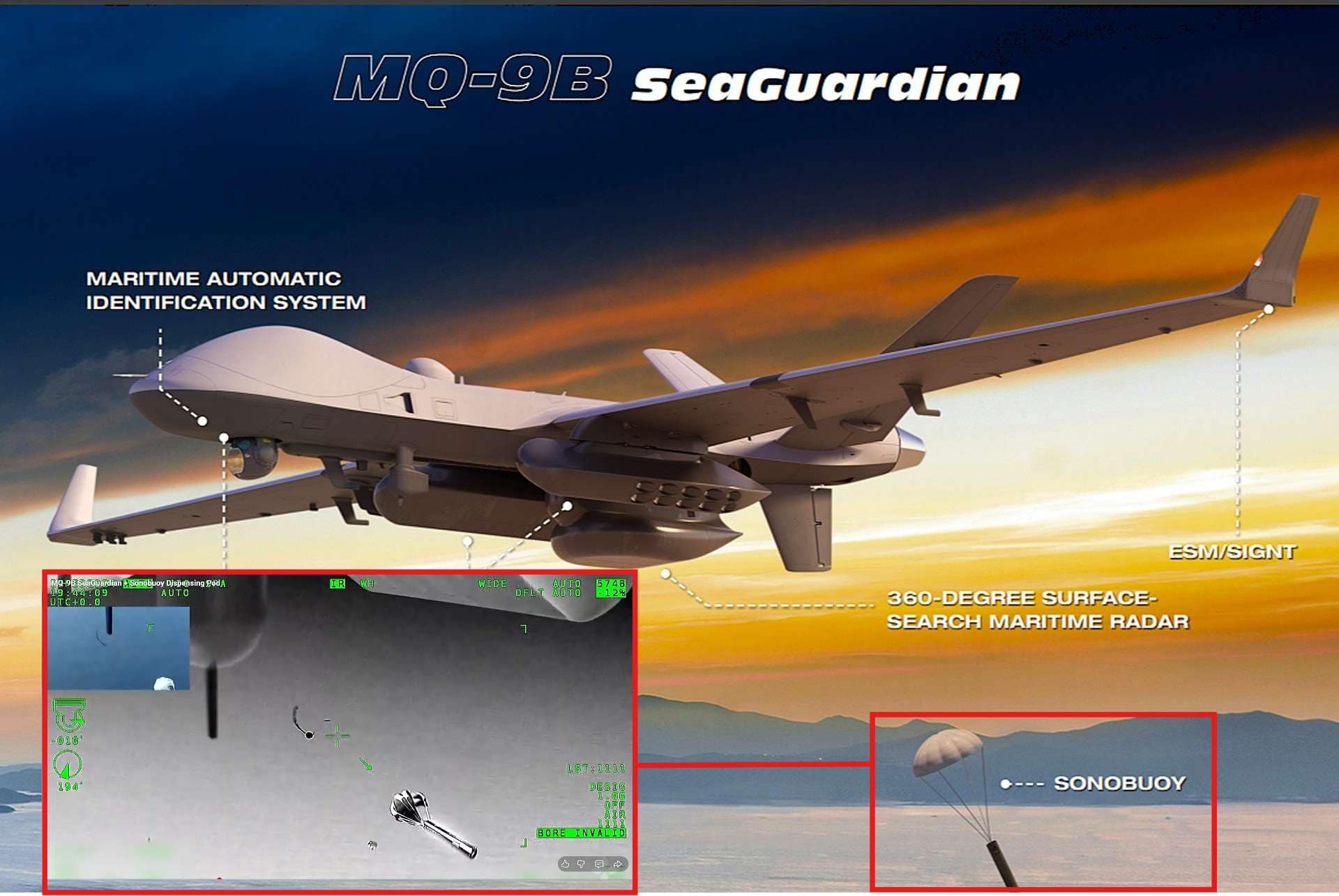
The SeaGuardian’s value is persistence and cost. In a maritime ISR and ASW configuration its endurance exceeds 18 hours, with a mission radius near 1,200 nautical miles (about 2,220 km) and roughly eight hours of on-station time for submarine prosecution. The intent is manned-unmanned teaming: let the drone hold the watch over a box while the crewed fleet repositions, surges or handles time-sensitive localization.
Who Is Buying
Demand is already concrete. General Atomics had taken ASW orders from two foreign customers as far back as 2020, and the wider MQ-9B family is in service or on order with the United Kingdom (as Protector), India, Japan, Belgium, Canada, Poland and Taiwan.
In January 2026 Germany ordered eight MQ-9B aircraft through NSPA for maritime missions, explicitly including an ASW support role with underwing sonobuoy canisters, with first systems expected from 2028 and operations planned at Naval Air Wing 3 in Nordholz. Berlin frames the buy as a complement to its P-8A fleet — exactly the pairing the four-pod configuration is built to serve.
MQ-9B SeaGuardian dispensing sonobuoys for anti-submarine warfare — General Atomics.
The engineering case, then, is consistent across the demonstrations: more dispensers, onboard processing, and acoustic output fed into a network. Whether an unmanned aircraft can sustain a useful undersea picture under real operational friction is the next question the U.S. Navy’s clearance process will answer.
Sources: General Atomics Aeronautical Systems press releases; Naval News; New Atlas; Army Recognition; FlightGlobal; Naval Technology.
 English
0 Comments