
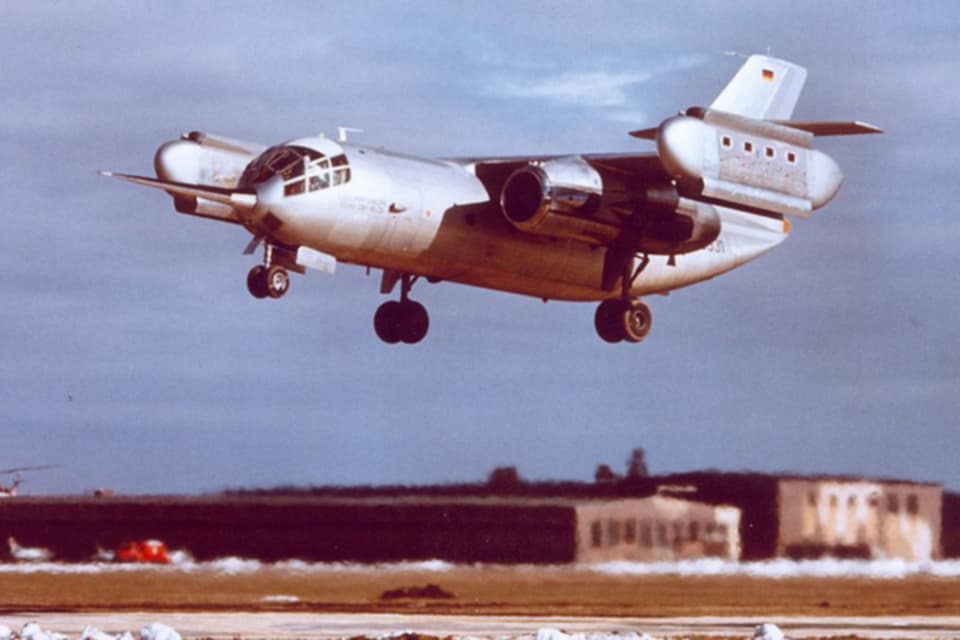
Oberpfaffenhofen, a grey July morning in 1967. Ten engines spool up at once, and the sound is less a roar than a physical wall — sixteen jets of exhaust hammering the concrete, kerosene heat shimmering off the apron. Then, impossibly, a 22-tonne transport with a cargo hold big enough for a three-tonne truck simply lifts straight up, hangs in the air, and pivots like a helicopter.
This was the Dornier Do 31, and nothing like it had flown before. Nothing like it has flown since. It remains the only jet-powered, vertical-takeoff cargo aircraft the world has ever built — a machine conceived to keep West Germany’s air arm fighting from forest clearings and stretches of Autobahn after Soviet missiles cratered its runways.
It set five world records, dazzled Paris and Hannover, and then, in the space of a single 1970 spring, it was over. The story of why is a precise lesson in physics, money, and timing.
Quick Facts
- Type: Experimental VTOL jet transport (West Germany, Dornier)
- First flight: 10 February 1967 (E1, conventional); first hover July 1967 (E3)
- Powerplant: 2 × Rolls-Royce (Bristol) Pegasus vectored-thrust turbofans + 8 × Rolls-Royce RB162 lift jets
- VTOL takeoff mass: ~21–22 tonnes (~49,500 lb)
- Records: 5 FAI Class H world records, Munich–Paris, 27 May 1969
- Built / survivors: 3 prototypes; E1 at Dornier Museum Friedrichshafen, E3 at Deutsches Museum Flugwerft Schleissheim
A Cold War Born of Cratered Runways
The logic was brutally simple. By the early 1960s the Bundesluftwaffe was certain that, in a war with the Eastern Bloc, its fixed airfields would be among the first targets to vanish under Soviet missiles. An air force tied to long concrete strips was an air force that could be grounded in an afternoon.
The answer was dispersal: fighters and transports that could rise vertically from clearings, forest roads, or sections of Autobahn. In February 1962 the Federal Defence Ministry funded a family of VTOL types — the EWR VJ 101 supersonic fighter, the later VAK 191B strike aircraft, and Dornier’s transport to supply them all. NATO requirement NBMR-4 gave the effort an alliance-wide blessing.
Dornier, a firm better known for flying boats and the tandem-engine Do 335, had been quietly studying jet-lift transports since 1959. Under engineer Gustav Wieland, the design crystallised in 1961 into the Do 31 — the “31” a transport to partner the VJ 101 fighter.
“What Went Wrong With Germany’s Insane Hover Transport?” — Mustard’s deep-dive on the Do 31 (YouTube).
Ten Engines and a Truck-Sized Hold
The engineering is where the Do 31 still makes aerodynamicists smile. Rather than bury lift jets in the fuselage and lose the cargo bay, Dornier hung everything in pods. Two inboard nacelles carried Bristol Pegasus vectored-thrust turbofans — the same engine family that would power the Harrier — each giving about 68.9 kN (15,500 lbf) of thrust through swivelling nozzles.
At each wingtip sat a pod of four Rolls-Royce RB162 lift jets, eight in total, each adding roughly 19.6 kN (4,400 lbf) pointing straight down. Ten engines, a combined vertical thrust near 300 kN, and a fuselage left clear enough to drive a NATO three-tonne truck up the rear ramp.
The hard problems were invisible. Sixteen exhaust fountains, twelve of them scorching hot, threatened to be re-ingested by the intakes during hover. Dornier found that canting the Pegasus nozzles to 85 degrees rather than a true 90 was enough to keep the hot gas from bouncing back — a one-degree-class fix discovered only by flying it.
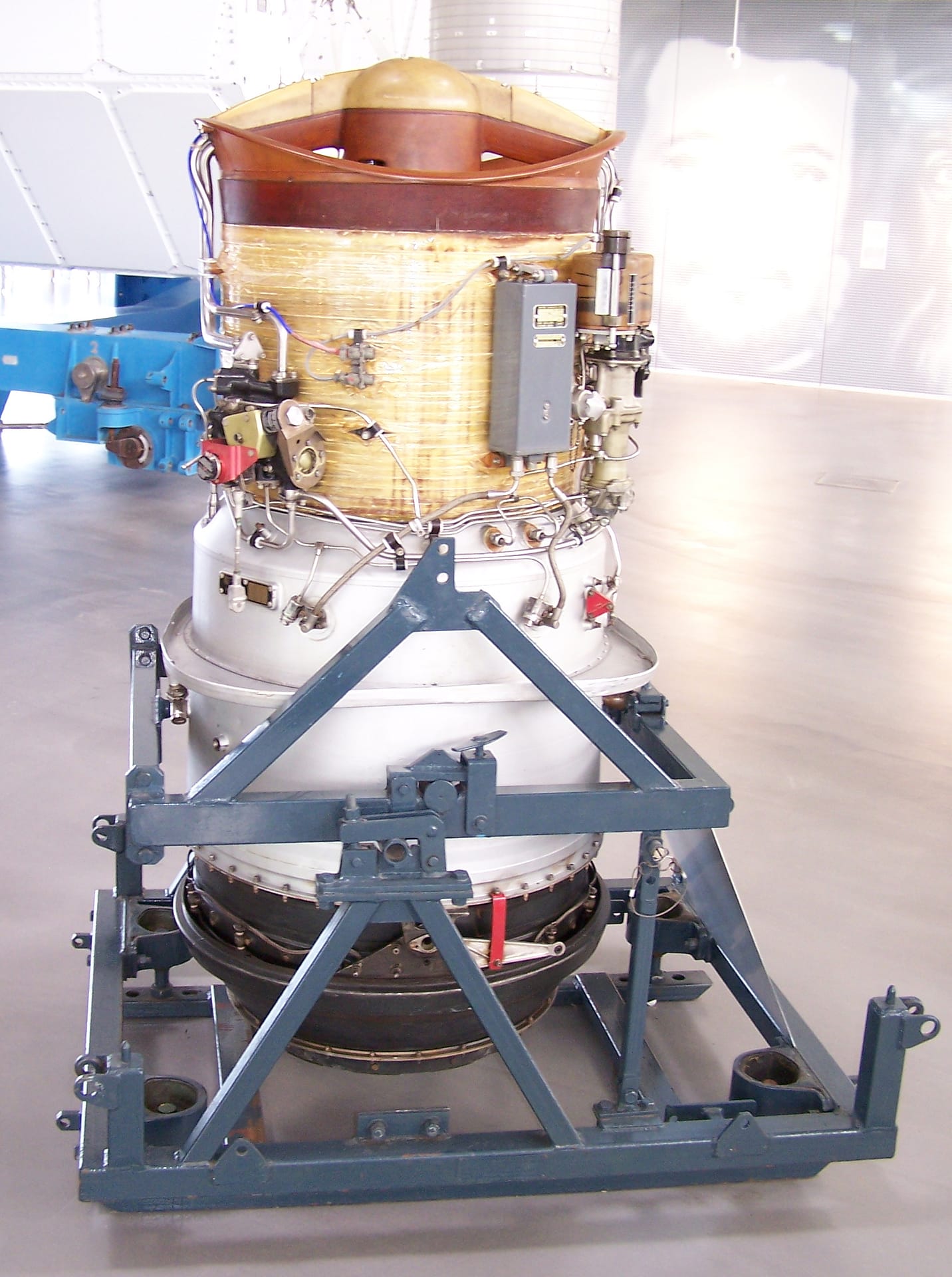
Three airframes were built at Oberpfaffenhofen, each badged “E” for Experimentell. E1 carried only the Pegasus engines and tested conventional flight; E2 was a static test hull that never flew; E3 wore the full set of ten engines and proved the vertical regime.
Learning to Hover a Jet Truck
The first flight, on 10 February 1967, was almost an anticlimax — E1 took off conventionally on its two Pegasus. The real adventure was the hover, and it fell to chief test pilot Drury Wood, a former U.S. Marine Corsair pilot who had trained alongside the VJ 101’s test pilot.
Wood first logged 145 flights in a small cruciform hover rig, then a larger one that mimicked the aircraft, before E3 hovered with all ten engines turning in July 1967. In late 1967 he flew the first free hover with full transitions to and from wingborne flight — 22 November 1967 in Wood’s account, while standard references date the first complete transition 16 December 1967.
The numbers, once tamed, were respectable for a flying machine that could land in its own shadow: a top speed around 730 km/h (452 mph), a cruise near 650 km/h (404 mph), and a service ceiling of about 10,700 m (35,100 ft) on the Pegasus alone.
Five World Records on the Way to Paris
On 27 May 1969, Wood and a German co-pilot ferried E3 from Oberpfaffenhofen to Le Bourget for the Paris Air Show. While the flight plan was being filed, Wood realised the obvious: there was no other aircraft of this class on Earth. They were, as he put it, in a category of their own.
A few phone calls enrolled them in the Fédération Aéronautique Internationale, and the heavily instrumented machine set five FAI Class H (VTOL) world records in one flight — for speed, distance, altitude, speed over a course, and duration. Among them: a maximum altitude of roughly 9,100 m, a duration of 79 minutes 30 seconds, and a speed near 514 km/h.
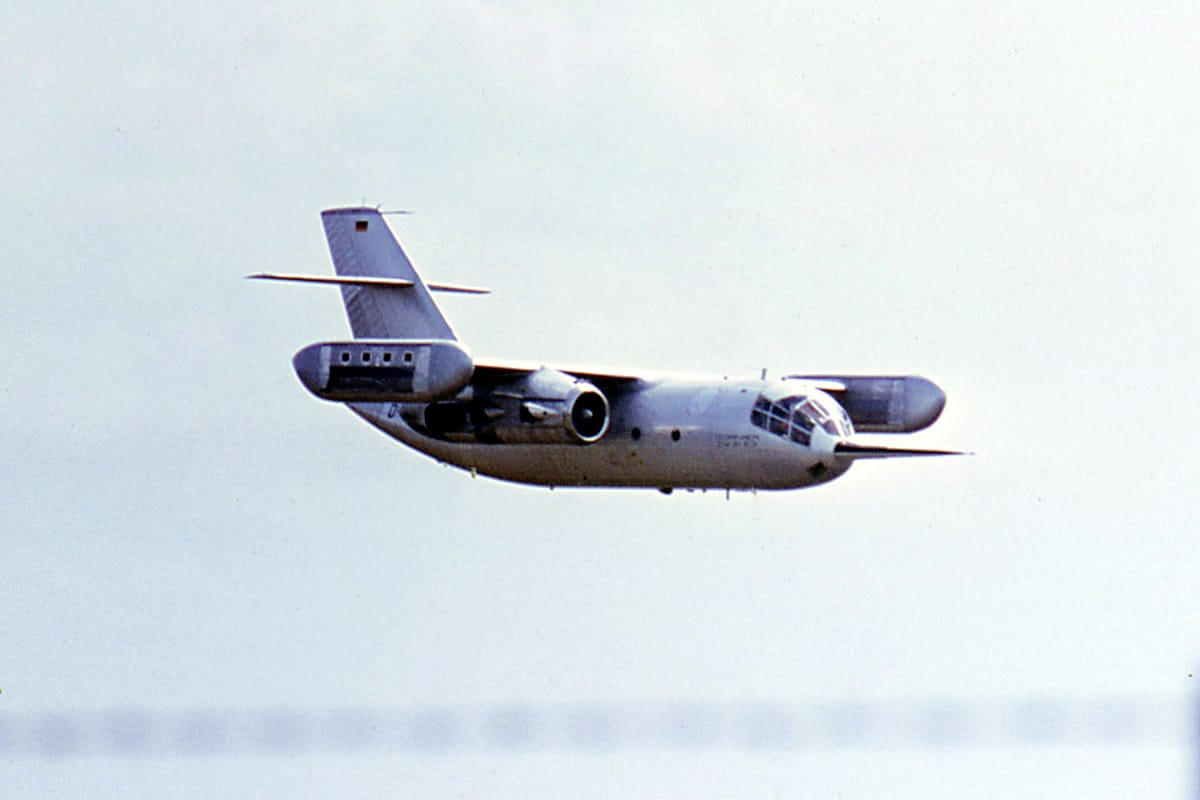
The drama was personal as well as aeronautical. The unpressurised aircraft climbed to 9,000 m with a failing oxygen mask; Wood held a tiny regulator plunger down with the barrel of a ballpoint pen for much of the cruise, marking time and quantity until he could descend to breathing altitude. The records, set that day, stood for decades.
Why the Future Never Came
For all its brilliance, the Do 31 was beaten by arithmetic. The wingtip lift pods were dead weight and drag in cruise; the engines that made vertical flight possible gutted the payload and range that made a transport useful. A VTOL launch left only about 200 km of radius in the museum’s own figures — a fraction of a conventional airlifter.
Money and politics finished the job. Andrew Dow, biographer of the Pegasus engine, records that Bonn was frustrated by the lack of NATO partners willing to share the enormous development bill, and was unwilling to carry it alone. Wood put it bluntly: there had never been serious interest from the alliance’s biggest member, the United States, and a hoped-for industrial partner had walked away.
There was also doctrine. As NATO drifted from massive nuclear retaliation toward flexible response, and as heavy helicopters such as the CH-53 matured, the case for a fragile, fuel-hungry jet-lift truck evaporated. In April 1970 the programme was cancelled; on 4 May 1970 E3 made its last public flight at the ILA show in Hannover.
Inside the cockpit of the surviving Do 31 — a walkaround of the controls (Military Aviation History, YouTube).
Where the Survivors Rest
Two of the three airframes outlived the programme. E1 is preserved at the Dornier Museum in Friedrichshafen; E3, the record-setter, sits in the great hangar of the Deutsches Museum Flugwerft Schleissheim near Munich, its rear ramp and wingtip pods on full display.
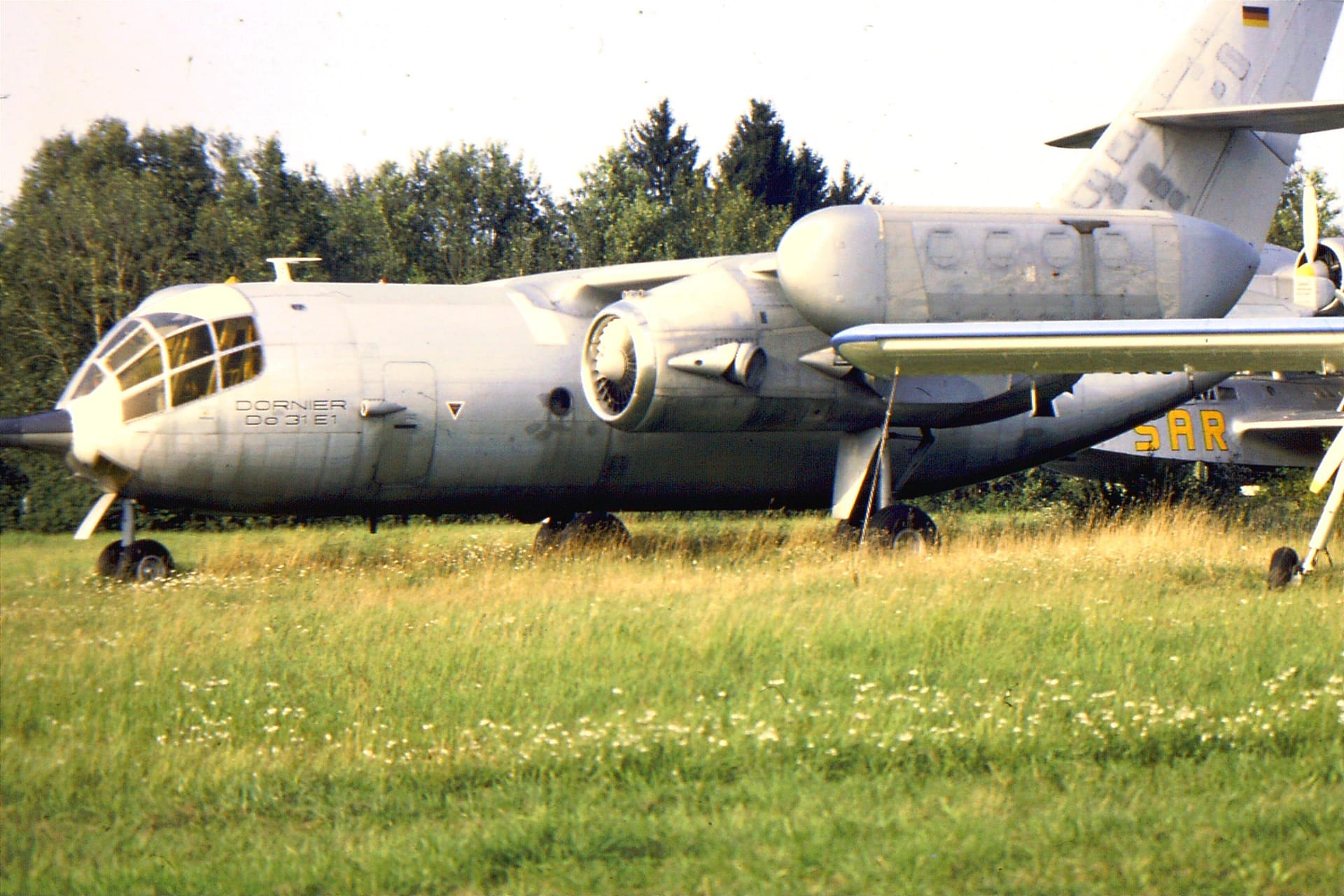
It is easy to file the Do 31 under glorious failure. The truer reading is that it answered its question perfectly — yes, a jet transport can take off vertically — only to discover the answer was no longer worth the price. The engineering was never wrong. The mission moved.
(Note on dates: sources agree on the 10 February 1967 first flight and a July 1967 first hover; the first full transitions are dated 22 November 1967 in the test pilot’s account, while standard references place the first complete transition on 16 December 1967. Performance figures vary slightly between the manufacturer, museum and reference works; metric figures here follow the Deutsches Museum and standard references.)
Sources: Deutsches Museum (Flugwerft Schleissheim); Aviation History / HistoryNet (Jon Guttman, interview with Drury Wood, 2012); Vintage Aviation News; Wikipedia (Dornier Do 31).
 English
0 Comments