
The Case for Two Engines
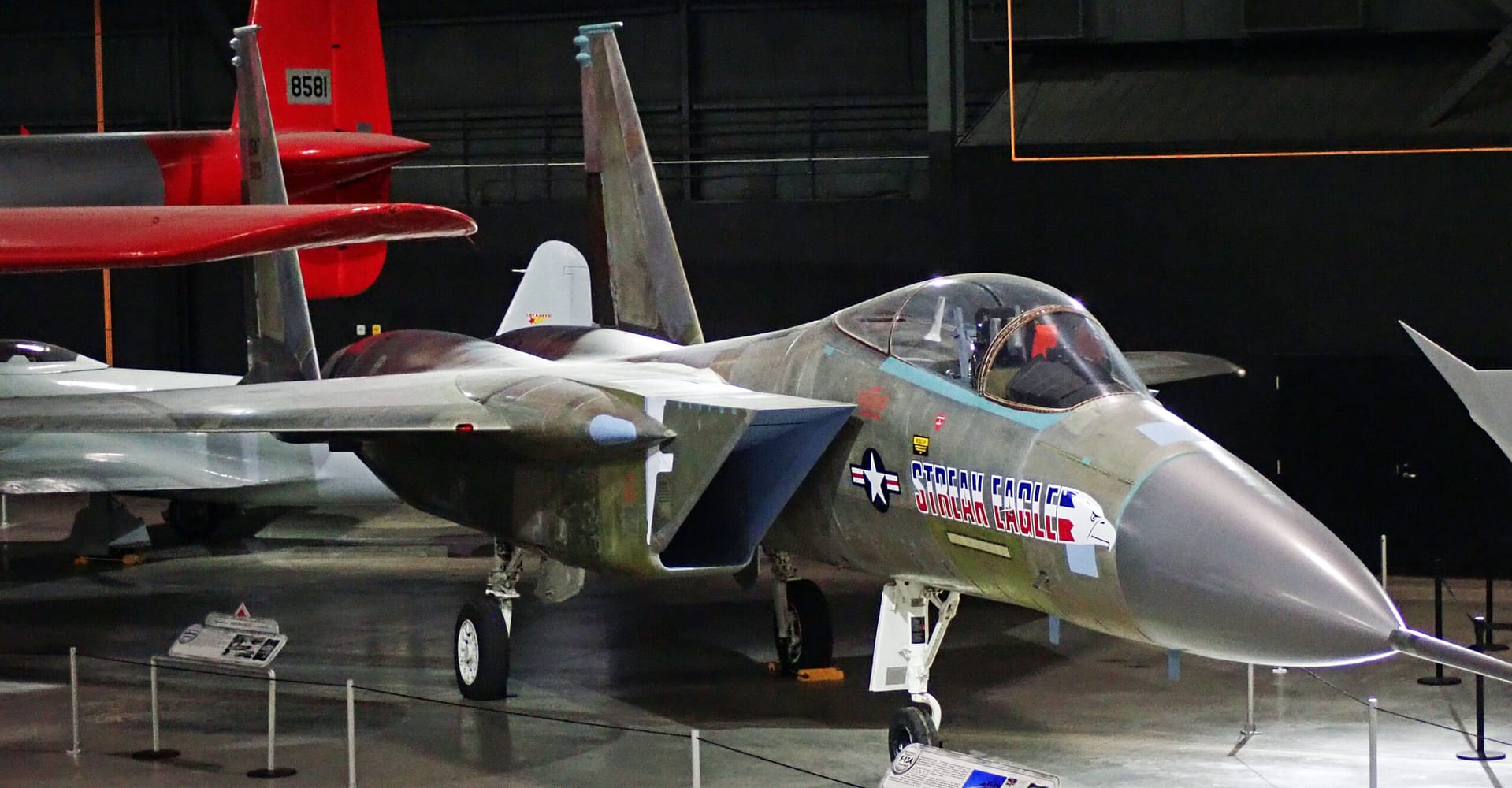
The argument for twin engines is simple: redundancy. If one engine fails — whether from mechanical malfunction, bird strike, or enemy fire — the pilot can fly home on the other. In combat, where aircraft routinely absorb damage, this redundancy can mean the difference between losing a $30 million airframe and landing it safely. The F-15 Eagle is the poster child. In more than fifty years of service and multiple wars, not a single F-15 has been lost to engine failure. In 1983, an Israeli F-15D lost its entire right wing in a midair collision and still landed safely — partly because two engines provided enough thrust to maintain controlled flight on the remaining aerodynamic surfaces. Twin engines also provide more total thrust, which translates to higher climb rates, better acceleration, and the ability to carry heavier weapons loads. The F/A-18 Super Hornet, the F-22 Raptor, and the Su-27 Flanker all use twin engines partly because their missions demand raw power that a single engine cannot deliver. The downside is cost. Two engines mean twice the procurement cost for powerplants, twice the maintenance burden, more fuel consumption, and a larger airframe to house them. A twin-engine fighter is almost always more expensive to buy and operate than a comparable single-engine design.“The Fighter Engine Debate — More is not Better. The single-engine F-35 is not a compromise; it is a deliberate design choice informed by decades of engine reliability data.”
— Billie Flynn, F-35 test pilot and retired RCAF fighter pilot
The Case for One Engine
The argument for a single engine is equally simple: affordability and mass. If your air force has a fixed budget, single-engine fighters let you buy more aircraft. And in air warfare, numbers matter. The F-16 Fighting Falcon is the ultimate expression of this philosophy. Designed in the 1970s as a lightweight, low-cost complement to the expensive F-15, the F-16 uses a single Pratt & Whitney F100 (or General Electric F110) engine. It is smaller, lighter, cheaper, and easier to maintain than any twin-engine fighter of comparable capability. More than 4,600 have been built — making it the most produced Western fighter since the F-86 Sabre. The single-engine approach also simplifies the airframe. One intake, one exhaust, one engine bay, one set of fuel lines. The aircraft is lighter, which improves turn performance and range per unit of fuel. For air forces that operate from well-maintained bases with good logistics — where the risk of battle damage is lower and the priority is cost-effective training and peacetime patrol — a single engine makes excellent sense. The risk is obvious: lose that one engine and you lose the aircraft. Single-engine fighters have a higher attrition rate from engine failures than their twin-engine counterparts. Over the F-16’s service life, engine-related losses have been significant — though modern engines are far more reliable than their predecessors, and the gap has narrowed.The Great Divide — Twin vs. Single Engine Fighters
| Factor | Single Engine | Twin Engine |
|---|---|---|
| Survivability | Lower (one failure = loss) | Higher (can fly on one engine) |
| Unit cost | Lower | Higher (roughly 30-50% more) |
| Operating cost/hr | Lower | Higher |
| Fleet size for same budget | Larger | Smaller |
| Maximum thrust | Limited by single engine | Higher total thrust available |
| Weight | Lighter | Heavier |
| Radar cross-section | Smaller (smaller airframe) | Larger (wider exhaust signature) |
| Maintenance complexity | Simpler | More complex |
| Examples | F-16, JAS 39 Gripen, F-35 | F-15, F/A-18, Su-27, F-22 |
Why was the F-16’s single engine a frequently discussed potential negative during its development, but the F-35’s single engine didn’t catch as much flak?
The Navy Factor
Naval aviation almost universally favours twin engines. When your runway is a carrier deck in the middle of the ocean, engine failure on approach is not a minor inconvenience — it is a likely fatality. The US Navy insisted on twin engines for the F/A-18 Hornet after the single-engine A-7 Corsair II’s engine-failure loss rate proved unacceptable in carrier operations. The F-35C — the carrier variant of the Joint Strike Fighter — is a notable exception. It uses a single Pratt & Whitney F135 engine, the most powerful fighter engine ever built. The Navy accepted the single-engine risk partly because the F135’s reliability statistics are significantly better than older engines, and partly because stealth requirements made a twin-engine design prohibitively large and expensive.The Stealth Complication
Stealth has added a new dimension to the debate. The F-22 Raptor uses two engines — necessary for its supercruise capability (sustained supersonic flight without afterburners) and the raw thrust needed to combine stealth with air superiority performance. The F-35, designed as a more affordable multi-role stealth fighter, uses one. The next generation is uncertain. The F-47 (formerly NGAD), America’s forthcoming sixth-generation fighter, is reportedly a twin-engine design optimised for extreme range in the Pacific theatre. But the CCAs — the autonomous drones that will fly alongside it — are single-engine by necessity: their entire design philosophy is built around being cheap enough to lose.“In the 1950s, jet engines failed roughly once every 1,000 flight hours. Today, turbofan engines like the F135 powering the F-35 average one failure per 200,000 hours. That two-orders-of-magnitude improvement is why single-engine fighters are viable today in a way they simply were not a generation ago.”
— RAND Corporation, analysis of fighter engine reliability trends
The Answer
There is no universal answer. The choice depends on the mission, the threat, the operating environment, and the budget. Air forces that expect to fight over hostile territory in high-threat environments — where battle damage is likely — tend to choose twin engines. Air forces that prioritise fleet size, affordability, and peacetime readiness tend to choose single engines. The real answer is: you probably need both.“The Lightweight Fighter programme proved that a smaller, cheaper, single-engine fighter could outperform the heavier twins in a dogfight. The F-16 went from being derided as a ‘lawn dart’ to becoming the most successful fighter of its generation.”Sources: Air Force Technology, USAF Historical Division, Lockheed Martin, Northrop Grumman, Jane’s Defence
— Harry Hillaker, Chief Designer of the F-16 Fighting Falcon

 English
0 Comments