The ceasefire was already fraying at the edges. Then, on June 8, an Iranian drone knocked a U.S. Army Apache helicopter out of the sky over the Strait of Hormuz — and four days of escalation rewrote the rules of the conflict.
Within 24 hours, 49 Tomahawk cruise missiles slammed into Iranian air-defense sites. Tehran answered by launching ballistic missiles at U.S. bases in three countries. The Strait of Hormuz closed again. Qatari mediators scrambled. And a U.S. strike on a civilian tanker killed three Indian seafarers, threatening to widen a war that has already burned for 104 days.
Here is how the last four days unravelled — and what comes next.
✈ Quick Facts
Trigger: U.S. Army AH-64 Apache downed near the Strait of Hormuz, June 8 — likely by an Iranian Shahed drone
U.S. response: Two nights of CENTCOM strikes (June 9–10) targeting air-defense sites, radars, command nodes, and ammunition depots
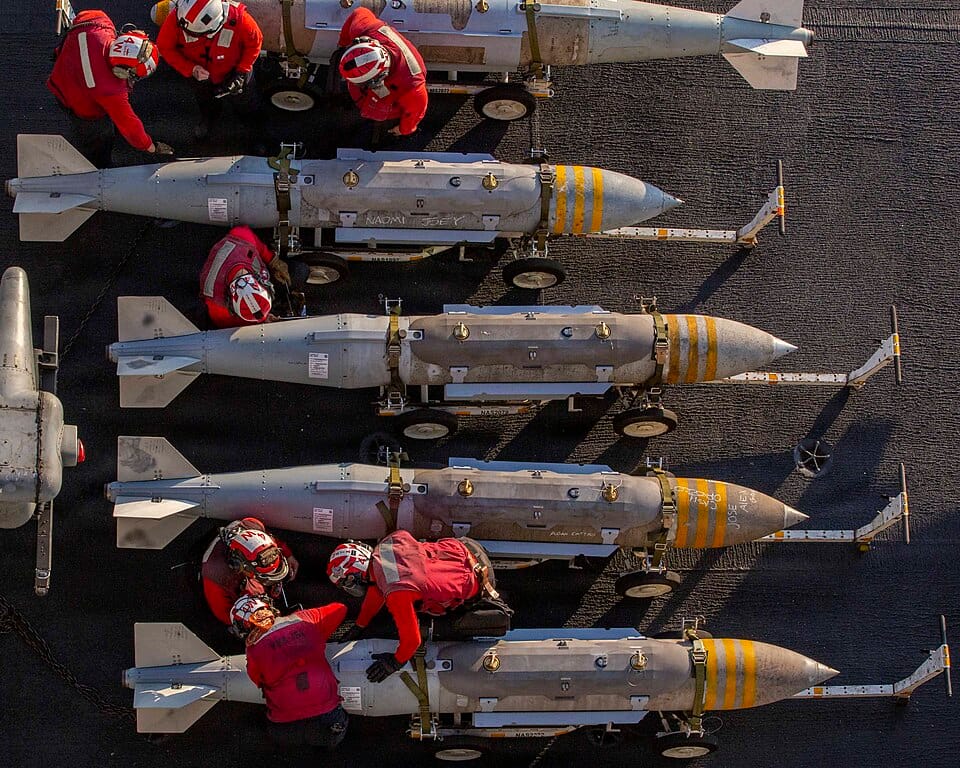
Weapons used: 49+ Tomahawk cruise missiles, precision munitions from USAF and USN fighter jets
Iran retaliation: Ballistic missiles and drones at U.S. bases in Bahrain (5th Fleet), Kuwait (Ali Al Salem), and Jordan (Al-Azraq)
Strait of Hormuz: Declared closed to all shipping by Iran’s Khatam al-Anbiya HQ
Mediation: Iranian delegation in Doha for Qatari-mediated indirect talks; ceasefire extension remains elusive
The Apache Goes Down
On the afternoon of June 8, a U.S. Army AH-64 Apache helicopter went down over the Strait of Hormuz during a routine patrol. Both crew members survived. They were plucked from the water by an unmanned surface vessel — the first known autonomous drone-boat rescue of downed aviators in U.S. military history.
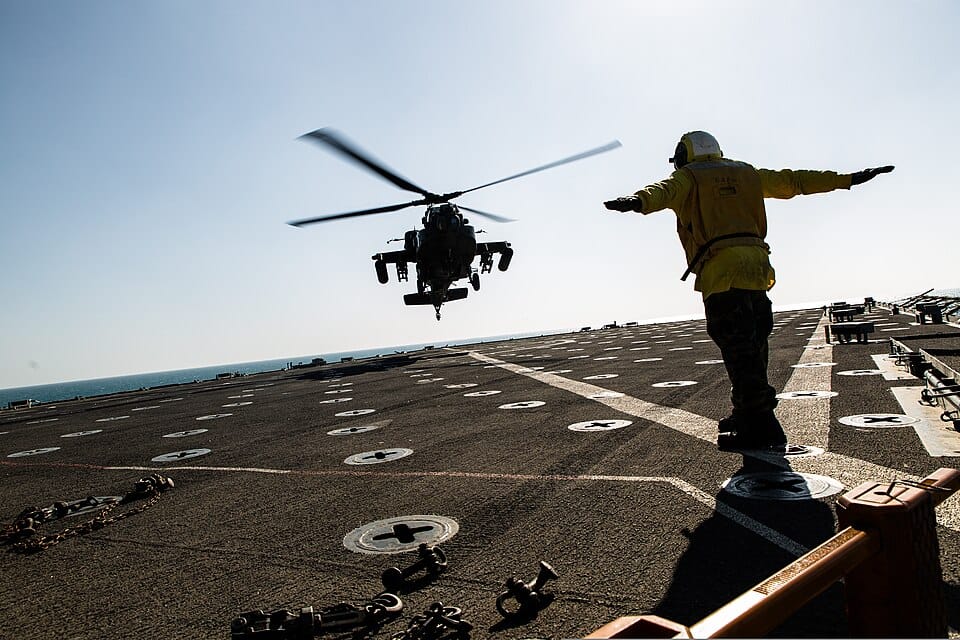
An AH-64 Apache operating in the Gulf — the same type downed over the Strait of Hormuz on June 8 by what U.S. officials believe was an Iranian Shahed drone. Photo: U.S. DoD
President Trump confirmed within hours that Iranian forces had shot the helicopter down. “The Iranians shot down one of our highly sophisticated Apache Helicopters,” he posted, adding that the United States “must respond.” Two U.S. officials later told CBS News that an Iranian Shahed one-way attack drone appeared to have brought the aircraft down, though the precise circumstances remain under investigation.
The incident shattered what remained of the fragile ceasefire observed since April 8. For weeks, American and Iranian negotiators had been engaged in indirect talks — mediated by Qatar and Pakistan — over extending the truce, reopening the Strait of Hormuz, and tackling Iran’s nuclear enrichment program. The helicopter downing ended that pause in a single afternoon.
CENTCOM Strikes Back
At 5 p.m. ET on June 9, U.S. Central Command began what it called “self-defense strikes” against Iranian territory. CENTCOM announced that U.S. Air Force and Navy fighter jets struck Iranian air-defense installations, ground control stations, and surveillance radar sites near the Strait of Hormuz with precision munitions.
“We hit them with 49 Tomahawks. Some of them hit within 40 miles of Tehran. We struck their radar and air-defense systems in southwestern Iran. It was a proportional response to unjustified Iranian aggression.”
— Donald Trump, President of the United States (via Fox News, June 9, 2026)
Multiple explosions were reported across southern Iran — in Bandar Abbas, Sirik, Jask, and on Qeshm Island. The strikes targeted the very radar and missile batteries that guard the entrance to the Strait of Hormuz, the chokepoint through which roughly 20 percent of the world’s traded oil passes.
It was the first major U.S. combat operation against Iran since the ceasefire began on April 8, and it signalled that Washington’s patience with Iranian provocations — including attacks on commercial shipping and coalition aircraft patrols — had run out.
Second Night — Deeper Targets
The strikes did not stop after one night. On June 10, CENTCOM confirmed “additional self-defense strikes against multiple targets” inside Iran, this time hitting military surveillance systems, communication networks, air-defense sites, ammunition depots, command-and-control nodes, and warehouses.
U.S. Marine Corps, Air Force, and Navy assets all participated. The target list expanded well beyond the Strait of Hormuz corridor to include logistics infrastructure deeper inside Iranian territory. Secretary of Defense Pete Hegseth told reporters the United States would “negotiate with bombs” if Iran refused a diplomatic path.
The two-night campaign represented the heaviest American strikes on Iran since the opening phase of Operation Epic Fury on February 28.
Iran Retaliates Across Three Countries
Tehran responded in kind. On the morning of June 10, Iran’s Islamic Revolutionary Guard Corps launched coordinated strikes against American military installations in Bahrain, Kuwait, and Jordan simultaneously.
Drones targeted the Fifth Fleet headquarters in Bahrain and Ali Al Salem Air Base in Kuwait, while ballistic missiles were fired toward the Azraq base in Jordan. The IRGC claimed attacks on the U.S. Fifth Fleet headquarters in Bahrain, the Ali Al Salem Air Base in Kuwait, and the Muwaffaq Salti Air Base at Al-Azraq, Jordan — home to F-35 operations.
Tehran claimed it struck 21 American targets and destroyed four, including an F-35 fighter jet hangar in Jordan. U.S. officials pushed back on those claims, stating that nearly all incoming missiles and drones were intercepted. No U.S. casualties or significant base damage has been confirmed as of this writing.
Hormuz Closed — Again
As the strikes intensified, Iran’s Khatam al-Anbiya Central Headquarters declared the Strait of Hormuz closed to all vessel traffic, citing “insecurity in the region.” The closure — the latest in a cycle that has repeated since February — immediately jolted global energy markets.
The waterway had been partially blocked since Iran began boarding merchant ships and laying sea mines in late February. A U.S. naval blockade of Iranian ports ran from April 13 to May 29, and every attempted reopening has collapsed under renewed violence.
Adding fuel: a U.S. Navy strike hit the tanker M/T Marivex as part of blockade enforcement operations in the Gulf of Oman. Three Indian seafarers aboard were killed. India condemned the attack, and the incident risks drawing a third-party nation deeper into a conflict that has so far remained a bilateral American-Iranian confrontation.
Where This Goes Next
Qatari and Pakistani mediators have not given up. An Iranian delegation led by Foreign Minister Abbas Araghchi, Parliament Speaker Mohammad Bagher Ghalibaf, and Central Bank Governor Abdolnaser Hemmati is in Doha to discuss extending the ceasefire. But the escalation cycle — helicopter downed, strikes launched, retaliation fired, strait closed — has repeated itself so many times since February that the diplomatic track is running on fumes.
The U.S. maintains carrier strike groups in the region, led by USS Abraham Lincoln. CENTCOM has made clear it will continue “self-defense” operations as long as its forces face threats. Iran has promised further retaliation.
Day 104 of the war has no off-ramp in sight.
Sources: CNN, Al Jazeera, CBS News, NBC News, NPR, Axios, CENTCOM, The Washington Post, PBS
Before AWACS, air warfare was a knife fight in a dark room. Pilots relied on their own radar, ground controllers with limited visibility, and radio calls that were often confused, late, or wrong. After AWACS, one side had the lights on and the other did not. The...
On May 1, 1960, CIA pilot Francis Gary Powers took off from Peshawar, Pakistan in a Lockheed U-2 spy plane. His mission: fly across the entire Soviet Union at 70,000 feet, photographing military installations, and land in Bodø, Norway. He never made it. A Soviet S-75...
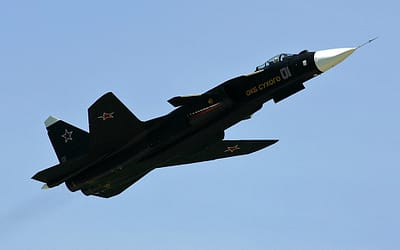
When the Sukhoi Su-47 Berkut rolled out in 1997, it looked like nothing else in the sky. Its wings swept forward instead of back — an aerodynamic concept that promised extraordinary agility, superior low-speed handling, and enhanced controllability at high angles of...

 English
0 Comments