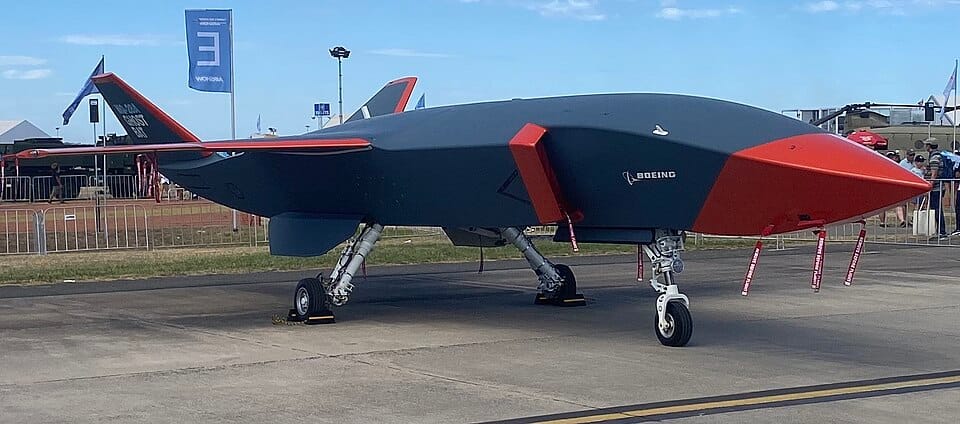
The drone everyone wanted to see at ILA Berlin just got dangerous. Boeing unveiled the MQ-28A Ghost Bat Block 3 on June 10 with a feature that changes the game for autonomous air combat: internal weapons bays carrying AIM-120 AMRAAM missiles and GBU-39 Small Diameter Bombs — without breaking its stealth profile.
Until now, the Ghost Bat was a sensor truck. Block 3 turns it into a shooter.
✈ Quick Facts
Aircraft: Boeing MQ-28A Ghost Bat Block 3
Revealed: ILA Berlin Air Show, June 10, 2026 (Boeing + Rheinmetall)
New: Two internal weapons bays — each carries 1× AIM-120 AMRAAM or 2× GBU-39/GBU-53 SDB
First operational CCA: RAAF service planned 2028 — potentially the world’s first
First live-fire: AIM-120 AMRAAM fired December 8, 2025 (Trial Kareela, Woomera)
From Sensor Truck to Stealth Shooter
The original Ghost Bat was designed to fly alongside manned fighters as a “loyal wingman” — carrying sensors, electronic warfare packages, and ISR payloads in its modular 1.5-cubic-metre nose bay. Useful, but unarmed.
Block 3 changes the equation. Two flush-fitting internal weapons stations now house medium-range air-to-air missiles or precision ground-attack bombs entirely inside the fuselage, preserving the aircraft’s validated low-observable radar cross-section. Boeing confirmed the RCS was tested in its own anechoic chamber.
“That additional capacity gives operators freedom to balance payload and endurance to configure for the mission at hand, whether that means carrying extra fuel for longer-range operations, increasing weapons carriage, or any combination of both.”
— Glen Ferguson, MQ-28 Global Program Director, Boeing
The wing is 25 percent larger than earlier blocks, adding 2,000 lb of additional fuel and payload capacity. Maximum takeoff weight climbs from 10,000 to 12,000 lb, and useful load now exceeds 4,500 lb.
AMRAAM Already Proven
This is not a paper capability. On December 8, 2025, an MQ-28 launched an AIM-120 AMRAAM during Trial Kareela at Woomera, South Australia, destroying a Phoenix target drone. It was the first time a collaborative combat aircraft fired a beyond-visual-range missile.
Block 3 adds beyond-line-of-sight communications, meaning a pilot in an F-35 — or an operator at a ground station or on a ship — can direct the drone from unlimited standoff range. The RAAF has already demonstrated two Ghost Bats controlled simultaneously by an E-7A Wedgetail.
Three external hardpoints provide additional weapons carriage when stealth is not required, giving commanders a sliding scale between survivability and firepower.
Germany Wants In
The ILA Berlin reveal was a sales pitch. Boeing and Rheinmetall announced a strategic partnership in March 2026 to offer the Ghost Bat to the German Luftwaffe. Rheinmetall CEO Armin Papperger said: “If they want to have the plane by 2029, my expectation is that by at least next year, we have to go into the final stage of negotiating the contract.”
Ferguson went further: “This is the third iteration of design now. It will be in service with the Royal Australian Air Force in 2028, and I am fairly certain that it will be the first operational CCA anywhere in the world.”
That claim carries weight. Boeing has completed more than 150 test sorties and over 20,000 hours of digital testing since the program was publicly unveiled in 2019. First flight was February 27, 2021. Boeing disclosed in May 2026 that the first U.S. flights had been completed at Point Mugu, California.
Why Internal Bays Matter
When weapons hang on external pylons, they dramatically increase radar cross-section. Block 3 solves this by housing missiles inside flush-fitting bays that preserve the low-observable profile. The Ghost Bat can penetrate contested airspace while armed, rather than choosing between stealth and lethality.
No other known CCA carries medium-range air-to-air missiles internally. That puts the Ghost Bat in a class previously occupied only by fifth-generation manned fighters. For force planners, a single manned fighter directing multiple armed, stealthy Ghost Bats creates a distributed combat network that multiplies firepower without multiplying pilot risk.
Sources: Boeing, The War Zone, Breaking Defense, Janes
Before AWACS, air warfare was a knife fight in a dark room. Pilots relied on their own radar, ground controllers with limited visibility, and radio calls that were often confused, late, or wrong. After AWACS, one side had the lights on and the other did not. The...
On May 1, 1960, CIA pilot Francis Gary Powers took off from Peshawar, Pakistan in a Lockheed U-2 spy plane. His mission: fly across the entire Soviet Union at 70,000 feet, photographing military installations, and land in Bodø, Norway. He never made it. A Soviet S-75...
When the Sukhoi Su-47 Berkut rolled out in 1997, it looked like nothing else in the sky. Its wings swept forward instead of back — an aerodynamic concept that promised extraordinary agility, superior low-speed handling, and enhanced controllability at high angles of...

 English
0 Comments