
✈ Quick Facts
- Program: Low-Cost Containerized Missiles (LCCM) program
- Announced: May 13, 2026 (framework agreements)
- Target: 10,000+ cruise missiles over 3 years (2027–2029)
- Unit cost target: ~$200,000 (vs. ~$2M for a Tomahawk)
- Winners: Anduril (Barracuda-500M), CoAspire (GHOST), Leidos (Black Arrow variant), Zone 5 (Rusty Dagger)
- Why now: The Iran war consumed 1,000+ Tomahawks — 9x the annual production rate
The Stockpile Crisis
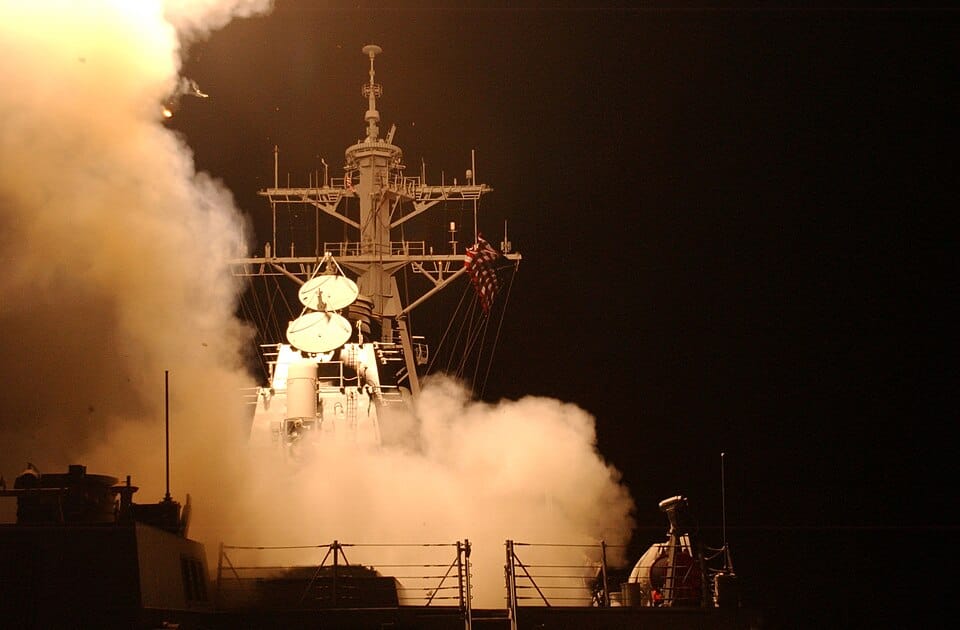
The U.S. fired over 850 Tomahawk cruise missiles in the first month of Operation Epic Fury alone. Subsequent reporting put total expenditure close to 1,000, including Red Sea operations — roughly nine times the annual Tomahawk production rate of about 100, per missile maker RTX. The Center for Strategic and International Studies warned it could take four to five years to replenish stocks at previous production rates. The Pentagon responded with a major budget increase for missile procurement in FY2027. But buying more Tomahawks at $2 million each is not the answer when the next conflict might demand even more volume. The LCCM program is the structural fix: mass-producible, cheap, containerized cruise missiles that can be stockpiled in the thousands.“We will deliver affordable mass for our warfighters at unprecedented speed.”
— Emil Michael, Pentagon Chief Technology Officer
Four Missiles, Four Companies
The four winners are all non-traditional defense contractors — a deliberate break from legacy primes like RTX/Raytheon. Anduril — Barracuda-500M: A turbojet-powered subsonic missile with 500+ nautical mile range and a 100 lb payload. Launched from standard 20-foot ISO shipping containers (16 rounds per container). Built largely from commercial off-the-shelf components for rapid, low-tooling assembly. Unit cost target: roughly $200,000. Anduril has committed to a minimum of 1,000 rounds per year for three years. CoAspire — GHOST: A 3D-printed aluminum fuselage missile with Tomahawk-class range (1,000+ nautical miles). CEO Doug Denneny: “We can design, print and build our missiles quickly, eliminating years of development and costs. We flew our first missile four months after contract award.” Leidos — Black Arrow variant: A scaled-up version of the 200 lb AGM-190A “Black Arrow,” with greater range via larger fuel capacity. Initial production: 3,000 munitions. Zone 5 Technologies — Rusty Dagger: A 500 lb-class, 500+ nm range missile with GPS/INS navigation. Already tested on F-16s at Eglin AFB in April 2026. Zone 5 is now 90 percent owned by Norway’s Kongsberg.The Container Revolution
Every LCCM missile launches from a standard ISO shipping container. That is not a logistical detail — it is a strategic shift. Container-launched missiles can deploy on trucks, cargo ships, or pre-positioned at forward bases without dedicated launchers. Any truck with a flatbed can become a cruise missile battery. Any port can become an arsenal.“We are moving beyond the traditional prime contractors to expand our industrial base, accelerating testing timelines, and sending a clear, long-term demand signal to innovative new entrants.”
— Michael Duffey, Under Secretary of Defense for Acquisition & Sustainment
 English
0 Comments