
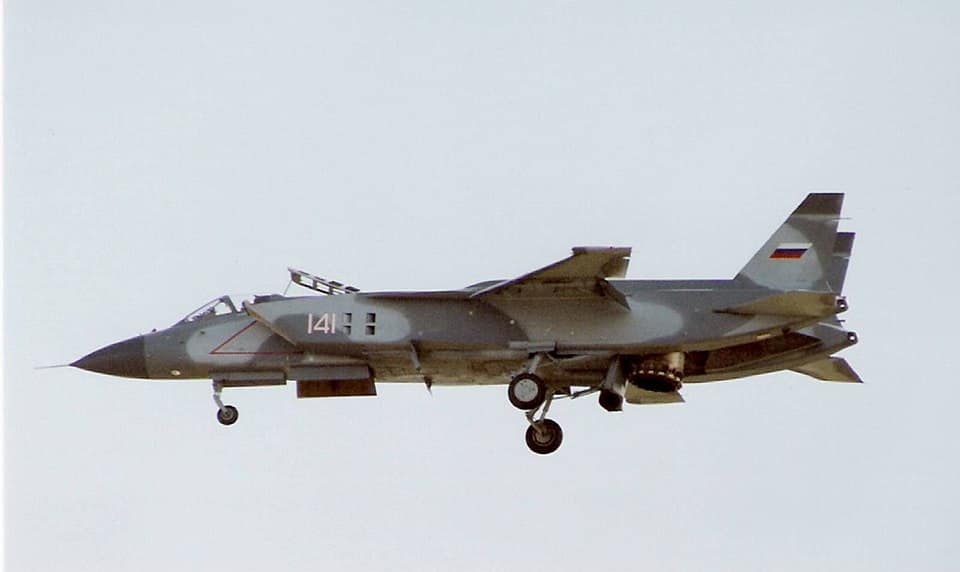
✈ Quick Facts
- Yak-141 first flight: March 9, 1987 (conventional); first VTOL hover: December 29, 1989
- Supersonic VTOL first: Achieved Mach 1.04 in level flight — world first for a VTOL jet
- Engine: R-79V-300 vectoring-thrust turbofan (34,170 lbf with afterburner) + 2x RD-41 lift jets
- Lockheed-Yakovlev agreement: 1991, reportedly worth $385–400 million
- Shared feature: Three-bearing swivel nozzle (3BSN) concept
- F-35B first flight: June 2008; first vertical landing: March 2010
- Yak-141 built: 4 prototypes (2 lost in accidents)
The Soviet VTOL Problem
The Soviet Union spent decades trying to crack vertical take-off for combat aircraft. The Yak-38 Forger — the USSR’s only operational VTOL fighter — was a disappointment: subsonic, short-ranged, payload-limited, and notoriously dangerous to fly. It served on Kiev-class aircraft carriers more as a political statement than a serious weapon. Yakovlev’s answer was the Yak-141 (NATO reporting name: Freestyle). The design was ambitious: a supersonic, radar-equipped combat aircraft capable of vertical take-off from short-deck carriers, with performance approaching conventional fighters. The key innovation was the propulsion system. The Yak-141 used a single Soyuz/Khatchaturov R-79V-300 main engine in the rear with a rotating thrust-vectoring nozzle that could direct exhaust downward for vertical flight, plus two smaller RD-41 lift jets behind the cockpit for additional vertical thrust. This “lift plus lift/cruise” arrangement gave the aircraft both VTOL capability and supersonic performance — something no Western design had achieved.A Brief, Brilliant Career
The Yak-141 set twelve FAI world records for VTOL aircraft in April 1991, including time-to-altitude records that still stand. It was genuinely fast — Mach 1.04 in level flight — and could carry a meaningful weapons load of 2,600 kg on six hardpoints. But the program was doomed. The Soviet economy was collapsing. On October 5, 1991, the second prototype crashed during a vertical landing on the carrier Admiral Gorshkov when the pilot descended too fast and the nozzle struck the deck, rupturing a fuel tank. The pilot ejected safely, but the aircraft was destroyed. Two months later, the Soviet Union dissolved. Funding evaporated. Yakovlev had a supersonic VTOL fighter that worked — and no country to buy it.The Lockheed Connection
This is where the story gets contested. What is documented: Lockheed Martin and Yakovlev entered into a cooperative agreement in 1991, reportedly involving a payment of $385–400 million from Lockheed to Yakovlev. The agreement gave Lockheed access to Yak-141 design data and test results. At the time, Lockheed was competing for the Joint Strike Fighter (JSF) contract — the program that would become the F-35. The STOVL (Short Take-Off and Vertical Landing) variant was a critical requirement, and Lockheed needed a viable approach to vectored thrust for vertical landing. What is debated: how much of the Yak-141’s technology actually influenced the F-35B’s design. The most visible connection is the three-bearing swivel nozzle (3BSN) — the mechanism that redirects the main engine’s exhaust downward for vertical operations. Both the Yak-141 and F-35B use a similar concept, and Lockheed’s access to Yakovlev’s nozzle data is well-documented.Lockheed Martin has acknowledged the cooperative agreement with Yakovlev and access to Yak-141 data. Former Lockheed engineer Paul Bevilaqua, who led the JSF propulsion design, has stated that while the 3BSN concept was studied, the F-35B’s shaft-driven lift fan system was an independent American innovation with no Soviet precedent.
— Based on published interviews with Paul Bevilaqua, Lockheed Martin
 English
0 Comments