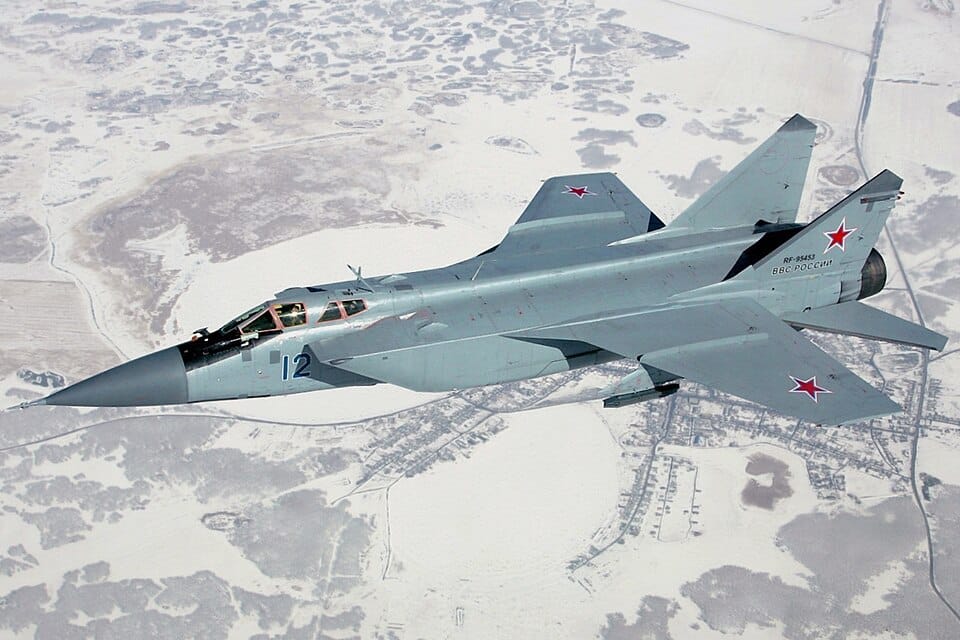
The Mikoyan MiG-31 Foxhound is the fastest combat aircraft in active service. It can exceed Mach 2.8, reach altitudes above 67,000 feet, and detect targets at ranges of over 200 kilometers with its Zaslon phased-array radar — the first of its kind ever fitted to a fighter. Designed to intercept American cruise missiles and bombers in the vast emptiness of the Soviet Arctic, the MiG-31 is less a fighter than a flying missile platform. And after more than four decades, it remains one of Russia’s most important military assets.
✈ Quick Facts
- NATO reporting name: Foxhound
- First flight: September 16, 1975
- Max speed: Mach 2.83 (3,000 km/h / 1,864 mph)
- Service ceiling: 67,600 ft (20,600 m) — dynamic ceiling above 80,000 ft
- Radar: Zaslon S-800 PESA (first airborne phased-array radar)
- Detection range: 200+ km (look-down/shoot-down capable)
- Primary weapon: R-33 (AA-9 Amos) long-range AAM, range 160+ km
- Crew: 2 (pilot + weapon systems officer)
- Engines: 2x Aviadvigatel D-30F6 turbofans (34,170 lbf each with afterburner)
- Active fleet: ~130 aircraft (Russian Aerospace Forces)
The Interceptor Doctrine
The MiG-31 was not designed to dogfight. It was designed to kill things that fly fast, fly high, or fly low — before they ever see the interceptor coming. This is a fundamentally different mission from air superiority, and it produced a fundamentally different aircraft.
The Soviet PVO Strany (Air Defense Forces) needed a platform to defend the enormous Soviet airspace — 22 million square kilometers — against American B-52 bombers, B-1B Lancers, SR-71 Blackbirds, and most critically, cruise missiles. The existing MiG-25 Foxbat was fast enough but lacked look-down/shoot-down capability: it could not detect or engage low-flying cruise missiles against ground clutter.
The MiG-31 solved this problem. Its Zaslon radar — a passive electronically scanned array (PESA) with a detection range exceeding 200 km — could track 10 targets simultaneously and engage four of them with R-33 long-range missiles. It could detect cruise missiles at low altitude, track them while flying at high altitude, and launch missiles from beyond the target’s detection range.
Four MiG-31s, operating in a coordinated line-abreast formation with datalink, could control an 800-kilometer front. This is the MiG-31’s true capability: not individual kills, but area denial across vast stretches of airspace.
Built for Speed and Endurance
The MiG-31 is big. At 22 meters long and with a maximum takeoff weight of 46 tonnes, it is one of the largest fighters ever built. Its two D-30F6 engines — enormous turbofans originally derived from a commercial airliner engine — produce over 34,000 pounds of thrust each in afterburner, propelling the aircraft to Mach 2.83.
But speed alone was not sufficient. The MiG-25 could reach similar speeds but burned fuel at a catastrophic rate, limiting its combat endurance. The MiG-31’s engines were designed for sustained supersonic cruise at Mach 1.5+ without afterburner — a capability that extends its patrol time and effective combat radius dramatically.
At subsonic speeds, the MiG-31 can patrol for over three hours without aerial refueling. With a single refueling, it can cover patrol orbits spanning thousands of kilometers of Arctic or Far Eastern coastline — exactly the mission the Soviet Union needed it for.
Between 2006 and 2010, MiGFlug offered “Edge of Space” flights aboard the MiG-31, taking civilian passengers to altitudes above 65,000 feet — high enough to see the curvature of the Earth against the black sky of near-space. It remains one of the most extreme aviation experiences ever offered commercially.
— MiGFlug Edge of Space program, 2006–2010
The Zaslon Radar: A Cold War First
The MiG-31’s most significant technological contribution was its Zaslon (Shield) radar. When it entered service in 1981, it was the world’s first operational airborne phased-array radar — a technology that the West would not deploy in a fighter until the F-22 Raptor’s AN/APG-77 entered service in 2005, nearly a quarter-century later.
Phased-array radars steer their beams electronically rather than mechanically, allowing them to scan large volumes of airspace rapidly, track multiple targets simultaneously, and resist jamming more effectively than conventional mechanically-scanned antennas. The Zaslon gave the MiG-31 a situational awareness advantage that no other interceptor of its era could match.
The upgraded Zaslon-M radar fitted to the MiG-31BM variant extends detection range to approximately 320 km for large targets and can guide the new R-37M ultra-long-range air-to-air missile — a weapon with a reported range exceeding 300 km that has been used in the Ukraine conflict.
The Kinzhal Carrier
The MiG-31’s latest role has made it front-page news: it is the primary launch platform for the Kh-47M2 Kinzhal (“Dagger”) hypersonic missile. The Kinzhal is an air-launched ballistic missile reportedly capable of speeds exceeding Mach 10 and ranges of up to 2,000 km when launched from a MiG-31.
The MiG-31K variant — modified to carry the Kinzhal on a centerline pylon — has been used operationally in the Ukraine war. The combination of the MiG-31’s speed and altitude with the Kinzhal’s hypersonic terminal velocity makes the weapon extremely difficult to intercept, though Ukraine has claimed successful interceptions using Patriot PAC-3 systems.
Whether the Kinzhal lives up to its billing as a game-changing weapon is debatable. What is not debatable is that the MiG-31 — an aircraft designed in the 1970s — has been given new strategic relevance by carrying it.
No Replacement in Sight
Russia has discussed a MiG-31 replacement — tentatively designated MiG-41 or PAK DP (Perspektivnyi Aviatsionnyi Kompleks Dalnego Perekhvata, “Prospective Long-Range Interception Aviation Complex”) — for over a decade. The program remains in the conceptual phase, with no prototype announced and no realistic timeline for service entry.
In the meantime, the MiG-31 fleet is being upgraded to MiG-31BM standard, with new avionics, improved radar, and compatibility with modern weapons. The airframes, built with exceptional structural margins for sustained supersonic flight, are expected to remain in service until at least the mid-2030s.
The MiG-31 Foxhound was built for a war that never came — Soviet interceptors racing to meet American bombers over the Arctic. Instead, it has outlasted the country that created it, adapted to missions its designers never imagined, and remains, at nearly 50 years old, one of the most formidable combat aircraft in the sky.
Sources: IISS Military Balance, “MiG-31 Foxhound” by Yefim Gordon, Russian Aerospace Forces official publications, Jane’s All the World’s Aircraft


 English
0 Comments