
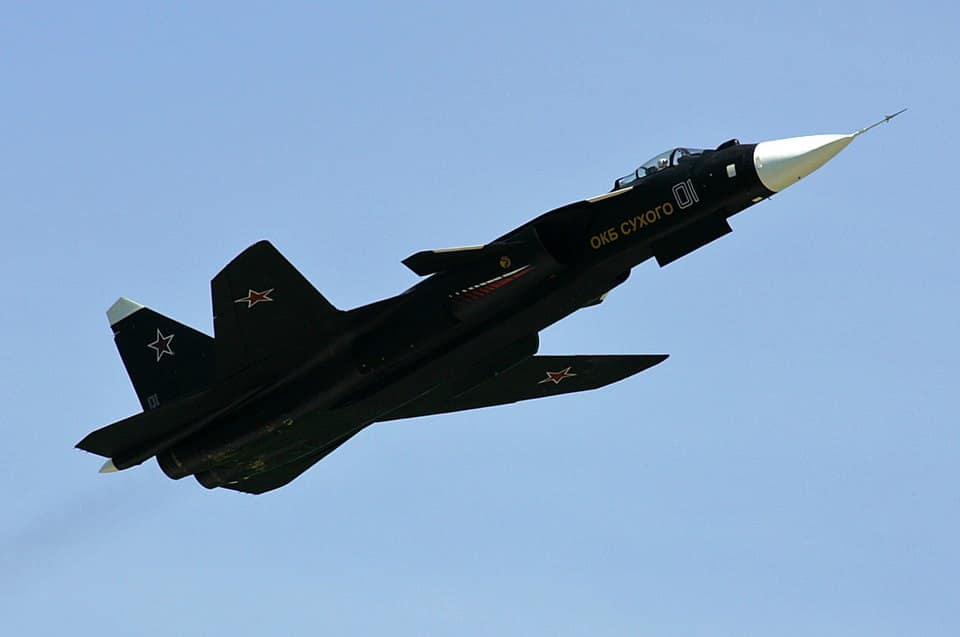
✈ Quick Facts
- Original designation: S-37 (redesignated Su-47 in 2002)
- NATO reporting name: Firkin (unofficial)
- First flight: September 25, 1997
- Wing sweep: -20° (forward) at leading edge
- Max speed: Mach 1.65 (estimated)
- Engines: 2x Aviadvigatel D-30F6 (same as MiG-31)
- Built: 1 prototype only
- Wing material: Carbon fiber composite (critical for structural integrity)
- Status: Technology demonstrator; never entered production
Why Sweep Forward?
Conventional swept-back wings work well at high speeds but have a fundamental problem at low speeds and high angles of attack: airflow separates from the wingtips first, causing loss of aileron effectiveness and a tendency to pitch up uncontrollably. This is why swept-wing fighters can depart controlled flight so violently in a tight turn. Forward-swept wings reverse this behavior. At high angles of attack, air flows inboard along a forward-swept wing rather than outboard. The wingtips — where the ailerons live — retain airflow longer, maintaining roll control authority at angles of attack where a conventional wing would have stalled. The result: better low-speed handling, improved controllability during aggressive maneuvering, and the ability to fly at extreme angles of attack without losing control. The aerodynamic advantages were real and measurable. Wind tunnel testing and computational analysis showed that a forward-swept wing fighter would outmaneuver a comparable swept-back wing design in close-in combat. The concept had been studied since the 1940s — the German Junkers Ju 287 bomber flew with forward-swept wings in 1944, and NASA’s X-29 proved the concept in the 1980s. So why didn’t it work?The Structural Nightmare
Forward-swept wings have a fatal engineering flaw: aeroelastic divergence. As speed increases, aerodynamic loads on a forward-swept wing tend to twist the wing further into the airflow, increasing the angle of attack at the tip, which increases the load, which increases the twist — a positive feedback loop that, in a metal wing, would rip the structure apart. With conventional aluminum construction, a forward-swept wing strong enough to resist divergence at combat speeds would be so heavy that it would cancel out all the aerodynamic benefits. This is why forward-swept wings remained a theoretical curiosity for decades — the math worked, but the materials did not. The solution, both for the American X-29 and the Russian Su-47, was carbon fiber composite construction. Composites can be laid up with fibers oriented to resist torsional loads specifically — a technique called aeroelastic tailoring. The wing bends under load but does not twist, preventing divergence without the weight penalty of a brute-force metal structure. The Su-47’s wings were built almost entirely from carbon fiber composites — a significant achievement for the Russian aerospace industry in the 1990s, when composite manufacturing expertise was far less mature than in the West.Sukhoi’s Black Bird
The Su-47 — originally designated S-37 — was Sukhoi’s privately funded technology demonstrator. In the economic chaos of post-Soviet Russia, state funding for advanced fighter development had collapsed. Sukhoi’s general designer, Mikhail Simonov, kept the program alive with internal resources, betting that a dramatic demonstrator would attract future funding. The aircraft first flew on September 25, 1997, piloted by test pilot Igor Votintsev. Painted in dramatic black, the Su-47 became an instant sensation at airshows. The forward-swept wings, combined with canards (small forward wings) and a conventional tail, gave it a look that was simultaneously aggressive and alien. The Su-47 was powered by two D-30F6 engines — the same powerplant used in the MiG-31 interceptor. These were interim engines; Sukhoi intended to eventually install the more powerful AL-41F engines being developed for the next-generation fighter program. Without thrust vectoring or the intended engines, the Su-47 as tested was limited to Mach 1.65 and could not demonstrate the full agility envelope that the design promised.“The Berkut was proof that Russian aeronautics could still produce world-class innovation, even when the country could barely afford to keep the lights on. It was as much a statement of survival as a technology program.”
— Assessment based on Russian aerospace industry analysis
 English
0 Comments