
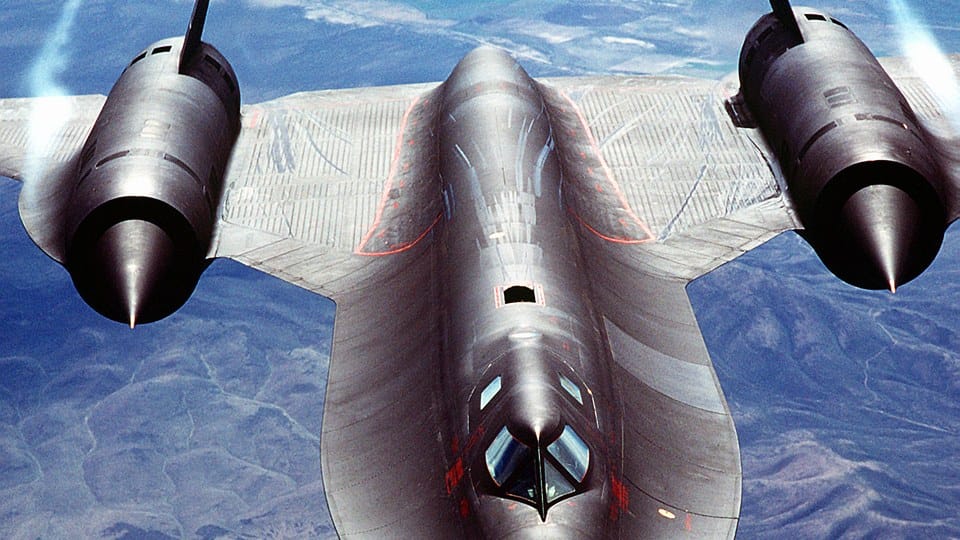
The standard defensive manoeuvre for an SR-71 Blackbird when it detected a surface-to-air missile launch was simple: accelerate. At Mach 3.3 and 85,000 feet, acceleration was sufficient. No SR-71 was ever shot down. In over 3,500 operational missions, spanning 24 years of service, not a single aircraft was lost to enemy action. The missiles always arrived too late — always chasing an exhaust plume that was already miles ahead and climbing.
The SR-71 Blackbird was not the fastest aircraft ever built — that distinction belongs to the rocket-powered X-15. But it was the fastest air-breathing aircraft ever to enter operational service, and it remains so to this day, more than 30 years after its retirement. Nothing that uses conventional jet engines has ever flown faster. It was designed in secrecy, built from a metal that barely existed when design began, and operated in a regime of speed and altitude that was — and in many ways remains — unreachable by anything else.

Designed in the Skunk Works
The SR-71 was the product of Lockheed's Advanced Development Projects division — universally known as the Skunk Works, after a moonshine operation in the Li'l Abner comic strip. Led by Clarence "Kelly" Johnson, one of the most gifted aircraft designers in history, the Skunk Works operated with minimal bureaucracy and maximum talent. Johnson's design philosophy was direct: "Be quick, be quiet, be on time." The SR-71's predecessor, the U-2, had been designed and built in eight months.
The A-12, the SR-71's direct ancestor, was designed starting in 1957 to replace the U-2 — which, as events in 1960 would prove, was vulnerable to Soviet surface-to-air missiles. The solution Johnson chose was brutal in its simplicity: fly so high and so fast that no missile could reach you. The resulting aircraft was a masterpiece of engineering necessity. Flying at Mach 3.2+, aerodynamic friction heats the airframe to temperatures that melt aluminium. Johnson chose titanium — stronger, lighter, and capable of withstanding the heat. The problem was that the United States produced almost no titanium domestically. The main global source was the Soviet Union. The CIA secretly purchased Soviet titanium, routed through shell companies, to build an aircraft designed to spy on Soviet military installations.
“We had to build everything ourselves. There were no manufacturers with the right materials, the right machines, or the right experience. The SR-71 taught the industry how to work with titanium.”
— Ben Rich, Skunk Works engineer and Kelly Johnson's successor“There were a lot of things we couldn't do in an SR-71, but we were the fastest guys on the block, and we loved reminding our fellow aviators of this fact.”
Maj. Brian Shul, USAF (Ret.) — SR-71 pilot, opening line of Sled Driver: Flying the World's Fastest Jet (1991)
The Physics of Flying at Mach 3
At cruising speed, the SR-71's airframe reached 316°C at the nose cone and around 260°C across the wing surfaces. The cockpit windscreen got hot enough to fry an egg. The titanium skin expanded several inches in length during a high-speed run. The aircraft was designed with gaps between panels — it literally leaked fuel on the ground, the gaps being intended to seal when the metal expanded at temperature. Ground crews joked that the SR-71 only stopped leaking when it was flying fast enough to need the fuel.
The engines — two Pratt & Whitney J58 turbojets — produced 32,500 pounds of thrust each. At Mach 3.2, the inlet compression heated the intake air to around 427°C before it even reached the engine. The J58 was designed to operate partly as a ramjet at high speed, bypassing the compressor stages and running on the ram pressure of the incoming air. It was the most sophisticated operational aircraft engine ever built.
The L.A. Speed Check
The most-repeated story about the SR-71 in aviation history is also the simplest. Major Brian Shul and his backseater Walter Watson, screaming across Southern California at 13 miles up, listened on the open Los Angeles air-traffic-control frequency as a Cessna asked Center for a ground-speed readout. Then a Twin Beech. Then a Hornet pilot, smugly, requested his own ground speed — confident he would top the readouts of the propeller traffic.
Walt keyed the mic, his voice perfectly bored: “Centre, Aspen 20, we're showing 1,742 knots on the speed.”
The frequency went silent for a long moment. Then the controller, unflappable: “Aspen 20, Center. Your equipment is probably more accurate than ours. You boys have a good one.” The Hornet pilot, somewhere out over the desert, did not transmit again. Shul spent the rest of his life retelling the story.
24 Years, 3,500 Missions, Zero Losses
The SR-71 entered service with the US Air Force in 1966 and flew operational missions until 1989, when it was retired — controversially — for budget reasons, replaced by satellite reconnaissance systems that the Air Force argued could do the same job at lower cost. The aircraft was briefly recalled to service in 1995 when it became clear that satellites couldn't provide the rapid-response reconnaissance capability the SR-71 offered, then permanently retired in 1998.
In those 24 years, SR-71s flew over North Vietnam, North Korea, Libya, the Middle East, Cuba, and the Soviet periphery. They photographed missile sites, naval bases, troop concentrations, and anything else the intelligence community wanted to see. They flew during the Yom Kippur War, the Falklands War, the Gulf War. Over 4,000 missiles were fired at SR-71s during the Cold War. None found their target. The standard procedure remained the same throughout: when a launch was detected, the pilot pushed the throttles forward and the world fell away behind him.
The absolute speed record — Mach 3.3, 2,193 mph, set on July 28, 1976 — still stands. Nothing with a conventional engine has matched it. The SR-71 remains, in that specific and remarkable sense, undefeated. It holds the record not because no one has tried to beat it, but because no one has found a reason compelling enough to justify the engineering required. For a machine that was designed in the 1950s and flew for the last time in 1998, that is an extraordinary legacy.
Sources: Ben Rich and Leo Janos, Skunk Works (1994); Paul Crickmore, Lockheed SR-71: The Secret Missions Exposed (1993); Wikipedia, "Lockheed SR-71 Blackbird"
Related Questions
What was the SR-71 Blackbird?
The Lockheed SR-71 Blackbird was an American strategic reconnaissance aircraft and the fastest air-breathing crewed jet ever to enter service. Cruising above Mach 3 at around 85,000 feet, it flew so high and fast that its defence against missiles was simply to accelerate. No SR-71 was ever lost to enemy action.
How fast did the SR-71 Blackbird fly?
The SR-71 cruised at about Mach 3.3, more than three times the speed of sound, at altitudes near 85,000 feet. At that performance it could outrun surface-to-air missiles, with crews trained to respond to a launch by speeding up. It remains the fastest jet-powered aircraft ever operated.
Was the SR-71 ever shot down?
No. Across more than 3,500 operational missions over 24 years of service, no SR-71 was ever shot down. Although enemy forces fired numerous surface-to-air missiles at it, none could catch an aircraft flying at Mach 3.3 and 85,000 feet. Losses came only from accidents, never enemy action.
What was the SR-71 used for?
The SR-71 was a spy plane, built to fly deep over hostile territory and gather photographic and electronic intelligence at speeds and altitudes no defence could reach. Developed by Lockheed's secretive Skunk Works during the Cold War, it gave the United States reconnaissance that satellites alone could not always provide.
Why couldn't missiles hit the SR-71?
Its combination of extreme speed and altitude left little time for a missile to intercept it. By the time a surface-to-air missile climbed to 85,000 feet, the Blackbird had already accelerated and moved on. Its shape and special paint also reduced its radar signature, making a firing solution even harder.
What made the SR-71 Blackbird so iconic?
Its sleek black shape, record-breaking speed and perfect combat-survival record made the Blackbird a legend, regularly listed among the most beautiful aircraft ever built. Like Concorde, it pushed the limits of what was physically possible for an aircraft and has never truly been replaced.
0 Comments