
On June 3, 2026, a Marine Corps AV-8B Harrier will lift off from the runway at MCAS Cherry Point, North Carolina, hover for a moment in that unmistakable way only a Harrier can, and then touch down for the very last time. After more than four decades of service, the jump jet is done.
VMA-223 — the "Bulldogs" — holds the distinction of being the last Marine attack squadron still flying the Harrier. The unit currently has a detachment deployed aboard the amphibious assault ship USS Iwo Jima with the 22nd Marine Expeditionary Unit. When those jets come home, the airframes go to the boneyard. The transition to the F-35B Lightning II, which began years ago, will be complete.
The retirement is happening a full year ahead of the original schedule. The Marines aren't waiting around for a sentimental goodbye — they're accelerating the transition because the F-35B is simply too much of an upgrade to delay.

The Jet That Defied Physics
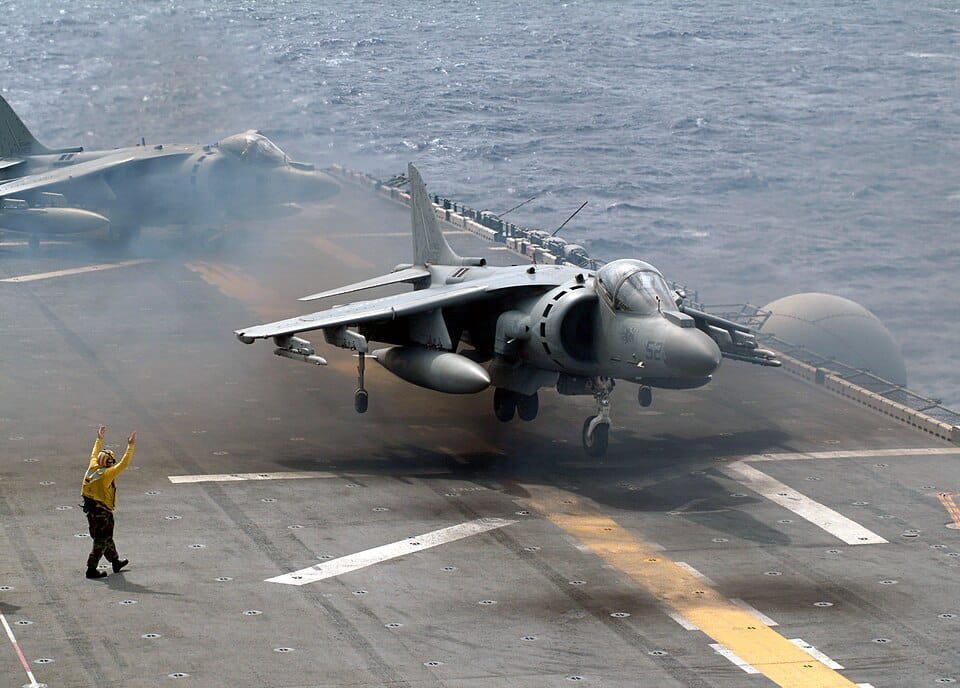
The Harrier's party trick — vertical takeoff and landing — was so counterintuitive that engineers spent decades trying to make it work before the British finally cracked it. Four rotating exhaust nozzles redirect thrust downward, turning a fast jet into something that can hover like a helicopter and operate from tiny forward bases, jungle clearings, or the deck of an amphibious assault ship. No catapult. No arresting wire. Just raw thrust pointed at the ground.
That capability defined a generation of Marine Corps doctrine. While the Navy needed aircraft carriers with steam catapults, the Marines could park a Harrier squadron on a flat-deck amphib and project air power anywhere within range. It was the ultimate expeditionary weapon.
But it came at a cost. The Harrier was brutally unforgiving. Its accident rate was among the highest in military aviation — at one point, the jet earned the grim nickname "the widowmaker." Hovering a fighter jet on a column of exhaust requires constant pilot input, and the margin between controlled flight and catastrophe is razor thin. Over the decades, dozens of pilots lost their lives.
Cherry Point Says Goodbye
The farewell won't be quiet. The 2nd Marine Aircraft Wing has planned a full week of events from June 1 through June 5. VMA-223 will host an open house on June 2 with a static Harrier display and simulator tours. Havelock Park in the nearby town will throw a festival with food, live music, and a final AV-8B flyover. The week wraps with a golf tournament — because even retiring a legend requires a 19th hole.
The real emotional moment, though, will be June 3. That final flight will mark the end of STOVL operations in the Marine Corps — at least with the Harrier. Every Harrier pilot who ever wrestled the jet through a vertical landing on a pitching deck will be watching.
What Comes Next: The F-35B
The F-35B keeps the Harrier's STOVL trick but adds everything else. It flies nearly twice as fast — Mach 1.6 versus the Harrier's subsonic cruise. Its stealth design makes it functionally invisible to most radar systems. Its sensor fusion gives the pilot a God's-eye view of the battlefield. By the end of 2026, the Marines will have received 205 F-35Bs and 56 F-35Cs.
Crucially, the Corps is making sure the hard-won institutional knowledge doesn't vanish with the last AV-8B. Experienced Harrier pilots and maintainers are being funneled directly into F-35B squadrons. The muscle memory of STOVL operations — the feel for crosswinds on a ship deck, the judgment calls during a hot vertical landing — transfers even when the airframe doesn't.
The Harrier was always an improbable machine. A jet that could stop in midair, land on a postage stamp, and still carry enough ordnance to ruin someone's day. It bent the rules of what a fighter could do, and for 40 years it gave the Marines something no other service had. On June 3, the nozzles rotate for the last time. This one deserves a salute.
Sources: Seapower Magazine, FlightGlobal, Defence Industry Europe, The War Zone
Related Questions
What is the AV-8B Harrier?
The AV-8B Harrier II is a single-engine ground-attack jet famous for vertical and short takeoff and landing (V/STOL). Four rotating exhaust nozzles redirect thrust downward, letting it hover like a helicopter and operate from small bases or amphibious assault ships without catapults or arresting wires.
When did the Marines retire the Harrier?
The U.S. Marine Corps planned to retire its last AV-8B Harriers on June 3, 2026, at MCAS Cherry Point, North Carolina - a full year ahead of the original schedule. The last Marine attack squadron flying the type was VMA-223, the Bulldogs. The Harrier had served for more than four decades.
What replaced the Harrier?
The Harrier is being replaced by the F-35B Lightning II, the short-takeoff and vertical-landing variant of the F-35. The Marines accelerated the switch because the F-35B is a major capability upgrade. F-35Bs share the Harrier's flexibility - Marines have even landed F-35Bs on a highway.
How does a Harrier take off vertically?
The Harrier uses four rotating exhaust nozzles that direct engine thrust downward, allowing it to lift off vertically or from a very short roll and to hover in place, so it can fly without runways. Other experimental aircraft achieved short takeoffs in stranger ways - one famously took off hanging from a hook.
Why was the Harrier's V/STOL ability important?
V/STOL let the Marines operate fast jets from austere forward bases, jungle clearings and the decks of amphibious ships without catapults or arresting gear, shaping decades of Marine Corps doctrine. The same flexibility now comes from the F-35B, which lets ships like Japan's Kaga operate as carriers.


Sad to see them depart was here in the 70s when they arrived..sad that their departure date coincides with my 75 birthday…
More like 50+ years not 40
What time of the day will the last rotation of the nozzles take place.. I’d love to see it happen for old time sake