
| Quick Facts | |
|---|---|
| What It Does | Prevents blood from pooling in the legs during high-G manoeuvres |
| How It Works | Air bladders inflate around legs and abdomen, squeezing blood back toward the heart and brain |
| G-Force Range | Modern fighters pull up to 9g |
| Unprotected Blackout | ~4–5g for most people |
| G-Suit Benefit | Adds ~1.5–2g of tolerance |
| Combined with AGSM | Pilots can sustain 9g for extended periods |

At 9g, you weigh nine times your normal body weight. Your 15-pound head weighs 135 pounds. Your arms are so heavy you can barely move them. And every drop of blood in your body is being dragged downward — away from your brain, away from your eyes, into your legs and feet — by a force that would pin you to the floor if you weren't strapped into an ejection seat.
Without protection, you'd be unconscious in seconds. Your vision would narrow to a grey tunnel, then go black, and then you'd lose consciousness entirely — a condition called G-induced loss of consciousness, or G-LOC. The aircraft, flying at 500 knots in a tight turn, would continue on its last control input with nobody at the controls. The outcome is a smoking hole in the ground.
The anti-G suit is the reason fighter pilots survive the forces they routinely endure. It is, quite literally, the difference between staying in the fight and dying in it.
The Physics of Blacking Out
The human cardiovascular system evolved for 1g — the normal force of gravity at the Earth's surface. The heart pumps blood upward to the brain with just enough pressure to overcome gravity's pull. At 1g, this works perfectly. The brain receives its constant supply of oxygenated blood, and you stay conscious.
At 2g, the heart has to work twice as hard to push blood upward. At 4g, most people's cardiovascular systems can't keep up. Blood pools in the lower body, blood pressure in the brain drops, and the retinal arteries — which are among the most sensitive to pressure changes — lose perfusion first. Vision goes grey, then tunnels, then blacks out entirely. This sequence — grey-out, tunnel vision, blackout — happens over a span of a few seconds.
If the G-force is sustained or increases beyond the blackout threshold, the brain itself loses blood supply. The pilot loses consciousness. Recovery takes 15 to 30 seconds after the G-force is released — an eternity in a fighter aircraft travelling at miles per minute toward the ground.
How the Suit Works
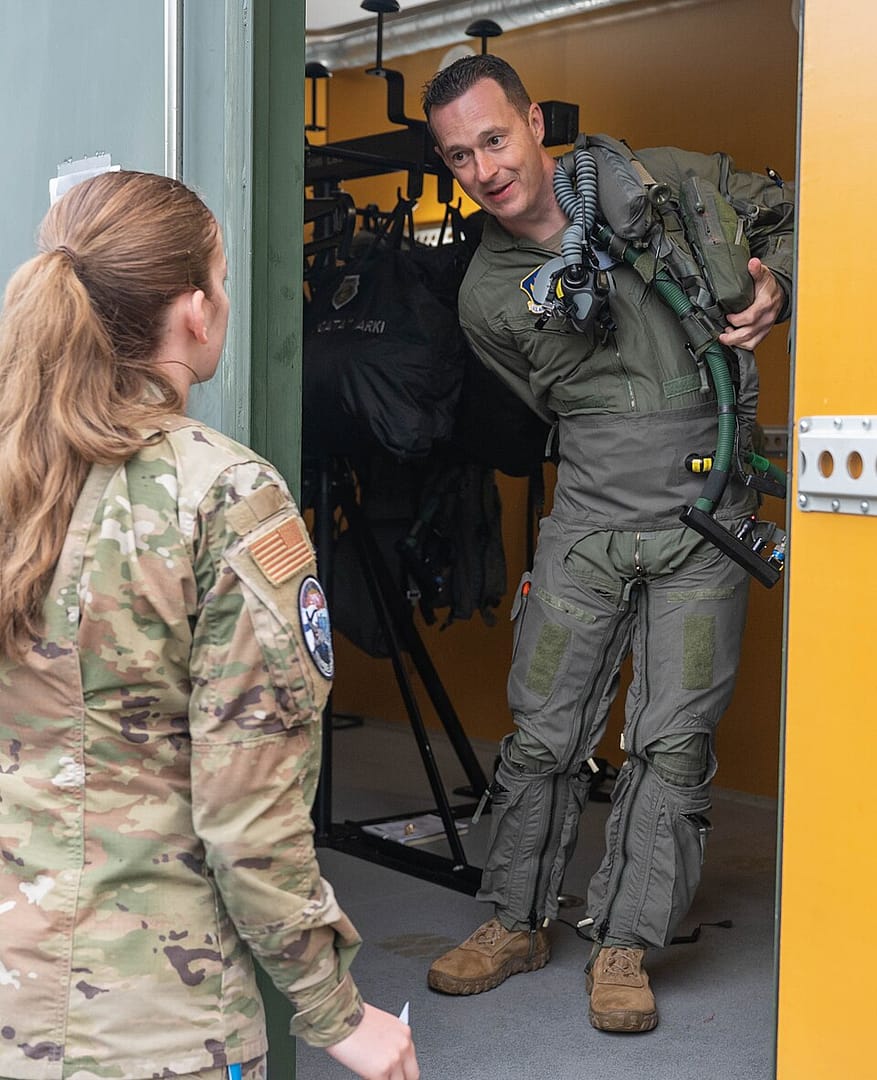
The anti-G suit is a pair of chaps — leggings that wrap around the calves, thighs and abdomen — containing inflatable bladders connected to the aircraft's pneumatic system by a hose. When the aircraft's accelerometer detects increasing G-forces, a valve automatically inflates the bladders. The higher the G, the more pressure.
The inflation squeezes the legs and abdomen like a full-body blood pressure cuff. This compression prevents blood from pooling in the lower body and forces it back toward the heart and brain. The effect adds approximately 1.5 to 2g of tolerance — meaning a pilot who would black out at 5g without a suit can sustain 6.5 to 7g with one.

But 7g isn't 9g. The suit alone isn't enough. That's where the Anti-G Straining Manoeuvre — the AGSM — comes in.
The Breathing Technique That Saves Lives
The AGSM is a forceful breathing technique that fighter pilots train until it becomes automatic. The pilot takes a sharp breath, tenses every muscle below the chest — legs, abdomen, glutes — and holds the tension for three seconds while breathing in short, explosive bursts against a closed glottis. It's essentially a whole-body isometric contraction that manually squeezes blood toward the brain.
Combined with the G-suit, the AGSM allows a well-trained pilot to sustain 9g for as long as the manoeuvre demands — sometimes 10 to 15 seconds in a hard sustained turn. It's physically exhausting. Pilots describe high-G combat manoeuvring as more physically demanding than any sport they've ever played. A five-minute dogfight leaves them drenched in sweat, muscles shaking, breathing hard.
The penalty for getting the AGSM wrong — relaxing the strain too early, missing a breath cycle, tensing the wrong muscles — is immediate. G-LOC can onset in under two seconds. There are cockpit videos of pilots losing consciousness mid-manoeuvre, their heads dropping, their hands falling from the controls, the aircraft rolling and pitching uncontrolled until either the G-force drops and the pilot wakes up, or the aircraft crashes.
What It Feels Like
Every MiGFlug passenger who flies in a fighter jet experiences G-forces firsthand. In the back seat of an L-39 Albatros or a MiG-29, the pilot pulls into a turn and the G-suit inflates around your legs — a sudden, firm squeeze that feels like someone wrapped your lower body in a vice. Your vision narrows. Your chest feels like it's carrying a concrete slab. Breathing becomes work.
At 4 to 5g — typical for a MiGFlug experience flight — most passengers feel the edges of their vision going grey. The tunnel effect is unmistakable. It's not frightening so much as astonishing: you can feel your own cardiovascular system losing the battle against physics in real time. When the G relaxes, the blood rushes back to your head, your vision floods with colour, and you understand — viscerally, physically — why fighter pilots train for years to operate in this environment.
The G-suit makes that experience survivable. Without it, those same forces would put you unconscious before you had time to say so. It's a garment made of nylon, rubber and compressed air — and it's the most important piece of equipment a fighter pilot wears.
Sources: NASA Human Performance Research, U.S. Air Force Aeromedical Research Laboratory
Related Questions
Why do fighter pilots wear G-suits?
Fighter pilots wear anti-G suits to stop blood from pooling in their legs during high-G manoeuvres. At up to 9g, blood is dragged away from the brain toward the feet, which would cause blackout and then loss of consciousness within seconds. The suit squeezes the legs and abdomen to force blood back toward the heart and brain. For more, see what pulling 9g does to the body.
How does a G-suit work?
An anti-G suit is a set of leggings with inflatable bladders around the calves, thighs, and abdomen, connected to the aircraft's pneumatic system. When the jet's accelerometer detects rising G-forces, a valve inflates the bladders — the higher the G, the more pressure — squeezing the body like a full-body blood-pressure cuff to keep blood from draining out of the brain.
What is G-LOC?
G-LOC is G-induced loss of consciousness — what happens when sustained G-force drains blood from the brain. Vision first greys out, then tunnels, then blacks out, and finally the pilot loses consciousness entirely. Recovery takes 15 to 30 seconds after the G-force is released — an eternity in a jet hurtling toward the ground at hundreds of miles per minute.
How many Gs can a fighter pilot withstand?
Most people black out at around 4–5g without protection. A G-suit adds about 1.5–2g, and combined with the anti-G straining manoeuvre, pilots sustain the 9g modern fighters pull — far beyond the 3–4g of a carrier catapult launch. At 9g a pilot effectively weighs nine times normal — a 15-pound head weighs 135 pounds.
How much extra G tolerance does a G-suit add?
A G-suit alone adds roughly 1.5–2g of tolerance, raising the blackout threshold from the unprotected 4–5g. It is not enough on its own for a 9g fighter; pilots must combine it with the anti-G straining manoeuvre. The two together let a trained pilot sustain 9g for extended periods.
What is the anti-G straining manoeuvre (AGSM)?
The anti-G straining manoeuvre is a breathing-and-muscle technique pilots perform to resist blackout: tensing the legs, abdomen, and chest while breathing in short, forceful bursts to keep blood pressure up in the brain. Combined with an anti-G suit, the AGSM lets pilots tolerate sustained 9g — neither alone is enough at the extreme end.
0 Comments