Stars and Stripes: Qatar’s Donated 747 Emerges as the New Air Force One

by | Jun 15, 2026 | Aviation World, News | 0 comments

A Boeing 747 that once carried Qatari royalty is now wearing the Stars and Stripes. First photographed on June 7 at a facility in Waco, Texas, the VC-25B Bridge aircraft has emerged from modification wearing a bold red, white, and blue livery — the design favoured by President Trump to replace the iconic Kennedy-era colour scheme that has defined Air Force One for more than 60 years. The aircraft is on track for delivery to Joint Base Andrews this summer, with the White House reportedly targeting July 4, 2026 — the nation’s 250th birthday — as the handover date. It is one of the more unusual origin stories in presidential aviation history.

Quick Facts — VC-25B Bridge

Aircraft: Boeing 747-8KB (ex-A7-HBJ, Qatar Amiri Flight)

Built: 2012, originally for Qatar’s House of Thani

Donated: May 2025; MoU signed July 7, 2025

Designation: VC-25B Bridge (serial 25-3300)

Livery: New red, white, and blue scheme (Trump design)

Modification: L3Harris, Greenville & Waco, Texas

Cost: Under $400 million for modifications

Target delivery: July 4, 2026

From Royal to Presidential

The aircraft started life as a Boeing 747-8KB — the business jet variant of the 747-8 Intercontinental — delivered to Qatar Amiri Flight in April 2012. Registered as A7-HBJ, it served the House of Thani for more than a decade before being withdrawn from service in 2023. Qatar formally offered the jet to the United States in May 2025, and Defense Secretary Pete Hegseth signed a memorandum of understanding accepting the “unconditional donation” on July 7, 2025. It was re-registered as N7478D on August 5 before receiving its military serial. The “Bridge” designation tells you everything about why this aircraft exists. Boeing’s main VC-25B programme — two purpose-built 747-8i conversions awarded under a $3.9 billion fixed-price contract in 2018 — is massively behind schedule. Originally due in December 2024, the first delivery is now expected in mid-2028. Boeing has absorbed more than $2.4 billion in losses on the programme, adding it to a defence portfolio that includes write-downs on the T-7A, KC-46A, and MQ-25. The current VC-25A fleet — the two 747-200Bs that have served since 1990 — is showing its age. The Bridge fills the gap.

The New Look

The livery is unmistakable — and deliberately different from the aircraft it will eventually supplement. The Air Force describes it as white on top, with red and gold accent lines running along the fuselage, a dark blue underside, and a large waving American flag on both sides of the tail. “UNITED STATES OF AMERICA” runs in bold text across the upper fuselage. The same colour scheme is already appearing on C-32A aircraft that serve as Air Force Two. It replaces a design that became one of the most recognisable liveries in aviation history. The original Air Force One colour scheme was created in 1962 by industrial designer Raymond Loewy, working directly with President Kennedy and First Lady Jackie Kennedy — they reportedly sat on the Oval Office floor drawing with crayons. Loewy settled on “luminous ultramarine blue” as the defining colour, paired with white and polished aluminium. The design debuted on SAM 26000, a Boeing 707, and served for more than six decades across three generations of presidential aircraft. Trump announced in 2018 that he wanted to replace what he called “Jackie Kennedy blue” with bolder colours. Biden reversed the decision during his term; Trump reinstated it upon returning to office.
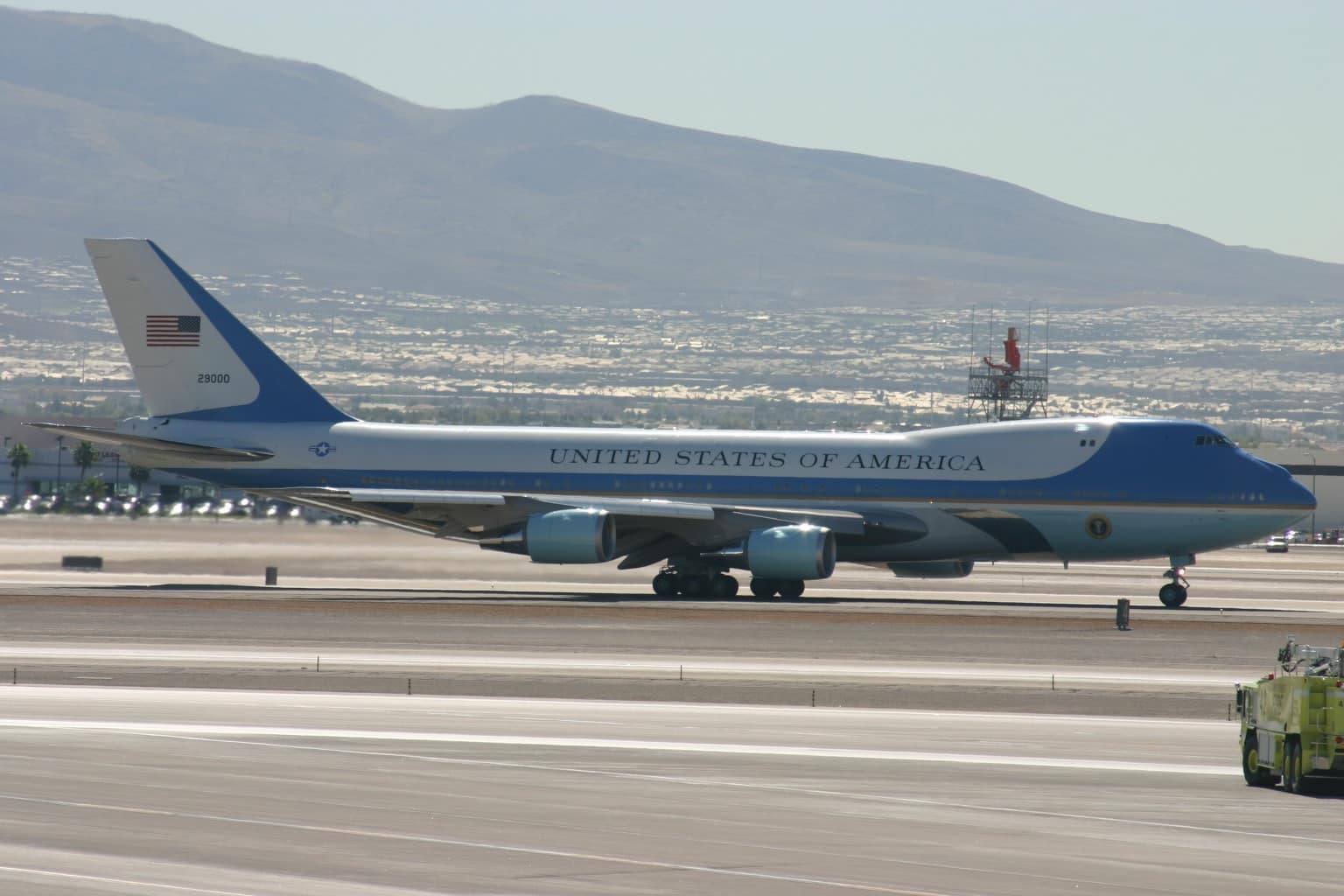
Current VC-25A Air Force One in classic Kennedy-era livery
The current VC-25A (92-9000) in the classic Kennedy-era livery designed by Raymond Loewy in 1962. The new VC-25B Bridge wears a different scheme. Wikimedia Commons

Modified, Not Rebuilt

The modifications were performed by L3Harris at facilities in Greenville and Waco, Texas, with Boeing providing engineering data for structural work. The focus was on safety, security, and secure communications rather than luxury — a deliberate choice that kept costs under $400 million, a fraction of the main programme’s multi-billion-dollar price tag. Deliberate trade-offs were made. The Bridge aircraft has fewer airstairs than the full VC-25B will have, less chiller space, and cannot perform the “Golden Eagle” mission — the protocol for transporting the remains of a former president. Government specialists developed protocols to detect and neutralise potential technical hazards on the previously owned airframe, a process that drew scrutiny from security experts who questioned the operational security implications of using a foreign-donated jet as a presidential transport. Flight testing was completed by May 1, 2026. The aircraft moved to Waco for painting in late May, and by early June it was wearing its new identity.

An Expensive Lesson

The Bridge aircraft exists because the main programme failed to deliver on time. The VC-25B contract was always ambitious — converting a commercial widebody into a flying White House with hardened electronics, aerial refuelling capability, an onboard medical suite, and protection against electromagnetic pulse — but it has become a cautionary tale about fixed-price defence contracting. Boeing’s cumulative losses on the programme exceed what many countries spend on their entire air forces. Until the two purpose-built VC-25B aircraft arrive in 2028 and beyond, the Bridge will carry the president. From Doha to Andrews, via Waco, in red, white, and blue. Sources: The War Zone, Air & Space Forces Magazine, Defense News, The Aviationist, AeroTime, Breaking Defense, CNN, DVIDS

Related Posts

0 Comments

Submit a Comment

Your email address will not be published. Required fields are marked *

en_USEnglish