
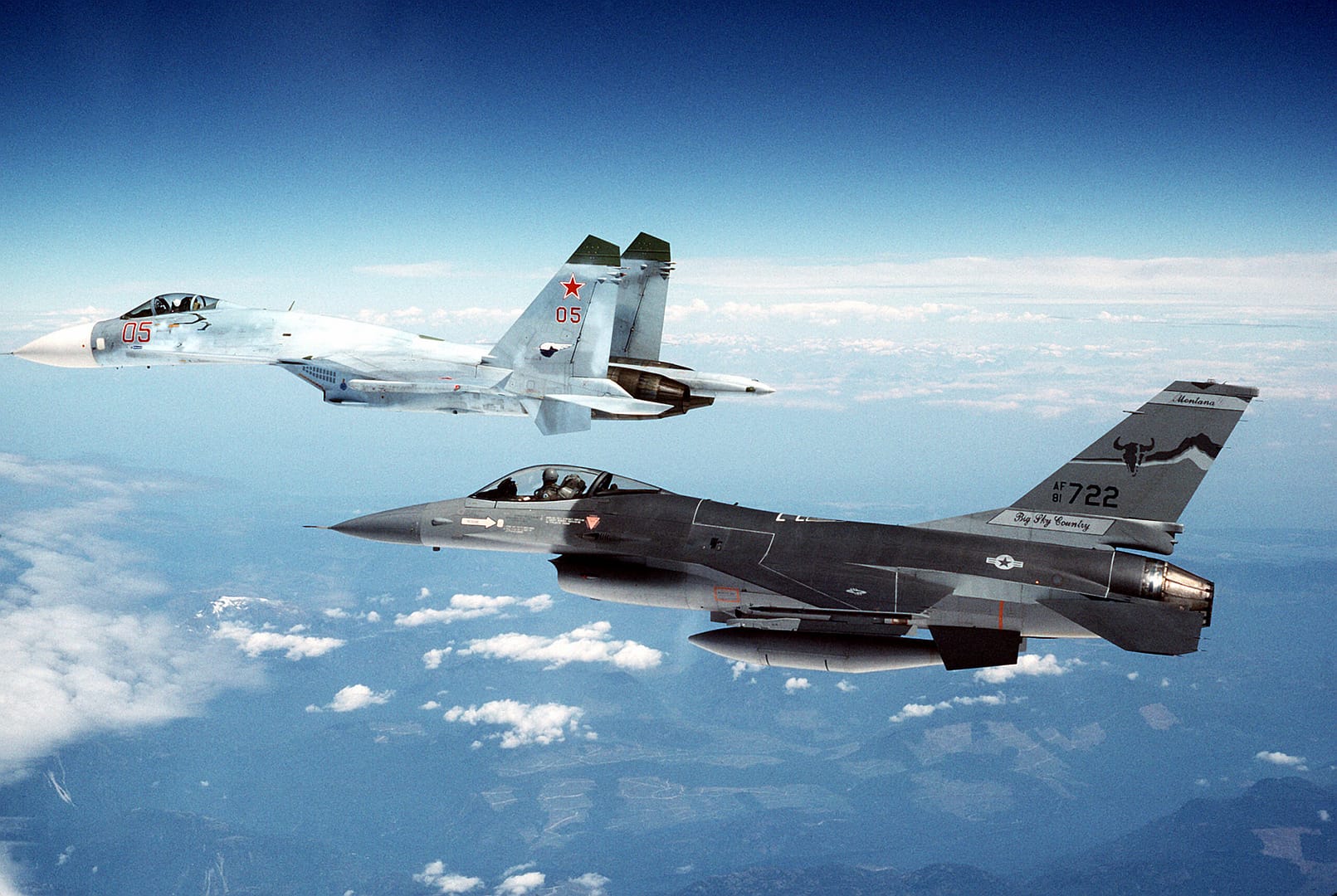
In 1977, a Soviet prototype took off from Zhukovsky airfield outside Moscow. It was ugly, it had problems, and its 13th test flight ended in a crash. The engineers went back to the drawing board and redesigned almost everything.
The result was the Sukhoi Su-27 Flanker — a fighter so good that one design has spawned an entire dynasty of aircraft spanning five decades, a dozen countries, and over a thousand airframes. No other fighter family since the F-16 has been so prolific.
Quick Facts
- Aircraft: Sukhoi Su-27 “Flanker”
- First flight: 20 May 1977 (T-10 prototype)
- Chief designer: Mikhail Simonov
- Engines: 2 × Saturn AL-31F turbofans
- Top speed: Mach 2.35
- Derivatives: Su-30, Su-33, Su-34, Su-35
- Famous for: Pugachev’s Cobra maneuver (1989 Paris Air Show)
Built to Kill the Eagle
The Su-27 exists because of the F-15 Eagle. When the Soviets learned about America’s new air superiority fighter in the early 1970s, they launched the PFI (Advanced Frontline Fighter) program to match it. The first prototype, the T-10-1, flew on May 20, 1977, piloted by Vladimir Ilyushin — son of the legendary aircraft designer Sergey Ilyushin.
The early design had serious issues. After the T-10-2 crashed on its 13th flight in July 1978, the team produced a heavily revised T-10S that was essentially a new aircraft. It first flew on April 20, 1981, and entered service in 1985. The final product was a revelation: Mach 2.35, a range of 3,530 km, a service ceiling of 60,695 feet, and a blended wing-body design that gave it extraordinary agility.
The Cobra That Stunned the West
At the 1989 Paris Air Show, Soviet test pilot Viktor Pugachev demonstrated a maneuver that Western engineers had considered aerodynamically impossible. He pulled the Su-27’s nose past vertical to 90-120 degrees angle of attack — the aircraft was essentially standing on its tail in mid-flight — bled airspeed to near zero, then recovered to normal flight.
Western test pilots watched in stunned silence. The Pugachev’s Cobra became one of the most iconic moments in aviation history, and it proved that the Flanker could do things no Western fighter could match in close-in maneuvering.

The Family Tree

From the original Su-27, Sukhoi built an entire dynasty:
The Su-30 added a second seat and multirole ground-attack capability. India’s Su-30MKI — with 265 aircraft the largest export fleet — features thrust-vectoring nozzles and canards. China, Algeria, Malaysia, and Venezuela all fly their own variants.
The Su-33 went to sea as a carrier-based variant for the Admiral Kuznetsov. The Su-34 Fullback became a dedicated strike fighter-bomber with side-by-side seating — the crew can stand up and stretch during long missions. And the Su-35S represents the latest evolution: thrust-vectoring, advanced radar, and updated avionics in a single-seat airframe.
Total production across all variants exceeds 1,000 aircraft, operated by more than 17 countries.
The Ukraine Reality Check
For decades, the Flanker’s combat record was largely theoretical. The Ethiopia-Eritrea war produced a handful of Su-27 kills, but nothing that tested the design against a peer adversary with modern weapons.
Ukraine changed that. The Su-35S — the most advanced Flanker variant — has suffered significant losses. Open-source tracking confirms at least 7-8 Su-35 losses, with some analyses claiming up to 23 (a 20% loss rate). Ukrainian Patriot batteries and F-16s armed with AIM-120 AMRAAMs have proven effective against the type. Russia’s attrition rate of 8-10 aircraft per year roughly matches or exceeds production capacity at the Komsomolsk-on-Amur plant, creating an unsustainable deficit under sanctions.
The Flanker was built to fight the F-15. In Ukraine, it’s discovering what happens when Western air defense technology catches up.
You Can Fly One
Here’s the remarkable thing: despite the Su-27’s status as one of the most formidable fighters ever built, you can actually fly one with MiGFlug. It remains one of the most advanced fighter jets available for civilian ride-along flights — a chance to experience the aircraft that stunned the world at Paris in 1989.
One Soviet design. Five decades. A dozen countries. Over a thousand airframes. The Flanker dynasty is the most successful fighter family of the post-Cold War era — and its story is still being written, one sortie at a time, over the skies of Ukraine.
Sources: Smithsonian Air & Space Magazine, War History Online, Key.Aero, The Aviation Geek Club, Afterburner.com.pl

 English
0 Comments