

In the 1960s, Sweden needed a fighter that could do everything: intercept Soviet bombers over the Baltic, attack ground targets in a NATO-free war, reconnoiter enemy positions — and do all of it from a 500-meter stretch of highway in the middle of a frozen forest. The result was the Saab 37 Viggen, one of the most innovative and least understood fighters of the Cold War.
The Viggen was the world’s first production canard fighter. It had thrust reversers — unheard of on a combat jet. It was designed to be maintained by conscripts with minimal training. And it was built entirely by a country of eight million people who had decided, quite calmly, that they would defend themselves against the Soviet Union without joining NATO.
✈ Quick Facts
- First flight: February 8, 1967
- Entered service: 1971 (AJ 37 attack variant)
- Retired: November 25, 2005
- Engine: Volvo Flygmotor RM8 (license-built Pratt & Whitney JT8D with Swedish afterburner)
- Max speed: Mach 2.1 (2,230 km/h)
- Key innovation: First production canard-delta configuration; first fighter with thrust reverser
- Total built: 329
- Variants: AJ 37 (attack), JA 37 (fighter), SF/SH 37 (recon), SK 37 (trainer)
- Operator: Sweden only — never exported

The Road Base Concept
Sweden’s defense doctrine during the Cold War was called Bas 90 — a dispersal system that assumed every conventional airfield would be cratered within hours of a Soviet attack. The solution: scatter the air force across the country’s highway network. Straight stretches of road were reinforced, and small clearings in forests were prepared as service areas where conscript ground crews could rearm and refuel aircraft.
The Viggen was designed from the ground up for this concept. Its thrust reverser allowed it to stop on short, icy runways — or road strips — that would have been suicidal for any other fighter. The canard configuration gave it exceptional low-speed handling, critical for approaches into improvised airstrips surrounded by trees. And its modular design meant that a team of six conscripts could turn the aircraft around in ten minutes using pre-packaged maintenance kits.
The Viggen was never just an aircraft — it sat at the centre of an entire war-fighting system. The road bases, the conscript ground crews and the rapid-turnaround doctrine all reflected Sweden’s distinctive Cold War way of war.
The Canard Revolution
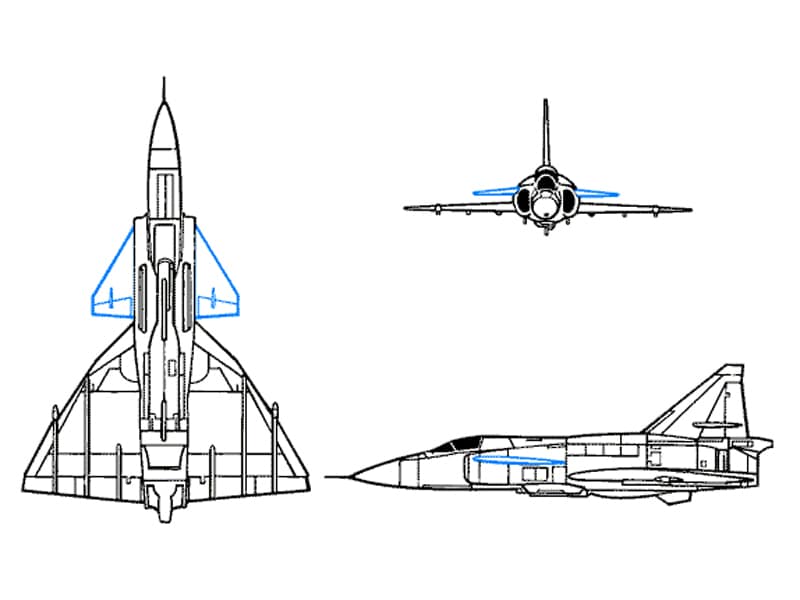
Before the Viggen, canard configurations were considered aerodynamically interesting but impractical for production fighters. Saab proved the doubters wrong. The Viggen’s canards weren’t just for show — they generated powerful vortices that flowed over the main delta wing, dramatically increasing lift at low speeds and high angles of attack. This gave the Viggen approach speeds as low as 220 km/h — remarkably slow for a Mach 2 fighter.
The canard-delta layout would later be adopted by the Eurofighter Typhoon, the Dassault Rafale, and Saab’s own Gripen. But the Viggen was there first, by two decades.
Locking On to the SR-71
The Viggen’s most celebrated moment came in January 1986, when a JA 37 interceptor piloted by Per-Olof Eldh achieved a confirmed radar lock on a USAF SR-71 Blackbird over the Baltic Sea. While the Viggen couldn’t have caught the Blackbird in a tail chase, the Swedish pilot used geometry — positioning himself ahead of the SR-71’s predicted flight path and locking on as it passed. It was one of very few confirmed radar locks ever achieved against the Blackbird by any fighter.
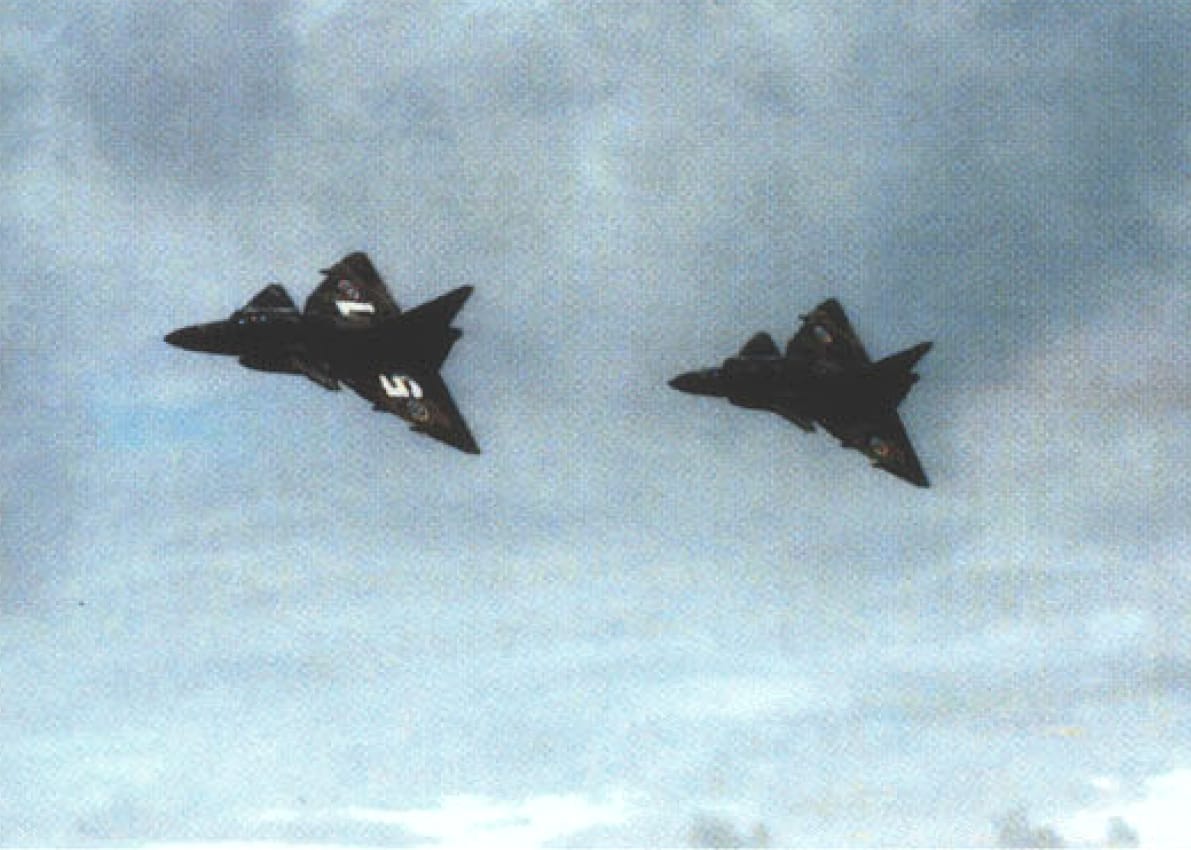
Swedish controllers and pilots refined a head-on intercept geometry that put the Viggen in position as the Blackbird passed — a feat US crews, accustomed to flying the Baltic route largely unchallenged, did not expect from a Swedish fighter.
Retirement and Legacy
The last Viggen flight took place on November 25, 2005 — nearly four decades after the prototype’s maiden flight. By then, the Gripen had taken over Sweden’s air defense duties. But the Viggen’s influence runs deep. Its canard-delta layout became the dominant European fighter configuration. Its road-base concept was studied and copied by Finland and Switzerland. And its philosophy — a small country building a world-class fighter entirely on its own terms — remains Sweden’s proudest aerospace achievement.
Sources: Swedish Air Force Museum, Saab Group, Aviation Republic, Paul Crickmore, “Lockheed Blackbird: Beyond the Secret Missions”, Flight International archive


 English
0 Comments