
Back to square one? The Russia–NATO conflict
More and more Cold War power dynamics can be seen in Europe. Yet again - we are reminding that the "End of History" thesis of Fukuyama couldn't be more wrong - compare the article here. Below is a kind of chessboard illustrating the current NATO vs. Russia conflict. There are just over 17,000 nuclear weapons worldwide, and only about 500 of those are held by countries other than NATO members and Russia. Even during peaceful years, this region remains potentially the most dangerous place on Earth. And instability between the two great powers is rising.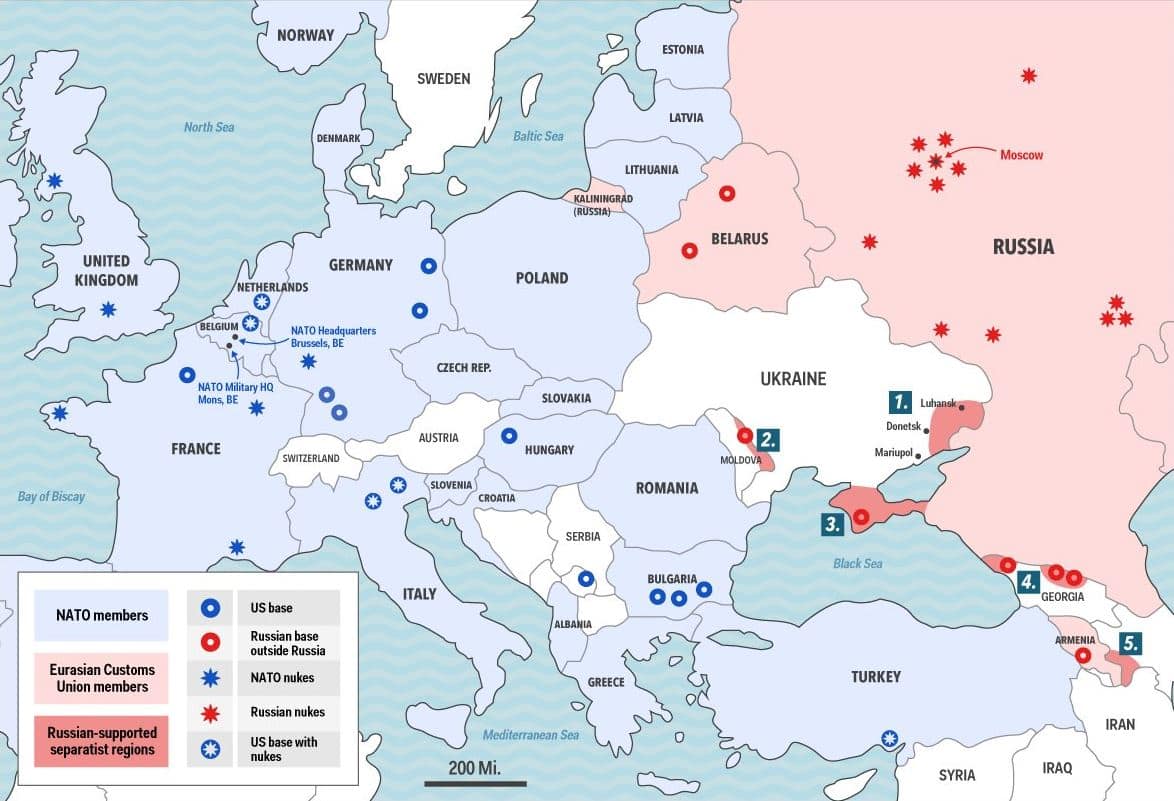 The confrontation between NATO and Russia - bases and nukes on both sides.
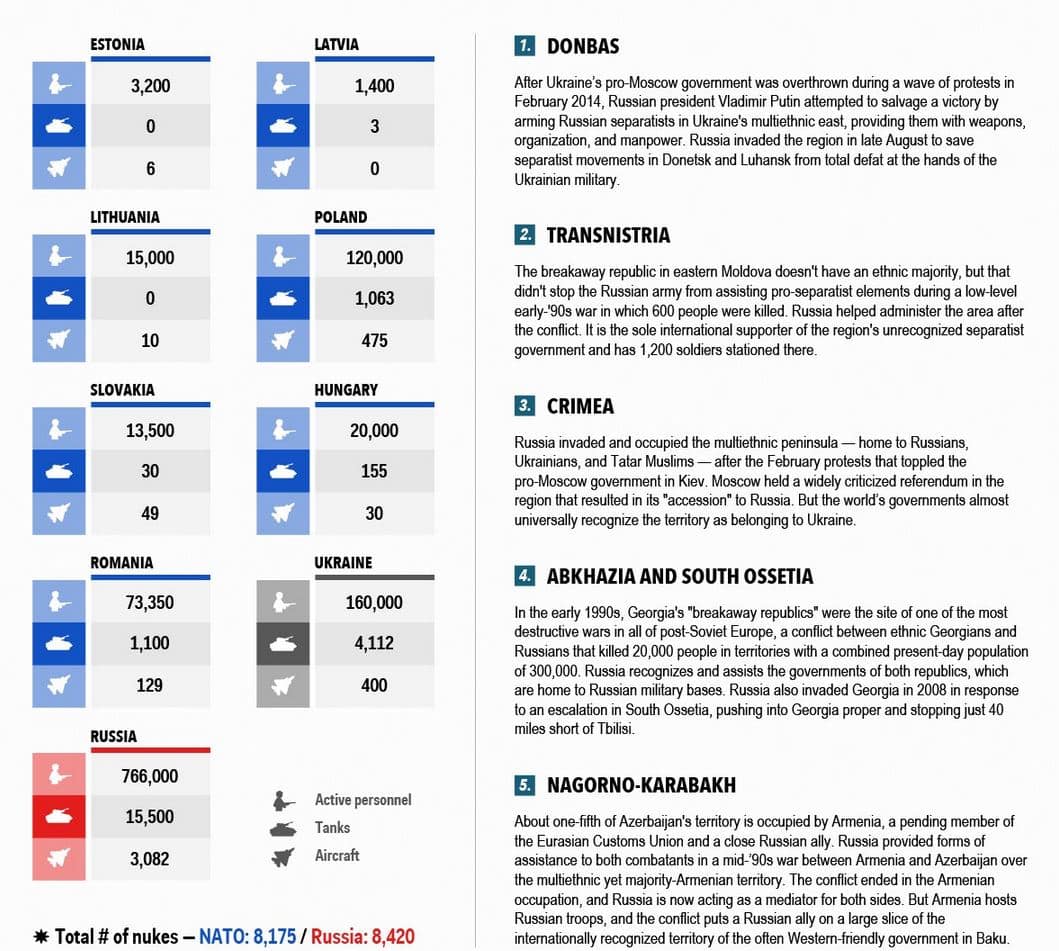
NATO and Russia Forces and conflict zones
Regional conflicts - backed by larger forces
Crimea and eastern Ukraine are just the newest hot spots along a larger, continent-wide fault line. The border between NATO-allied Europe on one side and Russia on the other side is dotted with herds of instability - including several separatist regions that Moscow and its allies support. One reason for this support is that Russia wants to keep this regions in the own influence zone. The EU for example doesn't allow countries with border conflicts to become members. So the Russian strategy here is to artificially create such border conflicts to make sure these countries can't join Western organisations. Also, it is a strong signal to other countries that have to decide between the planned, Moscow-controlled Eurasian Union (EEU) and the EU or NATO (=become pro-Western). Additional articles and resources- Russian Airforce most modern in Europe soon
- Comparison of Russian and US military aircraft
- The history of passenger fighter jet rides
- The future of military aviation - will UAVs displace fighter jets anytime soon?
- Sukhoi T-50 PAK FA – A Copy of the US F-22?
Related Questions
How many nuclear weapons are there in the world?
At the time of writing there were just over 17,000 nuclear weapons worldwide, and only about 500 of those were held by countries other than NATO members and Russia. That concentration is why the NATO–Russia frontier is often described as the most dangerous region on Earth.
What is the 'End of History' thesis?
The "End of History" is political scientist Francis Fukuyama's idea, popular after the Cold War, that humanity had reached the endpoint of its ideological evolution with the global triumph of liberal democracy. Renewed NATO–Russia confrontation is frequently cited as evidence that the thesis was premature.
Why does Russia support separatist regions near its borders?
To keep neighbouring states within its sphere of influence and out of Western institutions. Because the EU will not admit countries with active border disputes, fostering "frozen conflicts" in places like Ukraine and Georgia effectively blocks those states from joining the EU or NATO.
What is the Eurasian Economic Union?
The Eurasian Economic Union (EEU) is a Moscow-led economic bloc intended as an alternative to the European Union. It is designed to draw post-Soviet states toward Russia rather than toward Western organisations such as the EU and NATO, deepening Russia's regional influence.
Why are Crimea and eastern Ukraine considered flashpoints?
They are the newest hot spots along a continent-wide NATO–Russia fault line dotted with separatist regions that Moscow supports. Tensions there have driven sharp increases in military activity, including the kind of patrols described in this look at Russia's air force as a fading force.
Is Russia modernising its armed forces?
Yes, though unevenly. Russia continues to introduce new equipment, including the stealth fighter once designated the PAK FA. You can read about the Sukhoi T-50 PAK FA and how Russia positioned it as a rival to America's F-22 Raptor.
0 Comments