
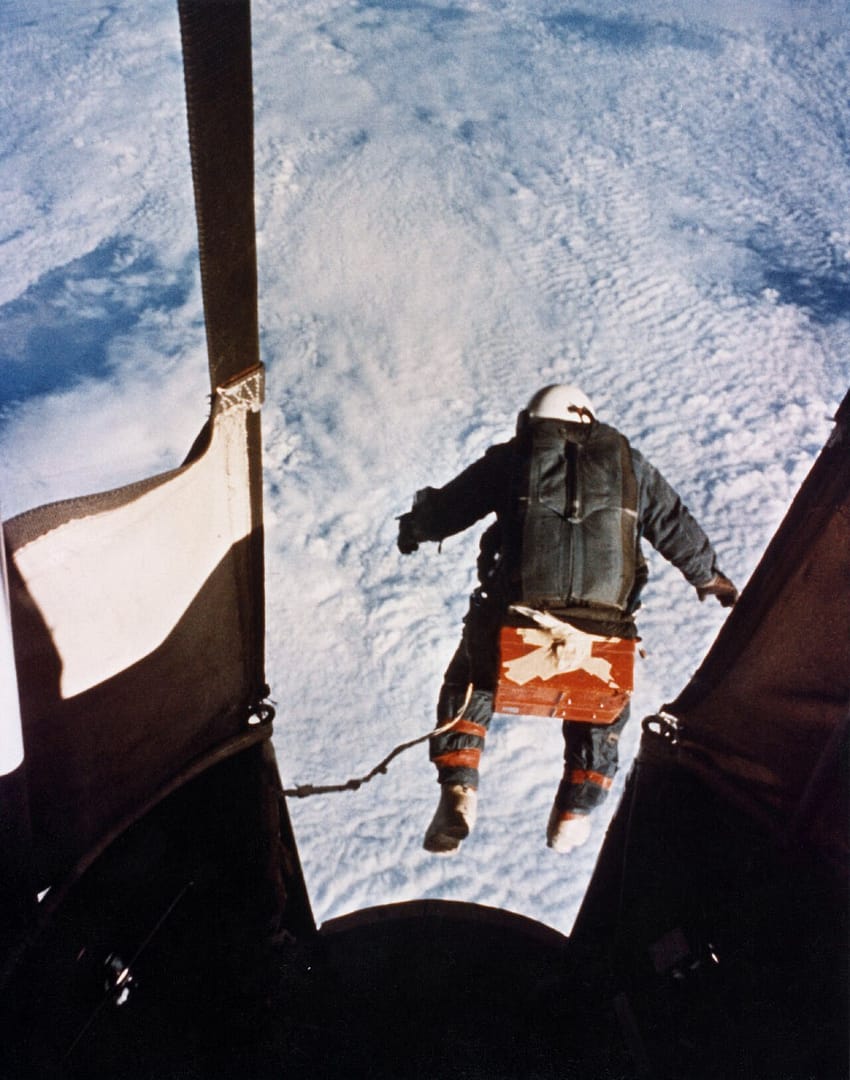
On 16 August 1960, a tiny open gondola hung beneath an enormous helium balloon, 102,800 feet above the New Mexico desert. That is more than 31 kilometres up — high enough that the sky overhead is black, the horizon curves, and there is almost no air left to breathe. Standing in the doorway, in a pressure suit, was a U.S. Air Force captain named Joe Kittinger.
He looked down at the Earth, said a quiet prayer, and stepped off into nothing.
What followed was one of the most extraordinary descents in the history of flight — a fall of more than four minutes that took a human being to the edge of the speed of sound, decades before anyone else would come close.
Mission: Project Excelsior III
Date: 16 August 1960
Jump altitude: 102,800 feet (31,300 m)
Freefall: 4 minutes 36 seconds, reaching ~614 mph (988 km/h)
Records held: 52 years — until Felix Baumgartner in 2012
The Highest Step in the World
Project Excelsior was deadly serious work: the Air Force needed to know whether a pilot or astronaut could safely bail out from the edge of space. Kittinger had already made two jumps when he rode Excelsior III up to 102,800 feet. During the ascent, the pressure seal in his right glove failed. His hand swelled painfully and lost its use — and he chose not to tell mission control, fearing they would abort. He kept climbing.
Four and a Half Minutes of Falling
Kittinger fell for 4 minutes and 36 seconds, stabilised by a small drogue parachute, and accelerated to roughly 614 miles per hour — close to the speed of sound — in the thin upper atmosphere. He opened his main canopy at 18,000 feet and landed safely. In the process he set world records for the highest parachute jump, the longest drogue-stabilised fall, and the fastest speed ever reached by a human falling through the atmosphere.
It was 1960. No one had done anything remotely like it, and for more than half a century, no one would.
Fifty-Two Years Later
Kittinger’s altitude and speed records stood, almost unbelievably, for 52 years. Then, on 14 October 2012, Austrian skydiver Felix Baumgartner rode a Red Bull Stratos balloon to about 127,852 feet — nearly 39 kilometres — and jumped. In freefall he reached roughly Mach 1.25, becoming the first human being to break the sound barrier with his own body, no aircraft around him.

And here is the detail that makes the story sing: in Baumgartner’s ear the entire way up and down was a single calm voice — Joe Kittinger himself, then 84, serving as the mission’s capsule communicator and mentor. The man who had set the record in 1960 personally talked the man who broke it through every step. The GoPro footage of that jump remains breathtaking:
Why It Still Matters
Neither jump was a stunt for its own sake. Excelsior helped prove that aircrew could survive a bailout from extreme altitude; Stratos pushed pressure-suit and high-altitude escape technology forward again. But what lingers is the human thread running through both — a man stepping alone into the void in 1960, and then, fifty-two years later, steadying the voice of the next man to do it.
Joe Kittinger died in 2022. He spent his life going higher and falling farther than almost anyone — and then made sure the record he loved was broken by someone he had personally guided to the edge.
Sources: National Air and Space Museum; Wikipedia (Project Excelsior; Joseph Kittinger; Red Bull Stratos); AOPA; StratoCat.
Related Questions
Who jumped from the edge of space in 1960?
U.S. Air Force Captain Joseph Kittinger jumped from a balloon at 102,800 feet — nearly the edge of space — on 16 August 1960, as part of Project Excelsior. He fell for over four minutes before his parachute opened, testing high-altitude bailout for pilots and astronauts.
How high did Joseph Kittinger jump from?
He jumped from 102,800 feet (about 31,300 metres), riding an open gondola beneath a helium balloon. At that altitude the sky is black and the curvature of the Earth is visible — Kittinger called the view "the highest step in the world."
How fast did Kittinger fall?
During a free fall lasting 4 minutes 36 seconds, Kittinger reached roughly 614 mph (988 km/h) in the thin upper atmosphere — close to the speed of sound — before reaching denser air and deploying his parachute.
Why did Joseph Kittinger jump from such a height?
It was serious research, not a stunt. Project Excelsior aimed to find out whether a pilot or astronaut could safely bail out from extreme altitude, testing the equipment and techniques needed to survive a high-altitude escape.
How long did Kittinger's altitude record stand?
Kittinger's jump records stood for 52 years, until Felix Baumgartner broke them in 2012 with a higher jump from the stratosphere — a feat Kittinger himself helped advise.


0 Comments