
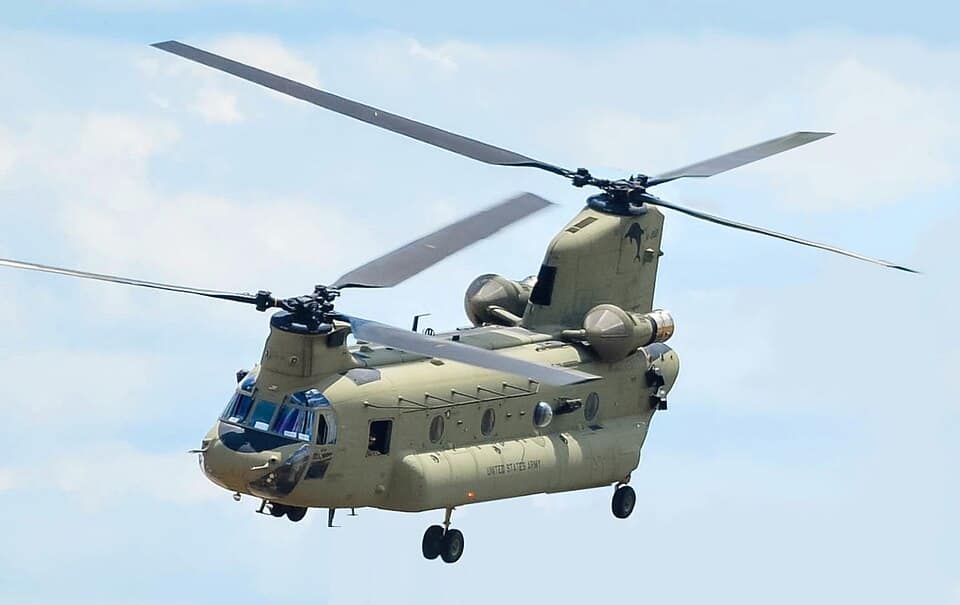
Quick Facts
Aircraft: CH-47F Chinook (U.S. Army)
Software: Boeing A2X (Approach-to-X)
Flight Control: Digital Automated Flight Control System (DAFCS)
Test Campaign: 150+ automated approaches since January 2026
Positional Accuracy: Sub-five-foot average error
Test Profile: Hover at 100 ft → autonomous approach → four-wheel touchdown
Pilot Input: Zero during approach and landing
What A2X Does
The Approach-to-X system is exactly what its name suggests — software that can fly a helicopter from any approach profile to any landing point (the X) without human intervention. It is not autopilot in the traditional sense. Traditional helicopter autopilots hold heading, altitude, and airspeed. A2X manages the entire terminal phase of flight: decelerating from forward flight, transitioning through translational lift, hovering, descending, and touching down. The Chinook is a particularly demanding test platform. Twin rotors, tandem configuration, 50,000 pounds of maximum gross weight — the CH-47F is one of the most aerodynamically complex helicopters in service. A system that can land a Chinook autonomously can land almost anything. Boeing’s approach was incremental. The flight test programme began in January 2026 with captive-carry evaluations and graduated through increasingly autonomous profiles. By the time the full hands-off landing was achieved, the A2X system had already proven its reliability across more than 150 approaches, with sub-five-foot positional accuracy in every case.Why the Army Wants Pilotless Helicopters
The U.S. Army has a helicopter pilot problem. Training a rotary-wing aviator takes years and costs millions. Retaining them is even harder — civilian airlines and commercial operators offer better pay, better hours, and nobody shooting at you. The result is a chronic pilot shortage that limits how many helicopters the Army can fly. Autonomous landing is not the same as removing the pilot entirely. The A2X system is designed to reduce pilot workload in the most demanding phase of flight — the approach and landing, particularly in degraded visual environments where brownout, snow, or darkness make manual flying dangerous. In those conditions, which account for a disproportionate share of helicopter accidents, letting the software fly the final hundred feet saves lives. But the technology points toward a longer-term future. The Army has already taken delivery of a Black Hawk designed to fly with reduced crew — or in some cases, with no crew at all. The Chinook autonomous landing is a parallel track on the same road: building the software, the sensor suite, and the institutional trust needed to eventually fly heavy-lift helicopters without anyone in the cockpit.The Bigger Picture
Boeing is not the only company chasing autonomous rotorcraft. Sikorsky demonstrated its MATRIX system on a Black Hawk years ago. Kaman has tested autonomous cargo delivery. The Army’s Future Vertical Lift programme has autonomous capability baked into its requirements. What makes the Chinook test significant is the aircraft. The CH-47 is the backbone of Army heavy lift. It hauls artillery, vehicles, troops, and supplies to places no other aircraft can reach. If the Chinook can land itself — in dust, in snow, in the dark, on an unprepared surface — that capability cascades across every mission the helicopter flies. Five feet of error on a runway is tight. Five feet of error on a hilltop landing zone in Afghanistan, in a brownout, at night, would be remarkable. The A2X system is not there yet. But 150 approaches without a miss is the kind of data that turns sceptics into believers.Sources: Defense News, Boeing, The Defense Post, Army Recognition
 English
0 Comments